
Kundt tube spacing fit 2026-10-18
Write the measured positions of consecutive maxima of sound pressure amplitude as . The arbitrary origin is fitted along with the half-wavelength by linear regression; forcing the line through zero would turn a ruler-origin offset into an erroneous slope. For independent equal-variance position errors of standard deviation ,As an original example, choose , and . Add stipulated position errors at . Their sum and index-weighted sum vanish, so the fitted values remain and , giving . These are synthetic inputs, not measurements of a particular air sample.
With stipulated and independent drive-frequency uncertainty , first-order uncertainty propagation givesThis statistical calculation omits common scale-calibration error, thermal drift and mode misidentification. Counting more positions reduces independent localization error; it cannot correct a wrong family of extrema or an incorrectly calibrated ruler.
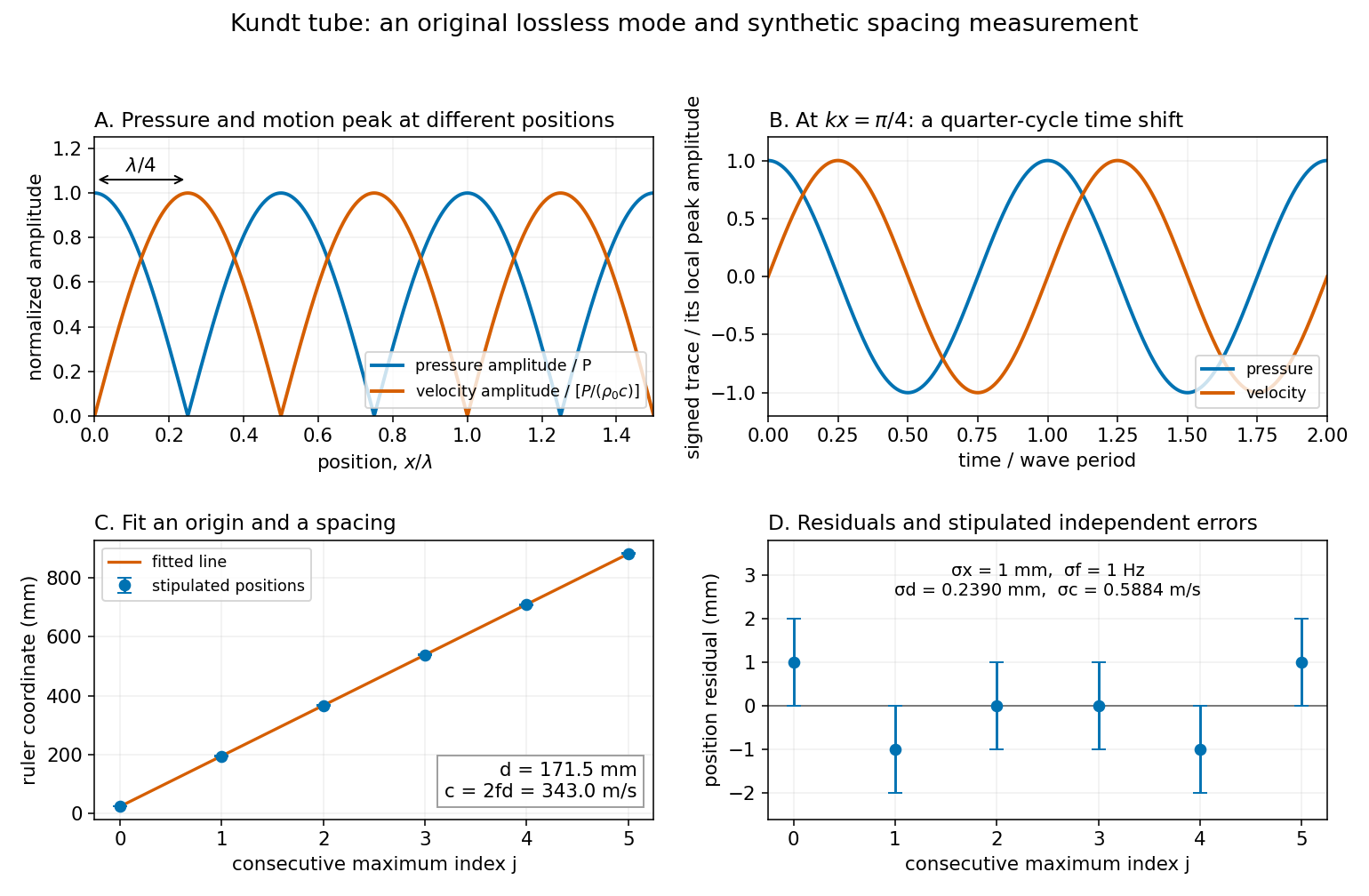

Consider a uniform tube with rigid ends, constant undisturbed mass density and speed of sound . Neglect losses and transverse structure. A free normal mode hasand a consistent choice of sound pressure, acoustic particle velocity and acoustic displacement isHere is a peak sound pressure. Direct differentiation verifies and , the one-dimensional linear homentropic acoustic equations. The rigid ends enforce there. A driven experiment only approximates this free-mode geometry; the formulas do not predict a finite resonant amplitude for an undamped driven tube.
The maxima of sound pressure amplitude occur at , where acoustic particle velocity vanishes. The maxima of acoustic particle velocity amplitude instead occur at , where sound pressure vanishes. The two families are displaced by , but each family repeats after . At a position where both are nonzero, the time dependence is also a quarter cycle apart. Using consecutive maxima of sound pressure amplitude therefore givesThe relation also applies to consecutive minima of sound pressure amplitude, provided the same family is used throughout. Mixing maxima and minima would halve the spacing and give an erroneous speed of sound.
The local acoustic energy density is . Averaging over one wave period gives , independent of . Likewise : this ideal standing wave has no mean longitudinal acoustic energy flux, although its pressure and fluid velocity oscillate. Energy transport into a real lossy tube is a different question from the free-mode pattern.
Kundt tube experiment 2026-10-18
PHYWE's implementation rubs a rod supported from each end. Its end disc drives a dusty glass tube; a movable tuning slide selects a clear pattern. A ruler measures repeated positions and a thermometer records gas temperature. The two supports select a rod wavelength equal to its length.[ref]
The University of Iowa also documents an electronic version: a loudspeaker drives the tube and a microphone on a plunger supplies an oscilloscope readout. This permits a spatial scan of sound pressure without relying on the dust pattern.[ref]
3D30.60 - Kundt’s Tube by University of Iowa Department of Physics and Astronomy. Demonstration 3D30.60, Procedure: speaker and microphone-plunger alternative
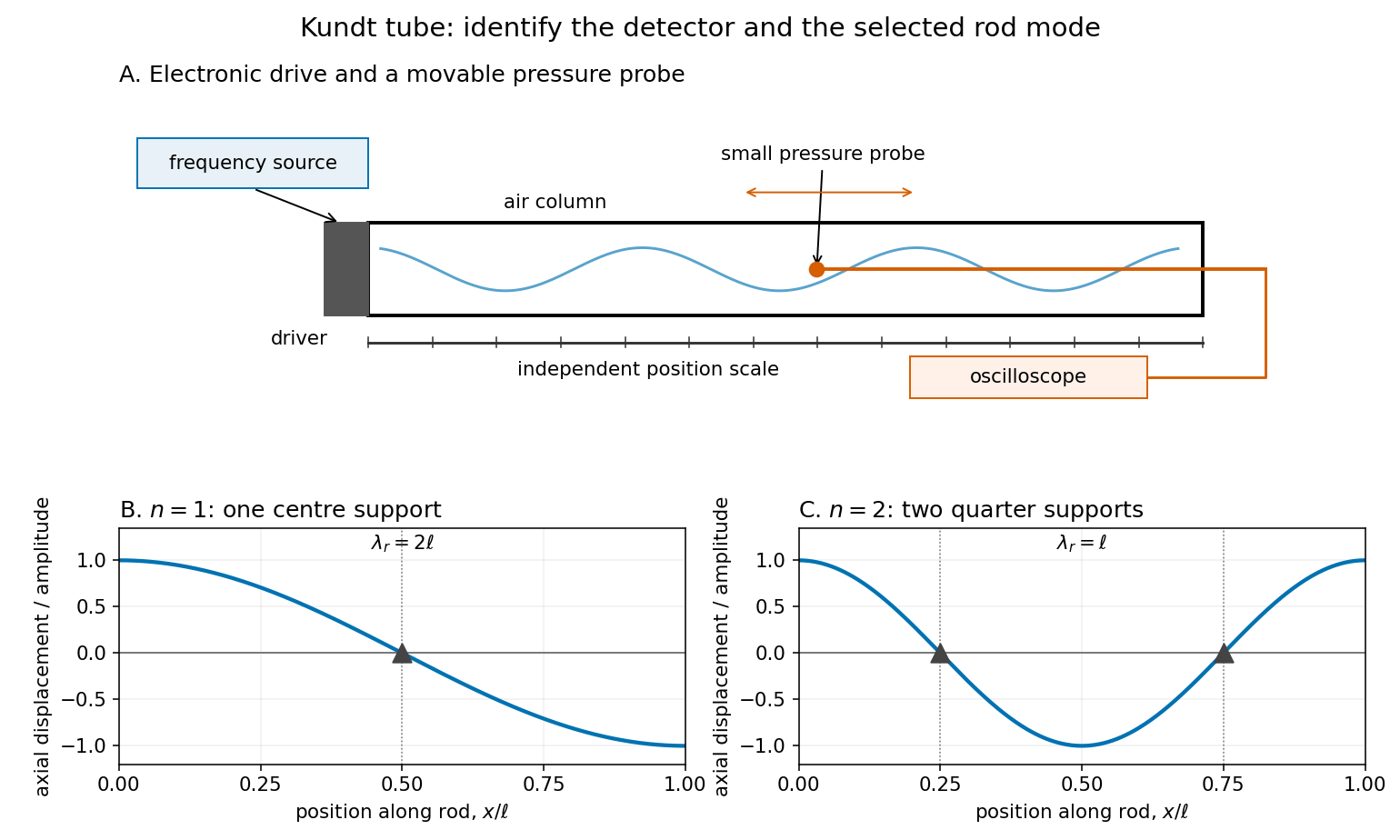

For a proposed pressure-scan measurement, keep the drive frequency fixed and move a small microphone through the tube. Record its position and fitted sinusoidal amplitude after each move; repeat the scan in reverse to reveal drift. Locate several consecutive maxima, rather than estimating a wavelength from a single pair. Reducing the drive checks whether the inferred spacing is independent of amplitude in the linear acoustics regime. A drive-off record estimates electrical background. These are controls for the proposed measurement, not reported observations from the cited demonstrations.
A microphone and its access opening can perturb the field. End compliance, losses and transverse modes also challenge the one-dimensional description. Dust traces identify a repeating structure, but the grains are not fluid parcels: the equations below describe sound pressure and acoustic particle velocity, rather than a detailed grain-transport model. The temperature and gas composition must remain sufficiently uniform to interpret a single fitted speed of sound.
For rotational motion about a fixed axis, let be cylindrical radius, the signed tangential velocity, and the mass measure. Define the kinetic energy, axial angular momentum, and moment of inertia byThe Cauchy-Schwarz inequality gives . More precisely, direct expansion gives the nonnegative energy gapThus the minimum at fixed and fixed mass distribution occurs exactly when almost everywhere with respect to . This means constant angular velocity , or solid-body rotation. If the profile is continuous, the equality holds at every point in the mass support.
Relativistic kinetic energy Created 2026-10-18 Updated 2026-10-20
For a free particle of rest mass , subtract its rest energy from its total energy , where is the Lorentz factor. The low-speed binomial series gives , recovering classical kinetic energy.
Electro-optic Kerr effect Created 2026-10-18 Updated 2026-11-05
The electro-optic Kerr effect produces linear birefringence proportional to the square of a static applied electric field. Defining the Kerr effect coefficient by , a length produces phase retardation . A switchable quarter-wave plate requires modulo , with fixed principal axes. This differs from the Faraday effect, whose eigenpolarizations are circular polarizations.
Residence time in planar extension 2026-10-18
An original local flow model has velocity for constant extensional strain rate . Its divergence is zero, and its trajectories satisfy the displayed equations. Material approaches along and leaves along . If the idealized observation region ends at , a trajectory starting at has residence timeFor chosen , and , this is . Starting ten times farther from the symmetry line halves this particular residence time. The mathematical trajectory never exits in this model; diffusion, imperfect flow and finite apparatus prevent treating that ideal trajectory as a guaranteed infinite exposure in an experiment.
Work by Kazuhiko Kinosita Jr. Created 2026-10-18 Updated 2026-10-31
Neutral antikaon Created 2026-10-18 Updated 2026-10-25
The neutral strange meson with strangeness and valence content . It is distinct from the neutral kaon flavour state , which has strangeness . These are flavour eigenstates, not the weak-interaction propagation eigenstates of neutral kaon mixing.
Sudbury Neutrino Observatory Created 2026-10-18 Updated 2026-10-20
The SNO Collaboration used tonnes of heavy water in a acrylic sphere, surrounded by ordinary water shielding and photomultipliers. Weak charged current (CC) breakup of a deuteron selects electron neutrinos; weak neutral current (NC) breakup measures all active neutrino flavors; electron elastic scattering (ES) has reduced non-electron sensitivity.[ref]
Super-Kamiokande Created 2026-10-18 Updated 2026-11-05
Super-Kamiokande is an underground water Cherenkov detector in Japan. Its roughly 50,000-ton water target is viewed by photomultipliers around the tank. A neutrino is observed indirectly when an interaction produces charged secondaries that emit Cherenkov radiation.[ref]
Super-Kamiokande Overview by Kamioka Observatory. Detector tank, photomultiplier instrumentation and underground location
Photon arrival times and detected charges constrain interaction position and outgoing directions. Ring appearance helps distinguish showering electrons from more track-like muons, enabling the Super-Kamiokande atmospheric-neutrino experiment. The water mass is both target and optical medium: transparency, sensor timing and background rejection affect reconstruction. The useful fiducial volume is smaller than the full water volume.
In an n-channel junction field-effect transistor, increasing drain voltage increases the local gate-channel reverse bias near the drain. The depletion region can meet there, ending the quasi-neutral channel before the drain. Carriers already in the channel are swept across the remaining high-field region, so drain-end pinch-off produces current saturation rather than zero current. A sufficiently negative gate voltage can instead deplete the whole channel and cut the device off. In the one-sided depletion approximation, a channel half-width and donor density give a depletion threshold voltage ; with built-in junction voltage , drain-end pinch-off occurs approximately at .
Let each side of a symmetric abrupt p-n junction have thickness , area and doping density . Partial depletion gives . Both sides become fully depleted at . Beyond that point, the ionized dopant charges are fixed, but an incremental terminal voltage changes the electric field uniformly across the full thickness . Gauss's law then gives , up to terminal orientation. The measured positive capacitance approaches rather than vanishing. This geometrical result assumes ideal contacts, negligible mobile carriers, no breakdown and no other series capacitances.
Work by Joshua Lederberg 2026-10-18
Current-biased Josephson phase dynamics 2026-10-18
A Josephson junction can make a collective quantum phase behave as a measurable dynamical coordinate. In current-biased Josephson phase dynamics, the Gauge-invariant Josephson phase moves in a tilted Josephson washboard potential; the junction's capacitance supplies its effective inertia. A trapped phase gives zero mean electric potential difference, while sustained phase advance produces a nonzero mean electric potential difference. Quantized phase levels in a Josephson junction and quantum escape of a current-biased Josephson junction test quantum mechanics for this collective coordinate.
Begin with a stipulated parallel electrical circuit: an ideal sinusoidal Josephson junction, capacitance , and effective electrical resistance . The Kirchhoff node law and Josephson effect giveHere is the constant bias electric current, is a deliberately applied microwave electric current, and represents unwanted fluctuating electric current. Multiplication by puts the undriven equation into the mechanical formThe effective inertia is a coefficient for a dimensionless quantum phase, not a literal material mass moving through the insulating layer. The capacitor's energy, , provides a direct check of that identification. The effective includes loading by the external electrical circuit; a constant parallel is an approximation over the relevant frequency range.
The useful design freedom is that changes the confinement while changes its inertia. The same manufactured device can therefore connect a classical oscillation, discrete energy levels, and escape to an electrical readout. The Martinis-Devoret-Clarke circuit experiments separate these questions experimentally. John Clarke, Michel H. Devoret and John M. Martinis shared the 2025 Nobel Prize in Physics for circuit experiments establishing macroscopic quantum tunnelling and discrete energy levels.[ref]
The Nobel Prize in Physics 2025 — Press release by Royal Swedish Academy of Sciences. 7 October 2025, p.1, award decision
Josephson effect Created 2026-10-18 Updated 2026-10-20
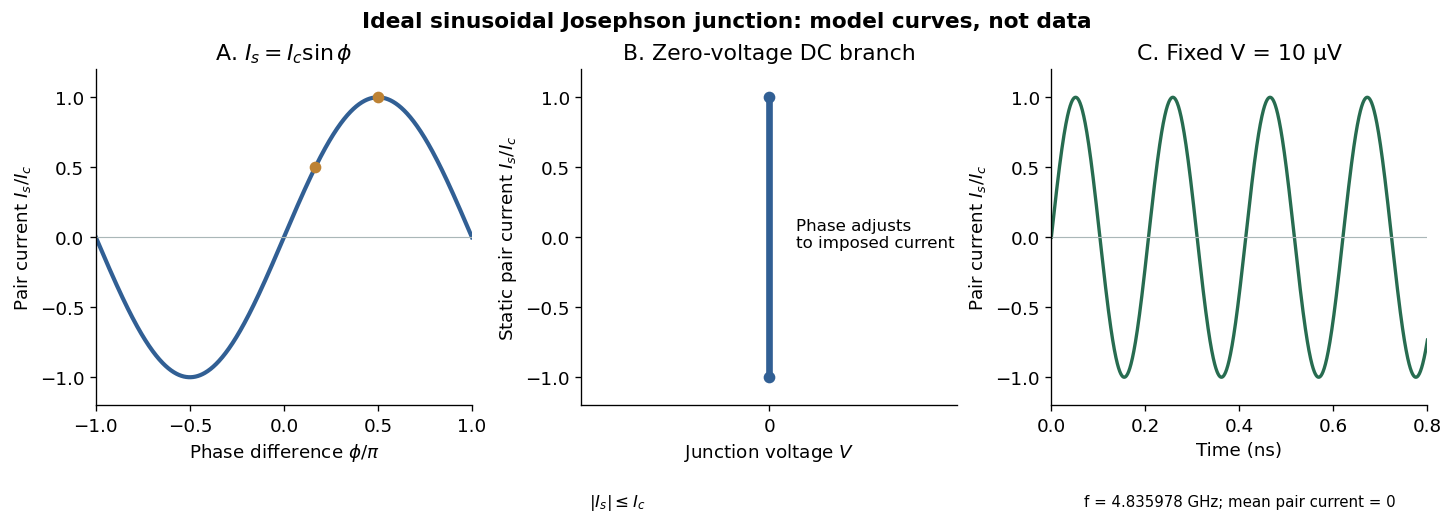
In the ideal sinusoidal Josephson junction, the pair electric current and quantum phase obeyHere is the magnitude of the electron electric charge, uses the Planck constant, and is the junction's superconducting critical current under the specified conditions. Define the signs as follows: positive conventional electric current flows from terminal 2 to terminal 1, and is the voltage of terminal 2 relative to terminal 1. The Gauge-invariant Josephson phase below fixes the matching orientation of . The DC Josephson effect and AC Josephson effect follow from these relations. [ref]
Possible new effects in superconductive tunnelling by Brian D. Josephson. Josephson (1962), p. 252, predictions (i) and (ii): zero-voltage supercurrent and frequency 2eV/h

Superconducting weak link Created 2026-10-18 Updated 2026-10-25
A superconducting weak link is a connection between regions with superconductivity whose coupling is weak enough that a substantial difference of quantum phase can develop across the connection. An insulating tunnel barrier is one realization; a narrow conducting constriction can also couple the regions. The current-phase relation of a superconducting weak link depends on the connection. A sinusoid is the leading tunnel-junction approximation, not a universal law for every superconducting weak link. [ref]
The Discovery of Tunnelling Supercurrents by Brian D. Josephson. Josephson, Nobel lecture (12 December 1973), final discussion of weak links and tunnel barriers
Circular-eigenmode Jones propagator 2026-10-18
For fixed circular eigenvectors , let . A uniform optical medium with amplitude propagation coefficients has the displayed Jones matrix. Put and . ThenThe sum of the two modal exponentials supplies a hyperbolic cosine, not its reciprocal. The determinant is , and . Real modal coefficients give circular dichroism; purely imaginary coefficients give lossless circular birefringence. Complex modal labels do not have an intrinsic numerical ordering.
Work by John T. Germaine 2026-10-18
Work by John L. Rubinstein Created 2026-10-18 Updated 2026-10-31
There are unlisted articles, also show them or only show them.