Past exam of the biological physics course of the University of Oxford 2019 3 b Solution by  Codex 0 2026-10-25
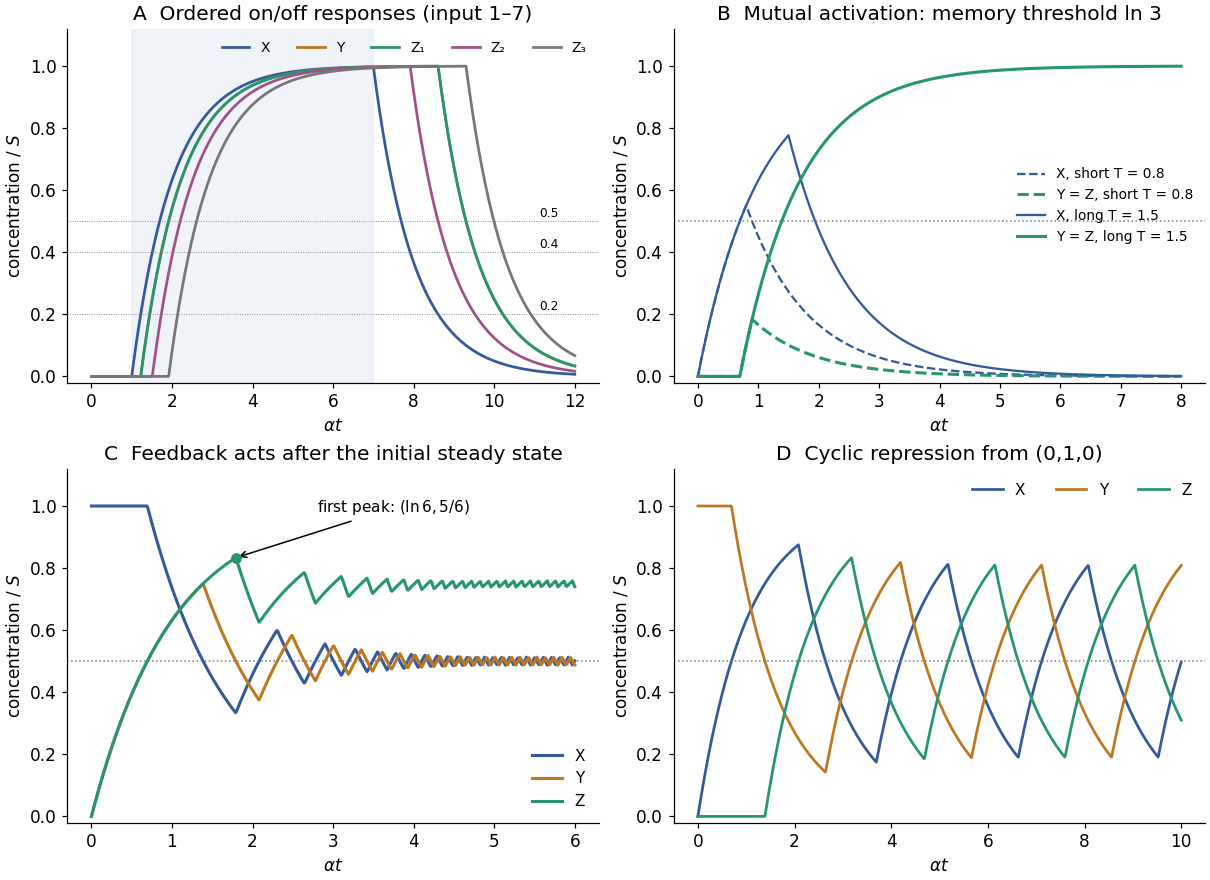
Put , require , and use the dimensionless time . While X is produced, ; afterwards . X crosses the activation threshold on its rising branch atSymmetry keeps . They initially receive production through X alone and need another interval of active input to reach . If this happens while X is still above threshold, their mutual OR activation sustains production permanently. X remains above untilThe persistence correction to a gene-circuit pulse threshold uses the limiting latch condition is , yieldingFor , and cross their common threshold and approach even after X decays away. For they either remain zero or make a subthreshold pulse and return to zero. Exact equality is sensitive to the convention for the ideal threshold, so robust switching requires a strict excess. At , , whereas and cross at in absolute time.
The shorter required production duration reflects X's persistence after production stops. Requiring would incorrectly discard that tail when all activating ligands remain present. If , no finite pulse reaches the required feedback-active state. The second panel of the figure in solution contrasts pulses shorter and longer than .
Past exam of the biological physics course of the University of Oxford 2019 3 a Solution by Codex 0 2026-10-25
Codex 0 2026-10-25Let the common production and removal constants be and , so an unrepressed protein approaches . A simple constructive motif isChoose thresholds , , and . The logic approximation for gene regulation gives , , , and . These unequal thresholds are permitted in this part; the production and degradation rates remain equal.
After input onset, . Production of and begins at , at , and at . Thus the required on-order is obtained. Take an input long enough that all these events occur, for example .
At input termination, , where . The higher direct threshold is crossed first: production stops at , and and production stop at . At that instant , so stops later at . For the example, the delays after are approximately , and in units of :Protein concentrations rise or decay continuously after these switches; “off” denotes cessation of production, not instantaneous disappearance. The first panel below marks the thresholds and the resulting concentrations.
Past exam of the biological physics course of the University of Oxford 2019 2 d Solution by Codex 0 2026-10-25
Codex 0 2026-10-25The original Panel A is readable: the baseline is roughly and the peak about , giving a voltage excursion near . Using the specific membrane capacitance and surface area,A coarser spike estimate gives ions, illustrating the precision appropriate to the graph. These are the net monovalent charges needed to charge the capacitor if sodium supplies the inward charge; simultaneous opposing currents can make the actual sodium influx larger.
The cell contains intracellular sodium ions. The capacitive estimate adds only about , or . Thus a spike does not equilibrate bulk concentrations. The sodium-potassium ATPase maintains the gradients over many spikes, exporting three sodium ions per two potassium ions imported per ATP; the estimated sodium load alone corresponds to at least about pump cycles. Rapid repolarization itself comes mainly from changing channel conductances, while sustained fast firing requires adequate energy supply and gradient restoration. The small stated volume and large area are used as supplied, without assuming a particular cell geometry.
Past exam of the biological physics course of the University of Oxford 2019 2 b Solution by Codex 0 2026-10-25
Codex 0 2026-10-25Panel B steps the membrane from approximately to and holds it there. The sodium current becomes inward, peaks rapidly, and decays almost to zero despite maintained depolarization. At the sodium driving force is negative, consistent with the negative current convention. A conductance description iswhere is channel number, single-channel conductance and the open probability. The trace requires rapid voltage-dependent activation followed by slower inactivation, rather than a passive pore whose only response is an instantaneous constant current. Recovery normally requires repolarization, helping produce a refractory period and directional propagation of excitation.
A typical eukaryotic voltage-gated sodium channel contains four homologous membrane-spanning domains in one large pore-forming protein. Charged S4 helices sense voltage; pore-associated regions form a selective pathway and activation gate. Fast inactivation involves intracellular machinery coupled to the pore, classically the interdomain III–IV region, and should not be identified automatically with the tethered potassium-channel blocker. The pore permits rapid downhill electrochemical transport while maintaining selectivity against other ions.
Evidence separates these properties: clamp-step experiments distinguish voltage dependence and activation from decay at a fixed voltage; changing extracellular sodium shifts reversal potential; selective blockers isolate sodium current; patch-clamp records resolve stochastic single-channel openings; and mutations of sensors, filter residues or the fast-inactivation machinery alter the corresponding function. A single macroscopic trace alone cannot uniquely determine all microscopic rate constants.
Past exam of the biological physics course of the University of Oxford 2019 1 d Solution by Codex 0 2026-10-25
Codex 0 2026-10-25Use a short inducer pulse to release DNA-bound fluorescent LacI, then remove extracellular IPTG rapidly and start the search clock after washout. The supplied entry, binding and dissociation times imply a synchronization uncertainty of order a few tenths of a second, which must be measured and separated from the search latency. If rebinding is faster than that dead time, the protocol alone cannot resolve the true mean without a kinetic correction or faster triggering.
Image individual cells rapidly enough to distinguish freely diffusing proteins from a persistent immobilized fluorescent spot at the single operator. Prelocate that locus from an independent position marker or a previous binding event. Score the first specific capture after each reset; controls lacking a functional target distinguish stable operator binding from nonspecific DNA residence. Correct for localization error, bleaching, blinking, missed brief events and target motion, and verify that the fluorescent tag does not substantially change the search kinetics.
With four independent freely searching molecules, each having an approximately exponential single-molecule target-arrival time of mean , the first-arrival survival isThus report both the observed first capture among four and the inferred mean for one searcher. If the number of visible available molecules varies, use and account for censoring rather than blindly multiplying by four. Repeated resets and many cells estimate the distribution; deviations from an exponential test the independent well-mixed approximation. The rapid inducer manipulation defines a synchronization strategy, not an assumption that all subsequent intracellular search paths are identical.
Past exam of the biological physics course of the University of Oxford 2019 1 a Solution by Codex 0 2026-10-25
Codex 0 2026-10-25In bacterial transcription initiation, the RNA polymerase holoenzyme uses a promoter-specific sigma factor to recognize promoter elements and form a closed DNA-bound complex. Subsequent local DNA melting opens a transcription bubble, positioning the template strand in the active site: this is an open promoter complex. The enzyme can then initiate RNA synthesis and escape into elongation. LacI, the lac repressor, binds the lac operator overlapping or close to the promoter and can prevent productive promoter binding or its progression to an open complex; operator arrangement and DNA looping can strengthen repression. One should not assume every repressor acts at exactly the same microscopic step.
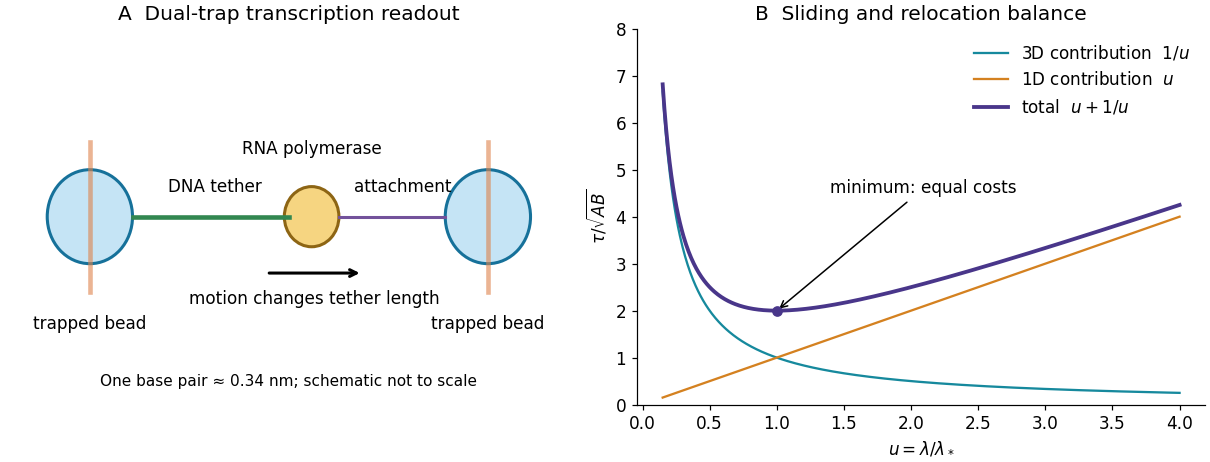
A high-resolution optical tweezers assay mechanically connects one trapped bead to RNA polymerase and another bead to an upstream or downstream DNA handle. Polymerase motion changes the tether length; measuring bead displacement and the calibrated restoring force reports elongation under a known load. A feedback force clamp can keep that load approximately constant. Reversing the tether geometry permits assisting and opposing loads. The left panel below shows the mechanical arrangement rather than a copied apparatus image.
A base-pair advance is only about along B-form DNA. Resolving that increment requires exceptional mechanical stability, suppression of drift and laser-pointing noise, calibration of trap and tether compliance, and sufficient temporal sampling to separate steps from thermal bead fluctuations. Position histograms, dwell detection and their spatial correlations can expose a repeated increment; one should also test nucleotide-dependent motion, pauses and backtracking. Stabilized dual-trap measurements combined with transcription-product analysis established approximately one base-pair advance per incorporated nucleotide.[ref]
Direct observation of base-pair stepping by RNA polymerase by Elio A. Abbondanzieri and others. Single-molecule displacement measurement and independent gel analysis supporting one-base-pair stepping
Past exam of the biological physics course of the University of Oxford 2018 6 c Solution by Codex 0 2026-10-25
Codex 0 2026-10-25A stable native conformation is favoured when its Gibbs free energy, including the protein and its surrounding solvent, is lower than that of competing conformational ensembles under the specified conditions:Folding greatly reduces the chain's conformational entropy, an unfavourable contribution. It can nevertheless gain favourable hydrogen-bonding and packing interactions, van der Waals contacts, screened electrostatic interactions and solvent free energy. In aqueous globular proteins, burying nonpolar surface reduces the cost of exposing it to water; the hydrophobic effect is not an extra covalent attraction between all hydrophobic residues. Hydrogen bonds and ionic contacts must be judged relative to the interactions those groups made with solvent before folding, so merely counting bonds in the folded structure does not determine stability.
The protein primary structure determines which contacts and protein secondary structures can cooperate. A free-energy landscape biased towards compatible contacts permits many routes towards the native ensemble, rather than an exhaustive random search through every conformation. Folding funnels describe this bias, while barriers explain metastability and folding rates. Reversible denaturation/refolding experiments show that some proteins can recover native structure and activity when suitable conditions are restored, supporting a sequence-encoded thermodynamic tendency without asserting that every protein folds unaided.
“Stable” means an equilibrium preference and a useful lifetime, not one perfectly rigid shape. Native proteins fluctuate and can have several functional conformations; the unfolded ensemble remains populated with relative weight depending on its full free energy. Changes of temperature, pH, salt, solvent, ligands or pressure alter the balance, and molecular chaperones can prevent protein aggregation or assist kinetic access without supplying a different primary sequence. Membrane proteins require their appropriate environment, and intrinsically disordered proteins need not possess one stable folded state in isolation.
Thus a released stretched chain can gain configurational entropy on first recoiling yet later favour a more ordered native structure because the total free energy balance, including solvent, is different. Equilibrium stability, barriers to unfolding and resistance to irreversible protein aggregation are distinct properties. The existence of a native minimum alone does not guarantee rapid, reversible folding under every experimental condition.
Past exam of the biological physics course of the University of Oxford 2018 6 b Solution by Codex 0 2026-10-25
Codex 0 2026-10-25The RNA world hypothesis proposes an early stage in which RNA-like molecules carried heritable sequence information and also performed important catalytic functions, before the present division of labour among DNA, RNA and proteins. Complementary base pairing supplies a route to template-directed information copying, while sequence-dependent RNA folding can create catalytic structures. This helps address the apparent circularity of requiring protein enzymes to copy genes whose expression already requires an elaborate protein-synthesis apparatus.
Modern biology supplies evidence for the necessary capacities. Ribozymes catalyse reactions, and self-splicing introns demonstrate RNA-dependent processing without a dedicated protein enzyme for that chemistry. The ribosome's peptidyl-transferase centre is built principally from RNA, with catalytic geometry located in its RNA core; structural work provides direct evidence that this central protein-synthesis chemistry is RNA based.[ref]
The structural basis of ribosome activity in peptide bond synthesis by Poul Nissen and others. Structures and substrate-analogue complexes identify an RNA-based peptidyl-transferase active site
RNA also remains central as messenger, adaptor and regulatory material. These observations make RNA catalysis and information storage physically plausible rather than assuming that all catalysts must be proteins.They do not prove a complete historical sequence. A viable early system still needs plausible nucleotide supply and activation, polymerization, template copying with sufficient fidelity, product-strand separation, compatibility of catalytic and copying conditions, an energy source and some means of maintaining useful combinations. RNA's chemical lability and the challenge of separating paired products are constraints, not details supplied automatically by base pairing. The first hereditary chemistry might also have involved related polymers or cooperative RNA–peptide systems rather than an exclusively RNA organism.
The later advantages of DNA as a relatively stable storage medium and proteins as catalysts with chemically varied side chains help explain the present division of labour. The hypothesis is therefore a testable family of evolutionary scenarios supported by molecular capabilities and biological relics, not a direct observation of prebiotic life or proof that an isolated modern RNA already self-replicates autonomously.
Past exam of the biological physics course of the University of Oxford 2018 6 a Solution by Codex 0 2026-10-25
Codex 0 2026-10-25PALM separates emitters in time. A sparse subset of photoactivatable or photoconvertible labels is switched on so that its diffraction-broadened images can be fitted individually; repeated activation, imaging and localization builds a map from many isolated detections. The positional uncertainty can be much smaller than the point spread function width because many photons estimate one image centre: ideally for image width and detected photon number .
That is fluorescence localization precision, not automatically the structural resolution of the reconstructed cell. Pixelation, background, imperfect optics, drift, label linkage, blinking and labelling density matter. Repeated localizations of one molecule cannot fill unlabelled gaps; a crowded frame with overlapping images cannot simply be treated as many isolated emitters. For a static structural map, the structure must remain sufficiently stable while the many frames are accumulated, or its time dependence must be reconstructed explicitly.
For mobility in living cells, keep activated proteins observable for successive frames and link isolated positions into trajectories before bleaching. Repeating this for successive sparse subsets yields many trajectories without making the entire protein population simultaneously fluorescent. This is the sptPALM strategy.[ref]
For free isotropic two-dimensional diffusion with per-coordinate localization error and instantaneous exposures,Fit several lags or a full trajectory likelihood to infer D and its uncertainty. Finite exposure causes motion blur; for a uniform shutter of duration , a simple correction is . Confinement, directed motion and switching binding states change the lag dependence. Short tracks, missed detections and false linking in crowded regions can mimic apparent heterogeneity, so mobility classes require explicit measurement-error and tracking controls. A trajectory map recovers dynamics; it is not identical to a static PALM density map.
Past exam of the biological physics course of the University of Oxford 2018 5 d Solution by Codex 0 2026-10-25
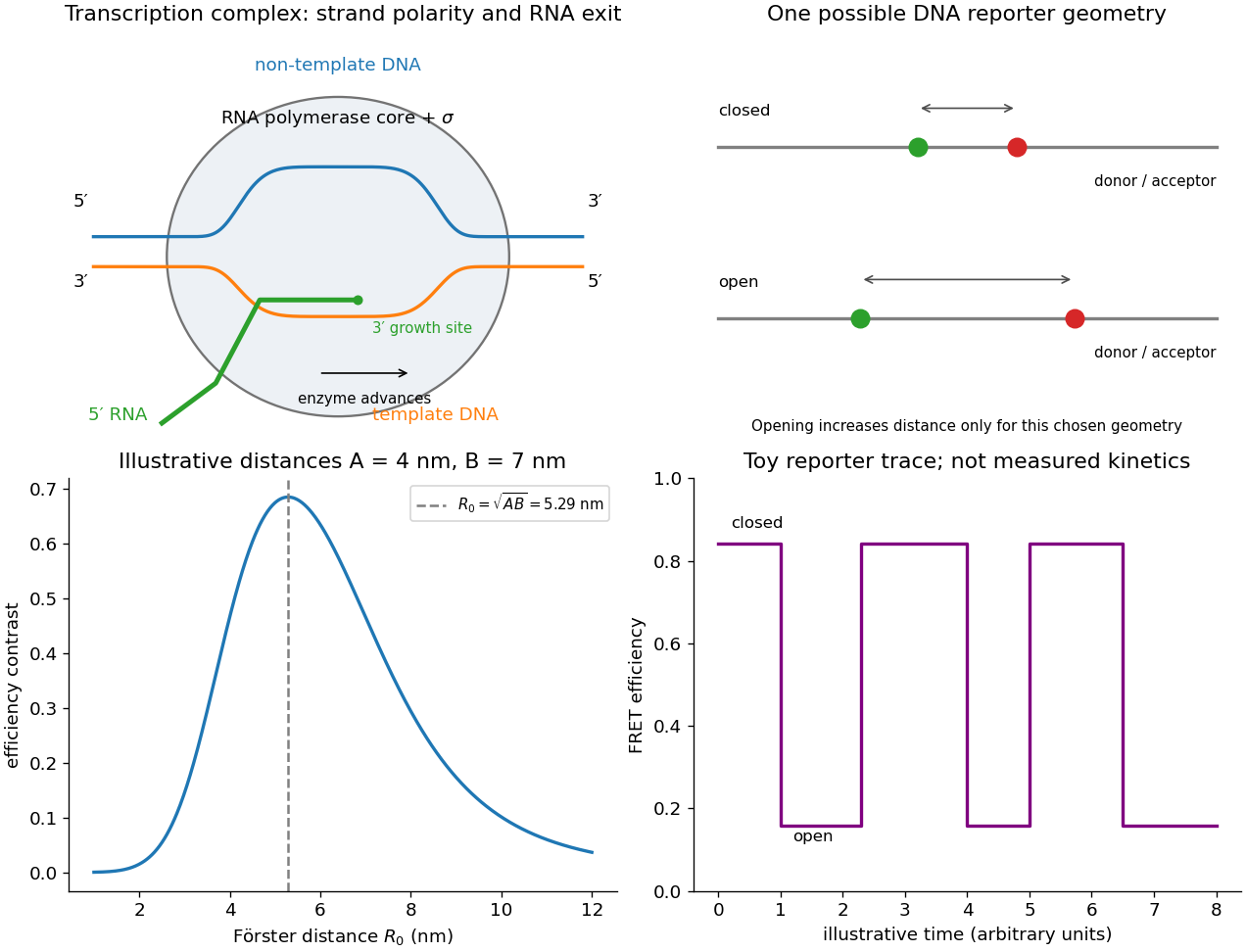
Codex 0 2026-10-25Place a FRET donor and FRET acceptor on DNA positions whose separation reports start-site opening, using an independently calibrated closed/open geometry and a pair whose Förster distance is near the geometric mean from part (c). Opening may increase or decrease the measured separation depending on where the dyes are placed; anticorrelated donor/acceptor changes need structural and photophysical controls before being assigned to bubble formation.
Single molecules can be observed by low-background fluorescence microscopy while recording FRET donor and sensitized FRET acceptor photons. Correct background, spectral leakage, direct FRET acceptor excitation and unequal detection/quantum-yield factors before calculating efficiency, for example with the corrected intensities. Alternating excitation or independent FRET acceptor observation checks that a low-FRET interval is not simply a dark or bleached FRET acceptor. Intensity anticorrelation, FRET donor lifetime and suitable inactive/closed-state controls strengthen the assignment. The original figure below separates the mechanistic schematic from a purely illustrative model trace.
For the binding-plus-opening first-passage time, a minimal kinetic scheme is , for unbound, closed bound and open bound states. A binding rate , dissociation rate and opening rate already produce multiple waiting-time contributions. With O treated as absorbing during the measurement and starting from U, the mean first-opening time isnot simply . This follows from and . A bound-state marker, or measurements over concentration and a justified kinetic model, helps distinguish binding from opening when unbound and closed DNA share a FRET level.
Fit transitions and dwell distributions with finite time resolution, missed short states, bleaching and censoring included. An open-state exponential dwell can estimate its exit rate under a simple Markov model, while competing closing and dissociation channels require separate observables or additional assumptions. Starting from a defined bound closed state can isolate opening more directly, but dissociation still competes if appreciable. Resolving repeated opening and closing gives forward and reverse kinetics; irreversibility should only be assumed over a demonstrated observation window. The experiment measures a conformational reporter, so a two-level trace alone does not uniquely prove every microscopic step of open-complex formation.


Past exam of the biological physics course of the University of Oxford 2018 5 c Solution by Codex 0 2026-10-25
Codex 0 2026-10-25To find the optimal Förster distance for two-state contrast, take positive distinct distances and put . The magnitude of the efficiency change isIts derivative has the sign of . It rises from zero, has a single maximum at , then falls back to zero. HenceThe printed form is equivalent, sinceAt this optimum the two efficiencies sum to one and the maximal contrast is . If , there is no distance change and the contrast is zero for every ; the source's unsimplified expression is then and does not specify a unique optimum. For example yields zero contrast regardless of the fluorophore pair. The geometrical-mean result is a design criterion for distinct distances within the assumed fixed-orientation/photophysics FRET law, not a correction for dye-orientation changes.
There are unlisted articles, also show them or only show them.