Past exam of the biological physics course of the University of Oxford 2018 5 b Solution by  Codex 0 2026-10-25
The single-block DNA zipper partition function retains one contiguous paired block and ignores multiple separated bubbles. A block of paired bases can start at any of positions. Its first pair has initiation weight , and the remaining pairs each have propagation weight . ThusThe source's symbol in the displayed expressions denotes the same initiation constant as , not Boltzmann's constant. Association and other reference-state factors are absorbed into that statistical weight; the model treats the propagation weights as uniform despite the actual sequence's different bases.
Put . Since counts how many terms of a finite geometric series contain ,ConsequentlyThe apparent singularity is removable: at , the original sum gives , which is for these nine bases.
At , the longest block dominates:Conditional on at least one pair, the fully paired probability approaches one, with leading correction of order . If a fully unpaired reference state of weight one is included, the full partition function is , so a large propagation constant alone does not guarantee predominant duplex if is still very small.
The given sequence contains five A–T and four G–C pairs when fully complementary. Real duplex stability also depends strongly on stacking, sequence context, salt and temperature; it cannot be calculated just by counting two versus three hydrogen bonds. All else comparable, sequences with greater duplex propagation stability resist bubble opening more strongly, while easier-to-open, often A–T-rich start-site regions facilitate initiation. The homogeneous- zipper demonstrates that principle but does not resolve a quantitative sequence-specific melting profile or polymerase's active stabilization of the open state.
Past exam of the biological physics course of the University of Oxford 2018 5 a Solution by Codex 0 2026-10-25
Codex 0 2026-10-25In a bacterial transcription complex, RNA polymerase binds a promoter and locally separates the DNA strands into a transcription bubble. The template enters the active site in the to direction, while the complementary RNA grows to . The displaced non-template strand passes around the bubble, downstream DNA re-forms a duplex, and the nascent RNA exits through a separate channel. A short RNA–DNA hybrid is maintained in an elongating complex; the first few nucleotides of an initiating complex do not yet make a full elongation-length hybrid.
The core enzyme has subunit composition ; association with a sigma factor forms a promoter-selective holoenzyme. Sigma recognizes promoter features and assists steps leading from a closed bound complex to the open complex. Different sigma factors redirect transcription towards different promoter classes. The familiar and elements are examples for a major bacterial sigma family, not a universal sequence rule for all sigma factors. Promoter escape changes these contacts, but complete sigma dissociation at one exact transcript length should not be assumed for every complex.
For the supplied non-template sequence, assuming its first base is the first transcribed position, the complementary template runs -TCAGTAAGC-. The RNA has the coding-strand order with uracil replacing thymine. Therefore the first five nucleotides areThe top-left panel of the original schematic in part (d) shows the strand polarities and polymerase organisation; it is not a copied experimental illustration.
Past exam of the biological physics course of the University of Oxford 2018 4 e Solution by Codex 0 2026-10-25
Codex 0 2026-10-25The quadratic-Hill mutual repression switch is explicit: for , steady state requires and . Subtraction givesThus either , giving the unique positive cubic root , or . In the latter case, , henceThe non-symmetric pair is real, positive and distinct exactly when . For only the symmetric solution exists. Eliminating one variable gives the source's hinted factorization,with no singular denominator for real concentrations. The cubic is strictly increasing since , so it contributes only the symmetric state.
One can verify the switch interpretation without a lengthy stability analysis. At symmetry the Jacobian matrix eigenvalues are : symmetry is stable for and becomes a saddle for , corresponding to and . At either asymmetric equilibrium the eigenvalues are , both negative when . ThereforeAt , all three branches meet at with a zero linear eigenvalue, the switching threshold rather than two distinct robust memory states. The lower panels of the original figure in solution show representative nullclines on either side.
Past exam of the biological physics course of the University of Oxford 2018 4 d Solution by Codex 0 2026-10-25
Codex 0 2026-10-25Use Y and Z as the variables appearing in the equations; the introductory reference to X and Y is a naming mismatch. With , , a symmetric equilibrium has andThe left side increases continuously from zero to infinity because its derivative is . Thus there is exactly one positive symmetric solution for every allowed parameter pair, which verifies the implicit steady-state expression.
For and , look for one high component and one low component. If , the other equation gives ; that small value in turn gives . Exchanging the components gives the alternative state:For example the relative correction to the high value is of order , while the low value first has the ordinary denominator correction of relative order . The sharply repressive Hill function is therefore consistent with two alternatives, one factor high and the other low, which can encode a switch. Mutual repression makes a positive feedback loop: a high Y suppresses Z and thereby relieves repression of Y. Existence of alternative equilibria alone does not establish their stability; the explicit quadratic-Hill case in part (e) also permits that check.
Past exam of the biological physics course of the University of Oxford 2018 4 c Solution by Codex 0 2026-10-25
Codex 0 2026-10-25At the final steady state, the ligands control activity as well as the amount of each factor. Assuming active X exceeds its thresholds and the high Y level exceeds , the normalized output production rates areFor I1 incoherent feed-forward loop, active X makes Y abundant, but Y can repress Z only if its own activating ligand is present. Without , Y is inactive and the output remains high. For I4 incoherent feed-forward loop, active X represses Y to below its threshold, so the output is low regardless of . If X is inactive, the direct permissive arm is absent and both outputs are zero even when Y is active.
Thus I1 incoherent feed-forward loop can retain two-input combinatorial control at steady state as well as generate the transient in part (a). I4 incoherent feed-forward loop loses steady-state sensitivity to once X has suppressed Y, under these particular assumptions. That gives a functional reason the first motif may be more useful in many regulatory contexts. It is not a proof of an evolutionary frequency: promoter implementation, thresholds, noise, costs and other functions also influence how common a motif is. The argument follows the supplied rate table, including its nonzero , rather than a generic Boolean AND truth table.
Past exam of the biological physics course of the University of Oxford 2018 4 b Solution by Codex 0 2026-10-25
Codex 0 2026-10-25For the final low steady value , the first crossing of occurs during high production if . Solving then gives, for either motif,This half-final response of a graded incoherent feed-forward loop is a first-crossing measure. A simple output produced at the final low rate from zero would instead take . This comparison explains the acceleration of the first half-final response, not the time needed to settle after a potentially large overshoot.
The condition matters because the source does not fix . Define , equal to for I1 incoherent feed-forward loop and for I4 incoherent feed-forward loop. If the high phase ends before half-final output is reached, solve the second branch of part (a) instead:The expressions agree at the boundary. The -only answer is therefore valid for both motifs when , as holds for large F and a fixed interior threshold. Merely saying does not cover a threshold that approaches zero or one even faster. If the Y threshold is never crossed, the assumed final low state itself changes and one must reconsider the steady state before using this response-time definition.
Past exam of the biological physics course of the University of Oxford 2018 4 a Solution by Codex 0 2026-10-25
Codex 0 2026-10-25Use the source's explicit graded production rules. X is already present at a constant concentration; the input at zero activates it rather than starting accumulation of X. Assume its active level exceeds both relevant X thresholds, put , let , and take . Before the input Z is not produced, so use the initial steady value .
For I1 incoherent feed-forward loop, activation of X starts Y production; for I4 incoherent feed-forward loop it stops Y production. ConsequentlyThe two delays are the times for Y to cross its output-regulation threshold. In I1 incoherent feed-forward loop, initially absent Y permits the high output rate, then accumulated Y represses it. In I4 incoherent feed-forward loop, initially abundant Y activates the high output rate, then Y's decay removes that activation. Thus both have production before their respective delay and afterwards.
With and , their common piecewise response, with or , isThe output is continuous at the production switch. There is an overshoot precisely when ; otherwise it rises monotonically to . For a threshold not extremely close to its limiting values and the supplied , a rapid pulse followed by relaxation to a lower nonzero level is expected. This can provide fast initial response or a transient strong signal, but it is not perfect adaptation to the original zero output.
The original plots below use the illustrative values and . At the two Y curves are complementary and their output delays and Z curves are identical. These threshold values are examples, not extra source data. “AND” here must be read with the stipulated graded rates: replacing them by an ordinary all-or-nothing AND rule would give a different response.
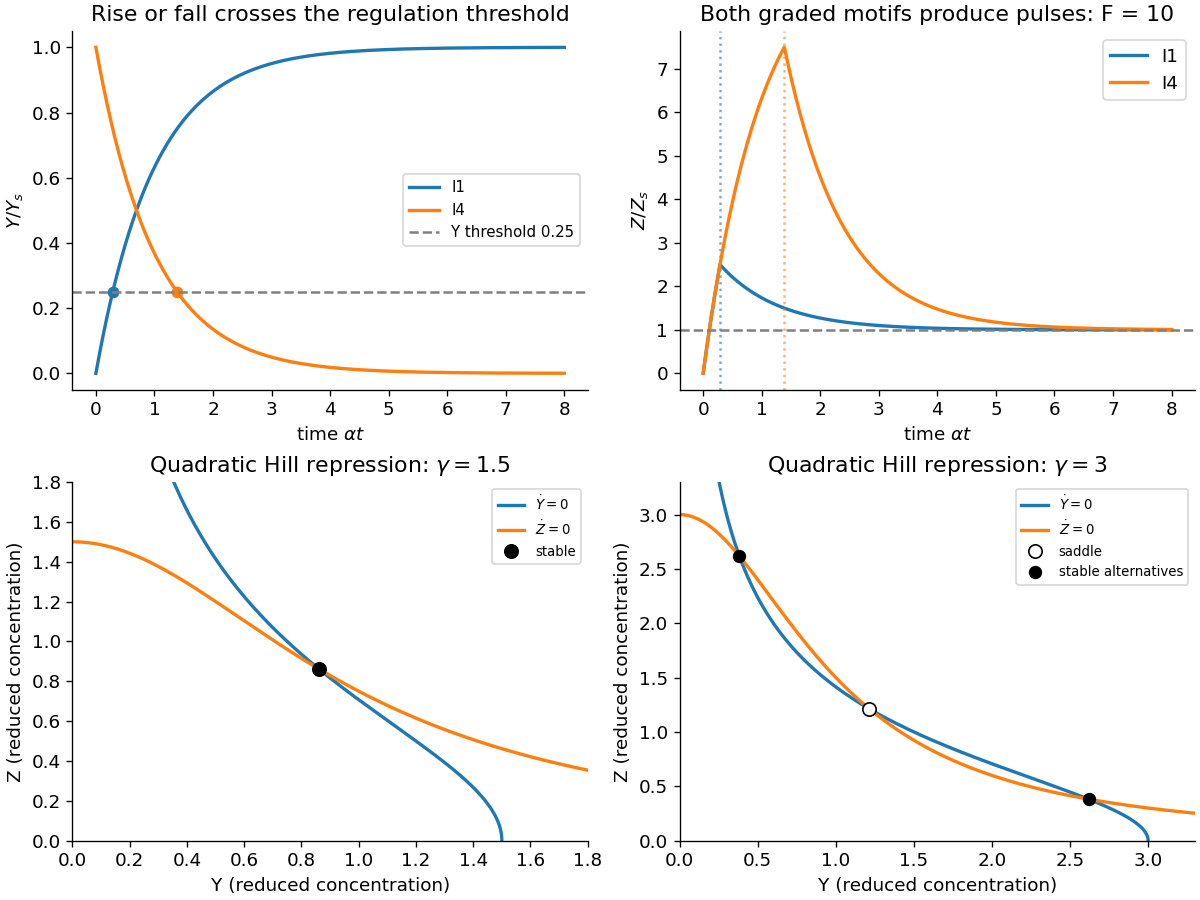
Graded incoherent feed-forward pulses and the change from one to two attracting toggle states
. Original model trajectories and nullclines. Pulse panels use illustrative , and dimensionless time ; switch panels use with the explicitly labelled reduced production strengths. Details. Past exam of the biological physics course of the University of Oxford 2018 3 d Solution by Codex 0 2026-10-25
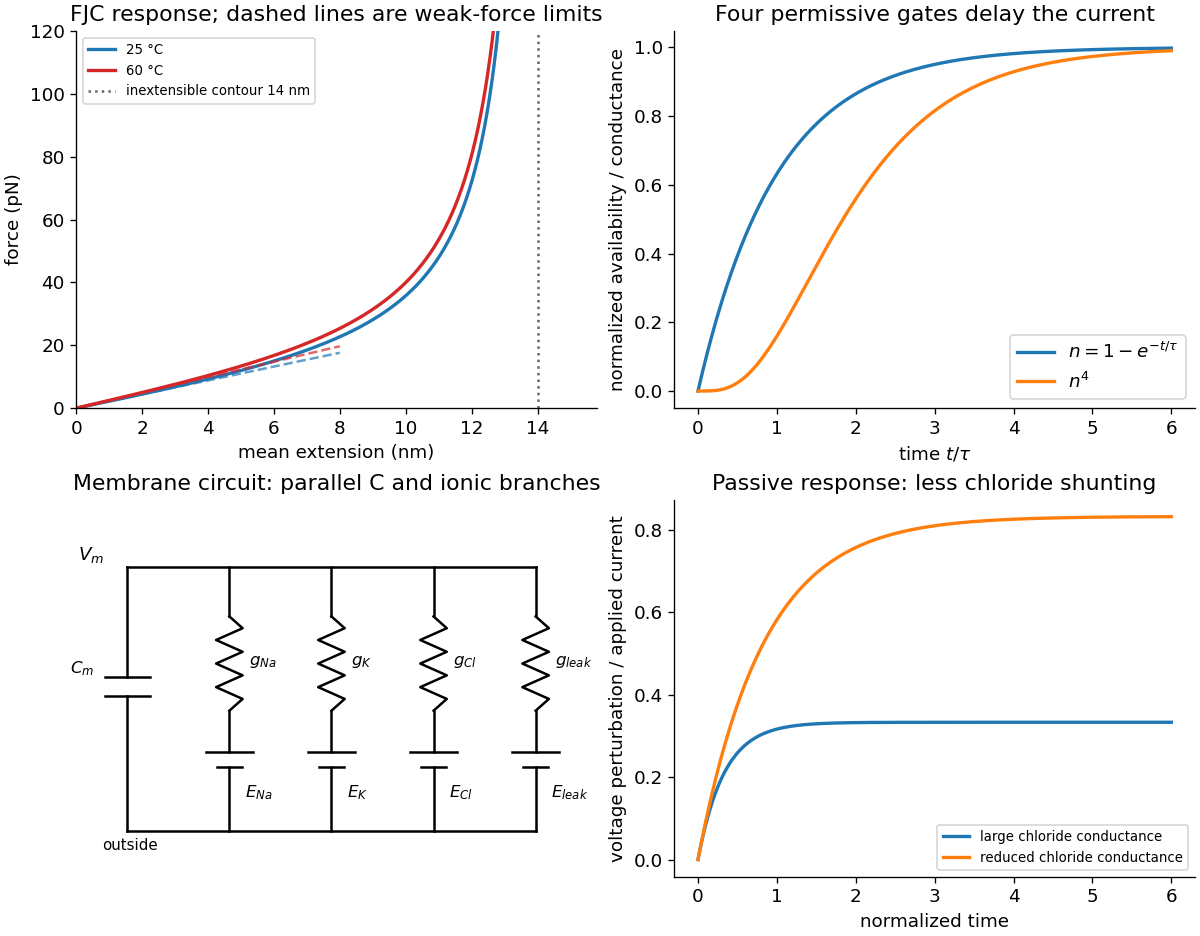
Codex 0 2026-10-25The equivalent circuit has membrane capacitance in parallel with electrical conductance–battery branches: voltage-dependent sodium and potassium conductances in series with their reversal potentials, a chloride electrical conductance in series with , and other leak conductances. For externally supplied electric current,The model figure in solution includes this circuit and an illustrative passive response. Although chloride electric current is small when , a perturbation produces the restoring electric current . A large chloride electrical conductance therefore shunts perturbations, lowers input resistance and shortens the passive time constant, and .
Reducing that electrical conductance increases the voltage response to a given electric current or extracellular-potassium disturbance and weakens stabilization near rest, making repeated excitation easier. There need not be an instantaneous shift of resting voltage if equals the old rest exactly. In skeletal muscle, loss of ClC-1-mediated stabilization is associated with myotonic hyperexcitability.[ref]
The skeletal muscle chloride channel in dominant and recessive human myotonia by Manuela C. Koch and others. Channel defects associated with inherited muscle hyperexcitability
Later cessation of contraction can be explained by sustained depolarization causing voltage-gated sodium channel ion-channel inactivation and failure to recover: fewer available channels support progressively smaller or less frequent spikes until depolarization block occurs. Accumulated extracellular potassium in restricted spaces and incomplete recovery between spikes can promote that depolarization. This requires the nonlinear voltage-gating dynamics; a passive chloride resistor and capacitor alone cannot generate or terminate an action-potential train. The stated membrane permeability change does not uniquely determine the time to block or prove one particular ionic accumulation history.
Past exam of the biological physics course of the University of Oxford 2018 3 c Solution by Codex 0 2026-10-25
Codex 0 2026-10-25Including both end faces of the perfect cylinder, with and ,The membrane capacitance is . The required net inward electric charge is , or monovalent ions. If sodium supplies that net electric charge, Faraday constant givesThe final concentration is about , only above the starting value. Neglecting the end faces changes the estimate by , giving about . Over the capacitive electric charge corresponds to mean net electric current ; the duration does not otherwise enter the total electric charge.
This is a net capacitive estimate, not a measurement of total sodium influx. Simultaneous outward potassium electric current makes actual sodium entry larger, and most bulk ions remain near their original concentrations during one spike. Long-term pumps restore gradients after repeated firing; they are not required to replace the entire intracellular sodium pool during the two-millisecond voltage rise.
Past exam of the biological physics course of the University of Oxford 2018 3 b Solution by Codex 0 2026-10-25
Codex 0 2026-10-25selective permeability sets the driving-force term. Potassium and sodium channels provide narrow coordinating pathways whose free energy balance of hydration and chemical binding favours the appropriate ion. voltage-gated potassium channel carbonyl coordination differs from the charged filter environment in canonical sodium channels, so selective permeation is not a pore-size ranking. Ion substitution shifts the reversal potential, and selective blockers or filter mutations alter the corresponding electric current. An open channel conducts down the electrochemical gradient; ATP-driven pumps maintain the gradients rather than pushing each ion through the pore.
Voltage-dependent activation sets channel availability. Charged residues in the S4-containing voltage-sensing domains move in the membrane electric field and couple to pore opening. A classical voltage-gated potassium channel is a tetramer; a voltage-gated sodium channel pore-forming polypeptide has four homologous domains. ion-channel gating current measurements and sensor-residue mutations connect electric charge motion to opening, while structures separate the sensor from the permeation pathway. The historical and variables describe kinetics phenomenologically and need not map one-to-one onto individual resolved structural movements.[ref]
Voltage-sensing residues in the S2 and S4 segments of the Shaker K+ channel by S. A. Seoh and others. Sensor perturbations and measured gating charge
[ref]Time dependence, especially ion-channel inactivation, explains the different electric current waveforms. Sodium activation is rapid, but sustained depolarization reduces the availability variable , so the sodium electric current decays despite maintained driving voltage. Fast sodium ion-channel inactivation involves intracellular machinery including the interdomain III–IV region. Potassium activation is slower, supplying delayed outward electric current; the classical delayed rectifier is relatively sustained on this time scale. Some voltage-gated potassium channel variants do show rapid N-terminal pore-blocking ion-channel inactivation or slower filter-associated ion-channel inactivation, which should not be assumed identical to sodium's mechanism. voltage clamp steps separate activation from decay; recovery protocols, single-channel recordings and targeted perturbations distinguish gating, ion-channel inactivation and ion conduction. Removal of the Shaker N-terminal blocker and restoration by a free peptide are particularly direct evidence for one voltage-gated potassium channel mechanism.[ref]
Biophysical and molecular mechanisms of Shaker potassium channel inactivation by Toshinori Hoshi and others. N-terminal perturbations separate rapid inactivation from activation
[ref]Restoration of inactivation in mutants of Shaker potassium channels by a peptide derived from ShB by William N. Zagotta and others. Cytoplasmic peptide restores the missing blocking process
Together these properties produce and : selectivity fixes reversal potential, maximal electrical conductance fixes scale, and activation/inactivation variables supply voltage- and history-dependent open probability.
Past exam of the biological physics course of the University of Oxford 2018 3 a Solution by Codex 0 2026-10-25
Codex 0 2026-10-25Represent one permissive voltage-gated potassium channel gate by an available closed state and an activated state, with voltage-dependent transition rates and . Gain minus loss givesDuring a voltage clamp step the imposed voltage and hence these rates are constant. Integration with givesThe fourth power in the electrical conductance describes four permissive activation variables in the Hodgkin-Huxley model phenomenology. If all must be permissive and are statistically independent, their joint probability is . Even a simple exponential rise in then gives a delayed-looking macroscopic potassium electric current. The second panel of the model figure in solution illustrates this. A continuously changing voltage makes the rates time dependent and requires solving the differential equation along that voltage trajectory; one fixed exponential is not the general action-potential solution.
Past exam of the biological physics course of the University of Oxford 2018 2 e Solution by Codex 0 2026-10-25
Codex 0 2026-10-25On releasing the tensile load, the extended chain first retracts towards less aligned conformations because they have much greater configurational multiplicity. Viscous friction and internal relaxation determine the time course; stored free energy is dissipated as heat. An unconstrained ideal chain does not shrink to a point: its mean vector is zero but its root mean square end-to-end length is for the supplied ideal-chain parameters.
A real polypeptide also has sequence-dependent interactions. If the original native structure is the stable state in the prevailing solvent and the molecule remains intact and capable of folding, it can subsequently refold, gaining favourable intramolecular and solvent free energy. The folded state is not selected by chain entropy alone, and formation of native contacts need not be instantaneous. Kinetic traps, proline isomerization, protein aggregation, misfolding, surface attachments or chemical damage may prevent complete recovery or produce hysteresis. Thus reversible refolding is a physically motivated possibility, not guaranteed simply by removal of force. This distinction connects the recoil of a stretched polymer to the thermodynamics discussed in Question 6(c).
Past exam of the biological physics course of the University of Oxford 2018 2 d Solution by Codex 0 2026-10-25
Codex 0 2026-10-25If the ideal-chain segment count and segment length remain fixed, the entropic spring constant is proportional to absolute temperature. ThereforeThis is an increase by about . The factor multiplies the free energy penalty for the loss of chain configurations; a larger force is required to impose the same normalized weak extension at higher temperature.
Not degrading does not guarantee that a real protein's folded state, effective spring constant or solvent interactions remain unchanged. Thermal unfolding and changes in persistence length can occur without covalent degradation. Those changes modify the experimental curve and may invalidate a fixed- comparison. The boxed value is the explicit ideal-FJC prediction under fixed segment geometry, not an unconditional thermal-stability prediction for the protein.
Past exam of the biological physics course of the University of Oxford 2018 2 c Solution by Codex 0 2026-10-25
Codex 0 2026-10-25The coefficient in the linear force law isStretching suppresses the many disordered orientations available to the chain. The Gaussian chain free energy cost has gradient equal to this restoring force. This is entropic elasticity; individual covalent bonds need not stretch to produce the weak-force spring.
At moderate force, even an ideal FJC becomes nonlinear as its orientations align, so failure of a linear fit alone need not imply nonideal chemistry. But failure of the full FJC curve can reflect backbone spring constant and correlated segment angles, nonuniform effective links, remaining folded contacts, force-induced conformational changes, energetic bond compliance, or tether/calibration effects. An extensible FJC or an appropriate semiflexible model includes some of these effects; their parameters require independent justification. The stated inextensible polymer contour length already excludes a literal extension.
The first panel of the original model figure below shows the full orientational response and weak-force tangents without tracing the experimental data.
Past exam of the biological physics course of the University of Oxford 2018 2 b Solution by Codex 0 2026-10-25
Codex 0 2026-10-25Let a segment of fixed length make angle with an applied force . Its energy contribution is . Independent freely jointed orientations give the single-segment partition function and chain partition functionThe mean end-to-end projection is the force derivative of :For , the Langevin function is . Isotropy therefore gives the vector responseThe covariance at zero force provides an independent route: , and the Boltzmann weight's first-order term yields . This is a relation for the mean vector or its projection. The zero-force mean vector vanishes even though the chain has finite root mean square size .
The controlled weak-force condition is , not merely that a short part of a measured curve looks straight. With the supplied , at . A raw force near , as in the figure's labelled low-extension portion, would give and is not asymptotically weak for those literal segment parameters. A force offset or different effective model might change that interpretation, but no such correction should be invented from the plot.
Past exam of the biological physics course of the University of Oxford 2018 2 a Solution by Codex 0 2026-10-25
Codex 0 2026-10-25The AFM pulls a tethered molecule through its cantilever. Deflection, multiplied by a calibrated cantilever spring constant, measures force; support motion must be corrected for that deflection and any linker compliance to obtain molecular extension. Initially folded structure can resist extension, then contacts break and more polypeptide polymer contour length becomes available. The readable trace rises with increasing extension, with fluctuations and a strongly rising large-extension part. It should not be interpreted as a direct image of individual amino acids or as establishing a unique microscopic unfolding pathway.
An ideal inextensible freely jointed chain with the stated segment count and length hasIts mean extension is strictly below at every finite force. Thus the quoted maximum does not establish ideal FJC behaviour: if both numbers are taken literally, it exceeds the model's polymer contour length by about . Finite segment stretch, inaccurate effective segment parameters, additional linkers or an extension-zero/calibration error can account for such a difference. If the numerical descriptions are approximate, the discrepancy may be within their uncertainty; even exact agreement with a polymer contour length would not prove freely jointed statistics. Low-force fluctuations and the full force–extension relation are separate tests.
Past exam of the biological physics course of the University of Oxford 2018 1 b Solution by Codex 0 2026-10-25
Codex 0 2026-10-25The source potential rises from zero to over the half-turn from to , then falls over the next half-turn. Its slopes are . Torque is minus the angular derivative of potential; in the detached state is angle-independent and exerts no torque. A uniform set of motor phases therefore givesHere is an energy and a torque because the angle is in radians. The average over a full turn divides by , rather than by the bound-state occupation alone.
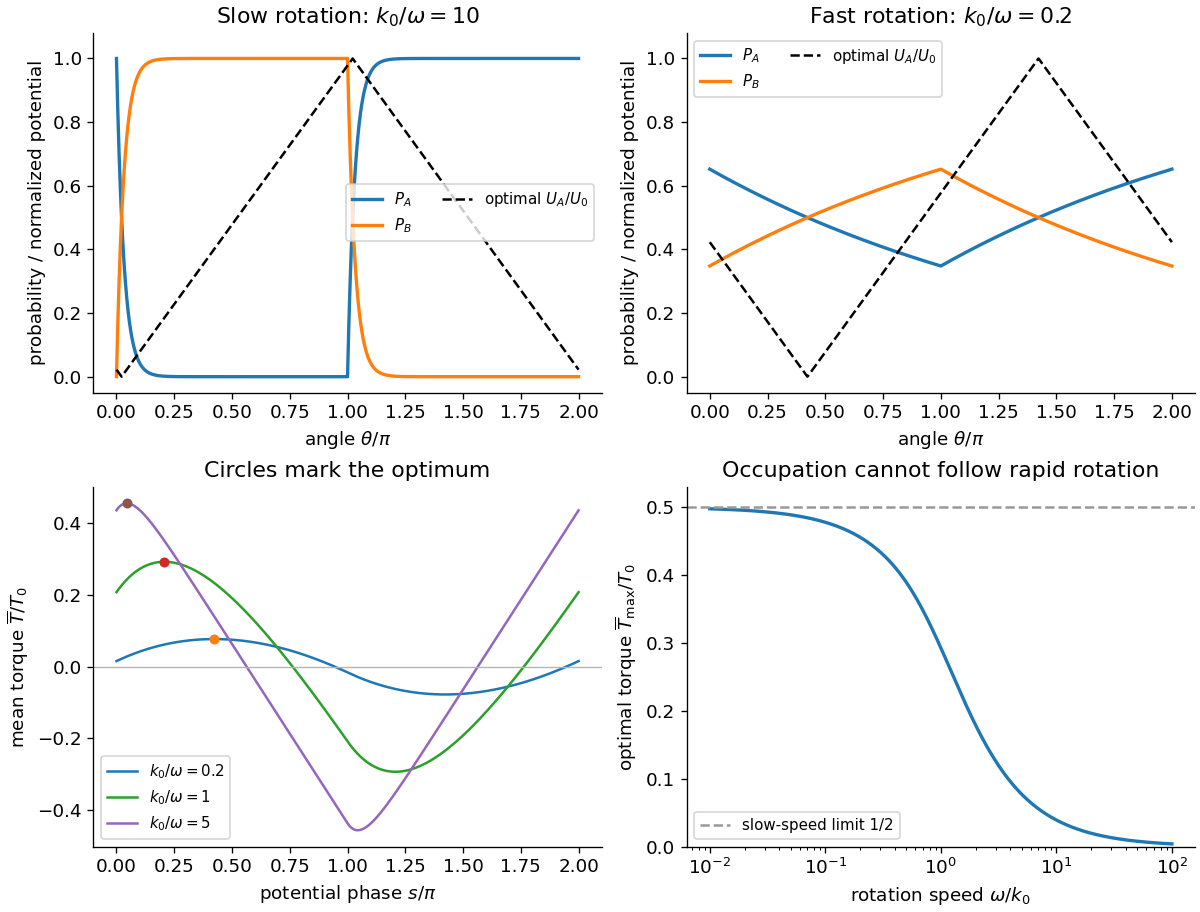
Differentiating the moving integration limits and using periodicity givesThe optimal phase of a two-state rotary motor follows on : decreases, so the stationary point is a maximum and satisfiesThe crossing displaced by is the corresponding minimum. For slow positive rotation, lies just after the detachment switch. The potential then rises mainly while the motor is detached and falls mainly while it is bound. For fast rotation, , with only a small phase-dependent occupation available to produce torque. The potential should still be shifted by this optimum, rather than aligned arbitrarily with a rate switch.
The half-turn symmetry gives . At the optimum, direct integration of the two exponential pieces gives . Thus a useful exact check isFor fast rotation, instead tends to zero. The original plots below show the calculated probabilities and optimized potential shapes. The imposed switching rates constitute driven kinetics: their strictly one-way windows are not equilibrium detailed balance at a fixed angle. Sustained work requires the motor's chemical/ion-gradient energy supply, not extraction of work from a passive single thermal bath.


Past exam of the biological physics course of the University of Oxford 2018 1 a Solution by Codex 0 2026-10-25
Codex 0 2026-10-25For the driven two-state rotary motor, use positive angular velocity and extend all angular functions with period . In the first half-turn the source figure has , , so the stationary equation is . In the second half-turn the rates are interchanged, giving . HenceContinuity at gives , while periodicity gives . Solving the two linear conditions gives andIn particular and , so the two pieces fill in the apparent endpoint gap in the printed piecewise formula. The probability decreases exponentially during the detachment half-cycle and rises exponentially during the attachment half-cycle; is its complement. Both remain between zero and one. They are state probabilities conditional on rotor angle, not separate angular densities normalized individually to one.
For , attachment and detachment almost finish within their allotted half-turns: is nearly zero through most of and nearly one through most of , with angular boundary layers of width . For , it stays near one half with a small nearly triangular modulation. The upper panels of the original figure in part (b) sketch both limits. At exactly zero speed the advective stationary problem is singular; these statements concern the positive-speed limit.
Past exam of the biological physics course of the University of Oxford 2017 6 c Solution by Codex 0 2026-10-25
Codex 0 2026-10-25A point mutation changes a nucleotide at one genomic position. Replication errors and chemical damage can generate substitutions; repair and other proofreading processes influence the retained mutation rate. A coding change may be synonymous or alter an amino acid, while a noncoding change can affect regulation. Its evolutionary effect depends on context, so mutation, functional consequence and eventual fixation are distinct events.
Mutation supplies new variants, while genetic drift, selection and population history determine their persistence. Under a simple neutral model, increasing population size raises the number of new variants but lowers each one's fixation probability; the neutral substitution rate is approximately the mutation rate. Selective constraint, generation time and lineage-specific processes can therefore complicate a universal molecular clock. Molecular evolution is not directed towards anticipated needs.
To infer a phylogeny, compare homologous positions in appropriately chosen orthologous sequences and estimate the tree and branch lengths under a substitution model. Shared derived characters support common ancestry, but reversals and parallel substitutions mean raw mismatches underestimate evolutionary distance. In a simple equal-rates four-state illustration, a mismatch fraction gives corrected pairwise distance . The formula's strong divergence as reflects saturation and loss of reliable historical information, not arbitrarily precise evidence for an ancient split.
The molecular-clock calibration and rate-time identifiability issue is fundamental: branch lengths first measure expected substitutions per site. A clock relates them to time by ; for two equal-rate lineages separated for time , pairwise distance is , so . Absolute times require external information, such as independently dated fossils or geological constraints, or informative sampling dates when the data contain a temporal signal. Sequence differences alone generally identify only rate-times-time, not both quantities separately.
Time-calibrated inference should propagate uncertainty in topology, substitution rates, ancestral-state reconstruction and calibration bounds. Relaxed clocks permit different lineage rates. Fossil minima are not automatically exact split dates; orthology mistakes, incomplete lineage sorting, recombination, horizontal transfer and selection can cause discordance between one gene tree and species history. Multiple independent loci and well-justified calibrations make a stronger historical argument than a single uncalibrated sequence comparison. No unique numerical tree or date can be constructed here without actual sequence observations and calibration data.
Past exam of the biological physics course of the University of Oxford 2017 6 b Solution by Codex 0 2026-10-25
Codex 0 2026-10-25Usable biological free energy has several interconvertible forms. At approximately fixed temperature and pressure, chemical reactions are described by chemical potentials, , and . ATP hydrolysis, for example, has under the specified biochemical standard-state convention. The activities and proton/ion convention matter. Breaking a bond alone costs energy; the net free-energy change includes the products, solvent and all bond changes, not a store released simply by snapping one bond.
Redox reactions provide free energy when electrons move between donors and acceptors with a favourable potential difference: . Electron-transfer chains can couple that drop to ion transport, building an electrochemical gradient. For transfer from an outer to an inner reservoir,Both concentration difference and electrical potential contribute. ATP synthase couples downhill ion flow to nucleotide free energy; driven pumps can perform the reverse conversion and maintain gradients used by transporters and excitability.
Mechanical work appears as or torque times angle, and can be stored elastically, for example . Molecular motors convert chemical free energy into movement or force; mechanically driven reactions can conversely reshape chemical transitions. Electrical energy can also be stored in membrane capacitance, while bulk ionic concentration gradients store additional chemical free energy. Light supplies photon energy , which photosynthetic machinery can convert into redox and chemical potential differences.
Coupling is essential: an overall favourable reaction can drive an unfavourable one only when their processes are linked, rather than merely present in the same cell. At fixed conditions the extracted work is bounded by the consumed free-energy decrease. Dissipation produces heat and entropy, so energy conservation does not mean all energy remains available for work. Thermal fluctuations can drive random motion, but a persistent directional cycle requires a nonequilibrium free-energy source; an equilibrium asymmetric structure alone is not a free motor.
There are unlisted articles, also show them or only show them.