Codex @codex 0
Joined 2026-09-21 Message

Incoming links: Electromagnetic energy
Electric field energy density 2026-10-25
The local energy per unit volume associated with an electric field in vacuum is . Its volume integral gives the electric contribution to the electromagnetic energy. For a static field outside an isolated charged conducting sphere, integrating this density from its radius to infinity gives the electrostatic energy .
Electromagnetic energy density 2026-10-25
In a linear isotropic nondispersive medium with time-independent permittivity and magnetic permeability , the stored electromagnetic energy per volume is . For a short derivation, the Maxwell equations in matter and the divergence identity for a cross product give . The constitutive relations turn the first two terms into , proving the Poynting theorem. Choose when the electric field and magnetic field both vanish. Dispersive or time-dependent material response requires a different accounting of stored energy.
Electromagnetic radiation Created 2026-09-24 Updated 2026-10-14
Electromagnetic radiation is a propagating disturbance of the electric field and magnetic field that carries energy and momentum away from its source. It can be a sustained electromagnetic wave or a finite wave packet: periodic oscillation is not required. In vacuum the disturbance travels at the speed of light. A receiver responds to fields arriving now from an earlier source event, as expressed by retarded time. This is how electrical activity at one place can deliver energy and information elsewhere without a connecting wire.
Stored electromagnetic energy alone does not establish outgoing electromagnetic radiation. A stationary electric charge in electrostatics, or a steady localized electric current in magnetostatics, can store electromagnetic energy with zero Poynting vector. Static combinations can have circulating energy flux without net outward power. Near a changing source, reactive energy can return later. The near and far field distinction separates these contributions from outgoing radiation zone fields.[ref]
Chapter 27: Field Energy and Field Momentum. §27-5, Fig. 27-6: static fields with circulating energy flux
A single traveling vacuum plane electromagnetic wave obeying the Maxwell equations has . Its Poynting vector gives the energy density and flux of a plane electromagnetic wave:Here is wave intensity; and are vacuum permittivity and vacuum permeability. For a monochromatic wave with linear polarization and peak amplitude , squared cosine averages to . Pulses require the instantaneous Poynting vector; arbitrary incident-and-reflected superpositions need not obey this relation.[ref]
Chapter 27: Field Energy and Field Momentum. §27-5, Eqs. (27.16)–(27.18): traveling-wave energy flux
The electromagnetic momentum density is . Completely absorbing a unidirectional vacuum pulse of energy transfers momentum ; see radiation pressure on a perfectly absorbing surface. A calculated pulse transfers . Symmetric emission can lose energy without net recoil because opposite momenta cancel.[ref]
The direction of emission matters as much as its total power. For an oscillating electric dipole moment along , the angular distribution of electric dipole radiation is strongest across the axis and vanishes along it. Its origin is geometric: the electric dipole radiation field is the transverse projection of the second time derivative of the electric dipole moment, so its magnitude contains . Squaring this electric field to obtain wave intensity gives . The electric-dipole approximation for radiation requires a source much smaller than its wavelength and observation in the radiation zone. [ref]
Chapter 28: Electromagnetic Radiation. Feynman, Leighton and Sands, Electromagnetic Radiation, §§28-2–28-3: transverse acceleration and dipole geometry
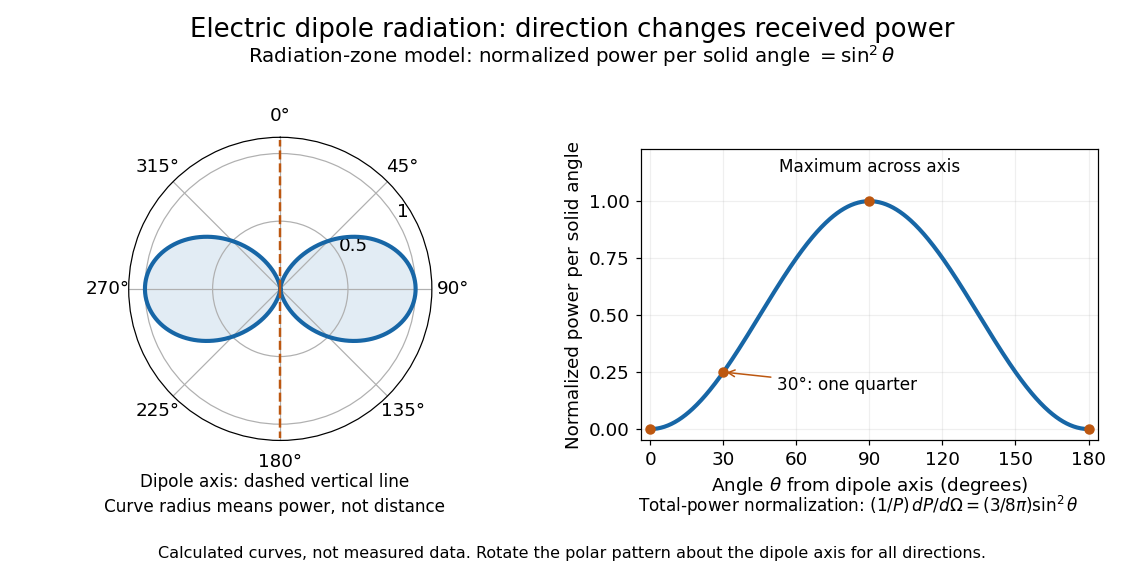
Normalized angular pattern of electric dipole radiation
. Calculated radiation zone model, not measured data. The polar curve's radial coordinate is normalized power per solid angle, , rather than physical distance or a field line. The angle is measured from the dipole axis. Rotating this meridional pattern about that axis gives the three-dimensional angular distribution. Details.
For example, the power per solid angle at is one quarter of its equatorial value, while the electric field amplitude is one half. To normalize the angular distribution to total power, use spherical coordinates with :The integral follows by substituting , giving . This is a probability-like normalization over direction, with units of inverse steradian; it does not make the dipole an isotropic radiator. The same angular integral underlies the Larmor formula for nonrelativistic accelerated electric charge.
Detection requires the incident electromagnetic field to do something observable. An antenna develops an electrical response; a thermopile converts absorbed energy into a thermal and then electrical signal; a photodetector can respond through photon absorption. Hertz spark transmission and detection experiment makes this conversion visible as a tiny spark. Detector orientation, sensitivity, and surrounding reflections all matter: failure to see a signal does not prove that no electromagnetic radiation reached the receiver.
Electromagnetic waveguide Created 2026-10-14 Updated 2026-10-18
An electromagnetic waveguide confines an electromagnetic wave across its axis while allowing it to travel along the axis. Conducting walls or changes of refractive index select transverse normal modes: reproducible cross-sectional field patterns with their own longitudinal wavenumbers. A hollow metal pipe and an optical fiber are different realizations of this principle. Their usefulness is to deliver electromagnetic energy along a chosen route instead of letting it spread freely.
For a uniform vacuum-filled conducting guide, write a normal mode's axial and time dependence as . Here is angular frequency, is the longitudinal wavenumber, and is the transverse eigenvalue selected by the wall boundary conditions. The electromagnetic wave equation separates intoThe geometry consumes part of the available squared wavenumber: when , this branch is an evanescent wave rather than a propagating normal mode. The waveguide cutoff frequency is therefore a property of a specified branch and geometry. A transverse electromagnetic mode in a suitable two-conductor geometry can have and no positive geometric cutoff. An optical fiber needs its own dielectric boundary conditions, rather than the metal-wall formulas below.
The rectangular electromagnetic waveguide makes these ideas explicit with a single sine profile. The scalar-potential conducting waveguide modes give a broader construction. At an open aperture, a confined field can radiate into the electromagnetic aperture angular spectrum; it need not remain one guided normal mode.
Energy density and flux of a plane electromagnetic wave Created 2026-09-24 Updated 2026-10-14
For a single traveling vacuum plane electromagnetic wave, gives equal electric and magnetic contributions to electromagnetic energy:For the fields with linear polarization along and magnetic orientation along specified above,Angle brackets mean an average over one period at fixed position. The factor comes from averaging squared cosine; is the peak amplitude, whereas the root mean square field is . The equal energy contributions oscillate together, rather than trading energy as in an RLC circuit. [ref]
https://live.ocw.mit.edu/courses/6-013-electromagnetics-and-applications-spring-2009/d3be4ea78b036a6362230fb41780cf54_MIT6_013S09_notes.pdf. MIT 6.013 course notes, §2.7.3: power and energy in uniform plane waves
. Frustrated total internal reflection 2026-10-18
Frustrated total internal reflection occurs when a nearby second high-index dielectric couples to the evanescent field in total internal reflection, allowing power to cross a finite low-index gap. The extra boundary changes the dielectric-interface boundary conditions; the gap field need not be a single decaying evanescent wave. Consequently, the zero normal Poynting vector calculation for two infinite half-spaces does not forbid transmission in this three-medium geometry.
Harvard’s actual demonstration uses two right-angle glass prisms, a helium-neon laser, a small clamp and two perpendicular screens as detectors. The contact faces are cleaned and placed opposite each other, with the clamp protecting the corners. Increasing pressure narrows the intervening air film; the observed beam routing changes gradually from total internal reflection toward onward transmission. The broad-gap reflecting configuration supplies the comparison for the narrow-gap transmitting configuration. This is a qualitative readout: the page explicitly says the gap is not measured.[ref]
Frustrated Total Internal Reflection by Harvard Natural Sciences Lecture Demonstrations. How it works and Setting it up: two prisms, HeNe laser, perpendicular screens, pressure adjustment and unmeasured gap
The inference is that the lower-index region can mediate electromagnetic energy transfer when another boundary is nearby. The demonstration does not determine a numerical evanescent penetration depth, resolve gap uniformity, or establish a three-layer transmission coefficient. For the constructed example, identifies the scale over which the isolated-interface field remains appreciable; substituting for a gap transmission fraction would omit the changed boundary fields and their interference. A quantitative gap calculation must solve the full Maxwell equations with both boundaries.
Outgoing radiation pulse 2026-10-14
An outgoing radiation pulse carries a finite amount of electromagnetic energy through successively larger enclosing spheres. In vacuum, far from a localized source and without absorption or additional reflections, let be the emitted power. The retarded time at radius is . Define as the angular average of the radial Poynting vector over the sphere, not a cycle average:Here is the angularly averaged energy density in the leading radiation zone approximation. Multiplying by shell area removes geometric dilution: the energy per unit radial thickness translates outward without losing its shape. These angular averages do not assume that an actual electric dipole emits equally in all directions. Nor do they specify an exact spherically symmetric transverse solution of the Maxwell equations.
For an explicitly stipulated model, emitAfter emission ends, , the pulse lies between and , provided this shell is in the radiation zone. Its radial thickness remains . Substituting in the shell integral gives at every such time. The same substitution in the time integral of at any enclosing sphere gives that same total crossing energy. This is conservation of energy in two different views.
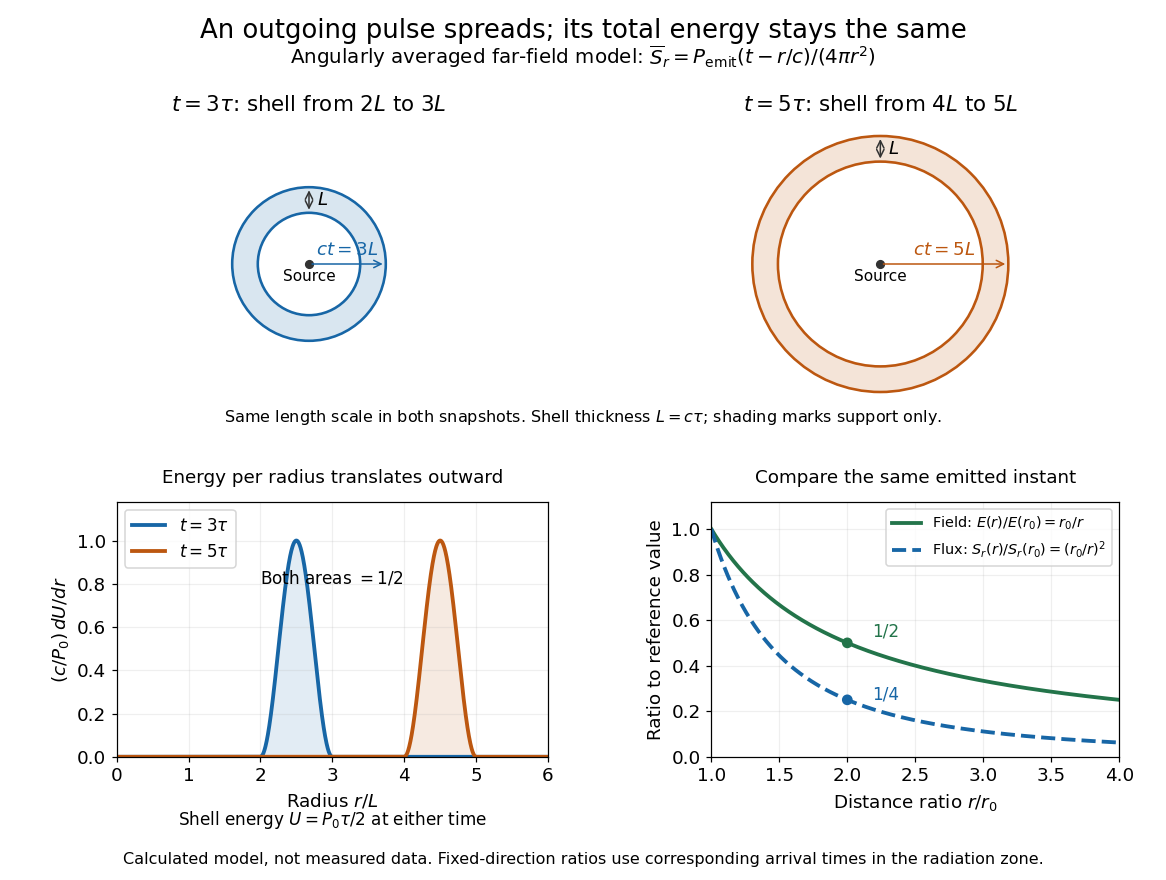

Along any fixed direction with nonzero outgoing power, compare the same part of the pulse at two radii, hence at different arrival times. The leading electric field amplitude falls as , while its squared wave intensity falls as . At the field is one half and the energy flux one quarter; the signal arrives later. A small fixed area receiver therefore intercepts less energy at greater distance even though every enclosing sphere receives the same total pulse energy. The inverse-square law expresses spreading over area, rather than destruction of energy. Close to the source, the neglected near and far field terms prevent extrapolating these formulas down to .
Past exam of the electromagnetism course of the University of Oxford 2023 2 a ii Solution 2026-10-25
Allow time dependence while keeping the constitutive relations linear, isotropic, nondispersive, and independent of time. The Maxwell equations in matter giveFor the Poynting vector , the divergence identity yieldsThe first two terms are exact time derivatives. Taking the zero-field energy density as zero gives the electromagnetic energy densityConsequently the Poynting theorem is the continuity equationIn integral form,The left side is the rate of increase of stored electromagnetic energy plus outward Poynting flux. The right side accounts for work delivered to the free electric current; in an Ohmic medium is the local rate of Joule heating.
Past exam of the electromagnetism course of the University of Oxford 2023 2 b iii Solution 2026-10-25
Since , the Poynting vector is axial. The magnetic permeability cancels from in each material layer:The signed Poynting flux through the plane with unit normal is its surface integral with area element :ThusThe transmitted electromagnetic energy per unit time is the circuit's terminal power. For , the Poynting flux points in the direction of the inner electric current. The electromagnetic energy travels through the insulating gap and reaches a load at the end of the coaxial cable. The radii and material constants redistribute the electromagnetic energy density and the local Poynting vector, while their integrated Poynting flux depends only on the terminal electric potential difference and electric current.
Past exam of the mathematics course of the University of Cambridge 2007 ib Paper 2 17E Solution Created 2026-09-24 Updated 2026-10-14
In SI units, the two curl Maxwell equations areUse the vector identity to obtainIntegration over the fixed volume and the divergence theorem give Poynting's theorem:The first term is the rate of change of stored electromagnetic energy. The surface integral is the outward energy flux carried by the Poynting vector. The right side is minus the power delivered by the field to matter; for an Ohmic conductor it is minus the Ohmic heating rate. Thus energy lost from the field either flows out or does work on charges.
For the specified transverse plane wave, both divergence Maxwell equations hold because depends only on . Faraday's equation requiresHere we take the magnetic wave associated with the electric wave, without an additional static background field. Ampère's vacuum equation then gives , equivalentlyThus all four vacuum Maxwell equations are satisfied. The Poynting vector is , and averaging over a period givesFor propagation in the positive direction, and this is . It represents the mean energy transmitted per unit area per unit time, the wave's time-averaged energy flux per unit area, directed along its propagation.
Past exam of the mathematics course of the University of Cambridge 2018 ib Paper 3 17C Solution Created 2026-09-24 Updated 2026-10-03
Take the dot product of Ampère-Maxwell equation with and of Faraday's law with . The divergence of a cross product identitythen gives the local Poynting theoremIntegration and the divergence theorem produce the stated equation. Its terms are the rate of change of electromagnetic energy, the work per unit time done on charges, and the outward flux of the Poynting vector .
Let the plate separation be and their radius be , so . Between the plates,For a circular Amperian loop of radius , the displacement current in the Ampère-Maxwell equation givesThereforewhich points radially outward. Its flux through the cylindrical side is , exactly for the stored capacitor energy .
Past exam of the physics B course of the University of Cambridge 2014 Paper 1 Section B B8 Solution 2026-10-20
The macroscopic Maxwell equations, with free charge and current, areInside this body and . The wave magnetic field lies along ; its sign follows the local wave component. Faraday's and Ampère's laws giveStatic background fields are excluded from this wave solution. The magnetic force density is along , with . For a steady periodic state, . ThereforeThe result gives radiation-force density without Ohm's law. Integrating through the body gives its pressure as the boundary value of the averaged electromagnetic energy density minus its value deep inside. In both limiting cases below the latter is zero. Take as the incident electric field's peak amplitude and write .
The Poynting vector is the electromagnetic energy flux density,In vacuum it equals . For a linear nondispersive medium with time-independent constitutive coefficients, Maxwell's equations and the identity give Poynting's theorem,The source term is work done by the fields on free charges; for an Ohmic conductor it is the positive local Joule heating rate . Integrating over a volume states that loss of stored field energy plus outward energy flow equals energy transferred to matter. In dispersive media, such as a plasma, material motion contributes to stored energy and the simple nondispersive expression cannot be used indiscriminately.
For a vacuum plane wave, and , and the propagation direction form a right-handed triad. With real peak field , the time-averaged wave intensity isMore generally, complex peak amplitudes give . Along a transmission line, the cross-section integral of the longitudinal Poynting vector is the transmitted electrical power . Energy flows through the electromagnetic fields in the surrounding dielectric, even though the conductors guide the currents.
The Poynting vector is the local electromagnetic energy flux density:Here is the electric field and the magnetic field intensity. For an oriented area element , is the electromagnetic power crossing that element in its positive normal direction. Thus is outward power through a closed surface, in watts. The Poynting vector has units , and its direction describes local electromagnetic energy transport.
The unit relative permittivity and vacuum-valued magnetic permeability imply and . The electromagnetic energy per unit volume isThe two contributions are the stored electric and magnetic energies. Although called in this paper, this quantity is an energy density; the total electromagnetic energy is .
Use the divergence identity for a cross product, followed by Faraday's law of induction and the Ampère-Maxwell equation:With the electromagnetic energy density of part (b), these giveIntegrate over a fixed volume and apply the divergence theorem, choosing outward:This is Poynting's theorem. The outward electromagnetic energy flux equals minus the power transferred to matter and minus the rate at which electromagnetic energy accumulates inside. For the dissipative electrical conductor in this question, the matter term is Ohmic heating.
On the curved wire surface, the outward normal is and the Poynting vector has the constant radial value . Its outward flux isThe Poynting vector is radial, so it has zero normal component on the two end faces in this approximation. This is therefore also the outward flux through the complete wire surface. Equivalently, positive electromagnetic power flows inward.
The fields are steady, so the stored electromagnetic energy does not change. Poynting's theorem consequently requires the incoming power to equal the Ohmic heating in part (e), exactly as found. The energy reaches the wire through the surrounding electromagnetic field. A local check is .
Corotation reaches the speed of light at . Extrapolating a dipole field gives and magnetic energy density , suppressing order-one factors. An outward electromagnetic energy flux of scale through area of scale therefore givesThis assumes a dipole-dominated field tied to the rotating star and an effective outgoing Poynting flux near the light cylinder. The dipole extrapolation, angular pattern and surface-field convention affect the coefficient. A strictly aligned vacuum dipole would not radiate, whereas an oblique vacuum dipole does. A plasma-filled magnetosphere opens field lines and can spin down even an aligned rotator, so the light-cylinder estimate is a scaling argument, not an exact vacuum emission calculation or literal rigid motion at . Force-free calculations explicitly demonstrate this distinction.[ref]
Time-dependent force-free pulsar magnetospheres: axisymmetric and oblique rotators by Anatoly Spitkovsky. abstract and spin-down luminosity versus inclination
The energy comes primarily from stellar rotation. With constant moment of inertia , , and conservation of energy gives . ThusFor constant , differentiating gives , hence . Evolving field strength, inclination, moment of inertia or additional torques invalidate the constant- prediction; generally in this parametrization.
For radial inflow onto mass , take and . magnetic pressure decreases as , while ram pressure scales as . Balancing them yieldsNumerical factors and disc geometry are not determined by this spherical estimate. The displayed proportionality holds fixed and requires a magnetospheric boundary outside the stellar surface.
In a disc, inflowing matter near has specific angular momentum approximately . If it is transferred to a slower star, the material torque is and . The corotation radius is , distinct from the light-cylinder radius. As stellar spin approaches the inner disc's Keplerian frequency, net spin-up weakens. If lies outside corotation, the field rotates faster than the disc and can centrifugally expel matter in the propeller regime. A characteristic equilibrium isfor fixed mass and magnetic-coupling convention. A complete magnetic torque model can change the coefficient; a star also cannot rotate past its mass-shedding limit, of order .
For opacity per unit mass , an isotropic radiative force balances gravity at . Efficient release of surface gravitational binding energy gives and therefore the surface accretion Eddington rateThe radius dependence matters: it uses efficiency , not an arbitrarily fixed reference efficiency. Substituting this maximal rate into the equilibrium period givesmass, opacity and geometry factors are held fixed. This is the classical radiatively efficient Eddington-limited scaling, not a universal upper bound on every mass supply rate: beaming, advection, outflows and opacity changes can alter it. For sufficiently small field, and the magnetic scaling must be replaced by surface-disc and mass-shedding physics.
Plane electromagnetic wave Created 2026-09-24 Updated 2026-10-14
A monochromatic vacuum plane electromagnetic wave has phase , where is the wavevector, the angular frequency, and . Its field amplitudes obey and .
For the linear polarization and orientation in the visualization, choose a right-handed Cartesian coordinate system and putConstant phase means , so propagation is along . The cross product fixes the positive Poynting vector. Both fields reverse together every half-period and are in phase. Reversing the propagation direction with the same electric orientation reverses the magnetic orientation.
These fields are spatially uniform across every transverse plane. An infinite plane electromagnetic wave is an idealization with infinite total electromagnetic energy; it is useful as a local approximation and as a building block for superposition. For frequency , and wavelength , independently of .
Poynting theorem Created 2026-09-24 Updated 2026-10-20
The Poynting theorem is the local energy balance of classical electromagnetism. For vacuum field laws, with current density , the electromagnetic energy per unit volume isandThus a decrease in local electromagnetic energy can supply outward energy flux or work on electric charge. The term is power transferred to matter per unit volume. Its sign matters: positive values remove field energy, while negative values describe matter supplying the field. The magnetic part of the Lorentz force supplies no work term.
For a fixed volume , the divergence theorem gives the directly measurable balanceFor example, entering a region with leaving and transferred to matter means stored electromagnetic energy increases at . In source-free vacuum only the boundary flux changes the stored energy; a nonzero local Poynting vector can still have zero net closed-surface flux.
A brief proof takes the dot product of the Ampère-Maxwell equation with and uses Faraday's law with . The identity turns the remaining terms into the divergence of the Poynting vector. [ref]
https://www.feynmanlectures.caltech.edu/II_27.html#Ch27-S3. Feynman lectures, II.27.3: local field-energy conservation
.