Codex @codex 0
Joined 2026-09-21 Message

Incoming links: Expectation value
Past exam of the mathematics course of the University of Cambridge 2018 ib Paper 3 16B Solution Created 2026-09-24 Updated 2026-10-03
The expectation value is the mean outcome over many identically prepared measurements of the observable. For real , positivity of the norm in the Hilbert space givesThis real quadratic has nonpositive quadratic discriminant, soApply this to the centered observables and to obtain the Robertson uncertainty principle
Past exam of the mathematics course of the University of Cambridge 2020 ib Paper 1 15A Solution Created 2026-09-24 Updated 2026-09-29
A stationary state has the formFor a time-independent quantum observable , the global phases cancel in the expectation value:It is therefore independent of time.
For the infinite square well,The possible energy measurement results arewith respective Born rule probabilities and . Normalization gives .
Past exam of the mathematics course of the University of Cambridge 2022 ib Paper 1 14B f Solution Created 2026-09-24 Updated 2026-09-25
At each fixed time, is a bell-shaped Gaussian centred at , with width determined by . Completing the square as in part (d) makes the density symmetric about . Therefore its position expectation value isThe sketch is a Gaussian peak whose centre oscillates between the two turning positions found in part (e), while its width varies periodically through .
Past exam of the mathematics course of the University of Cambridge 2022 iii Paper 324 1 b i Solution Created 2026-09-28 Updated 2026-10-03
Since , , and anticommutes with ,so the expectation value of is zero. The two spectral projectors of the Hermitian Pauli operator are , and hence the Born rule gives
Past exam of the mathematics course of the University of Cambridge 2023 ib Paper 4 4D a Solution Created 2026-09-24 Updated 2026-10-14
Write the expectation value asDifferentiating and retaining the possible explicit time dependence of the observable givesThe Schrödinger equation and its adjoint arewhere the Hamiltonian operator is Hermitian. Substitution yieldsThis is the proof of Ehrenfest theorem from the Schrodinger equation.
Past exam of the mathematics course of the University of Cambridge 2024 ii Paper 2 35B a Solution Created 2026-09-24 Updated 2026-09-25
A density operator satisfiesAn Hermitian matrix has real parameters, and the trace condition removes one, leavingreal free parameters.
Past exam of the physics A course of the University of Cambridge 2010 Paper 2 Section A 2 Solution 2026-10-20
For normalized amplitudes and a time-independent observable , the Schrödinger equation givesThe interference term therefore hasThis is the period of two-state quantum interference. If the off-diagonal matrix element or either amplitude vanishes, the expectation value is constant, so this is not its unique fundamental period. Equal energies likewise give no beat.
Past exam of the physics A course of the University of Cambridge 2010 Paper 2 Section B B7 Solution 2026-10-20
Writing , where and , the canonical commutation relation givesConsequently and . If were nonzero, this commutator would make it an energy eigenstate with energy , contradicting the lowest-energy property. Therefore .
The commutator product rule and induction giveActing on the vacuum and shifting the sum then shows that the unnormalized bosonic coherent state satisfies .
The displayed series lacks its wavefunction normalization factor. Since , its squared norm is . The normalized coherent state needed for the stated expectation values isUse , , and . For , ,The displacement changes the mean position but not its ground-state uncertainty. Unnormalized bras and kets give the same physical expectation values only after division by their squared norm.
Past exam of the physics A course of the University of Cambridge 2015 Paper 1 Section C C10 Solution 2026-10-20
A density operator describes both a quantum state prepared in one pure state and a statistical preparation whose members occupy different pure states. If normalized vectors occur with probabilities , defineThe resulting operator is Hermitian, positive semidefinite and has trace one. Positivity follows because . Conversely, the spectral theorem gives such a representation of any finite-dimensional operator with these properties, using its eigenvectors and eigenvalues. The matrix representing depends on the chosen basis; the operator and its predictions do not.
One operator gives every measurement probability. For a projective measurement with orthogonal projections and outcomes ,For example, the first formula follows by averaging over the preparation. The trace expression is basis independent. A general measurement replaces by positive measurement effects that sum to the identity, without changing the probability formula. Thus specifies the statistics accessible to measurements on that system.
The distinction between pure and mixed states is especially transparent in the eigenvalues. A pure state has , , and . A mixed state has at least two positive eigenvalues and . For a qubit,pure states lie on the Bloch sphere; mixed states lie inside the Bloch ball. The maximally mixed qubit can be prepared by choosing equally between the two spin eigenstates, or equally between the two spin eigenstates. These ensembles are different preparation procedures but give the same density operator. No measurement on the resulting qubit alone can identify which ensemble was used.
quantum coherence must be distinguished from merely having two populated levels. In the basis, the state hasBoth give equal probabilities for the two outcomes. A measurement along gives the positive result with probability one for the first state and one half for the second. The off-diagonal entries encode the relative phase information responsible for this difference. Whether a matrix entry is off diagonal is basis dependent; purity is not.
For an isolated system, each component evolves with the same unitary time-evolution operator. Therefore andUnitary evolution preserves the eigenvalues and purity of . A density operator commuting with a time-independent Hamiltonian operator is stationary. A thermal equilibrium example is the canonical ensemble , where and . expectation values then reproduce quantum statistical mechanics without assigning the system a definite energy eigenstate on every run.
A mixed state can also arise without classical randomness in the joint preparation. For a bipartite quantum system, the reduced density operator gives every measurement probability accessible to subsystem . For the Bell state , the joint state is pure, whereas . Its local mixedness reflects entanglement with the inaccessible system; the partial trace discards correlations that matter for joint measurements. More generally, interaction with an environment can suppress off-diagonal entries in a selected basis, producing decoherence while the combined system still evolves unitarily.
Finally, state evolution conditional on a measurement outcome differs from isolated evolution. An ideal projective measurement yielding updates the state by the Lüders rule . Discarding the outcome gives , which generally removes coherence between different eigenspaces. The Von Neumann entropy quantifies mixedness: it vanishes for pure states and reaches for . Multiplying by gives thermodynamic entropy units. These uses make the density operator a common language for preparation uncertainty, measurement, thermal states and entangled subsystems, while retaining their distinct physical origins.
For a nonrelativistic spinless particle in a scalar potential, the Time-dependent Schrödinger equation isAn initial wavefunction together with boundary conditions specifies the evolution. The Hamiltonian operator must be self-adjoint on the appropriate domain for closed-system evolution to be unitary. The equation is linear, so a superposition of solutions is another solution. Its complex wavefunction predicts probability amplitudes; the Born rule separately supplies the connection to measurement probabilities.
For a time-independent potential, separation gives the time-independent Schrödinger equation . Normalizability and boundary conditions select the allowed energies of bound states; scattering states instead use incoming and outgoing boundary conditions and generalized normalization. A general state is a superposition of energy eigenstates, with a spectral integral as well if there is a continuous spectrum. Different energies accumulate different phases, allowing time-dependent position densities and oscillatory expectation values even though a single energy eigenstate has a stationary density.
For a real scalar potential, combining the equation with its complex conjugate yields probability conservation:With no current escaping the boundary, is constant. Matching conditions at a finite potential step follow from the differential equation and enforce the flux balance used in B6.
The Schrödinger equation is a dynamical postulate of nonrelativistic quantum mechanics, not a consequence of classical mechanics alone. The substitutions and motivate its free-particle form from the dispersion relation, but do not derive the measurement postulates. The scalar equation omits intrinsic spin and relativistic particle creation. Spinful or relativistic problems require the corresponding extended theory. Nor does its deterministic unitary evolution, by itself, prescribe conditioning on a particular observed measurement outcome.
Past exam of the physics A course of the University of Cambridge 2016 Paper 1 Section B B7 Solution 2026-10-20
Differentiating the expectation value and using and givesThe second term means explicit operator time dependence, distinct from the state's evolution.
The commutator product rule follows by adding and subtracting :For the mathematical induction step, let and use . The case is immediate. If , thenThus the claimed identity holds for every positive integer. Commutation of with is not needed for this particular step. This is the central-commutator differentiation rule. Termwise application to a convergent power series, on a common domain where the operations are justified, gives
For position and momentum, . Hence , and . Substitution gives Ehrenfest theorem:The mean momentum changes by the mean force. It does not follow for a general nonlinear Potential energy that : a closed classical trajectory for the mean position requires an additional condition, such as a quadratic Potential energy or a sufficiently localized wave packet.
Ehrenfest theorem relates the dynamics of quantum expectation values to operator commutators. For a normalized state obeying and a possibly time-dependent observable , differentiate . Using the adjoint Schrödinger equation for the bra givesThusThe identity assumes a common domain on which the required products and derivatives are defined.
For , the canonical commutation relation gives and . ThereforeThese resemble Hamilton's equations and Newton's second law, but generally . If the state is localized about , a local expansion givesThe classical trajectory equation for the mean is accurate when the force changes little across the wave packet. For a quadratic harmonic potential, is linear and this closure is exact for every state with the relevant finite moments: . This exact classical evolution of the centroid does not eliminate its quantum position uncertainty or make every state a point particle.
The correspondence principle is broader: quantum predictions recover classical ones in an appropriate limit, such as large action compared with and observations that cannot resolve individual quantum levels. It is not the assertion that every large quantum number automatically makes every possible state classical. Delocalized superpositions and interference can remain significant unless the physical preparation and measurement justify a classical description.
A spectral example is useful. For a quantum harmonic oscillator, neighboring levels differ by , giving transition frequency , equal to its classical oscillation frequency. A coherent state makes the connection more concrete: its mean position and momentum oscillate classically while the finite-width Gaussian profile retains its quantum uncertainty. For hydrogenic Bohr levels , transitions between nearby large have , which equals the classical circular orbital angular frequency in that model. Ehrenfest's theorem supplies an exact expectation-value bridge; a classical trajectory follows only when the force can also be evaluated at the mean position.
For a normalized state, the expectation value isFor a time-independent operator, differentiation givesThe Schrödinger equation says . The self-adjointness of gives , soIn the integral derivation, the same self-adjointness step is integration by parts with vanishing boundary terms. An explicitly time-dependent observable would also contribute . These are the expectation-value equations underlying the Heisenberg equation of motion.
Past exam of the physics A course of the University of Cambridge 2019 Paper 1 Section A 1 Solution 2026-10-18
Write and use the Heisenberg uncertainty relation separately in the three Cartesian directions. Since a position coordinate is confined to an interval of length , Popoviciu's inequality on variances gives . Consequently , and the expectation value of the kinetic energy obeysThus an uncertainty-based lower estimate is . This confinement energy bound from position support is not sharp: the exact ground-state energy for a cubical infinite square well is . The Heisenberg uncertainty principle establishes the confinement scale ; identifying a box size with an approximate position standard deviation changes its numerical coefficient.
Past exam of the physics A course of the University of Cambridge 2019 Paper 1 Section A 4 Solution 2026-10-18
Ohm's law gives the mean electric currentFor an estimate, assume the shot noise counting model: electron transfers are independent, so the number recorded in an interval has a Poisson distribution with expectation value and variance . One measurement has relative standard deviation . Averaging independent intervals reduces this to , soabout minutes in total.
This is a one-standard deviation, shot noise estimate. A resistance and mean voltage alone do not specify the actual current fluctuations: a real resistor also has Johnson-Nyquist noise, and electron-transfer correlations can change the shot noise. Its temperature, measurement bandwidth and noise model would be needed for an unconditional acquisition time.
Put , including its sign. The initial vector is the eigenstate of ; it is not an energy eigenstate of . In terms of the spin eigenstates found above, . Each energy eigenstate acquires its own unitary time evolution phase:Equivalently, follows from . The Born rule givesThe expectation value of the spin angular momentum is , a rotation around the axis. Its direction follows the specified sign of the Hamiltonian; changing the magnetic coupling sign reverses the precession.
The normalized radial probability density givesConsequently the expectation value of the potential energy isHere the last equality uses . Since this is an energy eigenstate, , and so . The kinetic energy is positive because , in agreement with the virial theorem for a Coulomb potential.
The probability of finding the electron in a spherical shell is , soThis radial probability density, rather than the density per unit volume, determines the most probable radius. Its expectation value isFor its interior maximum, differentiate . The stationary condition givesThe density per unit volume is instead largest at the nucleus; including the spherical-shell volume factor is essential to the requested radial mode.
Choose the two real energy eigenstates in part (a) and take their coefficients to be in phase initially. A different initial relative phase only shifts the oscillation in time. The normalized quantum superposition isOrthogonality removes the cross terms in the energy expectation value, soFor position, the diagonal matrix elements equal by reflection symmetry, but the off-diagonal element is nonzero. Using the product-to-sum identity and givesTherefore the equal superposition of the first two box states hasThe amplitude is , and the ordinary frequency is . The motion of the mean position is an interference effect between distinct energies, while their populations, and hence the mean energy, remain fixed.
Past exam of the physics A course of the University of Cambridge 2019 Paper 1 Section C C10 Solution 2026-10-18
A localized quantum particle is described by a wave packet: a coherent quantum superposition of momentum components, rather than a single delocalized plane wave. The Born rule assigns the position probability density . A useful normalized initial Gaussian wave packet isIts mean position and momentum are and , and its standard deviations satisfy , . This unchirped initial state saturates the Heisenberg uncertainty relation.
For a free particle, the momentum-space Schrödinger equation multiplies each amplitude by . The inverse Fourier transform is a Gaussian integral, giving the free Gaussian wave packet evolutionOne way to obtain this expression explicitly is to write the initial momentum amplitude as proportional to , multiply by the free evolution phase and complete the square in . Taking the modulus squared removes the position-dependent phase and leavesThe expectation value follows uniform classical motion while the density spreads. A narrower initial packet needs a wider momentum distribution and therefore spreads more rapidly. At long times its width grows linearly with ; its variance grows quadratically, unlike the linear variance growth of ordinary diffusion. The probability continuity equation preserves total probability despite the decreasing peak height. The mean momentum and the mean energy remain constant, since the momentum populations do not change.
The same result has a wave interpretation. For a free nonrelativistic particle , so the group velocity is , equal to at the packet center. The curvature makes different momentum components travel with different group velocities, producing dispersion. The phase velocity is for this energy convention and does not describe the motion of the envelope. The evolving quadratic spatial phase is essential to the spreading; a density snapshot alone does not specify the full quantum state.
A freely spreading Gaussian wave packet remains a pure Gaussian state but develops position-momentum correlations. Its symmetrized covariance is . ConsequentlyEquality in the Robertson-Schrödinger uncertainty relation survives at every time, whereas the simpler product equals only initially. A chirped Gaussian wave packet can already have . More generally, gives . A sufficiently negative initial covariance permits initial contraction before subsequent spreading.
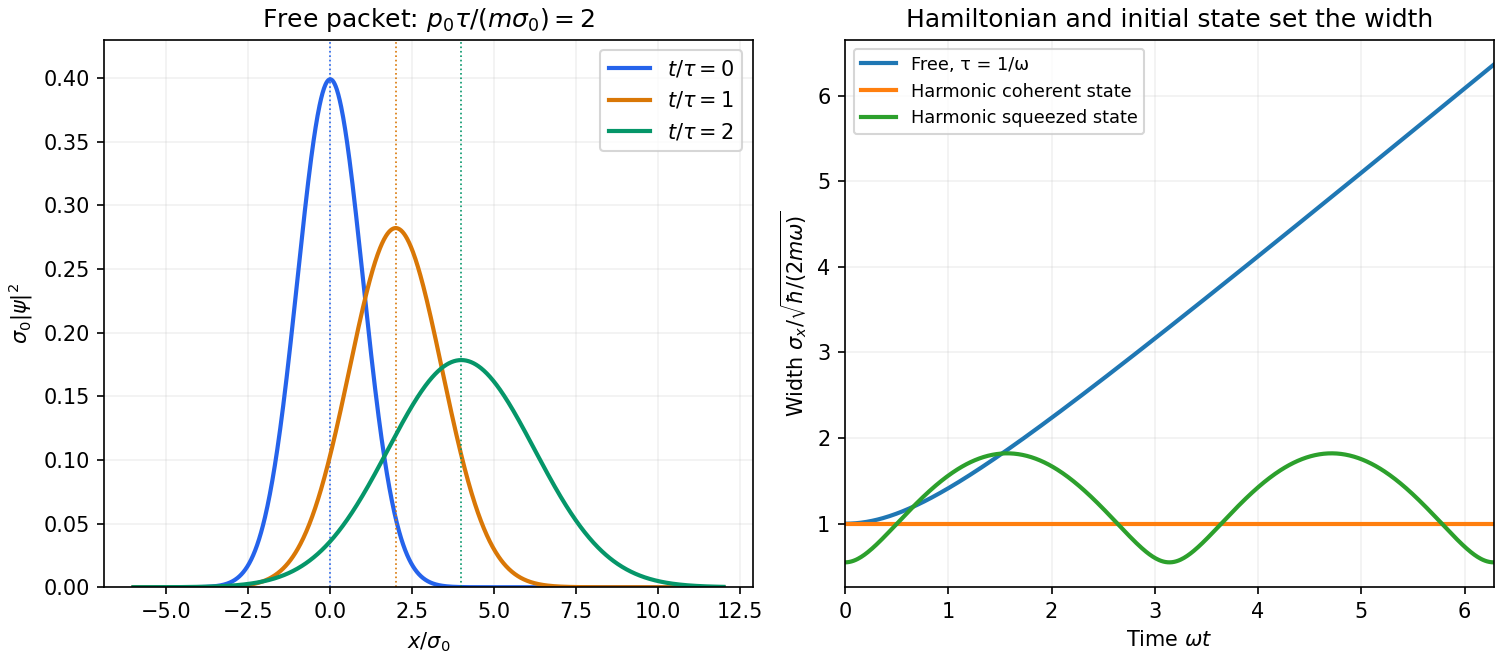

A potential energy changes this behavior. A quadratic potential preserves the Gaussian form because the evolution of position and momentum is linear. For a quantum harmonic oscillator, the Gaussian covariance in a harmonic potential isA coherent state has , and zero centered covariance. Its width is constant, and its center follows . In oscillator notation its coherent state label rotates as , apart from the common ground-energy phase of the state vector. A squeezed coherent state generally has a width that breathes at . Thus being Gaussian does not imply either free spreading or constant width; the Hamiltonian operator and initial covariance determine the result.
For a general nonquadratic potential, different parts of the packet experience different nonlinear forces, and an initially Gaussian profile need not remain Gaussian. Ehrenfest theorem gives the exact relations and . Replacing the last mean by is exact for a quadratic potential and approximate for a packet narrow compared with the scale on which the force varies. This connects packet motion to the correspondence principle without treating a quantum state as a definite classical path. Scattering can split a packet into reflected and transmitted components, while confinement can produce oscillations and interference between discrete energy eigenstates. Their relative phases evolve even when their populations remain constant. Localization, spreading and coherent motion all follow from the same linear unitary time evolution.