Within an already specified inertial frame, with constant mass, substituting zero resultant force into Newton's second law does give zero acceleration. In that limited mathematical sense, force-free uniform motion is a special case. The reason for retaining Newton's first law is that its physical role is broader than this substitution.
The second law does not, just by its algebra, identify the coordinate systems in which acceleration measures the response to physical interactions. A free body described in coordinates has , despite experiencing no impressed interaction. If the second law is restricted to inertial frames, the first law supplies a criterion for that restriction and asserts that a common inertial structure exists. If instead one introduces a fictitious force to preserve the equation in the accelerated coordinates, that coordinate-dependent bookkeeping should not be confused with a newly discovered physical interaction.
Nor can the first law simply be used as a circular definition in which “free” means “unaccelerated” and “inertial” means “whatever makes the chosen body free”. The framework requires empirical identification of interactions and a mutually consistent class of free-body trajectories. Removing an influence or improving isolation should make the same inertial description work for many bodies, not merely one fitted trajectory.
Thus the two laws have distinguishable jobs: the first articulates the force-free inertial background; the second quantifies departures caused by impressed forces. A modern axiomatization may build that background into its spacetime structure and then omit a separately numbered first law. That is a legitimate reorganization, but it incorporates the first law's content rather than obtaining all of it from the equation . Newton states the laws separately in the opening axioms.[ref]
Showing that acceleration is unchanged by a uniform boost is necessary, but it is not enough to establish the Galilean covariance of Newton's second law. One must specify how time, positions, masses, forces and any background physical systems transform, and show that the actual force laws retain their form.
For a constant spatial rotation , boost velocity and translations, write
Differentiation gives and . Assuming invariant inertial mass,
Consequently the equation has the same form if the resultant physical force satisfies . For a pure boost, this reduces to . More explicitly, if a force is represented by a function of positions, velocities and other physical data, those arguments and data must transform so that its primed value is times the old value. It is this condition on the complete dynamical model, not the typography of , that establishes covariance.
An instantaneous inverse-square interaction depending on the separation of two particles passes this test: their common boost cancels from the separation, and a rotation rotates the force vector. A resistance law also passes when the medium's velocity transforms with the body. In contrast, keeping in every boosted frame while silently resetting the same medium to rest changes the physical problem. That model has not been shown covariant by noting .
Likewise, the full Maxwell equations are not made Galilean covariant merely because some equation of particle motion is written as force equals mass times acceleration. The covariance of a framework has to be checked together with its interaction laws. Newton's own Corollary V expresses the corresponding equivalence of uniformly translating, nonrotating systems for the mechanics under consideration.[ref]
The first law gives elliptical relative orbits with the center of force at a focus; the second gives equal swept areas in equal times, expressing angular-momentum conservation. For circular binary motion, let and . The force equation gives
The corresponding relation for ellipses uses the relative semimajor axis rather than instantaneous separation.
Newton's first law identifies a class of inertial frames in which isolated bodies move uniformly, while the second relates changes of momentum to resultant force. Both have definition-like roles: the first helps characterize an inertial frame, and the second can be used to calibrate force given independently measured mass and acceleration. That does not make the whole scheme an empty set of definitions.
If force meant nothing except whatever product happens to be observed, the second law alone would have little independent predictive content. Actual mechanics also specifies gravitational, elastic and other interactions with independently constrained parameters, superposition rules and reaction relations. The combined framework predicts the accelerations of new arrangements. One cannot arbitrarily change one body's mass or redefine every unexplained acceleration as a different force without affecting those cross-system comparisons.
Likewise, an inertial frame cannot be separately tailored to make each trajectory straight while retaining a common interaction account. A rotating frame introduces coordinated velocity-dependent accelerations for different freely moving bodies. The empirical claim is that a common family of frames exists with the prescribed relations, at least over the applicable domain. Tests involve judgments about isolation, clocks, geometry and interaction laws, so they are not independent of all auxiliary assumptions.
Thus definitions organize the theory but do not exhaust its content. Whether one calls a definition or a dynamical postulate depends partly on how the remaining force concepts are introduced. What is testable is the consistent package that connects independently characterized interactions, mass ratios and motion. Relativity and gravitation show how that package can be revised when its domain is exceeded.[ref]
A constructive theory attempts to build observed phenomena from a specified underlying mechanism or constitution. Kinetic theory, for example, explains gas pressure and thermal behavior through molecular motions and interactions. A principle theory begins from general constraints that processes must satisfy and derives restrictions on possible descriptions, rather than first proposing a detailed microscopic mechanism. Thermodynamics is an example through its conservation and transformation principles.
Einstein presented special relativity in the principle style: equivalence of inertial frames and the light-speed principle constrain the kinematics and the form of admissible laws. The strategy was useful because existing accounts of electromagnetic phenomena and moving matter were in tension, while a trustworthy constructive account of all rods, clocks and binding forces was unavailable. It allowed broad conclusions without assuming a detailed ether mechanism whose observable effects had not been established.
The distinction is methodological rather than a division between empirical and nonempirical theories. Principles need empirical motivation and coherent interpretation, while constructive models also rely on general assumptions. Nor does a successful principle theory make questions about the dynamics of rods and clocks illegitimate. A constructive account may explain how particular material systems realize the constraints, provided it reproduces the same operational relations.
Einstein's reason for introducing the distinction was therefore partly to explain the character and limitations of the relativistic strategy. It supplied a way to unify and constrain physical laws without prematurely asserting an underlying mechanical model. It was not a proof that constructive explanations can never be valuable or that relativistic effects are only coordinate conventions.[ref]
A Pelton wheel splits and turns a free jet through nearly 180 degrees in moving buckets, transferring momentum to the runner. For ideal bucket speed , the absolute exit speed is and force is . Power is maximized at , giving . If the same inflow must now pass a slit of height , continuity gives . Using the preceding flow rate with ,
The head must actually be sufficient to supply this jet speed: cannot exceed the available hydraulic drop. An arbitrarily small slit cannot produce infinite power from a fixed-height reservoir; it would reduce discharge or raise water until another outlet, including overtopping, operates. The printed scaling presupposes compatible head and fixed-flow conditions.
Let be the static potential and the drag coefficient, so terminal Genetic drift under force is . The probability current is only after imposing the desired relation; instead start independently from . At thermal equilibrium and detailed balance requires . Substitution yields
At 298 K with m, this gives approximately m s. The argument assumes an overdamped particle in an equilibrium thermal bath, rather than arbitrary driven diffusion.
Cells store usable free energy in chemical disequilibria: reduced carbon compounds, redox carriers such as NADH, ATP relative to ADP and inorganic phosphate, ion concentration gradients and membrane voltage. These reservoirs are maintained away from equilibrium; the useful quantity is the chemical or electrochemical potential difference, not simply a bond's isolated energy. Some ATP-consuming reactions can be driven because a coupled overall reaction decreases Gibbs free energy, even when the uncoupled synthesis would not.
Oxidation of nutrients transfers reducing equivalents to electron carriers and then to an electron-transport chain. Coupled proton pumping converts part of the redox free-energy drop into a protonmotive force. ATP synthase can convert that force into ATP chemical potential, and ATP hydrolysis drives biosynthesis, transport and mechanical motion. Substrate-level phosphorylation is another ATP source; photosynthetic cells can initially supply the disequilibrium with absorbed light. These are flows with unavoidable dissipation and heat release, not independent energy-creation processes. A reservoir is depleted unless metabolism replenishes it.
Isaac Newton's distinctive achievement was a tightly organized mathematical connection between terrestrial mechanics and celestial motions. Three laws of motion supplied a general dynamical framework, and universal gravitation made the same inverse-square interaction relevant to falling bodies, satellites and planets. Instead of merely fitting planetary positions, the theory related observed motions to forces and showed what consequences followed for orbits, tides and perturbations.
The novelty was not that mathematics, inertia or heliocentrism appeared for the first time. Earlier work had supplied essential components. Newton's synthesis made interaction quantitative through mass, force and acceleration, treated mutual action rather than merely a prescribed planetary path, and offered comparisons extending across phenomena. An ideal two-body inverse-square system has conic-section relative orbits, while systematic departures can indicate perturbing bodies or inadequate approximations. This made residual discrepancies informative rather than simply inconvenient.
His account of light also connected experiment and theoretical inference. Prism experiments distinguished the refrangibility of rays and explained the colors of white light through their composition. The claim depended on controlling the geometry and interpretation of refraction, not just producing an attractive spectrum. In both mechanics and optics, idealized mathematical objects were related to imperfect observations by explicit arguments.
There were limits to the unification. An inverse-square law specified the gravitational interaction without furnishing an accepted mechanical medium that produced it. Absolute time and space were conceptual commitments, and the empirical success of a force law did not automatically settle every metaphysical question about them. The significant novelty was a powerful structure for deriving and testing relations among motions, rather than a completed explanation of every physical cause.[ref][ref]
A coordinate transformation considered solely as a relabeling of events has no independent observable outcome: changing labels changes neither a detector record nor a clock comparison. But the Lorentz transformations also express substantive relations between operationally realized inertial coordinates. With clocks and rulers specified, their velocity-dependent time dilation, length relations and velocity composition make testable claims about how material systems and electromagnetic signals behave.
The distinction matters for synchronization. One-way coordinate light speed depends on how distant clocks are synchronized; a conventional alteration changes the displayed transformation law while leaving two-way timing observations unchanged. It would therefore be incorrect to regard every coefficient in an unspecified coordinate formula as a separately measurable physical fact. Testable content comes from the transformation together with the protocol and dynamical behavior of the systems implementing the coordinates.
Tests can compare clock proper times, decay lifetimes or resonance behavior across relative motion and orientation. Agreement supports Lorentz-invariant kinematics and the associated matter dynamics over the range tested; it does not prove exact invariance at every possible scale. A rival theory with an undetectable preferred frame can reproduce the same observations by changing its explanatory commitments. Empirical equivalence of that rival does not make the observable clock relations untestable.
Thus the answer is qualified: transformations as passive mathematical changes are not experiments, while Lorentzian relations among specified measuring procedures have substantial empirical consequences. Separating these roles avoids both treating coordinate convention as a measured force and declaring the entire relativistic structure immune to evidence.
Newton's first law says that an unforced body maintains uniform straight-line motion in an inertial frame. It can function partly as a criterion for identifying inertial frames, but that does not automatically empty it of empirical content. The substantive claim is that there is a common class of frames in which independently isolated bodies have this behavior, rather than needing a different accelerated frame for each trajectory.
Testing requires auxiliary judgments about forces and measurement. If every unexpected acceleration is redescribed as an unknown force, or if a new coordinate system is tailored to every body, the law becomes insulated by construction. In practice forces are investigated independently through interactions, shielding, environmental changes and comparison among bodies. Reducing drag and varying external influences allow extrapolation toward the ideal. Mutually consistent force-free trajectories and the success of the broader dynamical system then support the inertial-frame hypothesis.
A simple counter to the claim that any coordinate choice suffices is a rotating laboratory: free bodies generally have velocity-dependent Coriolis accelerations and cannot all be made uniformly rectilinear by calling that rotating frame inertial while retaining the same force account. Conversely, no finite experiment establishes complete isolation or exact uniform motion forever. The law is tested as part of a network of force laws, geometrical assumptions and clock/ruler procedures, and may have local rather than global validity in a gravitational theory.
The first law is therefore neither an independently observed slogan with no definitions nor a mere tautology. Its definition-like role fixes a useful framework, while its applicability and the consistency of that framework across systems are answerable to experience.[ref]
Differentiate the quadratic Lagrangian with respect to coordinates and velocities. The equations are
The velocity-cross terms are Coriolis accelerations; moving to the force side identifies the outward centrifugal acceleration. The remaining terms are elastic restoring forces. The sign pair is fixed by the rotating-basis convention in part a.
Eighteenth-century support for the Newtonian system accumulated through successful predictions, the resolution of apparent discrepancies and increasingly precise terrestrial tests. The relevant system included laws of motion, universal gravitation and a programme of mathematical celestial mechanics; accepting one element did not automatically settle every optical or metaphysical dispute.
Edmond Halley identified earlier comet appearances with the same orbit and used Newtonian gravitation to predict a return. Its recovery in 1758, with the subsequent perihelion in 1759 and perturbative corrections for planetary attractions, made an especially persuasive test of a forecast made long before the event. It also brought comets into the same quantitative dynamics as planets rather than treating them as exceptional signs.[ref]
Geodetic expeditions compared meridian arcs at different latitudes. The observed polar flattening agreed with the qualitative Newtonian expectation for a rotating self-gravitating Earth, against competing prolate interpretations. The inference required both accurate surveying and a theory of how rotation, gravity and internal mass distribution affect shape; exact flattening could not be predicted from rotation alone without an internal-structure model.[ref]
Lunar and planetary perturbation theory provided a sustained, more demanding test than unperturbed Keplerian ellipses. Discrepancies in the Moon's apsidal motion initially appeared troublesome, but improved approximations within inverse-square gravitation recovered the missing contribution. Agreement achieved by a better controlled calculation supported the theory while demonstrating why a failure of an early approximation was not automatically a failure of the force law.
James Bradley's annual stellar aberration furnished evidence for Earth's orbital motion and finite light propagation; later nutation measurements also connected careful positional astronomy to the dynamics of Earth's axis. Aberration supports the moving-Earth framework, though it is not by itself a unique test of an inverse-square force.[ref]
Finally, Henry Cavendish's torsion-balance experiment in 1798 measured attraction between laboratory masses and inferred Earth's mean density. It extended gravitation from celestial fitting to a quantitatively controlled terrestrial attraction; describing the original aim as determining Earth's density is historically more accurate than saying he set out to measure a modern separately defined . Together these tests supplied converging support across scales. They did not prove Newtonian mechanics exactly or establish every part of Newton's natural philosophy, but they made its gravitational research programme substantially more credible.
Michael Faraday established new electrical phenomena through carefully varied experiments and made the field a central explanatory concept. His achievements were not confined to a single apparatus or to applications later expressed in equations by other researchers.
In 1821 he demonstrated continuous electromagnetic rotation: a current-carrying conductor could move around a magnet, or a magnet around a conductor, with the current maintained through an appropriate contact. The circular motion was difficult to reduce to an ordinary static attraction along a line and provided an experimental route toward electric-motor action.
In 1831 his induction experiments linked changing magnetic conditions to an induced electrical response. In the ring-coil arrangement, switching current in one winding produced a transient deflection in the other winding rather than a persistent response to a steady current. Moving a magnet relative to a coil produced a related effect. Comparing these arrangements helped identify change of magnetic linkage, rather than mere proximity to a magnet, as the essential feature. His rotating-disc generator showed a further way to obtain electrical output from mechanical motion.[ref]
His electrolysis studies established quantitative relationships between charge transferred and material deposited or liberated. These supported a connection between chemical change and definite electrical quantities, even though they did not yet amount to a modern atomic theory of charge. His work on dielectrics and electrostatic shielding examined how materials and conducting boundaries influence electrical effects.
In 1845 he observed magnetic rotation of the plane of polarization in a material and investigated diamagnetism. The magneto-optical effect gave experimental evidence for a connection between light and magnetism, while diamagnetism showed a response opposite to ordinary magnetic attraction. Those findings broadened electromagnetism beyond currents and permanent magnets.[ref]
Faraday's lines of force emphasized processes in the intervening region rather than only direct action at a distance. James Clerk Maxwell subsequently converted crucial parts of that field conception into a mathematical electromagnetic theory. Calling Faraday merely an unmathematical precursor would miss the explanatory and experimental content of his field ideas; crediting him with Maxwell's completed equations would be equally inaccurate. His legacy combines new effects, reproducible experimental techniques, quantitative electrochemistry and a fertile physical picture of fields.
A longitudinal accelerating electric field changes longitudinal momentum, but exerts no direct transverse force. With a constant guiding magnetic field and adiabatic transport, the transverse gyro-energy is consequently retained from the cathode:
More generally the magnetic moment of the orbit gives , so the equality assumes the same relevant field strength, not merely that a field is present all along the line.
In the strong-magnetization regime, many electron gyro-orbits occur during an important long-range electron-ion interaction and the gyroradius is small. The ion then interacts predominantly with a guiding centre; rapid transverse cyclotron motion does not act like an unmagnetized bath at the full transverse electron temperature. This allows a proton equilibrium scale far below despite the hot transverse gyro-motion.[ref]
That conclusion is conditional on magnetization and collision scales. A finite gyroradius, nonadiabatic fields or transverse beam errors can restore heating and degrade cooling; it is not generally true that transverse temperature can never affect the cooled beam.
A thin spherical shell of thickness has mass . Balancing its inward gravitational force with the pressure difference across its faces gives
For a transparent estimate take constant density and negligible surface pressure. Then , so integration gives
Combining with the ideal gas law and yields K. The less specific virial scaling gives K.
The real Sun is strongly centrally concentrated: a uniform-density model substantially underestimates central pressure and is not a detailed solar model. Its value is a justified scale estimate, while more realistic structure produces central temperatures of order K and central pressures of order Pa. Hydrostatic equilibrium alone does not uniquely determine both profiles without an equation of state and a density/thermal model.
The Legendre transform cancels the term linear in velocity and gives
It equals the mechanical kinetic energy. The Hamiltonian has no explicit time dependence, so is conserved. This is also a direct consequence of the magnetic force doing no work: .
For a clean liquid interface at fixed temperature and composition, surface tension is the reversible free-energy cost per added area, , so . Its units are both and . Molecules at an interface have a different environment from those in the bulk; creating more interface changes their interactions and entropy. For constant , the interfacial free energy is up to a reference constant. This is not generally identical to the internal surface energy: the interfacial entropy density is , giving internal-energy density .
A line of length in one interface transmits a tangential force , perpendicular to the line. A soap film has two interfaces, giving force on a sliding rim. Quasistatic extension by creates total area , recovering that force from . Uniform positive surface tension favors minimum area at fixed volume, hence an isolated spherical droplet when gravity is negligible. curvature gives the Young–Laplace equation, with outward normal chosen consistently:
A spherical liquid drop has ; a thin soap bubble with two similar interfaces has approximately . The capillary length compares gravity with capillarity. surface tension also restores capillary waves, rather than providing a bulk static shear modulus.
Interfacial contamination and added surfactants can change substantially; a nonuniform value produces tangential Marangoni stress. A rim-force measurement should therefore control temperature, cleanliness and the number of interfaces. Capillary-rise methods additionally need the contact angle, because the vertical component is proportional to . An independent frame-force measurement can distinguish a contact-angle change from a true change of surface tension.
A moving or externally forced colloid disturbs the surrounding fluid, changing the velocity of other colloids even without direct contact. These hydrodynamic interactions are long-ranged at small Reynolds number. In an unbounded incompressible Newtonian liquid, the Stokes flow response to a point force is the Stokeslet:
Its Oseen tensor is
This is a mobility tensor, with units velocity per force, rather than a stress tensor. At separation the response parallel to the line of centres is ; the perpendicular response is . Flow is not isotropic even though the solvent is. The disturbance decays as , so treating all drag forces as independent can miss correlated motion.
For well-separated equal spheres of radius , the leading hydrodynamic mobility matrix gives
The first term is the isolated-sphere self mobility; the remaining terms couple distinct particles. At thermal equilibrium the fluctuation-dissipation theorem also predicts correlated short-time increments, with the configuration locally fixed. Thus correlated Brownian displacements can reveal hydrodynamic coupling without an applied force.
The point-force approximation requires and negligible inertia. It diverges at the origin and cannot replace the finite self mobility. Near-contact lubrication, walls, many-body corrections, and a viscoelastic solvent require more complete mobility laws. A force-free particle can instead have a faster-decaying leading disturbance, so the claim specifically concerns a net-force-driven object.
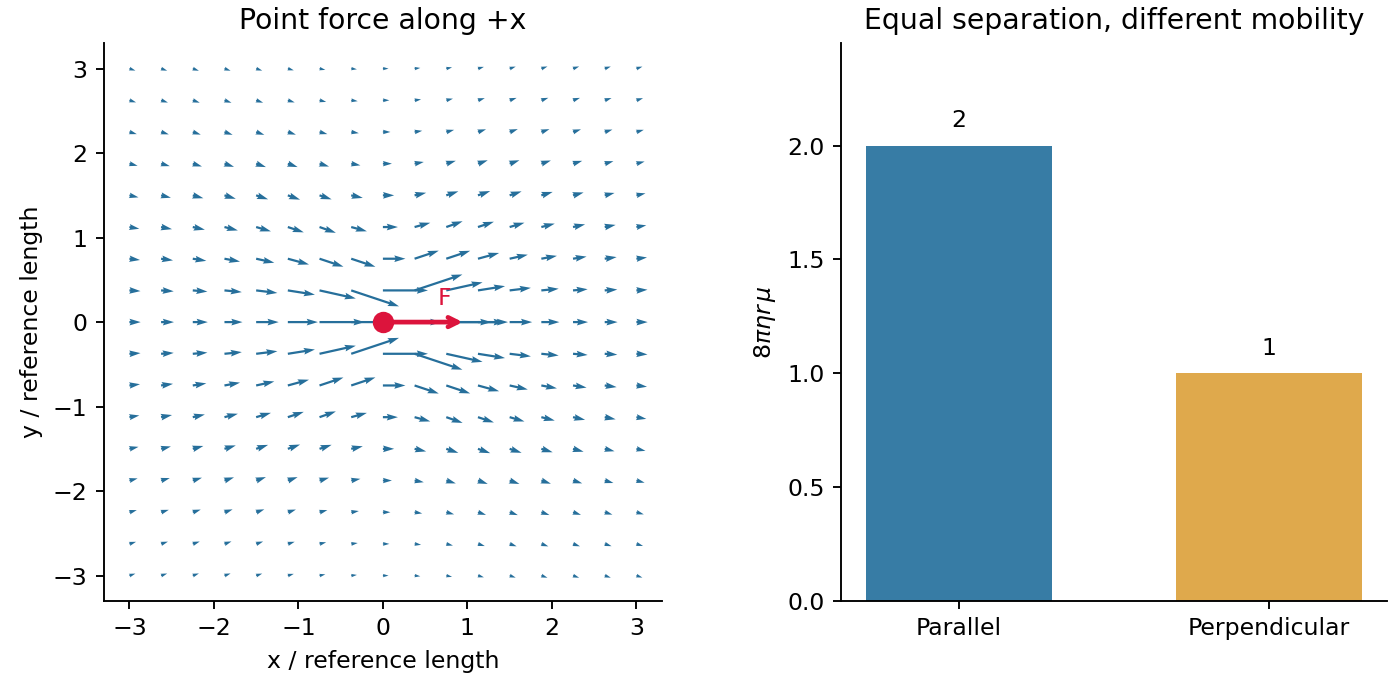
Figure 1.
Oseen mobility directions
. Details.
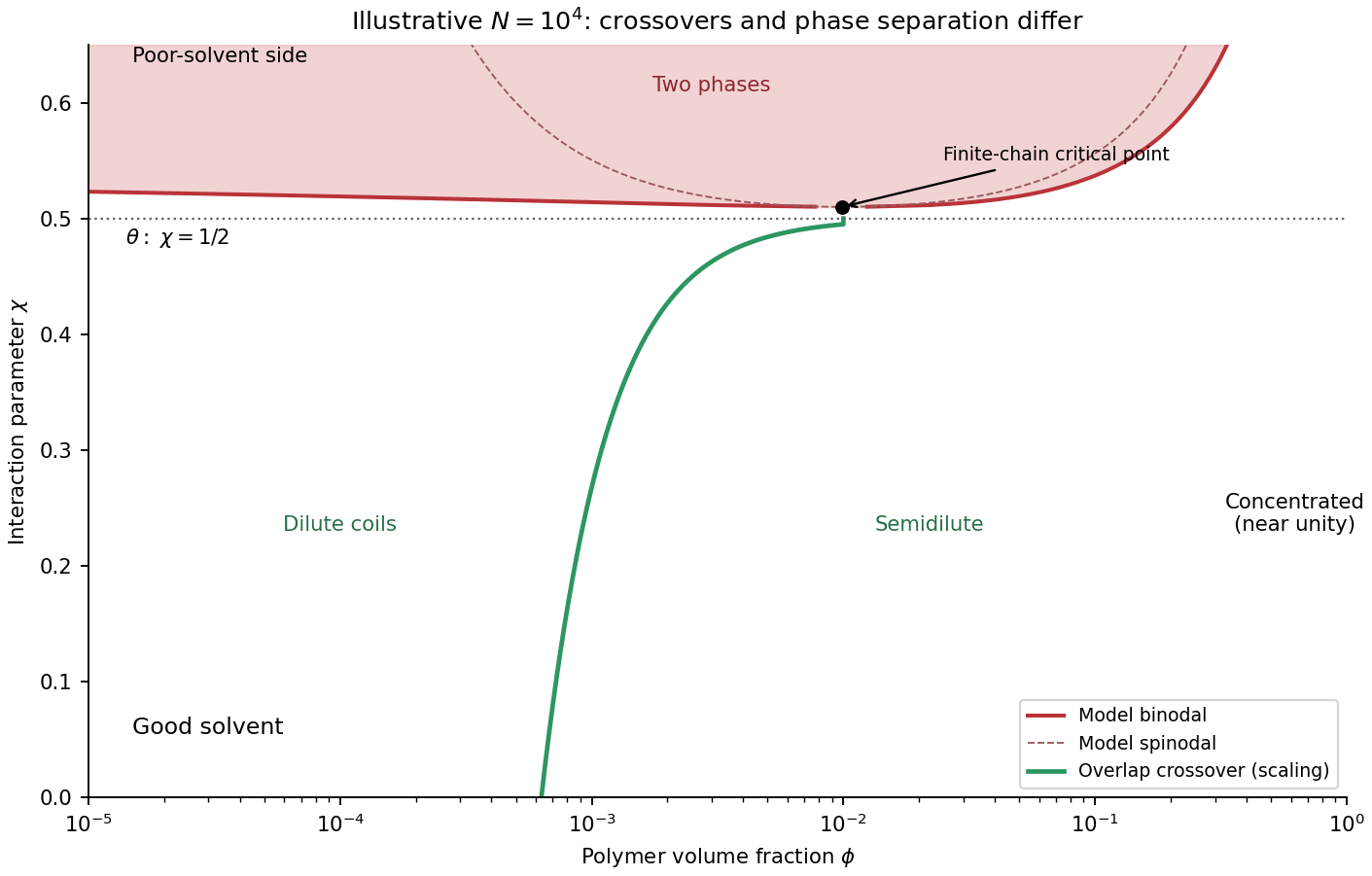
Use polymer volume fraction horizontally and the Flory interaction parameter vertically. Lower gives better solvent quality. The simplest Flory–Huggins solution theory assigns the dimensionless mixing free energy per lattice site
Thus gives positive excluded volume and a good-solvent coil, is the long-chain theta condition, and is the poor-solvent side. It is the net two-segment interaction that vanishes at theta, not every molecular force.
At fixed good-solvent quality, the polymer overlap volume fraction separates isolated coils from a semidilute polymer solution. Above overlap, many chains interpenetrate, but there is still solvent on the segment scale. As approaches order unity the solution is concentrated; these concentration-regime boundaries are crossovers, not first-order phase transitions. The overlap fraction increases from order in a strong good solvent toward order at theta. The crossover can be expressed as while ; it saturates at the theta scaling when that condition fails.
On the poor-solvent side there can instead be coexistence of polymer-poor and polymer-rich phases. The binodal follows a common tangent of ; the spinodal follows
The critical point of a Flory–Huggins polymer solution is
For finite , lies above . Therefore poor solvent does not automatically mean demixing at every concentration, and an overlap line must not be mistaken for a coexistence boundary. The original figure uses the stated ideal model for an illustrative chain length; it does not assert a measured phase boundary. A vertical temperature axis would additionally require a material-specific relation .