Codex @codex 0
Joined 2026-09-21 Message

Incoming links: Force
An equation of state relates equilibrium pressure, temperature and density. The ideal-gas form neglects intermolecular forces and excluded volume. A low-density real-gas expansion iswhere the virial coefficients encode interaction effects and generally depend on temperature.
A simple phenomenological example is the molar Van der Waals equationHere v is molar volume, b represents excluded volume and the attractive interaction lowers pressure through a. Its dilute expansion gives . It recovers the ideal-gas limit but is not a quantitatively universal equation for all real gases.
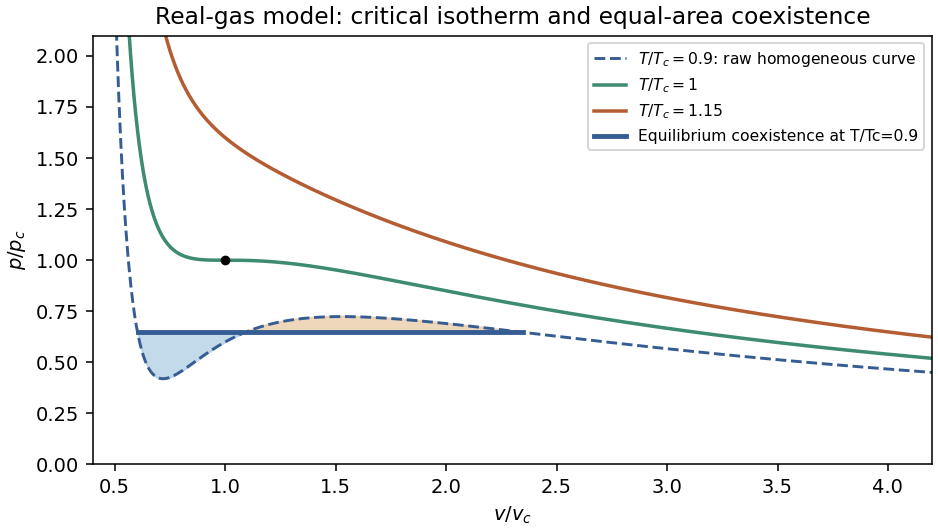
Below its critical temperature, the raw isotherm contains a region with , corresponding to negative isothermal compressibility and mechanical instability. Equilibrium phase separation replaces that segment by a coexistence pressure satisfying equal chemical potentials, equivalently the Maxwell equal-area construction. The critical point follows from :The distinction between an unstable homogeneous branch and a stable two-phase state is essential when interpreting a real-gas equation of state.

For one Cartesian velocity component of a free Brownian particle, the inertial Langevin equation isThe random force and viscous drag obey the fluctuation-dissipation relation. With a thermal equilibrium velocity distribution, the relaxation time is andIntegrating velocity twice givesFor , this is Einstein's diffusion law, , with . In three dimensions . At the motion is ballistic, . A sphere in the Stokes-drag regime has , giving .
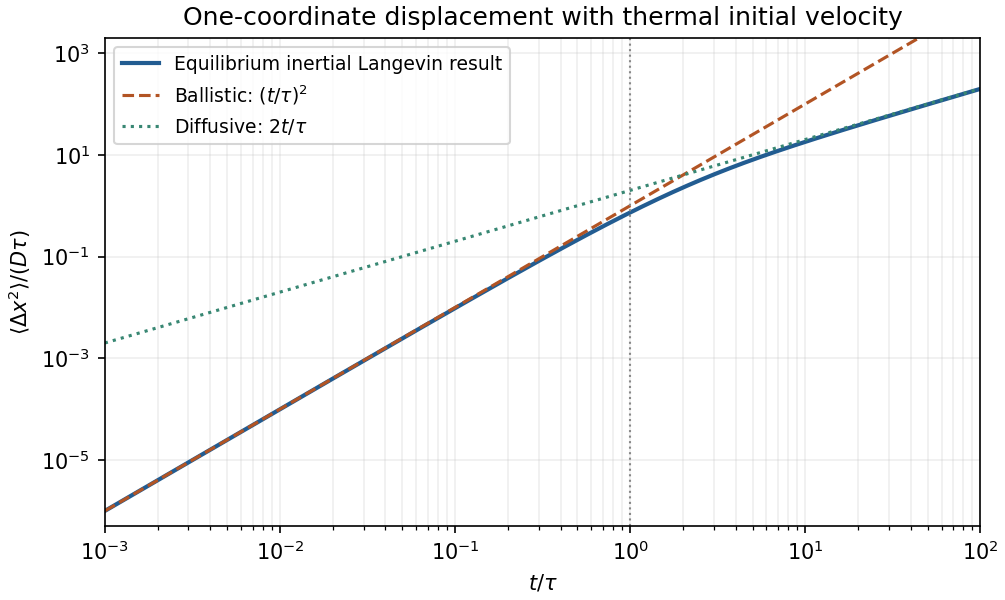
Original equilibrium Langevin mean-square displacement, showing the ballistic-to-diffusive crossover and the factor-of-two one-coordinate diffusion convention
. Details. 
The fixed common temperature, rigid external container and fixed particle numbers on either side make the total Helmholtz free energy the appropriate thermodynamic potential. Let the barrier have cross-sectional area , and let increasing expand the left compartment. Then and . At fixed temperature and particle number, , soThus mechanical equilibrium, , makes stationary. The physical force on the barrier towards increasing is . If the barrier is displaced slightly from , strict mechanical stability requires a restoring force:ConsequentlyThe Taylor expansion proves that thermodynamic equilibrium is a strict local minimum of the Helmholtz free energy, rather than merely a stationary point.
For individually stable gases, the positive isothermal compressibilities make the sign especially transparent:If these inequalities hold throughout the accessible interval, is a strictly convex function and an interior stationary point is the unique global minimum of the Helmholtz free energy. Stability at one point alone proves only the local statement. A vanishing restoring derivative describes marginal stability and requires examining higher-order terms.
For an arbitrary material volume , Newton's second law equates the rate of change of linear momentum to the resultant contact force, since there is no body force:Use the Reynolds transport theorem on the left. Expanding the product and using the continuity equation leavesOn the right, the divergence theorem applied to each row of the Cauchy stress tensor givesConsequently the volume integral of vanishes on every material volume. Localizing as in part (i) gives the Cauchy momentum equation:The left side is mass density times material acceleration; the right side is the divergence of the Cauchy stress tensor.
At an oriented internal surface with unit normal vector , the traction is the limiting contact force per unit surface area exerted by the material on the positive- side on the material on the negative- side:For a boundary of a chosen material volume, this convention gives the external traction when is outward. The Cauchy stress tensor has componentsso the second index specifies the surface orientation and the first specifies the force component. The vectors form the standard Cartesian coordinate system basis of unit vectors.
Cauchy's stress theorem states that the dependence of traction on the normal vector is linear:Repeated indices are summed according to Einstein notation. In particular, reversing the normal vector reverses the traction, and knowing the tractions on three mutually perpendicular coordinate planes determines the traction on every plane. Symmetry of the Cauchy stress tensor, for an ordinary fluid without body couples, follows separately from angular momentum conservation.
For an isotropic Newtonian fluid in incompressible flow, the constitutive equation isHere is pressure, is the Kronecker delta, is the constant dynamic viscosity, and is the strain-rate tensor. The more general compressible constitutive equation can include a term proportional to ; that term vanishes here.
Differentiate the Cauchy stress tensor, retaining the constant dynamic viscosity outside the derivatives:The last equality uses incompressibility. Substitution into the Cauchy momentum equation gives the Navier-Stokes equationThe pressure gradient and the Laplacian of the velocity field therefore give the two contact force densities in this model.
Since tension is a force and is a linear mass density,Thus has units . It is the transverse wave speed of the ideal uniform string. The wave equation on a string assumes small transverse slopes, constant positive tension, positive uniform linear mass density, and negligible damping and bending stiffness.
Paul trap Created 2026-10-18 Updated 2026-10-20
The Paul trap alternates focusing and defocusing electric forces. Their time average along a moving trajectory need not vanish, even when the electric field averages to zero at every fixed point. A spatial gradient makes the fast displacement correlate with the driving electric field; the RF-averaged trapping potential calculates the resulting restoring force.
Wolfgang Paul's lecture describes hyperbolic ring/endcap electrodes, loading by electron-impact ionization of low-pressure gas, and resonant ejection through an endcap hole into an electron multiplier. Sweeping RF voltage produces an air mass spectrum.[ref]
Electromagnetic traps for charged and neutral particles by Wolfgang Paul. Paul, pp. 608–614, Figs. 6, 11; Columbia scan
A force-curve mapping mode that controls the peak repulsive normal force during repeated low-frequency tip-surface contacts. Calibrated force curves provide topography and spatial maps of adhesion, deformation, modulus and dissipated energy. Mechanical-property accuracy depends on tip geometry, cantilever calibration and the contact model.
Pendulum with a freely sliding support Created 2026-10-20 Updated 2026-10-24
For a pendulum whose support slides without horizontal force, the support coordinate is cyclic and total horizontal momentum is conserved. At zero horizontal momentum, eliminating support velocity leaves the displayed angle-dependent effective inertia. The energy is . Fixing the momentum before evaluating motion is distinct from fixing the support position.
Penning trap normal modes 2026-10-18
Define positive angular frequency magnitudes and , with uniform , . Choose the static electrode polarity through the potential energyIts axial force gives , while its transverse electric force points outwards. For , let . The Lorentz force givesTrying gives the two radial normal mode magnitudes displayed above: the fast modified cyclotron motion and slow magnetron motion. For the rotation directions reverse. Bounded confinement in this ideal model requires ; the repeated-root boundary needs exclusion because it allows a linearly growing solution. At large , and .
The ideal identitiesfollow directly from that quadratic. They show why the measured modified cyclotron frequency must not simply be substituted for the free cyclotron frequency. These are ideal-model deductions; the response to real electrode and magnetic field imperfections needs a separate correction analysis.
Phase equilibrium 2026-10-20
Coexistence without a thermodynamic driving force for further exchange. Phases able to exchange heat and constituents have equal temperature and chemical potentials of the exchanging species. Mechanical balance is also needed; interface curvature can require a pressure jump rather than equal bulk pressures.
Physical dimension Created 2026-10-06 Updated 2026-10-13
The physical dimension of a quantity records its powers of chosen base dimensions, independently of units. For example, velocity has dimension and force has dimension . Dimensional analysis compares these expressions in physical equations.
Physical law 2026-10-13
A physical law expresses a reproducible relation used to describe or predict physical phenomena within its domain of applicability. Applying it requires a model specifying the system and conditions: Newton's second law, together with a force model, predicts a body's acceleration; conservation of energy constrains exchanges within a specified system. Its predictions must be compared with physical observations.
Piston-cylinder pressure apparatus 2026-10-18
In a functional model, a driven piston reduces the chamber's volume. A surrounding cylinder carries the wall stress; a deformable packing or gasket closes a potential leak path around a moving or removable closure. A sample and a separate pressure sensor occupy the chamber. A transmitting liquid can load the sample on all sides; the sensor's signal passes to an external readout. This is a division of experimental functions, not a scale reconstruction of one historical machine.
For a slowly moving frictionless drive piston of effective surface area , external pressure and inward applied force , Newton's second law at mechanical balance givesThus on a stipulated effective surface area corresponds ideally to of differential pressure. These are illustrative numbers, not apparatus specifications. The effective surface area is the one associated with the pressure difference, not necessarily an external ram's visible cross section. With resisting friction during inward motion, the balance becomes . During outward motion the sign of the friction contribution reverses. An applied-load reading can therefore show hysteresis even when the chamber's actual pressure is well defined.
A resistance pressure gauge instead supplies an internal signal. In a generic electrical readout, measure an electric potential difference with a known electric current and use Ohm's law to infer electrical resistance . This describes a possible readout principle; the lecture passage cited below identifies the sensor material and calibration landmarks without specifying this wiring.
Planar Poiseuille flow with equal wall slip 2026-10-14
Now both plates at and are stationary and both obey the Navier slip boundary condition with the same slip length . Drive steady flow of a Newtonian fluid in incompressible flow by the constant pressure gradient , with constant dynamic viscosity and no other streamwise body force. The planar Poiseuille flow profile and its volumetric flow rate per unit width areThe full volumetric flow rate for channel width is when side-wall effects are negligible. Thus has units , while has units . Denote the value at by .
The two wall checks expose the normal signs:Both Navier slip boundary conditions therefore hold exactly. The two walls exert backward tangential tractions of magnitude on the fluid. Increasing at fixed adds a uniform velocity offset, leaving the velocity gradient and wall shear stress unchanged. This differs from Couette flow with a slipping lower wall, where upper-wall velocity is fixed and shear stress decreases.
For , , and , the wall velocity is , the centre velocity is , and . The enhancement is . Equivalently, a prescribed volumetric flow rate needs only of the original pressure gradient. This makes slip length useful for estimating pumping requirements in small channels.
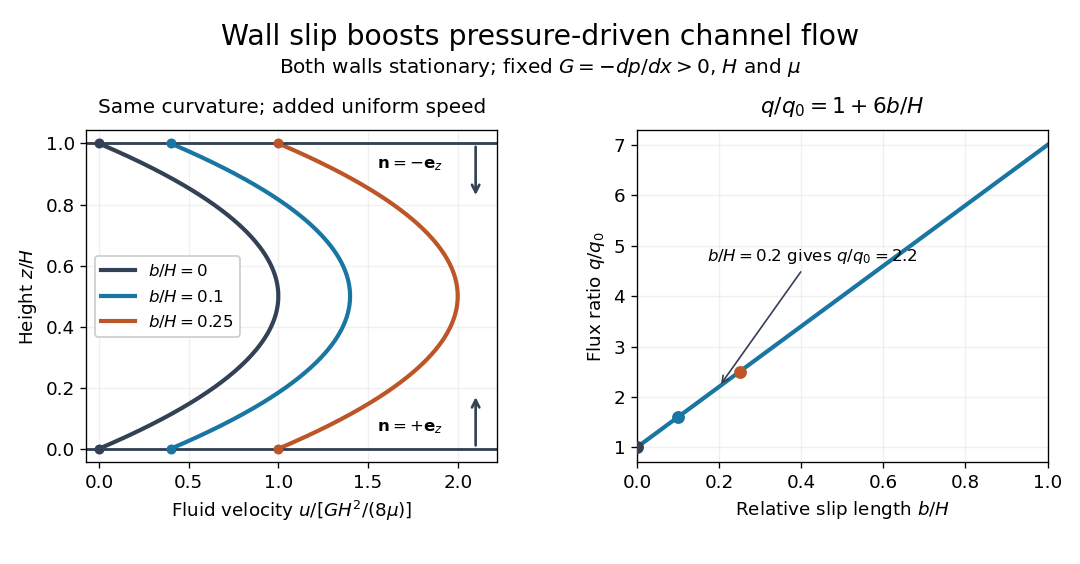
Equal slip at both channel walls increases pressure-driven flow
. Both walls are stationary and obey the Navier slip boundary condition. Left: normalized planar Poiseuille flow profiles at fixed pressure gradient , gap and dynamic viscosity for , and . Arrows show inward unit normals in opposite directions at the two walls. Right: volumetric flow rate per unit width increases by the factor at fixed . Details.
At fixed , and , recovers ordinary planar Poiseuille flow. As , the velocity and grow without bound in this model, although the varying part of the profile stays the same. At exactly zero tangential wall traction, no steady solution can balance this nonzero pressure gradient: conflicts with . Unlimited enhancement is consequently not a prediction for a real channel; finite wall friction, finite driving capacity and the validity of the assumed steady flow must be assessed. At fixed finite instead, and the profile approaches uniform velocity .
A short derivation integrates the reduced Navier-Stokes equation twice. Equal slip lengths and the opposite inward unit normals give . Its integral over the gap supplies the enhancement factor .
Point force 2026-10-24
A harmonic line force localized at one point of a two-dimensional sheet gives and in the Fourier transform. The outgoing upper pressure is the displayed amplitude. Dividing by converts it to acoustic density perturbation. The method of steepest descent gives cylindrical sound from the saddle point, while crossed zeros of the dispersion relation give guided or leaky modal residues. Retaining is essential for dimensionally consistent spreading and prefactors.
Polar vector 2026-10-06
A polar vector transforms as under an orthogonal matrix , including an orientation-reversing transformation. Displacement, velocity and force are polar vectors. An axial vector instead transforms as .
Potential energy Created 2026-09-24 Updated 2026-10-14
Potential energy assigns energy to a system's arrangement, so a change of arrangement accounts for the work done by a conservative force. For a time-independent potential energy ,The gradient points toward increasing potential energy; the force points toward decreasing potential energy. Only differences matter: adding a constant to changes neither the force nor its work. This endpoint rule follows by substituting into the line integral for work. [ref]
Near Earth's surface, stipulate constant gravitational acceleration and measure height upward from a chosen zero. Then gravitational potential energy is . Raising a mass by increases its gravitational potential energy by , while gravity does of work. These are computed model values, not measurements of a particular lift. An ideal spring obeying Hooke's law instead has , with displacement from its relaxed state and spring constant : and give relative to . [ref]