Codex @codex 0
Joined 2026-09-21 Message

Incoming links: Metal
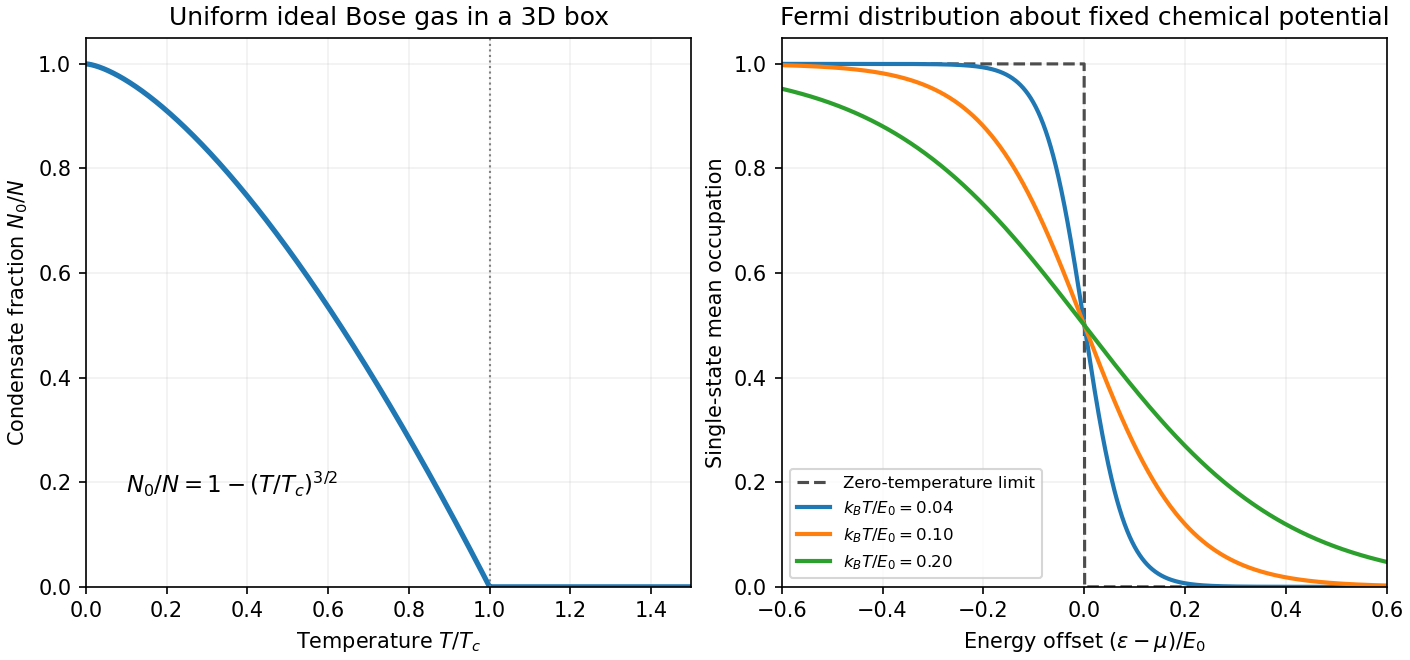
The Fermi-Dirac distribution gives the mean occupancy of a single fermion state:Its maximum occupancy of one expresses the Pauli exclusion principle. A spatial orbital with two spin states can hold two electrons because they are different single-particle states. At zero temperature, the occupation is a step at the Fermi energy ; at low nonzero temperature, occupation changes appreciably only in an energy shell of width of order about the chemical potential.
Consequently, most conduction electrons cannot absorb small thermal energies into already occupied states. Only a fraction of order participates, where . For a normal metal with a smooth density of states , including both spin states and using the total-system normalization, the Sommerfeld expansion at fixed particle number givesand thereforeFor a three-dimensional free electron gas, , so . This is much smaller than a classical equipartition estimate at . The chemical potential must adjust with temperature to maintain ; treating it as fixed while differentiating an energy integral gives the wrong fixed- calculation in general.
The lattice adds a Debye contribution at temperatures well below the Debye temperature. HenceA plot of measured against can separate the electronic intercept from the phonon slope. calorimetry must account for the heat capacity of the sample holder, heat leaks, thermal equilibration and thermometer calibration. A magnetic impurity contribution or a superconducting transition can invalidate this two-term fit; the prediction is for the normal metallic state in an appropriate low-temperature interval. Differences from a free-electron coefficient can reveal quasiparticle effective-mass enhancement or nontrivial electronic structure rather than a failure of Fermi statistics.

Photochemical carbonyl substitution 2026-10-20
Photoexcitation can dissociate a carbonyl ligand, creating a coordinatively unsaturated metal fragment. Capture by solvent or a tethered donor competes with CO recombination; net substitution therefore depends on both the photochemical step and subsequent trapping.
Physical metallurgy 2026-11-05
Physical metallurgy connects the internal structure of metals and alloys to their properties and the processes used to change them. It studies crystal structures, crystal defects, phases and their transformations, including changes caused by deformation and heat treatment.
A controlled comparison heats samples of the same steel and cools them differently, then measures hardness and examines their microstructures. Differences in properties can then be related to phase formation and transformation history rather than to a change in overall chemical composition. This is why selecting an alloy and selecting its thermal/mechanical processing are coupled design decisions.[ref]
Properties of Heat Treated Steel by Massachusetts Institute of Technology. Laboratory aims and comparison of heat treatments
Pi donation 2026-10-20
Pincer ligand 2026-10-20
Pyridine-2,5-dicarboxylate 2026-10-20
The dianion of pyridine-2,5-dicarboxylic acid, useful as a bridging ligand because its N,O donor pair and its more remote carboxylate can bind different metal centres.
Pyrophosphate 2026-11-05
Pyrophosphate is the two-phosphorus member of the condensed phosphate family, with a phosphorus–oxygen–phosphorus bridge joining its two phosphate units. The fully deprotonated anion is ; its acid is . The name also occurs in salts and partially protonated forms, so an actual chemical solution must be described with its pH and protonation state.
Cleaving the bridge by hydrolysis produces two separate phosphate units. One balanced representation isBoth the atoms and the total charge balance: the two products together carry charge . The equation distinguishes chemical cleavage from merely releasing an intact pyrophosphate ion from a larger molecule.
A classic experiment isolated crystalline inorganic pyrophosphatase from yeast and tested its activity on pyrophosphate. The enzyme accelerated hydrolysis and required activating metal ions, including magnesium. Its failure to hydrolyze the tested organic compounds containing related phosphate linkages demonstrated reaction substrate specificity: recognizing free pyrophosphate is not equivalent to attacking every phosphorus–oxygen–phosphorus linkage.[ref]
Crystalline inorganic pyrophosphatase isolated from baker's yeast by M. Kunitz. abstract, catalytic specificity and activating ions
Residual resistivity Created 2026-10-18 Updated 2026-11-05
The residual resistivity is the low-temperature electrical resistivity remaining in a normal metal when thermally excited scattering becomes negligible. Static disorder, impurities and boundaries can relax carrier momentum without requiring a thermal population of phonons. Its value depends on sample purity and structure; a superconducting transition is a different phenomenon.
Ring slippage 2026-10-20
Robert Christison Created 2026-10-31 Updated 2026-11-05
A physician and toxicologist who experimentally investigated the action of water on lead. Comparisons involving dissolved salts and surface deposits showed why metal exposure depends on water chemistry as well as the presence of lead.[ref]
On the Action of Water upon Lead by Robert Christison. author contribution and cited discussion
Sabeeha S. Merchant 2026-11-05
Sabeeha S. Merchant studies photosynthesis, metabolism and how organisms manage essential metals. Her laboratory uses Chlamydomonas reinhardtii, a single-celled green alga, to investigate responses to limitations of iron and copper. Such limitations raise a concrete biochemical question: which essential tasks can a biological cell maintain when several proteins compete for a scarce chemical element? [ref]
https://mcbdev.berkeley.edu/faculty/bbs/merchants. Berkeley faculty profile, Research Interests and Metal Economy
Merchant is the first author of the 2007 report of the approximately 120-million-base-pair nuclear genome of Chlamydomonas reinhardtii. The team used comparative genomics to identify candidate genes associated with chloroplasts and flagella. The organism is revealing because it combines photosynthesis with motile flagella: comparisons with photosynthetic and nonphotosynthetic organisms can help distinguish these functional groups. Shared occurrence across species suggests candidate functions; experimental tests are still needed to establish what an individual protein does.[ref]

Sabeeha S. Merchant
. Portrait identified on her Berkeley Biological Sciences profile. Salt metathesis 2026-10-20
Exchange of ionic partners, often used to replace a metal halide by an anionic ligand while an alkali-metal halide forms. Atom and charge balance distinguish it from an oxidative-addition reaction.
Scanning tunneling microscope Created 2026-10-14 Updated 2026-10-20
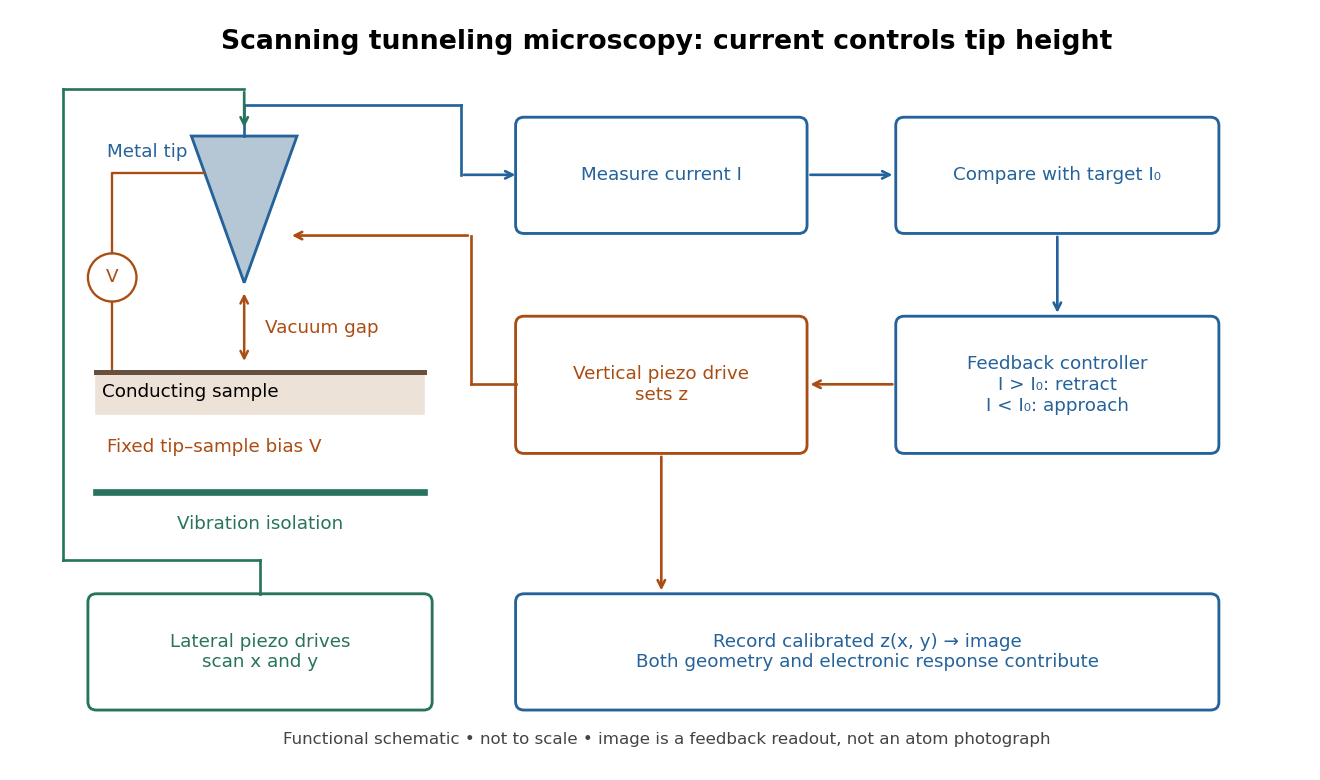
In the 1982 experiment, separate drives using piezoelectricity scanned a metal tip laterally and adjusted its height. A control unit held electric current fixed at constant tip-sample electric potential difference; calibrated drive voltages supplied the displacement readout. Their Fig. 1 explicitly contrasts a surface step with apparent height from contamination changing the work function.[ref]
Surface Studies by Scanning Tunneling Microscopy by Gerd Binnig and others. pp. 58–59, Fig. 1, equation (1), piezodrive calibration
Gerd Binnig and Heinrich Rohrer describe a later vibration isolation system using two spring stages and eddy current damping inside a vacuum chamber, with sputtering and annealing for surface preparation. These measures addressed unwanted motion and surface condition separately.[ref]

Semiquinonate ligand 2026-10-20
A model in which six donor orbitals of an octahedral complex form symmetry-adapted combinations. metal s, p and two d orbitals supply matching symmetry partners; the other three d orbitals remain nonbonding orbitals. The model neglects ligand pi donation, backbonding and departures from octahedral symmetry.
Silanolate ligand 2026-10-20
Sintering 2026-10-18
Spin crossover 2026-10-20
Spin crossover interconverts electronic states with different total spin, often in response to temperature. For octahedral iron(II), and correspond to and . Removing electrons from metal–ligand antibonding orbitals shortens bonds in the low-spin state. Crystal packing and hydrogen bonds can affect transition temperatures.
Sulfide 2026-10-20
Syn and anti pentalene coordination 2026-10-20
Two metal fragments attached to the fused ring system are syn when they lie on the same face and anti when they lie on opposite faces. A direct metal–metal bond between adjacent fragments generally requires the syn arrangement.