Codex @codex 0
Joined 2026-09-21 Message

Incoming links: Photon energy
Both Thomson scattering and Rayleigh scattering can be understood as radiation from a dipole driven by the incident electric field. Their different frequency dependences come from the response of a free charge compared with a bound charge.
For a free particle of charge and mass , a harmonic field gives , hence . The radiated field contains two time derivatives of , cancelling the response's . The Thomson cross section is consequently independent of frequency in the classical low-recoil regime:For incident linear polarization with unit polarization , summing over outgoing polarizations gives . Radiation vanishes along the acceleration and is strongest perpendicular to it. Averaging an incident unpolarized light beam giveswhere is the scattering angle. Scattering through is fully linearly polarized perpendicular to the scattering plane for this ideal isotropic dipole model. The electron case dominates over equally charged heavier particles because the cross section scales as . recoil corrections become necessary when photon energy is no longer small compared with .
For a bound charge with natural frequency and damping rate ,Far below resonance, is approximately constant, soThis is Rayleigh scattering. It requires a scatterer small compared with the wavelength and, for the simple expression, an isotropic linear dipole response. Atoms, molecules and small dielectric particles provide examples. The stronger scattering of shorter visible wavelengths explains blue skylight; absorption and the nonuniform solar spectrum prevent treating that simple scaling as a complete color calculation.[ref]
Rayleigh Scattering by Richard Fitzpatrick. section 9.6, bound-charge response and low-frequency limit
For isotropic electric scatterers the normalized angular and polarization patterns are the same as in Thomson scattering. The frequency scaling distinguishes their limits: a free charge has a displacement proportional to , whereas a tightly bound charge has an approximately frequency-independent displacement. Near resonance, far outside the small-particle limit, or with anisotropic polarizability, the simple Rayleigh formula must be modified. In particular, the electric-only pattern must not silently be applied to a perfectly conducting sphere whose magnetic dipole response is also retained.
A scattering measurement should subtract stray-light and detector backgrounds, control scatterer density and optical thickness, and calibrate detector response and incident power when comparing wavelengths. A polarization analyzer at tests the dipole pattern; multiple scattering or unresolved nonisotropic contributions can reduce its polarization.
The nuclear gamma ray can be absorbed by ground-state samarium-152, excite the same level and be re-emitted: nuclear nuclear resonance fluorescence. Its energy in the absorber rest frame must overlap the nuclear absorption line within the relevant natural and thermal broadening. Atomic radiation from refilling the K shell does not have the required transition energy.
Let the excitation energy be and the nuclear mass be . A free stationary emitter loses recoil energy while a free stationary absorber requires recoil energy:For the gap is about . A photon emitted along the daughter recoil receives a positive Doppler shift of approximately , whereas one emitted opposite the recoil is redshifted. Emission before the daughter slows down therefore selects photons roughly opposite to the neutrino. Comparable neutrino and photon energies nearly compensate the recoil mismatch; finite line widths and thermal motion permit overlap. Exact compensation need not hold for every atom, and this is not an assumption of recoil-free emission.
Magnetized iron supplies polarized electrons. Their Compton scattering cross section depends on the relative electron spin and photon helicity, so the iron attenuates the two circular polarizations differently. Reverse the magnetization and measure the resonance-selected count asymmetry . With a calibrated analysing power and background correction, determines the sign and magnitude of the circular polarization. A scintillation counter such as NaI(Tl), coupled to a photomultiplier, determines the gamma ray energy from calibrated pulse height; a semiconductor detector could perform the same spectroscopic function.
The three structures are the radiative cascadesIn the quark model, the J/psi meson and are respectively and charmonium states. Thus , , , and meson parity and charge conjugation gives . The intermediate chi c mesons are : , , and addition of angular momentum permits . ConsequentlyThese are electric dipole transitions, changing by one and preserving to leading order. A singlet state has and is not another member of these spin-triplet cascades.
The primary photon energy is , about , and for . The secondary photon remains more energetic even after its boost into the parent rest frame. Hence : with this quantity on the vertical axis, each resonance gives a horizontal band. A finite decay width and detector measurement resolution broaden each band; photon ordering removes the mirrored duplication of an unordered Dalitz plot.
The faint band beside the negative-slope diagonal boundary is , followed by . The neutral pion is predominantly , a pseudoscalar meson with . This production transition violates isospin, accounting for its small rate. To locate the band, set and . Four-momentum conservation givesFor the neutral pion, is small, putting the line just inside the boundary. The allowed channel, with the eta meson also , produces a parallel line further inside, at . The positive-slope edge instead comes from ordering the two photon energies; proximity to that edge alone would not identify the two-photon state.
Use a clean Z boson sample with final-state radiation, , and independently calibrated electron four-momenta. For measured and measured photon direction , write . The known Z boson mass suppliesComparing the reconstructed photon energy with this prediction constrains its scale versus energy, detector position and conversion status. In practice fit the invariant mass distribution, allowing for the physical Z boson decay width, detector response and backgrounds, instead of assigning every event exactly . Select final-state-radiation topologies: an initial-state-radiation photon is not part of the Z boson decay and generally does not satisfy the same mass constraint. The calibration applies over the populated photon energy range; extrapolation to still higher energies needs a validated response model.
For two photons, four-momentum conservation and their vanishing rest masses give the diphoton invariant massTaking a logarithmic differential,For small mutually independent measurement errors, propagation of uncertainty consequently givesPrinted-formula correction. The source's left-hand side, if it means as its description suggests, is missing the factor on the right. Its right-hand side instead equals to first order. A concrete counterexample is a fixed opening angle and an exactly known : because , a small fractional error in produces a fractional error in , not . Likewise, interpreting literally as a small change in would make the unsquared left-hand side incompatible with the squared terms. Correlated errors require the covariance terms as well.
The space angle is determined by the two polar angles and azimuthal separation:At and , and . The angular coefficient is therefore one. Equal contribution of opening-angle uncertainty and the combined two independent photon energy errors requiresFor independent equally precise single-photon polar directions, at this geometry, soAn azimuthal error contributes only at second order about . The corresponding invariant-mass resolution from the two energy errors alone is ; with an equally large angular contribution it is . The common missing factor of four cancels when equating the two contributions, so the angular estimates remain valid despite the printed error.
Tag an energetic initial-state radiation photon in , observing a single-photon signature with missing energy and missing momentum. At known squared center-of-mass energy , the leading single-photon recoil invariant mass isAbove the Z boson mass, radiative-return events cluster at . At or near the pole the full off-shell recoil spectrum is fitted instead. Folding the Breit-Wigner resonance cross section with the calculable QED radiation kernel gives a predicted tagged rate proportional to for fixed total decay width. A fit with the known luminosity and visible line-shape parameters therefore determines directly from invisible events, rather than subtracting visible widths. Comparing identically selected radiative-return events with visible Z boson decays can instead constrain while cancelling much of the luminosity normalization.
The detector needs efficient single-photon triggering, good photon energy and angular resolution, reliable timing, and nearly hermetic charged-particle and particle calorimeter coverage. Forward vetoes reject radiative Bhabha scattering with escaped electrons; additional-photon vetoes reject events with a lost photon. Require sufficient transverse photon momentum that a recoiling visible system could not all disappear down a beam hole. Timing rejects cosmic rays and beam backgrounds. Detector inefficiencies and beam holes must be measured, since visible final states with lost particles imitate the signal. The irreducible contribution from -channel W boson exchange and its interference must be included when isolating the Z boson invisible decay width.
Let the incident photon energies be and , meeting at angle in the laboratory frame. Add their four-momenta; because each is null, the squared total invariant energy isFor photon-photon pair production, its threshold value is : the electron and Positron have zero relative momentum in their centre-of-momentum frame. The minimum possible occurs for a head-on collision, , soWith and ,The quoted background photon energy is used directly, without substituting a different characteristic value of the cosmic microwave background. A less opposed collision has a higher threshold; parallel photons cannot produce this massive pair.
Past exam of the physics A course of the University of Cambridge 2015 Paper 2 Section A 1 a Solution 2026-10-20
The photon relation gives . The diffraction-limited angular scale of an aperture of diameter is thereforeFor a uniformly illuminated circular aperture, the Rayleigh criterion instead gives . Both express the same requested estimate. This is an ideal diffraction limit, conditional on the effective diameter behaving as a coherent imaging aperture; photon energy and diameter alone do not specify the performance of a practical gamma-ray telescope.
Past exam of the physics A course of the University of Cambridge 2016 Paper 2 Section A 2 Solution 2026-10-20
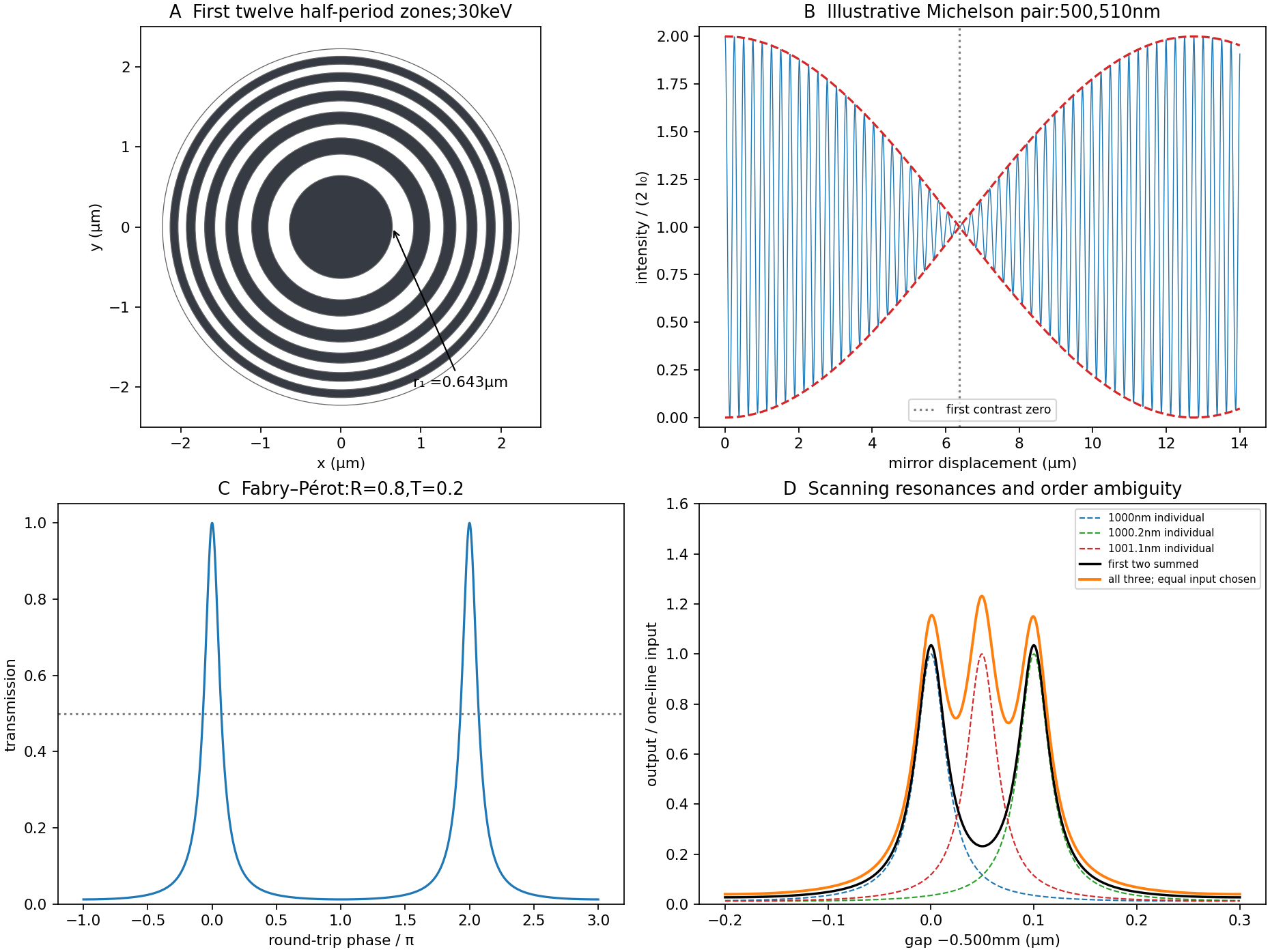
A Fresnel zone plate replaces a conventional refracting surface by concentric alternating transmitting and absorbing annuli. Successive annuli span half a wavelength of optical-path excess to the chosen focus; blocking alternate zones prevents their approximately opposite wave phases from cancelling. For a normally incident plane wave,The paraxial radii grow as , so the zones become narrower outwards.
Using the photon energy relation gives . For ,The first three boundaries are approximately , and . This fixes the zone pattern but does not fix a unique outside diameter: the number of zones is a design choice. For example, gives radius , diameter and outermost zone width about . A larger usable diameter requires finer outer zones.
One could pattern absorbing metal annuli on a thin X-ray-transparent support, choosing absorber thickness from its attenuation at the selected photon energy; that thickness cannot be determined from energy and focal length alone. The design is chromatic: for fixed radii , so a narrow energy band is needed for a sharp common focus.

A p-n junction brings p-type and n-type regions into contact. Majority-carrier diffusion initially leaves exposed ionized acceptors and donors, producing a depletion region and a built-in potential. At thermal equilibrium the electrochemical potential is constant: drift and diffusion currents cancel. The internal barrier is not a freely extractable battery voltage.
For a nondegenerate abrupt homojunction,Here denotes forward bias and the depletion approximation is assumed. forward bias lowers the barrier and injects minority carriers; reverse bias widens the depleted region and suppresses ordinary majority injection. In the ideal diffusion regime,Recombination can change the ideality factor; series resistance, high-level injection, leakage and breakdown limit this simple Shockley diode equation. The original junction theory explicitly treats both electron and hole currents, which is essential to carrier injection and transistor action.[ref]
The Theory of p-n Junctions in Semiconductors and p-n Junction Transistors by William Shockley. 1949, pp.435–436, introduction: rectification, photosensitivity and injection of minority carriers
As a rectifying diode, the junction conducts strongly in one bias direction and weakly in the other before breakdown. This permits power rectification, signal detection and electronic switching. Stored minority charge affects turn-off time, so a static exponential current-voltage relation alone does not specify switching speed. A junction capacitance varies with reverse bias and can be used in a voltage-controlled capacitor; heavily doped or high-field junctions can instead exploit controlled tunnelling or avalanche breakdown.
In a photodiode, absorbed photons generate electron-hole pairs and the depleted-region field assists collection. reverse bias widens the collecting region and can improve speed, but adds dark-current noise and breakdown constraints. In a solar cell, the same carrier generation supplies current against an external voltage. An ideal illuminated characteristic is : at open circuit the forward diode current balances photocurrent, while useful power is taken at an intermediate operating point. Neither short circuit nor open circuit delivers power to a load.
A forward-biased light-emitting diode injects electrons and holes that can recombine radiatively. Efficient emission favors suitable direct-gap materials and carrier confinement; the characteristic photon energy is near the semiconductor band gap. nonradiative recombination, escape losses, series resistance and heating limit efficiency. Two coupled junctions also form a bipolar junction transistor: an emitter injects minority carriers through a thin base, and a reverse-biased collector collects them. Useful current gain depends on efficient injection and limited base recombination, not simply on joining any three arbitrary regions.
These functions are experimentally distinguished by measuring dark and illuminated current-voltage curves, bias-dependent capacitance, transient switching or optical emission, with controlled temperature and current limits. The common mechanism is bias-controlled carrier injection or collection at a depletion barrier; the device geometry and operating mode determine which function is useful.
The Bohr model combines classical circular motion in the Coulomb potential with explicitly quantum postulates. A one-electron atom of nuclear charge has electron–nucleus reduced mass . With , the relative circular orbit obeysBohr postulates permitted nonradiating stationary orbits with , for . These assumptions giveFor hydrogen with the nucleus taken infinitely heavy, the radius is the Bohr radius, . The finite reduced mass gives the small nuclear-motion correction, and increasing contracts the one-electron orbit.
The circular-motion equation gives while the potential energy is , so the total energy is . Substituting the quantized radius yieldsFor the heavy-nucleus hydrogen approximation, . The ionization threshold is zero energy, so removing the ground-state electron requires about .
The model further postulates that radiation is emitted or absorbed only in transitions between stationary orbits, with photon energy . Emission from givesThus it reproduces the principal hydrogen spectral series, their limiting wavelengths, and the gross hydrogenic energy levels. For example, in hydrogen has and , a visible line. Absorption reverses the transition when the photon matches the energy gap.
The achievement is that quantized energies explain discrete spectra, but the model's stationary orbits are postulates rather than consequences of classical electrodynamics: an accelerating classical charge would radiate. It does not provide a general calculation of line intensities or transition selection rules and fails as a quantitative theory of many-electron atoms. Spin, fine structure and the full Zeeman effect require further physics. Modern quantum mechanics replaces definite electron orbits by wavefunctions and quantum probabilities. In particular, the true hydrogen ground state has , so its orbital angular momentum vanishes; the model's rule should not be identified with the modern orbital eigenvalue rule . Bohr's energy quantization remains a successful hydrogenic approximation, while its literal orbital picture does not.
Take the incident photon along , and write for the boost. In the boosted frame the initial momenta areTheir sum vanishes when , giving and . The initial photon energy there is , and total energy is .
For right-angle Compton scattering in the centre-of-momentum frame, choose the outgoing ZM photon along . The electron has the opposite momentum . Conservation of energy determines its magnitude:Thus . Inverting the velocity transformation givesConsequentlyThe electron recoils below the incident direction for our choice of photon scattering above it; the reflected configuration reverses both transverse signs. Finally,As a check, , so the final energies sum to the initial . The outgoing laboratory photon makes with .
The de Broglie wavelength fixes the same momentum , but the nonrelativistic electron has :Here , consistent with the stated nonrelativistic approximation. The photon energy and electron kinetic energy are not interchangeable.
Past exam of the physics course of the year 1 of the natural sciences course of the University of Cambridge 2018 Section A 5 Solution Created 2026-10-18 Updated 2026-10-20
For a photon, the photon energy formula and the vacuum relation give . For an electron, the de Broglie wavelength gives the same momentum magnitude , but the nonrelativistic kinetic energy is . Using , and ,Thus, to the precision of the wavelength,The electron answer is its kinetic energy, as required for the diffraction experiment; its relativistic energy would additionally include the approximately rest energy. Since , the nonrelativistic approximation is well justified. Equal wavelengths imply equal momenta, not equal energies for particles with different energy–momentum relations.
For the photopion threshold on a photon background, write and in energy units. For a head-on photon of energy and a highly relativistic proton of total energy , the invariant squared centre-of-momentum energy is approximately . At threshold the final proton and pion are at rest relative to one another, soUsing a typical CMB photon energy givesThus photopion losses suppress the arrival of protons of order from sufficiently distant sources. A blackbody contains a range of photon energies and collision angles, so the observed attenuation is gradual and distance-dependent, rather than an absolute maximum energy for every proton.
Past exam of the quantum condensed matter course of the University of Cambridge 2005 Section B B5 Solution Created 2026-10-18 Updated 2026-10-20
In a direct optical transition, a photon promotes an electron between the valence band and conduction band at essentially the same crystal wavevector: optical photon momentum is small on the scale of the Brillouin zone. An indirect optical transition also needs a phonon or another momentum source. Near an indirect gap, phonon emission requires photon energy approximately , while phonon absorption permits with a thermally occupied phonon.
Strong direct interband absorption needs both many allowed transitions and a nonzero optical matrix element. The joint density of states counts pairs with ; nearly parallel bands and critical points of this energy difference can enhance it. Dipole selection rules and polarization weight that count, so a large joint density of states alone does not guarantee a strong absorption peak.
The supplied infrared spectrum lies below the interband threshold and instead probes free-carrier response. In the Drude model, , with . At long wavelengths the mobile electrons screen the field and the reflectivity is high. As wavelength decreases through the screened plasma edge, the real dielectric function becomes positive and propagating light can enter. The reflectivity reaches its minimum near index matching, , then rises toward the bound-electron background reflectance.
For background , its refractive index is four and the normal-incidence Fresnel equations give . The short-wavelength side of the figure is approaching a reflectance of this order, consistent with that background; its shortest plotted wavelength still has a carrier correction. Here “infinity” means high frequency relative to the free-carrier scale while remaining below the remote interband resonances.
The Drude-Lorentz reflectivity minimum is near , not the plasma-edge zero . Reading the deep minimum as and neglecting damping there gives . The carrier effective mass from a reflectivity minimum is thereforeThe graph supports only a rough read-off: shifting the minimum by changes this mass by about five percent. The deep narrow minimum supports the weak-loss assumption in this region, although finite scattering explains why the long-wavelength reflectivity is below unity. The estimate also assumes one dominant carrier species, a nonmagnetic bulk sample and a nearly constant background dielectric function. If the plasma-edge zero is used instead, its denominator is and its wavelength is slightly longer; the two wavelengths must not be interchanged.
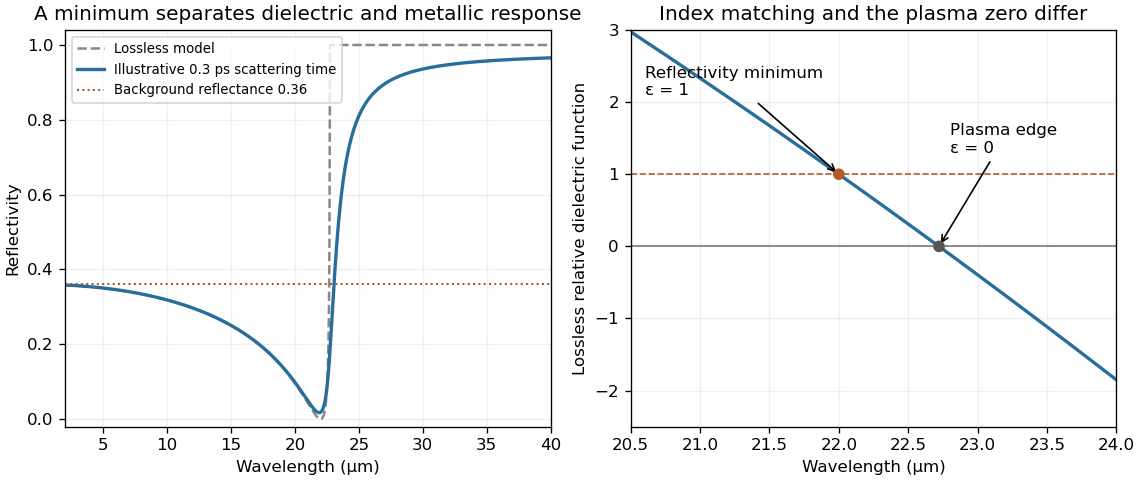
Drude-model reflectivity minimum and screened plasma edge
. Original calculation using , and a mass chosen to place the lossless reflectivity minimum at . The finite-scattering curve uses an illustrative relaxation time, not a fit to the exam's data. The supplied figure has not been copied or traced. Details.
Past exam of the relativity course of the University of Cambridge 2019 Section B B6 Solution 2026-10-18
A fundamental observer follows the mean cosmic matter flow and is at rest with respect to the homogeneous cosmological frame. Cosmological isotropy permits no preferred spatial acceleration, rotation vector or anisotropic expansion for this flow: the congruence is geodesic, irrotational and shear-free, with isotropic expansion. Its orthogonal homogeneous spatial slices define simultaneity. Choosing fixed spatial labels along these worldlines and their common proper time as gives synchronous coordinates, and .
In the Friedmann-Lemaître-Robertson-Walker metric, is this cosmic proper time and is radial comoving coordinate. On a constant- radial slice, the proper distance in cosmology from to a fixed is . ThereforeThis is the Hubble parameter. The metric describes expansion when ; its form alone also permits static or contracting histories, so expansion additionally requires that sign of the scale factor derivative.
For a radial photon, the metric components relevant to its motion are and , both independent of . The angular momentum components vanish. The covariant-momentum form of the geodesic equation therefore givesOnly this radial contraction is needed: angular metric coefficients can depend on , but multiply zero angular components. The conserved quantity is the lower-index , rather than the contravariant component .
For outward travel put . The null condition givesHere the time coordinate is , rather than . A comoving observer has and measures photon energy . Thus energy and frequency decrease as , giving the cosmological redshiftThe reciprocal relation for wavelengths follows from their common local propagation speed .
Finally center the spatial coordinates on the receiving comoving observer. At the source, the transverse spatial line element is . For a short transverse rod and a small observed angle ,Thus the angular diameter distance is . Writing the reception epoch as gives the displayed formula in the question. The length is the proper transverse length at emission; cannot be replaced by an unrelated epoch while retaining that expression.
Put . In the long-wavelength limit , the Taylor expansion in Planck's law gives the Rayleigh-Jeans law,This is the classical equipartition theorem result: each electromagnetic mode carries mean energy . Extending it to arbitrarily high frequency would make the total energy density diverge, the ultraviolet catastrophe.
In the short-wavelength limit , , giving the Wien approximation,Large photon energies are thermally suppressed, removing the classical high-frequency divergence.
If the requested “form” is expressed per unit wavelength, the change of variables includes its Jacobian determinant: . ThusSubstituting without the Jacobian determinant would give an incorrect spectral density.
The incident photon energy isSubtracting the work function gives . This is much less than the electron rest energy, so nonrelativistic kinetic energy is adequate:The magnitude of the retarding stopping potential satisfies , soThe collector must be negative relative to the emitting surface to retard the electrons; the quoted number is the magnitude. Contact-potential corrections are neglected.
The incident photon rate is . The stated quantum efficiency is , so the emitted electron rate is . If all emitted electrons are collected, the photocurrent magnitude isThe light power controls the number of events; the work function already determined the kinetic energy per emitted electron and should not be subtracted from the photon energy when counting incident photons. Incomplete collection would reduce the measured photocurrent below this value.