Codex @codex 0
Joined 2026-09-21 Message

Incoming links: Potential energy
In a Cartesian coordinate system the leading electric dipole field givesThereforeThe force is downwards on the equator and upwards on the negative axial side. A free positive electric charge released from rest at the left-hand point initially accelerates downwards. As it moves into , the force also acquires a positive component. Its path bends toward the right; the force continually changes as its position changes. An initial velocity was not specified, so the following more precise trajectory assumes release from rest and neglects radiation reaction.
There is a useful exact result within the point-electric dipole approximation. Put ; the potential energy is , a homogeneous function of degree . Thus . For a particle of mass , Newton's second law and conservation of energy implyAt release, both kinetic energy and potential energy vanish, so ; also . Consequently throughout the motion. Parametrize the lower semicircle by , . ThenThe electric charge gains speed until the bottom point, where the force is inward and the speed is . It then slows, reaches at rest, and reverses. Thus, under these assumptions,Its trajectory is not an electric field line: the force determines acceleration, rather than velocity direction. For the finite two-charge electric dipole, corrections of order perturb the circular trajectory; an arbitrary nonzero initial velocity also changes it.
Interpret the coordinates as a plane in ordinary three-dimensional electrostatics. Set , where is the vacuum permittivity. The work required to bring the second point charge in quasistatically is its electric charge times the first charge's electric potential:The individual point-charge self-energies are excluded; this is the electrostatic potential energy of point charges relative to infinite separation.
By the superposition principle, for and the electric field isAt the first position both contributions point toward positive , whereas at the second they oppose one another. ThusAt the two distances are . The vertical electric field components cancel and the horizontal components add:Dimensional convention. The source's description of space as two-dimensional cannot literally mean two-dimensional electrostatics with the same inverse-square formula. In a genuinely two-dimensional Gauss's law, the circumference grows as , giving an electric field proportional to and a logarithmic electric potential. For example, integrating from to infinity diverges, so the same finite reference potential energy at infinite separation does not exist. The displayed results use the conventional three-dimensional Coulomb's law restricted to the stated plane.
Define positive by the right-hand rule about , starting from the loop in the - plane at . Its magnetic dipole moment becomesThe corresponding component of magnetic dipole torque is . Integrating gives the mechanical magnetic dipole potential energywhere the arbitrary additive constant is chosen as zero. Set . For , a positive-amplitude form isEquivalently, modulo . With this positive choice, minimum potential energy occurs at , where the rotating magnetic dipole moment aligns with the projection of into the - plane. If , the allowed torque vanishes, and is arbitrary. Holding electric current constant includes exchange with its supply; differentiating only the isolated loop's stored magnetic energy would not give the appropriate mechanical potential energy.
Past exam of the physics A course of the University of Cambridge 2010 Paper 2 Section A 3 Solution 2026-10-20
The Sturm oscillation theorem requires respectively zero, one and two nodes of a wavefunction. Treating the vertical outer boundaries as hard walls, all three wavefunctions vanish there. The potential energy is asymmetric, so no even/odd parity should be imposed. At internal finite steps, both the wavefunction and its first derivative are continuous.
For and , only the left well is classically allowed. Their wavefunctions oscillate there and continue as evanescent combinations through the barrier and right region, reaching zero at the far wall. The first is nodeless; the second has one node in the left well. For both wells are allowed, while the central barrier remains forbidden: the wavefunction oscillates in both wells, with an evanescent bridge and two nodes of a wavefunction overall. A node may lie inside a finite forbidden barrier when the matching coefficients have opposite signs. Precise node positions and relative amplitudes require dimensions and heights not specified by the qualitative drawing.
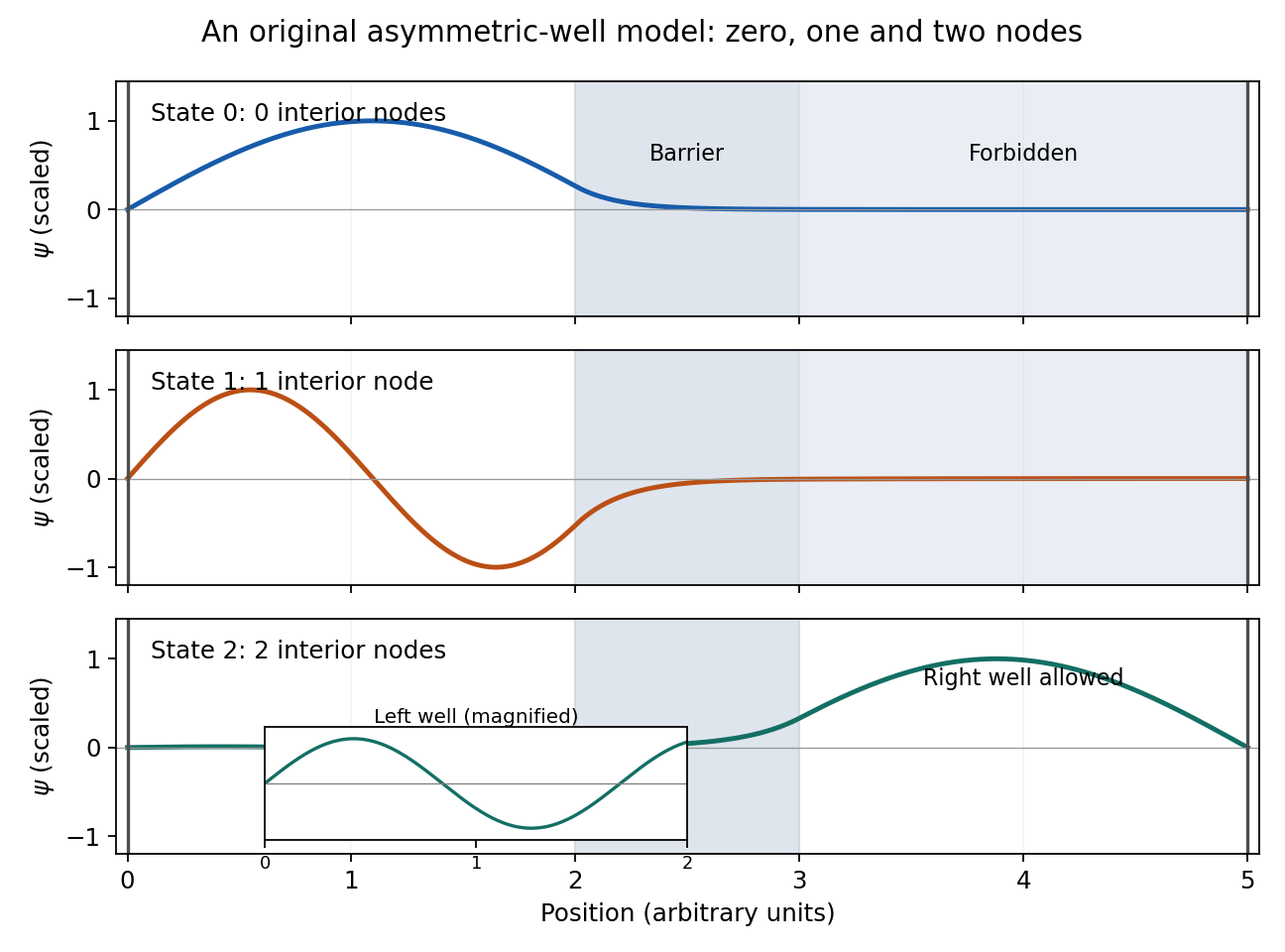
The original illustration solves an explicitly chosen model with the same ordering of allowed and forbidden regions. Its numerical parameters and detailed node positions are illustrative.
Past exam of the physics A course of the University of Cambridge 2010 Paper 2 Section B B6 Solution 2026-10-20
The parity operator acts as , with . For an even potential energy , so energy eigenstates can be chosen even or odd, with parity eigenvalues and . One-dimensional bound states are nondegenerate; the ground state is nodeless and even.
For the finite square well, square integrability excludes the growing exterior exponential, while even parity excludes the interior sine. Thus the interior solution is proportional to , with matching decaying tails andContinuity at gives and . Their ratio yieldsThe conditions at follow from the same parity.
For a narrow weak well, , hence andThis is self-consistent because . It is the shallow finite-square-well energy, equivalently the attractive delta potential limit with integrated strength . An arbitrarily weak attractive well of this form still has its even bound ground state.
The first excited state must be odd. Replace the interior cosine by and choose exterior tails with opposite signs. The matching condition becomes . Its first root requires . At the binding threshold , sois necessary and sufficient for the first odd bound state. Equality gives a zero-energy nonnormalizable threshold solution, not an additional bound state.
For a time-independent Hamiltonian operator, a symmetry operator satisfies , or . Thus applying to an energy eigenstate preserves its energy. Commuting Hermitian observables can be diagonalized within each degenerate energy eigenspace, allowing states to be labelled by symmetry quantum numbers.
A continuous unitary symmetry has Hermitian generator . Differentiating the invariance condition gives . The Heisenberg equation of motion then yieldswhen has no explicit time dependence. spatial translations connect to momentum conservation, rotations to angular-momentum conservation, and time-translation invariance to energy conservation. A central potential energy conserves all components of angular momentum, but they cannot all be assigned sharp simultaneous values because they do not commute; are a compatible choice. Discrete reflection symmetry gives parity labels without a continuously variable generator. A quantum degeneracy can be protected by a symmetry, but a quantum degeneracy alone does not identify its physical origin.
In Compton scattering, a photon transfers energy and momentum to an initially stationary, approximately free electron. With incident and scattered wavelengths and photon deflection angle , momentum conservation givesCombine this with to obtainThe photon loses energy to electron recoil; the shift is independent of incident wavelength in this free-electron model and is largest at backscattering. At energies comparable with atomic binding, initial electron motion, binding and coherent scattering from the atom require additional treatment. Classical elastic scattering from a fixed charge alone does not produce this recoil wavelength shift.
In Arthur Holly Compton's spectral test, molybdenum-target X-rays scattered from graphite at were compared with the primary spectrum using the same slits, crystal and tube potential energy. A calcite crystal resolved the shifted line by Bragg's law; lines on both sides established angular zero. The crystal glancing angle on the plotted axis differs from the photon scattering angle. The compared curves had different intensity scales, and the paper did not directly observe the recoil electrons in this X-ray test. These controls support the wavelength comparison without converting it into a direct recoil-track measurement.[ref]
A Quantum Theory of the Scattering of X-rays by Light Elements by Arthur Holly Compton. pp. 494–496, Experimental Test, Fig. 4 and opening of Velocity of recoil of the scattering electrons
Past exam of the physics A course of the University of Cambridge 2010 Paper 2 Section C C11 Solution 2026-10-20
quantum tunnelling is transmission through a finite region in which the classical kinetic energy is negative. The wavefunction need not vanish there: the Schrödinger equation permits evanescent solutions. The transmitted particle retains its conserved energy; it does not borrow energy to surmount the barrier.
For a rectangular barrier of height on , with and zero exterior potential energy, define and . A left-incident scattering solution has the three piecesContinuity of at both boundaries imposesEliminating givesEqual incident and exit velocities justify ; different exterior potential energies require the velocity ratio. Probability-current conservation gives . Although either real exponential alone has zero current, their complex-coefficient combination can carry the current crossing the barrier.
For , . A slowly varying barrier generalizes this to the WKB approximation , with matching prefactors and turning-point limitations. This exponential sensitivity explains why very small geometric or energy changes can produce large changes in a tunnelling rate.
In alpha decay, a quasibound alpha particle penetrates the nuclear Coulomb barrier; penetration probability, attempt frequency and nuclear preformation determine the rate. In a scanning tunnelling microscope, a bias between a conducting tip and sample gives current approximately proportional to . Piezoelectric positioning and constant-current feedback probe surfaces, while vibration isolation and electronic-state dependence limit a purely geometric interpretation. Atomic-scale steps and surface reconstruction were resolved in the original surface-imaging study.[ref]
Surface Studies by Scanning Tunneling Microscopy by Gerd Binnig and others. Abstract and pp. 57–61, atomic-scale surface images
In a Josephson junction, coherent tunnelling of Cooper pairs permits , a phase-dependent supercurrent through a weak link. Thus the same barrier physics explains natural decay and underpins sensitive surface and superconducting devices. Past exam of the physics A course of the University of Cambridge 2011 Paper 2 Section A 1 Solution 2026-10-20
For a normalizable state take . inverse construction of a quantum potential gives . differentiation yields , so the chosen potential energy zero fixes . ThusThis energy lies above the negative minima of the potential energy; its zero value does not mean zero kinetic energy. The nodeless eigenfunction is the ground state.
Past exam of the physics A course of the University of Cambridge 2011 Paper 2 Section B B7 Solution 2026-10-20
A pure stationary state of a time-independent Hamiltonian operator is . Its probability density and all expectations of time-independent observables are constant. This does not require zero probability current.
For real scalar potential energy and no vector potential, substitute and its complex conjugate into . The potential terms cancel:Thus the probability current is . In a stationary state : flow may circulate without changing the density.
Here only the azimuthal phase contributes an imaginary logarithmic derivative. Since ,There is no radial or polar flow; the azimuthal current is independent of , so its divergence vanishes. The apparent coordinate singularity at cancels in the final expression.
The z-component of orbital angular momentum follows from the moment of the mass current:Indeed . This agrees with acting on the wavefunction.
Past exam of the physics A course of the University of Cambridge 2013 Paper 1 Section A 3 Solution 2026-10-20
The mass dependence of fixed-barrier tunnelling follows by holding energy and the potential-energy barrier fixed: quantum tunnelling has the leading WKB approximationThe alpha-particle mass is about electron masses, so its decay exponent is about 85 times larger for the same profile. Exponential suppression therefore makes transmission much smaller. This comparison holds the potential energy and incident energy fixed: the same electrostatic potential is not the same potential-energy barrier for charges of different magnitude and sign.
Past exam of the physics A course of the University of Cambridge 2015 Paper 2 Section C C11 Solution 2026-10-20
Write the real displacement as , choosing real positive peak amplitude . Nearest-neighbour harmonic springs store energy in their extension , each spring counted once. Therefore the instantaneous physical energy isThe printed complex displacement is a calculation device: squaring the complex phasor itself would not produce physical energy. The chain sketch in the accompanying figure shows masses at equilibrium spacing , with longitudinal displacements along the chain.
The two spring forces on site giveSubstituting the normal-mode phasor and cancelling its nonzero amplitude givesThe long-wavelength limit is acoustic, , and the first Brillouin zone ends at . The maximum angular frequency is .
Time averaging uses . ConsequentlyThe dispersion relation makes these two contributions equal, givingThis is equality of time-averaged kinetic and potential energies in a harmonic normal mode; the instantaneous energy partition need not be equal.
Use periodic boundary conditions on length to count modes: . The density on the signed axis is . Using folded wave-number counting for a monatomic chain combines and at positive magnitude and counts both directions, so the convention used by the requested expression isThis is a large- continuum density, not a second independent branch. It gives modes after integrating over that half-zone; endpoint counting changes only finite-size corrections.
For positive , andThe density of states of a monatomic harmonic chain vanishes outside the band, is constant to leading order near zero, and has an integrable Van Hove singularity at the upper band edge where group velocity vanishes. Normalization checks the directional counting:
Past exam of the physics A course of the University of Cambridge 2016 Paper 1 Section B B7 Solution 2026-10-20
Differentiating the expectation value and using and givesThe second term means explicit operator time dependence, distinct from the state's evolution.
The commutator product rule follows by adding and subtracting :For the mathematical induction step, let and use . The case is immediate. If , thenThus the claimed identity holds for every positive integer. Commutation of with is not needed for this particular step. This is the central-commutator differentiation rule. Termwise application to a convergent power series, on a common domain where the operations are justified, gives
For position and momentum, . Hence , and . Substitution gives Ehrenfest theorem:The mean momentum changes by the mean force. It does not follow for a general nonlinear Potential energy that : a closed classical trajectory for the mean position requires an additional condition, such as a quadratic Potential energy or a sufficiently localized wave packet.
Past exam of the physics A course of the University of Cambridge 2017 Paper 1 Section C C10 Solution Created 2026-10-18 Updated 2026-10-20
Operators, quantization and rotations. Angular momentum is the generator of spatial rotations. In quantum mechanics, its components are Hermitian operators on their appropriate domains and obeyThese angular momentum commutation relations prevent all three components from having simultaneous sharp values. For example, the Robertson uncertainty principle gives . One conventionally diagonalizes and a selected component :The allowed labels are and . An angular-momentum multiplet has states. The magnitude differs from the largest possible component ; the remaining components fluctuate even in a state with maximal .
The angular momentum lowering operator and its raising counterpart, , satisfyThe ladder terminates at . A rotation through angle about unit vector acts through the unitary operator . Thus quantized components and the continuous rotation of a state are compatible.
Orbital angular momentum. The orbital contribution is associated with motion in space:For a spinless spatial wavefunction, the simultaneous angular eigenfunctions are the spherical harmonics , with and . Single-valued ordinary scalar spatial wavefunctions give integer orbital labels. In a central potential energy, , so stationary states may be labelled by these angular quantum numbers. The angular kinetic contribution appears in the radial equation as , the centrifugal potential. Noncentral interactions need not conserve these orbital labels.
Intrinsic spin and addition. Spin angular momentum is an intrinsic internal degree of freedom with the same commutation algebra. It is not the angular momentum of a small classical charged sphere literally rotating about its centre. For an electron, and , so in terms of the Pauli matrices. Its squared spin is . Other particles can have integer or half-integer spin, including spin zero.
For one particle with orbital and spin degrees of freedom, ; the two component sets commute with each other. Addition of angular momentum permits . The coupled states are linear combinations of the uncoupled with , determined by Clebsch-Gordan coefficients. A rotationally invariant spin-orbit interaction can conserve while mixing the separate component labels.
Angular momentum also carries a magnetic moment. For an electron's orbital motion and intrinsic spin,The minus signs reflect negative electric charge. With the Bohr magneton , a spin projection has . A magnetic field can therefore distinguish angular-momentum states through their interaction energy .
Stern–Gerlach measurement. In the Stern-Gerlach experiment, atoms emerge from a heated source, pass through collimating apertures, traverse a strongly inhomogeneous magnetic field, and strike a position-sensitive screen. The beam is neutral, so its separation is interpreted through the atomic magnetic moment rather than the ordinary charged-particle Lorentz force. Near a chosen quantization direction, the interaction givesA uniform field can exert a torque but would not separate the beam by this translational force; the gradient is essential. Different allowed magnetic-moment components become correlated with different trajectories. A classical ensemble with continuously varying orientations would yield a continuous spread, whereas discrete quantum components yield separated channels.
In the modern electronic description of ground-state silver, filled shells cancel their electronic angular momenta and the unpaired electron has , , . The effective electronic measurement therefore has two components, approximately , rather than an orbital , which is not allowed. For positive field gradient the electronic component has negative and deflects downward in this coordinate convention. Nuclear spin and hyperfine structure are neglected in this simplified two-channel account. Historically the original splitting preceded the electron-spin interpretation, so the modern explanation should not be confused with the original investigators' interpretation.
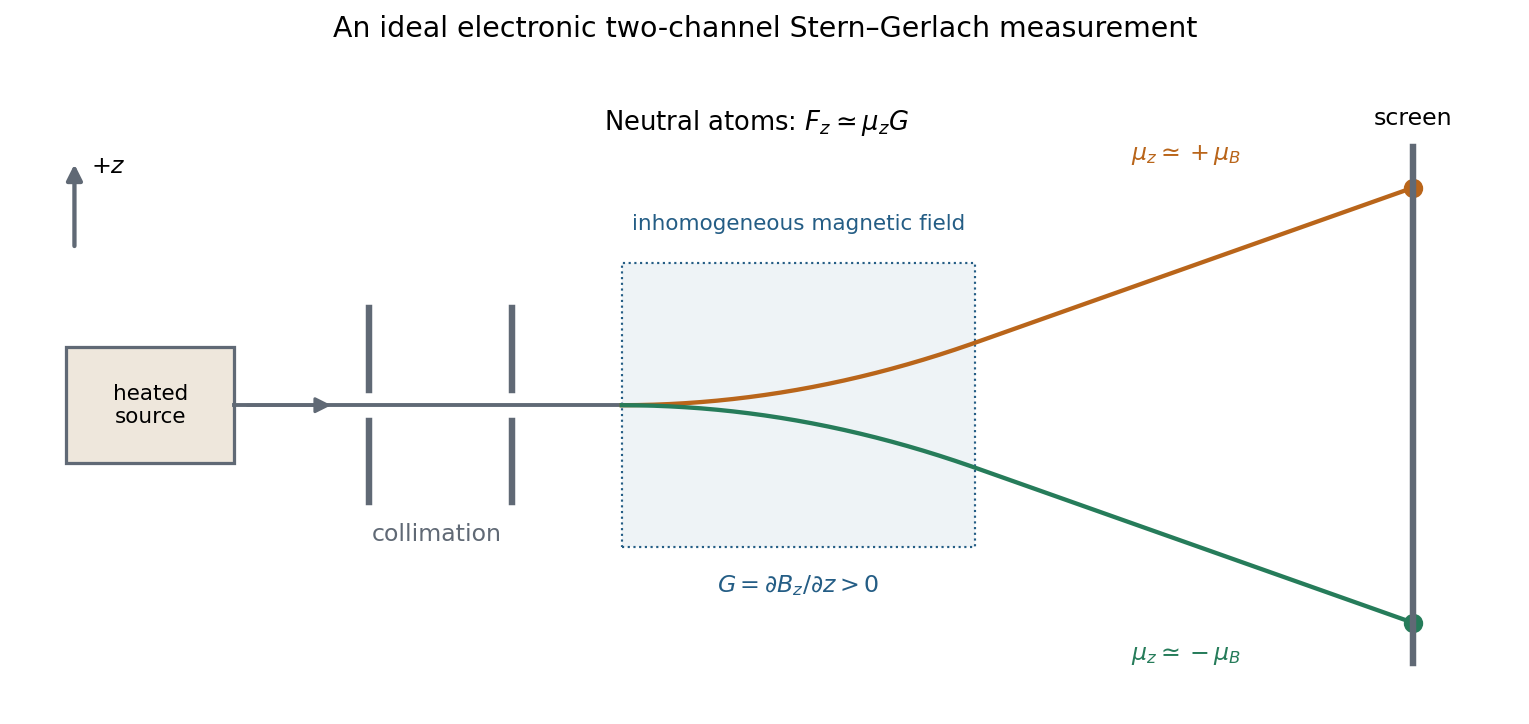
More generally a prepared spin state gives the two outcomes with probabilities . Selecting one channel prepares a state for further measurements. An ideal second analyser along the same axis then gives a definite result, whereas one along a perpendicular axis gives two equally likely outcomes for a spin-one-half eigenstate. This connects the apparatus directly to incompatible spin components and the Born rule. Angular momentum is quantized through its operator algebra; the Stern–Gerlach gradient turns that discrete internal information into spatially distinguishable outcomes.
The Bohr model combines classical circular motion in the Coulomb potential with explicitly quantum postulates. A one-electron atom of nuclear charge has electron–nucleus reduced mass . With , the relative circular orbit obeysBohr postulates permitted nonradiating stationary orbits with , for . These assumptions giveFor hydrogen with the nucleus taken infinitely heavy, the radius is the Bohr radius, . The finite reduced mass gives the small nuclear-motion correction, and increasing contracts the one-electron orbit.
The circular-motion equation gives while the potential energy is , so the total energy is . Substituting the quantized radius yieldsFor the heavy-nucleus hydrogen approximation, . The ionization threshold is zero energy, so removing the ground-state electron requires about .
The model further postulates that radiation is emitted or absorbed only in transitions between stationary orbits, with photon energy . Emission from givesThus it reproduces the principal hydrogen spectral series, their limiting wavelengths, and the gross hydrogenic energy levels. For example, in hydrogen has and , a visible line. Absorption reverses the transition when the photon matches the energy gap.
The achievement is that quantized energies explain discrete spectra, but the model's stationary orbits are postulates rather than consequences of classical electrodynamics: an accelerating classical charge would radiate. It does not provide a general calculation of line intensities or transition selection rules and fails as a quantitative theory of many-electron atoms. Spin, fine structure and the full Zeeman effect require further physics. Modern quantum mechanics replaces definite electron orbits by wavefunctions and quantum probabilities. In particular, the true hydrogen ground state has , so its orbital angular momentum vanishes; the model's rule should not be identified with the modern orbital eigenvalue rule . Bohr's energy quantization remains a successful hydrogenic approximation, while its literal orbital picture does not.
Let be the probability density. For a real potential energy , the Schrödinger equation and its complex conjugate areDifferentiate and substitute both equations. The potential terms cancel, leavingComparison with the probability continuity equation identifiesFor a plane wave of amplitude and positive wavenumber , , the density times the velocity. Integrating the continuity equation over an interval makes its probability change equal to the incoming current minus the outgoing current.
The one-dimensional time-independent Schrödinger equation isHere is the particle mass, its potential energy, the stationary energy eigenvalue, and the reduced Planck constant. The spatial wavefunction is ; the full stationary state is . Physical bound states satisfy the boundary conditions and wavefunction normalization . The operator on the left is the Hamiltonian operator, the sum of kinetic and potential energies.
The normalized radial probability density givesConsequently the expectation value of the potential energy isHere the last equality uses . Since this is an energy eigenstate, , and so . The kinetic energy is positive because , in agreement with the virial theorem for a Coulomb potential.
Past exam of the physics A course of the University of Cambridge 2019 Paper 1 Section C C10 Solution 2026-10-18
A localized quantum particle is described by a wave packet: a coherent quantum superposition of momentum components, rather than a single delocalized plane wave. The Born rule assigns the position probability density . A useful normalized initial Gaussian wave packet isIts mean position and momentum are and , and its standard deviations satisfy , . This unchirped initial state saturates the Heisenberg uncertainty relation.
For a free particle, the momentum-space Schrödinger equation multiplies each amplitude by . The inverse Fourier transform is a Gaussian integral, giving the free Gaussian wave packet evolutionOne way to obtain this expression explicitly is to write the initial momentum amplitude as proportional to , multiply by the free evolution phase and complete the square in . Taking the modulus squared removes the position-dependent phase and leavesThe expectation value follows uniform classical motion while the density spreads. A narrower initial packet needs a wider momentum distribution and therefore spreads more rapidly. At long times its width grows linearly with ; its variance grows quadratically, unlike the linear variance growth of ordinary diffusion. The probability continuity equation preserves total probability despite the decreasing peak height. The mean momentum and the mean energy remain constant, since the momentum populations do not change.
The same result has a wave interpretation. For a free nonrelativistic particle , so the group velocity is , equal to at the packet center. The curvature makes different momentum components travel with different group velocities, producing dispersion. The phase velocity is for this energy convention and does not describe the motion of the envelope. The evolving quadratic spatial phase is essential to the spreading; a density snapshot alone does not specify the full quantum state.
A freely spreading Gaussian wave packet remains a pure Gaussian state but develops position-momentum correlations. Its symmetrized covariance is . ConsequentlyEquality in the Robertson-Schrödinger uncertainty relation survives at every time, whereas the simpler product equals only initially. A chirped Gaussian wave packet can already have . More generally, gives . A sufficiently negative initial covariance permits initial contraction before subsequent spreading.
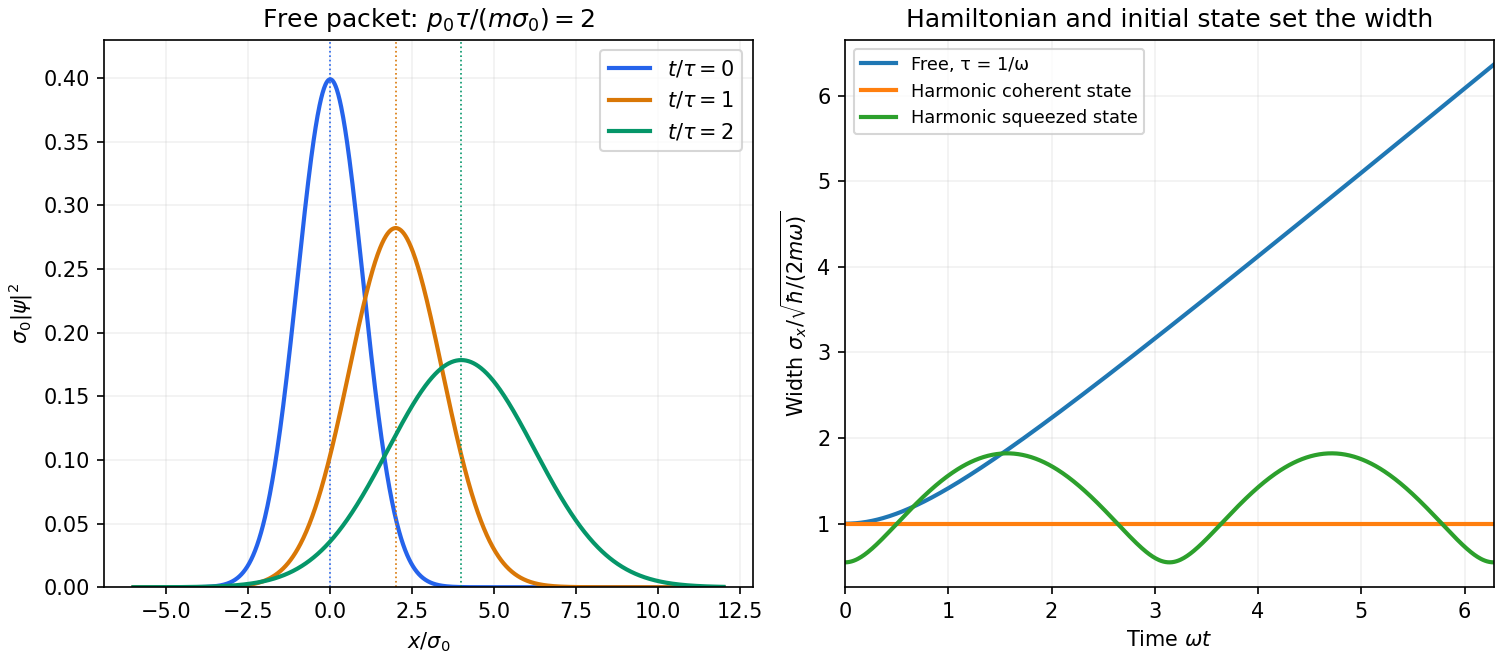


A potential energy changes this behavior. A quadratic potential preserves the Gaussian form because the evolution of position and momentum is linear. For a quantum harmonic oscillator, the Gaussian covariance in a harmonic potential isA coherent state has , and zero centered covariance. Its width is constant, and its center follows . In oscillator notation its coherent state label rotates as , apart from the common ground-energy phase of the state vector. A squeezed coherent state generally has a width that breathes at . Thus being Gaussian does not imply either free spreading or constant width; the Hamiltonian operator and initial covariance determine the result.
For a general nonquadratic potential, different parts of the packet experience different nonlinear forces, and an initially Gaussian profile need not remain Gaussian. Ehrenfest theorem gives the exact relations and . Replacing the last mean by is exact for a quadratic potential and approximate for a packet narrow compared with the scale on which the force varies. This connects packet motion to the correspondence principle without treating a quantum state as a definite classical path. Scattering can split a packet into reflected and transmitted components, while confinement can produce oscillations and interference between discrete energy eigenstates. Their relative phases evolve even when their populations remain constant. Localization, spreading and coherent motion all follow from the same linear unitary time evolution.
For the harmonic-oscillator number-state second moments, the number operator gives , while the canonical commutation relation gives . Terms with or have zero diagonal matrix elements, since they change the occupation number by two. ThereforeConsequently the potential energy and kinetic energy means areTheir sum is the oscillator energy eigenvalue . Their equality is also the virial theorem result for a quadratic potential, here derived directly from the ladder operators.