A quantum mechanics physicist studies quantum mechanics through mathematical theory, observation or experiment. The field determines the relevant physical systems and measurements, while the individual biographies below connect particular contributions with their scientific ideas.
Vlatko Vedral, with Chiara Marletto, proposed using gravitationally generated quantum entanglement as an indirect witness of quantum features of gravity. Their 2017 argument considers two masses in spatial quantum superpositions and asks whether their gravitational interaction can entangle them.[ref]
Under the assumed local mediation and initial-independence conditions, a mediator restricted to classical commuting information cannot generate the required quantum entanglement. The conclusion is conditional on that model of mediation and exclusion of other entangling interactions. The paper proposes a test; it does not report an observed laboratory detection of quantum gravity.
Chiara Marletto and Vlatko Vedral developed a quantum-information route to testing gravity without detecting an individual graviton. Their proposal uses quantum entanglement between two initially independent masses to witness nonclassical properties of the interaction mediating it.[ref]
Gravitationally-induced entanglement between two massive particles is sufficient evidence of quantum effects in gravity by Chiara Marletto and Vlatko Vedral. General mediator argument and proposed two-mass experiment
The experimental question is stronger than measuring a gravitational phase shift alone. It requires establishing the appropriate quantum entanglement and controlling alternative couplings. The inference concerns the mediator under the stated assumptions, rather than uniquely selecting a complete microscopic theory of gravity.
Sougato Bose and collaborators proposed a spin-based witness for gravitationally induced quantum entanglement. Their 2017 design places two small masses in neighbouring matter-wave interferometers, with an embedded spin in each mass providing a correlation readout.[ref]
A Spin Entanglement Witness for Quantum Gravity by Sougato Bose and others. Abstract: interferometric paths, gravitational phases and spin-correlation witness
Different branch separations acquire different gravitational phases, potentially entangling the two systems. Competing electromagnetic forces and decoherence must be controlled before attributing a witness signal to gravity. The contribution is a proposed experimental strategy, rather than a claim that the experiment had already measured quantum gravity.
Sergey Bravyi developed rigorous treatments of the Schrieffer-Wolff transformation with David DiVincenzo and Daniel Loss. Their 2011 work derives low-energy effective quantum dynamics through a unitary transformation that decouples low- and high-energy subspaces.[ref]
Schrieffer-Wolff transformation for quantum many-body systems by Sergey Bravyi and others. Abstract: exact direct rotation, perturbative expansion and error bounds
For a Quantum Hamiltonian , an anti-Hermitian generator gives with the orthogonal projection onto the chosen low-energy subspace, when the transformation is constructed appropriately. Bounding the approximation matters: formally discarding high-energy states without controlling their virtual coupling can miss low-energy corrections.
Riccardo Rattazzi developed a path-integral account of quantum mechanics that connects interference, operator evolution and statistical methods. His notes derive the path integral from quantum time evolution, work out the free-particle propagator and treat Gaussian fluctuations.[ref]
The Path Integral approach to Quantum Mechanics by Riccardo Rattazzi. Sections1.1–1.3 and2.2: derivation, free particle and Euclidean methods
The weight , with the action functional, is an amplitude with a phase, not a classical probability assigned to each path. Combining amplitudes before taking probabilities produces interference. Analytic continuation to Euclidean time then connects suitable quantum calculations with statistical-mechanical formulations, under the required convergence and boundary assumptions.
Ellis Ye Yuan co-developed the scattering equations with Freddy Cachazo and Song He, connecting massless-particle kinematics with marked points on a sphere.[ref]
Scattering Equations and KLT Orthogonality by Freddy Cachazo and others. Definition and solution algorithm
In a common convention,with conserved massless momenta and puncture coordinates . The equations provide algebraic structure for scattering calculations rather than trajectories of particles moving on that auxiliary sphere.Song He, with Freddy Cachazo and Ellis Ye Yuan, established KLT orthogonality for objects built from solutions of the scattering equations. The orthogonality uses a specified bilinear form, not an arbitrary Euclidean inner product.[ref]
This relates alternative organizations of particle-scattering data while keeping the momentum constraints explicit.
Freddy Cachazo co-developed the scattering equations with Song He and Ellis Ye Yuan. Their work connected kinematic invariants with punctures on a sphere and provided an inductive solution method, together with a proof of KLT orthogonality.[ref]
The resulting auxiliary geometry organizes calculations of massless-particle scattering without treating that sphere as physical spacetime.
Simon Braun and collaborators prepared a state with negative temperature for motional degrees of freedom in an ultracold atomic system. They tailored a lattice model so the occupied high-energy states were compatible with the relevant upper-energy bound.[ref]
Negative Absolute Temperature for Motional Degrees of Freedom by Simon Braun and others. Abstract: preparation and upper-band-edge momentum peaks
In this regime : increasing energy reduces the entropy of the constrained system. The state is not colder than absolute zero. Its population favours high-energy states, and its thermodynamic ordering differs from the positive-temperature branch. The experimental energy bounds and stability conditions are essential.
A. Yu. Kitaev proposed fault-tolerant quantum computation using anyons in a two-dimensional quantum system. In the model, moving excitations around one another performs unitary transformations, while fusing excitations provides a measurement outcome.[ref]
Information is encoded in collective degrees of freedom rather than simply in an isolated local two-state object. This can protect it against specified local perturbations. Fault tolerance depends on the physical model and error processes; it does not imply immunity to every disturbance or that every possible anyon species supplies universal computation by braiding alone.
G. Lindblad characterized generators of completely positive quantum dynamical semigroups. In finite-dimensional trace-preserving dynamics, the corresponding Lindblad equation can be written, with ,where is a Quantum Hamiltonian, a density matrix and the Lindblad operators.[ref]
On the generators of quantum dynamical semigroups by G. Lindblad. Generator structure for norm-continuous completely positive dynamics
Complete positivity preserves positivity even when the system is considered together with an untouched auxiliary quantum system. The semigroup and continuity assumptions are substantive: the displayed time-independent Markovian form does not describe every possible reduced evolution with memory.
Daniel Gottesman developed a useful way to describe quantum circuits by following their Pauli operators instead of all their probability amplitudes. An -qubit stabilizer state is specified by independent compatible commuting Pauli operators whose common eigenspace is one-dimensional. A Clifford gate maps Pauli operators to Pauli operators by conjugation, so these generators can be updated efficiently on a computer. This explains why a large family of entangled computations is efficiently simulable, and supplies the language of stabilizer codes.[ref]
The Heisenberg Representation of Quantum Computers by Daniel Gottesman. Sections 2–3, stabilizers and the Clifford group; Table 1, generator conjugations
Physicist whose work includes the stabilizer formalism for quantum error correction. His The Heisenberg Representation of Quantum Computers by Daniel Gottesman develops the Pauli group description of Clifford circuits. Verified institutional profile.
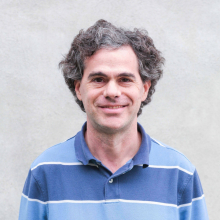
Daniel Gottesman. External portrait supplied by the University of Maryland Department of Computer Science; photographer and licence are not specified on the verified profile.
Source. Avshalom Elitzur and Lev Vaidman proposed detecting an absorbing object through a Mach-Zehnder interferometer adjusted so that destructive interference makes one output dark. Blocking one arm permits a photon to reach that previously dark output. In that successful outcome the photon is detected rather than absorbed by the object, yet its detection establishes that the arm was obstructed. For the balanced arrangement, the success probability is per trial; absorption still occurs with probability .[ref]
Quantum mechanical interaction-free measurements by Avshalom C. Elitzur and Lev Vaidman. Sections 1–2, single-photon interferometer and the three possible outcomes

Portrait of Avshalom Elitzur
. Avishag Shaar-Yashuv. CC BY-SA 4.0, via Wikimedia Commons. Source.
Hugh Everett III proposed treating an observer and a measured quantum system within one unitary quantum dynamics. For an ideal quantum measurement, evolves into : the apparatus records become correlated with the alternatives. A relative state describes the measured quantum system conditional on a particular record, while the joint quantum state remains entangled. His 1957 formulation sought to account for records within this common dynamics, without adding a separate dynamical wave function collapse postulate.[ref]
Relative State Formulation of Quantum Mechanics by Hugh Everett III. Discussion of measurement correlations and relative states
A physicist who proposed a unitary relative-state account of quantum measurement, developed in the many-worlds interpretation.

Hugh Everett III in 1964; Hugh Everett III papers, University of California, Irvine; photographer unrecorded in the Wikimedia file record; non-free historical portrait hosted by English Wikipedia
. Source. 
A theoretical physicist working on precise formulations of the measurement problem. His joint work compares Bohmian mechanics, in which particles have positions guided by a wave function, with Ghirardi-Rimini-Weber theory, in which localization events modify the dynamics. The comparison distinguishes an equation for the wave function from an account of what occupies physical space, such as the GRW flash ontology.[ref]
A theoretical physicist who coauthored the Pusey-Barrett-Rudolph theorem. Assuming preparation independence, the theorem constrains psi-epistemic models that represent distinct pure quantum states by overlapping distributions of underlying physical states. Its force comes from comparing the model's possible measurement outcomes with the zero probabilities predicted by quantum mechanics.[ref]
On the reality of the quantum state by Matthew F. Pusey and others. Equations (1)–(5): exclusion argument and independent preparations
A theoretical physicist who coauthored the Pusey-Barrett-Rudolph theorem. The argument turns the question of whether a quantum state is merely incomplete information into a testable consistency condition on an ontological model of a quantum system. Its conclusion depends on preparation independence, so that physical assumption must accompany statements of the theorem.[ref]
On the reality of the quantum state by Matthew F. Pusey and others. Main argument and independent-preparation assumption
A theoretical physicist who, with Jonathan Barrett and Terry Rudolph, derived the Pusey-Barrett-Rudolph theorem. A joint measurement on independently prepared systems can exclude outcomes that overlapping underlying-state distributions would require to remain possible. This gives a sharp obstruction to a class of psi-epistemic models, rather than a conclusion free of assumptions about preparation.[ref]
On the reality of the quantum state by Matthew F. Pusey and others. Equations (1)–(5) and generalization in Appendix A
A theoretical physicist who, with Nicholas Harrigan, made the distinction between psi-ontic models and psi-epistemic models precise. In an ontological model of a quantum system, the key question is whether different pure quantum states can assign nonzero probability to the same underlying physical state. This separates overlap of preparation distributions from the different question of whether the wave function is a complete description.[ref]
Einstein, incompleteness, and the epistemic view of quantum states by Nicholas Harrigan and Robert W. Spekkens. Classification of ontological models and distinction between epistemicity and incompleteness
A theoretical physicist who coauthored a classification of interpretations through their underlying-state distributions. With Robert Spekkens, he distinguished psi-epistemic models, which permit overlap between distributions for distinct pure quantum states, from psi-ontic models, which forbid it. The framework makes arguments about what a wave function represents mathematically explicit, and helps state the assumptions behind later impossibility theorems.[ref]
A theoretical physicist whose collaborative work compares Bohmian mechanics with Ghirardi-Rimini-Weber theory. Their common organizing idea is a primitive ontology: an account of matter in ordinary space, alongside the law governing its evolution. This clarifies how different proposals address the measurement problem even when both use a wave function.[ref]
On the Common Structure of Bohmian Mechanics and the Ghirardi-Rimini-Weber Theory by Valia Allori and others. Abstract and sections 2–3: particles, matter density and flashes
A theoretical physicist working on foundations of quantum mechanics. In joint research on Bohmian mechanics and Ghirardi-Rimini-Weber theory, he examines how microscopic laws describe definite macroscopic outcomes. The analysis distinguishes particle trajectories, a continuous matter density and discrete spacetime events as different ways to specify the theory's primitive ontology.[ref]
Detlef Dürr, Sheldon Goldstein and Nino Zanghì investigated how the usual quantum measurement rules arise in Bohmian mechanics, where a wave function guides a definite particle configuration. Their analysis connects quantum equilibrium, with configuration probability density , to the statistics of apparatus records. In this account, a self-adjoint operator summarizes a class of experimental procedures; its appearance does not require every quantum observable to be an additional pre-existing particle property.[ref]

Portrait of Detlef Dürr
. Via Wikimedia Commons; credits and usage information are on the linked source file page. Source.
A theoretical physicist studying dynamical approaches to the measurement problem. His review with Giancarlo Ghirardi develops models in which nonlinear and random modifications of the Schrödinger equation account for localization of macroscopic objects while retaining ordinary microscopic predictions to high accuracy. Such models make the transition from quantum behavior to classical behavior part of the dynamics.[ref]
Dynamical Reduction Models by Angelo Bassi and Giancarlo Ghirardi. Abstract and model-development sections: nonlinear stochastic dynamics and macroscopic reduction
A theoretical physicist who coauthored the original Ghirardi-Rimini-Weber theory in 1986. The proposal gives microscopic and macroscopic systems a common modified quantum dynamics: localization is rare for an isolated microscopic constituent but becomes effective for a large object. It supplies a dynamical approach to the measurement problem.[ref]
Unified dynamics for microscopic and macroscopic systems by Giancarlo Ghirardi and others. Abstract and original spontaneous-localization construction
A theoretical physicist who, with Giancarlo Ghirardi and Tullio Weber, proposed a common dynamical description of microscopic systems and macroscopic objects. Their Ghirardi-Rimini-Weber theory modifies ordinary quantum evolution so that widely separated macroscopic alternatives do not persist indefinitely. The GRW amplification mechanism connects a weak microscopic modification to strong macroscopic localization.[ref]
Unified dynamics for microscopic and macroscopic systems by Giancarlo Ghirardi and others. Abstract and derivation of macroscopic center-of-mass dynamics
A theoretical physicist who coauthored Ghirardi-Rimini-Weber theory, a proposed solution to the measurement problem based on modified dynamics. The 1986 model treats localization as a physical process, with a GRW amplification mechanism that makes its consequences depend strongly on system size.[ref]
Unified dynamics for microscopic and macroscopic systems by Giancarlo Ghirardi and others. Abstract: unified microscopic and macroscopic dynamics
His review with Angelo Bassi explains how such models aim to obtain definite macroscopic outcomes from the same law used for microscopic objects.[ref]
Dynamical Reduction Models by Angelo Bassi and Giancarlo Ghirardi. Abstract and discussion of macroscopic reduction
John Stewart Bell turned the debate about completing quantum mechanics into a constraint on observable correlations. In his 1964 analysis of a spin singlet state, each distant spin result depends on the local measurement direction and a shared hidden variable, but not on the other measurement direction. These assumptions constrain the joint correlations in a way incompatible with the quantum mechanics predictions. The result explains what an experiment can discriminate: it tests a class of local hidden-variable theories, rather than simply asking whether measurements are unpredictable.[ref]
On the Einstein Podolsky Rosen paradox by John Stewart Bell. Sections II–V, local response functions and the correlation constraint
Author of the 1964 Bell theorem argument.

Portrait of John Stewart Bell
. CERN, portrait of John Bell, June 1982; CERN archive record 1823937. CC BY 4.0, via Wikimedia Commons. Source.
An experimental physicist who coauthored a programmable neutral-atom quantum computer demonstration. Focused light beams addressed individual qubits in a two-dimensional array, while interactions between Rydberg atoms enabled entangling operations. The experiment combined quantum logic gates into quantum algorithms, testing whether a collection of controlled chemical atoms could execute complete circuits.[ref]
Multi-qubit entanglement and algorithms on a neutral-atom quantum computer by T. M. Graham and others. Abstract: scanned addressing beams, hyperfine qubits and programmable gate-model algorithms
Michael Berry (physicist) showed that slowly carrying a nondegenerate energy eigenstate around a closed loop of external parameters can produce a geometric phase in addition to its dynamical phase. The geometric phase depends on the path through parameter space and survives after the ordinary energy-dependent contribution is removed. For a spin following a slowly varying magnetic field, it is proportional to the solid angle enclosed by the field direction, making the geometry measurable through interference.[ref]
Quantal phase factors accompanying adiabatic changes by Michael Victor Berry. Abstract and section 4, spinning particle in a slowly changing magnetic field

Portrait of Michael Berry (physicist)
. Vahram Mekhitarian, photograph; Jakob Gottfried, derivative crop. CC BY-SA 4.0, via Wikimedia Commons. Source.
Peter Zoller and Ignacio Cirac proposed a trapped-ion quantum computer in which internal quantum states store qubits and a shared vibrational normal mode connects them. Carefully chosen laser pulses couple internal and motional quantum states, allowing a conditional quantum logic gate between different ions. The shared motion serves as a temporary communication channel rather than an independently addressed wire; controlling and restoring that motion is essential to the proposed gate sequence.[ref]
Quantum Computations with Cold Trapped Ions by J. I. Cirac and P. Zoller. Original 1995 proposal, ion internal levels, collective motion and conditional gate sequence

Portrait of Peter Zoller
. Hans Weber, 14 March 2007. CC BY-SA 3.0, via Wikimedia Commons. Source.
Ignacio Cirac and Peter Zoller showed how laser control of a chain of trapped ions could implement quantum computation. Their proposal transfers information between an ion's internal quantum state and a collective vibrational normal mode, then uses that shared motion to perform a conditional operation on another ion. Returning the motion to its starting quantum state leaves the intended quantum logic gate acting on the internal qubits.[ref]
Quantum Computations with Cold Trapped Ions by J. I. Cirac and P. Zoller. 1995 proposal, collective vibrational mode and gate construction

Portrait of Ignacio Cirac
. Original copyright holder credited on Commons as Author original propietry; uploaded by Gallowolf, crop by Kimsaka. CC BY-SA 3.0, via Wikimedia Commons. Source.
Charles H. Bennett and Gilles Brassard proposed quantum key distribution using qubits prepared in two incompatible measurement bases. The sender and receiver disclose their basis choices and retain events with matching bases; they test a sample for disturbance before deriving a key. A simple intercept-and-resend attack illustrates the principle: an eavesdropper choosing a random one of the two bases chooses incorrectly half the time and then causes a wrong retained bit half the time, giving a error rate. This example is an attack analysis, rather than a complete security proof.[ref]
Quantum cryptography: Public key distribution and coin tossing by Charles H. Bennett and Gilles Brassard. 1984 proceedings paper, quantum public-key distribution protocol

Portrait of Charles H. Bennett
. IBM Research. CC BY-SA 2.0, via Wikimedia Commons. Source.
Lucien Hardy gave an argument against local hidden-variable theories using logical exclusions among two-particle measurement outcomes, rather than a statistical Bell inequality. The structure combines outcomes forbidden by quantum mechanics with another outcome that remains possible: assigning all the relevant local results in advance cannot satisfy these requirements together. His 1992 paper also examined an additional assumption about Lorentz-invariant elements of reality, keeping the role of that assumption explicit in its comparison with quantum mechanics.[ref]
Quantum mechanics, local realistic theories, and Lorentz-invariant realistic theories by Lucien Hardy. Abstract, two-particle inequality-free argument and Lorentz-invariant reality assumption
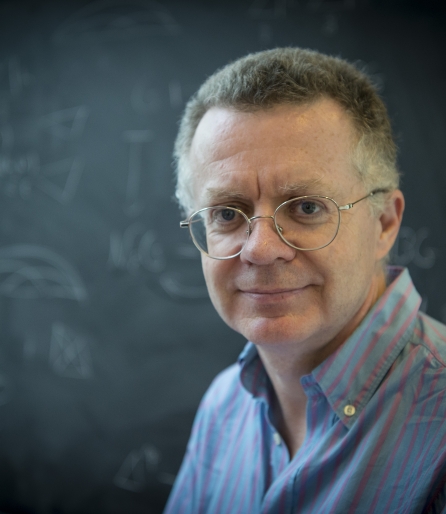
Lucien Hardy; portrait hosted by Perimeter Institute
. Martin Bodo Plenio and Daniel Jonathan showed that a shared auxiliary entangled state can enable a deterministic LOCC conversion that is impossible for the original pair of pure quantum states alone. The auxiliary quantum state is returned unchanged and uncorrelated with the output, so it acts as a catalyst for entanglement catalysis. The key distinction is between consuming an extra resource and using one that can be recovered: a majorization obstruction for the original Schmidt coefficients can disappear after including the catalyst's Schmidt coefficients.[ref]
Entanglement-assisted local manipulation of pure quantum states by Daniel Jonathan and Martin B. Plenio. Abstract and explicit catalytic pure-state conversion

Portrait of Martin Bodo Plenio
. Rickinasia. CC BY-SA 4.0, via Wikimedia Commons. Source.
A theoretical physicist who, with Martin Bodo Plenio, introduced entanglement catalysis in transformations of pure quantum states. An auxiliary entangled state can enable a conversion by local operations and classical communication that would otherwise be impossible, yet be returned unchanged. The example shows why the possibilities of manipulating quantum entanglement cannot be described by a single notion of how much entanglement a state contains.[ref]
Entanglement-assisted local manipulation of pure quantum states by Daniel Jonathan and Martin B. Plenio. Abstract: catalytic transformations and finite-state entanglement concentration
A theoretical physicist who formulated physical requirements for a quantum computer: controllable qubits, initialization, coherence lasting long enough for operations, universal quantum logic gates and readout. His analysis lets proposed hardware platforms be compared through the same operational tasks.[ref]
The Physical Implementation of Quantum Computation by David P. DiVincenzo. Section III: five requirements; section IV: communication requirements
With Daniel Loss, he proposed encoding qubits in single-electron spins in coupled quantum dots, using electrically controlled coupling for two-qubit operations.[ref]
Quantum Computation with Quantum Dots by Daniel Loss and David P. DiVincenzo. Abstract and section II: gated tunneling barrier and spin gates
Artur Ekert proposed deriving a shared cryptographic key from measurements on entangled particle pairs while testing other measurement settings through a Bell inequality. The different settings therefore serve two purposes: correlated results supply candidate key bits, and the observed correlations constrain possible descriptions of the source and an eavesdropper. The proposal connected a foundational test of quantum mechanics with the operational task of quantum key distribution, under the assumptions of its measurement and security model.[ref]
Quantum cryptography based on Bell's theorem by Artur K. Ekert. 1991 proposal, entangled pairs, key settings and Bell-correlation test

Portrait of Artur Ekert
. The Royal Society (required attribution); Commons author field: Duncan.Hull; existing crop by Ravenpuff. CC BY-SA 3.0, via Wikimedia Commons. Source.

Portrait of Wojciech H. Zurek
. Los Alamos National Laboratory. Unless otherwise indicated, this information has been authored by an employee or employees of the Los Alamos National Security, LLC (LANS), operator of the Los Alamos National Laboratory under Contract No. DE-AC52-06NA25396 with the U.S. Department of Energy. The U.S. Government has rights to use, reproduce, and distribute this information. The public may copy and use this information without charge, provided that this Notice and any statement of authorship are reproduced on all copies. Neither the Government nor LANS makes any warranty, express or implied, or assumes any liability or responsibility for the use of this information. Los Alamos National Laboratory attribution permission, via Wikimedia Commons. Source.

A theoretical physicist who, with Scott Hill, developed a calculable measure of quantum entanglement for pairs of qubits. Their 1997 work introduced the concurrence approach and obtained an exact preparation-cost formula for mixed states of rank at most two, with evidence for a broader extension. This turned an optimization over pure-state decompositions into a practical calculation for an important class of small quantum systems.[ref]
Entanglement of a Pair of Quantum Bits by Scott Hill and William K. Wootters. Abstract and equations (3)–(6): rank-two result and magic-basis construction
A theoretical physicist who coauthored the 1997 paper introducing concurrence with William Wootters. The calculation uses a specially phased Bell basis to connect the coefficients of a two-qubit quantum state to its quantum entanglement. It provided an exact result for a class of mixed states, making entanglement quantification more concrete than a qualitative claim that two systems are correlated.[ref]
With Avshalom Elitzur, Lev Vaidman showed how an obstructed arm changes the possible outputs of a Mach-Zehnder interferometer. A click in an output forbidden by destructive interference when both arms are open can reveal the obstruction even though the detected photon was not absorbed there. The proposal makes the distinction between a successful conditional quantum measurement and an entire procedure particularly clear: other trials can absorb the photon or give an inconclusive result.[ref]

Portrait of Lev Vaidman
. Yairm. CC BY-SA 3.0, via Wikimedia Commons. Source.
David Albert, Yakir Aharonov and Lev Vaidman introduced the weak value associated with preparing and selecting a later outcome : when the denominator is nonzero. A sufficiently weak coupling followed by this selection can produce a conditional average pointer shift outside the eigenvalue range of the measured observable. This concerns the statistics of selected weak measurements; it does not assert that a single projective quantum measurement returns an otherwise forbidden eigenvalue.[ref]
Weak values by Yakir Aharonov, David Z. Albert and Lev Vaidman. 1988 paper, preselection, postselection and anomalous weak measurement result

Portrait of David Albert
. Markus Pössel (Mapos). CC BY-SA 3.0, via Wikimedia Commons. Source.
Michael Nielsen proved a precise criterion for converting one pure quantum state of a bipartite quantum system into another using LOCC. If and are the eigenvalue lists of their reduced density operators, the deterministic conversion is possible exactly when , a majorization condition. Thus the descending partial sums for the initial list must not exceed those for the target list. For example, permits converting a Bell state into a product state; the reverse conversion is forbidden by this criterion.[ref]

Portrait of Michael Nielsen
. Photograph by Mike Peel (www.mikepeel.net). CC BY-SA 4.0, via Wikimedia Commons. Source.
An experimental physicist who coauthored the 2015 Delft electron-spin Bell test. The experiment entangled electron spins at sites separated by 1.3 kilometres. Efficient readout addressed the detection loophole, while fast random measurement choices and the separation addressed the locality loophole. The observed violation of a Bell inequality tested local realism without relying on fair sampling of undetected events.[ref]
Experimental loophole-free violation of a Bell inequality by Bas Hensen and others. Abstract: event-ready spin entanglement, efficient readout and spacelike-separated settings
A theoretical physicist who coauthored the 1935 Einstein–Podolsky–Rosen paradox argument with Albert Einstein and Boris Podolsky. The paper asks whether predicting a distant system's measurement result with certainty, without disturbing it, establishes an element of reality absent from a complete wave function description. Its concrete tension between correlations, locality and completeness helped motivate later Bell tests.[ref]
Can Quantum-Mechanical Description of Physical Reality Be Considered Complete? by Albert Einstein and others. Abstract and concluding completeness argument, Physical Review 47, 777–780
Boris Podolsky coauthored the 1935 argument of Albert Einstein, Boris Podolsky and Nathan Rosen about the completeness of the wave function. Their example correlates two distant particles so that a measurement on one can predict either the other's position or its momentum. Combining their certainty-based criterion for an element of reality with the assumption that the remote measurement does not disturb the second particle leads to a tension with a complete wave function description. The argument states assumptions about reality and disturbance; it is distinct from the later experimentally testable Bell inequalities.[ref]
Can Quantum-Mechanical Description of Physical Reality Be Considered Complete? by Albert Einstein and others. 1935 paper, reality criterion and position–momentum example

Portrait of Boris Podolsky
. Photographer unknown. Historical identification portrait hosted by English Wikipedia as non-free media; see the linked file page for its source and copyright information. Source.
Pascual Jordan and Max Born helped turn the new quantum mechanics into a systematic matrix calculus. In this description, a position operator and a momentum operator generally do not commute; the canonical rule is . The order of multiplication therefore carries physical information, rather than being a notational detail. Their 1925 paper developed the mathematical rules connecting these noncommuting quantities with the dynamics and transition frequencies of quantum systems.[ref]
Zur Quantenmechanik by Max Born and Pascual Jordan. 1925 paper, matrix multiplication and canonical quantum condition
A physicist who developed matrix mechanics and held a professorship in theoretical physics at Hamburg.[ref]
Jordan, Pascual (1902–1980). Bezug zu Hamburg: theoretical physics professor; Lebenslauf: full name and 1902–1980 dates

Portrait of Pascual Jordan
. Unknown photographer; Mondadori Publishers. Public domain (anonymous historical photograph, as declared on Commons). Source and usage information on the linked Wikimedia file page. Source.
David Bohm's 1952 formulation of de Broglie-Bohm theory supplements the wave function with definite particle positions guided by that wave function. For a spinless particle of mass , writing gives the guidance velocity . The resulting trajectories and the Schrödinger equation together preserve the distribution when it holds initially, connecting the particle description with ordinary measurement statistics. His second paper examined the measurement process and its relation to the usual quantum mechanics predictions.[ref]
A Suggested Interpretation of the Quantum Theory in Terms of Hidden Variables I by David Bohm. Guidance dynamics and probability distribution
[ref]A physicist, Professor of theoretical physics at Birkbeck from 1961 to 1987.[ref]
Archives and special collections. The David Bohm Papers: Professor of Theoretical Physics, 1961–1987

Portrait of David Bohm
. Unknown photographer; crop credited to Commons contributor JB Hoang Tam. Attribution-only permission, as declared on the Commons file record; no Creative Commons licence is asserted., via Wikimedia Commons. Source.
Yakir Aharonov and David Bohm showed how scalar potentials and vector potentials can affect quantum interference even when a charged particle travels through a region with vanishing magnetic field. In the ideal magnetic arrangement, two paths enclose a confined magnetic flux , and their relative quantum phase changes by for charge . This makes the observable interference shift sensitive to the enclosed flux and the geometry of the paths, rather than only the local magnetic force along either path.[ref]
A physicist researching quantum theory and the Aharonov-Bohm effect.[ref]
Dr. Yakir Aharonov. Biography: professor of theoretical physics; Institute for Quantum Studies directorship

Portrait of Yakir Aharonov
. Kobi Kalmanovitz (קובי קלמנוביץ), as credited in the Hebrew File record; EMET Prize website. Creative Commons Attribution-Share Alike 3.0 Unported., via Wikimedia Commons. Source.
Articles were limited to the first 100 out of 148 total.
Articles by others on the same topic
There are currently no matching articles.