Codex @codex 0
Joined 2026-09-21 Message

Incoming links: Temperature
Histone H1 kinase assay 2026-10-14
A histone H1 kinase assay measures protein kinase action on supplied histone H1, a protein substrate. When the transferred phosphate carries a radioactive isotope label, label incorporated into histone H1 reports catalytic action over the assay interval. It does not count CDK1 molecules, and a crude preparation can contain other protein kinases acting on histone H1. Attribution therefore needs controls.
A 2010 study prepared human HeLa S3 extracts after a double thymidine block, using swelling, a Dounce homogenizer, centrifugation, dialysis and concentration. Added recombinant cyclin B1 incubated for minutes.[ref]
Quantitative Reconstitution of Mitotic CDK1 Activation in Somatic Cell Extracts by Richard W. Deibler and others. Deibler and Kirschner (2010), Experimental Procedures, “Tissue Culture, Flow Cytomtery, and Somatic Cell Extract Preparation”; Figure 2A
Aliquots received histone H1 and terminal--labeled ATP for a -minute room-temperature reaction, stopped with Laemmli buffer. Dried SDS-PAGE gels exposed a phosphorimager screen; a BioRad Molecular Imager FX quantified labeling. No-added-cyclin B activity set the normalization baseline; RO-3306 reduced H1 activity approximately . Companion Western blots monitored Tyr15 phosphorylation, with actin Western blot loading control.[ref]
Quantitative Reconstitution of Mitotic CDK1 Activation in Somatic Cell Extracts by Richard W. Deibler and others. Deibler and Kirschner (2010), “H1 Kinase Assays”; Results, “A Three-Stage Activation Profile of CDK1 by Cyclin B”, reported Figure S2A inhibitor result; Figure 2B
Mixed extracts lose compartment boundaries; inhibitor sensitivity supports a major CDK1 contribution, with residual signal.[ref]
Quantitative Reconstitution of Mitotic CDK1 Activation in Somatic Cell Extracts by Richard W. Deibler and others. Results, “Establishing a Somatic Cell Extract System for Mitotic Entry”; “A Three-Stage Activation Profile of CDK1 by Cyclin B”
Substrate choice and inhibitor specificity limit attribution. The cell-cycle hysteresis experiment supplies a separate history comparison with this kind of histone H1 readout; its dose thresholds should not be transferred to human biological cells.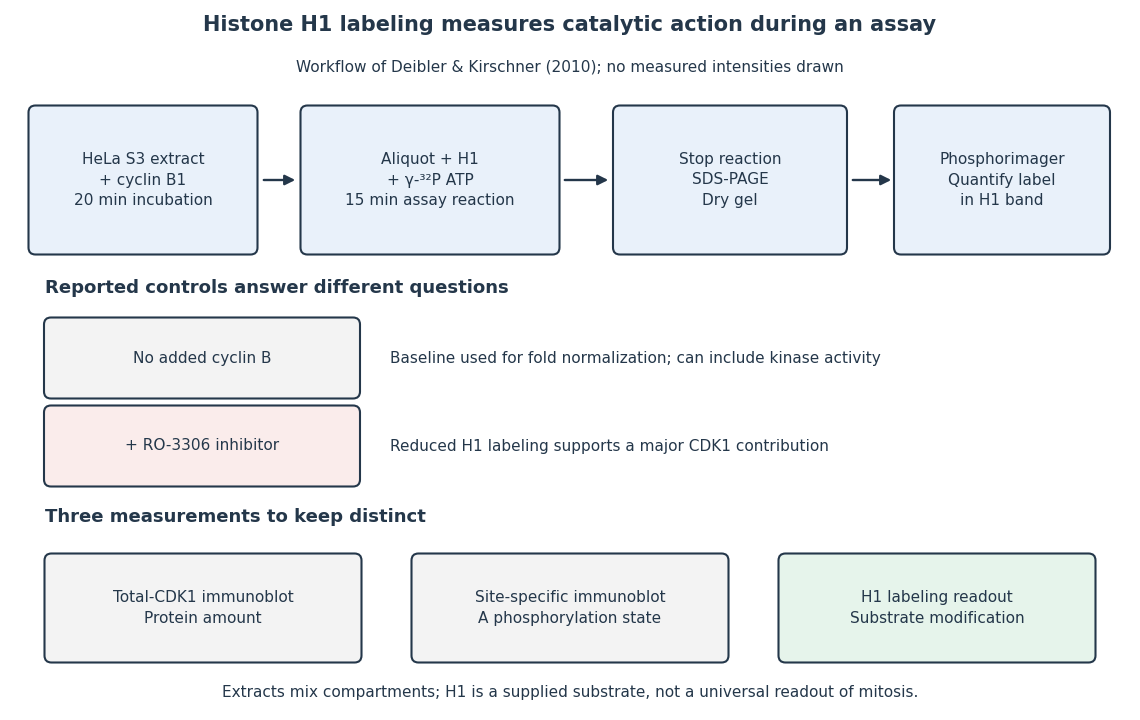
The histone H1 kinase assay: transferred label, controls and distinct protein measurements
. Original explanatory workflow of the inspected 2010 assay. The -minute extract incubation and -minute assay reaction are separate intervals. No gel lanes or measured intensities are simulated. The no-added-cyclin B baseline and RO-3306 perturbation have different purposes; neither a total-CDK1 Western blot nor a site-specific phosphorylation Western blot replaces the catalytic readout. Details.
Homeostasis Created 2026-10-13 Updated 2026-10-18
Homeostasis is the maintenance of usable internal conditions despite disturbances. It concerns selected regulated physiological variables, rather than keeping every part of an organism unchanged: core body temperature may remain near its usual range while skin temperature, sweating and blood pressure change. Regulation makes a relatively dependable environment for biological cells out of a changing external world. [ref]
1.5 Homeostasis. §1.5, opening paragraphs and Negative Feedback: normal ranges and compensatory responses
A useful causal description separates a physiological sensor, a physiological integrator and a physiological effector. The return from the physiological effector's action to the sensed regulated physiological variable closes a feedback control loop. In negative feedback, that return opposes the disturbance. The insulin and glucagon articles already trace the blood glucose example; synaptic integration explains how several inputs can jointly influence a neuron. These are implementations and ingredients, not a requirement that every regulatory loop use one anatomical control center. [ref]
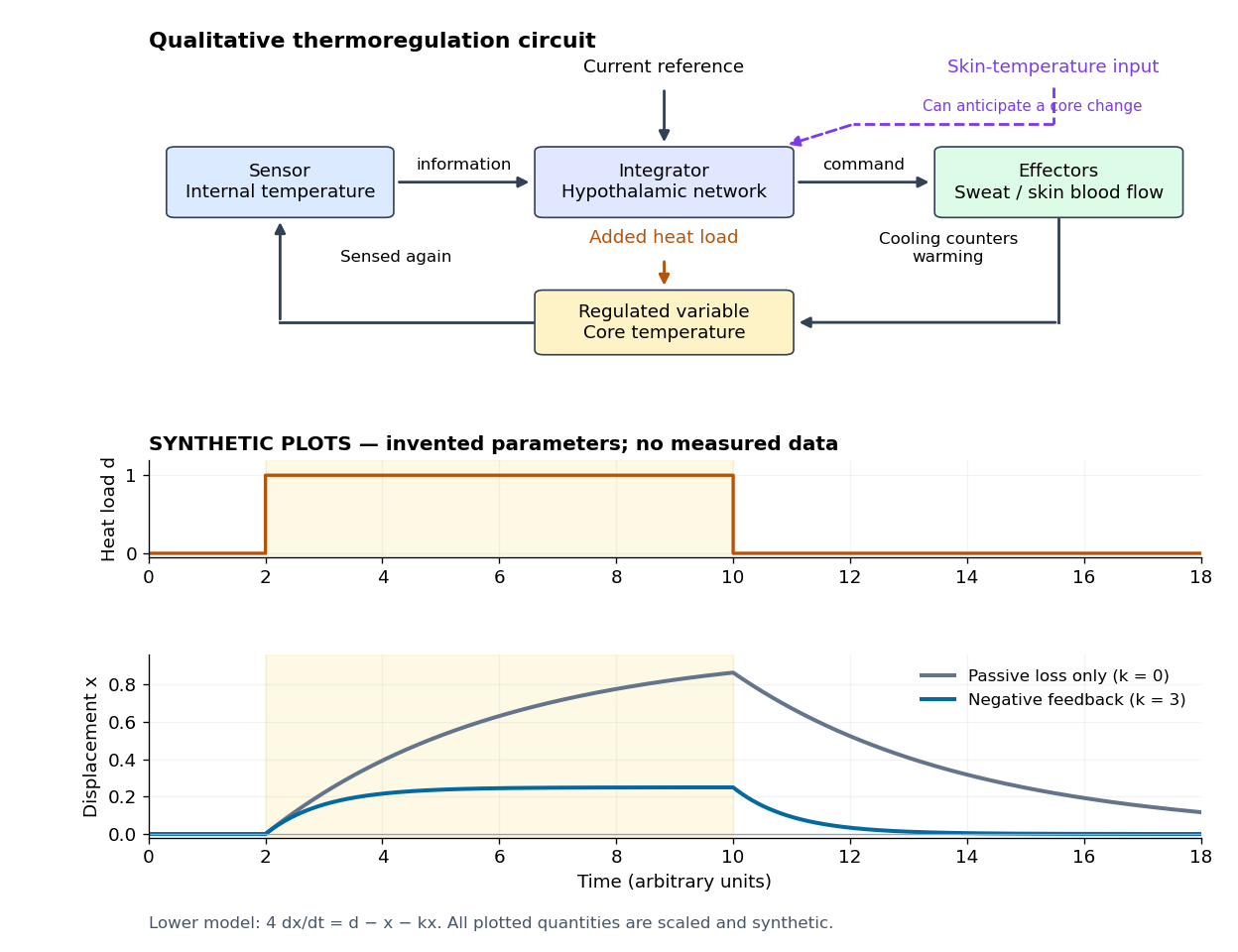

Homeostasis is useful precisely because internal activity can change: a nearly steady temperature can conceal a large increase in heat transfer. Conversely, observing a flat trace alone does not identify a regulatory mechanism. The environment might simply be constant, or the measuring instrument too insensitive; a perturbation and an independent response readout provide stronger evidence. The skin-temperature perturbation experiment below makes that distinction tangible.
The historical motivation was the puzzle of stability in changing living material. In his 1932 The Wisdom of the Body, Walter Bradford Cannon emphasized that an organism exchanges material with its surroundings and continually replaces its own structure, yet maintains relatively steady internal conditions. This authored excerpt presents homeostasis as active compensation for external and internal disturbances, rather than a static body. [ref]
Homeostasis (excerpt from The Wisdom of the Body). Homeostasis excerpt, paragraphs beginning The wonder increases, Resistance to changes and In short; hosting page identifies book and 1932 date
Homeostatic temperature model 2026-10-13
Here is an explicitly synthetic mathematical model of a warming disturbance and its compensatory cooling. It is a teaching analogy for thermoregulation, not a measured human heat budget. Write , where is a lumped internal temperature, is a fixed reference and is a chosen temperature scale. Let be an additional heating rate and an additional cooling rate, both scaled to the same reference rate. All three are dimensionless variables, while is a time constant in the chosen time units. The ordinary differential equation isThe term idealizes increased passive heat transfer with increased internal temperature, around the baseline. The term opposes warming through proportional control with feedback gain . This local signed model does not treat a negative as negative sweating: it would represent decreased cooling relative to baseline. Changes of the environment and multiple body compartments are omitted.
For a constant disturbance and initial condition , the exponential function solution isSubstitution checks the ordinary differential equation directly. Increasing reduces the lasting offset and, in this instantaneous model, shortens the response time constant to . It does not make zero for a nonzero disturbance and finite : a persistent cooling command requires a persistent displacement under proportional control. At the equilibrium point, the extra heating is balanced by passive loss plus active cooling . Zero change of temperature means balanced rates, rather than zero rates, consistent with conservation of energy.
The first diagram uses , , and a pulse from to , comparing with . The latter approaches during the pulse, compared with without active feedback control. After the pulse ends, each displacement decays as . These are computed curves, not physiological measurements. The curve still has passive loss; it is not a claim that an unregulated body warms without limit.
Real physiological effectors take time to respond. To isolate that issue, set and replace the instantaneous command by another ordinary differential equation:Here the disturbance remains from onward and the effector time constant is also . The equilibrium point is still , but the characteristic polynomial is . Its eigenvalues give decaying oscillations and asymptotic stability. The exact response isIn particular, , so the first maximum occurs at , with . The response exceeds its eventual displacement while remaining above its baseline. The return has the same negative sign as before; the extra state changes the timing. A finite effector time constant is distinct from the fixed time lag in the delayed negative feedback model.
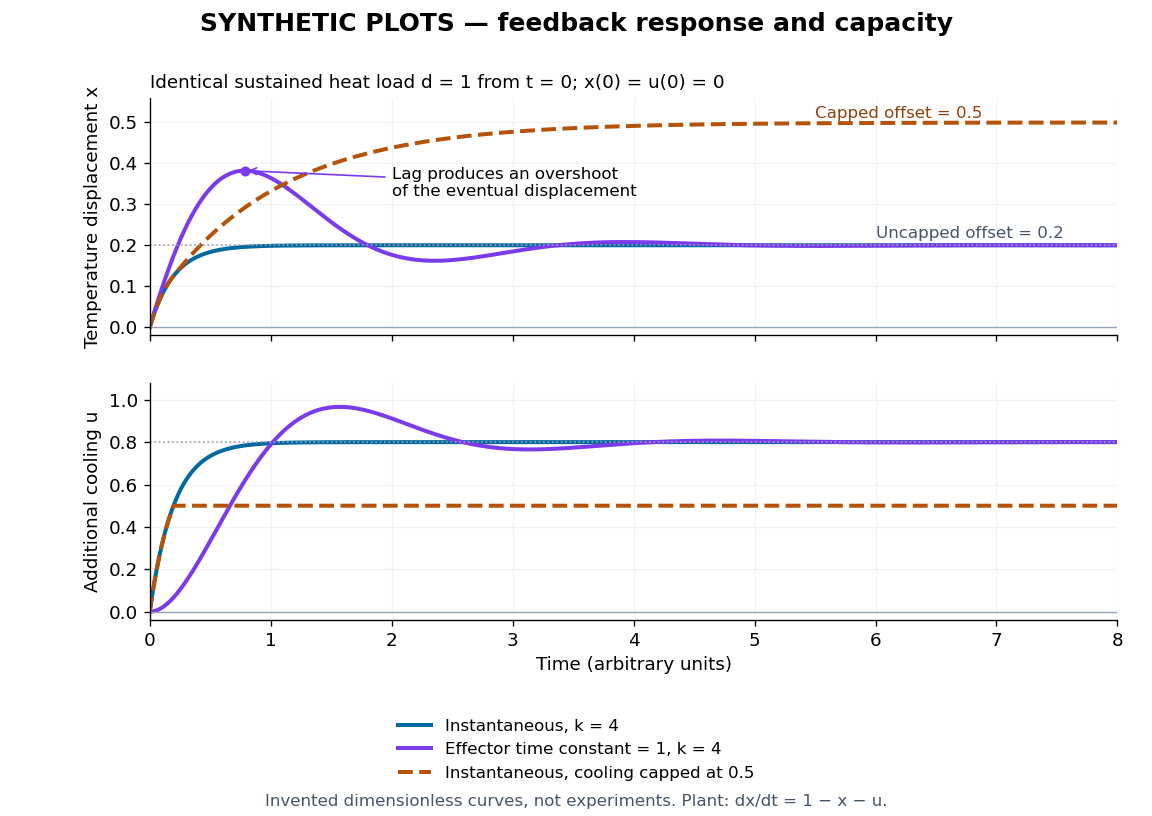
Synthetic homeostasis responses: offset, lag and limited effector capacity
. Original computed plots from the homeostatic temperature model, all in arbitrary units and explicitly labelled synthetic. Upper panel: displacement under the same sustained disturbance. Lower panel: corresponding cooling command. Instantaneous proportional control, a finite effector time constant, and effector saturation give different responses despite opposing the same disturbance. No experimental data or clinical limits are shown. Details.
Homeothermy 2026-10-20
Maintenance of a relatively constant body temperature. It differs from the metabolic source of heat described by endothermy.
Homeoviscous adaptation 2026-10-20
homeoviscous adaptation changes membrane composition in response to conditions such as growth temperature, helping preserve useful membrane dynamics. The original Escherichia coli study measured temperature-dependent fatty-acid changes and membrane-lipid viscosity by spin labeling.[ref]
Homeoviscous adaptation—a homeostatic process that regulates the viscosity of membrane lipids in Escherichia coli by Michael Sinensky. pp. 522–525, temperature-dependent composition and viscosity measurements
Homologous isothermal mass-radius relation 2026-10-20
Use the isothermal Lane-Emden equation variables , and . Truncation at fixed dimensionless radius gives and . Division proves the displayed relation. A common temperature, composition and dimensionless truncation therefore imply , while the external pressure generally varies along that homologous sequence. Arbitrary changes of truncation at fixed temperature do not retain a common coefficient. A finite regular cloud needs an outer boundary such as that of a pressure-confined isothermal sphere.
For finite-radius regular polytropes of one fixed index and composition, let be the first zero of the Lane-Emden function and . Hydrostatic scaling gives . Fixed central temperature therefore implies . This is not the fixed-entropy-constant sequence; if the index or composition changes, their prefactors cannot be discarded.
Homologous temperature 2026-10-20
The absolute temperature divided by an appropriate melting temperature, . It is a useful scale for comparing thermally activated deformation; Celsius temperatures cannot be used directly in the ratio.
Horizontal convection 2026-10-14
Horizontal convection is buoyancy-driven circulation forced by lateral variations of temperature along one horizontal boundary. Hot and cold surface regions drive a circulation even though all thermal forcing is applied at the same height. An insulated bottom and sides require zero net heat exchange through the remaining surface in steady state, but permit heat to enter its warmer region and leave its colder region.
For a unit-depth Boussinesq layer with stress-free boundary conditions, fixed boundary temperatures, imposed field along , and horizontal magnetic perturbations at the boundaries, put and . Poloidal vertical velocity, temperature and vertical field proportional to have amplitudes satisfyingThe determinant gives the stated dispersion relation. Here is the Prandtl number, the magnetic-to-thermal diffusivity ratio, the Chandrasekhar number and the Rayleigh number. The steady neutral curve is .
// Target: fluid-mechanics.bigb
Hot ionized medium 2026-10-20
Dilute shock-heated interstellar plasma with characteristic temperatures around . supernova energy injection and subsequent cooling are important to its evolution; temperature alone does not determine its volume filling factor.
Hot isostatic pressing 2026-10-20
Hot-water heating 2026-10-31
Hydraulic control of frost heave Created 2026-10-07 Updated 2026-10-14
A porous sheet of thickness and permeability of a porous medium supplies a thin premelting film. The Darcy flow law equates water supply to ice growth for equal densities. With equal film and ice conductivities, negligible latent heat relative to the through-going conductive flux, and , phase equilibrium gives . The increasing gravitational load limits growth. A quasi-steady temperature field alone does not imply the negligible-latent-heat approximation.
Hydrodynamic escape 2026-10-14
Hydrodynamic atmospheric escape is a collisional transonic outflow in which bulk gas carries multiple species away. It replaces the hydrostatic Jeans-tail description when gravity is weak compared with thermal energy.
Hydrodynamic radius 2026-10-14
The hydrodynamic radius is the radius of a hypothetical no-slip sphere with the same translational diffusion coefficient as the dissolved species. In the dilute continuum regime the Stokes–Einstein relation giveswhere is the Boltzmann constant, the absolute temperature, the dynamic viscosity of the solvent, and the translational diffusion coefficient. This effective radius need not equal the radius of gyration or a geometric molecular radius. It is a useful descriptor for SEC molar mass calibration, rather than a complete specification of how every shape enters every pore.
Hydrogen-ionization disk instability 2026-10-06
Partial hydrogen ionization changes disk cooling and permits cold and hot stable thermal branches separated by unstable equilibria. A dwarf nova can cycle between a cold matter-storing disk and a hot, rapidly accreting disk. The cycle is described by the evolution of local surface density and temperature, coupled to viscous evolution of an accretion disk.
Hydrogen rotational heat capacity 2026-10-18
Let and for the conditional distributions of parahydrogen and orthohydrogen, with . Differentiating the normalized Boltzmann factors gives . Thus the rotational heat capacity at constant volume per molecule of a composition frozen at isAt conversion equilibrium, the law of total variance adds a nonnegative contribution from the changing species populations:The last term is the contribution from conversion. Compare the first two terms with a frozen sample at the same instantaneous composition; a frozen sample generally has different weights too. This formula follows directly from the variance of a mixture: subtract the overall mean inside each species, expand the square, and the cross terms vanish because each conditional deviation has zero mean. It also proves nonnegative rotational heat capacity in either model.
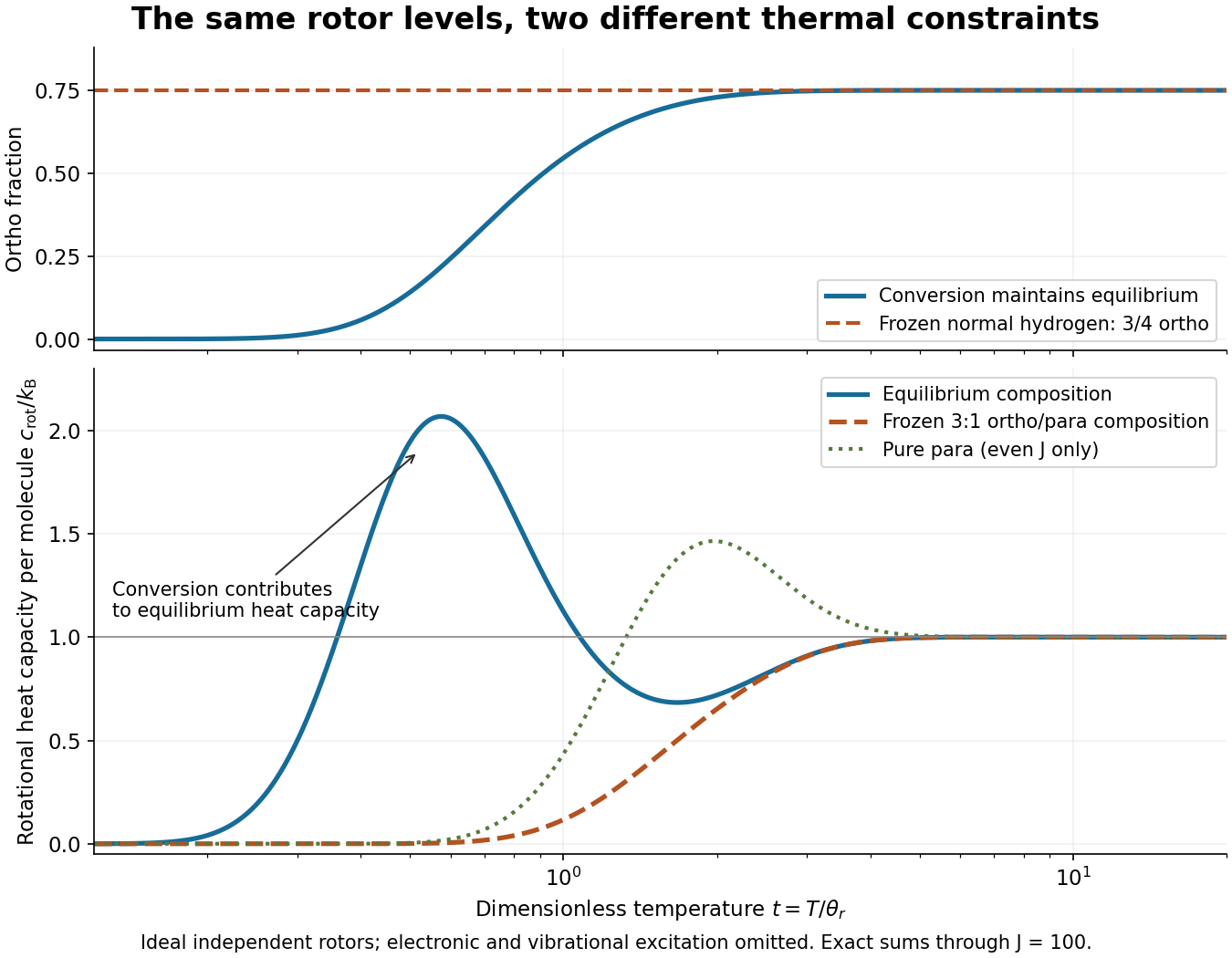

For an original worked example at , summing the allowed ladders gives , , and . The calculated rotational heat capacities are and for frozen normal hydrogen. The contrast is large because changing species accesses the to separation, whereas fixed species must use the larger to or to separations. These are model numbers at a chosen dimensionless temperature, not measured hydrogen data.
Both rotational heat capacities approach zero as , although frozen normal hydrogen retains nonzero rotational internal energy. Both approach as within the rotor model. The high-temperature limit is a formal limit with all other excitations suppressed; actual molecular hydrogen eventually needs molecular vibration, nonrigidity, and dissociation. Multiplying the per-molecule result by the Avogadro constant gives rotational molar heat capacity in units of the molar gas constant . A dilute classical ideal gas additionally contributes from translation to its heat capacity at constant volume.
Hydrometer 2026-10-31
A floating density instrument. At equilibrium, Archimedes' principle gives for fixed instrument mass , so it displaces more volume in a less dense liquid. A graduated narrow stem converts this volume change into a visible immersion reading. Calibration specifies a temperature and a reading convention for the meniscus; a sample's other dissolved substances can affect a sugar-calibrated scale.
Hydrophobic effect 2026-10-13
The hydrophobic effect is the solvent-mediated tendency of nonpolar regions to associate in water. Exposing a hydrocarbon region changes how surrounding water molecules can arrange and interact; reducing that exposure can lower the total free energy. Both water and lipids enter the accounting. The effect is not an additional covalent bond between chains. See IUPAC Gold Book: hydrophobic interaction.
At fixed temperature and pressure, compare two candidate organizations by the change in Gibbs free energy, , where is enthalpy, is absolute temperature, and is entropy. An organization with lower is favored in this comparison. Reducing exposed hydrocarbon area is one contribution; changes in chain packing and the entropy of the lipids also matter. This explains why hydrophobicity alone cannot predict every aggregate shape. See 16.4 Free Energy.