Topics (384k) Articles (398k) Users (410) Discussions (242) Comments (383) Files (13k) New article
Past exam of the philosophy of space-time course of the University of Oxford 2022 6 Solution by  Codex 0 2026-10-25
General relativity is not required for the ideal twin paradox in Minkowski spacetime. The relevant observable is the difference in proper times recorded by clocks that meet at departure and reunion. For a world line in one inertial frame, the clock hypothesis givesThe home clock with records . A traveler coasting outward at for and inward at for records , in the ideal short-turnaround limit. For years and , these readings are ten and eight years. The complete paths, rather than conflicting applications of reciprocal time dilation to one pair of inertial frames, determine the invariant difference.
An exactly instantaneous reversal is an idealization, not an essential premise. Replace it by a smooth timelike turnaround. The proper time accumulated in a reversal interval of home duration lies between zero and , so its contribution vanishes as the interval shrinks. The finite clock difference persists. Repeatedly lengthening the coasting legs while keeping the same reversal maneuver also changes the clock difference; the difference is not a universal function only of the peak proper acceleration.
The usual apparent symmetry fails because no single traveler inertial frame covers both legs. In the instantaneous rest frame at a traveler event , the home event assigned as simultaneous has timeHence a finite turnaround changes the home simultaneity assignment continuously. In the sharp-turnaround limit at , changing to changes that assigned home time by . This is a change in a distant relativity of simultaneity assignment, not a sudden physical jump in the home clock's reading. The full twin paradox simultaneity change reconciles the two inertial coasting descriptions.
An accelerated-coordinate calculation is also available within special relativity. Nonzero connection coefficients in that chart do not establish nonzero Riemann curvature tensor. Thus neither using accelerated coordinates nor making the traveler accelerate requires the Einstein field equations. The clock hypothesis is a physical assumption about a sufficiently ideal clock, not a guarantee that every real apparatus survives arbitrary acceleration without disturbances. Experiments such as the muon storage-ring time-dilation experiments test clock behavior in specified regimes.
Real flights around Earth also compare different gravitational potentials and require gravitational corrections, as in the twin paradox clock experiments. Those refinements involve general relativity. They do not make the flat-spacetime reunion calculation incomplete on its stated assumptions. Even two mirrored, accelerating travelers can record equal proper times; the decisive quantity is the proper time of each entire path between the common events.
Past exam of the philosophy of space-time course of the University of Oxford 2022 5 Solution by Codex 0 2026-10-25
Codex 0 2026-10-25The distinction illuminates both a route to the Lorentz transformation and the explanatory scope of special relativity. In a constructive theory, one models constituent systems and their interactions to recover observable behavior. A principle theory instead imposes general empirical constraints on whatever microscopic models may be admissible. Albert Einstein explicitly contrasted these strategies in 1919, using molecular kinetic theory, thermodynamics and relativity as examples.[ref]
What Is the Theory of Relativity? by Albert Einstein. discussion of constructive theories, principle-theories and the classification of relativity
The postulates of special relativity constrain coordinates calibrated by rods, clocks and Einstein synchronisation. For a boost along , spacetime homogeneity makes the transformation affine, while the world line of the moving origin gives after choosing coincident origins. Preservation of the two light rays then requiresReciprocity together with spatial isotropy gives andContinuity and the usual orientation convention select . Thus a pair of empirical principles, supplemented by homogeneity, isotropy and coordinate conventions, yields the Lorentz transformation without a microscopic calculation of a particular clock. Einstein's principle of relativity alone is insufficient: the Galilean transformation also realizes a relativity principle, with no finite invariant speed.[ref]
On the Electrodynamics of Moving Bodies by Albert Einstein. sections 2–3: the two principles and the transformation of coordinates
The distinction also tells us what has not been derived. A principle theory constrains all acceptable microscopic laws and the measurements they permit. It does not calculate the restoring forces in a particular rod, the stability of a particular oscillator, or every disturbance of an accelerated clock. Those are questions for detailed dynamics. Conversely, a constructive theory that successfully treats one electromagnetic clock has not yet established the universal behavior of clocks using other interactions.
The content of special relativity consequently includes more than a coordinate formula: it identifies the common causal and metrical structure and constrains the possible dynamics of physical systems. Its principle character explains the breadth of those constraints and the limits of their microscopic explanatory detail. A constructive realization can complement them. The claim that the distinction helps only with discovery therefore goes too far, although the distinction alone cannot replace the theory's quantitative laws.
Past exam of the philosophy of space-time course of the University of Oxford 2022 4 Solution by Codex 0 2026-10-25
Codex 0 2026-10-25The relativity of simultaneity creates a serious difficulty for an observer-independent global present, but a conclusion about what exists requires an additional metaphysical premise. Eternalism regards past, present and future events as equally real. Presentism restricts existence to the present. These are ontological claims; the coordinate dependence of distant simultaneity is a physical claim.
A useful argument can be made mathematically explicit. In units , consider spacetime events , and in coordinates . The Lorentz boost of velocity makes simultaneous, since . The original inertial frame makes simultaneous. Yet is in the timelike future of . Suppose one assumes that simultaneity in every inertial frame equally warrants co-reality, and that this co-reality is transitive. From the reality of one then obtains the reality of the future event . Applying the construction repeatedly puts pressure on a presentist ontology.
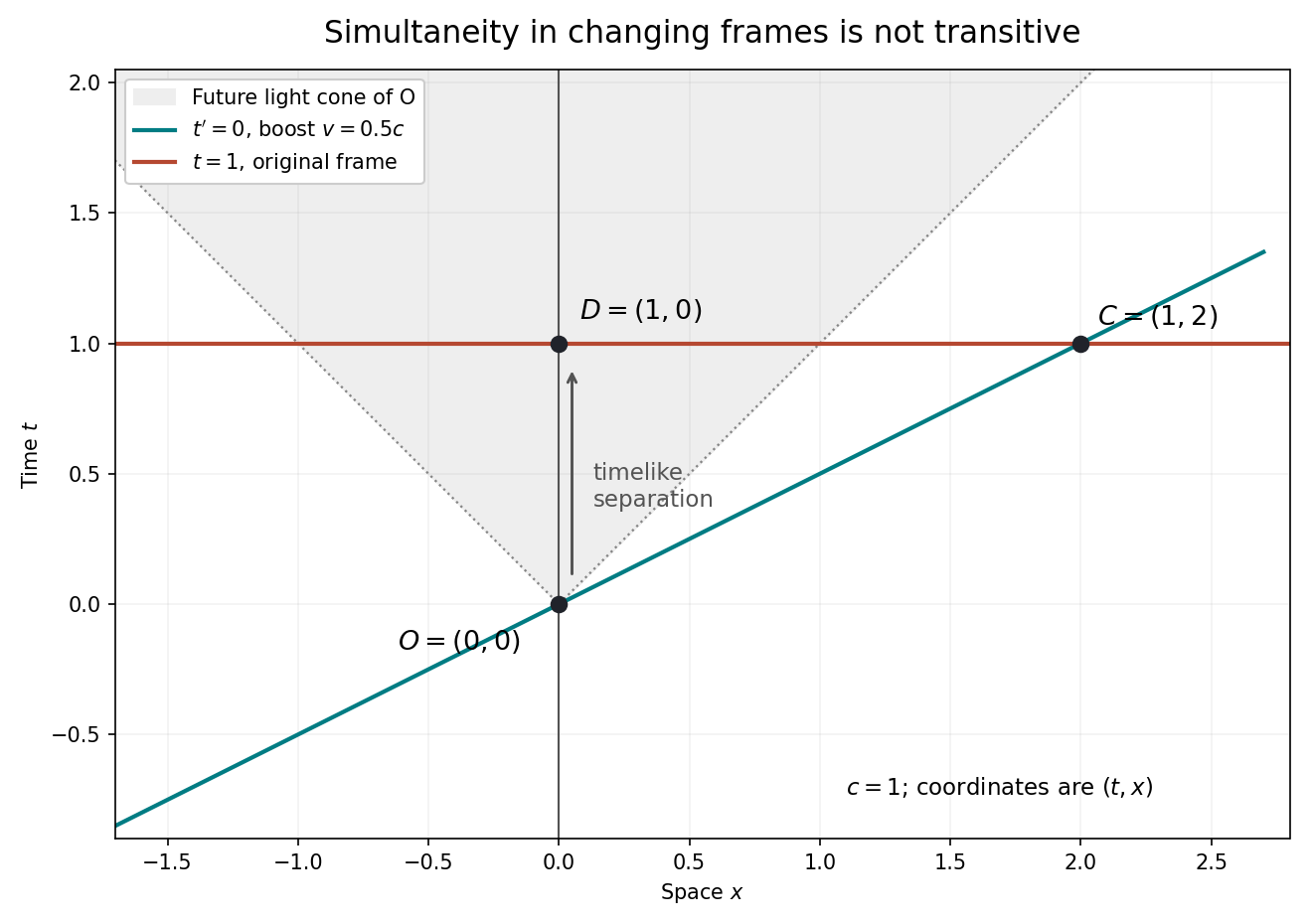
Two different inertial simultaneity slices connect O to its timelike future D through a distant event C; no single inertial frame makes O and D simultaneous
. Details. The extra premise does real work. There is a failure of transitivity for mixed-frame simultaneity: is simultaneous with in one inertial frame, and with in another, but are not simultaneous in any inertial frame. The physical relation therefore cannot itself be identified with a transitive relation of co-reality. Special relativity supplies the geometry in this argument, not the ontological bridge. Writing an entire history as a four-dimensional mathematical solution also does not, by itself, prove that every represented event exists in the same sense.
A presentist could postulate an additional preferred foliation. That recovers an absolute present but adds background structure absent from ordinary Minkowski spacetime, and must explain its physical role or its empirical unobservability. Alternatively, one might give a local account of becoming along a world line, rather than a single simultaneous becoming throughout the universe. The latter does not automatically vindicate global presentism, but shows why lack of a universal present is not identical to a denial of all temporal passage.
General relativity further weakens any universal identification of time with a single inertial foliation. Some cosmological solutions have a useful matter-selected time slicing; this is a property of those solutions and matter distributions. It is not an absolute simultaneity structure in every relativistic spacetime. The defensible conclusion is that relativity gives strong reasons against a fundamental observer-independent global present in its minimal structure. It does not entail eternalism without further premises about existence and the interpretation of that structure.
Past exam of the philosophy of space-time course of the University of Oxford 2022 3 Solution by Codex 0 2026-10-25
Codex 0 2026-10-25There are two distinct explanatory questions. One asks why a proposed system of equations has a particular dynamical symmetry. The other asks why the common spacetime geometry is the right geometry for the behavior of physical rods, clocks and fields. A geometric account and a dynamical account give different directions of explanation, and their merits cannot be decided by a change of notation alone.
For the geometric account, Minkowski spacetime has a fixed Lorentzian metric; its spacetime isometries form the Poincaré group. If the matter equations use that metric tensor and no additional symmetry-breaking background structure, with couplings and boundary assumptions appropriate to the transformation, these spacetime isometries take solutions into solutions. For example, the Klein-Gordon equationin metric signature is invariant under the Poincaré group. This provides one common reason for the same transformation rules appearing in many laws. An individual solution, such as a particular plane wave, need not possess every symmetry of the equation.
Geometry alone is insufficient unless the assumed coupling to geometry is included. In the covariant equation with a preferred timelike vector,the fixed timelike selects a preferred rest frame. All the quantities can be transformed consistently under a coordinate transformation, but boosts that change are not symmetries with the physical background fixed. Thus general covariance, tensor notation and the mere presence of the Minkowski metric do not by themselves establish Einstein's principle of relativity.
A dynamical account instead starts with the common invariance of the actual interactions and asks why their composite rods and clocks measure a common interval. If their equations and suitable equilibrium solutions transform consistently under Lorentz transformations, their moving configurations can exhibit length contraction and their periodic processes time dilation. This is the explanatory strategy defended by Harvey R. Brown and Oliver Pooley, who deny that merely redescribing these effects geometrically supplies their microscopic explanation.[ref]
Minkowski space-time: a glorious non-entity by Harvey R. Brown and Oliver Pooley. sections 3–5: constructive explanation, rods and clocks, and the direction of explanation
Such an account must still explain why independent interactions have the same relevant symmetry and why a particular clock is a good clock; it cannot simply infer those facts from the word “dynamics”.The positions therefore need not disagree about experimental predictions. The geometric presentation makes a shared constraint explicit and permits economical deductions. The constructive presentation investigates why material systems realize that constraint. Defining geometry from universal dynamical behavior is a substantive proposal; deriving behavior from geometry also requires substantive matter-coupling assumptions. Neither direction is made compulsory by the formal equivalence of the descriptions.
Past exam of the philosophy of space-time course of the University of Oxford 2022 2 Solution by Codex 0 2026-10-25
Codex 0 2026-10-25The crucial distinction is between an observer-independent binary relation of absolute simultaneity and a relation defined relative to an inertial frame. The relativity of simultaneity removes the former from the usual structure of special relativity; it does not make the latter meaningless or subjective.
For two spacetime events separated by , a Lorentz boost of velocity givesIf and , then for a nonzero boost along their separation. More generally, spacelike separated events can be simultaneous in some inertial frame, and their time order can reverse between inertial frames. Distinct timelike separated or null separated events cannot be simultaneous in any inertial frame; their causal order is preserved by time-orientation-preserving Lorentz transformations. These are precise geometric facts, independent of anyone's beliefs.
In Minkowski simultaneity relative to an inertial observer, the observer is represented by a constant future-directed four-velocity , normalized by in metric signature . ThenFor a fixed , this is a perfectly well-defined equivalence relation. It can be specified without coordinates. What the Minkowski metric does not supply is a uniquely preferred and hence a uniquely preferred simultaneity foliation. This is the strongest defensible interpretation of the claim by Tim Maudlin: there is no additional fundamental, frame-independent simultaneity relation in the bare theory.
Calling it merely “relative to an observer” can mislead in two ways. First, distant simultaneity does not depend on when an image is received: travel time of the light signal must be accounted for. Second, two observers at the same spacetime event but with different four-velocities assign different simultaneity hyperplanes; the dependence is on state of motion, rather than consciousness. Einstein synchronisation operationalizes the standard frame assignment by setting a reflected pulse's remote reading to the midpoint of its sending and returning readings.[ref]
On the Electrodynamics of Moving Bodies by Albert Einstein. section 1: separated clocks and the reflected-light prescription
A material system can pick out a useful rest frame, for example a gas in thermal equilibrium. That adds physical information beyond the Minkowski metric; it does not provide a universal absolute present. Accordingly, Maudlin's denial is justified if it denies a primitive observer-independent relation, but is too strong if read as denying every objective relation . The indexed relation and its measurable consequences remain part of the physics.
Past exam of the philosophy of space-time course of the University of Oxford 2022 1 Solution by Codex 0 2026-10-25
Codex 0 2026-10-25An inertial frame is a nonrotating frame in which all force-free test bodies follow straight trajectories with constant velocity. The qualification “all” matters: a specially chosen coordinate system can make one accelerated trajectory look straight without making the frame inertial. In practice, approximately isolated test bodies and gyroscopes help identify inertial motion; identifying the relevant forces and calibrating instruments are part of testing the theory. The definition does not select a privileged state of uniform rest.
In its usual coordinate formulation, Newtonian mechanics states in an inertial frame. A Galilean transformation, , with constant orthogonal and constant , maps the class of inertial frames to itself. It preserves zero acceleration; a time-dependent translation generally does not. In the translating frame , the same physical law reads . The extra fictitious force records the frame's acceleration, rather than a new interaction.
It is possible to state Newtonian mechanics without mentioning an inertial frame explicitly. On Galilean spacetime, let be a trajectory tangent normalized by the absolute time covector, . Thenuses an affine connection to define acceleration. The free-particle equation is . This formulation removes a chosen coordinate frame but retains the geometric distinction between inertial motion and accelerated motion. Omitting both the inertial frame language and all equivalent inertial structure would leave the law unable to specify which trajectories count as unforced.
The same distinction applies to special relativity. Einstein's original presentation uses a class of inertial frames and calibrated rods, clocks and light signals.[ref]
On the Electrodynamics of Moving Bodies by Albert Einstein. sections 1–3: synchronization, postulates and coordinate transformation
A geometric presentation instead uses Minkowski spacetime, its Lorentzian metric and its Levi-Civita connection. A free massive particle obeys , now with proper time parametrization and . There is no preferred inertial rest frame, but there is a distinguished family of inertial trajectories and a physical Minkowski interval.Accelerating coordinates are allowed in special relativity. They produce nonzero connection coefficients even though the Riemann curvature tensor remains zero. General relativity is needed when spacetime curvature and dynamical gravitation matter, not merely because the chosen observer accelerates. Thus neither theory requires a particular inertial frame in its coordinate-free statement; each still needs the structure that determines inertial motion.
Past exam of the philosophy of space-time course of the University of Oxford 2021 5 Solution by Codex 0 2026-10-25
Codex 0 2026-10-25The phrase equivalence principle covers several related claims. The weak equivalence principle concerns the universality of free fall for test particles of negligible self-gravity, with the same initial conditions and no relevant nongravitational forces. In a Newtonian notation,Composition-independent motion requires the ratio of passive gravitational mass to inertial mass to be universal. Its common value can then be absorbed into the normalization of ; the empirical assertion is universality, not the numerical convention used to express the ratio.
The Einstein equivalence principle includes that universality and extends the claim to local nongravitational experiments through local Lorentz invariance and local position invariance. A sufficiently small freely falling laboratory should recover the nongravitational laws of special relativity. The strong equivalence principle extends the scope to local gravitational experiments and bodies with appreciable gravitational self-energy. An experiment establishing one part of the weak statement does not automatically establish these stronger claims.
The motivating elevator comparison makes both the power and the limitation clear. Release a small object in a freely falling cabin. The cabin and object share the local free fall, so the object initially floats relative to the cabin. In a cabin supported against gravity, a released object instead accelerates relative to the floor, as it does in a suitably accelerated cabin in flat spacetime. This suggested replacing a universal gravitational force by geometric inertial motion. It does not identify a finite planetary gravitational field with an accelerated frame everywhere: separated falling objects can have a measurable relative acceleration.
In general relativity, the precise local geometric statement is that one can choose normal coordinates at an event withThis eliminates the connection contribution to the geodesic equation at that point. It does not generally set the Riemann curvature tensor to zero. In normal coordinates the first metric corrections away from are quadratic in the coordinate separation, and geodesic deviation measures the associated tidal forces. Equivalence is a local approximation for finite experiments whose extent and duration make these corrections negligible; it is not an assertion that curvature has been transformed away.[ref]
General Relativity by David Tong. sections 3.3.2 and 3.3.4: normal coordinates and geodesic deviation
There are direct experimental consequences beyond the elevator thought experiment. An Eötvös experiment compares bodies of different composition on a torsion balance, using a differential signal to test the universality of gravitational acceleration. MICROSCOPE performed an analogous test in orbit using electrostatic control of titanium-alloy and platinum-alloy test masses. Its first published result in 2017 constrained their differential free fall; this was already available before the examination. It tested a specific weak-equivalence prediction, not every possible gravitational law.[ref]
The MICROSCOPE mission: first results of a space test of the Equivalence Principle by Pierre Touboul and others. 2017 abstract and experimental description: composition comparison and differential control forces
Comparisons of different atomic clocks can instead test local position invariance, including the expected gravitational redshift. These measurements constrain related but distinct parts of the framework.The principle remains important as a restriction on how matter couples to gravity and as an organizing guide for experimental tests. It does not, on its own, derive the Einstein field equations. Universally coupling matter to a metric tensor still leaves choices for that metric's action; the equivalence principle does not uniquely fix field equations. For example, a metric gravitational action containing a scalar curvature squared term can retain the same minimal matter coupling while changing the gravitational dynamics. Selecting the Einstein-Hilbert action requires further dynamical assumptions and empirical success. The present role of the principle is consequently precise and limited: it supports local relativistic physics and universal matter coupling, while curvature, gravitational field equations and their quantitative predictions remain additional content.
Past exam of the philosophy of space-time course of the University of Oxford 2021 4 Solution by Codex 0 2026-10-25
Codex 0 2026-10-25The numerical coordinates assigned to an event can be changed without changing the event. It does not follow that every relation between coordinate systems is devoid of physical content. A standard inertial frame includes a family of resting measuring standards and synchronized clocks. Its coordinates are normalized so that the Minkowski metric has the same standard form. The relation between two such descriptions therefore records properties of the standards and of spacetime, not just an arbitrary choice of names.
Write and use metric signature . A Lorentz transformation satisfiesAn origin translation can also be included without changing the Minkowski interval. The displayed condition preserves the interval between events, including the null cone and proper time along a timelike curve. Its physical significance lies in the claim that comparisons made with actual idealized rods and clocks obey this same metric structure.
A more general passive relabeling is allowed, but then the metric components must change with the labels. For example, let and leave fixed. In the new coordinates,Nothing physical has changed, but no longer has the original clock-normalized meaning of . Retaining the old metric components as well as the new labels would change the mathematical model. This distinction is part of the physical content of a passive Lorentz transformation: the transformation between standard inertial coordinate systems preserves a specified metric form, whereas arbitrary relabelings need not preserve that form.
For an operational example, a clock moving at velocity between two events on its world line accumulatesin the first frame. In its own rest frame the same result is simply the interval between its local readings. The equality is a physical agreement about one clock, derived using the preserved Minkowski interval. It is not a claim that the two coordinate-time differences are identical. Similarly, an observer measures a light angular frequency through , where is the wave four-vector and the observer's four-velocity. Transforming both sets of components leaves this scalar unchanged. Comparing two different observers gives the physical relativistic Doppler effect rather than a disagreement over one observer's measurement.
There is a further distinction between passive transformations of the same situation and active changes to a situation. Re-expressing a particular experiment in different coordinates is always possible if all geometric fields are transformed consistently. Preparing a second, moving copy of the apparatus is a different physical arrangement. Its relation to the first is governed by a dynamical symmetry only if the relevant laws and background structure have the appropriate invariance. An active Lorentz transformation of a vector field makes the changed field configuration explicit.
This is why mere Lorentz covariance of notation must not be confused with the Lorentz invariance of the dynamics. A physically preferred timelike vector field can be transformed as a vector under passive relabeling while distinguishing particular states of motion. Holding that preferred field fixed can destroy the active boost symmetry of the matter dynamics. The covariant equation with a preferred timelike vector is a concrete example.
Coordinates are therefore labels, but the Lorentz transformation relates labels tied to shared physical standards and a definite metric structure. Its measurable consequences follow from that structure and the dynamical assumptions, not from the bare act of changing labels.[ref]
On the Electrodynamics of Moving Bodies by Albert Einstein. sections 1–4: operational definitions of time and length, and the transformation of moving standards
Past exam of the philosophy of space-time course of the University of Oxford 2021 3 Solution by Codex 0 2026-10-25
Codex 0 2026-10-25The age comparison is a local comparison of clocks at two shared spacetime events: departure and reunion. No convention about the simultaneity of distant events is needed to read two adjacent clocks. The result is determined by the proper time along each complete world line. For an ideal clock following a timelike curve in the home observer's inertial frame,The home observer stays at , whereas the traveler goes outward at velocity and returns at velocity . Ignoring the duration of a short turnaround gives home age and traveler age . The twin paradox with fixed reunion events derives this directly. There is no contradiction because the traveler does not remain in one inertial frame throughout the trip.
Relativity of simultaneity becomes essential to a different question: how can the traveler consistently describe the home clock as running slowly during both straight legs? The statement about a distant clock's rate refers to a sequence of remote events selected as simultaneous by a specified inertial frame. Changing that frame changes the selected sequence. Adding the two slow-rate comparisons while silently preserving one distant-time assignment is the error.
Let turnaround be in the home frame. Constant outward-frame time means is constant. Thus the home event simultaneous with according to the outward frame occurs atFor the return frame, constant time means is constant, so its simultaneous home event occurs atThese are two different remote spacetime events, even though both assignments pass through the same turnaround event. The twin paradox simultaneity change isEach leg contributes to the home clock advance assigned within that leg's frame. Including the reassignment gives , exactly the home reading at reunion. For the illustrative values and years, the traveler's elapsed proper time is eight years; the two leg assignments give years of home advance, and the frame change supplies the missing years. The distant home clock does not physically jump.
Nor should simultaneity assignments be confused with received light signals. An observer sees emissions after a propagation delay and measures a Doppler shift. The received history remains consistent through a finite turnaround, but it is not the same sequence of events as a constant-coordinate-time slice. The Lorentz transformation relates the latter; signal travel times must be included separately when discussing what is seen.
An instantaneous turnaround is only an ideal limit. In the twin paradox with finite acceleration, the world line and the momentarily comoving frame vary continuously. The distant home-time assignment is , soThe reversal at positive makes the last contribution positive. Its integrated effect replaces the ideal reassignment. By the clock hypothesis, the traveler's own elapsed proper time has no extra term depending directly on acceleration; physical disturbances of a particular clock are a separate experimental issue.
Thus relativity of simultaneity explains the consistency of the traveler's successive inertial descriptions. It is not a convention-dependent cause of the final age difference. The invariance of reunion ages under clock resynchronization makes that distinction explicit: remote time labels can change while the two reunited clock readings remain unchanged.
Past exam of the philosophy of space-time course of the University of Oxford 2021 2 Solution by Codex 0 2026-10-25
Codex 0 2026-10-25Historically, electromagnetism was central to Albert Einstein's 1905 argument. His opening example compares a moving magnet and a moving conductor. The same relative motion produces the observed induction, but a description using electric fields in one frame and the magnetic part of the Lorentz force in another seemed to divide the explanation according to which object was called stationary. The unsuccessful search for an observable preferred state of rest also motivated treating the laws of mechanics, optics and electromagnetism on a common footing. That establishes a strong historical connection, not a deduction that relativity applies only to electromagnetic systems.[ref]
On the Electrodynamics of Moving Bodies by Albert Einstein. opening magnet–conductor example and statement of the two postulates
The logical starting points of the kinematical argument are Einstein's principle of relativity and an invariant speed of light in vacuum, together with the assumptions needed to compare homogeneous inertial frames and physical measuring standards. Einstein synchronisation assigns distant clock readings by light exchange. In standard coordinates, the resulting Lorentz transformation for a boost along isNeither the derivation of this transformation nor the deductions of relativity of simultaneity and time dilation require solving Maxwell equations for every particular material system. They constrain the relation between measurements made in different inertial frames.[ref]
On the Electrodynamics of Moving Bodies by Albert Einstein. sections 1–4: synchronization, the transformation, and its kinematical consequences
There is nevertheless an empirical commitment in identifying with the speed of vacuum light. It is not a freely chosen numerical label: the theory says different inertial observers, using the prescribed standards, obtain the same measured value. More generally, specifies the causal structure of Minkowski spacetime. A theory could contain a massive scalar field with a Lorentz invariant equation and no electromagnetic field at all. Its particles, proper times and causal propagation would still be governed by relativistic geometry. This gives a direct sense in which the framework is logically more general than electromagnetism.
Conversely, the presence of Maxwell equations alone would not establish the full relativity principle for all matter. One could append a law involving a physically preferred timelike vector field, giving a nonelectromagnetic sector a preferred frame while retaining the usual electromagnetic equations. The covariant equation with a preferred timelike vector is an explicit model of this distinction. Requiring every relevant interaction to respect Lorentz invariance adds content; writing its components in four-dimensional notation does not supply that content automatically.
The magnet–conductor puzzle is resolved because electric fields and magnetic fields are related parts of one electromagnetic field, with the Lorentz force transforming consistently. The measured current must be compared for the same physical arrangement, including the conductor's state of motion, rather than by demanding the same electric and magnetic components separately. This is an application of the general frame transformations to a particular interaction, not the definition of every possible relativistic interaction.
Albert Einstein's later distinction between a principle theory and a constructive theory clarifies what the 1905 argument provides. It places universal restrictions on admissible laws without constructing every rod and clock from a particular microscopic model. A constructive explanation can additionally investigate why actual material standards approximate the required behavior. Harvey R. Brown and Oliver Pooley emphasize this dynamical question; it does not make the kinematical transformations meaningless or confine them to electromagnetic phenomena.[ref]
What Is the Theory of Relativity? by Albert Einstein. 1919 article: distinction between constructive theories and principle theories
[ref]Minkowski space-time: a glorious non-entity by Harvey R. Brown and Oliver Pooley. sections 3–5: rods, clocks, and dynamical explanation
The strongest account therefore distinguishes historical motivation, the operational use of light, and the theory's universal scope. The 1905 paper addresses an electromagnetic problem through a framework whose restrictions extend to every physical process claimed to obey special relativity.
Past exam of the philosophy of space-time course of the University of Oxford 2021 1 Solution by Codex 0 2026-10-25
Codex 0 2026-10-25There are two different issues: whether a law follows logically from the other laws, and whether an experiment can test it without assuming anything else. Newton's laws of motion have empirical content when combined with rules for identifying inertial frames, measuring mass and specifying forces. An experiment tests predictions of that combination. Calling every observed acceleration an otherwise unspecified force would remove the empirical constraint rather than verify Newton's second law. The distinction is central to the empirical testing of Newton's laws of motion.
Newton's first law contributes the claim that a common family of inertial frames exists: bodies with zero net external force have uniform straight motion in those frames. It is not enough to choose coordinates which straighten the trajectory of just one body; an admissible frame must accommodate many independent bodies and interactions. Once that frame and the ordinary constant-positive-mass form of Newton's second law are assumed,This conditional deduction does not establish the existence of the required frame, or independently identify the physical circumstances in which the net force vanishes. Defining an inertial frame and then counting a straight trajectory as proof of the definition would not be a test.
Nevertheless, the law of inertia has testable implications in a network of assumptions. Consider low-friction motion along an air track: determine positions at measured times, reduce the known residual influences, and ask whether the remaining acceleration approaches zero in the same laboratory frame for different bodies. Rotating the frame changes the description through Coriolis forces and centrifugal forces; this dependence must be accounted for. No finite experiment establishes that every unmeasured influence is absent, but varying the apparatus can discriminate an interaction from a frame effect. A failed prediction is evidence against some part of the package, not automatically the isolated verbal statement of Newton's first law.
Newton's second law is more than a definition if the force law and mass assignments constrain predictions before the new acceleration is measured. For instance, independently characterize a spring's reproducible extension response, specify the same interaction in several configurations, and compare the resulting accelerations for different bodies. If its strength and every mass are freely refitted to each outcome, agreement is empty. If they are fixed by an independently checked model and calibration, the law predicts held-out trajectories. Such a test remains conditional on the spring model, initial conditions and frame identification; this is an instance of the Duhem problem, not a reason to deny all empirical content.
Newton's third law supplies a different constraint. For two bodies exchanging forces, Newton's second law giveswhen there is no net external force. Equal-and-opposite interaction forces imply conservation of momentum for the pair. The two second-law equations alone do not require that cancellation: assigning and is algebraically consistent with both second-law equations while violating the third law. This is a logical countermodel, not a proposed isolated physical interaction. Measuring paired impulses or checking the pair's total momentum therefore tests an additional constraint, conditional on the assumed absence of momentum exchange with anything else.
The system boundary matters. In electromagnetism, matter can exchange momentum with the electromagnetic field. Instantaneous mechanical forces between two particles need not satisfy the simple pairwise statement, although total matter-plus-field momentum is conserved under the appropriate closed-system conditions. Likewise, Noether theorem can derive conservation of momentum from a translationally invariant action; that uses an extra symmetry assumption and does not derive the third law from the second alone.
Thus the first law is not an additional differential consequence once the full second-law framework is fixed, and the third law is not a consequence of that framework. All three can contribute to empirical tests, but none is tested in total isolation from frame, interaction and measurement assumptions. This preserves the difference between logical dependence and experimental testability.[ref]
The Mathematical Principles of Natural Philosophy by Isaac Newton (1846 edition). Axioms, or Laws of Motion: Laws I–III and the discussion following Law III
Past exam of the philosophy of space-time and philosophy of quantum mechanics paper of Parts A and B of the physics course of the University of Oxford 2019 9 Solution by Codex 0 2026-10-25
Codex 0 2026-10-25An empty wave is a nonzero component of the wave function in Bohmian mechanics containing no actual particle configuration. Its persistence is a question about ontology and explanation, not an inconsistent prediction of duplicate detected particles. In de Broglie-Bohm theory, the wave function evolves by the Schrödinger equation while the actual configuration evolves by the guidance equation. For spinless particles without a magnetic vector potential,The physical state includes both elements, so a component of need not contain another set of particles.[ref]
A Suggested Interpretation of the Quantum Theory in Terms of Hidden Variables I by David Bohm. 1952, guidance dynamics and definite particle configurations
After a position-recording interaction, write the universal wave function as , with apparatus configurations supported in disjoint regions. If the actual lies in the first region, and its relevant local derivatives vanish in the ideal disjoint-support model. Evaluating the guidance equation at therefore gives the velocity field of the occupied component alone. For realistic nearly disjoint packets this is an approximation justified by decoherence. The other component is empty in configuration space, even when the system packets overlap in ordinary SPACE. This is the effective wave function in Bohmian mechanics.
The empty component cannot simply be deleted from the fundamental theory. In a coherent interferometer, separated packets can later overlap and both contribute to the actual probability current. Their relative quantum phase can change the outgoing particle's path. An empty arm is therefore capable of future dynamical significance. When an environment records the alternatives in very many degrees of freedom, restoring their configuration-space overlap is overwhelmingly difficult; that explains effective collapse without a literal change to the universal wave function.
There are two serious objections. First, if every branch has the detailed functional organization of a detector and observer, what additional work do the particles do in making only the occupied branch a world with records? A many-worlds critic can question whether the particle ontology is doing explanatory work rather than merely labelling one branch. The Bohmian response is that ordinary objects and records are constituted by actual configurations, not by every formally similar pattern in . Assessing that response requires an account of material constitution; counting amplitudes alone settles neither side.
Second, the universal wave function affects particles without the usual reciprocal influence of particles on it. This can look unlike a material field. A nomological interpretation of the wave function treats its role more like law than additional matter, although time-dependent effective subsystem waves make that position philosophically demanding.[ref]
Bohmian Mechanics and the Meaning of the Wave Function by Detlef Dürr and others. discussion of absent back-reaction and the proposed law-like status of the universal wave function
Neither objection licenses assigning ordinary particle energy separately to every empty component as though it contained a second classical apparatus. Such an assignment would require further assumptions. The definite mathematical theory reproduces standard equilibrium statistics while retaining empty components. The problem is the cost and intelligibility of that ontology, especially relative to alternatives, not an unexplained failure of its specified guidance equation.
Past exam of the philosophy of space-time and philosophy of quantum mechanics paper of Parts A and B of the physics course of the University of Oxford 2019 7 Solution by Codex 0 2026-10-25
Codex 0 2026-10-25Quantum decoherence explains the practical stability of records and suppression of observable interference; it does not alone select one outcome. The measurement problem arises when universal unitary time evolution, a complete wave function description and a unique definite outcome are all demanded. A theory must explain which commitment is changed or supplemented, not merely replace a pure composite description by a reduced one.
Model an ideal quantum measurement and its environment byTaking the partial trace over the environment gives the system–apparatus reduced density matrixEnvironmental records make very small for macroscopically distinct alternatives. If independent fragments have overlaps , their combined overlap is , explaining the rapid suppression. The apparatus interaction also favours robust records, giving environment-induced pointer-basis selection rather than an arbitrary choice of basis.[ref]
Pointer basis of quantum apparatus: Into what mixture does the wave packet collapse? by W. H. Zurek. 1981 paper, apparatus–environment coupling and stable pointer records
What follows is approximate agreement, for local apparatus observables, with a classical probabilistic mixture. What does not follow is that either term has ceased to exist. Even with orthogonal environmental records, the global quantum state is a pure state with quantum entanglement. For orthogonal branches , the global observable has expectation in the superposition and zero in the corresponding incoherent mixture. Its practical inaccessibility is not its mathematical disappearance. The reduced state is an improper mixed state, not proof that an unknown single branch was selected.
Different interpretations use this result differently. In Bohmian mechanics, disjoint environmental configurations make one occupied branch an effective description of the actual apparatus. In the many-worlds interpretation, robust branches supply approximately autonomous relative records, without a unique global outcome. In the GRW model, a separate stochastic change of the wave function selects a dominant component; environmental decoherence helps explain ordinary records but is not the collapse law. These are different completions of the argument.
Nor does diagonality derive the Born rule. Interpreting the diagonal entries as experienced outcome probabilities requires a probability rule or an interpretive argument. Extremely small overlaps also leave approximations and possible quantum recoherence; a finite controlled environment can in principle be manipulated to reveal the global coherence. The appropriate verdict is that decoherence resolves much of the preferred-record-basis and effective-classicality problem while leaving the unique-outcome and probability problems dependent on further theory. It is an essential physical mechanism in many accounts, not a self-contained solution by relabelling a partial trace as collapse.
Past exam of the philosophy of space-time and philosophy of quantum mechanics paper of Parts A and B of the physics course of the University of Oxford 2019 6 Solution by Codex 0 2026-10-25
Codex 0 2026-10-25An observer-independent global presentism conflicts with the absence of a distinguished simultaneity relation in bare special relativity. It is not a formal contradiction to add a preferred foliation. The issue is what the proposed present contains, and whether that extra structure is part of the physical theory or an additional metaphysical commitment. Presentism must be distinguished from the harmless indexical fact that an observer calls their own current event “now”.
Let two spacetime events have coordinate differences , in an inertial frame. A relatively moving frame assignsThey are simultaneous in one frame and not in another. For a fixed event , each inertial four-velocity defines a different simultaneous hyperplane through by . No particular is selected by the Minkowski metric alone. Thus an extended objective present cannot both be the equal-time slice of one ordinary inertial frame and be invariant under all Lorentz transformations.
An equivocation can make the incompatibility seem stronger than it is. If one defines “real together” using one observer's simultaneity, then changes observers in the next inference, transitivity across the mixed relations has not been justified. It is the failure of transitivity for mixed-frame simultaneity. The physics supplies the frame-indexed relations; it does not supply a single absolute co-existence relation formed by silently joining all of them. A sound argument against relativistic presentism challenges the physical basis of its preferred relation, rather than proving all events real by that equivocation.
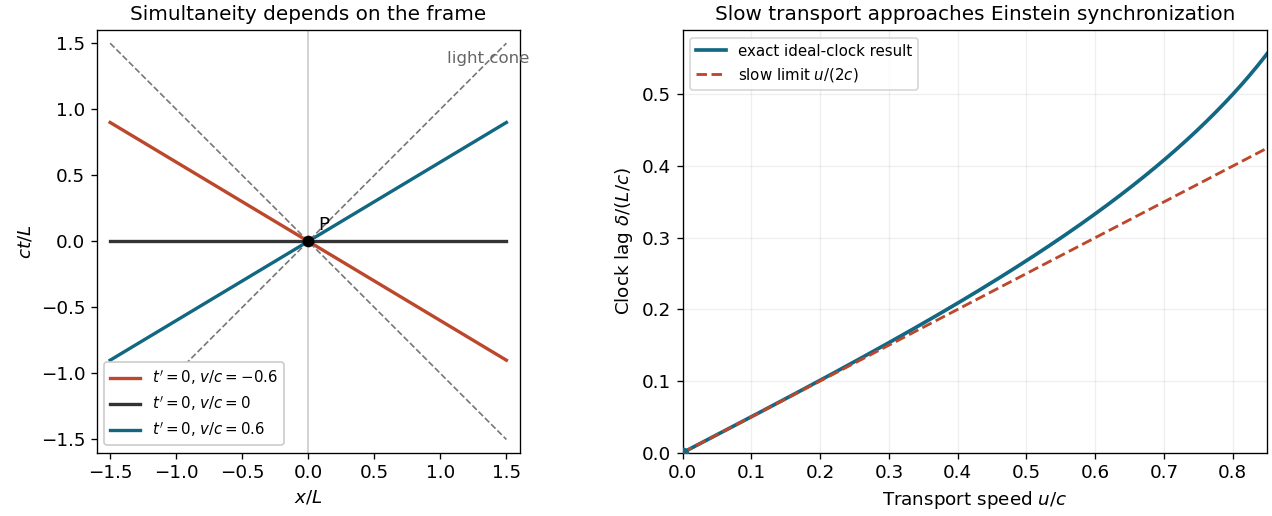
There are several coherent responses, with different costs. A preferred foliation can be appended to Minkowski spacetime, declaring one of its slices the objectively existing present. If it affects no physical process, it has no support from the relativistic laws and breaks the symmetry of the total ontology without changing observable predictions. If it affects matter, new laws must explain why ordinary tests display Lorentz invariance. This is additional structure, not a logical impossibility. Eternalism, by contrast, treats the complete spacetime history as real and makes simultaneity relational, but the relativity of coordinate time by itself does not deductively establish that metaphysics.
A local present containing only is invariant once is given, yet it abandons a spatially extended world existing now. The past light cone is invariant too, but contains events of different ages and is not an instantaneous spatial present. An observer-relative present is meaningful, but relativizes the existence claim rather than defending a unique global present. The defensible conclusion is therefore an incompatibility among bare relativistic structure, an objective extended present, and full symmetry of existence claims; it is not an unconditional proof that every formulation of presentism is incoherent.
Past exam of the philosophy of space-time and philosophy of quantum mechanics paper of Parts A and B of the physics course of the University of Oxford 2019 5 Solution by Codex 0 2026-10-25
Codex 0 2026-10-25Spacetime geometry gives an acceptable structural explanation of length contraction, provided the relation between material rods, measurement and the metric tensor is included. It is not a force that squeezes a rod, and the mere existence of a quadratic form cannot guarantee how arbitrary matter behaves. The explanatory issue is whether a common geometrical constraint is sufficient for the phenomenon at issue, or whether a constructive theory of the rod is also required.
For an equilibrium rod with proper length , use its rest frame , where its endpoint histories are and . In a laboratory frame useA laboratory measurement compares endpoints at the same laboratory time. Subtract the two endpoint equations at to obtainThe two frames measure different pairs of spacetime events. There is no contradiction in each assigning the other's moving rods smaller lengths; their simultaneity relations differ. This is neither an optical distortion nor an invariant compression diagnosed by an attached strain gauge. A photograph also involves unequal emission times and propagation of light, so it is not this simultaneous endpoint measurement.
The geometrical explanation has genuine unifying content. Once all suitable equilibrium rods measure the spatial distances induced by the same Minkowski metric, the result is independent of chemical composition. It relates length contraction to time dilation and relativity of simultaneity, rather than postulating separate mechanisms for every device. A structural explanation need not be a temporal causal story: the result compares descriptions of an existing world tube, not successive states of a rod being accelerated.
The main objection asks what warrants the italicized measurement premise. Matter on a mathematical Minkowski spacetime could obey equations involving an additional preferred vector field, as in 3. Such matter need not form devices with the usual transformation behaviour. Harvey R. Brown and Oliver Pooley argue that a constructive understanding must attend to the Lorentz-invariant dynamics of matter.[ref]
Minkowski space-time: a glorious non-entity by Harvey R. Brown and Oliver Pooley. §§3–5, critique of assigning constructive explanatory work to bare geometry
This objection has force against treating a bare metric tensor as an independently acting agent. It does not invalidate the endpoint derivation once the physical metric interpretation is established.Acceleration introduces a different explanatory task. A rod pushed at one end can undergo stresses, heating and oscillations; its final proper length can change. A dynamical calculation is needed to determine whether it settles into an equivalent equilibrium state. The comparison assumes a specified equilibrium proper length, and does not assert that every acceleration history preserves it. Geometry constrains the measurement of that state; material dynamics explain its formation and stability. Those explanatory roles can coexist without making either empty.
Past exam of the philosophy of space-time and philosophy of quantum mechanics paper of Parts A and B of the physics course of the University of Oxford 2019 4 Solution by Codex 0 2026-10-25
Codex 0 2026-10-25The ideal slow clock transport synchronization procedure reproduces Einstein synchronisation in an inertial frame, as a limiting result about proper time. It does not determine distant simultaneity without assumptions about clocks and their dynamics. Begin with identical ideal clocks together at , with matching rates and readings. Leave one there and transport the other to a laboratory position at small constant speed , neglecting gravity. Use Einstein-synchronised laboratory coordinates to calculate the result, rather than assuming that the transported clock already displays coordinate time.
The journey takes laboratory time . The transported clock's proper time is , giving the lagConsequentlyThe small time dilation accumulates over a long journey, but its quadratic dependence on dominates the journey's inverse dependence on . Saying that the journey is arbitrarily long is therefore not an objection to this limit. For a nonuniform journey with , ; a simple monotonic path of fixed length has the same vanishing bound. Acceleration stages can be arranged with vanishing displacement and proper time deficit, assuming the clock hypothesis.[ref]
On the Electrodynamics of Moving Bodies by Albert Einstein. §4, transported clocks and the leading quadratic retardation
This procedure establishes synchronization operationally for stationary laboratory clocks, once ideal-clock behaviour has empirical support. It does not show that every actual device is insensitive to transport: thermal shifts, acceleration-dependent mechanisms or differing gravitational potentials can spoil the idealization. Nor does the same construction define global synchronization for rotating laboratories, where path dependence is significant.
The conventionality question is separate. Resynchronize the same laboratory with , where . At the arrival event the transported clock approaches the reading , whereas a stationary clock displaying reads . Slow transport has not eliminated that difference. The transformed metric tensor has an off-diagonal term, and the proper time calculation still gives the same physical clock reading: changing labels cannot change its ticks. This is the invariance of reunion ages under clock resynchronization, applied to transport comparisons.
Slow clock transport synchronization is thus a useful physical realization of a preferred conventional coordinate choice given Lorentz-invariant dynamics and ideal clocks. It does not independently prove that the one-way speed of light must be isotropic in every admissible synchronization. It supplies a reproducible convention with a strong physical rationale, rather than a convention-free observation of an absolute present.
Past exam of the philosophy of space-time and philosophy of quantum mechanics paper of Parts A and B of the physics course of the University of Oxford 2019 3 Solution by Codex 0 2026-10-25
Codex 0 2026-10-25Matching spacetime symmetries to dynamical symmetries is a powerful demand for a coherent interpretation, but an unconditional equality theorem does not follow from logic or from general covariance. A spacetime symmetry preserves the structure declared physically significant: for Minkowski spacetime, the metric tensor and relevant orientations. A dynamical symmetry takes solutions to solutions with the laws' fixed backgrounds held fixed. The appropriate comparison concerns external transformations on the same physical quantities; internal gauge symmetries have no reason to be isometries of spacetime.
One direction becomes a theorem after important premises are supplied. Suppose all fixed background structure is geometrical and the matter equations are constructed covariantly from it. An automorphism of that full structure then takes solutions of those equations to solutions. For example, the Klein-Gordon equation , in units , has the Poincaré symmetry of the fixed Minkowski metric. This is an explanation of symmetry inheritance conditional on a coupling prescription; it does not derive that prescription from the bare existence of a metric tensor.
A counterexample exposes the missing premise. On the same Minkowski spacetime, add a fixed timelike vector field and a matter termFor generic nonzero , a boost which preserves but changes is not a symmetry with that background held fixed. The full background has fewer symmetries than the metric tensor alone. Writing the equations in arbitrary coordinates and transforming as a vector field gives general covariance, not Lorentz invariance. Conversely, redundant unobservable geometrical structure could make the declared spacetime symmetry group artificially too small. Accidental symmetries of a restricted matter sector could make its dynamical symmetry group too large.
There are deeper motivations for avoiding such mismatches. If all measuring devices obey Lorentz-invariant dynamics, their behaviour supports a common Minkowski metric interpretation; adding an undetectable preferred rest structure sacrifices explanatory economy. If a preferred structure affects some device, then the original metric-only geometry was incomplete as a description of physical background structure. These observations support either revising the geometry or explaining the universal matter symmetry, but they are methodological and interpretive arguments, not an automatic metaphysical identity.[ref]
Minkowski space-time: a glorious non-entity by Harvey R. Brown and Oliver Pooley. §§3–5, rods, clocks and the relation between geometry and matter dynamics
Two qualifications matter. Boundary conditions and initial conditions can select a rest frame in an individual solution while the laws remain boost symmetric. Also, a symmetry of the complete theory need not be detectable by transforming only a subsystem relative to its environment. The best principle therefore matches the physically relevant geometry to the external symmetries of the complete laws, after all backgrounds and couplings are included. Calling it merely a bookkeeping preference understates its explanatory value; calling it an unavoidable consequence of covariance overstates its logical force.
Pinned article: Introduction to the OurBigBook Project
Welcome to the OurBigBook Project! Our goal is to create the perfect publishing platform for STEM subjects, and get university-level students to write the best free STEM tutorials ever.
Everyone is welcome to create an account and play with the site: ourbigbook.com/go/register. We belive that students themselves can write amazing tutorials, but teachers are welcome too. You can write about anything you want, it doesn't have to be STEM or even educational. Silly test content is very welcome and you won't be penalized in any way. Just keep it legal!
Intro to OurBigBook
. Source. We have two killer features:
- topics: topics group articles by different users with the same title, e.g. here is the topic for the "Fundamental Theorem of Calculus" ourbigbook.com/go/topic/fundamental-theorem-of-calculusArticles of different users are sorted by upvote within each article page. This feature is a bit like:
- a Wikipedia where each user can have their own version of each article
- a Q&A website like Stack Overflow, where multiple people can give their views on a given topic, and the best ones are sorted by upvote. Except you don't need to wait for someone to ask first, and any topic goes, no matter how narrow or broad
This feature makes it possible for readers to find better explanations of any topic created by other writers. And it allows writers to create an explanation in a place that readers might actually find it.
Figure 1. Screenshot of the "Derivative" topic page. View it live at: ourbigbook.com/go/topic/derivativeVideo 2. OurBigBook Web topics demo. Source. - local editing: you can store all your personal knowledge base content locally in a plaintext markup format that can be edited locally and published either:This way you can be sure that even if OurBigBook.com were to go down one day (which we have no plans to do as it is quite cheap to host!), your content will still be perfectly readable as a static site.
- to OurBigBook.com to get awesome multi-user features like topics and likes
- as HTML files to a static website, which you can host yourself for free on many external providers like GitHub Pages, and remain in full control

Figure 2. You can publish local OurBigBook lightweight markup files to either OurBigBook.com or as a static website.
Figure 3. Visual Studio Code extension installation.
Figure 5. . You can also edit articles on the Web editor without installing anything locally. Video 3. Edit locally and publish demo. Source. This shows editing OurBigBook Markup and publishing it using the Visual Studio Code extension. 
- Infinitely deep tables of contents:




All our software is open source and hosted at: github.com/ourbigbook/ourbigbook
Further documentation can be found at: docs.ourbigbook.com
Feel free to reach our to us for any help or suggestions: docs.ourbigbook.com/#contact