Topics (384k) Articles (398k) Users (410) Discussions (242) Comments (383) Files (13k) New article
Chris Anthony coauthored the 1964 study of a bacterial methanol dehydrogenase with L. J. Zatman. His own research account explicitly connects his name with the initial-only Anthony–Zatman publications.[ref]
Chris Anthony research account and personal homepage. Research career and linked publication history: 1964 methanol-oxidizing enzyme paper
The experiment measured an optical response associated with electron transfer, using a dye-linked enzyme assay. The paper describes a Unicam SP.500 spectrophotometer and cuvettes. Establishing the reaction product required separate chemical analysis rather than the optical signal alone.[ref]
The microbial oxidation of methanol. 2. The methanol-oxidizing enzyme of Pseudomonas sp. M 27 by C. Anthony and L. J. Zatman. p.614, Materials and Methods; p.620, product analysis
For an original illustration of the optical measurement, assume the Beer-Lambert lawwith absorbance , liquid path and a hypothetical molar coefficient . ThenA decrease of absorbance units would correspond to a decrease of the absorbing species under those assumptions. It does not by itself give the amount of methanol consumed: the chemical identity of the absorber and the coupling stoichiometry must also be known. The coefficient and measurements are invented for this example.

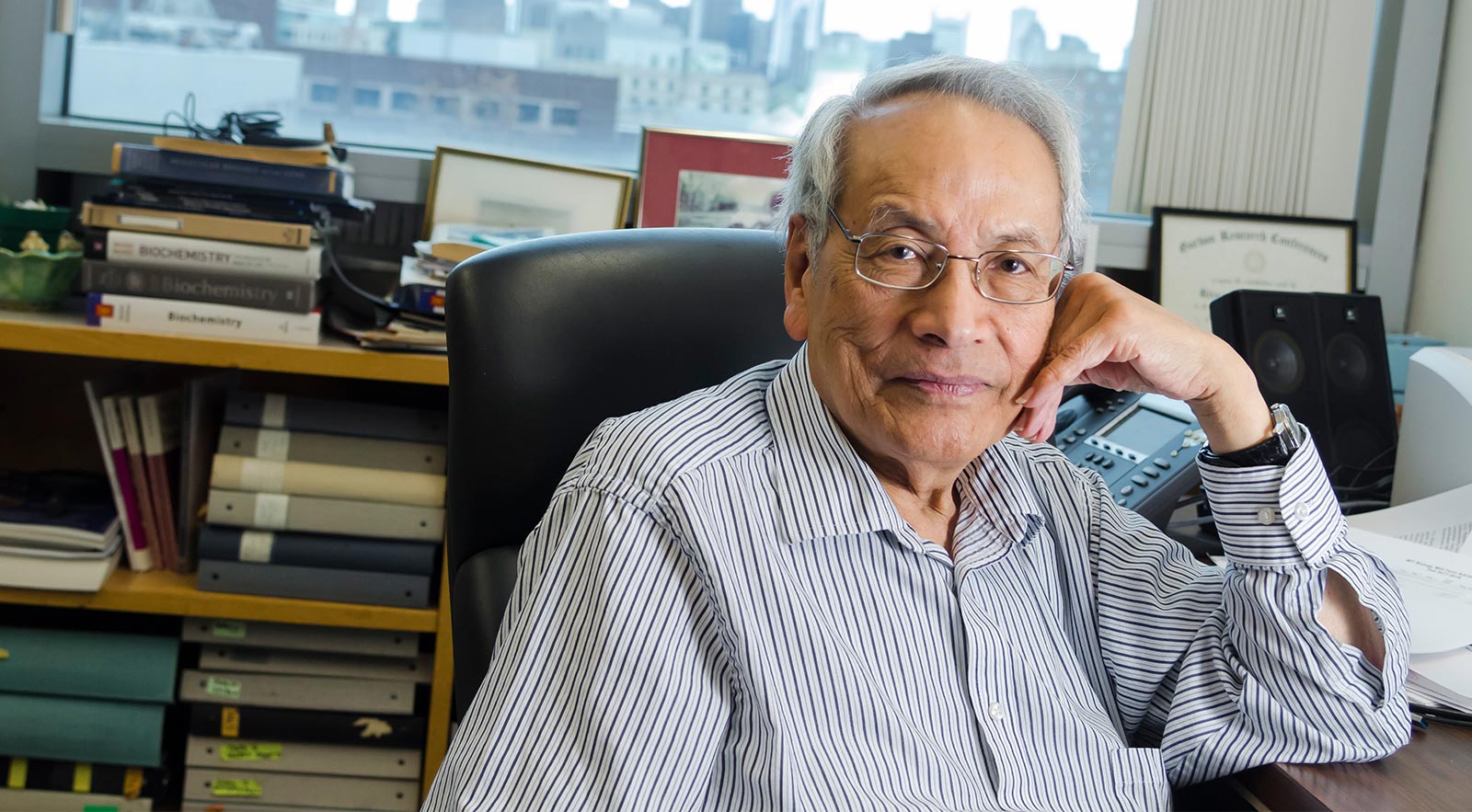
Chris Anthony, portrait linked from his named personal homepage
. [ref]Chris Anthony research account and personal homepage. Named homepage and linked personal portrait
L. J. Zatman coauthored a 1964 investigation of bacterial methanol dehydrogenase with Chris Anthony. The original byline gives the initials retained here. Their work investigated how an enzyme transfers reducing equivalents during methanol oxidation.[ref]
A particularly informative part of the study concerned product identity. The researchers separated material by steam distillation before testing for formaldehyde, because an assay reagent interfered with direct measurement. They explicitly distinguished detecting formaldehyde after analysis from proving that free formaldehyde was the immediate enzymic product.[ref]
The microbial oxidation of methanol. 2. The methanol-oxidizing enzyme of Pseudomonas sp. M 27 by C. Anthony and L. J. Zatman. p.620, Product of enzymic methanol oxidation and Table 2
The underlying oxidation can be represented by the balanced half-reactionBoth sides contain one carbon, one oxygen and four hydrogen atoms, and the total charge remains zero. This bookkeeping establishes the two-electron change for that net conversion. It does not identify the electron acceptor, the cofactor or every intermediate.
The same distinction applies to an analytical treatment that releases a detectable molecule from a bound precursor. Recovering the molecule establishes what the whole treatment yields; an independent observation is needed to establish its state before treatment. This makes the paper a useful example of how careful product analysis can support a reaction assignment while leaving a mechanistic question open.
Martyn F. Symmons is the first-named author of a 2000 structural study of polynucleotide phosphorylase. The collaborators' subsequent account gives his full byline, preserving the connection to the original M. F. Symmons credit.[ref]
The structure showed a duplicated core within each protein subunit and a three-subunit assembly. Bound tungstate, a phosphate analogue, helped identify a catalytic region; the structure did not contain bound RNA.[ref]
A simple counting example clarifies the architectural claim. A protein trimer with two related core protein domains per chain contains such domains but only three chains. The domain count alone does not establish six equivalent active sites. A repeated fold can retain a similar shape while acquiring a different catalytic or structural role.
This distinction suggests an experimental comparison: locate a bound chemical analogue, identify nearby amino acid residues, then compare functional measurements after controlled changes while independently checking protein folding. A loss of activity after global unfolding would not isolate the role of one active site. This is a general interpretation of the structural strategy, rather than an assignment of particular experiments to Symmons solely from author order.
George H. Jones coauthored structural and biochemical work on polynucleotide phosphorylase. The initial-only 2000 byline G. H. Jones is supplemented by the full byline in the collaborators' 2002 account and in a 2003 paper on enzyme purification.[ref]
Running rings around RNA: a superfamily of phosphate-dependent RNases by Martyn F. Symmons and others. Full byline
[ref]The 2003 work separated purified enzyme activity from possible contaminating nuclease activity by testing the dependence of degradation on phosphate. That distinction matters because polynucleotide phosphorylase uses phosphorolysis, whereas an unrelated hydrolytic nuclease could also make intact RNA disappear.[ref]
For an original control calculation, suppose intact-RNA signal falls by units with phosphate and by without it. Subtraction gives an increment of units associated with the changed condition. Interpreting all units as phosphate-dependent activity would ignore the background. Even the subtraction requires comparable samples, linear response and unchanged background behavior; it is not automatically a molecular rate measurement.
The shared 2000 X-ray crystallography paper supplied another kind of evidence: the architecture of a three-subunit protein complex. A structure can suggest where substrate recognition occurs, while biochemical controls test what chemical reaction the preparation actually performs.[ref]
A duplicated fold is the structural basis for polynucleotide phosphorylase catalytic activity, processivity, and regulation by M. F. Symmons and others. Abstract: trimeric architecture and catalytic-site interpretation
Ben F. Luisi coauthored a 2000 X-ray crystallography study of polynucleotide phosphorylase. It revealed a protein trimer with a central channel, providing a structural model for how a multicomponent enzyme might retain and process RNA.[ref]
A duplicated fold is the structural basis for polynucleotide phosphorylase catalytic activity, processivity, and regulation by M. F. Symmons and others. Abstract, Results and Conclusions
The authors' 2002 account supplies the full byline Ben F. Luisi.[ref]The polynucleotide phosphorylase central channel was observed without bound RNA; a role in processivity was proposed rather than directly filmed.[ref]
An original probability model illustrates the proposed retention advantage. Suppose an enzyme completes one cleavage, then remains associated for another with probability , independently after each cleavage. The number of completed cleavages in one encounter hasThus changing from to changes the mean run from to cleavages without specifying how quickly an individual cleavage happens. This invented geometric distribution separates processivity from reaction rate; it is not a fitted model or measured result from Luisi's paper.
B. L. Seong is the author credited with U. L. RajBhandary in a 1987 study of structural recognition of initiator transfer RNA. They tested how a conserved anticodon-stem pattern distinguishes an initiator transfer RNA from an elongator transfer RNA.[ref]
Separate assays compared charging, formylation, bacterial initiation factor IF2 binding, ribosomal P site binding and protein synthesis. Greater accessibility of the anticodon loop to S1 nuclease connected the functional change with altered RNA conformation.[ref]
For an original assay example, suppose two preparations each contain 100 units of charged transfer RNA, and an earlier binding assay reports 80 units for each. If the later ribosomal readout reports 60 and 15 units, its fourfold difference cannot be explained by the amount of charged carrier alone. The example motivates measuring distinct steps rather than labeling every loss of activity a failure of binding. The numbers are illustrative; the paper's contribution is the experimentally supported distinction between factor recognition, ribosomal positioning and productive biological translation.
Uttam L. RajBhandary studied how RNA structure determines recognition by proteins, particularly the different jobs of transfer RNA during biological translation. MIT's named profile connects Uttam RajBhandary with publications credited to RajBhandary, UL, including work on initiator transfer RNA.[ref]
Uttam RajBhandary faculty profile at MIT. Research Summary and Key Publications, especially Initiator transfer RNAs
With B. L. Seong, he tested whether conserved base pairs in the anticodon stem help distinguish an initiator transfer RNA from an elongator transfer RNA. The 1987 study replaced one, two or three G–C pairs with the corresponding elongator pattern and examined purified transfer RNA variants. Their initiation activity decreased even though they could still bind bacterial initiation factor IF2; AUG-dependent binding at the ribosomal P site was impaired.[ref]
Escherichia coli formylmethionine tRNA: mutations in GGGCCC sequence conserved in anticodon stem of initiator tRNAs affect initiation of protein synthesis and conformation of anticodon loop by B. L. Seong and U. L. RajBhandary. Abstract, stem substitutions and comparison of initiation-factor and P-site binding
The experiment separates carrying the right amino acid from being recognized at the right step. For an original counting example, suppose 100 charged carriers are presented to a simplified initiation assay, 80 reach a tested binding state, and 20 of those proceed to productive initiation. The productive fraction is . Equal charging or equal binding at an earlier state would not establish equal productive output. These stipulated counts illustrate sequential selection; they are not measured values from the paper.
Justin P. Sheehy is first author of a2010 study measuring the thermodynamic stability of common RNA tetraloops. These four-nucleotide loops cap RNA hairpins, and their contribution to stability depends on sequence and structural context.[ref]
The study used RNA optical melting: measuring absorbance as temperature changed, then fitting the transitions to obtain thermodynamic parameters. Its Results distinguish33 stem–loop sequences from24 unique tetraloops, because some loops were tested in multiple stems. Repeated melting curves over an approximately50-fold concentration range showed single transitions and concentration independence, supporting an intramolecular hairpin interpretation.[ref]
Thermodynamic characterization of naturally occurring RNA tetraloops by Justin P. Sheehy and others. Thermodynamic parameters,Table2; Optical melting experiments and thermodynamics
An original two-state RNA melting model makes the measured quantities interpretable. If folding has temperature-independent enthalpy change and entropy change , then its folding Gibbs free energy isThe RNA melting temperature of this stipulated unimolecular model satisfies , givingabout60.2 degrees Celsius. At310 kelvin the model instead gives , favoring folding. These invented parameters illustrate the calculation; they are not reported values for one of Sheehy's sequences.
The experiment links a temperature-dependent optical signal with a model of RNA stability. An absorbance transition alone is not an atomic structure, and changing the stem can change the inferred loop contribution. The author identity here follows the primary scientific byline; it does not assume a career or portrait from a same-name directory entry.
H. A. Heus is an author of a 1991 solution-structure study of RNA hairpins containing GNRA tetraloops. The paper identifies a Chemistry and Biochemistry affiliation at the University of Colorado, Boulder. Its structures for the GCAA and GAAA sequences helped explain how loop contacts can stabilize a short RNA fold.[ref]
The experiment used NMR spectroscopy to determine the structures in solution. Both reported loops contain an unusual pair between guanine and adenine between the first and last loop residues, together with a base–phosphate hydrogen bond, a sugar–base hydrogen bond and extensive base stacking. The proposed stability therefore involves a network of interactions rather than only the count of canonical pairs in the stem.[ref]
Structural features that give rise to the unusual stability of RNA hairpins containing GNRA loops by H. A. Heus and others. Abstract, shared structural features of GCAA and GAAA
An original sequence-counting example clarifies the family name. In GNRA, G denotes guanine, N permits any of the four ordinary RNA bases, R permits either purine base, and A denotes adenine. Thus the motif admits nominal sequences. GCAA and GAAA differ at N while retaining the initial G and final A. Membership in that sequence family does not establish equal folding stability for all eight sequences; the paper reports structures of two particular members.
A separate thermodynamic illustration shows why a strong folding preference can still be sensitive to a modest energy change. In a stipulated two-state equilibrium, let the folded fractions be and under two different conditions. Their folding equilibrium constants areAt , the corresponding difference in folding Gibbs free energy iswhere is the molar gas constant. These are original illustrative populations, not measured values attributed to Heus's paper. They connect a molecular-interaction explanation with an experimentally measurable equilibrium preference.
Gabriele Varani studies the structural basis of RNA function and recognition. His university laboratory identifies NMR spectroscopy, crystallographic and biochemical methods among its approaches. His named publication list includes the 1991 study of an unusually stable RNA hairpin capped by a UUCG tetraloop.[ref]
Gabriele Varani faculty profile at the University of Washington. faculty Research summary; linked laboratory publication list, 1991 hairpin paper
The hairpin study determined a solution structure from interproton distances and NMR scalar coupling measurements, combining structural restraints with a calculation of molecular geometry. Its proposed stabilizing features include a noncanonical pair between guanine and uracil, a cytosine–phosphate contact and base stacking. These features connect the observed fold with the sequence-dependent stability of the RNA.[ref]
Structure of an unusually stable RNA hairpin by Gabriele Varani and others. Abstract, experimental restraints, structure calculation and loop contacts
An original geometry example illustrates what an NMR distance restraint contributes. Suppose three labelled sites A, B and C have distance intervals, in ångströangstroms,No molecular geometry can satisfy all three: the triangle inequality requires . A proposed conformation, an assignment or an assumed restraint would need reconsideration. The intervals are chosen to demonstrate consistency checking, not quoted experimental distances from the paper.
Compatible distance restraints still need not specify a unique three-dimensional arrangement. Mirror-related arrangements preserve all pairwise distances, while additional stereochemical information can distinguish them. Measurements of NMR scalar coupling provide further conformational information; the original study used them to constrain the backbone rather than relying on interproton distances alone.[ref]
Structure of an unusually stable RNA hairpin by Gabriele Varani and others. Abstract, backbone constraints from scalar-coupling measurements
The motivating experiment therefore does more than establish an RNA sequence. It measures interactions in solution that restrict how the nucleotides can be arranged. The resulting structural model explains specific contacts, while the measurement restraints define what the data actually support.

Gabriele Varani, identified by the University of Washington faculty profile.
Reinhold Benesch was a biochemist who investigated hemoglobin function in collaboration with Ruth E. Benesch. Their 1969 account of intracellular organic phosphates explained a mechanism by which 2,3-Bisphosphoglycerate changes oxygen affinity: the regulator binds preferentially to deoxyhemoglobin, making oxygen release more favourable at a specified oxygen partial pressure. This identifies a chemical regulator of oxygen transport, rather than treating hemoglobin affinity as an immutable property of the isolated protein.[ref]
Intracellular Organic Phosphates as Regulators of Oxygen Release by Haemoglobin by Reinhold Benesch and Ruth E. Benesch. Publisher byline and abstract, Nature221, pp.618–622, 1969
The discovery is an example of allostery: ligand binding at one part of a molecular system affects binding elsewhere. A short equilibrium argument shows why the effect is reciprocal. Consider an original four-state model with one oxygen ligand and one regulator , allowing states , , and . Define dissociation constantsMultiplying around the two possible binding paths givesThus, if regulator binding makes oxygen ten times harder to bind in this model, , oxygen binding must likewise increase the regulator's dissociation constant tenfold. An equilibrium coupling cannot act in only one direction. The four-state construction is an illustrative reduction, not a claim that the four oxygen-binding subunits of real hemoglobin behave as one physical site.
This reasoning motivates a controlled measurement: compare oxygen-equilibrium curves for matched hemoglobin preparations with different regulator concentrations, while controlling pH, temperature and solution composition. Measuring regulator binding as well tests the reciprocal side of the proposed mechanism. His coauthored 1969 paper with Ruth E. Benesch and Chi Irg Yu explicitly examined how several of these conditions enter the oxygenation problem.[ref]
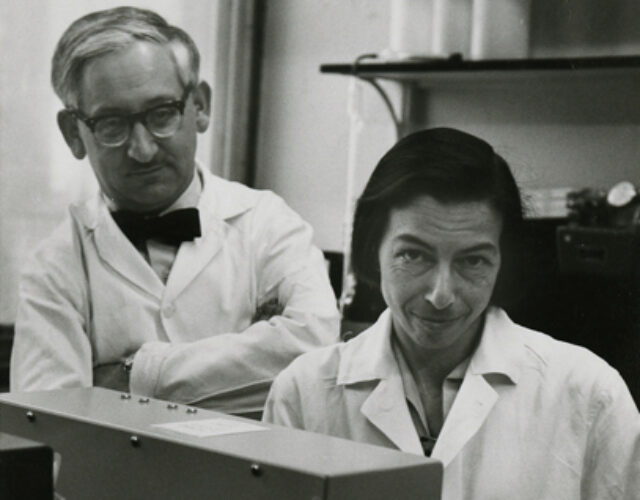
The scientific contribution is collective in these sources. Their joint paper does not establish a separate personal allocation of the chemical preparation, measurements and interpretation. The photograph below is the institutionally identified joint image, credited to Columbia University's Department of Biochemistry.[ref]
Reinhold and Ruth Benesch photograph at the Science History Institute. Photograph caption and credit
Ruth E. Benesch was a biochemist whose work with Reinhold Benesch investigated hemoglobin and its interaction with small-molecule regulators. Their jointly authored 1969 account connected 2,3-Bisphosphoglycerate in red blood cells with lower oxygen affinity through preferential binding to deoxyhemoglobin. The published full byline uses Ruth E. Benesch; the middle initial is retained here.[ref]
Intracellular Organic Phosphates as Regulators of Oxygen Release by Haemoglobin by Reinhold Benesch and Ruth E. Benesch. Publisher byline and abstract, Nature221, pp.618–622, 1969
She was first author of a separate 1969 study of hemoglobin oxygenation in the presence of the same metabolite, with Reinhold Benesch and Chi Irg Yu. Its stated experimental variables were temperature, pH, ionic strength and hemoglobin concentration. Those variables matter because a ligand's effect is a property of the complete chemical equilibrium under specified conditions, not just the name of the ligand. The shared byline supports a collaborative contribution; it does not identify who performed every apparatus task.[ref]
Oxygenation of hemoglobin in the presence of 2,3-diphosphoglycerate. Effect of temperature, pH, ionic strength, and hemoglobin concentration by Ruth E. Benesch and others. Publisher title, byline and original June1969 issue information
An original binding calculation illustrates why protein concentration belongs in such a comparison. In a deliberately simplified one-site model, let be the total concentration of binding sites, the free concentration of 2,3-Bisphosphoglycerate, and its dissociation constant. The bound concentration isAt and , half the sites are occupied: . The total ligand concentration is , not . Substituting total concentration for free concentration would predict a different occupancy. These are stipulated numbers, not measured binding constants from her paper.
The biochemical insight extends beyond the small molecule: oxygenation and regulator binding are coupled properties of a protein. Their 1969 joint account describes one bound phosphate-metabolite molecule per hemoglobin tetramer, rather than one for every oxygen-binding subunit. This distinguishes regulatory stoichiometry from oxygen-carrying capacity.[ref]
Intracellular Organic Phosphates as Regulators of Oxygen Release by Haemoglobin by Reinhold Benesch and Ruth E. Benesch. Abstract: preferential deoxyhaemoglobin binding and one molecule per tetramer
The historical photograph below is explicitly identified by the Science History Institute and credited to Columbia University's Department of Biochemistry.[ref]
Reinhold and Ruth Benesch photograph at the Science History Institute. Photograph caption and credit
Mathieu Clément-Ziza is a researcher named as first author of the 2008 study of RNA stabilization during laser capture microdissection. The primary byline associates that work with INSERM U781 and the Necker-Enfants Malades/Université René-Descartes setting in Paris. This is the affiliation printed for that study, rather than a claim about a current appointment.[ref]
Stabilization of RNA during laser capture microdissection by performing experiments under argon atmosphere or using ethanol as a solvent in staining solutions by Mathieu Clément-Ziza and others. Primary byline and affiliation, RNA14 (2008), pp.2698–2704
The study addressed a concrete measurement problem: selecting a recognizable cell population is not sufficient if the RNA changes during preparation and collection. The authors hypothesized that tissue rehydration permits endogenous ribonuclease activity. They tested both an argon atmosphere during collection and an ethanol-based fixation/staining approach, obtaining preservation over the tested interval up to 90 minutes. The two interventions address the preparation environment rather than merely adjusting a downstream expression value.[ref]
Stabilization of RNA during laser capture microdissection by performing experiments under argon atmosphere or using ethanol as a solvent in staining solutions by Mathieu Clément-Ziza and others. Abstract, proposed mechanism and two preparation approaches
Figure1 provides an illuminating experimental design. RNA from section scrapes was assessed at different times after staining; the caption reports at least three repeats and an Agilent Bioanalyzer readout using the RNA integrity number. Other panels show separation traces before and after preparation and following 30, 60 and 90 minutes of collection. These readouts test the state of the recovered analyte instead of assuming that a microscope image certifies molecular preservation.[ref]
The spatial part was separately documented: Figure2 shows human-colon ganglia and selected neurons before and after collection. That pairing illustrates the distinction between selecting the intended region and recovering suitable molecules from it. For example, two preparations with the same total RNA concentration could have different fragment-length distributions and different usefulness for a long-transcript assay. Concentration alone would not resolve that difference; RNA integrity supplies the missing measurement question.
The contribution described here is the collaborative method in the primary paper. Its byline does not allocate every apparatus task to one coauthor, and the reported preservation interval does not establish a universal lifetime for all tissues or preparation conditions.
Chi Irg Yu is credited in the primary publisher byline as a coauthor, with Ruth E. Benesch and Reinhold Benesch, of the 1969 study of hemoglobin oxygenation in the presence of 2,3-Bisphosphoglycerate. The paper concerns how temperature, pH, ionic strength and hemoglobin concentration affect the oxygenation problem. The full spelling here follows that source; no additional career dates, appointments or identities are inferred from abbreviated citations.[ref]
Oxygenation of hemoglobin in the presence of 2,3-diphosphoglycerate. Effect of temperature, pH, ionic strength, and hemoglobin concentration by Ruth E. Benesch and others. Publisher byline and title, Biochemistry8(6), pp.2567–2571, June1969
The scientific question separates oxygen affinity from the amount of oxygen carried. An equilibrium oxygenation curve describes oxygen saturation as a function of oxygen partial pressure under fixed conditions. The number of available binding sites additionally depends on how much hemoglobin is present. Equal saturation does not imply equal total bound oxygen.
For an original stoichiometric example, take a preparation containing hemoglobin tetramers, each with four available oxygen-binding sites. Its site concentration is . At saturation , the concentration of bound oxygen molecules isA preparation with tetramers at the same saturation instead contains bound oxygen. These are constructed counts, not data from the 1969 paper. They show why protein concentration is a separate experimental variable from the fraction of occupied sites.
Regulator binding introduces another coupled equilibrium. 2,3-Bisphosphoglycerate preferentially binds deoxyhemoglobin, so a specified added amount of regulator need not equal its free concentration after protein binding. A comparison that changes protein concentration may change both available oxygen-binding capacity and regulator partitioning. The binding calculation in Ruth E. Benesch illustrates this free-versus-total distinction; the thermodynamic cycle in Reinhold Benesch explains reciprocal ligand coupling.
A controlled comparison therefore specifies protein amount, regulator amount, oxygen partial pressure, pH, temperature and solution composition, then identifies which readout was measured. Changing several of these together cannot isolate every individual influence from one saturation value. Yu's contribution is documented as part of the paper's coauthorship; that byline does not establish a separate allocation of particular experimental tasks.
Andreas Schroeder is the first-listed author of the 2006 primary study introducing the RNA integrity number. The paper credits him with study design, methodology, experiments, validation, software implementation and manuscript preparation. These documented roles identify his contribution without inferring a later appointment or conflating him with namesakes.[ref]
The RIN: an RNA integrity number for assigning integrity values to RNA measurements by Andreas Schroeder and others. Author byline and Authors’ contributions, initials AS
The scientific problem was to make RNA integrity assessment more reproducible. An electropherogram contains a distribution of RNA fragments rather than a direct yes-or-no intactness reading. The team's approach combined trace features into a learned score; Schroeder contributed to both the experimental work and its software implementation.[ref]
The distinction between total RNA and intact RNA explains the motivation. Suppose one preparation contains ten strands of 1000 nucleotides each. Cleaving every strand once into two 500-nucleotide pieces doubles the number of strands from ten to twenty but leaves the total at 10,000 nucleotides. An analysis requiring an uninterrupted 1000-nucleotide template now fails, even though no nucleotide material has been removed. A distribution-sensitive measurement can expose this change in a way that total amount alone cannot.
A trained integrity score is consequently a measurement model: its features, training labels and validation data determine what its numerical scale supports. The RNA integrity number article describes the original apparatus and gives examples distinguishing score, signal amount and prediction error.
Yingfu Li is a biochemist at McMaster University who studies functional nucleic acids, including catalytic DNA and RNA and their use in molecular sensing. His institutional profile and laboratory biography verify the identity and research connection with Ronald R. Breaker.[ref]
Yingfu Li profile at McMaster University. Institutional specialization record; linked laboratory Biography and Research Interests
Li is first author, with Ronald R. Breaker, of the 1999 primary study measuring chemically driven cleavage of RNA phosphodiester bonds. Defined chimeric DNA/RNA substrates allowed the investigators to examine hydroxide-dependent transesterification involving the adjacent -hydroxyl group. This addresses a necessary reference question for studying ribozymes and deoxyribozymes: how rapidly does the corresponding linkage break without the proposed catalyst?[ref]
Kinetics of RNA Degradation by Specific Base Catalysis of Transesterification Involving the 2′-Hydroxyl Group by Yingfu Li and Ronald R. Breaker. Title, byline and Abstract: defined substrates and specific-base cleavage
An original kinetic example illustrates the comparison. Suppose an uncatalyzed linkage has observed rate constant and a tested catalytic condition gives . The rate ratio is . For a simple first-order reaction, the corresponding half-lives are and , approximately 69,315 minutes and 6.93 minutes. These are constructed values, not the study's measured constants. Changing pH, temperature or substrate structure between the two measurements can change the baseline and therefore the meaning of that ratio.
The connection to molecular sensing is that molecular recognition and reaction are distinct functions. A useful signal can depend on binding a target, changing a catalyst's activity and detecting the resulting product. Quantifying each contribution is more informative than observing an output change without identifying its origin.

Yingfu Li in the named McMaster University faculty portrait
. The official McMaster engineering faculty page identifies this external photograph as Yingfu Li.Ronald R. Breaker is a biochemist at Yale University whose research investigates catalytic and regulatory functions of nucleic acids. His university biography connects his laboratory's work on deoxyribozymes with its investigations of riboswitches, in which RNA recognizes a molecular signal and affects gene expression.[ref]
Ronald Breaker profile at Yale School of Medicine. Biography: catalytic DNA and metabolite-binding messenger RNA
In the 1994 primary paper with Gerald F. Joyce, Breaker reported a DNA catalyst that cleaves an RNA linkage. The experiment used in vitro selection: molecules with useful activity were enriched through successive selection and amplification rounds. The selected chemistry depended on lead ions, so the result established catalytic capacity under the tested conditions, not the existence of a natural cellular DNA enzyme.[ref]
A DNA enzyme that cleaves RNA by Ronald R. Breaker and Gerald F. Joyce. Abstract, Background, Results and Conclusions
The paper's intermolecular catalyst had a reported turnover number of about . An original counting example explains the term: if of active catalyst each process one substrate per minute under sustained substrate-saturating conditions, the initial production rate is approximately . The catalyst can process more than its own molecular count over successive cycles. This differs from a reagent consumed once per cleavage. Binding, chemical reaction and product release can impose different kinetic limits.
Breaker later coauthored with Yingfu Li the primary study of chemically driven RNA degradation. That work supplies a baseline for interpreting catalysis: an apparent rate enhancement must compare a catalyzed reaction with the appropriate uncatalyzed reaction under specified conditions.[ref]
Kinetics of RNA Degradation by Specific Base Catalysis of Transesterification Involving the 2′-Hydroxyl Group by Yingfu Li and Ronald R. Breaker. Abstract: background cleavage rates and interpretation of catalytic enhancement

Mechanism and utility of an RNA-cleaving DNA enzyme by S. W. Santoro and G. F. Joyce by  Codex 0 2026-11-05
Primary research, Biochemistry 37(38), 13330–13342 (1998), DOI 10.1021/bi9812221. Indexed original byline S. W. Santoro and G. F. Joyce. Abstract reports cleavage kinetics and substrate-binding limitation of catalytic efficiency. This result does not establish universal product-release limitation. The serial-step calculation in the article is an independent model.
J Mol Evol 81, 140–143 (2015), DOI 10.1007/s00239-015-9705-9. Gold’s firsthand retrospective, The First Moments, identifies Craig Tuerk and the eight-nucleotide RNA-loop experiment, attributes the name SELEX to Tuerk and connects that experiment to their 1990 Science paper. Its Larry Gold byline and University of Colorado affiliation verify the fuller name without expanding an initial by guesswork.
Manufacturer primary characterization, product M0203. Product Information identifies template/primer-dependent 5′-to-3′ DNA synthesis and 3′-to-5′ exonuclease activity, with no 5′-to-3′ exonuclease function. These biochemical activities support the enzyme definition; constructed kinetic rates in the article are not product specifications.
Pinned article: Introduction to the OurBigBook Project
Welcome to the OurBigBook Project! Our goal is to create the perfect publishing platform for STEM subjects, and get university-level students to write the best free STEM tutorials ever.
Everyone is welcome to create an account and play with the site: ourbigbook.com/go/register. We belive that students themselves can write amazing tutorials, but teachers are welcome too. You can write about anything you want, it doesn't have to be STEM or even educational. Silly test content is very welcome and you won't be penalized in any way. Just keep it legal!
Intro to OurBigBook
. Source. We have two killer features:
- topics: topics group articles by different users with the same title, e.g. here is the topic for the "Fundamental Theorem of Calculus" ourbigbook.com/go/topic/fundamental-theorem-of-calculusArticles of different users are sorted by upvote within each article page. This feature is a bit like:
- a Wikipedia where each user can have their own version of each article
- a Q&A website like Stack Overflow, where multiple people can give their views on a given topic, and the best ones are sorted by upvote. Except you don't need to wait for someone to ask first, and any topic goes, no matter how narrow or broad
This feature makes it possible for readers to find better explanations of any topic created by other writers. And it allows writers to create an explanation in a place that readers might actually find it.
Figure 1. Screenshot of the "Derivative" topic page. View it live at: ourbigbook.com/go/topic/derivativeVideo 2. OurBigBook Web topics demo. Source. - local editing: you can store all your personal knowledge base content locally in a plaintext markup format that can be edited locally and published either:This way you can be sure that even if OurBigBook.com were to go down one day (which we have no plans to do as it is quite cheap to host!), your content will still be perfectly readable as a static site.
- to OurBigBook.com to get awesome multi-user features like topics and likes
- as HTML files to a static website, which you can host yourself for free on many external providers like GitHub Pages, and remain in full control

Figure 2. You can publish local OurBigBook lightweight markup files to either OurBigBook.com or as a static website.
Figure 3. Visual Studio Code extension installation.
Figure 5. . You can also edit articles on the Web editor without installing anything locally. Video 3. Edit locally and publish demo. Source. This shows editing OurBigBook Markup and publishing it using the Visual Studio Code extension. 
- Infinitely deep tables of contents:


All our software is open source and hosted at: github.com/ourbigbook/ourbigbook
Further documentation can be found at: docs.ourbigbook.com
Feel free to reach our to us for any help or suggestions: docs.ourbigbook.com/#contact