Topics (384k) Articles (398k) Users (410) Discussions (242) Comments (383) Files (13k) New article

A modular function for a finite-index subgroup is a meromorphic function on the complex upper half-plane that is invariant under and is meromorphic at every modular cusp:At a modular cusp of width , meromorphicity means that the transformed function has a Laurent series in the local parameter with only finitely many negative powers. Thus a modular function can have poles, in contrast to a modular form, which is required to be holomorphic on the half-plane and at the modular cusps. The Klein j-invariant is a fundamental example for the full modular group.
Some sources use the broader expression modular function of weight for a meromorphic function satisfyingwith the corresponding meromorphic cusp condition. This is also called a meromorphic modular form; the unqualified term modular function ordinarily means weight zero. Weight-zero modular functions descend to meromorphic functions on the compactified modular curve.[ref]
A chemical reaction network specifies chemical species, reactions between them, and their stoichiometric vectors. It can be modelled deterministically by reaction-rate equations or stochastically by molecule-copy-number jumps.
Genetics studies how genes are inherited, how their alleles vary, and how that variation contributes to phenotypes. Its central distinction is between an inherited description, the genotype, and what an organism actually expresses, the phenotype. Following alleles through a pedigree answers a family-level question; following allele frequencies through generations leads to population genetics and evolution.
The beauty of Mendelian segregation is that discrete inherited copies can generate predictable statistical patterns without making every offspring identical. A single genetic locus already connects meiosis, probability and observable variation. The Hardy-Weinberg principle then supplies a population baseline: it separates reshuffling inherited copies from processes such as natural selection that change their frequencies. These simple models are useful precisely because their assumptions can be stated and checked.
The ionization energy is the minimum energy needed to remove an electron from an isolated atom or molecule in a specified state. Ground-state hydrogen has ionization energy .
The Einstein static universe has a time-independent scale factor and positively curved spatial sections with the geometry of a round three-sphere. For pressureless matter and a positive cosmological constant, its static conditions in units are and .
The first equality balances matter's attractive contribution in the Friedmann acceleration equation against the cosmological repulsion; the second follows from the Friedmann equation with zero expansion. Spatial curvature enters that constraint, rather than being the attractive source in the acceleration balance. This is an exact equilibrium model. Whether a perturbed model remains near it requires a separate stability analysis.
A curvature singularity is an incomplete spacetime boundary approached by curves along which a scalar curvature invariant or a component of the Riemann curvature tensor in a parallel-propagated frame becomes unbounded. Such divergence cannot be removed by changing coordinates.
The equivalence principle states that gravity couples universally to energy-momentum and that a freely falling local frame removes uniform gravitational acceleration at a point. Tidal curvature remains measurable over a finite region.
Imagine releasing a ball inside a small falling elevator. Relative to the cabin it initially floats, because cabin and ball share the same free fall. The weak equivalence principle says this trajectory is independent of the test particle's composition for identical initial conditions. The Einstein equivalence principle further identifies local nongravitational experiments with those of special relativity. It is a statement about experiments in a local inertial frame, not just equality of two masses.
The word local is essential. Coordinates can make the metric tensor equal to the Minkowski metric and its first derivatives vanish at one event. They generally cannot erase the Riemann curvature tensor, which involves second derivatives. Two separated balls can therefore approach or recede even inside the falling cabin. A sufficiently extended experiment detects these tidal forces; a long observation can accumulate them even when the cabin is small. The equivalence principle does not identify an entire planetary gravitational field with acceleration in flat spacetime. See Tong's discussion of normal coordinates and local equivalence.
Natural ventilation exchanges air through openings using pressure differences generated by wind or buoyancy. A warmer indoor column can have a different vertical hydrostatic pressure gradient from outdoor air; connected low and high openings then permit a circulation. Wind can instead create unequal external pressures on different sides of a building.
The resulting volume flux depends on opening areas, their discharge properties and the pressure differences that remain once flow is established. The stack effect and cross ventilation describe different driving geometries and can reinforce or oppose one another. Measuring indoor/outdoor temperatures alone does not determine the exchange rate without those geometric and flow conditions. A simple thermal budget combines the exchanged enthalpy with internal heating; a stratified room can require more than one representative temperature.
Fluid entrainment is incorporation of surrounding fluid into a moving current, jet or buoyant plume. A downstream increase in the flow's volume flux can therefore occur without an additional localized source. The added fluid generally changes the mean velocity, temperature or constituent concentration of the moving region.
For a steady jet whose surroundings initially carry little axial momentum, entrainment increases transported volume while the conserved axial momentum flux constrains how the jet slows and spreads. In a warm buoyant plume, entrained ambient air similarly dilutes the temperature anomaly while increasing the total flow. Measuring only a centreline speed cannot determine the entrainment rate; one needs integrated transport across successive sections or a suitable boundary-flux estimate. Entrainment is different from molecular diffusion, although both can contribute to mixing and are often coupled in an observed flow.
Mass diffusivity is a transport coefficient describing how a constituent spreads relative to the mean material motion. For a simple dilute concentration field with constant isotropic coefficient , Fick's first law gives relative flux . Combining it with local conservation in stationary material gives the diffusion equation .
The units are length squared per time, so spreading over distance takes a characteristic time of order . A narrow dye layer in otherwise still fluid provides a motivating measurement: tracking the widening concentration profile can infer when other transport is negligible. In a moving fluid, advection is an additional mechanism, and enhanced spreading need not mean larger molecular mass diffusivity. Mixtures, anisotropic media and concentration-dependent response can require a more general flux law.
For a background scalar field and fluid displacement , the Lagrangian perturbation follows the displaced fluid element while the Eulerian perturbation compares fields at one fixed position. To first order,
A linear shear flow has velocity that varies linearly in a transverse coordinate, such as . Its velocity gradient and shear rate are spatially constant.
Hydrodynamic stability studies how a fluid flow responds to a small disturbance of a specified base state. The base state, boundary conditions and measure of disturbance size are part of the problem. Linearizing the Navier-Stokes equation gives a perturbation evolution equation; a normal mode proportional to grows exponentially when . For a viscous parallel shear flow, the Orr-Sommerfeld equation and Squire equation describe this modal problem.
A complete account also asks about transient growth. Stable eigenvalues do not guarantee that perturbation kinetic energy decreases at every instant; even a non-normal matrix with decaying modes can exhibit transient growth. The lift-up effect supplies a concrete mechanism: cross-stream velocity displaces fluid between regions of different mean streamwise momentum, producing streamwise velocity proportional to time in the ideal inviscid calculation. A finite disturbance can consequently become much larger before eventual decay.
Different physical mechanisms require different stability tests. The Rayleigh-Taylor instability releases gravitational potential energy from an unfavorable density arrangement, while baroclinic instability draws on the available potential energy of a stratified sheared state. A linear instability identifies initial amplification; predicting the eventual flow requires nonlinear dynamics and its additional constraints.
Buoyancy is the resultant upward force exerted by a resting fluid on an immersed body in a downward gravitational field. The fluid pushes inward, perpendicular to each part of the body's surface. Because hydrostatic pressure increases with depth, the upward push from below exceeds the downward push from above. Opposite horizontal forces cancel; buoyancy is the remaining vertical force. A sinking body still receives this upward support. [ref]
More precisely, pressure on a small surface of area with outward unit normal vector exertsThe minus sign says the force points into the body. On a cube, the top force points down, the bottom force points up, and the side forces cancel in pairs because opposite sides have the same pressure at each depth. This is a surface traction; gravity on the body itself is a separate body force. [ref]
For a computed example, stipulate resting water with constant mass density and uniform gravitational acceleration . A fully immersed cube has side , top depth and bottom depth . Each horizontal face has area , and its volume is . Its top and bottom gauge pressures areThe corresponding forces relative to the common surface pressure are downward and upward. Therefore the net buoyancy isUsing absolute pressures adds the same to both face forces, leaving their difference unchanged. Zero gauge pressure at the surface does not mean zero absolute pressure. Increasing both depths by the same amount also leaves buoyancy unchanged in this constant-mass density model.
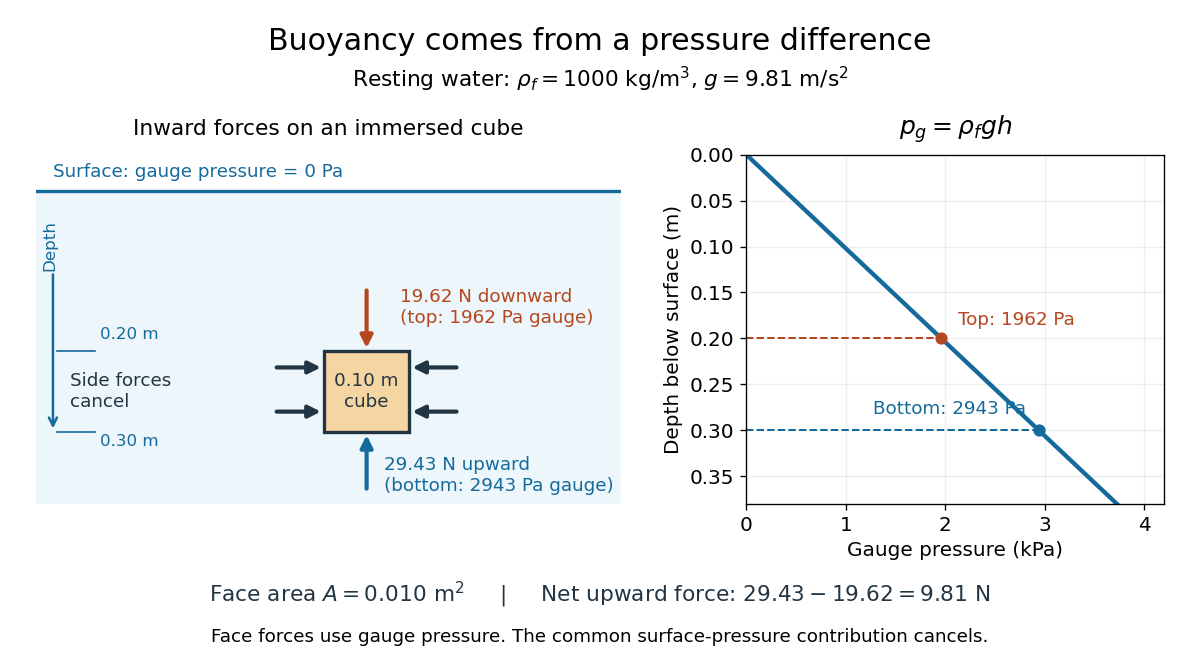
Archimedes' principle turns this calculation into a rule for bodies of any shape. It explains floating equilibrium and lets us infer an immersed body's volume from the difference between its force from gravity and the force needed to support it. In particular, buoyancy depends on the displaced volume and the surrounding mass density, whereas the body's own mass density decides how its force from gravity compares with that support.
Thermal convection is fluid motion driven by temperature-dependent buoyancy. It transports heat by bulk motion in addition to thermal conduction.
The electromagnetic interaction is the long-range interaction of electrically charged matter with the electromagnetic field. Its massless gauge boson is the photon.
A steady state is a state whose observable description is independent of time. In a transport problem it can sustain nonzero fluxes even though local fields remain time independent.
For an autonomous ordinary differential equation, the flow map sends each initial state to its state after time . Uniqueness gives and whenever both sides exist.
Matter-radiation equality is the epoch at which the background matter and radiation densities are equal. Its horizon wavenumber sets the turnover scale of the cold-dark-matter transfer function.
Pinned article: Introduction to the OurBigBook Project
Welcome to the OurBigBook Project! Our goal is to create the perfect publishing platform for STEM subjects, and get university-level students to write the best free STEM tutorials ever.
Everyone is welcome to create an account and play with the site: ourbigbook.com/go/register. We belive that students themselves can write amazing tutorials, but teachers are welcome too. You can write about anything you want, it doesn't have to be STEM or even educational. Silly test content is very welcome and you won't be penalized in any way. Just keep it legal!
Intro to OurBigBook
. Source. We have two killer features:
- topics: topics group articles by different users with the same title, e.g. here is the topic for the "Fundamental Theorem of Calculus" ourbigbook.com/go/topic/fundamental-theorem-of-calculusArticles of different users are sorted by upvote within each article page. This feature is a bit like:
- a Wikipedia where each user can have their own version of each article
- a Q&A website like Stack Overflow, where multiple people can give their views on a given topic, and the best ones are sorted by upvote. Except you don't need to wait for someone to ask first, and any topic goes, no matter how narrow or broad
This feature makes it possible for readers to find better explanations of any topic created by other writers. And it allows writers to create an explanation in a place that readers might actually find it.
Figure 1. Screenshot of the "Derivative" topic page. View it live at: ourbigbook.com/go/topic/derivativeVideo 2. OurBigBook Web topics demo. Source. - local editing: you can store all your personal knowledge base content locally in a plaintext markup format that can be edited locally and published either:This way you can be sure that even if OurBigBook.com were to go down one day (which we have no plans to do as it is quite cheap to host!), your content will still be perfectly readable as a static site.
- to OurBigBook.com to get awesome multi-user features like topics and likes
- as HTML files to a static website, which you can host yourself for free on many external providers like GitHub Pages, and remain in full control

Figure 2. You can publish local OurBigBook lightweight markup files to either OurBigBook.com or as a static website.
Figure 3. Visual Studio Code extension installation.
Figure 5. . You can also edit articles on the Web editor without installing anything locally. Video 3. Edit locally and publish demo. Source. This shows editing OurBigBook Markup and publishing it using the Visual Studio Code extension. 
- Infinitely deep tables of contents:



All our software is open source and hosted at: github.com/ourbigbook/ourbigbook
Further documentation can be found at: docs.ourbigbook.com
Feel free to reach our to us for any help or suggestions: docs.ourbigbook.com/#contact