
Work by William Sealy Gosset 2026-10-18
William Weber Coblentz's primary report describes an electrically heated porcelain cavity wound with platinum ribbon. Mirrors imaged its central radiating diaphragm onto a optical slit; a fluorite optical prism dispersed the beam onto a vacuum bolometer. Galvanometer deflections read the detector response. A resistance standard checked electrical sensitivity, while repeated readings checked stability. Sodium lines fixed the angular zero; a refractive index curve supplied wavelengths and slit-bandwidth corrections. Thermocouples were standardized at freezing points of zinc, antimony and copper. Drying the optical path reduced atmospheric absorption; prism scattering and temperature calibration remained limitations. These were Coblentz's measurements. His extraction of radiation constants assumed the Planck law, so it was not a model-independent proof of the spectral formula.[ref]
Constants of Spectral Radiation of a Uniformly Heated Inclosure or So-Called Black Body, I by William Weber Coblentz. W. W. Coblentz, Constants of spectral radiation of a uniformly heated inclosure or so-called black body, I: printed pp.15–27, 35, 42–47 and 73–77; apparatus, sensitivity checks, temperature scale, wavelength calibration and model-dependent constants
The inference to test is whether corrected spectra taken at independently determined temperatures have their maxima at a constant product . Comparing raw galvanometer deflections at different optical prism settings would also compare different wavelength widths and optical losses. The response integral in blackbody peak and detector response explains why those corrections belong to the physical inference rather than merely to presentation.
Blackbody peak and detector response 2026-10-18
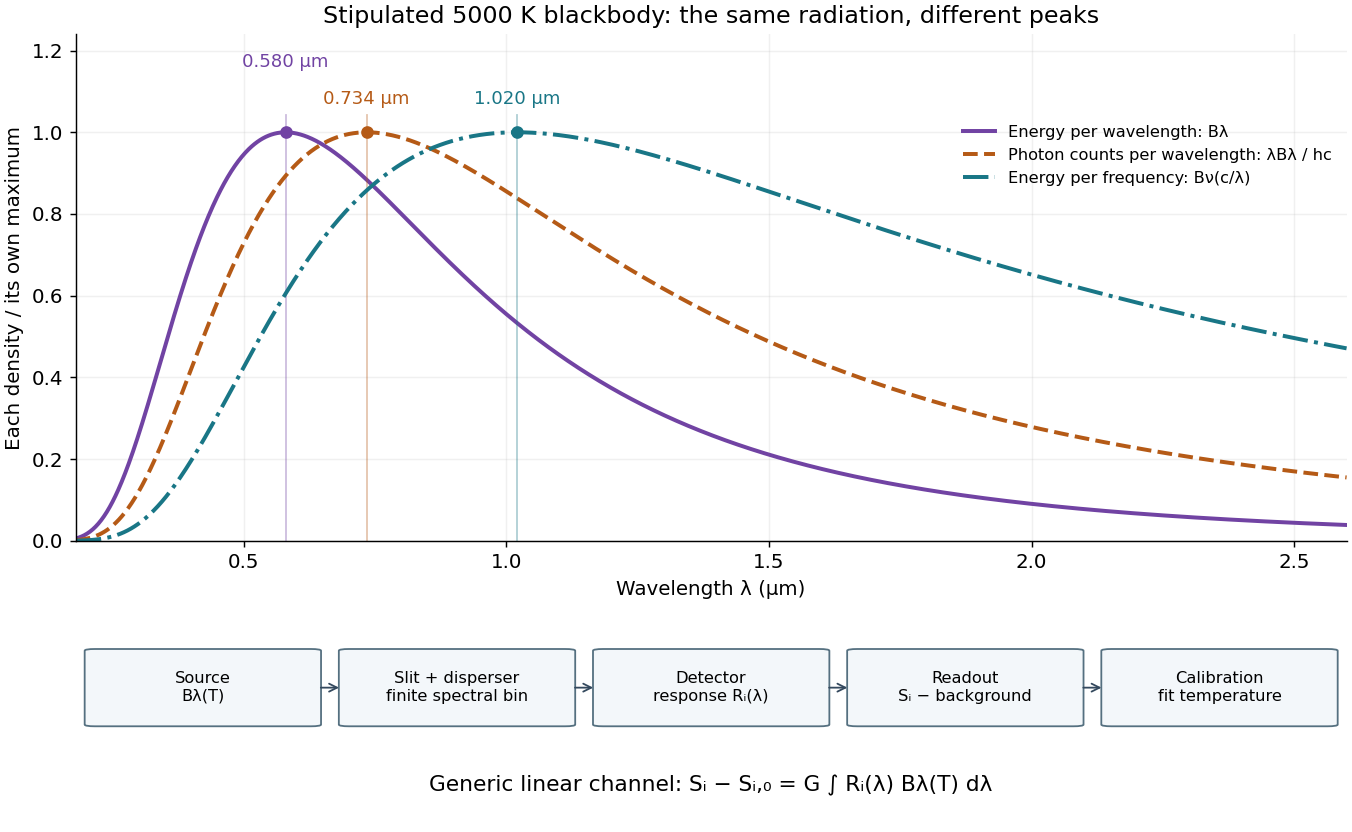
Consider a hypothetical star whose emitted specific intensity is exactly that of a uniform blackbody. Assume transparent propagation with negligible Doppler shift and interstellar extinction, so geometric dilution multiplies every spectral interval by the same factor. The stipulated temperature givesUsing the converted frequency peak as though it maximized would return , a substantial error caused solely by mixing spectral conventions.
Now stipulate a photodetector with constant quantum efficiency over the relevant wavelengths, collecting equal narrow wavelength bins. For fixed accepted projected area times solid angle , with dilution included in , its expected photon count rate density isThis follows by dividing the received power by the photon energy . It peaks where , at , giving for the same model star. Constant quantum efficiency is not constant energy spectral responsivity: the latter includes the wavelength-dependent photon energy conversion. For example, , and a bin centered at give approximately detected photons per second in the narrow-bin approximation. These are calculated model values, not observations of a named star.
A more general linear detector channel has outputwhere is the background reading and includes spectral selection, optical transmission and detector spectral responsivity. A raw channel maximum need not locate either Planck function maximum. Recovering a temperature requires an appropriate calibrated response and an emission model. For a real stellar atmosphere, opacity and radiative transfer can reshape the spectrum; interstellar extinction can reshape it again. A single peak does not establish a unique physical temperature without those assumptions.

Derivation of Wien's displacement law 2026-10-18
At fixed , substitute into the Planck function:Here is the Planck constant, the Boltzmann constant, and the speed of light. Since , an interior maximum in wavelength is also a stationary point in . A logarithmic derivative givesThe required positive root is . The rearranged equation also has , but that endpoint is not a peak. For , changes sign once, at . Thus first increases and then decreases to negative values, crossing zero exactly once for . Since tends to zero at both endpoints, this stationary point is the unique global maximum. Solving the definition of for wavelength givesThe inverse-temperature dependence follows before any numerical root-finding. More generally for one fixed function , so spectra at all temperatures have the same rescaled shape. This is stronger than a relation between two peak positions. Replacing the denominator by in the Wien approximation would instead give and a peak wavelength about too short.
Weyl Hamiltonian Created 2026-10-18 Updated 2026-11-05
The isotropic Weyl Hamiltonian acts on a two-component spinor as . For a plane wave of momentum , its two energy eigenvalues are . For the corresponding Bloch vectors point along and opposite , respectively. If the Pauli matrices describe physical spin one-half, the mean spin is ; in an effective two-band model the same algebra can describe an internal pseudospin instead. The bands meet linearly at the origin. [ref]
https://www.damtp.cam.ac.uk/user/tong/gaugetheory/4lattice.pdf. David Tong, Gauge Theory, §4.3.2, continuum Hamiltonian near equation (4.26)
Weighted norm 2026-10-18
A positive measurable weight defines the displayed norm on the L2 space for the measure , with functions identified when equal almost everywhere. This is the norm induced by the weighted inner product. Changing changes the contribution of each region to approximation error. If are nonzero mutually orthogonal real functions, completing squares shows that the unique best approximation to real in their linear span has coefficients .
Duality gap 2026-10-18
For finite primal and dual optimal values in a minimization problem, the duality gap is . Strong duality means this difference is zero.
Complex wavenumber Created 2026-10-18 Updated 2026-10-25
A complex number used as a wavenumber to encode both spatial oscillation and exponential variation of a wave amplitude. With the convention , a disturbance decaying for increasing has . The sign depends on the convention; thermal diffusion waves provide a concrete example.
For the lossless small-slope wave equation on a string, tension and linear mass density give wave speed . With transverse force exerted across a cut toward increasing , a rightgoing displacement has velocity . Its positive mechanical impedance is therefore . A leftgoing component has under the same fixed orientation. A rightgoing time-harmonic wave with peak displacement wave amplitude carries mean power .
String with an endpoint mass Created 2026-10-18 Updated 2026-10-20
For a uniform string with tension , linear mass density , left end fixed, and a freely transverse-moving point mass at , the wave equation and endpoint law areThe last equation is Newton's second law: the string pulls the mass back toward the interior, giving the minus sign. With wave speed , a nonzero normal mode has spatial part and satisfiesFor , its dimensionless roots occur once in each , , because decreases from infinity to zero while increases. For , : the right end has a homogeneous Neumann boundary condition. There is no nonzero zero-frequency mode, since a linear spatial profile vanishing at the left end and with zero right slope must vanish everywhere.
Multiplying the spatial equation by and using integration by parts givesFor two different modes, the same calculation gives the weighted inner product orthogonality . The endpoint mass therefore contributes to both inertia and mode orthogonality.
Velocity field of a dense coaxial vortex-ring array Created 2026-10-18 Updated 2026-11-05
A long array of equal co-oriented vortex rings, spaced by , approximates an azimuthal vortex sheet on a cylinder of radius . The circulation per unit axial length is . The conditions and are mathematically analogous to the magnetostatic equations for a solenoid. Away from its ends, an array long compared with produces nearly uniform axial flow inside and weak flow outside. A finite array has return flow outside connecting its two ends. The uniform-core approximation fails close to individual vortex cores and near the ends, and the field requires a stated circulation orientation and background flow.
Slow-drain angular-momentum amplification Created 2026-10-18 Updated 2026-11-05
Axisymmetric inviscid flow has no azimuthal pressure torque, so each parcel conserves specific axial angular momentum . If late draining fluid originally lay near the rim of a uniformly rotating pool, then and . The late-origin assumption is essential; torque conservation alone gives for each parcel's own initial radius . Quasistatic radial and vertical pressure balance then gives free-surface depression . The singular profile applies outside a finite drain or vortex core, not at the rotation axis.
Passivity in linear viscoelasticity Created 2026-10-18 Updated 2026-11-05
A passive viscoelasticity law cannot deliver net work in a periodic steady deformation without an external source of energy. With strain and stress , the cycle-averaged supplied power is . Thus a necessary passivity condition, using the convention , is a nonnegative loss modulus at every positive frequency. Equivalently the work per cycle is . A stable differential equation for stress does not by itself ensure this energetic condition.
Standard linear solid model Created 2026-10-18 Updated 2026-11-05
A standard linear solid model has a finite instantaneous stiffness, a nonzero long-time stiffness and one exponential stress-relaxation mode. A Kelvin-Voigt model with spring and viscosity in series with spring givesThese expressions follow by adding series strains under common stress. Its storage modulus is and its loss modulus is for . Its relaxation modulus is , while its creep compliance is . Thus creep retardation and stress-relaxation times differ. This solid has bounded creep and cannot represent terminal fluid flow.
Anelasticity Created 2026-10-18 Updated 2026-10-20
Anelasticity is a delayed but recoverable strain response caused by relaxation of internal degrees of freedom. After a small imposed stress is removed, the strain can return to its original value over a finite time rather than instantaneously. Under oscillatory loading, this delay causes a phase lag and dissipation, measured by a loss modulus or loss tangent. Stress-induced redistribution of interstitial impurities in a metal gives the Snoek effect. This solid-state response is distinct from an approximation to fluid mass conservation carrying a similar name.
Roots from a completed square 2026-10-18
Setting gives . A positive gives two distinct roots of a polynomial in the real numbers; zero gives a repeated root of a polynomial at ; a negative value gives a pair of complex conjugate roots of a polynomial. For the downward-opening example, the two roots of a polynomial are , approximately and .
The discriminant packages the same calculation, becauseSince , the sign of determines which of the three cases occurs. This derives the quadratic formula by a polynomial identity, and explains its structure: first shift to , then take a square root. For the upward-opening example, gives the complex conjugate roots of a polynomial .
Boiling Created 2026-10-18 Updated 2026-11-05
Boiling is vaporization through the formation and growth of vapor bubbles within a liquid. It differs from surface evaporation, which can occur without bubbles in the bulk. At equilibrium, the boiling point of a pure liquid is set by equality of its saturation vapor pressure and the external pressure.
A real bubble must also overcome local hydrostatic pressure and the capillary pressure of its curved surface. Creating the interface costs energy, giving a nucleation barrier; a smooth clean vessel can therefore permit superheating. Surface cavities and boiling chips supply sites where bubbles form more readily. The observed onset depends on these sites and heating conditions, while the equilibrium boiling point remains a property specified at the chosen pressure.
Heavy-hole and light-hole bands 2026-10-18
Near the zone centre of many cubic semiconductors, the upper valence bands have different curvatures and hence different band effective masses. In the isotropic approximation, the states with angular-momentum projection magnitude along the propagation direction form the heavy-hole branch; projection magnitude gives the light-hole branch. A flatter downward electron dispersion corresponds to a larger positive electron hole effective mass. Crystal anisotropy, strain and confinement can mix these branches, so the labels do not imply direction-independent exact masses.
Split-off valence band 2026-10-18
Spin-orbit coupling separates the valence states from the upper manifold at the zone centre in common cubic semiconductors. If its maximum lies below the upper valence band edge, its thermal electron hole population is suppressed by apart from effective density of states factors. Neglect requires ; it is not valid at every temperature or in every material.
Equilibrium vacancies with variable lattice size Created 2026-10-18 Updated 2026-10-20
Consider fixed atoms and variable vacancies among sites, each of volume , with vacancy energy . The configuration count is . At fixed pressure and temperature, leading Stirling's approximation gives the excess Gibbs free energy . Its stationary point is the displayed , and its second derivative is . Relative to the vacancy-free Gibbs free energy, the minimum is . The resulting mean-field volume is . Normalizability requires , and large vacancy fractions lie outside a realistic dilute-defect crystal model.
There are unlisted articles, also show them or only show them.