
Polynomial evaluated at a matrix 2026-10-18
For a polynomial , substitute a fixed square matrix for , taking . In particular, becomes , not with the scalar added separately to each entry. Polynomials in the same matrix commute with each other, even though arbitrary matrix multiplication is noncommutative.
Symmetric gradient and curl decomposition Created 2026-10-18 Updated 2026-11-05
For a twice continuously differentiable three-dimensional vector field , split its gradient tensor into symmetric and antisymmetric parts. The symmetric part is . Contracting the antisymmetric part with the Levi-Civita symbol gives the axial vector , proving the decomposition. If , the divergence of the symmetric part is . This lets a vector Laplacian be converted into a boundary integral of a symmetric tensor by the divergence theorem.
Cabibbo-angle extraction from semileptonic decay rates Created 2026-10-18 Updated 2026-11-05
If two semileptonic decays differ by versus , an equal-hadronic-strength approximation and a fifth-power phase space ansatz give and . Their partial decay rates are , where is the appropriate branching fraction and the total mean lifetime. Taking the ratio gives the displayed expression. Different hadronic form factors, finite electron mass and recoil corrections prevent this simplified extraction from being an exact determination.
Peak resonance cross section and branching fractions Created 2026-10-18 Updated 2026-10-20
At , the Breit-Wigner resonance cross section loses its explicit dependence on the total decay width after writing and . For an unpolarized ultrarelativistic electron-Positron initial state and a spin-one resonance, and , giving in natural units. An elastic resonant channel therefore measures the square , rather than one power of the electronic branching fraction.
Lattice translation 2026-10-18
A lattice translation moves every lattice point of a Bravais lattice onto another lattice point. Its vector is an integer combination of primitive lattice translation vectors. The Laue equations require the wave phase factor of every such translation to be one.
Primitive lattice translation vector 2026-10-18
A member of a set of linearly independent vectors whose integer combinations generate every lattice point of a Bravais lattice. Such basis vectors specify translations; an atomic basis of a crystal specifies the chemical motif repeated under them.
Primitive cubic lattice Created 2026-10-18 Updated 2026-11-05
The primitive cubic lattice consists of all integer combinations of three perpendicular, equal-length primitive translations:Its conventional cubic unit cell is already primitive, with volume and one lattice point after shared-boundary counting. Each point has six nearest neighbors at distance .
The reciprocal lattice is also simple cubic, with primitive vectors of length in the usual diffraction convention. A primitive cubic Bravais lattice specifies translations rather than a chemical motif: placing several atoms at each lattice point changes the atomic basis of a crystal without automatically changing the translation lattice. This distinction is essential when interpreting crystal basis structure factors.
Hard-sphere atomic volume in cubic lattices Created 2026-10-18 Updated 2026-11-05
For identical touching atoms represented by hard spheres of radius , a face-centered cubic lattice has conventional side and four atoms per conventional cell. A body-centered cubic lattice has side and two atoms per conventional cell. Their primitive unit cell volumes are respectivelyEach primitive cell contains one atom in the monatomic model, so its mass density is atomic mass divided by . These are contact-geometry estimates; a fixed hard-sphere radius does not encode thermal expansion or phase-dependent electronic bonding.
Dilute-gas Bose-Einstein condensation 2026-10-18
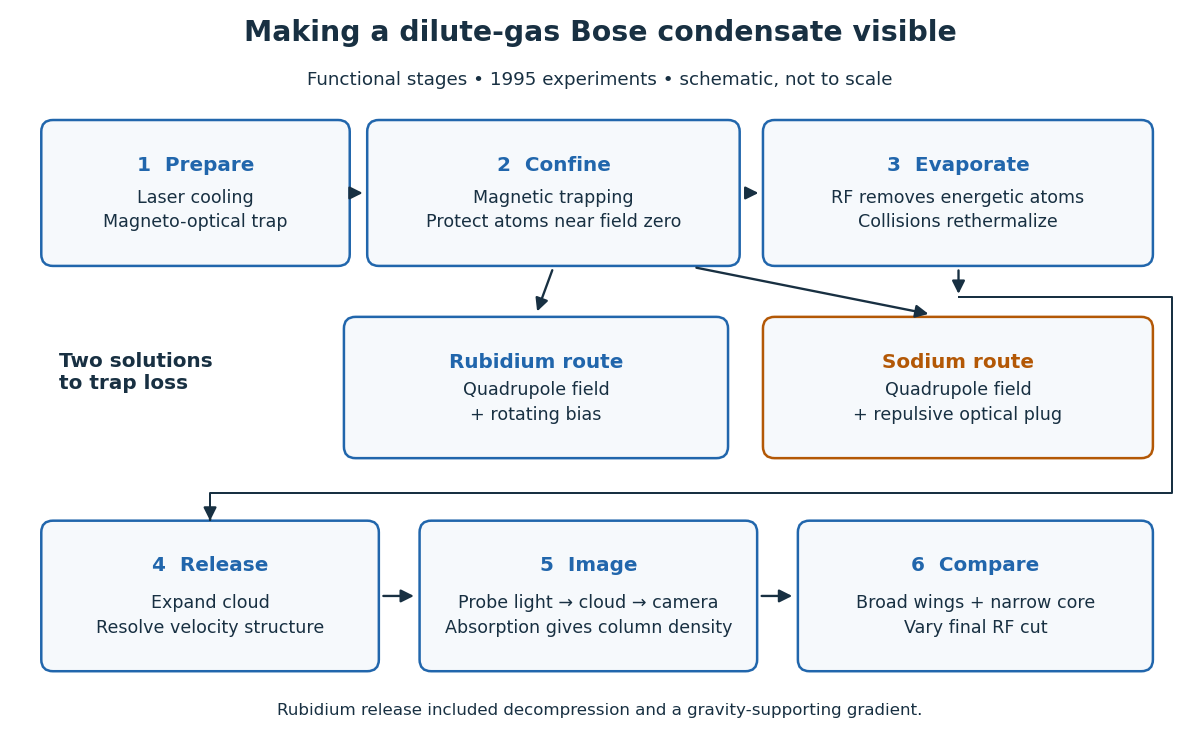
In a dilute gas, Bose-Einstein condensation makes a single one-particle state hold a substantial fraction of the bosons. This is a population effect: cooling reduces the number that the excited energy eigenstates can accommodate at thermal equilibrium. The surplus accumulates in a Bose-Einstein condensate. For an ideal gas the occupied mode is the trap ground state; interactions can deform that mode, as described by the Gross–Pitaevskii equation. Dilute does not mean classical: a small number density can still give overlapping thermal de Broglie wavelengths at sufficiently low temperature.
The appeal is that changing the trap changes a calculable Quantum Hamiltonian, while absorption imaging makes its population distribution visible. The Bose condensation in a three-dimensional harmonic trap below turns density of states into a prediction for a critical temperature and condensate fraction. These are separate questions from measuring matter-wave coherence or superfluidity.
Eric A. Cornell and Carl E. Wieman's joint lecture emphasizes the competition between useful elastic collisions, which restore thermal equilibrium during evaporative cooling, and collisions that remove or heat the trapped sample. A long trap lifetime alone is insufficient: reequilibration must keep up with evaporation.[ref]
Nobel Lecture: Bose-Einstein condensation in a dilute gas, the first 70 years and some recent experiments by Eric A. Cornell and Carl Wieman. pp. 878–879 and 890, collisional requirements

Homogeneous ideal Bose gas condensation Created 2026-10-18 Updated 2026-11-05
For a uniform three-dimensional ideal gas of spinless bosons with energy and ground energy set to zero, the excited number density is , with quantum gas fugacity . Its finite maximum gives the displayed critical temperature. Below it, particle conservation gives condensate fraction . The excited-state internal energy is , with below the transition. The exponent differs from that of a harmonic trap. Condensation is not by itself a demonstration of superfluidity; the ideal quadratic dispersion has vanishing Landau critical speed.
Consider one chosen model at a fixed total energy, with two open scattering channels, no absorption and no omitted outgoing modes. Channel 1 leaves the target unchanged; channel 2 excites it. Let and . For the same projectile mass, conservation of energy then requires a target excitation . These are hypothetical parameters, not a fit to a particular atom. Each incoming or outgoing mode is normalized to unit probability current; the outgoing modes will have the angular profiles specified below.
Choose the S-matrixThis phenomenological unitary matrix specifies the channel conversion; it is not derived here from an interaction potential energy. For incidence in channel 1, its first column gives the outgoing flux amplitudesTo recover ordinary wave coefficients relative to an incident coefficient one, undo the velocity normalization:Thus is allowed: channel 2 travels more slowly. Its outgoing probability current fraction is , not . Renormalizing the unweighted squares would give and , the wrong probabilities. More generally the ordinary coefficient map is , with ; it obeys . The conserved quantity is the squared coefficient norm weighted by velocity, which represents probability current.
Now specify an original angular realization of these two outgoing modes, with scattering angle and no azimuth dependence:The first normalization follows from , where . These angular profiles define the modes of this model; they are not asserted to follow from Born's approximation or an atomic potential energy. The joint directional probability densities are
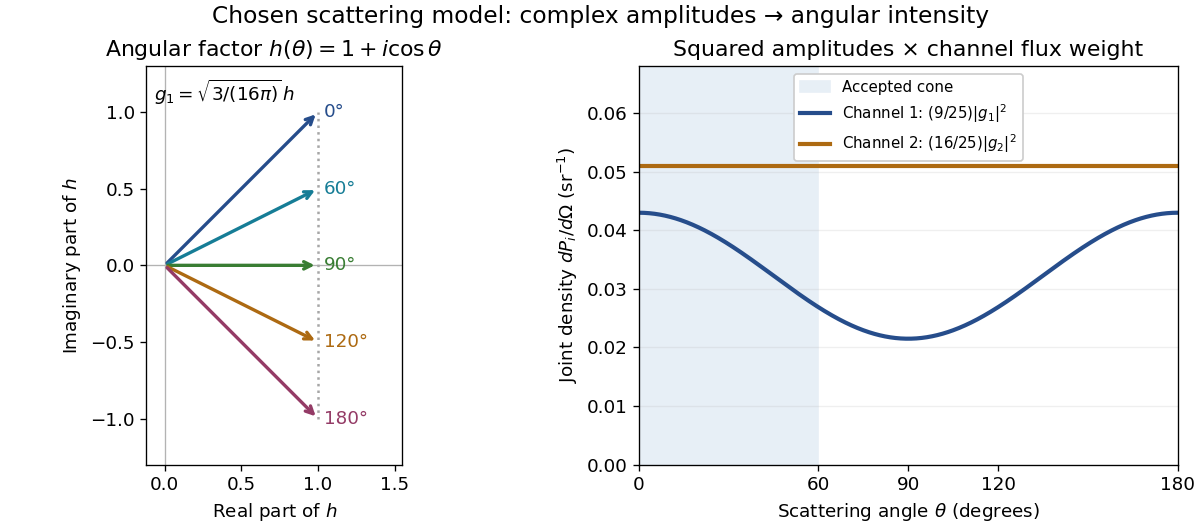
Complex angular amplitudes become channel-resolved scattering intensity
. Original two-channel model. Left: arrows in the complex plane show , the angular factor of . Right: the joint directional probability densities , per solid angle, retain the channel flux weights and . The shaded interval is the cone ; its probability requires the measure , not the area under a curve against degrees. These are chosen amplitudes, not historical measurements. Source. Details.
Suppose a detector accepts the cone , with full azimuth and unit efficiency. Its angular fractions within the channels areMultiplying the angular fractions by the outgoing flux weights givesFor independent incident events, the expected values are therefore and accepted detections, compared with and over all directions. The remaining expected events fall outside the cone. The chosen incident number makes the expectations integers; actual counts fluctuate. Conditional on a detection inside the cone, the channel probabilities are and , rather than and . Angular acceptance changes the observed channel proportions even with equal detector efficiencies.
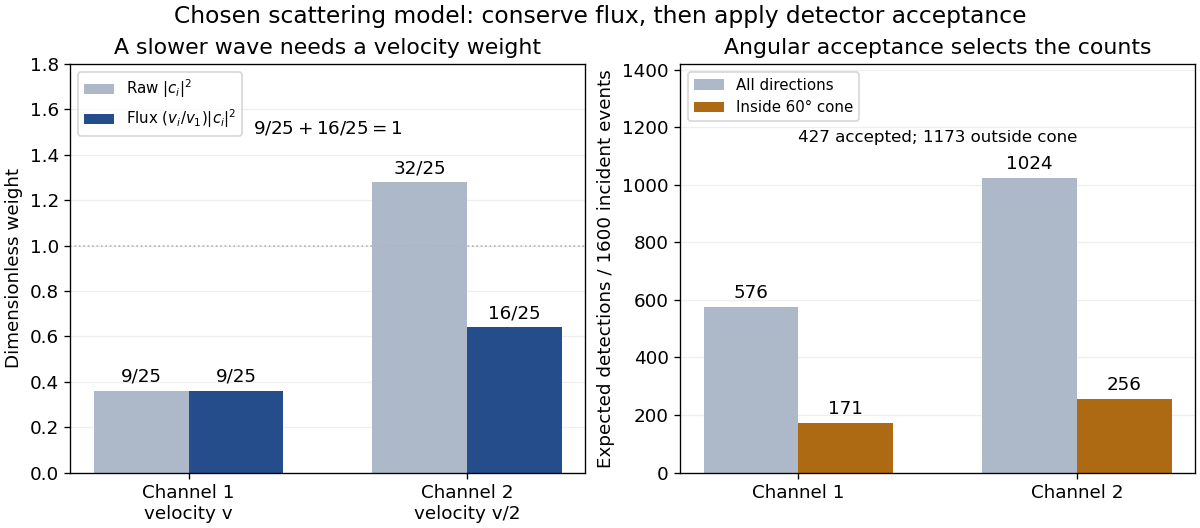

The final atomic states are orthogonal, so ignoring the atomic readout adds the two channel intensities; it does not produce . Coherent paths that reach the same final state can instead interfere, as the existing probability amplitude and quantum superposition examples demonstrate. The distinction is physical distinguishability of final states, not whether the detector operator chooses to display their labels. Flux normalization and angular integration make the scattering interpretation useful: they turn complex outgoing waves into conserved event weights and then into the statistics of a specified detector.
Take nonrelativistic quantum mechanics, a short-range interaction, a fixed heavy target, and a common projectile mass . An incoming plane wave in atomic state has unit coefficient. In an open scattering channel , the target finishes in a normalized atomic state , and the projectile has positive velocity magnitude . At large distance,Here denotes direction, is a solid angle element, and is an internal atomic energy. Different are orthogonal. The scattering amplitude has units of length. A closed scattering channel has no propagating outgoing probability current at this total energy.
The incoming probability current density is . The outgoing radial probability current density in channel is . Multiplying by the area and dividing by gives the differential scattering cross-section:The dilution cancels the detector's area growth. The velocity ratio remains: a squared wave coefficient alone is not generally a flux fraction. A differential scattering cross-section has units of area per solid angle, rather than being a normalized directional probability density. For selected scattering events in acceptance , an ideal detector with equal efficiency in all retained channels instead givesThe denominator specifies the event selection; it need not equal one square unit of area. Absolute rates require incident flux, target number and detector efficiency in addition to these relative weights. The next finite-mode model normalizes outgoing probability current to one incoming event and predicts event fractions directly.
Boiling chip Created 2026-10-18 Updated 2026-11-05
A boiling chip is a small solid piece with cavities or a porous surface that supplies sites for heterogeneous nucleation of vapor bubbles in a heated liquid. Gas trapped in a cavity can help an incipient bubble survive the capillary pressure that would collapse a sufficiently small isolated bubble.
Many active sites encourage repeated bubble release, reducing the large, irregular boiling events associated with delayed nucleation and superheating. The chip changes the route by which boiling begins; it does not materially redefine the liquid's equilibrium boiling point. Its action is therefore understood through interface formation and bubble growth, rather than through a chemical conversion of the solvent.
GaN blue LED development Created 2026-10-18 Updated 2026-10-31
Isamu Akasaki chose metalorganic vapour-phase epitaxy and sapphire, which tolerated hot Ammonia. Large lattice mismatch hindered film growth. In 1985, Hiroshi Amano and Isamu Akasaki's group developed an aluminium nitride epitaxial buffer layer deposited before hotter gallium nitride growth. The buffer supplies initial growth sites; growing islands join into a continuous film. It improves growth without making the lattices identical. Isamu Akasaki separately credits Shuji Nakamura's 1991 gallium nitride buffer.[ref]
https://www.kapitza.ras.ru/~glazkov/students/Nobel-akasaki-lecture.pdf. §§3.2–4.2, pp. 13–20, Figs. 7–11: growth sequence and microscopy
The 1986 growth paper reports a vertical metalorganic vapour-phase epitaxy reactor, source gases mixed just before delivery to slanted sapphire, and subsequent gallium nitride growth over aluminium nitride. Surface microscopy, X-ray diffraction and photoluminescence tested different aspects of the result. Buffered and unbuffered growth supplied the comparison. Its reported preparation conditions should not be replaced by one universal buffer temperature: the later lecture's account of the first low-temperature trial and the paper's parameter study describe different stages of development.[ref]
Metalorganic vapor phase epitaxial growth of a high quality GaN film using an AlN buffer layer by Hiroshi Amano and others. p. 353, Fig. 1 and Table I; p. 354, surface and diffraction comparisons
A magnesium acceptor impurity in gallium nitride accepts a valence band electron, leaving a mobile electron hole. Hydrogen passivation of magnesium acceptors in gallium nitride suppresses this activity. Post-growth activation restores existing impurities' electrical activity; ionization of active acceptor impurities supplies mobile electron holes. Adding magnesium alone is insufficient.[ref]
In 1989, Hiroshi Amano, Masahiro Kito, Kazumasa Hiramatsu and Isamu Akasaki obtained p-type semiconductor conduction in magnesium-doped gallium nitride using low-energy electron beam irradiation. Hiroshi Amano recalls initially resistive samples, an unreliable hot-probe test, then Masahiro Kito's Hall effect confirmation. A junction irradiated in an M-shaped region emitted in that pattern. Treatment, carrier-sign measurement and spatial emission supplied different evidence. Earlier zinc-doped samples brightened under irradiation without becoming p-type semiconductors: brightness alone did not prove the carrier sign.[ref]
https://journals.aps.org/rmp/pdf/10.1103/RevModPhys.87.1133. §V, pp. 1135–1136, Figs. 3–4; authors of 1989 paper in references, p. 1137
Shuji Nakamura, Takashi Mukai, Masayuki Senoh and Naruhito Iwasa's 1992 thermal-activation paper established another route using annealing in nitrogen. Their companion study compared already conducting films heated in nitrogen with films heated in Ammonia: the latter became highly resistive again. Its hydrogen-complex explanation connected this atmosphere dependence to acceptor impurity passivation. These are thermal treatment and atmosphere comparisons, distinct from the earlier electron beam intervention; neither observation alone images an individual hydrogen complex.[ref]
Thermal Annealing Effects on P-Type Mg-Doped GaN Films by Shuji Nakamura and others. abstract: nitrogen annealing above 700 degrees Celsius and electrical changes
[ref]Hole Compensation Mechanism of P-Type GaN Films by Shuji Nakamura and others. p. 1258, abstract and §§1–2: activation history, nitrogen/ammonia comparison and hydrogenation hypothesis
Shuji Nakamura's two-flow metalorganic chemical vapor deposition reactor, gallium nitride buffer, thermal activation and improved indium gallium nitride growth enabled bright double heterostructure devices, followed by thinner quantum well devices.[ref]
The original 1994 paper by Shuji Nakamura, Takashi Mukai and Masayuki Senoh describes a sapphire/gallium nitride-buffer device with zinc-doped indium gallium nitride emission and aluminium gallium nitride confinement. After nitrogen annealing, etching exposed the n-side for a separate contact. At room temperature, varied forward electric currents gave emission spectra and optical-output curves alongside a current-voltage characteristic. At : output, peak wavelength, terminal electric potential difference. The peak stayed nearly fixed across the current series. The paper omits a complete calibrated collection apparatus; comparisons with earlier devices change several preparation details.[ref]
Candela-class high-brightness InGaN⁄AlGaN double-heterostructure blue-light-emitting diodes by Shuji Nakamura and others. pp. 1687–1688, fabrication and Figs. 1–4
TXS 0506+056 Created 2026-10-18 Updated 2026-11-05
TXS 0506+056 is a blazar studied through a gamma-ray flare associated in direction and time with the high-energy neutrino alert IceCube-170922A. The event motivated coordinated observations across the electromagnetic spectrum, connecting a variable relativistic source with a possible source of energetic neutrinos.[ref]
Multi-messenger observations of a flaring blazar coincident with high-energy neutrino IceCube-170922A by IceCube Collaboration and others. Abstract: alert, directional/temporal association and follow-up observations
An association is a statistical inference involving localization, timing and backgrounds. It does not directly image the neutrino-production site or uniquely determine the jet's particle composition. The physical interpretation must account for the measured photons and neutrino evidence together.
Circular birefringence 2026-10-18
Circular birefringence means different refractive indices for opposite circular polarizations. In a transparent isotropic medium, their relative wave phase changes rotate the direction of transmitted linear polarization; optical activity gives the solution measurement and convention.
Linear birefringence Created 2026-10-18 Updated 2026-10-20
Linear birefringence means that two orthogonal linear polarizations have different refractive indices. Their different propagation phases produce phase retardation. In a lossless waveplate, with fast-axis angle and slow-minus-fast retardation , the Jones matrix, up to a common phase, isusing time dependence . Circular birefringence instead has circular eigenpolarizations.
Square-root binomial series at its endpoints 2026-10-18
Write , . The binomial series for has positive numbers as the magnitudes of its nonconstant coefficients. The product tends to zero, since . Thus by telescoping. The Weierstrass M-test gives uniform convergence and absolute convergence on . Continuity extends the interior identity to both endpoints. Its radius of convergence is one; outside this interval its terms do not tend to zero.
Let and be independent random variables with binomial distributions and . Conditional on having positive probability, the possible values of satisfy . Their probabilities arewhere the denominator sums over that feasible integer range. The formula follows by multiplying independent binomial probabilities and dividing by the probability of the disjoint union of all feasible count pairs.
For , common factors cancel and the weights are proportional to , where . If , this reduces to the hypergeometric distribution, with probabilities . At parameter endpoints, use the original probability weights and check that the conditioning event has positive probability before dividing.
Binomial probability Created 2026-10-18 Updated 2026-11-05
The binomial distribution with parameters and assigns the displayed probability to successes, for integers . Each specified sequence of independent trials has probability , and the binomial coefficient counts the sequences with exactly successes. Outside this range the probability is zero.
There are unlisted articles, also show them or only show them.