
E. M. Greitzer Created 2026-10-14 Updated 2026-11-05
An engineering educator whose joint thermodynamics text emphasizes choosing a thermodynamic system before applying an energy balance. A heater can transfer energy as electrical work across one boundary and as heat across another. The distinction depends on the selected system, making explicit boundaries essential when interpreting an apparatus.[ref]
PHYWE Systeme GmbH & Co. KG 2026-10-14
List of physicists Created 2026-10-14 Updated 2026-10-31
Adsorption Created 2026-10-14 Updated 2026-10-18
Adsorption is accumulation of a substance at an interface. Binding a solute to a packing surface can delay its passage through a chromatography column. Ideal size-exclusion chromatography separates through SEC pore access without such binding; extra retention from adsorption requires a different interpretation.
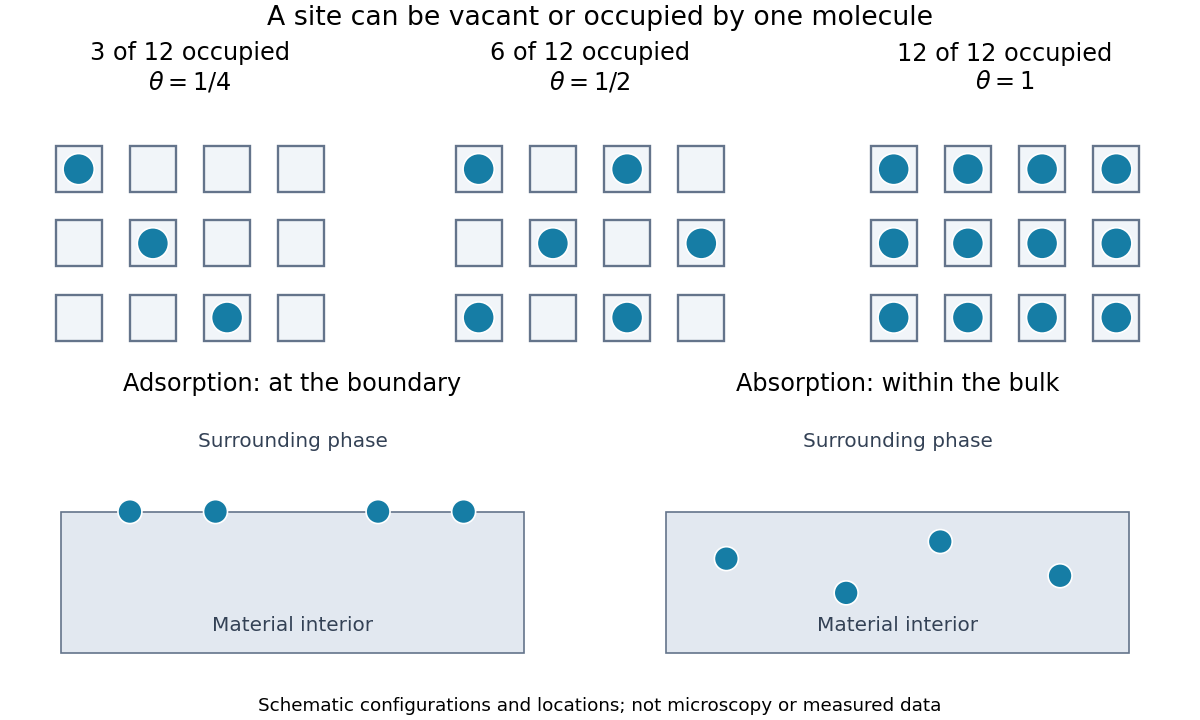
For a gas contacting a solid, adsorption concentrates molecules at the boundary; absorption takes material into the bulk. A porous solid can have a large internal surface area: binding on pore walls is still adsorption, even though those walls lie inside the particle. Both processes can occur together. Desorption returns adsorbed material to the surrounding phase. The useful question is therefore not just how much material disappeared from the gas, but where it went and whether it returns when the pressure falls.
An adsorption site model turns this spatial distinction into counting. With twelve identical adsorption sites and three bound molecules, the surface coverage is . Filling six gives ; filling twelve gives a complete monolayer. These are configurations illustrating the count, rather than measured arrangements or claims that all real surfaces have twelve sites.

Crystal structure Created 2026-10-14 Updated 2026-10-18
A crystal structure specifies the chemical species and spatial arrangement of the chemical atoms or ions in a crystal. For an ideal periodic structure, separate two ingredients: a Bravais lattice specifies the translations that repeat the arrangement, and an atomic basis of a crystal specifies the chemical motif repeated at every lattice point. The outward shape, or crystal habit, is a different description: the internal arrangement is what this article describes.
For a concrete two-dimensional model, choose primitive lattice translation vectors and in arbitrary length units. At every lattice point , with integers , place species A at and a different species B at . Translating by or preserves both the positions and their chemical labels. Translating by sends one A position to a B position, so it is not a translation symmetry of the labeled structure. A picture of dots with the labels erased can therefore conceal essential chemical information.
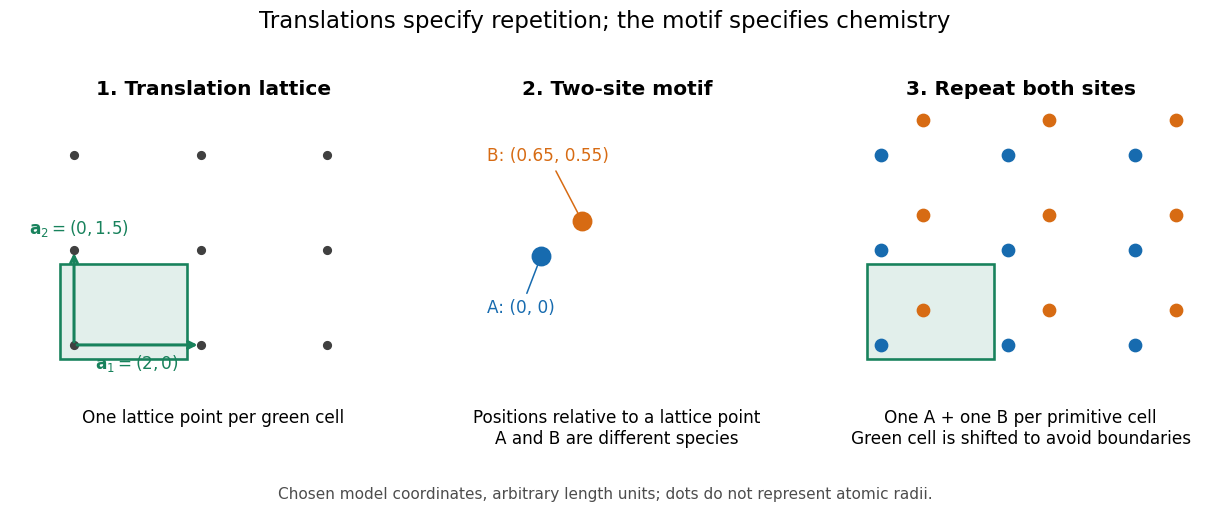

A primitive unit cell contains one lattice point, but may contain several chemical atoms. A conventional unit cell can contain several lattice points to display the symmetry more clearly. Thus the conventional cube of a face-centered cubic lattice contains four lattice points, whereas a body-centered cubic lattice has two. Neither lattice name alone specifies which chemical species occupies the repeated motif. The NaCl conventional cell and coordination example makes the distinction explicit.
This separation is useful experimentally: interplanar spacings constrain the repeating geometry, while relative wave intensities also depend on the atomic basis of a crystal through the crystal basis structure factor. The Bragg crystal reflection experiment of 1913 describes the X-ray spectrometer, angular scans and detector checks in detail. Its conversion from angle to length is developed under Bragg's law; a geometrically possible reflection can still have zero wave intensity.
William Lawrence Bragg's 1913 structure determination supplied a complementary test. He directed X-rays through sodium chloride sections cut parallel to a cube face and recorded spots on photographic plates. Comparing section thicknesses tested how transmission altered the pattern: the relative spot strengths changed. Comparing related salts led him to two interpenetrating face-centered cubic lattices, one for each kind of constituent. He explicitly distinguished evidence for that arrangement from the still-needed identification of a single chemical atom with each scattering center. The photographs were evidence for a structural model, not direct pictures of labeled ions.[ref]
Dona Mapston Created 2026-10-14 Updated 2026-10-24
Neuroscientist Created 2026-10-14 Updated 2026-11-05
A neuroscientist studies the nervous system, connecting its structure, activity, development or evolution to function. Experiments can address processes from ion channels to animal behaviour; an explanation at one scale need not replace measurements at another.
Single-molecule experiment 2026-10-14
A single-molecule experiment resolves a response attributable to an individual molecule, rather than only an average over many molecules. Optical detection need not resolve its constituent chemical atoms in an image: repeated photon absorption by the same molecule can produce a measurable response. One detected photon is not automatically one different molecule.
The measured channel matters. Direct photon absorption detection measures a change in transmitted light. Fluorescence detection collects photons emitted after excitation; a fluorescence excitation spectrum varies the illuminating frequency while observing that emission. Both can probe excitation, but their backgrounds and readouts differ. A labeled particle cartoon explains the interpretation; it supplies no experimental evidence by itself.
Such measurements expose differences that a population average can conceal. Suppose two groups of molecules switch between different internal quantum states. Their average response could vary smoothly even though each molecule changes in discrete steps. Resolving an individual response tests that interpretation directly, subject to the measurement's time resolution, sensitivity, and particle assignment. The following experiment makes that assignment through spectral selection and controlled perturbations.
Molecule bookkeeping 2026-10-14
Four water molecules contain eight hydrogen and four oxygen chemical atoms, twelve constituent chemical atoms altogether. Counting the constituents does not mean they have been separated by breaking chemical bonds. The same sample has different counts because the specified entities differ.
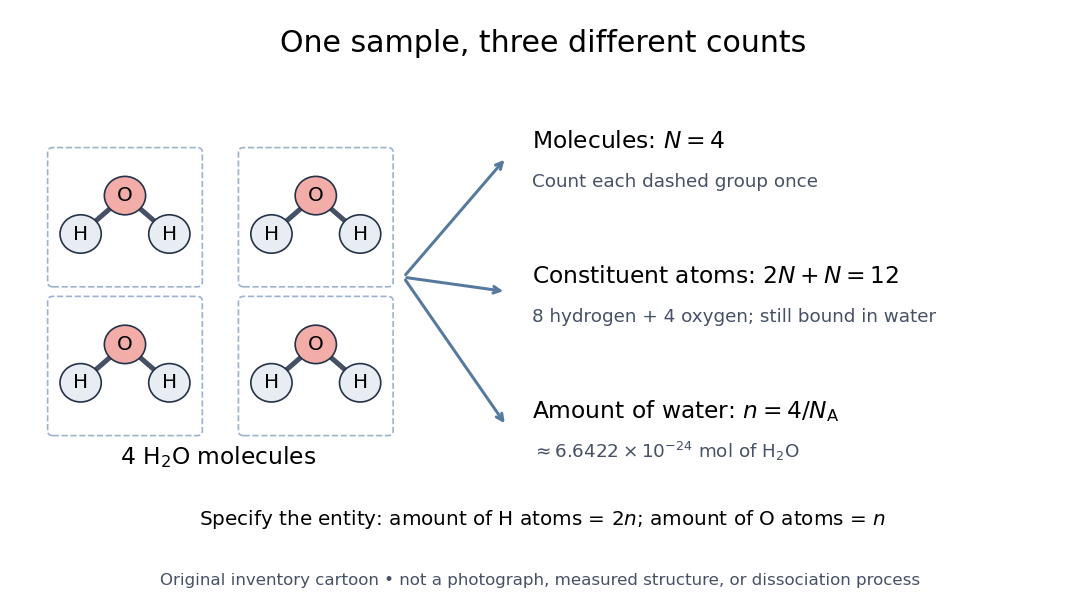

For water molecules, their amount of substance is , while the constituent hydrogen and oxygen inventories correspond to and respectively. The exact Avogadro constant is . The mole applies to specified entities, including chemical atoms, molecules, and ions.[ref]
SI base unit: mole by Bureau International des Poids et Mesures. SI base unit: mole, definition and the requirement to specify the elementary entity
Thus four water molecules correspond to approximately of water, but twice that amount of substance of constituent hydrogen chemical atoms. A macroscopic conversion through measured mass additionally needs the relevant molar mass, as in water mass to molecular count. Macromolecule Created 2026-10-14 Updated 2026-10-20
A molecule with a high relative molecular mass, typically built from many smaller units joined by covalent bonds. Proteins and nucleic acids are examples. In dialysis, a semipermeable membrane can retain these large molecules while smaller solutes diffuse through.
Vapor-density molar mass measurement 2026-10-14
An ideal gas law measurement obtains amount of substance without knowing the chemical formula in advance:Here is vapor pressure, is its occupied volume, is absolute temperature, is the molar gas constant, and is the mass of vapor occupying that volume at those conditions.
Santa Monica College's teaching experiment uses a Erlenmeyer flask with a pinhole foil cap, a water bath on a hot plate, a thermometer, and a barometer. Excess volatile liquid displaces air. A dissolved dye loses its colour and deposits when the liquid evaporates; three more minutes of heating follow. Cooling condenses retained vapor. Subtracting the dry assembly mass from the cooled assembly mass supplies . The flask volume comes from brim-full water mass and mass density at its measured temperature. Controls include a dry exterior, excluding bath water, and three trials.[ref]
11B: The Dumas Method (Experiment) by Santa Monica College. Santa Monica College, 11B, Experimental Set-up steps 1–6; Trials 1–3 steps 1–4: apparatus, dye endpoint, heating, drying and repetition
The inference assumes vapor pressure equals atmospheric pressure, vapor and bath reach thermal equilibrium, the retained vapor mass is recovered on cooling, and the vapor obeys the ideal gas law. Residual air, thermal expansion of the flask, and vapor temperature below bath temperature are explicit error questions in the teaching experiment. Repeating trials assesses repeatability; it does not remove a shared bias.[ref]
11B: The Dumas Method (Experiment) by Santa Monica College. Lab Report, questions 1–4: residual air, glass expansion, nonideal vapor and incomplete thermal equilibration
Two-population molar mass example 2026-10-14
Suppose a synthetic polymer population contains three chains of molar mass for every one chain of molar mass . Multiplying both chain counts by any common factor leaves the averages unchanged. Substitution into the existing number-average molar mass and weight-average molar mass definitions givesThe larger chains are only one quarter of the chain count but supply of the mass. Thus a weighted mean that emphasizes mass gives a larger result than one that weights each molecule equally. Total mass divided by total chain amount of substance gives , while is not the mean mass of a randomly chosen chain. Inferring chain counts from size-exclusion chromatography still requires the existing SEC detector response and SEC molar mass calibration assumptions.
Water mass to molecular count 2026-10-14
Choose approximate atomic weights and , and use . The chemical formula then gives water molar massThese are deliberately chosen rounded inputs, not exact atomic weights or a universal value for every water sample. Different isotopic abundances, notably those in heavy water, change the mean molar mass; chemical formula alone does not specify them. Adding atomic weights also neglects the tiny mass change associated with chemical bond energies, immaterial at this rounding precision.
For an illustrative pure water sample of mass , this convention givesThe count refers to water molecules. Their hydrogen chemical atom count is approximately , and their oxygen chemical atom count is approximately . The mean mass per water molecule is . Extra displayed digits expose the arithmetic; they do not imply that the sample composition or mass was measured that precisely.
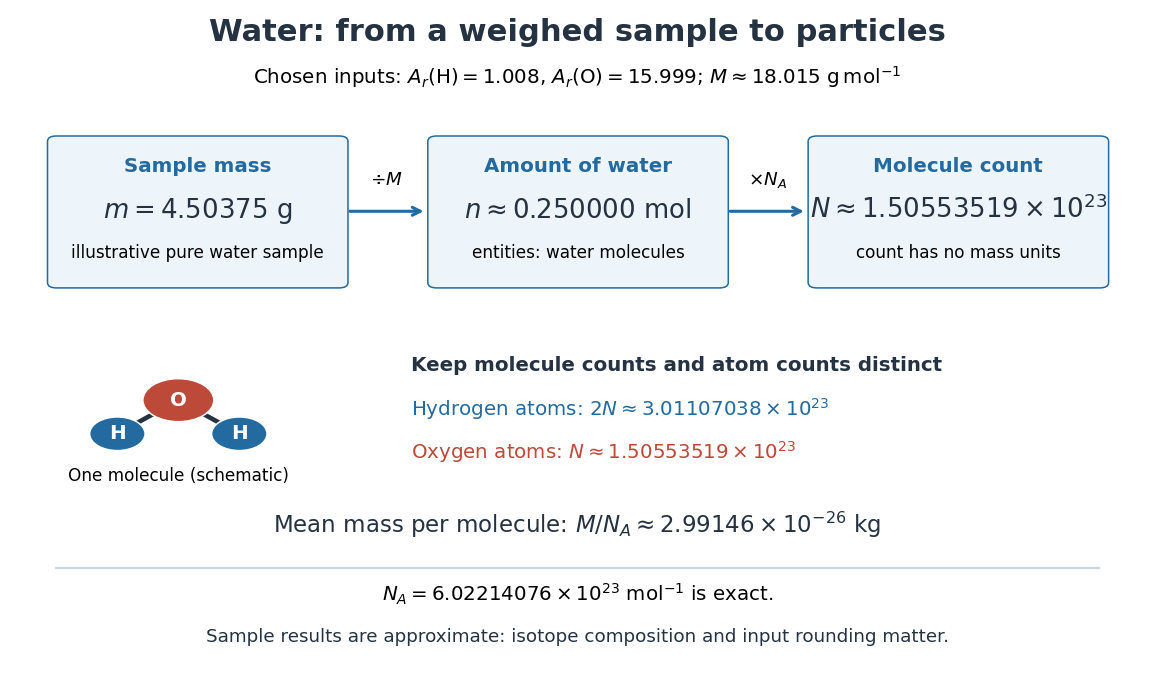
Mapping water mass through amount of substance to molecule and chemical atom counts using chosen approximate atomic weights
. Details. 
The same conversion makes stoichiometry a mass calculation. For the chemical equation , complete conversion of of molecular hydrogen and of molecular oxygen gives of water. With the chosen approximate atomic weights, the reactant masses are and , summing to . The ratio belongs to molecule counts and amount of substance, not to masses; this bookkeeping neglects the much smaller reaction energy contribution to mass.
Molar mass constant 2026-10-14
The molar mass constant converts relative atomic mass or relative molecular mass into molar mass. It is approximately . Its SI numerical value is determined experimentally: the exact Avogadro constant multiplies an experimentally determined unified atomic mass unit in kilograms. Treating as exactly is therefore an excellent elementary-calculation approximation, rather than a defining equality of the modern SI.[ref]
Relative molecular mass 2026-10-14
The relative molecular mass is the dimensionless ratio of a specified mean molecule mass to the unified atomic mass unit, written when treated as a physical quantity:Thus a relative molecular mass of approximately and a molar mass of approximately describe related quantities with different units. The conversion uses the molar mass constant, rather than identifying a dimensionless number with a mass per mole.
Weight-average molar mass 2026-10-14
The weight-average molar mass weights each population by its contribution to total mass:Here counts molecules with molar mass . SEC light-scattering detection can infer this average for an eluting slice under its optical and concentration assumptions; overlapping species need not have the same individual molar mass.
Number-average molar mass 2026-10-14
The number-average molar mass weights each molecule equally. For counts with molar masses ,A mass-proportional SEC detector response requires conversion to counts before determining this average.
Diatomaceous earth Created 2026-10-14 Updated 2026-11-05
Diatomaceous earth is a porous material formed largely from the silica-rich remains of diatoms. It is a particulate mixture rather than a single chemical compound with one exact molecular formula.
Its pore structure and high surface area make it useful as a filtration aid and absorbent material. The distinction between particle geometry and chemical composition matters: two silica-rich powders can have different filtration behavior because their pore sizes and packing differ. Natural and processed grades can also differ in mineral content and crystalline-silica fraction.
Pycnometer 2026-10-14
A calibrated vessel used to infer a liquid's mass density from its mass and filled volume; see pycnometer density measurement for an inspected experiment and the accounting formula.
Metrologist Created 2026-10-14 Updated 2026-11-05
A metrologist studies measurements and the references, methods and uncertainties that make them comparable. The work connects a specified measurand to measurement calibration, measurement uncertainty and reproducible units of measurement. An experiment that improves the stability of a length standard or checks the response of a force probe is therefore investigating how confidently other experiments can compare their results.
There are unlisted articles, also show them or only show them.