
Wilhelm Eduard Weber, portrait by Gottlieb Biermann, 1885
. Portrait source. Gottlieb Biermann; scanned by Michael Schönitzer in November 2008 from Die großen Deutschen im Bilde (1936). Public-domain artwork; faithful photographic reproduction, PD-Art / Public Domain Mark.

Portrait source. Julien Léopold Boilly; Wellcome Collection, image V0000147, library reference ICV No 329. Creative Commons Attribution 4.0 International.
A researcher credited with Electrostatics of Two Charged Conducting Spheres by John Lekner. The 2012 paper gives an affiliation at Victoria University of Wellington.
Verified external portrait reference: Portrait or portrait collection identifying the sitter.

Portrait of Carlo Matteucci
. Historical photographic portrait of Carlo Matteucci; photographer not identified. Public-domain image hosted by Wikimedia Commons. Source.
Portrait of Hans Christian Ørsted
. Portrait by Christian Albrecht Jensen, 1842; public-domain reproduction hosted by Wikimedia Commons. Source.
Portrait of Leopoldo Nobili
. Historical portrait, with source provenance from the Smithsonian scientific-identity collection; public-domain reproduction hosted by Wikimedia Commons. Source.A physicist associated with the Ehrenfest theorem and, with Tatyana Afanasyeva-Ehrenfest, the Ehrenfest model.

Portrait of Paul Ehrenfest
. Historical photograph by an unknown photographer, held by the Noord-Hollands Archief. Listed as public domain by Wikimedia Commons. Source.Physicist and computer scientist associated with the Karnaugh map for simplifying Boolean functions. Wikipedia biography identifies the subject and his logic-design contribution.
Author credited under these initials on the 1965 Monte Carlo method plasma paper Monte Carlo Calculations of the Radial Distribution Functions for a Proton-Electron Plasma by A. A. Barker. The initials are not expanded because an exact identity beyond the publication credit has not been established here. University of Adelaide thesis addendum identifying the 1965 publication.
Physicist and engineer whose work includes friction and strength of materials. His name appears in the Mohr-Coulomb failure criterion.

Portrait of Charles-Augustin de Coulomb
. Louis Hierle, 1894, after Hippolyte Lecomte; painted portrait at Versailles. Public domain according to the Wikimedia Commons file page (PD-old-100 and PD-US-expired). Source usage terms, via Wikimedia Commons. Source.Physicist and clinical radiobiology researcher whose work addressed fractionation in radiation therapy.[ref]
https://www.thegreenjournal.com/article/S0167-8140%2816%2934439-5/fulltext. Primary identity record

Modern reconstructed portrait of Robert Hooke
. Rita Greer, 2006; modern imaginative reconstruction from written descriptions, not an authenticated lifetime likeness. Free Art License, artlibre.org/licence/lal/en/ . Wikimedia permission ticket 2009082810018211; no alteration other than display scaling. Source.
Benjamin Thompson, Count Rumford; early nineteenth-century copy after a 1792 portrait by Moritz Kellerhoven; National Portrait Gallery, London; public-domain image via Wikimedia Commons
. Source. A physicist whose thermodynamics distinguished conservation of energy from restrictions on cyclic heat-to-work conversion.

William Thomson, Lord Kelvin; photograph credited to Messrs. Dickinson, London; Smithsonian Libraries, via Wikimedia Commons; public domain
. Source. Experimental physicist associated with detector development and biomedical applications at Jefferson Lab.

Portrait of John Holdren
. Office of Science and Technology Policy, official portrait, 24 April 2009. Public domain in the United States: OSTP employee’s official-duty federal-government work. Source usage terms, via Wikimedia Commons. Source.
Portrait of Galileo Galilei
. Oil painting after Justus Sustermans; Wellcome Library, London, image M0008554. CC BY 4.0, via Wikimedia Commons. Source.
Portrait of Paul Langevin
. Photographer not identified; Wellcome Library/Collection, London, image V0028220; existing Langevin portrait crop. CC BY 4.0, via Wikimedia Commons. Source.
Portrait of Paul Richard Heinrich Blasius
. Unknown photographer; Heinrich Blasius at the engineering school, circa 1920; source HAW Hamburg. Commons PD-anon-expired: US publication before 1931 and anonymous-work terms of 95 years or fewer, via Wikimedia Commons. Source.
Portrait of Franz Ernst Neumann
. Carl Steffeck, 1886; Nationalgalerie Berlin, accession A I 376; faithful reproduction via Wikimedia Commons. Public-domain artwork: author died more than 100 years ago; faithful reproduction treated as public domain in the United States under Commons PD-Art. Source usage terms, via Wikimedia Commons. Source.
Portrait of Christian Møller
. GFHund, July 1963; photograph from Friedrich Hund’s estate, prepared for Wikipedia by Gerhard Hund. CC BY 3.0, via Wikimedia Commons. Source.A physicist and mathematician associated with Stokes flow, Stokes' second problem and Stokes theorem.

Portrait of George Gabriel Stokes
. Swan Electric Engraving Co., as credited by the File; Archivio storico dell’Accademia delle Scienze di Torino, catalog 0155, accession IST. 4.1.3. 2. Commons claims origin/life-plus-100-or-shorter public domain and pre-1931 United States publication. Source usage terms, via Wikimedia Commons. Source.James Prescott Joule was an English physicist whose private experiments connected electricity, heat and mechanical work. His family ran a brewery in Salford; he developed an experimental laboratory while working in the family business.[ref]
James Prescott Joule by Science Museum Group. Biographical account: brewing family, private laboratory and experimental interests
The Royal Society's archive identifies his occupation as physicist and records his life as 1818–1889.[ref]James Prescott Joule by Royal Society. Person record NA7041: occupation and life dates

Portrait of James Prescott Joule, 1882
. Source. His electrical heating experiments placed metal coils in water and measured the temperature change. Later, he used the brewery cellar to reduce ambient temperature fluctuations during friction experiments and took particular care over thermometer calibration.[ref]
James Prescott Joule by Science Museum Group. Electrical heating experiments; brewery-cellar friction measurements and precision thermometers
These practical choices address a central difficulty of calorimetry: a small temperature rise can reflect both the intended input of energy and unwanted heat transfer to the surroundings. A quiet baseline and a known heat capacity are part of the measurement, not decoration around the formula.The contrast between Joule heating and Joule's paddle-wheel experiment makes the connection especially clear. One supplies electrical work; the other supplies mechanical work. In each case, calorimetry tracks the resulting change of internal energy. Comparing quantitatively controlled inputs with thermal changes gives an experimental test of conservation of energy, rather than merely showing that stirring or an electric current can warm water. The paddle-wheel account describes the descending weights, vanes, thermal controls and corrections needed for that comparison.
Joule's free-expansion experiment asks a different question: how does a gas's temperature change during expansion without external work? The Joule-Thomson effect instead concerns flow through a restriction and a balance involving enthalpy. Keeping the two experiments distinct prevents a shared historical name from hiding different system boundaries and different conserved quantities.
A physicist appointed to Dresden in 1911 to establish an institute for electrical engineering.[ref]
Uni-Gebäude und ihre Namen: Barkhausen-Bau by Jörg Zaun. Heinrich Barkhausen biography: physicist; Dresden professorship and institute founded in 1911
A physicist whose research includes acoustics.[ref]
Joe Wolfe: educational videos and pages by Joe Wolfe. Introductory paragraph: physics research in musical-instrument acoustics, voice acoustics and cellular cryobiology
A physicist appointed to the Paris Observatory in 1855 who developed telescopes.[ref]
Léon Foucault à l’Observatoire by Observatoire de Paris. Léon Foucault à l’Observatoire, p. 2: appointed physicist in 1855; telescope development

Portrait of Léon Foucault
. Muzelle - E. Pérot, as credited on Commons; portrait reproduced in Recueil des travaux scientifiques de Léon Foucault, Gauthier-Villars, Paris, 1878; Gallica digital reproduction. Commons claims public domain in the country of origin and jurisdictions with life-plus-70 terms or shorter. Source usage terms, via Wikimedia Commons. Source.A physicist whose appointments took him from Zürich in 1868 through Würzburg and Strasbourg to the Berlin chair of experimental physics in 1888.[ref]
August Kundt by Berlin-Brandenburgische Akademie der Wissenschaften. Kurzbiographie: physics professorships and life dates

Portrait of August Kundt
. Source. A physicist researching general relativity.[ref]
Professional profile of David Garfinkle (oakland.edu). Independent professional identity
A physicist researching general relativity.[ref]
Professional profile of José M. Martín Senovilla (ehu.eus). Independent professional identity
A physicist researching general relativity.[ref]
Amal Kumar Raychaudhuri by Jayant Vishnu Narlikar. Independent professional identity
A physicist.[ref]
https://kapitza.ras.ru/history/LDLandau/main.html. Independent professional profile

Portrait of Lev Landau
. Nobel Foundation; individual photographer unidentified. Commons PD-Sweden photograph designation; File requests a separate US public-domain tag. Not a worldwide clearance., via Wikimedia Commons. Source.A physicist.[ref]
https://teara.govt.nz/en/biographies/5b9/barnett-miles-aylmer-fulton. Independent professional profile
A physicist working on electron diffraction.[ref]
https://www.nature.com/articles/122103a0. Independent professional profile
Physics and acoustics.[ref]
https://archives.lib.byu.edu/agents/people/3946. Independent professional profile

Portrait of Harvey Fletcher
. American Institute of Physics (AIP), Emilio Segrè Visual Archives. Attribution permission: unrestricted reuse, derivatives and commercial use permitted with attribution to American Institute of Physics (AIP), via Wikimedia Commons. Source.Physics (also physical chemistry).[ref]
https://www.cnrseditions.fr/auteur/jean-perrin/. Independent professional profile

Portrait of Jean Perrin
. Agence de presse Meurisse / Bibliothèque nationale de France; existing Commons crop. Commons PD-old/life-plus-70 claim in the country of origin, with a request for a separate US tag. No universal rights claim., via Wikimedia Commons. Source.- Les Atomes by Jean Baptiste Perrin
- Les Atomes by Jean Baptiste Perrin III. Mouvement brownien - Émulsions
- Les Atomes by Jean Baptiste Perrin IV. Lois du mouvement brownien
- Mouvement brownien et réalité moléculaire by Jean Baptiste Perrin
- Nobel Lectures, Physics 1922–1941 Discontinuous Structure of Matter by Jean Baptiste Perrin
A physicist.[ref]
https://www.nobelprize.org/prizes/physics/1902/lorentz/biographical/. Biographical identity and professional specialization
The Lorentz force connects charged-particle motion to the electric field and magnetic field. His theoretical account of the Zeeman effect connects that motion to changes in emitted light.

Portrait of Hendrik Lorentz
. Photographer unidentified; Museum Boerhaave attribution is reported by the File via the Royal Library; reproduced through Frankfurt theoretical-physics image collection. Commons PD-old/life-plus-70 and pre-1931 US-publication claims; Museum Boerhaave publication-permission statement reported. These are jurisdiction-qualified claims., via Wikimedia Commons. Source.A physicist.[ref]
https://www.nobelprize.org/prizes/physics/1906/thomson/biographical/. Biographical identity and professional specialization
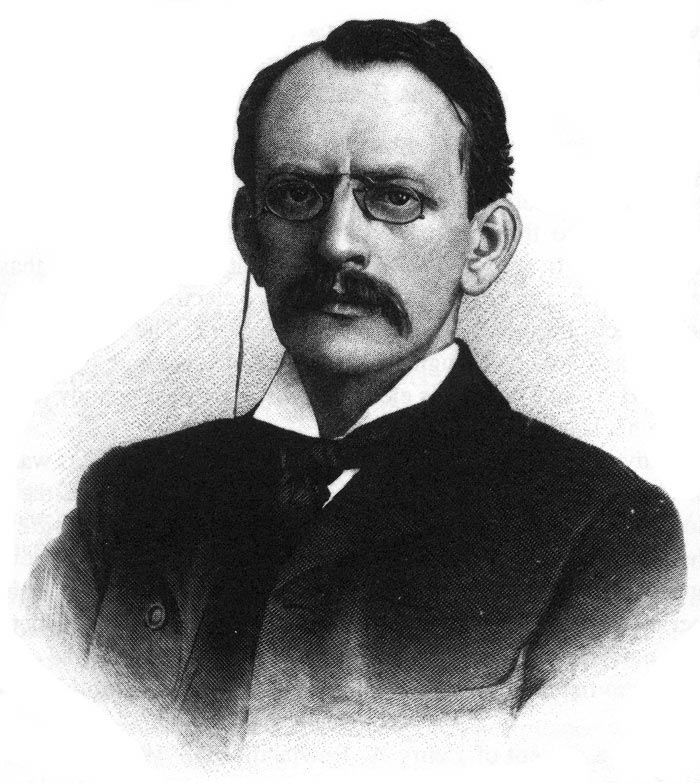
Portrait of Joseph John Thomson
. Source. The Thomson charge-to-mass experiment used electric and magnetic deflections of cathode rays to investigate their charged constituents. It determines a charge-to-mass ratio; separating electric charge from mass requires additional information.
A physicist.[ref]
https://www.uni-wuerzburg.de/uniarchiv/persoenlichkeiten/gelehrtentafeln/wilhelm-wien/. Independent biographical identity and professional specialization
Wien's displacement law connects a thermal spectrum's peak position to temperature. Specifying whether the spectrum is expressed per unit wavelength or per unit frequency is essential to stating which peak is meant.

Portrait of Wilhelm Wien
. Unknown photographer; Nobel Prize photograph, 1911, published in Les Prix Nobel (1912), p. 62. Public domain in Sweden (PD-Sweden photograph). Source usage terms, via Wikimedia Commons. Source.A physicist.[ref]
https://actorenregister.nationaalarchief.nl/actor-persoon/waals-sr-prof-dr-jd-van-der-te-amsterdam. Independent biographical identity and professional specialization

Portrait of Johannes Diderik van der Waals
. Source. The Van der Waals equation connects a dilute gas model to the possibility of a liquid-gas critical point. Its usefulness includes showing how attractions and excluded volume can change an equation of state; its simple constants do not make it an exact model for every fluid.
A physicist.[ref]
https://www.uni-heidelberg.de/en/university/history/heidelberg-university-nobel-laureates?menu=2. Independent biographical identity and professional specialization

Portrait of Philipp Lenard
. Photographer unidentified; AIP Emilio Segrè Visual Archives, via Encyclopaedia Britannica, as recorded on Commons. Commons claims expiry for an anonymous work under its European anonymous-work public-domain rationale., via Wikimedia Commons. Source.A physicist.[ref]
https://magazines.hachettelearning.com/magazine/physics-review/19/2/the-nobel-prize-in-1909/. Independent biographical identity and professional specialization

Portrait of Guglielmo Marconi
. Source. Wireless telegraphy links the dynamics of a transmitter, propagation and the response of a receiver. A successful detector reading depends on that complete chain, rather than on the transmitter alone.
A physicist.[ref]
https://physique-ingenierie.unistra.fr/en/faculty/translate-to-english-histoire-de-la-faculte/. Independent biographical identity and professional specialization

Portrait of Karl Ferdinand Braun
. Source. Wireless telegraphy connects an oscillating electrical circuit to a distant receiver. Tuning and coupling determine how effectively the circuit transfers a signal.
A physicist whose work connects special relativity, general relativity, Brownian motion and the photoelectric effect. He worked at the Institute for Advanced Study from 1933 until his death in 1955.[ref]
Albert Einstein (institutional profile) by Institute for Advanced Study. Institutional profile: physicist, life dates and Institute appointment
In 1905, Albert Einstein used the photoelectric effect to explore quantized light, related Brownian motion to molecular agitation, formulated special relativity, and connected changes in mass and energy. These problems link visible measurements to otherwise inaccessible structure: emitted electron energies, suspended-particle displacements and comparisons of clocks.[ref]
Albert Einstein: The Great Works by Center for History of Physics. March, May, June and September 1905: the four papers and their physical questions
The Millikan photoelectric experiment follows one of those predictions into the laboratory. Its stopping-voltage measurements test a quantitative relation; the experiment's apparatus, surface preparation and electrical corrections matter to that inference. The Einstein field equations and general relativity lead to a different set of tests involving gravity and spacetime.
The Nobel Prize in Physics in 1921 recognized his theoretical work, particularly the law of the photoelectric effect; the award was presented in 1922.[ref]
Albert Einstein, Facts by Nobel Prize Outreach. Prize motivation and the note that Einstein received the 1921 award in 1922

Portrait of Albert Einstein in 1947
. Photograph by Orren Jack Turner, Princeton, 1947; Library of Congress, cph.3b46036. Digital modifications credited to PM_Poon and Dantadd. The linked Wikimedia Commons file records U.S. public-domain status based on nonrenewal and links the original Library of Congress rights statement. Source.- Can Quantum-Mechanical Description of Physical Reality Be Considered Complete? by Albert Einstein and others
- Einstein's Miraculous Year On a Heuristic Point of View Concerning the Production and Transformation of Light by Albert Einstein
- Experimental proof of the existence of Ampère's molecular currents by Albert Einstein and Wander Johannes de Haas
- On the Electrodynamics of Moving Bodies by Albert Einstein
- On the Movement of Small Particles Suspended in a Stationary Liquid Demanded by the Molecular-Kinetic Theory of Heat by Albert Einstein
- What Is the Theory of Relativity? by Albert Einstein
An experimental physicist known for measurements of electron charge and the photoelectric effect. The Millikan photoelectric experiment describes the apparatus and stopping-voltage measurements behind his 1916 test.[ref]
Robert Andrews Millikan Collection by National Archives and Records Administration. Collection description: full name, 1868–1953 and experimental-physics work

Portrait of Robert Andrews Millikan
. Unknown photographer; Smithsonian Institution Libraries, Dibner Library, Scientific Identity collection, SIL14-M004-03. No known copyright restrictions, as supplied by Smithsonian through Flickr Commons and reviewed on Commons., via Wikimedia Commons. Source.- A Direct Photoelectric Determination of Planck's h by Robert Andrews Millikan
- Nobel Lectures, Physics 1922–1941 The Electron and the Light-Quant from the Experimental Point of View by Robert Andrews Millikan
- On the Elementary Electrical Charge and the Avogadro Constant by Robert Andrews Millikan
- The Isolation of an Ion, a Precision Measurement of Its Charge, and the Correction of Stokes’s Law by Robert Andrews Millikan
A physicist who translated Heinrich Hertz's Electric Waves into English for the 1893 edition.[ref]
https://archive.org/stream/b2172457x/b2172457x_djvu.txt. Title page: authorized English translation by D. E. Jones, formerly Professor of Physics at University College of Wales, Aberystwyth; Macmillan, 1893
Homepage: www.dhm.de/lemo/biografie/heinrich-hertz

Portrait of Heinrich Hertz
. Photograph identified on the portrait record. Source. Articles were limited to the first 100 out of 111 total.
Articles by others on the same topic



The "List of physicists" generally refers to a compilation of notable individuals who have made significant contributions to the field of physics. This list can include a wide range of physicists, from historical figures to contemporary scientists, and may encompass various subfields such as theoretical physics, experimental physics, astrophysics, condensed matter physics, and more. Key physicists often included in such lists are: 1. **Isaac Newton** - Known for laws of motion and universal gravitation.