
Past exam of the mathematics course of the University of Cambridge 2006 iii Paper 50 4 Solution Created 2026-10-03 Updated 2026-10-14
Use the metric and first consider the connected Poincaré group, . Physical half-integer spins require unitary representations of its double cover ; genuine representations of the group without this cover permit only integer spin. Write and . Strong continuity gives self-adjoint generators, with commutators understood on a common invariant dense domain.
The commuting translation generators have a joint spectral resolution. Lorentz transformations carry the spectral four-momentum to , so an irreducible representation has its momentum spectral measure concentrated on a single Lorentz orbit. For positive-energy particles the orbits of interest are the future mass shells , or with and . The zero-momentum orbit and spacelike or negative-energy orbits are outside these two particle cases.
Choose and define the Pauli-Lubanski pseudovector with the overall sign conventionThis sign makes the spatial rest-frame vector equal to . The generators' Hermiticity and the antisymmetric epsilon contraction make Hermitian: the ordering correction from commuting through contracts metric tensors into epsilon and vanishes. The same antisymmetry proves Pauli-Lubanski orthogonality, .
The assumed commutators say that and transform as four-vectors and that commutes with all translations. Consequentlycommute with the entire Poincare algebra. For instance the two terms in the Lorentz commutator with a contracted vector square cancel. The Casimir operators therefore have fixed spectral values in a unitary irreducible representation, by the Schur lemma applied to their spectral projections. A second ingredient, the little group, distinguishes the internal states.
Fix a standard momentum on the orbit. Its little group is the subgroup of Lorentz transformations leaving fixed. Choose with . A Lorentz transformation acts on the internal fibre by the Wigner rotationIf is a unitary irreducible representation of this stabilizer, the induced representation acts on wavefunctions asThe measure on either future mass shell is Lorentz invariant, so this action is unitary. The identityproves the group multiplication law. Conversely, covariance of the translation spectral resolution supplies precisely these fibres and their stabilizer action. A commuting operator acts fibrewise; transitivity relates its fibre values, and irreducibility of makes it scalar. This explains why the construction gives, and classifies, the unitary irreducible representations on each orbit.
For a timelike momentum choose . A Lorentz transformation fixing it acts only as a rotation of its spatial orthogonal complement, so the massive particle little group is , or in the double cover. PutThe Poincare algebra gives . The unitary irreducible representations of are labelled by , with and eigenvalues . Evaluation of the Pauli-Lubanski pseudovector at gives , . Thus the massive Pauli-Lubanski Casimir and particle labels areThe full massive induced representation of the Poincare double cover is infinite-dimensional because momentum ranges continuously over the orbit; its finite internal multiplicity is .
For a null momentum choose with . The infinitesimal stabilizer generators areTheir commutators with momentum, evaluated at , vanish. From the rotation and boost commutators of the Poincare algebra one obtainsThese are the massless little-group generators of : a planar rotation and two commuting null rotations, which act like translations in the little-group algebra. Hence the massless particle little group is the Euclidean plane group, with the appropriate double cover for half-integer spin.
The definition of gives and . At the standard null momentum,Suppose the little-group representation has finite dimension, as for particles with finitely many polarizations. The commuting Hermitian have a finite joint spectrum. Conjugation by rotates this spectrum through every planar angle. The only finite set invariant under all these rotations is the origin. Thus both vanish, proving that finite-dimensional unitary representations of the massless little group have trivial translations. Irreducibility then leaves a one-dimensional rotation character, . The massless longitudinal Pauli-Lubanski eigenvalues arefor the double cover, with for a genuine character. The number is helicity. Different helicities have the same two Casimir eigenvalues, so the little group is indispensable for the classification. A connected-group irreducible representation has one helicity; if parity is also implemented, it exchanges and and normally requires their pair.
Unitarity alone also permits nontrivial null-rotation generators. The rotation-invariant operator is scalar in an irreducible little-group representation; if it has value , one obtains a continuous-spin representation. A concrete realization on angular wavefunctions isThese operators satisfy the same commutators. Periodic or antiperiodic angular wavefunctions give integer or half-integer rotation modes, and the translation generators connect infinitely many such modes. The invariant labels areThese are the additional infinite-polarization massless unitary irreducible representations. Restricting to finitely many particle polarizations excludes them; they must not be ruled out merely by assuming unitarity. This completes the timelike and null cases of the Wigner classification.
Past exam of the mathematics course of the University of Cambridge 2006 iii Paper 50 3 Solution Created 2026-10-03 Updated 2026-10-14
Take a local gauge transformation acting on the adjoint field by . The connection convention is compatible withIndeed, differentiating gives the extra commutator , exactly cancelled by the inhomogeneous term in the transformed gauge potential.
For a direct proof of the Yang-Mills gauge transformation of curvature, put and . Differentiation givesSubstituting into the Yang-Mills field strength cancels all terms involving and leavesThis direct calculation also applies when the adjoint action has a kernel.
Expand . The mixed second derivatives of cancel in pairs. The first-derivative terms from differentiating cancel the terms from . The remaining sum isby the Jacobi identity. Thus the gauge-theory Bianchi identity is
For the variation of the Yang-Mills action, write . Differentiating the curvature gives . Invariance of the Killing form impliesThis is invariant integration by parts for a gauge covariant derivative. Using symmetry of the Killing form, antisymmetry of , and compactly supported variations,Since the Killing form of a semisimple Lie algebra is nondegenerate and the variations are arbitrary, the Yang-Mills equations are
For the constant Yang-Mills theta term, symmetry under exchanging the two antisymmetric index pairs givesup to the boundary variation of the Yang-Mills theta term. Contracting the gauge-theory Bianchi identity with makes the last integrand vanish. Therefore a constant theta term does not alter the bulk Yang-Mills equations: . Its variation is a boundary term, so this conclusion uses compact support or boundary conditions that remove that term.
Finally apply to the gauge-theory Bianchi identity, obtainingThe adjoint covariant derivative obeys . Commute past the other derivative. The differentiated divergences vanish by the Yang-Mills equations, leavingIn the last line the second commutator needs its sign tracked carefully: directly,Thus the simplified sum gives the covariant wave equation for the Yang-Mills field strengthAll spacetime derivatives and index manipulations here use the fixed flat metric.
Past exam of the mathematics course of the University of Cambridge 2006 iii Paper 50 2 i Created 2026-10-03 Updated 2026-10-14
Past exam of the mathematics course of the University of Cambridge 2006 iii Paper 50 1 Solution Created 2026-10-03 Updated 2026-10-14
For , define the Adjoint representation of a Lie algebra by . The Jacobi identity gives, for every ,Thus preserves brackets and is a Lie algebra representation. Its Killing form isUsing the representation identity and the cyclic property of the trace,The Killing form is also symmetric by cyclicity.
In a basis , write . The lowered structure constants satisfyThe first expression is antisymmetric in and the second in . These transpositions generate all permutations, so is totally antisymmetric.
An invariant subspace of under its Adjoint representation of a Lie algebra is exactly an ideal of a Lie algebra: . A simple Lie algebra has no nonzero proper ideal, proving the adjoint representation is irreducible.
Put . The same trace calculation proves invariance of the Trace form of a Lie algebra representation:Because the are anti-Hermitian, is a real symmetric bilinear form. The Killing form of a simple compact Lie algebra is negative definite. Define a real linear map by . Invariance of both forms implies that commutes with every , while symmetry makes self-adjoint for the positive inner product . By the spectral theorem, its real eigenspaces are invariant under the Adjoint representation of a Lie algebra. Irreducibility forces a single eigenvalue, so and . This also avoids the extra care needed when applying the complex form of the Schur lemma to a real vector space.
The kernel of is an ideal of a Lie algebra. It cannot be all of : a trivial representation of dimension greater than one is reducible. Simplicity therefore makes faithful. For every nonzero ,Hence the positive trace index for a compact simple Lie algebra givesin the adapted basis.
For the cubic trace tensor of a Lie algebra representation, the identityexpands toSet , , , . Cyclicity of converts to and to . Thus the invariance identity for a cubic trace tensor is
For the final contraction, it is important to keep the specified index-raising convention. In the adapted basis write . Then , while raising the last two indices with gives . Total antisymmetry and the definition of the Killing form implyOnly the antisymmetric part of in contributes, soConsequently the Killing-normalized contraction of a cubic trace tensor isThe negative sign printed in the last requested identity is incompatible with raising indices by the inverse Killing form. The opposite sign is obtained if one instead defines the lowered structure constants using the positive Euclidean metric, a different convention from the one specified.
For a concrete check, take the two-dimensional representation of with , where the are Pauli matrices. ThenTheir contraction is , confirming the positive sign with and providing a counterexample to the printed sign.
Past exam of the mathematics course of the University of Cambridge 2006 iii Paper 49 4 Solution Created 2026-10-03 Updated 2026-10-14
The gauge-invariant Yang-Mills action integrates over physically equivalent configurations along each gauge orbit. At the quadratic level its gauge-field kernel has longitudinal zero directions: in momentum space satisfies . It therefore has no inverse from which to construct a gauge-boson propagator. Gauge fixing both removes the redundant orbit integration and supplies an invertible quadratic operator away from the ordinary physical propagator poles.
For the covariant condition , the Faddeev-Popov determinant is that of . Its representation by odd Faddeev-Popov ghost fields and antighost fields produces the displayed ghost term. In a nonabelian theory depends on the gauge field, so the determinant is not an irrelevant constant: ghost interactions must be retained. The even Nakanishi-Lautrup field writes gauge fixing in a form with off-shell BRS symmetry. For , its algebraic equation is , giving after elimination. At it imposes the gauge condition as a Lagrange multiplier.
For the nilpotence proof, write the adjoint bracket as , with coefficients in a Grassmann algebra. If are their parities, this is a graded Lie bracket:Thus two odd fields have a symmetric bracket, in particular need not vanish. The transformations become , , , , and obeys the left graded Leibniz rule.
Because is even, . Varying both the field and the connection in now givesFor the ghost,The last equality is the graded Jacobi identity applied to three copies of the odd field . In components the remaining expression is ; its coefficient is antisymmetrized over , and the ordinary Jacobi identity for the structure constants makes that antisymmetrization zero. Finally and . HenceThis is off-shell nilpotence of the Yang-Mills BRST quartet.
To verify invariance of the complete Lagrangian, , obtained from . Thus because the product of the two curvature components is symmetric in their color labels while is antisymmetric. The remaining terms vary asThe last term vanishes by the already proved , and the first and third terms cancel pointwise. ThereforeEquivalently, the covariant gauge-fixing density as a BRST variation is with . The graded sign from moving past produces the positive ghost term, and proves its invariance. No integration-by-parts qualification is needed for the density as written.
Let be the BRS charge. The physical state space is its BRST cohomology, usually at ghost number zero:Nilpotence ensures . A state is orthogonal to every closed state because , and its norm is . Thus adding an exact state changes neither physical inner products nor amplitudes. Self-adjointness here is relative to the stated indefinite Hermitian form; a nonzero self-adjoint nilpotent operator could not exist on a positive-definite state space. Positivity must be proved on the quotient, not assumed on the gauge/ghost space.
Fix a color label and a nonzero momentum , and take the usual nontrivial asymptotic charge, . Nilpotence on a vector state gives , because at least one component of is nonzero. Nilpotence on the antighost state then givesThe two coefficients are complex conjugates as required by self-adjointness: using the given ghost pairing,Thus the antighost-to-vector coefficient is , as the printed bar notation indicates. These conditions are the massless shell condition and the consistency of the charge with the inner products.
A general one-particle vector representative is . It is closed precisely when . The vector state is exact, so representatives obeyThe ghost state is also exact: choose with , then . The antighost state is not closed because its image is a nonzero longitudinal vector. More explicitly, closure of a general sum of vector, ghost and antighost states forces the antighost coefficient to vanish and the vector polarization to be orthogonal to ; its ghost component disappears in the quotient. Thus the full one-particle cohomology already reduces toWith the mostly-plus Minkowski metric, choose a Lorentz frame with , . Closure gives , and the norm isSubtracting a multiple of sets . Consequently positive one-particle BRST cohomology consists of two transverse positive-norm polarizations per color, represented by . A nonzero class has strictly positive norm; the zero-norm longitudinal direction was precisely the exact direction removed.
The qualifications and are essential to this one-particle argument. The zero-momentum sector requires separate treatment, and the trivial-charge case cannot yield the asserted removal of negative-norm vector states from the stated relations alone. Abstract nilpotence and self-adjointness by themselves do not guarantee positive cohomology.
Past exam of the mathematics course of the University of Cambridge 2006 iii Paper 49 3 Solution Created 2026-10-03 Updated 2026-10-14
In units , the action is dimensionless and a Lagrangian density has mass dimension . The kinetic term therefore gives . Requiring each interaction density to have the same dimension givesThis is engineering dimension; quantum scaling can acquire an anomalous dimension.
For a connected Feynman diagram with no derivative interactions, each independent loop integration contributes powers of momentum, and each internal scalar propagator contributes . Thus its superficial degree of divergence is . Let . A connected graph has independent cycles, and counting the half-edges incident on vertices gives . Substitution proves the scalar graph power-counting identity:For a graph with connected components, the first is instead , since . The printed expression therefore uses the usual connected-graph convention. This is the overall degree under simultaneous rescaling of all loop momenta. Subgraphs can still have ultraviolet divergences when the whole graph has , so their counterterms must be subtracted before declaring an integral finite.
When all retained couplings have nonnegative dimension, only finitely many external-leg/derivative structures can have nonnegative degree. Positive-dimensional relevant couplings lower as vertices are added, giving superrenormalizable interactions. Zero-dimensional marginal couplings give power-counting renormalizable interactions. Negative-dimensional irrelevant couplings instead permit to grow with the number of vertices, generally requiring an unbounded list of counterterms. Such nonrenormalizable interactions can still define an effective field theory to any fixed order in a low-energy expansion.
In , : cubic interactions are superrenormalizable, quartic interactions are marginal and renormalizable, and powers are nonrenormalizable. In , : cubic, quartic and quintic interactions are superrenormalizable, sixth-order interactions are marginal and renormalizable, and are nonrenormalizable. This is a power-counting classification, not a guarantee that an odd highest-power potential is bounded below. All lower-dimensional operators allowed by the symmetries must be included when required by renormalization; for example, odd interactions can require a linear counterterm, whereas the quartic model's symmetry excludes it.
Dimensional regularization defines convergent Euclidean loop integrals in a suitable domain of , then continues their parameter formulas meromorphically to complex . The Gaussian identity supplies and Schwinger parameterization supplies Gamma functions such as . Their poles encode the ultraviolet singularities near physical dimension. Noninteger complex is an analytic regulator of amplitudes, not a literal space with a noninteger number of coordinates. Masses or nonexceptional external momenta distinguish ultraviolet poles from infrared poles; scaleless integrals vanish in this convention and can hide that distinction.
For the quartic model let , , and . In renormalized fields, the bare Lagrangian isSeparate the terms with each equal to one from their differences. The differences are field, mass and quartic counterterms. After subtracting divergent subgraphs, the remaining ultraviolet pole of a proper graph is a local polynomial in its external momenta. In four-dimensional phi-fourth theory, power counting and reflection symmetry restrict these local terms to , , and a field-independent constant. Choosing the Laurent coefficients of the three renormalization factors recursively cancels these poles at every perturbative order. The constant vacuum term is removed by the zero-source normalization. This is an order-by-order finite renormalized expansion, not a claim of convergence of the perturbation series.
The source renormalization of a scalar generating functional follows directly from rewriting the source coupling in bare variables:A general source attached to a single elementary field needs this field renormalization; its connected correlations are the ordinary renormalized Green functions. Normalizing the path integral at cancels source-independent vacuum diagrams. Subject to a separate infrared/volume prescription, their source-dependent generating functional is consequently ultraviolet finite order by order. For a constant source, this statement is interpreted as a formal connected expansion or a vacuum density, not as an automatically finite total logarithm in infinite spacetime.
Changing integration variables from to introduces a source-independent constant Jacobian that cancels between the numerator and its normalization. The resulting normalized integral depends only on and fixed physical boundary/volume data. ThusDefine all scale derivatives at these fixed bare quantities:In a mass-independent subtraction scheme, logarithmic differentiation of the bare relations givesThe factors contain regulator poles, but the combinations determining the physical renormalization group functions have finite limits. In particular and . The chain rule now gives the requested equation:As a sign check, minimal subtraction gives and , with . Hence , , and starts at two loops. The positive signs agree with the tadpole subtraction and the three four-point channels.
The dimensional rewriting needs care. The chosen source normalization gives , , and , so and are the natural dimensionless parameters. For the full source functional, spacetime arguments must also be rescaled: with , write and . The dimensionless functional then depends on , the rescaled source profile, and the rescaled integration domain.
For a literal uniform source in a fixed physical spacetime volume , the uniform-source vacuum functional and spacetime volume relation is insteadFor example, even at and , completing the square for the constant mode givesThus the printed three-argument rewriting of the total suppresses necessary volume/source-profile data. It is valid as a dimensional shorthand only with those data understood; a dimensionless density has the three arguments, while its scale equation includes its engineering dimension. At infinite volume, the total constant-source logarithm is generally extensive and infinite even after ultraviolet renormalization.
The massless renormalization-group characteristics with a source solve the requested flow directly, independently of this notational issue. Since the mass flow is proportional to , its zero value remains zero. Starting at a reference scale , solveThenwith any physical volume or source-shape data retained. Where , the running quantities are determined byThese equations transport matching data at one scale to any other scale on the same flow trajectory. At a zero of the beta function use the differential equations themselves, rather than divide by zero.
For the uniform-source density, set and . At the corrected dimensionless equation and its local characteristic solution areThe arbitrary function is fixed by boundary/matching data. If the volume is retained as a dimensionless argument , the full dimensionless functional obeys the same transport operator with in place of the additive term; extensivity makes the two statements equivalent. Massless zero-momentum source expansions can also have infrared singularities, so this RG solution is formal until an infrared prescription or a suitable background expansion is chosen.
An ultraviolet fixed point is a zero of the beta functions approached by the dimensionless couplings as . Near a single-coupling fixed point , perturbations obey , so gives attraction in that direction. In four-dimensional quartic scalar theory, the positive one-loop beta function makes positive small coupling grow toward the ultraviolet: . This exhibits a perturbative Landau pole, not an interacting ultraviolet fixed point. A perturbative result does not exclude hypothetical strong-coupling behavior beyond its regime.
Past exam of the mathematics course of the University of Cambridge 2006 iii Paper 49 2 Solution Created 2026-10-03 Updated 2026-10-14
Use the mostly-plus Minkowski metric, so , and the source term . Define the vacuum-normalized generating functional, connected generating functional, and quantum effective action byThe Legendre transform is taken after expressing in terms of , locally where this relation is invertible. Varying it gives and . The logarithm generates connected graphs; the Legendre transform removes graphs joined by a single propagator, leaving one-particle-irreducible vertices. This sign convention is important: its classical limit is , consistent with the positive vertices in this question.
For the free real scalar field, integration by parts puts the action into the form , where has Fourier symbol . Include the Feynman i-epsilon prescription . Completing the square yieldsand consequentlyThe physical scalar propagator is , whereas the inverse quadratic kernel appearing in is . Differentiating this quadratic functional and Fourier transforming givesThe infinitesimal prescription specifies propagators and is dropped when quoting the local vertex kernel.
At the order represented by tree-level Feynman diagrams, stationary phase gives , with the classical field equation . The Legendre transform cancels the source term, soThusOther connected tree graphs with several quartic vertices are one-particle reducible and belong to , not to the proper vertices of . This explains why no extra tree correction is hidden in these formulas.
The one-loop proper two-point graph is the tadpole diagram. The one-loop proper four-point graphs are the three bubble diagrams, with pairings , and of the external legs. Each has Feynman-diagram symmetry factor . The figure shows the topologies and every four-point channel; external momenta are incoming.
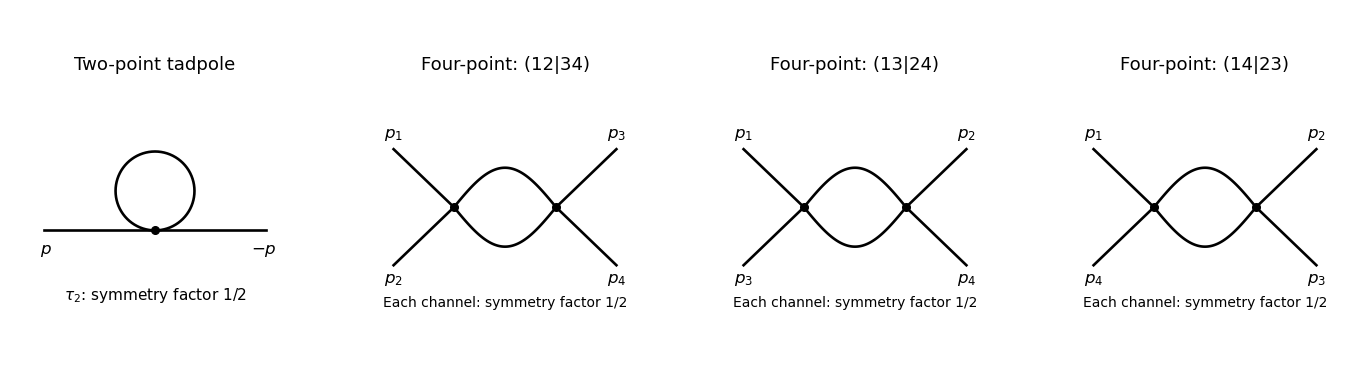
The tadpole factor can also be counted directly: there are assignments of two labeled external legs to one quartic vertex, while its normalization leaves . For a fixed four-point partition, the interchange of the two internal lines gives the same factor ; there are three distinct partitions. Graphs with an external self-energy insertion are one-particle reducible and are not additional contributions to .
For the two-point divergence, perform a Wick rotation. The Euclidean tadpole contribution to the proper inverse kernel isAssume to separate the ultraviolet calculation from infrared issues. A Schwinger parameterization gives . Using the supplied Gaussian integral, initially in the convergence region, givesThe last expression provides the meromorphic dimensional regularization continuation. Set . Since ,If the coupling is written as , that factor multiplies the intermediate integral but does not change the displayed pole residue. The negative pole is a property of analytic continuation; it must not be inferred from the positive cutoff integrand without carrying out the continuation.
The added mass counterterm contributes to , because and its Lagrangian term is . Hence cancellation requiresup to an arbitrary finite subtraction specifying the renormalization scheme. No external momentum occurs in the tadpole, so no one-loop wave-function renormalization is needed. At the unregulated tadpole is scaleless and vanishes in dimensional regularization; the massive calculation identifies the mass-dependent ultraviolet pole without conflating it with a massless infrared limit.
For completeness, the signs of the four-point graphs in this effective-action convention can be read from the Euclidean one-loop functional . Its expansion has terms and . Differentiating four times givesThis is the Euclidean form, analytically continued to the physical external momenta. It confirms the three channel diagrams and their symmetry factors; evaluating its divergence is not needed for the requested mass counterterm.
Past exam of the mathematics course of the University of Cambridge 2006 iii Paper 49 1 Solution Created 2026-10-03 Updated 2026-10-14
Work in units and with the particle mass absorbed into the stated kinetic term. Divide the interval into pieces of length . For a suitable self-adjoint Hamiltonian operator, the Trotter product formula gives the regulated limitInsert between neighboring factors. Because is diagonal in the position operator basis, the given free-particle propagator yieldsThe exponent is the time-sliced action. Its continuum notation isThe measure is defined by the displayed finite-dimensional limits and their normalization, not by a translation-invariant flat measure on an infinite-dimensional space. The oscillatory limit needs a damping/analytic-continuation prescription. This is the time-sliced configuration-space path integral derived from the operator kernel.
For a quadratic potential energy, write , where the classical path satisfies and the endpoint conditions, and . Expansion is exact:Integration by parts makes the linear term equal to , since the endpoint term vanishes. It is zero by the Euler-Lagrange equation. Also is constant, independent of the endpoints. Thus classical-path factorization of a quadratic path integral is exact:Only the classical action carries the endpoint dependence.
Let on homogeneous Dirichlet boundary conditions. Expand in its normalized eigenfunctions, with eigenvalues . The fluctuation integral becomes a product of regulated integrals . Each is proportional to , with a prescribed complex phase. Relative to , the normalization is thereforeThe subscript denotes the Dirichlet operator domain, and the square-root branch is continued from the free kernel with its convergence prescription. Equivalently one can use determinants of and . For , the Dirichlet oscillator determinant ratio isThis also checks the free limit. At conjugate times, the fluctuation operator has a zero eigenvalue and the ordinary finite-prefactor expression fails; the kernel is obtained by distributional continuation. Away from these times the classical boundary problem is unique and the stated factorization applies directly.
For the infinite-time oscillator with an external source, use vacuum boundary conditions and the Feynman i-epsilon prescription. For a smooth source of compact support, defineThe imaginary term damps the real-field integral. Integration by parts gives , with the pairings understood as time integrals. Completing the square givesTranslate the integration variable. The source-independent Gaussian functional integral is , soOn Fourier modes , has eigenvalue , henceFor , closing the contour above for and below for gives . The physical time-ordered oscillator quantum field theory propagator is , not itself. The shifted stationary path is and obeys with the same vacuum prescription. A retarded inverse would define a different boundary problem. Dividing by the zero-source integral removes and gives the vacuum source functional of a quantum oscillator. At zero mass an additional infrared prescription is needed for the inverse on constant modes.
Past exam of the mathematics course of the University of Cambridge 2006 iii Paper 48 4 Solution Created 2026-10-03 Updated 2026-10-14
In quantum electrodynamics, gauge invariance connects local phase freedom, electric-charge conservation and the restrictions on photon interactions. For definiteness takeThe gauge transformationhas : the derivative of the local phase cancels the added gauge potential. Also is unchanged because mixed partial derivatives commute. Consequently every term in the Lagrangian density is invariant. This derives the minimal electromagnetic coupling of a Dirac field, including the interaction . A fermion mass is compatible with the symmetry, whereas a local Proca photon mass is not.
The classical Maxwell equations are , with . Taking a divergence gives because is antisymmetric. The same conservation law follows directly from the charged Dirac equation and its adjoint. For vanishing flux at spatial infinity, is conserved. Gauss law identifies this charge with the electric flux through a surrounding surface. Particle-antiparticle creation is allowed, but its net electric charge is zero.
Local gauge invariance is also a redundancy in the potentials, rather than an extra propagating degree of freedom. The canonical momentum of vanishes, and its field equation enforces the Gauss law constraint in gauge theory, . After imposing the constraint and quotienting gauge freedom, a massless photon has two transverse physical polarizations. Gauge transformations vanishing at the boundary identify equivalent descriptions; constant phase transformations at infinity can act on charged states and generate their conserved charge. This distinction explains why gauge redundancy and electric charge are compatible.
In perturbative QED, the quadratic photon operator cannot be inverted before gauge fixing. Adding gives the covariant gauge propagatorThis propagator contains longitudinal and timelike components, but these are not external physical photon states. A Gupta-Bleuler null-state quotient, or the equivalent BRST construction, removes them. In linear Lorenz gauge, , so the Faddeev-Popov determinant is independent of and the Faddeev-Popov ghost fields decouple. This last statement concerns the linear gauge; Abelian gauge groups alone do not guarantee decoupling in a nonlinear gauge condition.
At the quantum level, the vector symmetry gives a Ward identity. One way to obtain it is to change variables by a localized phase in a time-ordered correlation function containing and . The action variation becomes a current divergence; the two field insertions contribute opposite contact terms, since their charges are opposite. Fourier transformation turns the divergence into the photon momentum, and amputating the external fermion propagators turns the two contact terms into the difference of their inverse propagators. With the charge removed from the proper vertex and the overall propagator factor removed from its inverse, the result is the proper-vertex Ward-Takahashi identity in QEDAt tree level this is simply . Between on-shell external spinors, the inverse propagators vanish, so the full physical scattering amplitude satisfies . Therefore replacing a photon polarization vector by leaves the amplitude unchanged. The identity applies to the complete required sum of diagrams, not necessarily each diagram separately. It also ensures cancellation of the gauge parameter from physical observables when all terms at the chosen perturbative order are included.
For the photon two-point function, the Ward identity implies transverse photon vacuum polarization:Thus ultraviolet subtraction renormalizes the gauge-invariant kinetic term, rather than requiring a local photon-mass counterterm. Perturbative unbroken QED retains a massless photon. Transversality by itself would not exclude a nonlocal massless pole in a different theory; the assertion here includes the perturbative QED setting.
Taking in the proper-vertex identity gives . Matching the divergent coefficients of the derivative and vertex terms yields the Ward identity for QED renormalization constants, , in a gauge-preserving prescription. If and , comparison of the interaction coefficients givesHence charge renormalization is fixed by photon wave-function renormalization. Gauge invariance constrains counterterms and relates renormalizations; it does not make the electric charge independent of scale.
The Soft photon theorem gives another physical manifestation. Attaching a photon of small momentum to the external charged legs gives the leading factorwhere is charge in units of and for outgoing and for incoming legs. Replacing by makes this factor proportional to , which vanishes by electric charge conservation. Massless photons also cause infrared divergences; physical inclusive measurements combine unresolved real emission with virtual corrections, rather than treating either contribution alone as an observable.
Finally, the vector gauge symmetry of a Dirac fermion in QED is anomaly-free, so it can be maintained by regularization and renormalization. This must be distinguished from the axial current: its divergence has explicit mass terms, as in Question 3, and can additionally have a quantum chiral anomaly. Conservation of the gauge current does not imply axial-current conservation. The resulting picture is that gauge invariance simultaneously organizes the physical photon states, enforces electric-charge conservation and ties together amplitudes and ultraviolet subtractions.
Past exam of the mathematics course of the University of Cambridge 2006 iii Paper 48 3 Solution Created 2026-10-03 Updated 2026-10-14
Let the masses of and be and , respectively. Write their external four-momenta as , with and . The condition opens the two-body decay phase space. Use mostly-minus Minkowski spacetime, the Dirac propagator , and the convention that an amputated connected diagram contributes .
There is no tree-level three-scalar Feynman vertex in the displayed interaction. The leading decay amplitude has one Yukawa interaction and two Yukawa interactions, so is of order . The Yukawa fermion triangle is:
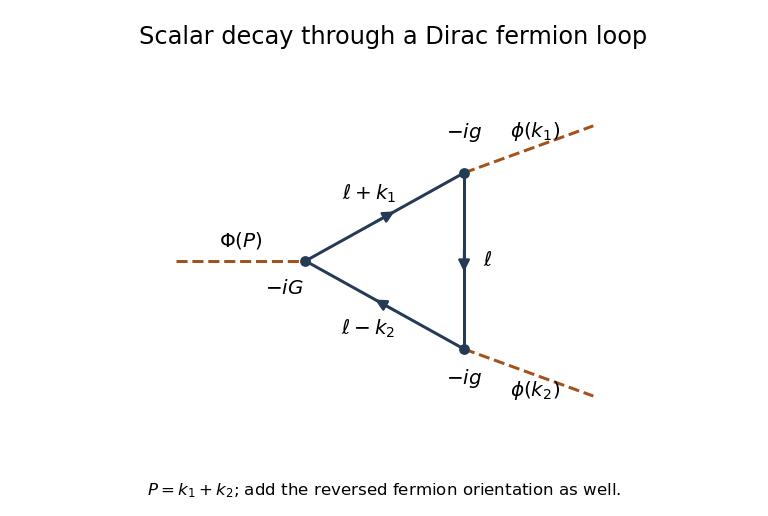
The two inequivalent cyclic orderings around the fermion loop are related by reversal and interchange of . They give equal integrals: reversing all internal four-momenta leaves the masses and denominators unchanged, and the scalar gamma matrix trace identities below give the same numerator. Both must be included. The closed fermion loop sign supplies , and each ordering has the productThere is no extra in the decay amplitude. Such a factor belongs to integration over the identical-particle final phase space when calculating a decay rate.
Route , , and define , and similarly for . A regulated leading decay amplitude isHere dimensional regularization preserves translation of the loop momentum, and is its reference mass scale. Factors account for the loop's dimension; dimensionally continued couplings can equivalently carry these powers. No occurs in this scalar loop, so there is no regularization ambiguity.
Using gamma matrix trace identities, traces with an odd number of gamma matrices vanish, while and . Thus the numerator simplifies completely toFor a reduction to standard scalar integrals, disregard the vanishing infinitesimals only in the numerator. Since up to those infinitesimals,Define the scalar bubble and scalar triangle Feynman integral byCancelling each denominator in turn gives two bubbles with external invariant and one with invariant . ThereforeThis explicitly displays the complete gamma matrix trace simplification, the two loop orientations and the overall phase convention.
There is a renormalization qualification to this answer. For the loop is logarithmically divergent; retaining just the unregulated four-dimensional integral would not specify a finite physical decay amplitude. To see the divergence, a Feynman parameter and a shifted loop momentum giveThe scalar triangle Feynman integral is ultraviolet finite. HenceA cubic counterterm from a Yukawa fermion triangle, , contributes to and cancels the pole with . This is an instance of counterterm closure of a massive Yukawa theory. After subtraction the physical answer is , where a renormalization condition fixes the finite cubic coupling . The displayed interaction alone does not supply that condition. For example, setting at a specified subtraction scale defines one prescription for the loop-induced decay. The regulated expressions above remain the lowest-order loop answer without such extra data. For the trace, and therefore this scalar triangle contribution, vanishes identically.
Now take the Hermitian pseudoscalar Yukawa interaction with the sign printed in the PDF. Varying with respect to the Dirac adjoint gives the Dirac equationVarying with respect to and integrating by parts gives the adjoint Dirac equationThe factor in the coupling matters: is anti-Hermitian, so this factor makes the interaction Hermitian for real .
For the axial-current divergence for scalar and pseudoscalar backgrounds, set and . The two equations are equivalentlyIn the divergence of the axial current, use and :ThusThis is the classical field-equation identity requested here. It includes explicit breaking by both backgrounds; it is not a claim that a renormalized quantum axial current has no chiral anomaly when gauge interactions are present.
Past exam of the mathematics course of the University of Cambridge 2006 iii Paper 48 2 Solution Created 2026-10-03 Updated 2026-10-14
Fix the phi-fourth theory convention , with mostly-minus Minkowski spacetime and . Define the scattering amplitude by stripping the overall momentum-conserving delta function from . If instead the coupling is defined by , every vertex coupling below must be replaced by ; the question does not specify this factorial convention.
The momentum-space Feynman rules are a Feynman propagator for each internal scalar line, a Feynman vertex with four scalar legs, and four-momentum conservation at each vertex. Integrate each independent loop momentum with and divide by the Feynman-diagram symmetry factor. For an amputated scattering amplitude there are no external propagators; external states have the usual relativistic normalization. Sum the connected diagrams and all inequivalent assignments of the labelled external momenta. The overall delta function is .
These Feynman rules follow by expanding the Dyson series and applying the Wick theorem to the free-field correlation functions. A Wick contraction gives the free Feynman propagator; the ways of contracting a vertex cancel its factorial denominator. The expansion's cancels permutations of identical interaction insertions, while any remaining automorphisms give the Feynman-diagram symmetry factor. Fourier transformation produces momentum conservation, and the LSZ reduction formula amputates external propagators to obtain the scattering amplitude.
For six-point amplitudes in phi-fourth theory, an original pair of diagrams is:
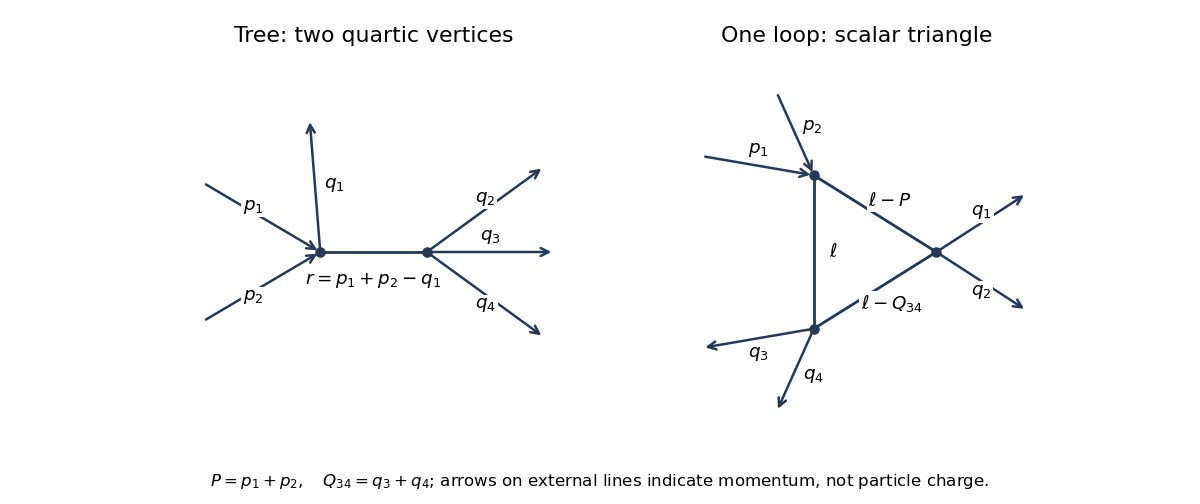


In the tree-level Feynman diagram, let the internal four-momentum be . The labelled diagram has symmetry factor one, so its contribution isThis is one channel. The full tree scattering amplitude sums the ten unordered partitions of the six labelled external legs into two groups of three, since .
For the one-loop triangle Feynman diagram, set , , , so . A consistent routing has denominatorsWith the external labels held fixed, no nontrivial graph automorphism remains, so again the symmetry factor is one. The contribution isThere are other labelled assignments and other one-loop topologies in the full scattering amplitude; the displayed expression belongs to the particular drawn diagram.
One can also express this scalar triangle Feynman integral using Feynman parameters. With , completing the square in givesThe identity and the shifted momentum integral yieldThus times the displayed parameter integral. It is ultraviolet finite in four dimensions, although physical threshold singularities must retain the Feynman i-epsilon prescription.
For the fixed-target production threshold, the incoming four-momenta are and , with . Their invariant mass obeysIn the centre-of-momentum frame, four final particles have total energy at least , attained when all four are at rest in that frame. Therefore , equivalently , andThis is the kinematic threshold for . Exactly at equality the final phase space has zero volume; a nonzero production rate requires a strict inequality.
There are unlisted articles, also show them or only show them.