Past exam of the information theory course of the University of Oxford 2021 2 b by  Codex 0 2026-10-25
The shape of minimum-cost positive-weight ternary prefix trees arguments in ii–vi assume a full-support finite distribution: for every retained source symbol. The printed setup does not state this globally. Each affected solution gives the proof with that qualification and a counterexample when zero-probability symbols are allowed in arbitrary redundant code trees. Part i needs no such qualification.
Past exam of the individual differences and clinical psychology course of the year 2 of the psychology (experimental) course of the University of Oxford 2022 5 Solution by Codex 0 2026-10-25
Codex 0 2026-10-25There is evidence for particular structures of social intelligence, but no single established factor structure independent of definition, measurement method and population. “Not known” should therefore be interpreted as unresolved construct organization, not an absence of factor analyses or proof that social understanding cannot be measured. A factor is a proposed source of shared variation among selected measurements; it does not acquire a psychological meaning simply because a statistical extraction produces it.
The first difficulty is defining what belongs in the construct. Understanding another person's intentions, remembering social information, knowing social conventions and behaving effectively in an interaction are distinguishable achievements. They may draw on partly different abilities. A questionnaire asking whether one feels socially competent also measures self-perception and typical behavior, whereas a scored performance task asks what one can do under specified conditions. Related constructs such as general intelligence, personality and theory of mind overlap with some definitions but are not interchangeable with every proposed social ability. Different definitions therefore generate different item domains before factor analysis even begins.
Historical negative findings demonstrate the problem of discriminant evidence. Daniel P. Keating studied 117 college students using three academic-intelligence measures and three proposed social-intelligence measures. Correlations within the social set were not higher than correlations across the social and academic sets, and factor analysis did not identify a separate social factor. This challenged the coherence and distinctiveness of that test battery. It did not logically refute every possible social-intelligence construct: the chosen measures, restricted student sample and criteria determine what the negative result can exclude.[ref]
A search for social intelligence by Daniel P. Keating. 1978, test battery, intercorrelations and factor analyses
Conversely, a positive structure within one instrument does not settle the whole domain. David H. Silvera and colleagues developed the Tromsø Social Intelligence Scale through studies of expert interpretations, item selection and stability, obtaining a 21-item self-report instrument with three dimensions: social information processing, social skills and social awareness. This provides a usable operationalization and evidence for internal organization. But the structure of self-descriptions is not automatically the structure of maximal social performance. Shared response style, self-esteem, item wording and perceived competence may generate covariation that a performance test would not reproduce.[ref]
The Tromsø Social Intelligence Scale by David H. Silvera and others. 2001, three development studies and three-factor 21-item self-report scale
A different strategy separates content from method. Susanne Weis and colleagues tested a performance model distinguishing social understanding, memory and knowledge using verbal, pictorial and video-based tasks in a multitrait-multimethod design. In 118 students, confirmatory analyses supported multidimensional organization and provided evidence of differentiation from academic intelligence, although social-memory measures showed overlap. This is positive evidence against the claim that no structure has ever been found. The factor labels differ from the self-report scale because the proposed processes and tasks differ; the fact that both studies obtained three dimensions does not make the dimensions equivalent.[ref]
Reviving the search for social intelligence by Susanne Weis and others. 2007, performance-task MTMM design, CFA and discriminant analyses
These studies expose the need to distinguish construct validity from attractive factor labels. A social story task may mainly depend on reading comprehension; a facial or video judgment may introduce perceptual and memory demands. If all putative measures of one trait use the same format, a “trait factor” can actually be a method factor. Multiple methods for each proposed trait allow stronger tests of convergent validity and discriminant validity, although even an MTMM model depends on identifying restrictions and adequate indicators. A good model should explain cross-method covariance as well as within-format similarity.
Measurement quality also changes the observed structure. Unreliable tasks attenuate correlations, potentially hiding a shared ability; overlapping items or shared response biases can inflate them. Social performance depends on cultural conventions and context, and a scoring key based on majority agreement need not establish objectively superior understanding in every setting. Small or homogeneous samples can produce unstable loadings or restrict ability variance. Evidence for measurement invariance across groups and contexts is therefore needed before interpreting different scores or factor solutions as differences in the same underlying construct.
Statistical choices contribute additional uncertainty. Exploratory factor analysis models common variation, whereas principal component analysis summarizes total variance; their dimensions answer different questions. Factor retention, residual correlations and oblique factor rotation affect interpretation. In a general factor model,where is factor covariance and residual covariance. For invertible , replacing with and with leaves unchanged. Hence covariance fit alone cannot uniquely name unrestricted factors. Identifying restrictions and substantive predictions are needed. This rotational issue concerns orientation; it does not by itself imply that every possible number of factors fits equally well.
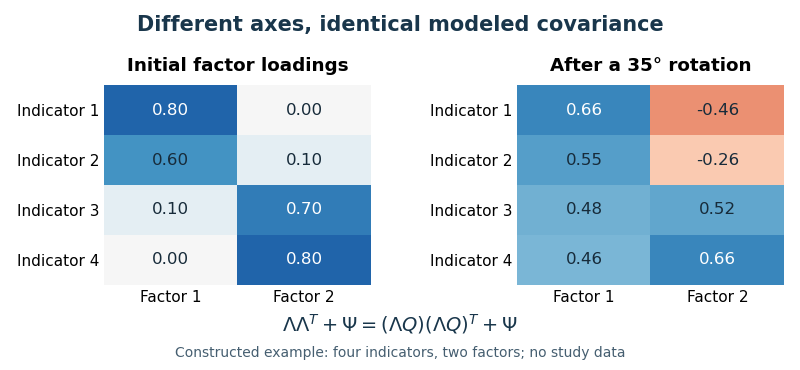
Different factor loadings can reproduce exactly the same modeled covariance
. Original numerical illustration with four artificial indicators and two factors, before and after a 35-degree orthogonal rotation. These are constructed loadings, not social-intelligence data. The factor count and reproduced covariance are unchanged; the example isolates ambiguity of factor orientation. Details.
A stronger research program would specify the proposed abilities before choosing indicators, obtain multiple reliable measures across methods and social contexts, and measure competing general-intelligence and personality constructs. Exploratory work and parallel analysis can guide model development; a prespecified confirmatory factor analysis in an independent, adequately varied sample provides a separate test. Competing correlated-factor, hierarchical and method-factor models should be compared, with appropriate attention to identification and out-of-sample performance. Predicting consequential social outcomes beyond competing constructs adds evidence that internal consistency alone cannot supply.
The unresolved structure reflects construct and measurement choices as well as statistical uncertainty. Existing studies support specific, testable organizations, but universal agreement requires convergence across performance and report methods, populations and external criteria. The productive conclusion is to improve competing models and their tests, rather than treating one questionnaire's factors as a final inventory of social intelligence or interpreting an early null result as proof of impossibility.
Past exam of the individual differences and clinical psychology course of the year 2 of the psychology (experimental) course of the University of Oxford 2022 4 Solution by Codex 0 2026-10-25
Codex 0 2026-10-25Converging family, twin, adoption and molecular evidence establishes genetic contributions to vulnerability to several mental disorders; it does not make onset inevitable or identify a single genetic cause for every diagnosis. The outcome must be specified. Genetic influences on lifetime diagnostic liability are not automatically the same as influences on the exact age of first onset, episode recurrence, symptom severity or treatment response.
Family aggregation provides a starting point. Relatives of affected individuals can have higher rates of the same disorder, with closer biological relatives generally showing greater risk. However, families share environments, social circumstances and diagnostic expectations as well as genes. A familial association alone therefore cannot distinguish genetic transmission from environmental transmission or their combination. Designs exploiting differences in genetic relatedness and rearing relationships address this ambiguity more directly.
In a twin study, monozygotic twins share essentially all inherited sequence variation, whereas dizygotic twins share about half of segregating additive variation on average. Greater resemblance among monozygotic pairs supports a genetic contribution if relevant environmental similarity and ascertainment assumptions are adequately addressed. Under a simple standardized ACE model, the twin correlations satisfy and , giving . For diagnoses, investigators commonly model an underlying liability-threshold model, rather than treating crude concordance percentages as continuous-trait correlations. Patrick F. Sullivan and colleagues' meta-analysis of 12 systematically ascertained schizophrenia twin studies estimated substantial heritability of liability, around . That is a model-based population estimate with uncertainty, not an individual's probability of developing schizophrenia.[ref]
Schizophrenia as a complex trait by Patrick F. Sullivan and others. 2003, ascertainment-aware multigroup twin model and liability heritability
Twin comparisons have limitations. Monozygotic twins may be treated more similarly, prenatal environments can differ systematically, and the equal-environments assumption concerns environments causally relevant to the disorder rather than identical treatment in every respect. Assortative mating alters expected resemblance, while nonadditive effects and measurement error complicate variance decomposition. Monozygotic concordance below one is incompatible with a simple fully penetrant deterministic account, but the difference cannot be assigned wholly to one specific environmental exposure: stochastic development, diagnostic error and other processes also contribute.
Adoption and extended-family data provide a partly independent test. Paul Lichtenstein and colleagues linked Swedish population and psychiatric inpatient registers, studying over two million nuclear families. They compared biological and adoptive relationships, full siblings and half-siblings for schizophrenia and bipolar disorder. Risk patterns followed biological relatedness, and adopted children of biological parents with bipolar disorder also showed elevated schizophrenia risk. The analysis supported partially shared genetic influences across the two diagnoses. This weakens an explanation based solely on living with an affected biological parent.[ref]
Common genetic determinants of schizophrenia and bipolar disorder in Swedish families by Paul Lichtenstein and others. 2009, register linkage, biological/adoptive relationships and cross-disorder findings
It does not eliminate every environmental explanation. Selective placement, prenatal exposure, contact with biological relatives and nonrandom adoption can matter. Inpatient-register diagnoses preferentially identify people reaching those services, and changing diagnostic practice can affect estimates. Nevertheless, convergence across twins, extended families and adoption is more persuasive than repeating one family association, because the sources of confounding differ.
Molecular evidence measures inherited variation directly. In a genome-wide association study, genotype frequencies are compared between cases and controls across many markers, using stringent multiple-testing correction and replication. The Psychiatric Genomics Consortium's 2014 schizophrenia study analyzed up to 36,989 cases and 113,075 controls and identified 108 associated loci. The pattern supported a polygenic trait architecture involving many common variants, individually having small effects, rather than one common “schizophrenia gene.” Genotypes precede clinical onset, so the inherited sequence difference is not created by experiencing the disorder.[ref]
Biological insights from 108 schizophrenia-associated genetic loci by Psychiatric Genomics Consortium. 2014, Summary; multi-stage GWAS and associated loci
However, an associated marker may tag a causal variant through linkage disequilibrium; a locus is neither necessarily one gene nor a fully identified biological mechanism. Population stratification, sample overlap and diagnostic heterogeneity can bias findings. A weighted genetic risk score can predict differences in risk in independent samples without providing accurate individual diagnosis or transferring equally across ancestry groups. Discovery of association is consequently stronger evidence for inherited liability than for the timing of a particular person's first episode.
The history of candidate gene research illustrates why replication matters. Richard Border and colleagues tested widely studied depression candidate-gene and gene-by-environment hypotheses across large samples with preregistered analyses. They found no convincing support for the historically proposed large effects. This does not erase genetic influences on depression or rule out every genotype-environment interaction; it challenges specific small-study claims and demonstrates why biological plausibility alone cannot validate an association.[ref]
No support for historic candidate gene or candidate gene-by-interaction hypotheses for major depression across multiple large samples by Richard Border and others. 2019, preregistered candidate-variant, gene and interaction analyses
Finally, heritability is conditional on a population, environment and measurement system. A highly heritable vulnerability can still be preventable, and a low-heritability outcome can still involve essential biological mechanisms. Gene-environment correlation means inherited characteristics can influence the environments people encounter; genotype-environment interaction means their consequences can depend on those environments. Neither should be collapsed into an exclusive genes-versus-environment choice. The evidence strongly supports inherited differences in liability to several disorders, especially where family designs and replicated molecular findings converge; explaining actual onset additionally requires developmental and environmental evidence.
Past exam of the individual differences and clinical psychology course of the year 2 of the psychology (experimental) course of the University of Oxford 2022 3 Solution by Codex 0 2026-10-25
Codex 0 2026-10-25Prevention can reduce the probability of later mental disorders by changing modifiable risk and protective processes before disorder develops; it cannot guarantee that every case will be avoided. A convincing claim needs an appropriate comparison group, assessment of later disorder or relevant functioning, and evidence that the intervention preceded the outcome. Improving knowledge immediately after a lesson is not equivalent to preventing a first episode years later.
The universal prevention, selective prevention and indicated prevention distinction concerns who is offered the intervention. Universal programs address a whole population regardless of individual risk; selective programs target groups with elevated risk; indicated programs target individuals already showing early signs who do not currently meet the relevant diagnostic threshold. This classification differs from the treatment of an established disorder and from relapse prevention. It also differs from whether delivery occurs in a school, family or clinic. The 2009 National Academies framework explicitly distinguishes these complementary approaches.[ref]
Preventing Mental, Emotional, and Behavioral Disorders Among Young People (2009). Chapter 3, Defining the Scope of Prevention; the 1994 IOM framework and Recommendation 3-1
A universal example is the Good Behavior Game, tested in early primary-school classrooms by Sheppard G. Kellam and colleagues. Teachers use explicit classroom rules, mixed teams and contingent group rewards to support cooperative behavior and reduce disruption. The proposed mechanism is a change in daily peer and classroom contingencies, improving behavioral regulation at an early developmental stage rather than waiting for a later diagnostic crisis. Because the whole class participates, children are not selected solely by a clinical risk score.
The Baltimore cluster-randomized trials followed participants into young adulthood. Benefits included reductions in several substance-use and antisocial outcomes among males, especially those initially more aggressive and disruptive. A second cohort with less teacher mentoring showed smaller or less consistent effects for several outcomes. Thus a universal offer can have heterogeneous benefits, and implementation support matters. The findings do not show prevention of every disorder or establish equal effects in all populations. Classroom allocation and school context also mean that statistical analysis must respect clustering rather than treating every child as an independently randomized unit.[ref]
Effects of a universal classroom behavior management program in first and second grades on young adult behavioral, psychiatric, and social outcomes by Sheppard G. Kellam and others. 2008, Baltimore design, young-adult outcomes and replication cohort
A selective example is the Family Bereavement Program, evaluated by Irwin Sandler and colleagues. Eligibility follows parental bereavement, an elevated-risk circumstance, rather than requiring every child already to have a disorder. Parallel caregiver and youth groups develop positive parenting, coping and communication skills; the program seeks to change the family processes through which a difficult event may affect later adjustment. Bereavement is not itself evidence that a child is psychiatrically ill, so a preventive offer should avoid pathologizing ordinary grief.
The randomized controlled trial used a literature-control condition providing bereavement books. At six years, intervention participants showed benefits on several measures, including externalizing problems, teacher-rated internalizing problems and self-esteem; parents also had lower depression scores. Diagnostic effects were moderated by baseline problems rather than being a uniform reduction in all diagnoses. This is evidence for a durable change in several outcomes, with the advantage of multiple informants, but the control did not match group contact or attention. Attrition and informant disagreement must be examined before interpreting the program as a universally effective causal package.[ref]
Six-year follow-up of a preventive intervention for parentally bereaved youths by Irwin Sandler and others. 2010, 12-session intervention, literature control, six-year outcomes and moderation
Indicated prevention is illustrated by cognitive-behavioral skills programs for young people with elevated but subdiagnostic symptoms. These teach ways to evaluate negative predictions, solve problems and manage stress before a current depressive disorder is established. Judy Garber and colleagues randomized 316 adolescents with parental depression histories and either elevated symptoms, previous depression or both to a group program or usual care. The program included eight weekly sessions and six monthly continuation sessions. It combines selective familial-risk targeting with indicated or recurrence-prevention elements; it should not be relabeled as a pure first-onset trial.
By postcontinuation follow-up, depressive episodes occurred in approximately of the intervention group versus with usual care. The absolute risk difference is percentage points, corresponding to roughly nine participants treated per additional episode prevented over this follow-up, using the reported rounded rates; this is an approximate number needed to treat, not an individual guarantee. Benefit was not demonstrated when the parent was currently depressed at baseline. These results support a preventive contribution while identifying family context as a potential limit; because some adolescents had previous episodes, they do not establish an identical effect on first-ever disorder. A subgroup result also needs replication rather than being turned into an absolute eligibility rule.[ref]
Prevention of Depression in At-Risk Adolescents by Judy Garber and others. 2009, inclusion criteria, program, incident-depression results and baseline parental-depression interaction
These programs suggest several routes to prevention: alter a high-frequency social environment, strengthen family support after an identifiable risk event, and teach coping before symptoms become a current disorder. They also show why a risk factor is not automatically a useful intervention target. It may be a marker rather than a cause, or may be impractical to change. Randomizing a program tests its overall effect; identifying its active mechanism additionally requires measurement of the proposed mediator before the outcome and care about alternative pathways.
Evaluation should distinguish symptom reduction, new diagnoses, recurrence and functioning, with sufficiently long follow-up and assessors unaware of allocation where feasible. Universal programs can reach many future cases and reduce selection barriers, but dilute average effects and require substantial resources. Targeted approaches concentrate effort, but can miss people whose risk is not recognized and can introduce labeling or access inequalities. Adverse effects, participation, fidelity, costs and transportability therefore belong alongside statistical significance. The strongest strategy combines developmentally appropriate universal support with proportionate targeted intervention, while making only the preventive claims that the design and outcomes actually establish.
Past exam of the individual differences and clinical psychology course of the year 2 of the psychology (experimental) course of the University of Oxford 2022 2 Solution by Codex 0 2026-10-25
Codex 0 2026-10-25For an adult with established obsessive-compulsive disorder, the core psychological recommendation is cognitive behavioral therapy including exposure and response prevention; an SSRI is another established first-line option, with choice and combination guided by impairment, preference, previous response and clinical assessment. There is no single justified prescription from the diagnostic label alone. A recommendation should connect the maintaining process to an intervention and then examine randomized evidence, tolerability and generalizability.
Assessment first distinguishes recurrent obsessions and compulsions from ordinary unwanted thoughts, practical precautions and other causes of repetitive behavior. Compulsions may be covert mental reviewing or neutralizing rather than visible washing or checking. Relevant information includes time consumed, distress, interference, avoidance, insight, concurrent depression, current risk, physical consequences, family responses and previous treatment. A baseline measure such as the Yale-Brown Obsessive Compulsive Scale can track severity, but neither a score nor the content of an intrusive thought replaces an assessment of its meaning and associated behavior.
Paul Salkovskis's cognitive-behavioral formulation distinguishes an intrusion from its appraisal and the responses that can maintain it. An unwanted thought is interpreted as unusually significant or as creating inflated responsibility for preventing harm. Ritualizing, reassurance or avoidance briefly reduces distress. This negative reinforcement makes repetition more likely and prevents learning that the intrusion can pass without neutralization. Attempting perfect certainty can generate still more checking. The target is therefore the response to the intrusion and its appraisal, not a requirement to eliminate all unwanted thoughts before normal life can resume.[ref]
Obsessional-compulsive problems: A cognitive-behavioural analysis by Paul Salkovskis. 1985, responsibility appraisals, cognitive-behavioral model and case material
In exposure and response prevention, therapist and patient agree a hierarchy of relevant situations and feared predictions. Exposure brings the person into contact with an appropriate trigger; response prevention means refraining from the ritual, including covert neutralization and reassurance that would perform the same function. Tasks may be in vivo or, where appropriate, imaginal. For checking, the learning target is tolerating ordinary uncertainty without repeated checking, rather than obtaining an absolute guarantee that nothing bad can happen. Tasks are collaborative and concern ordinary, acceptable uncertainty; genuine hazards are not deliberately created.
The rationale includes both learning that distress can change without ritualizing and testing whether compulsions are necessary. Habituation can occur, but a reduction in fear within every session is not the sole criterion of learning. An inhibitory learning interpretation emphasizes a new association between the cue and a nonritualized outcome that competes with the old threat expectation. Varying situations and planning practice between sessions can support retrieval of that learning outside the therapy room. Cognitive procedures address overestimation of threat, responsibility and the assumed significance of thoughts; they should facilitate behavioral learning rather than become endless reassurance.[ref]
Maximizing exposure therapy: An inhibitory learning approach by Michelle G. Craske and others. 2014, inhibitory-learning rationale, expectancy violation and retrieval across contexts
Randomized evidence supports this emphasis. Edna B. Foa and colleagues compared intensive exposure and ritual prevention, clomipramine, their combination and pill placebo in a trial with 122 adult entrants. All active conditions outperformed placebo, and exposure-based treatment performed better than clomipramine alone. Combining clomipramine with exposure did not clearly outperform exposure alone. This supports an effective psychological treatment, but does not establish that adding any medication is always useless: the comparison involved a particular drug, intensive expert-delivered exposure, and a particular treatment schedule. Medication could be blinded against placebo; psychological treatment could not be concealed from participants and therapists.[ref]
Randomized, placebo-controlled trial of exposure and ritual prevention, clomipramine, and their combination in the treatment of obsessive-compulsive disorder by Edna B. Foa and others. 2005, randomized conditions and acute-treatment results
An SSRI can be offered when preferred, when psychological treatment is inaccessible or difficult to engage with, or as part of combined care. Medication requires prescribing oversight, discussion of adverse effects, interactions and discontinuation, and a sufficient monitored trial before declaring nonresponse. Its effectiveness does not prove that an individual has a simple serotonin deficiency: changing a signaling system is different from establishing the original cause of a disorder.
The pre-examination NICE framework used stepped care: lower-intensity CBT including ERP for suitable mild impairment, a choice of more intensive CBT including ERP or an SSRI for moderate impairment, and combined CBT/ERP plus an SSRI for severe impairment. Inadequate response warrants review of diagnosis, treatment adequacy, engagement and comorbidity, followed by an agreed change or combination; persistent difficulty calls for specialist multidisciplinary assessment. These are severity-sensitive alternatives, not a demand that every adult start with combined treatment or that severity can be inferred from one alarming obsession.[ref]
For persistent symptoms despite an adequate serotonin-reuptake inhibitor trial, Helen Blair Simpson and colleagues randomized 100 adults to added exposure and ritual prevention, risperidone or placebo while continuing medication. At eight weeks, exposure-based augmentation produced more clinical response and minimal symptoms than either pill condition; risperidone did not outperform placebo in this trial. This is strong evidence to consider adequate ERP before routine antipsychotic augmentation in comparable patients. It is not proof that antipsychotics never help any subgroup, nor evidence that the result automatically generalizes to untreated first presentations.[ref]
Cognitive-behavioral therapy vs risperidone for augmenting serotonin reuptake inhibitors in obsessive-compulsive disorder by Helen Blair Simpson and others. 2013, randomized augmentation trial and week-eight outcomes
Practical delivery matters. Family accommodation can unintentionally maintain rituals; with agreement, carers can support ordinary activities without supplying repeated reassurance or completing compulsions. Outcomes should include functioning, valued activities and distress as well as symptom scores. Nonresponse should prompt examination of whether exposure actually occurred and whether subtle rituals continued, rather than blaming the person. A relapse plan identifies early warning signs and maintains independent practice. The best-supported recommendation is accessible, competent CBT/ERP, with an SSRI or combined treatment when indicated by assessment and preference, and structured review rather than automatic escalation.
Past exam of the individual differences and clinical psychology course of the year 2 of the psychology (experimental) course of the University of Oxford 2022 1 Solution by Codex 0 2026-10-25
Codex 0 2026-10-25Three useful maintaining mechanisms are catastrophic threat appraisal, avoidance with safety behaviors, and self-focused attention. They are separable hypotheses about why anxiety continues after an immediate threat has passed, not three diagnoses or a claim that every anxiety disorder has identical causes. A maintaining factor should predict persistence and, ideally, manipulating it should change anxiety or learning. Correlation between a symptom and anxiety alone is insufficient, because anxiety can itself produce that symptom.
The first mechanism is catastrophic misinterpretation. In David M. Clark's cognitive model of panic disorder, a bodily sensation is interpreted as evidence of imminent disaster. Perceived danger increases anxiety and bodily arousal; the resulting sensations appear to confirm the interpretation. A racing heart can thereby become evidence for an emergency precisely because the person has become frightened. The model explains a feedback loop and recurrent fear of sensations, rather than requiring a new external danger for every attack. It is a theoretical account with testable predictions, not itself a randomized demonstration that all panic has one cause.[ref]
A cognitive approach to panic by David M. Clark. 1986, cognitive model and interpretation of bodily sensations
Treatment addresses the appraisal through collaborative cognitive behavioral therapy. Therapist and patient identify a specific feared prediction, consider alternatives, and design a behavioral experiment that distinguishes them. For example, a medically appropriate, supervised interoceptive exposure exercise can test whether a familiar benign sensation necessarily leads to the feared loss of control. The aim is evidence-based revision of a prediction, not repeated reassurance or the assertion that every physical symptom is harmless. Assessment determines what can safely be tested. Changes in conviction, avoidance and functioning matter as well as immediate anxiety.
Clinical evidence supports the broader approach but requires careful interpretation. In a 1994 comparison involving 64 patients, David M. Clark and colleagues compared cognitive therapy with applied relaxation, imipramine and an initial waiting condition. All active treatments helped; cognitive therapy had advantages at several assessments, including after medication withdrawal. However, all treatments included self-exposure homework, and treatment contact differed. Thus the trial supports a treatment package while leaving open how much benefit arose specifically through appraisal change, exposure, expectancy or their interaction.[ref]
A comparison of cognitive therapy, applied relaxation and imipramine in the treatment of panic disorder by David M. Clark and others. 1994, treatment conditions, assessments and follow-up
The second mechanism is avoidance learning supported by negative reinforcement. Leaving a feared situation reduces distress immediately, increasing the likelihood of leaving again. Subtler safety behaviors, such as excessive preparation, monitoring or seeking reassurance, can have the same maintaining effect. They also prevent expectancy violation: if catastrophe fails to occur, the person attributes safety to the precaution rather than revising the danger belief. Some precautions can increase the very symptom being monitored, making the original belief appear even more credible.
Paul Salkovskis and colleagues tested this idea in patients with panic disorder and agoraphobia. During a brief exposure session, participants either maintained or dropped their within-situation safety behaviors. Those dropping them showed greater subsequent reductions in catastrophic beliefs and anxiety. Because exposure occurred in both conditions, this provides more specific evidence about how exposure is conducted than a comparison with no treatment. Nevertheless, it was a brief experimental intervention, not a demonstration that every behavior called “safety seeking” is harmful in every context.[ref]
An experimental investigation of the role of safety-seeking behaviours in the maintenance of panic disorder with agoraphobia by Paul Salkovskis and others. 1999, 15-minute exposure manipulation and repeated behavioral test
The corresponding intervention is planned exposure therapy with gradual removal of the behaviors that block learning. A prediction is specified before exposure and the observed outcome compared with it afterward. Repetition across contexts tests whether learning transfers. Treatment should distinguish unnecessary defensive rituals from objectively useful precautions; indiscriminate risk-taking is not the therapeutic mechanism. Nor is success simply enduring maximum distress until it falls: an informative experience may change expectations even without complete within-session habituation.
The third mechanism is self-focused attention, especially prominent in social anxiety disorder. Monitoring one's voice, posture or apparent blushing consumes attention that could register the actual interaction. An internal image based on anxiety sensations is then mistaken for how an observer sees the person. Monitoring and rehearsal can disrupt conversation, reduce access to disconfirming social information and increase the subjective impression of poor performance. This explains how private anxiety can become apparently public evidence of failure.
Freda McManus and colleagues first documented greater reported safety behavior use among highly socially anxious participants, then experimentally manipulated safety behaviors and self-focus. Their results supported adverse effects of these processes. A later clinical component study evaluated a self-focused attention/safety behavior experiment and video feedback, supporting their intended effects on negative self-impressions and symptoms. The combined manipulation does not uniquely isolate attention from every associated behavior, and a single-session component study is not a substitute for a full treatment trial.[ref]
Why social anxiety persists by Freda McManus and others. 2008, interview study and experimental manipulation
[ref]Treatment can compare inward monitoring with attending to the conversation and can use carefully prepared video feedback to test a concrete prediction about visible performance. The recording should be viewed as evidence, rather than scanned selectively for flaws; otherwise the same bias can operate on the video. Across the three mechanisms, the common principle is to identify a feedback loop, manipulate a hypothesized link and measure what changes. A good formulation selects the mechanisms actually operating in the person and uses cognitive revision, informative exposure and attention change to interrupt them. These mechanisms concern persistence; they need not explain why vulnerability first developed.
Past exam of the how to build a brain from scratch course of the University of Oxford 2022 6 Solution by Codex 0 2026-10-25
Codex 0 2026-10-25The main distinctions are connectivity, parameter sharing and internal state. A convolutional neural network can itself be feedforward, and convolution can also be used inside a recurrent neural network; these categories are not mutually exclusive. Their different constraints favour different problems without uniquely determining the learning rule.
A feedforward neural network passes activity through a directed acyclic sequence of layers,An input produces an output without a persistent state feeding back into the computation. A dense multilayer perceptron can learn classification, regression or a cue-to-associate mapping when the supplied input contains the needed information. Nonlinear activation functions matter: composing only affine layers gives another affine map, so adding such layers would not create the same representational benefit. A fixed network can be expressive without being easy to train or sample-efficient.
Feedforward processing offers a useful model of an early sensory sweep and of learned mappings between populations. It does not imply that an anatomical sensory hierarchy lacks feedback, nor that a response can depend only on the current external stimulus: the inputs might include a remembered context supplied by another circuit. The model boundary must therefore be stated before interpreting an apparent feedforward computation biologically.
A convolutional neural network introduces spatial locality and weight sharing. For a stride-one layer on an appropriate grid,The same filter is applied at many positions. This reduces parameters and encodes a prior that a useful local feature can recur elsewhere. As an exact count, an single-channel input with four filters and valid stride-one convolution produces a output using parameters. A fully connected layer from the same input to the same 144 output values uses parameters. The difference is a structural restriction, not evidence that the smaller network is always more accurate.
Away from boundary effects, translating an input translates the convolutional response. This is translation equivariance, not complete invariance. Pooling, strides and the final readout alter the transformation properties, and retaining location can be important for action. Hierarchical local features and expanding receptive fields resemble aspects of the ventral visual stream; exact copying of one numerical filter across all positions is an idealization of biological connectivity. Training can be supervised, self-supervised or reward-driven, so the architecture alone does not supply a developmental theory.
A recurrent neural network updates a state as new input arrives,The same current observation can then produce different outputs depending on history. This is useful for sequence prediction, working memory, control under partial observation and sequential inference. For an original scalar example, let with . Sequences and have the same final input but final states and . A feedforward map of only that final input cannot distinguish them. A feedforward map supplied with the complete two-step history could do so; recurrence supplies an economical state-update mechanism rather than a magical representational capability.
The classic context-copying recurrent simulations learned tasks including temporal XOR and prediction in artificial word sequences. Hidden representations reflected both past state and current task demands. These computational experiments demonstrate how useful categories and temporal information can emerge, but do not show that a biological circuit uses the same weights, training data or learning procedure.[ref]
Finding structure in time by Jeffrey L. Elman. Abstract; Cognitive Science 14, pp. 179–211, recurrent context, temporal XOR and sequence-learning simulations
Recurrent learning is also harder to explain biologically. Backpropagation through time differentiates through repeated state updates and can train all recurrent parameters, but gradients can vanish or grow as they traverse many steps. Gating can help preserve useful information and regulate updates; it does not remove every credit-assignment problem. Activity and stability depend on the operating regime. Even a linear recurrence can fade when its gain is below one or grow without bound when its gain exceeds one, whereas nonlinear circuits can have more varied attractor dynamics.
Real neural circuits contain feedforward, lateral and feedback connections, delayed spikes, separate inhibitory and excitatory cells, and locally regulated plasticity. A feedforward model can approximate a computation over a chosen time interval; a recurrent model can account for refinement and state dependence over longer intervals. Neither is a complete cell-level description. Biological training signals must also be distinguished from an engineering method that produces useful responses.
Feedforward networks favour direct mappings, convolutional constraints favour reusable spatial features, and recurrence favours state-dependent computation over time. Their scientific value is assessed by predictions about representations, timing, behaviour and learning, with the architecture and its training assumptions tested separately.
Past exam of the how to build a brain from scratch course of the University of Oxford 2022 5 Solution by Codex 0 2026-10-25
Codex 0 2026-10-25A world model supports intelligent behaviour by predicting the consequences of actions that need not be executed first. The prefrontal cortex can contribute task-state and goal control, while the hippocampus can supply relational and episodic content for constructing possible situations and trajectories. This is a division of computational requirements, not a rigid one-region-per-function scheme.
In a Markov decision process, a model can represent transitions and expected rewards . Planning uses them to evaluate an action through a backup such asLonger searches apply the same principle across alternative trajectories. A world model can be symbolic, distributed, probabilistic or a combination; it need only preserve information relevant to the decision. In a partially observed situation, the intelligent agent must infer a state or maintain uncertainty over states rather than treating the latest image as a complete description of the world.
For a simple constructed example, suppose one action leads to food and another to water, with current outcome values and . After the food is devalued to , an intelligent agent that knows the action–outcome relations can immediately prefer water without experiencing the food-producing action again. A purely cached action value does not necessarily change at that moment. This demonstrates the usefulness of an internal model; it does not imply that every devaluation effect uniquely identifies one algorithm, because inferred state changes or offline value updates can also alter cached decisions.
Mental simulation can recombine remembered components into a possible future, evaluate an untried route and compare goals. It differs from simply replaying a previous trajectory verbatim. It also differs from episodic memory retrieval: simulated content may describe something that never happened. Both operations can use shared representations, so a new imagined situation need not be generated independently of memory.
The prefrontal cortex is well placed to contribute the control side of this process: maintaining the current task, selecting relevant information, representing goals and using prospective outcomes to guide action. It is heterogeneous, and activity in one subregion is not evidence that all of prefrontal cortex carries a complete internal simulator. A particularly relevant hypothesis concerns the orbitofrontal cortex: a useful decision state may depend on previous events and task rules even when current sensory input is unchanged.
A human fMRI study used superimposed face and house images with a rule determining which category to judge from the preceding task history. Different hidden task states could therefore accompany similar current inputs. Cross-validated multivariate decoding recovered task-state information from orbitofrontal cortex, and decoding fidelity related to behavioural accuracy. This supports a role in representing the situation in which values and actions are evaluated. It does not demonstrate that the decoded patterns themselves contain a complete future trajectory, and noninvasive imaging cannot identify the synaptic algorithm.[ref]
Human Orbitofrontal Cortex Represents a Cognitive Map of State Space by Nicolas W. Schuck and others. Abstract, Figures 1–5 and Experimental Procedures: hidden task states, face/house judgements and cross-validated fMRI decoding
The hippocampus provides a complementary source of spatial and relational content. A cognitive map describes relationships among locations or task states rather than only a sequence of rewarded responses. Such a representation can support a novel route when goals change, and event representations can contribute objects, locations and contextual relations to a simulated scene. Whether an internally generated sequence represents a possible future, a remembered past or a training signal must be tested rather than inferred from sequence-like firing alone.
In freely moving rats choosing journeys between food locations, hippocampal place-cell ensembles sometimes produced internally generated sequences before travel. Decoded sequences described trajectories related to remembered goals and predicted upcoming behaviour. The ordering and timing make the result relevant to prospective computation, but the recording is correlational: a sequence could reflect a prepared choice or goal-related retrieval rather than perform the decisive search itself.[ref]
Hippocampal place-cell sequences depict future paths to remembered goals by Brad E. Pfeiffer and others. Abstract and Results; Nature 497, pp. 74–79: awake ensemble sequences before goal-directed journeys
A separate intervention interrupted awake sharp-wave ripples during a spatial alternation task and impaired learning and performance. Place fields and post-experience reactivation were relatively preserved, helping distinguish the effect from wholesale destruction of spatial coding or later replay. This supports a causal contribution of awake ripple-associated processing to memory-guided decisions, without identifying every disrupted sequence as a planning calculation.[ref]
Awake hippocampal sharp-wave ripples support spatial memory by Shantanu P. Jadhav and others. Abstract; Science 336, pp. 1454–1458: awake ripple interruption during spatial alternation
Human lesion evidence extends the discussion beyond navigation. Patients with predominantly bilateral hippocampal damage were asked to construct new experiences from short scenario cues. Their descriptions were generally less spatially coherent than those of matched controls, despite preserved semantic retrieval; one patient performed well. The task therefore supports a hippocampal contribution to binding imagined scene elements, while the spared case, lesion selectivity and the difference between scene construction and action planning limit a universal necessity claim.[ref]
Patients with hippocampal amnesia cannot imagine new experiences by Demis Hassabis and others. Results, Discussion and Methods: scenario construction, spatial coherence, preserved semantic retrieval and the spared patient
A plausible integrated model lets prefrontal representations specify the task and current goal, hippocampal and cortical representations generate or retrieve candidate situations, and valuation and action-selection circuits compare their consequences. Communication can be iterative: candidate outcomes change what information is sought, and new observations update the inferred state. This is more specific than assigning “imagination” to the hippocampus and “intelligence” to prefrontal cortex, but remains a hypothesis about their interaction.
Planning also has costs. Long simulations can amplify model errors, and unlimited search is computationally expensive. An intelligent agent should select a useful abstraction, prioritize relevant branches and decide when a cached policy is adequate. Tests should distinguish sensitivity to reward changes from sensitivity to transition changes, and compare neural predictions before a decision rather than only after a successful action. World models enable flexible prospective control; the evidence implicates interacting state, memory and valuation processes, rather than a single anatomical seat of mental simulation.
Past exam of the how to build a brain from scratch course of the University of Oxford 2022 4 Solution by Codex 0 2026-10-25
Codex 0 2026-10-25Temporal-difference learning uses sampled reward-plus-continuation predictions to approach a Bellman expectation equation. Policy evaluation must be distinguished from finding an optimal policy. Consider a finite Markov decision process, a fixed policy , bounded rewards and discount . DefineSeparating the first reward from the remaining return givesHere is expected immediate reward and is the transition matrix under the fixed policy. In matrix form, . The inverse exists because the geometric series converges in the supremum norm.
Define the Bellman expectation operator . A stochastic matrix averages component differences, soThe Banach fixed-point theorem gives a unique fixed point and convergence of exact repeated backups. This establishes why the equation has a well-defined solution in the stated discounted setting; it does not require the intelligent agent to know its transition matrix.
The model-free alternative observes and formsOther tabular entries remain unchanged. Under the same policy and Markov assumptions, conditioning on the current value estimates givesThus the sample error has the correct mean direction for correcting the current Bellman mismatch. The defining idea is bootstrapping: a later prediction supplies part of the earlier prediction's target, so learning need not wait for a final outcome.[ref]
Learning to predict by the methods of temporal differences by Richard S. Sutton. Abstract and sections 2–3; successive predictions and temporal credit assignment
In tabular temporal-difference policy evaluation, convergence requires appropriate sampling and step sizes, not merely writing the update. Standard sufficient conditions include bounded rewards, infinitely many visits to each relevant state and, along visits to each state, with . Diminishing steps allow continuing correction while limiting accumulated sampling noise. Constant steps generally track a noisy estimate instead of converging exactly. The target's dependence on the present values also means that this is not ordinary gradient descent on an independent, fixed supervised label. These tabular guarantees should not be transferred automatically to nonlinear function approximation or off-policy training.
For an exact illustrative problem, alternate deterministically between states and , receive reward on leaving and on leaving , and take . ThenStarting from zero with step size , the first transition updates to ; the next updates to . At the exact solution, both transition errors are zero. These values are a model calculation, not neural measurements.
This solves evaluation of the specified policy. The optimal Bellman equation instead maximizes over possible actions. An intelligent agent can combine policy evaluation with policy iteration or an actor-critic improvement mechanism. Estimating the value of a poor fixed policy does not by itself make that policy optimal. Episodic tasks use terminal-state value zero; undiscounted continuing tasks require additional conditions or a different formulation.
A proposed neural implementation uses a representation of the situation to drive a value-predicting population, with a reward prediction error modulating recently active synapses. An eligibility trace can preserve a record of prior activity so delayed errors influence earlier states. Temporal representation is indispensable: if the population does not distinguish when a reward is expected, it cannot generate the appropriate omission signal at that time.
Primate recordings during acquisition of successive delayed-response tasks found that dopamine-neuron reward responses were more prominent during learning than after performance was established, while significant cues elicited phasic responses. This supports prediction-sensitive signalling but also allows attentional and motivational contributions.[ref]
Responses of monkey dopamine neurons to reward and conditioned stimuli during successive steps of learning a delayed response task by Wolfram Schultz and others. Abstract; Journal of Neuroscience 13, pp. 900–913, learning versus established task performance
The temporal-difference interpretation explains how a reward response can diminish as reward becomes predicted and a response can develop at an informative cue; a worse-than-expected omission gives a negative error. The physiological interpretation is a quantitative hypothesis, not an identification of every dopamine signal with a single critic variable.[ref]A neural substrate of prediction and reward by Wolfram Schultz and others. Science 275, pp. 1593–1599, temporal-difference interpretation of reward and cue responses
Causal evidence comes from reward-timed stimulation of dopamine neurons in rat blocking and extinction tasks. Artificial activation, intended to supply a positive prediction-error-like event, increased subsequent cue-driven reward seeking. This strengthens the teaching-signal interpretation beyond response correlation. It does not show that all components of the Bellman computation reside in dopamine neurons or that the entire algorithm is unique.[ref]
A causal link between prediction errors, dopamine neurons and learning by Elizabeth E. Steinberg and others. Abstract and Figures 1–4, reward-timed dopamine stimulation in blocking and extinction
The mathematical bridge is precise: the mean TD error is the sampled Bellman mismatch, and appropriate repeated updates solve tabular policy evaluation. Neural evidence supports prediction-sensitive plasticity signals, while state representation, timing, function approximation and action improvement remain distinct parts of the implementation.
Past exam of the how to build a brain from scratch course of the University of Oxford 2022 3 Solution by Codex 0 2026-10-25
Codex 0 2026-10-25Supervised deep convolutional neural networks were strong quantitative models of aspects of rapid primate object vision, but the claim is too broad if it identifies them with the whole visual system or uniquely endorses supervised learning. Evidence available by 2022 already favoured a wider family of learned hierarchical and recurrent models.
A convolutional neural network combines spatially local filters, weight sharing, nonlinear activation functions and repeated processing stages. Later units integrate over larger effective receptive fields. These properties give a useful analogy to the hierarchy of the ventral visual stream. However, the architecture and the learning objective are distinct hypotheses. Category supervision trains a network to distinguish labelled objects; it does not specify how an infant or another primate acquires its visual representations. Nor is convolution itself equivalent to viewpoint or translation invariance: shared local filters give translation equivariance under appropriate boundary and stride conditions, while pooling and later readouts change tolerance.
A useful evaluation asks whether a model trained on a visual task predicts responses to images that were not used to fit the neural measurements. Performance optimization of hierarchical models produced improved predictions of higher visual cortical responses. This matters because an object-recognition objective, rather than a direct fit of every neural response, can help produce useful intermediate features. Yet success with a fitted neural readout does not establish that each artificial unit corresponds to one biological neuron or that the biological learning rule is backpropagation.[ref]
Performance-optimized hierarchical models predict neural responses in higher visual cortex by Daniel L. K. Yamins and others. Abstract and Results; PNAS 111, pp. 8619–8624, object-recognition optimization and held-out neural prediction
Representational similarity analysis provides a complementary test. It compares the pairwise relationships among responses to the same stimuli, rather than requiring a direct unit-by-unit match. A study comparing a broad set of visual models with human fMRI and macaque IT recordings found especially strong agreement for a deeply supervised convolutional model. Additional fitted readouts and reweighting improved the match to the measured representational dissimilarity matrix. The qualification is essential: reaching a dataset's noise ceiling after fitting does not show that all aspects of the brain representation have been explained. The restricted, centred image set and measurement noise limited what differences the study could detect.[ref]
Deep Supervised, but Not Unsupervised, Models May Explain IT Cortical Representation by Seyed-Mahdi Khaligh-Razavi and others. Abstract; Results, remixing and reweighting; Discussion, stimulus-set and noise-ceiling limitations
These findings made supervised networks compelling benchmarks, not a proof that semantic labels are necessary. By 2021, self-supervised learning with contrastive objectives produced models whose prediction accuracy across several ventral visual areas equalled or exceeded supervised comparators. Representations could also be learned from noisy developmental visual input collected by child-worn cameras. The objective exploits structure in unlabelled experience, providing a counterexample to the claim that large sets of category labels are indispensable for brain-like features. Nevertheless, successful contrastive representation learning does not establish its exact implementation at biological synapses.[ref]
Unsupervised neural network models of the ventral visual stream by Chengxu Zhuang and others. Abstract and Results; PNAS 118, e2014196118: contrastive learning, multi-area prediction and child-view training data
Static average accuracy can also conceal differences in computational time. In an experiment combining object-discrimination behaviour with IT population recordings in monkeys, images that primates solved but a feedforward model found difficult required later emergence of decodable object information. Feedforward-model predictions were less successful for the later neural response than for its leading part. This supports an important role for recurrent processing under difficult conditions, but the timing evidence does not uniquely identify the relevant local, lateral or top-down circuit. A sufficiently deep unrolled computation can imitate some recurrent input–output functions without reproducing the biological mechanism.[ref]
Evidence that recurrent circuits are critical to the ventral stream's execution of core object recognition behavior by Kohitij Kar and others. Introduction and Results; Nature Neuroscience 22, pp. 974–983: challenge images and IT population response timing
Behavioural error structure supplies another constraint. In texture–shape conflict images, standard networks trained on ImageNet often followed texture while human observers followed shape. Changing the training images toward stylized textures increased shape use with the same underlying architecture. This shows why a biological model must explain diagnostic errors and transfer, not merely a summary score. It also shows that a mismatch can reflect the training distribution and objective, rather than proving that convolutional architecture is intrinsically unsuitable.[ref]
ImageNet-trained CNNs are biased towards texture; increasing shape bias improves accuracy and robustness by Robert Geirhos and others. Abstract and cue-conflict experiments; ICLR 2019, texture–shape conflict and Stylized-ImageNet training
A fair comparison should therefore separate architecture, experience, learning rule and fitted readout. Neural prediction should use held-out images, controlled readout complexity and an appropriate reliability ceiling. Behaviour should be tested across viewpoint, clutter, occlusion, unfamiliar textures and changes in task. Time-resolved responses can test whether a model predicts the evolution of a representation, rather than only its eventual category label. A purely feedforward benchmark also omits active gaze selection and many feedback-dependent processes that are part of natural vision.
Biological plausibility is consequently graded. Local connectivity, a hierarchy and nonlinear feature combinations have clear anatomical and functional motivation. Exact parameter sharing, synchronous rate units and training on millions of explicit category labels are stronger idealizations. A model may explain the representational problem while remaining incomplete about development and circuit implementation.
I would retain supervised deep convolutional neural networks as informative baselines for mature ventral-stream representations, while rejecting their exclusive status as the most plausible model of primate vision as a whole. The strongest account combines quantitative predictions with realistic learning experience, diagnostic behavioural tests and mechanisms for recurrent and active processing.
Past exam of the how to build a brain from scratch course of the University of Oxford 2022 2 Solution by Codex 0 2026-10-25
Codex 0 2026-10-25Complementary learning systems address the conflict between rapidly remembering a particular experience and gradually learning shared structure without destroying prior knowledge. In the 1995 framework, the hippocampal system rapidly stores relatively separated event representations, while the neocortex learns more slowly through overlapping representations. Separation reduces interference between episodes; overlap allows related experiences to influence common features and support generalization. The hippocampal system can reinstate experiences for interleaved cortical learning. Thus the distinction is not simply a short-lived store versus a long-lived store, nor two copies differing only in learning rate. Representation, learning dynamics and communication between systems are complementary.[ref]
Why there are complementary learning systems in the hippocampus and neocortex: insights from the successes and failures of connectionist models of learning and memory by James L. McClelland and others. Psychological Review 102, pp. 419–457; pp. 432–435 and Figures 9–11, interference and interleaved learning; later sections on consolidation
The computational difficulty is catastrophic interference. When many memories share parameters, updates that improve a new task can impair previous tasks. Completely isolating every experience would reduce this problem, but would also prevent useful transfer through shared features. The intelligent agent therefore faces a stability-plasticity dilemma: it needs to remain responsive to new evidence while retaining useful old structure.
An original linear example exposes the issue without assuming contradictory facts. Let . An old example is with target , already fitted by . A new example is with target . One gradient descent step on its squared error, with learning rate , givesThe new prediction is now correct, but the old prediction falls from to . Both examples could have been fitted exactly by , so the loss is due to the training history, not an impossible specification. Interleaving old and new examples instead estimates the gradient of their joint loss function,whose unique minimum is . This small calculation illustrates interference and the benefit of retaining old constraints; it is not a reproduction of the published CLS simulations or measured forgetting.
A fast episodic store gives the intelligent agent immediate access to the new observation even while its slower predictive system is still learning. Subsequent retrieval supplies examples to be mixed with new experience. Over many updates, the slower system can extract regularities while accommodating exceptions. The mathematical target is a suitably weighted mixture of previous and current experience, not necessarily an exact photographic copy of every past event. Biased or incomplete replay can still distort learning, and finite storage does not eliminate the stability problem indefinitely.
The anatomical proposal fits previously established computations: dentate gyrus sparsification and pattern separation, recurrent hippocampal CA3 association, and hippocampal CA1 and cortical output pathways for reinstatement. These functions give a plausible route from a partial cue to a reactivated episode. They do not require every neuron or every memory to obey one perfectly separated code. A complementary architecture also need not imply that cortex never learns rapidly.
A motivating recording experiment compared hippocampal place-cell coactivity during spatial behaviour with sleep before and after it. Cell pairs coactive during behaviour were more likely to coactivate in subsequent sleep; inactive or spatially nonoverlapping pairs provided controls. This supports experience-related reactivation, rather than merely elevated firing during sleep. The 1994 result concerns ensemble coactivation: it should not be inflated into direct proof that a complete temporally ordered memory was transferred into cortex.[ref]
Reactivation of hippocampal ensemble memories during sleep by Matthew A. Wilson and others. Abstract; Science 265, pp. 676–679, place-cell coactivation before and after spatial experience
Intervention adds a different kind of evidence. Selectively suppressing hippocampal sharp-wave ripples during post-training consolidation periods impaired a spatial memory task in rats. This supports a functional role for ripple-associated processing, but does not reveal which information was replayed or establish that cortical weight changes followed the exact interleaving algorithm.[ref]
Selective suppression of hippocampal ripples impairs spatial memory by Gabrielle Girardeau and others. Abstract; Nature Neuroscience 12, pp. 1222–1223, post-training ripple suppression
An important qualification comes from flavour–place learning. After rats had acquired a structured set of associations, new information fitting that schema could be consolidated much more rapidly. This challenges an account in which cortical integration always requires the same long delay. It is compatible with the broader computational idea that information consistent with an established representation can be incorporated with less disruptive change.[ref]
Schemas and memory consolidation by Dorothy Tse and others. Abstract; Science 316, pp. 76–82, flavour–place paired associates and schema-dependent rapid consolidation
For artificial intelligent agents, an episodic memory and experience replay can similarly support rapid use of new observations and continued training of shared representations. This is a functional analogy, not proof that a replay buffer reproduces the hippocampus. It needs appropriate retrieval, protection against sampling bias and a representation that preserves relevant context. Exact episode details, semantic regularities and current goals may require different readouts.
The central contribution of complementary learning systems is a computational explanation of why rapid episodic storage and overlapping generalization should cooperate. The theory predicts distinctive effects of learning history, replay disruption and prior knowledge, while its biological implementation and the eventual hippocampal dependence of detailed memories remain matters for further testing.
Past exam of the how to build a brain from scratch course of the University of Oxford 2022 1 Solution by Codex 0 2026-10-25
Codex 0 2026-10-25For an intelligent agent that must perceive a changing world and reason about new combinations of objects and goals, a hybrid of learned representations and structured computation is the most defensible choice. The distinction concerns representation and operations, not whether the implementation is a computer or a biological neural network.
In symbolic computation, identifiable tokens stand for entities, properties or relations, and explicit procedures manipulate structured expressions. A planner might represent and apply an action rule with preconditions and consequences. The same rule can apply to different objects by substituting their tokens. Subsymbolic computation instead operates on quantities such as distributed activity vectors and learned connection weights; a concept need not correspond to one independently inspectable token. A neural network can transform an image into an action tendency through many interacting units without an explicit list of logical propositions.
The physical symbol system hypothesis made structured symbolic processing a proposed basis for general intelligence. Its accompanying account of search explains how a system can construct and test candidate solutions. This is a substantive empirical hypothesis about intelligent computation, not a theorem that all intelligent behaviour must have one implementation.[ref]
Computer science as empirical inquiry: symbols and search by Allen Newell and others. Communications of the ACM 19, pp. 113–126, physical symbol systems and search
Symbolic computation has strong advantages when a task already has a reliable relational description. A route planner can combine a newly learned destination with familiar movement rules, enforce a safety constraint explicitly, and revise a plan after a route is blocked. Its intermediate states can expose why an action is permitted. However, perceptual input does not arrive as a clean set of symbols. Identifying objects, deciding which relations matter and connecting tokens to sensory consequences constitute a symbol grounding problem. Large rule sets also face combinatorial search and brittle assumptions about uncertain or changing situations. Explicit representation does not guarantee that the rules are correct or that the search is tractable.
Subsymbolic computation is attractive for perception and motor coordination because statistical learning can exploit regularities in noisy, high-dimensional observations. Shared features allow a learned representation to generalize across similar inputs, and differentiable models can be optimized jointly with a task objective. Yet good interpolation is not the same as compositional generalization. A system can recognize familiar combinations while failing to recombine a familiar operation with a newly learned primitive. A plausible-looking output also need not satisfy a constraint or reflect calibrated uncertainty.
A useful computational test used artificial navigation commands paired with action sequences. Recurrent sequence models generalized well on ordinary splits but much less reliably on splits requiring systematic recombination of primitives and operators. The controlled split is crucial: high accuracy when train and test combinations resemble one another does not test the same claim as transfer to held-out constructions. This result constrains the tested training procedures and inductive biases; it does not prove that every recurrent neural network is incapable of compositional computation.[ref]
Generalization without Systematicity: On the Compositional Skills of Sequence-to-Sequence Recurrent Networks by Brenden M. Lake and others. Abstract and experiments; PMLR 80, pp. 2873–2882, systematic versus ordinary SCAN generalization
Evidence also argues against equating useful symbolic structure with a hand-written, deterministic rule book. In one-shot character learning, a probabilistic model represented a character through a generative drawing program and inferred that program from a small amount of evidence. It was tested on recognizing new examples and generating plausible variations, with comparisons to human performance. The study shows how Bayesian inference, reusable parts and structured generative programs can work together; it does not establish a universal advantage over every future deep learner or solve general agency.[ref]
Human-level concept learning through probabilistic program induction by Brenden M. Lake and others. Abstract; Science 350, pp. 1332–1338: one-shot handwritten-character learning and generative tests
The two approaches can therefore interact. A learned visual representation can propose objects and uncertain relations; a structured world model can evaluate actions and enforce constraints; sensory prediction errors can revise the representation. Conversely, a neural network can implement operations over structured variables, and a symbolic program can manipulate probabilities and call a learned perceptual module. A binary division into “rules” and “learning” misses these possibilities.
For viability, I would compare intelligent agents under the same sensory inputs, experience budget and action constraints. Tests should include novel combinations, changing goals, noisy observations, transfer after an intervention, and the computational cost of planning. The intelligent agent must learn which aspects of the environment can be trusted and detect when its abstractions fail. Learned distributed computation is particularly useful for acquiring representations; structured, uncertainty-aware computation is particularly useful for flexible recombination and planning. Their integration is a stronger proposal for broad agency than an unsupported claim of universal superiority for either alone.
Past exam of the history of science supplementary subject of the University of Oxford 2022 8 Solution by Codex 0 2026-10-25
Codex 0 2026-10-25Scientific knowledge is deeply shaped by historical context in the questions asked, evidence available and standards of credibility, but context does not make results arbitrary or determine their truth by itself. The strongest argument identifies mechanisms through which context enters inquiry and then examines what experimental or mathematical constraints can resist it. This avoids both the claim that facts emerge untouched by human activity and the opposite claim that a social explanation is a substitute for testing them.
First, inherited conceptual resources determine what an investigator initially thinks an observation might be. Joseph Priestley's experiments on oxygen illustrate this directly. Heating mercury(II) oxide produced an unusually combustion-supporting gas, but the experiment did not arrive labelled with a modern chemical formula. Phlogiston supplied an available vocabulary: the gas could be interpreted as exceptionally dephlogisticated air rather than a newly isolated chemical element. His own account acknowledges the difficulty of revising expectations even when striking observations appeared. This is specific evidence that interpretation has a history, rather than a general accusation that past investigators were irrational.[ref]
Experiments and Observations on Different Kinds of Air by Joseph Priestley (1775). Volume II, section III, opening methodological reflections and the subsequent interpretation of the new air
Antoine Lavoisier's material balances reorganized the same field by treating the air consumed during calcination as a constituent incorporated into the product. The retort, enclosed air supply and quantitative examination of products made some interpretations more difficult to maintain. Yet his identification of oxygen as the universal acidifying principle was itself wrong: hydrogen chloride gives an chemical acid without containing oxygen. The example establishes two distinct conclusions. An interpretive framework helps make observations intelligible; further observations and successful alternative explanations can expose its limits. Historical situatedness is compatible with correction.[ref]
Elements of Chemistry by Antoine Lavoisier. Part I, chapters III–V: mercury experiment, naming oxygen and proposed composition of acids
Second, instruments and techniques shape what can become an observable object. In nineteenth-century embryology, an optical microscope did not simply magnify a transparent miniature adult. Investigators needed suitable organisms, controlled access to eggs and sperm, ways of preparing thin or fixed material, and conventions for ordering developmental stages. Transparent sea-urchin eggs and external fertilization made processes accessible that were much harder to observe in opaque mammalian material. Such a choice was productive but selective: knowledge gained from one organism needed further work before it could be generalized to others.[ref]
The Cell by Oscar Hertwig. Chapters I–II on investigation and cell organization; chapter VII, Echinoderm Eggs, on observing fertilization
The Wilhelm Roux–Hans Driesch comparison shows why the details of an intervention matter. Killing an attached frog blastomere and separating a living sea-urchin blastomere differ both in material and operation. Partial development in one setting and a complete small larva in another cannot honestly be flattened into an experiment with one obvious answer. Nevertheless, the second outcome constrains the universality of an exclusively fixed mosaic theory of development. A capacity for regulation is empirically established in the tested conditions even if disagreement remains about its explanation. Technical and theoretical contexts shape the result's significance without allowing the observer simply to choose its outcome.[ref]
The Science and Philosophy of the Organism by Hans Driesch. Part I, section B.1: accounts of Roux's experiment and the author's separated-blastomere experiments
Third, social interests can supply a problem or analogy without fully fixing the resulting theory. Charles Darwin's adaptation of Thomas Robert Malthus's population argument is a clear case. A discussion of human subsistence helped him formulate a mechanism for changes among organisms. However, his broad struggle for existence includes dependence and physical conditions, not only direct competition. The resulting natural selection explanation must be evaluated through genetic variation, heredity and differential reproduction, not accepted or rejected merely because a stimulus came from political economy. The route by which a hypothesis is formed is a historical question; the evidence sustaining its application is a connected but distinct question.[ref]
Autobiography of Charles Darwin. Recollection of reading Malthus during the formation of the natural-selection theory
[ref]On the Origin of Species by Charles Darwin. 1859 edition, chapters III–IV: senses of struggle and the proposed mechanism of selection
Fourth, conventions of demonstration affect what a community can reliably criticize. Galileo Galilei's definitions of accelerated motion let readers derive a squared time relation and compare it with repeated descents on an inclined plane. A reader can dispute whether the apparatus sufficiently approximates the model, distinguish a rolling ball from a freely falling body, or check whether the mathematical conclusion follows. The idealization is historically chosen, but its consequences are not whatever the author wishes. For a constant acceleration from rest, the distance ratio for elapsed times in the ratio must be ; changing that conclusion requires changing the assumptions or the mathematics.[ref]
Two New Sciences by Galileo Galilei. Third Day: definition of uniformly accelerated motion, Theorem II and discussion of its experimental test
These cases support degrees rather than a single all-purpose answer. Historical context strongly affects research priorities, available specimens, instruments, vocabularies and access to credibility. It also affects which uncertainties become urgent and which applications receive resources. Its influence on a particular measured relation or mathematical entailment must be demonstrated rather than presumed. The same social setting can sustain competing interpretations, and a mathematical framework can travel beyond the setting in which it was first developed. Conversely, the ability to reproduce a result elsewhere does not erase the historical work needed to make that reproduction possible.
Scientific knowledge is historically produced and materially constrained. Context helps explain why a claim was thinkable, testable and persuasive at a particular time; it does not alone tell us whether the claim survives comparison, intervention and criticism. A convincing history therefore traces both the circumstances that make knowledge possible and the resistant evidence through which those circumstances can themselves be challenged.
Past exam of the history of science supplementary subject of the University of Oxford 2022 7 Solution by Codex 0 2026-10-25
Codex 0 2026-10-25Mid-twentieth-century environmental and population concerns converged around limits to growth, but disagreed over what caused environmental damage and what intervention followed. More people could increase pressure on land, food and water; that did not establish that numbers alone explained depletion or pollution. A strong account follows the transition from resource conservation to chemical contamination and then to explicit global mathematical models, distinguishing observations from conditional projections.
The resource argument was already prominent in 1948. William Vogt's Road to Survival by William Vogt linked human numbers to the productive capacity and degradation of land. Soil loss could reduce future food production, while further population increase enlarged the demands placed on the same resource base. The relevant constraint was not simply the size of the planet: it was the maintenance of the ecological processes on which agricultural production depended. This linked population dynamics with a changing carrying capacity. The argument's policy implications depended on whether one emphasized birth limitation, restoration of land or changes in resource use.[ref]
Road to Survival by William Vogt. 1948 text, reproduced extract in The Future of Nature, pp. 187–194: population pressure, land degradation and ecological productive capacity
The mechanism can be clarified with modern notation. If is biological population, a constant net per-capita rate gives the idealization , hence . A finite food supply cannot support that positive exponential growth indefinitely. But the premise is conditional: observed birth rates, mortality and food production need not remain fixed. A logistic growth equation, , represents one kind of density limitation; it does not prove that human carrying capacity is a fixed measurable number independent of technology, diet or distribution. Resource arguments needed empirical work on both population change and the systems supplying people.
The postwar problem was also about the consequences of attempts to sustain human welfare. Increasing agricultural output and suppressing insect-borne disease could reduce mortality or enlarge food supply, while chemical interventions created further ecological effects. Rachel Carson's Silent Spring by Rachel Carson made that feedback concrete. Its Clear Lake example followed DDD through plankton, fish and fish-eating birds: small environmental concentrations could become large tissue residues through exposure and feeding relationships. The account connected intended pest control with unintended damage to other biological populations. It did not depend on proving that the number of human inhabitants alone had caused the damage.[ref]
The distinction between bioaccumulation within an organism and biomagnification along a food chain matters here. Neither follows simply from dividing a pesticide dose by the number of people. Persistence, uptake, elimination and feeding relations determine exposure. Rachel Carson's 1963 response to critics listed continuing wildlife losses under officially organized spraying and protests by farmers themselves. The historical conflict was therefore over the evidential adequacy and distribution of an intervention's costs, not merely a choice between caring about people and caring about nature.[ref]
Rachel Carson Answers Her Critics. 1963 speech, reproduced by Audubon: examples of official spraying campaigns, continuing wildlife losses and objections from farmers
Paul R. Ehrlich and John P. Holdren's 1971 paper explicitly defended the importance of population growth while addressing consumption and technology. Its decomposition of total impact into numbers of people and impact per person also made clear why density alone is inadequate. A useful accounting identity for one specified pollutant iswhere is output or consumption per person and is impact per unit of that activity. For a waste stream measured in mass per year, the units multiply consistently to mass per year. This three-factor notation is an analytical extension of the debate, not a quotation of every equation in the 1971 article. It identifies separate questions about abundance, consumption and production techniques; it is not by itself an independently tested causal law.[ref]
Impact of Population Growth by Paul R. Ehrlich and John P. Holdren. Science 171 (1971), opening discussion and decomposition of total impact as population multiplied by per-capita impact; subsequent discussion of technological constraints
For example, doubling while halving at fixed leaves this defined impact unchanged. Conversely, constant is compatible with rising impact if increases or production becomes dirtier. These counterexamples do not show that population is irrelevant. They show why an explanation must state what else is changing. They also explain a political disagreement within environmentalism: concentrating on fertility can obscure high consumption and harmful production, while concentrating exclusively on cleaner technology can overlook the scale of demand.
The Limits to Growth by Donella H. Meadows and others in 1972 joined population, industrial production, food, resources and pollution in a computer computer simulation. Its importance lay in their interaction and in delays: a system could overshoot a sustainable level before feedback sufficiently changed investment or demographic behavior. The resulting curves were conditional scenarios generated by assumptions about those relations, not direct observations of the future. The authors examined changed assumptions and possible stabilization; the report should not be summarized as one unconditional prediction of a uniquely dated collapse.[ref]
The Limits to Growth by Donella H. Meadows and others. Chapters I and III–V: exponential growth, the world model, alternative technological assumptions and stabilization scenarios
The 1972 Stockholm Declaration exposed the need to connect these global concerns to unequal circumstances. Principle 8 treated economic and social development as necessary to environmental improvement, while principle 16 discussed demographic policies subject to human rights and governmental judgment. Their coexistence matters: a global population total did not erase differences in poverty, consumption or responsibility.[ref]
Declaration of the United Nations Conference on the Human Environment. Stockholm, 1972, principles 8–9 and 16
Environmental and population concerns were linked through demands on ecological systems, through the unintended effects of welfare technologies, and through models of interacting growth and limits. They never established one agreed diagnosis. The enduring historical issue was which variables, mechanisms and distributions of responsibility an apparently simple claim about too many people concealed.
Past exam of the history of science supplementary subject of the University of Oxford 2022 6 Solution by Codex 0 2026-10-25
Codex 0 2026-10-25Charles Darwin's theory was political in its sources, conditions of production, implications and uses, but natural selection did not logically prescribe a unique political programme. An adequate answer should distinguish those senses. Otherwise the presence of a social analogy becomes an alleged refutation of evolution, or a description of differential reproduction becomes an unwarranted moral command.
The clearest connection is with Thomas Robert Malthus. In his retrospective Autobiography of Charles Darwin, Charles Darwin recalled reading the population argument in 1838 and recognizing how a struggle under limited resources could preserve favorable variations. Thomas Robert Malthus's argument belonged to a debate about human subsistence and social provision, not originally to an experimentally established law of all species. Moving it into natural history was a creative transfer: if more offspring are produced than can persist, then small heritable differences can affect whose offspring contribute to later generations.[ref]
Autobiography of Charles Darwin. Section on the formation of the theory of natural selection: recollection of reading Malthus in October 1838
[ref]An Essay on the Principle of Population by Thomas Robert Malthus. 1798 edition, chapters I–II: contrast between population increase and subsistence
The transfer was not simply an assertion that nature is a competitive market. Chapter III of On the Origin of Species by Charles Darwin explains the struggle for existence broadly, including dependence between organisms and difficulty surviving physical conditions. A plant at the edge of its range can struggle against drought without fighting another plant. Chapter IV makes the explanatory connection: inherited differences that affect survival and reproduction change what is represented in later generations. Competition is one possible relation within the explanation, not its only mechanism.[ref]
On the Origin of Species by Charles Darwin. 1859 edition, chapters III–IV: broad sense of struggle, dependence, checks on increase and preservation of useful variations
The distinction can be stated precisely without pretending that Charles Darwin possessed modern population genetics. Suppose a heritable type initially has relative frequency and contributes an average of descendants, while the alternative contributes . Under a simple faithful-inheritance mathematical model,Thus, when the denominator is positive and ,This modern reconstruction identifies a conditional relation between heredity, reproductive success and changing relative frequency. It contains no statement that a successful type is morally superior, that it is physically strongest, or that governments ought to remove aid. Those conclusions would require additional premises that are absent from the mathematical model.
The production of the theory nevertheless had social conditions. Charles Darwin's natural history drew on travel, collections, correspondence and the expertise of practical breeders. His voyage was part of a naval surveying expedition, so the geography of observation depended partly on the state's maritime resources and access to distant places. That helps explain the production of his evidence without implying that a naval expedition could dictate the eventual theory.[ref]
Autobiography of Charles Darwin. Account of the Beagle voyage and its importance in his scientific life
Artificial selection in pigeons and domestic plants provided concrete evidence that inherited variation could accumulate, making an initially unfamiliar mechanism intelligible through familiar practices. A breeder's deliberate choice, however, was an analogy for some consequences of differential reproduction, not proof that natural selection has foresight or a public-policy goal. The evidence and its presentation were historically situated even when the resulting claim concerned processes outside Victorian society.[ref]On the Origin of Species by Charles Darwin. 1859 edition, chapter I: variation and selection under domestication; chapter IV: the analogy and differences between human selection and natural selection
Human applications created more direct political stakes. Common descent challenged rigid accounts of human separation from other animals, while The Descent of Man by Charles Darwin extended evolutionary explanations to human mental, social and moral capacities. It also contained hierarchical judgments about peoples that must be recognized as historical assertions, not adopted as scientific facts. An account of universal ancestry could be used to contest fixed human divisions, while assumptions about unequal advancement could support their reconstruction in evolutionary language. The same broad theory therefore entered arguments pulling in different directions.[ref]
Charles Darwin's discussion of sympathy illustrates why a simple laissez-faire label is inadequate. He worried that medicine and assistance might affect processes of selection, yet argued that suppressing sympathy would damage a noble part of human nature. This passage neither removes the troubling assumptions surrounding it nor supports the claim that he straightforwardly prescribed abandoning vulnerable people. It shows a tension within his own reasoning between evolutionary speculation and moral commitments. A historically responsible reading must retain both.[ref]
The Descent of Man by Charles Darwin. 1871 edition, volume I, chapter V: discussion of assistance to the weak and the moral consequences of checking sympathy
Later social Darwinism and eugenics therefore require separate histories of selection and transformation of claims. Invoking natural selection does not establish that a policy follows from the biological theory; equally, calling an application a misuse should not hide how readily some contemporary language of hierarchy encouraged it. Historical explanation needs both the available scientific vocabulary and the institutions and interests that put it to work. A political genealogy alone does not settle whether the biological mechanism operates: that issue must also be assessed through evidence about genetic variation, heredity, adaptation and reproduction.
The theory was politically situated and politically consequential, but politically underdeterminate. Its Malthusian stimulus, its practical evidential resources and its human applications belong inside its history. The direction of a social policy cannot be read straight off the fact that inherited differences sometimes produce differential reproductive success.
Past exam of the history of science supplementary subject of the University of Oxford 2022 5 Solution by Codex 0 2026-10-25
Codex 0 2026-10-25Nineteenth-century embryology transformed knowledge of reproduction from an account of fluids and visible growth into an increasingly cellular account of fertilization and biological development. It did not end with a complete mechanism of heredity. The century must be treated as a changing sequence: what was established by the 1890s cannot be attributed without qualification to an investigator in 1800. The key changes concerned the material contributions of the parents, the origin of embryonic structures and the evidential power of observation versus intervention.
An early problem was identifying the mammalian ovum. A large ovarian follicle is not itself the ovum, and failure to distinguish the two could confuse the material starting point of biological development. In 1827 Karl Ernst von Baer described the mammalian ovum, notably from the dog, in De ovi mammalium et hominis genesi by Karl Ernst von Baer. Dissection located the relevant structures; optical microscopy distinguished the small ovum within the follicle. The evidence was therefore a combination of anatomical placement and magnified appearance. The work's title must not be taken as proof that he directly observed every corresponding stage in human reproduction.[ref]
De ovi mammalium et hominis genesi by Karl Ernst von Baer. 1827 account and accompanying plate of the mammalian ovum, including the observations on the dog
This mattered to the contest between preformationism and epigenesis. If the embryo were already a tiny formed individual, growth would chiefly enlarge structures already present. Successive observations of incubated eggs instead showed structures appearing and differentiating over time. Serially examining embryos at different stages made an ordered developmental account possible; it did not normally follow the same opaque mammalian embryo continuously from beginning to end. Nor did rejection of a miniature adult settle every question about invisible inherited organization. An investigator could accept the visible emergence of structures yet propose pre-existing determinants below the resolving power of the optical microscope.[ref]
The Cell by Oscar Hertwig. Chapter IX, sections I–II: older and more recent theories of development and reproduction
During the century, cell theory and improved techniques made cell division a central explanatory object. Lenses, illumination, thin sections, fixation and staining helped observers distinguish cell nuclei, chromosomes and patterns of division. These were achievements of preparation as well as magnification: a preparation could preserve a fleeting structure but also distort it. Comparing preparations and checking fixed material against living specimens were therefore important safeguards. By the late century, a developmental sequence could be described as successive divisions and rearrangements of cells, rather than the spontaneous appearance of a fully organized body from undifferentiated fluid.[ref]
The Cell by Oscar Hertwig. Chapters I–II on investigating and organizing the cell; chapter VI on cell multiplication and nuclear division
Fertilization became a particularly revealing test. External fertilization in transparent marine eggs allowed investigators to mix sperm and unfertilized ova at a known time and watch the sequence under an optical microscope. Oscar Hertwig's sea-urchin investigations in the 1870s connected sperm entry with the appearance and union of the male and female nuclear contributions before the first cleavage division. His later The Cell by Oscar Hertwig presents these events as central to the process. Separating eggs from sperm, observing them before mixing, and comparing the sequence after mixing could distinguish fertilization from ordinary changes in an ageing egg. Serial nuclear observations supplied evidence about what entered and what happened next, not merely a correlation between mating and later offspring.[ref]
Nevertheless, fusion of parental nuclear material did not reveal the modern molecular mechanism of heredity. Chromosomes supplied observable structures whose behavior could be compared across cell divisions, and the contributions of the two gametes could be investigated. This is different from knowing that DNA encodes information in a particular nucleotide sequence, or knowing how that information directs development. Even the apparent continuity or disappearance of a cell nucleus during division was a historically difficult observational problem. The distinction between a visible structure and the theoretical function assigned to it is essential.[ref]
The Cell by Oscar Hertwig. Chapter VI, account of competing earlier interpretations of nuclear division; chapters VII and IX on fertilization and theories of heredity
The final decades added experimental embryology. In 1888 Wilhelm Roux injured one of the first two blastomeres of a frog embryo with a heated needle; partial development of the survivor appeared to support a mosaic theory of development, in which early divisions distribute distinct developmental capacities. In 1891 Hans Driesch separated early sea-urchin blastomeres by shaking and found that an isolated blastomere could form a small complete larva. That showed a regulatory capacity inconsistent with an exclusively rigid allocation of half the future organism to each of the first two cells.[ref]
The Science and Philosophy of the Organism by Hans Driesch. Part I, section B.1, Experimental Morphology: The Work of Wilhelm Roux and The Experiments on the Egg of the Sea-urchin; retrospective account explicitly dating the experiments to 1888 and 1891
The comparison requires care: killing a cell and leaving it attached is not the same intervention as removing it, and a frog is not a sea urchin. The results therefore did not establish that all embryos develop identically or that every early cell can make an entire organism. They did establish that a normal developmental fate cannot automatically be equated with an irreversible developmental capacity. Hans Driesch's later commitment to vitalism was one interpretation of this capacity, not something a complete larva logically proved. His 1908 retrospective account is valuable participant evidence, but it is later than the nineteenth-century trials it describes.[ref]
The Science and Philosophy of the Organism by Hans Driesch. Part I, section B.1: discussion of isolated blastomeres, regulation and the limits of the mosaic interpretation; Preface identifies the lectures as a personal philosophical account
By the century's end, investigators had strong evidence for the cellular starting points of sexual reproduction, parental nuclear participation in fertilization and active organization during biological development. They knew these things through dissection, prepared and living microscopic observations, comparison of stages, and increasingly discriminating interventions. Their continuing uncertainty about heredity and developmental organization was productive: it concerned mechanisms that their best observations had made more precisely questionable, rather than a simple absence of facts.
There are unlisted articles, also show them or only show them.