Past exam of the history of science supplementary subject of the University of Oxford 2016 9 Solution by  Codex 0 2026-10-25
The material culture of science comprises the objects, spaces and skilled practices through which inquiry is carried out and made credible. It includes scientific instruments and specimens, but also the workshop which produces them, the arrangements for storing and moving them, the paper on which observations are recorded, and the bodies trained to operate and inspect them. Its history asks how these things helped make a claim possible. It is not merely a catalogue of old apparatus attached to a history whose explanations are otherwise complete.
A telescope is a useful starting point. Galileo Galilei's celestial reports depended on shaped glass, an arrangement of lenses, pointing and focusing, and a practised interpretation of a small, unstable visual field. A potential witness needed reasons to trust that an unfamiliar appearance was celestial rather than an instrumental artefact. His repeated records of the changing positions near Jupiter supplied an evidential pattern: a sequence was more persuasive than a single spectacular image. The printed drawings and account carried an experience beyond the small group able to look through that particular scientific instrument.[ref]
Sidereus Nuncius by Galileo Galilei. Description of the instrument and the successive dated observations of Jupiter's companions
Microscopy illustrates why seeing is an activity rather than a passive delivery of facts. A specimen has to be selected, prepared, lit and brought into focus. Robert Hooke's Micrographia by Robert Hooke discusses improving sensory capacities and presents observations through text and engraving. Its enlarged structures are reasoned representations intended to communicate salient features; a reader cannot assume that an engraving is an unmediated view identical to every observer's sight. The modern question is not whether every historical drawing could be mistaken for a photograph, but how its production and circulation supported particular claims.[ref]
Micrographia by Robert Hooke. Preface; Observation I on a needle; Observation XXXIV on the eyes and head of a fly, including the problems of preparation and illumination
The air pump brings construction and maintenance into the explanation. A receiver, piston, connecting passage and valves create a setting in which air can be progressively withdrawn. Leaks, imperfect seals and the size of the pumping chamber affect what a trial actually achieves. In a modern idealized isothermal model with receiver volume and fresh evacuated pump space , connecting the two changes the receiver pressure by the factor . After such ideal cycles,This reconstructive model is not being attributed as Robert Boyle's own derivation. It shows why an instruction to use a pump cannot specify an experimental condition without information about the apparatus and procedure. Nor does a practical pump produce an exact vacuum merely because its operator uses that word.[ref]
New Experiments Physico-Mechanical by Robert Boyle (1682 edition). Apparatus description and reported pneumatic experiments; later collected edition of the work first issued in 1660
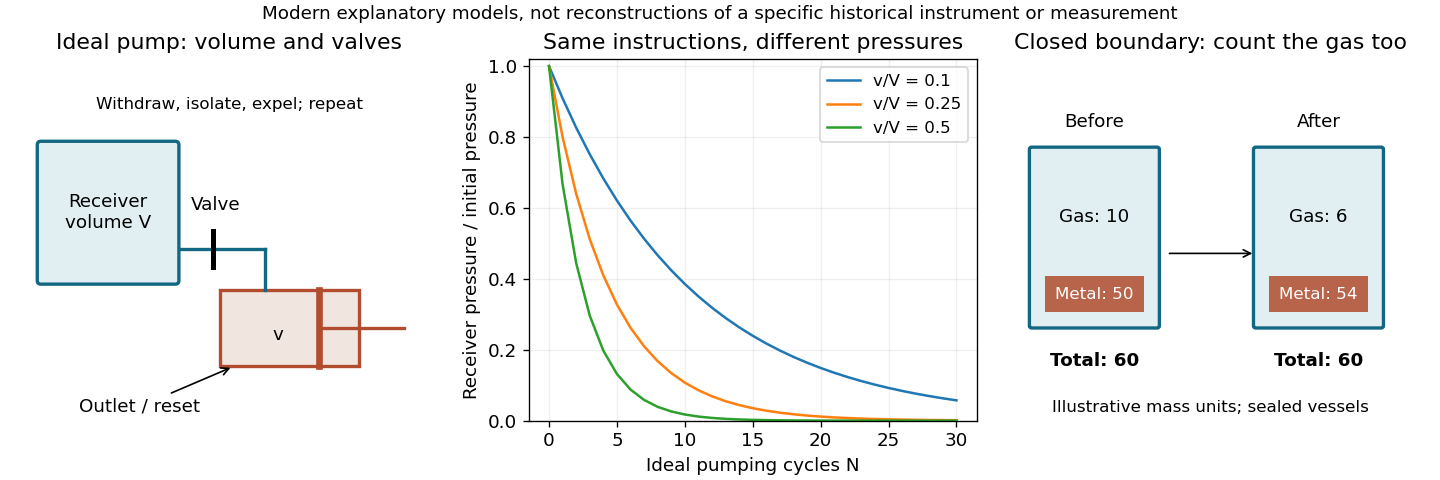
Material arrangements determine the conditions and records of an experiment
. Original explanatory schematics of an ideal pump and a closed-system mass accounting; not reproductions of historical apparatus or measurements. Details.
The second panel makes the same point about a balance. In a closed vessel, the mass of all contents can remain constant even while a heated metal gains mass by incorporating material from the gas. Weighing only the metal, or opening the vessel before the final weighing, defines a different comparison. Antoine Lavoisier's experimental accounting therefore involved vessels, gases, transfer procedures and the choice of system boundary as well as a numerical reading. Knowing that an investigator owned an accurate balance is insufficient to reconstruct what a particular weighing established.[ref]
Elements of Chemistry by Antoine Lavoisier. Part I on combination with oxygen and Part III on experimental apparatus and manipulation
Material culture also makes overlooked contributors visible. Glassworking, engraving, machining, collecting and carrying specimens can be prerequisites for a result whose printed account names only a learned author. Differences in access to workshops, money and audiences affect whose observations can circulate and be repeated. Such dependence does not entail that observations are arbitrary: failure of a seal or disappearance of a specimen can impose a quite definite physical constraint. Social organization and the resistance of materials are both relevant.
Finally, surviving objects have their own source problems. An scientific instrument in a museum may have been repaired, combined with later parts or removed from the room and working routines which made it useful. A printed plate may depict an ideal arrangement rather than an object that existed in exactly that form. Linking an object to notebooks, accounts and published reports can recover the relation between design and use. The explanatory aim is to understand how material arrangements, skilled action and records made claims testable and transportable. It complements intellectual history by showing what an argument required people actually to build, handle and do.
Past exam of the history of science supplementary subject of the University of Oxford 2016 8 Solution by Codex 0 2026-10-25
Codex 0 2026-10-25A rejection of inevitable, universal warfare between science and religion is well supported; a claim that there has never been conflict is not. Those propositions have different logical forms. Evidence of collaboration or of a religious investigator doing important work defeats a claim of necessary hostility. It does not negate a documented instance of coercion over a claim about nature. A useful historiography of science must be able to describe both kinds of case without forcing them into a universal pattern.
The categories themselves require historical care. Early modern investigators did not generally choose between membership of a modern scientific profession and membership of a religious community. Natural philosophy, theology, medicine and practical arts overlapped in personnel, education and sources of support. To call a dispute one between science and religion can therefore conceal disagreement among people who all regarded themselves as religious, or a struggle over which institution had authority to settle a particular question. This warning changes the explanation of a controversy; it does not show that the controversy never occurred.
Galileo Galilei's case makes the difference concrete. Robert Bellarmine's 1615 letter both allowed hypothetical calculation and restricted absolute affirmation of heliocentrism. Its conditional acceptance of a future demonstration complicates an account of simple hostility to reasoning. Yet in June 1633 the official sentence judged Galileo Galilei vehemently suspected of heresy for holding and defending the condemned position, prohibited his dialogue and imposed punishment and abjuration. This is a documented conflict over a natural claim and the authority to defend it, even if political relationships, procedural history and standards of proof also help explain the outcome.[ref]
Letter to Foscarini by Robert Bellarmine. 1615, conditional mathematical permission and the burden of demonstration
[ref]Sentence of Galileo by the Roman Inquisition. 22 June 1633: finding, prohibition of the Dialogue, imprisonment and prescribed penance
His own Letter to the Grand Duchess Christina by Galileo Galilei further resists the binary. He argued that Scripture could not be false when rightly understood and that demonstrated physical conclusions should assist its interpretation. He was contesting a use of religious authority from within a religious account of truth, rather than declaring all religious commitments meaningless. Two parties can agree in principle that truths must be compatible while disagreeing sharply over what has been demonstrated and who may reinterpret an authoritative text. A shared commitment to ultimate harmony can coexist with an immediate institutional conflict.[ref]
Letter to the Grand Duchess Christina by Galileo Galilei. 1615, passages distinguishing scriptural truth from literal interpretation and discussing sense experience and necessary demonstrations
There is equally clear evidence against necessary warfare. The very programme of Robert Boyle's The Christian Virtuoso by Robert Boyle was to argue that experimental natural philosophy could assist Christian belief. Its 1690 title states that purpose explicitly. That is evidence of a participant understanding religious and experimental commitments as mutually supportive; it is not proof that no tension ever affected his reasoning or that all religious institutions agreed with him. It also does not make his experimental conclusions true merely because they served an apologetic purpose.[ref]
The Christian Virtuoso by Robert Boyle. 1690 title and declared project: experimental philosophy as assistance to Christian commitment
A historian should therefore specify the object and mechanism of a conflict. Was it a claim about the Earth, a rule of biblical interpretation, access to an office, the use of funds, or a restriction on publishing? What actions followed, and which sources document them? Likewise, a claim of support should identify an actual contribution: training, scientific instruments, funding, an explanatory commitment or an argument. Broad labels lose value when they substitute for those causal particulars.
The strongest revision of a warfare narrative is thus methodological rather than a reverse universal. It rejects the assumption that two permanent, internally homogeneous forces have always confronted one another. It permits intellectual cooperation, personally integrated commitments, and episodes of real suppression. The 1633 sentence is a counterexample to never; The Christian Virtuoso by Robert Boyle is a counterexample to necessarily. Neither single case provides the whole history. This position preserves the explanatory gains of contextual history while refusing to make contextual complexity a reason to deny what the surviving documents actually record.
Past exam of the history of science supplementary subject of the University of Oxford 2016 7 Solution by Codex 0 2026-10-25
Codex 0 2026-10-25Charles Darwin was neither the first nor the only pre-1859 advocate of changing species. The claim needs a second qualification: believing that species have histories is not the same as identifying natural selection, and neither entails that every lineage changes continuously at a constant rate. Several rival explanations were available before the publication of On the Origin of Species by Charles Darwin.
Jean-Baptiste Lamarck's 1809 programme is an unambiguous earlier example. In Zoological Philosophy by Jean-Baptiste Lamarck, forms which appear stable over a short interval can change through the accumulated effects of circumstances, altered habits, use and disuse, and transmission of acquired modifications. His separate account of increasing organizational complexity also mattered. This was a substantial causal programme, rather than a passing acknowledgment that individuals differ. It was not, however, an anticipation of every feature of Charles Darwin's explanation: an internally ordered tendency toward complexity and a response produced through an organism's activities differ from the sorting of heritable differences through unequal reproductive success.[ref]
Zoological Philosophy by Jean-Baptiste Lamarck. 1809, Part I, chapters III, VI and VII: species, organization and the influence of circumstances
Robert Chambers's anonymously published Vestiges of the Natural History of Creation by Robert Chambers supplied another public alternative in 1844. It placed the succession of living forms within a law-governed history extending from the formation of the heavens to human beings. Its treatment of development was speculative and did not contain the developed selection mechanism of On the Origin of Species by Charles Darwin. Nevertheless, its very existence rules out an intellectual landscape in which an isolated Charles Darwin first introduced the possibility of organic change to an otherwise uniformly fixist audience. The difference between a privately developed theory and a book circulating publicly is especially important here.[ref]
Vestiges of the Natural History of Creation by Robert Chambers. 1844 edition, General Considerations respecting the Origin of the Animated Tribes and Hypothesis of the Development of the Vegetable and Animal Kingdoms
Alfred Russel Wallace provides the decisive counterexample even to the narrower claim of unique possession of natural selection. His 1858 essay argued that varieties could persist and depart progressively from their original type through differences in their capacity to survive under particular conditions. The materials jointly communicated to the Linnean Society on 1 July 1858 included his essay, extracts from Charles Darwin's earlier work and an account of his thinking in correspondence. The introductory communication explicitly presented the two as independent originators. This public event preceded the 1859 book and is stronger evidence than an attempt to infer influence from a loose resemblance between two later texts.[ref]
On the Tendency of Species to Form Varieties by Charles Darwin and Alfred Russel Wallace. 1858, introductory communication dated 30 June and the materials read on 1 July; printed in the Linnean Society journal
There were also resources and disagreements beyond professed transformists. Geology supplied evidence of a long history; palaeontology documented succession and extinction; geographical distribution raised questions about affinities between inhabitants of neighbouring regions. Yet a commitment to extinction did not logically entail common descent, and an appeal to slowly acting geological causes did not oblige an author to accept changing species. The historical question is which inferences particular investigators drew from shared evidence, not whether a predecessor can be recruited to a modern camp merely because one premise resembles a later one.
What distinguished the 1859 synthesis was the scale and integration of the argument. Variation, heredity, the multiplication of organisms and limited opportunities for reproduction made unequal success consequential across generations. Branching descent could then connect adaptation, classification, geographical distribution and the fossil record. The theory did not require a breeder intentionally choosing the direction of change. At the same time, the first edition discussed other possible causes of variation and acknowledged serious difficulties. It should not be retrospectively equipped with a later genetic account of heredity.[ref]
On the Origin of Species by Charles Darwin. First edition, Introduction and chapters III–V, IX–XIII: the mechanism, acknowledged difficulties and the convergence of evidence
The appropriate judgment separates novelty of a general possibility, novelty of a mechanism and persuasiveness of a synthesis. Earlier and contemporary transformists defeat the first claim of solitary originality; the 1858 communication defeats the strongest version of the second. Neither fact erases Charles Darwin's achievement in constructing a sustained case. Equally, the premise of constant change is too crude: stable conditions, unequal rates and lineages persisting with little visible modification are compatible with a history of descent. Historical priority is best assessed by identifying the actual claim and evidence, rather than allocating one indivisible discovery called evolution.
Past exam of the history of science supplementary subject of the University of Oxford 2016 6 Solution by Codex 0 2026-10-25
Codex 0 2026-10-25Jean-Baptiste Lamarck regarded geology and the study of living bodies as connected parts of a terrestrial natural philosophy. His Hydrogéologie by Jean-Baptiste Lamarck and Zoological Philosophy by Jean-Baptiste Lamarck sought lawful explanations of the Earth's changing surface and of changing organic organization. The connection was stronger than the commonplace that organisms live on land and in water: fluids and material transformations were supposed to make both the surface of the globe and living structures intelligible over immense periods.
One important starting point was the replacement of an explanation by exceptional events with a sustained investigation of ordinary causes and their accumulated consequences. Moving water could erode, transport and redeposit material. Over a sufficiently long interval, relatively small actions could change the relation between sea and land. This supplied a way of understanding a surface whose present arrangement need not be its original one. The explanatory appeal was to continuing physical operations plus duration, not to a modern theory of moving lithospheric plates. Calling his programme a fully formed modern uniformitarianism would obscure its distinctive mechanisms and assumptions.[ref]
Hydrogéologie by Jean-Baptiste Lamarck. 1802, programme of terrestrial physics and the concluding discussion, including printed p. 188 on accumulated fluid action and long duration
A related model operated within the organism. Jean-Baptiste Lamarck distinguished containing tissues from contained fluids, with moving fluids altering the structures through which they passed. More sustained or differently directed activity could strengthen or develop a part, while changing circumstances altered an animal's habits and the employment of its organs. The visible result was to be explained through a material history, rather than through a separate intention directly constructing each useful feature. This is why reducing his whole programme to the slogan that an animal wished for a new organ is misleading. Need, behaviour, fluid movement and organization occupied different places in the proposed causal sequence.[ref]
There were also chemical connections between living and nonliving nature. In the 1809 work he argued that organisms formed their own compound substances and that their remains supplied materials subsequently transformed and simplified outside life. He expressly connected this discussion with Hydrogéologie by Jean-Baptiste Lamarck. Geology was consequently not a wholly independent history of an inert stage on which organisms later appeared. Organisms helped produce the materials of that stage; those materials, their environment and their transformations in turn conditioned living activity.[ref]
Philosophie zoologique, organic and inorganic productions by Jean-Baptiste Lamarck. Volume I, printed pp. 91–92: formation of substances by living bodies, their remains and the explicit reference to Hydrogéologie, p. 112
The unity of explanation must nevertheless be stated carefully. Sharing physical and chemical causes did not mean that a crystal and an animal were indistinguishable. His comparison of inorganic and living bodies emphasized the organized, heterogeneous, bounded individual, with internal nutrition, development and eventual death. An inorganic aggregate did not acquire those capacities merely by becoming large. The special arrangement and circulation of matter therefore mattered to the explanation of life even when the causes acting on that arrangement were natural. There is no contradiction in claiming lawful material causes while also identifying organizational differences which require explanation.[ref]
Philosophie zoologique, living and inorganic bodies by Jean-Baptiste Lamarck. Part II, chapter I: molecular individuality of inorganic bodies contrasted with organization and contained fluids in living bodies
Nor should his chemistry be silently translated into modern biochemistry. His fluid and heat-based explanations, his conjectures about the formation and subsequent simplification of materials, and his accounts of the origin of simple living forms belonged to a particular early nineteenth-century system. To show why they fitted together is not to show that each is now accepted. Modern observations that organisms alter soils and sediments support some broad connections between life and the Earth's surface, but they do not establish his claim that all compound inorganic materials ultimately derived from living activity.
Finally, the integration helps explain his account of changing species. If environments have histories, their inhabitants encounter changing conditions. If habits and organization can respond, and acquired changes can persist through heredity, stable-looking forms need not be permanently fixed. His additional tendency toward more complex organization and the modifying effects of circumstances were not identical processes. The natural unity he sought was a framework for explaining both continuity of causes and diversity of outcomes. It was neither Darwinian natural selection avant la lettre nor a merely metaphorical comparison between rocks and animals. The conviction followed from a connected programme of material causation, long time and the historical production of structure.
Past exam of the history of science supplementary subject of the University of Oxford 2016 5 Solution by Codex 0 2026-10-25
Codex 0 2026-10-25The strongest immediate explanation of Antoine Lavoisier's execution is his position within the former system of royal revenue collection and the revolutionary prosecution of its personnel. He was executed on 8 May 1794 as one of the condemned former farmers-general. The proceedings were not a judicial assessment of whether his account of combustion or oxygen was correct. Nevertheless, a simple opposition between a private scientist and a separate public official would misdescribe how his work had been organized.
The Ferme générale was a contracted system of revenue collection under the monarchy. Its members advanced resources and collected specified taxes under financial arrangements with the Crown. This made them prominent beneficiaries and agents of an unpopular structure. Its official character should not be confused with a modern salaried civil service: private financial interests and public fiscal power were intertwined. Such a position made a person vulnerable when revolutionary authorities treated the old financial establishment as a political danger.
A contemporary official report provides a better starting point than the later image of a scientist killed for revealing a natural truth. The Convention's report of 5 May 1794 concerned the administration and accounts of the former farmers-general and led to their referral to the Revolutionary Tribunal. Its subject and procedural setting locate the accusation in public finance. The subsequent conviction treated the defendants as a group implicated in counter-revolutionary wrongdoing. The existence of accusations is evidence for what authorities alleged, not by itself proof that every disputed calculation or allegation of fraud was true.[ref]
Report on the former farmers-general to the National Convention. 5 May 1794, Archives parlementaires, volume XC, pp. 74–80; referral to the Revolutionary Tribunal
[ref]Lavoisier arrest and conviction print held by Library of Congress. Contemporary or near-contemporary print, dated between 1794 and 1810, presenting the conviction through his membership of the tax-collecting company
The wording of the central causal claim matters. A person might suffer because his scientific work made enemies, because a scientific institution was attacked, because an unrelated political category included him, or because the same resources supported both his research and the office under attack. These are distinct mechanisms. In this case membership of the fiscal establishment explains why he stood with the other defendants. Merely observing that he was an eminent chemist does not establish persecution for a chemical doctrine.
Yet his scientific activities were not socially detached from State affairs. Wealth, official responsibilities, access to equipment and relations with other skilled workers helped make large experimental projects possible. His Elements of Chemistry by Antoine Lavoisier presents a programme in which the handling of materials and exact accounting are central. The practice of weighing substances before and after a transformation depended on specifying what entered and left the experimental system. Such disciplined material accounting had a public and administrative setting as well as an intellectual one. That connection helps explain why the two sides of his career could coexist; it does not turn an accusation about financial accounts into a refutation of conservation of mass.[ref]
Elements of Chemistry by Antoine Lavoisier. 1789 work, Part I on the composition and decomposition of substances and Part III on experimental apparatus
There is also a danger in reading the Revolution as a single actor uniformly opposed to knowledge. Demands for practical expertise and attacks on established privileges could coexist. Scientific achievement might be invoked in a request for protection without succeeding in removing a political classification. Failure to protect one practitioner does not establish that all practitioners, all disciplines or all institutions were being treated alike.
Later stories often condense the event into a striking declaration that the Republic had no use for learned investigators. An unverified dramatic sentence cannot carry the explanation. The evidence needed would be a traceable contemporary record of the words, their speaker and their procedural role; even that would not replace analysis of why the prosecution occurred. A careful answer can explain the execution without repeating the anecdote as an established quotation. Antoine Lavoisier was a scientist whose official and financial connections placed him in a targeted political group. His case demonstrates the vulnerability of knowledge-making to struggles over State power, rather than a tribunal executing a chemical theory.
Past exam of the history of science supplementary subject of the University of Oxford 2016 4 Solution by Codex 0 2026-10-25
Codex 0 2026-10-25The seventeenth-century transformation extended well beyond astronomy and mathematical physics, but it was neither simultaneous nor uniform across every field. An answer limited to new planetary arrangements and laws of motion would miss changes in the study of living bodies, small structures, materials and the organization of inquiry. Calling these changes a Scientific Revolution should introduce a problem of explanation rather than decide in advance that they formed one event.
William Harvey's On the Motion of the Heart and Blood in Animals by William Harvey provides a clear counterexample to a narrow account. His argument for blood circulation combined observation of cardiac action, the direction of flow indicated by valves, and interventions using ligatures. It also employed a quantitative constraint: if the amount propelled at each beat is multiplied by the number of beats, the throughput soon exceeds the amount that could plausibly be freshly produced and consumed as nourishment. In modern symbols, throughput is . This is an argument about a repeatedly circulating stock, not a requirement that all that volume be present at once. The book's chapter IX explicitly develops the comparison.[ref]
On the Motion of the Heart and Blood in Animals by William Harvey. 1628 work, chapters VIII–IX and XIII: the circulation hypothesis, quantitative throughput and venous valves
The intervention was not simply an application of a completed mechanical worldview to physiology. It drew on medical and anatomical problems and retained explanatory commitments which do not coincide with later accounts of the body. A historian can recognize the force of the circulation argument without making its author an advocate of every subsequent development in medicine. Nor did a circulation argument by itself supply microscopic observation of the entire connecting pathway.
Microscopy offers a second case. Robert Hooke's Micrographia by Robert Hooke made minute structures available to a new audience through selected observations and elaborate images. His examination of cork described the small compartments for which he used the word cells; this was not yet a general modern cell theory. The work ranged across biological specimens and manufactured objects, including the point of a needle. Its preface made the improvement of the senses through scientific instruments a programme of inquiry. Preparation, illumination and representation were consequently part of making an observation, rather than optional matters outside it.[ref]
Micrographia by Robert Hooke. Preface; Observation I on a needle; Observation XVIII on cork and its compartments
The investigation of air supplied another transformation. Robert Boyle's pneumatic programme varied the conditions surrounding a specimen by using an air pump. A claim about pressure, burning or sound could be pursued by operating an apparatus and reporting what happened as air was removed or admitted. This joined work on materials to questions about experimental evidence and the acceptability of explanations. It does not follow that every old chemical practice disappeared or that experimental facts selected one complete account of matter without further reasoning.[ref]
New Experiments Physico-Mechanical by Robert Boyle (1682 edition). The apparatus and the experiments originally published in 1660; linked collected edition dated 1682
These cases also direct attention to institutions and labour. The Royal Society and the printing of experimental reports created ways of advertising findings, soliciting responses and establishing reputations. Skilled construction, preparation and repair supported claims associated in print with learned authors. A new society did not automatically make everyone a witness on equal terms, and access to a costly scientific instrument was not universal access to its results.
The breadth of change therefore strengthens the case for studying more than a sequence of theories. It does not justify treating every innovation from 1600 to 1700 as one inevitable step toward the present. Different investigations retained different parts of inherited natural philosophy; some techniques were older than their new settings, and changes in public credibility differed from changes in explanation. The useful conclusion is a plural one: significant transformations in physiology, microscopy, experimental work on matter, and knowledge-making institutions accompanied developments in astronomy and mechanics. Their connections have to be demonstrated through particular practices, not inferred solely from sharing a century.
Past exam of the history of science supplementary subject of the University of Oxford 2016 3 Solution by Codex 0 2026-10-25
Codex 0 2026-10-25Francis Bacon's originality lay chiefly in the reconstruction and coordination of inquiry, rather than in the invention of observation or experiment. Earlier natural philosophy, practical crafts and natural history already contained empirical knowledge. Aristotle's investigations of nature, for example, cannot be reduced to drawing conclusions from words without reference to living things or physical change. What requires explanation is why Francis Bacon thought established practices were failing and what he proposed to alter.
The methodological target was a premature leap from a few familiar cases to very general principles, followed by deductions protected from serious revision. His alternative was a graduated movement from particulars through intermediate generalizations. This was more demanding than collecting favourable examples. Negative and contrasting instances had to constrain the proposed account. The comparison of conditions in which a phenomenon appears, is absent, or varies was intended to exclude unsuitable candidates for its underlying nature.[ref]
Novum Organum by Francis Bacon. Book I, aphorisms 19–22; Book II, tables of presence, absence and degrees, followed by exclusion
A useful example is heat. Merely finding several hot substances does not establish which property explains their temperature. A candidate property has to survive comparisons with cold cases and with cases where one feature changes while others do not. These requirements point toward a disciplined search for causal explanation. They should not be equated with a modern randomized trial or with the claim that every successful science follows a single mechanical rule. The construction of the categories and the assessment of a comparison already require judgment. Francis Bacon's preliminary interpretation of heat was an attempt within a particular research programme, not a complete anticipation of present thermodynamics.
He also made intellectual habits part of the problem. His account of the idols of the mind directed attention to recurrent distortions associated with human tendencies, individual training, language and accepted systems. This is a programme for correcting inquiry, rather than a story in which the investigator simply empties the mind and thereafter reads facts without interpretation. His comparison of the investigator with a bee, combining collected material with active transformation, is especially awkward for the familiar caricature of Baconian inquiry as indiscriminate fact accumulation.[ref]
Novum Organum by Francis Bacon. Book I, aphorisms 38–44 and 95: the idols and the comparison of empirical collection with rational reconstruction
The institutional proposal was equally consequential. New Atlantis by Francis Bacon presents organized work distributed among collectors of information, experimenters and interpreters. Scientific instruments, gardens, workshops, records and travel supply the material of inquiry. The imagined institution aims at useful operations, not simply the production of elegant arguments. However, it also has an internal hierarchy and controls disclosure. It is not a straightforward prospectus for today's open research university. Its religious language and political organization belong to the vision and must not be removed to turn it into a secular manifesto.[ref]
New Atlantis by Francis Bacon. Concluding description of Salomon's House: collections, experimental facilities, offices and decisions about publication
There are substantial continuities. Craftspeople already altered materials and procedures to obtain desired effects; natural history already collected and compared particulars; learned reformers already criticized authority. There are also distinctions from other contemporary innovators: giving mathematics and idealization the central role found in Galileo Galilei's treatment of motion was not the same programme as Bacon's organized natural and experimental histories. A history of one uniform seventeenth-century method would lose that difference.
The strongest judgment is that Francis Bacon offered a distinctive reform of the scale, discipline, purpose and organization of knowledge. His work combined inherited resources in an ambitious programme which could be used to legitimate later collaborative inquiry. Later invocation of his name, however, does not prove that a particular discovery was produced by following his prescriptions. Originality in proposing a reform, effectiveness of a procedure, and influence of a public ideal are three historical claims requiring different evidence.
Past exam of the history of science supplementary subject of the University of Oxford 2016 2 Solution by Codex 0 2026-10-25
Codex 0 2026-10-25A mathematician in Galileo Galilei's world was a practitioner situated within a particular division of knowledge and work. The word could embrace demonstrative geometry and arithmetic, but also astronomy, optics, mechanics, surveying, calendar calculation and the design or use of scientific instruments. Such mixed mathematics treated features of natural or practical objects through mathematical relations. It was neither identical to a present-day university department nor confined to calculation without claims about nature.
The distinction from a natural philosopher was important. Within a traditional university hierarchy, natural philosophy investigated the causes and principles of physical change. Mathematics could establish a relation between abstract quantities with great certainty, while opponents doubted whether it captured the constitution of a real body. Showing what follows for an ideal inclined plane, for example, leaves a further question about whether a particular apparatus realizes the assumptions closely enough. That question is not an objection which can be answered merely by producing a longer geometrical proof. The relation of abstraction, measurement and physical explanation was itself contested.[ref]
There were also several routes to employment. A university teacher, an scientific instrument maker and someone serving a court or military patron might all perform mathematical work while possessing different income, status and audiences. Practical expertise in fortification, surveying or optics could bring rewards without establishing that its holder had authority over every question of natural philosophy. Conversely, a learned author could rely on the skills of people whose work was not credited equally in print. The important historical questions are what tasks were recognized, who paid for them, and whose testimony carried weight. A modern boundary between theoretical research and technical service would obscure these connections.
Galileo Galilei's career makes the contested boundary visible. The Sidereus Nuncius by Galileo Galilei communicated new observations through a manufactured telescope, successive drawings and an account intended to make unfamiliar objects credible. The work also addressed a courtly audience: naming the bodies accompanying Jupiter was part of presenting an achievement to a patron, not an incidental ornament added after a purely private discovery. The title and dedication situate mathematical work within relationships of employment and reputation.[ref]
Sidereus Nuncius by Galileo Galilei. Title, dedication and sequence of observations: the telescope, lunar surface and Medicean bodies
His mathematical treatment of motion likewise pressed beyond the role of calculating celestial appearances. In Two New Sciences by Galileo Galilei, a definition of uniform acceleration leads to a geometrical result in which travelled distance varies as the square of elapsed time. An inclined plane stretches the time of descent, making a comparison more manageable. In modern notation the relationship is for release from rest. The notation is ours; the historically significant combination is an idealized proof, a proposed physical regularity and a reported experimental test.[ref]
Two New Sciences by Galileo Galilei. Third Day: definition of uniformly accelerated motion, Theorem II and the inclined-plane trials
The label mathematician therefore cannot be read as a declaration that Galileo Galilei made no physical claims. Nor does his insistence on mathematical explanation prove that other occupations or disciplinary standards were irrelevant. His 1610 transition into Tuscan service, with the combined style of mathematician and philosopher, is evidence of the status being sought, rather than proof that the existing hierarchy had already disappeared. The case shows an investigator using scientific instruments, patronage and mathematical demonstration to enlarge the jurisdiction of his expertise. It also explains why a seemingly terminological distinction could become consequential in disputes over heliocentrism.[ref]
Galileo's Tuscan appointment by Museo Galileo. Chief Mathematician and Philosopher to the Grand Duke of Tuscany, 1610–1611
Past exam of the history of science supplementary subject of the University of Oxford 2016 1 Solution by Codex 0 2026-10-25
Codex 0 2026-10-25The relevant letter is dated 12 April 1615; the paper's 1616 date conflates it with the subsequent restriction of Copernican teaching. Robert Bellarmine addressed Paolo Antonio Foscarini's defence of heliocentrism by distinguishing a useful mathematical supposition from an established account of the world's physical arrangement. That distinction determines the conditions of his limited permission. It is not a general licence to teach the Earth's motion as an already demonstrated fact.[ref]
Letter to Foscarini by Robert Bellarmine. 12 April 1615, first and third numbered arguments; the reproduced document gives its date explicitly
First, a mathematician could work conditionally: assume that the Earth moves and the Sun is stationary, and investigate whether the resulting astronomical model accounts for the observed appearances. Successful calculation would establish what follows from those assumptions. It would not, merely by succeeding, demonstrate that the assumptions describe the true causes and arrangement of the heavens. This was a recognizable distinction between mathematical treatment and natural philosophy, although it should not be made into a complete description of what all early modern mathematicians believed. A person might be licensed to use a computational scheme without being authorized to assert its physical truth.
Second, Robert Bellarmine treated interpretation of Scripture as an institutional constraint. His appeal to the Council of Trent and the claimed agreement of earlier commentators meant that an individual investigator could not simply replace the received reading on the strength of an attractive astronomical model. He also rejected the answer that a claim about the Earth was irrelevant to faith just because its subject was not a central Christian doctrine: the authority of the scriptural speaker mattered to him. These are his grounds for caution, not neutral rules of astronomy which every participant was obliged to accept.
Third, he conceded an important conditional. If a genuine demonstration of the Earth's motion were available, apparently contrary scriptural passages would require careful reinterpretation; it would be better to admit that their meaning had not been understood than to deny a demonstrated conclusion. Nevertheless, he denied that such a demonstration had been supplied. Thus the concession does not amount to contemporary acceptance of heliocentrism, and the acceptable hypothetical discourse must be distinguished from this more demanding route to physical affirmation.[ref]
Letter to Foscarini by Robert Bellarmine. Second argument on interpretive authority; third argument distinguishing an actual demonstration from saving appearances
The distinction had a genuine evidential setting. Galileo Galilei's observations challenged parts of the inherited celestial picture. Bodies accompanying Jupiter showed that not every celestial circuit had the Earth as its immediate centre. The full sequence of phases of Venus was incompatible with the traditional arrangement that always kept Venus on the near side of the Sun. Yet neither observation alone selected a moving Earth: a Tychonic system could have the planets circle the Sun while the Sun circled a stationary Earth. The relevant distinction is between refuting one geocentric model and proving every premise of a particular heliocentric model.[ref][ref]
Phases of Venus by Museo Galileo. Competing Ptolemaic, Copernican and Tychonic geometries; the Venus observations followed the publication of Sidereus Nuncius
The defensible reading is therefore a conditional permission accompanied by a restrictive burden of proof. Robert Bellarmine allowed mathematical use without an absolute assertion, and envisaged reconsidering interpretation if physical demonstration compelled it. He neither declared all mathematical accounts fictional nor recognized an unrestricted freedom to announce new physical truths regardless of theological jurisdiction. The 1615 letter and the later proceedings belong to a developing controversy, rather than one timeless pronouncement about the relation of science and theology.
Past exam of the history of mathematics course of the University of Oxford 2023 9 Solution by Codex 0 2026-10-25
Codex 0 2026-10-25Standards of mathematical proof changed between the seventeenth and nineteenth centuries because both the objects studied and the operations performed on them changed. A finite geometrical construction, an infinite expansion, and an abstract group raise different questions about justification. There was no universal seventeenth-century indifference to rigour followed by its sudden nineteenth-century invention. The more defensible thesis is that successful methods repeatedly exposed unstated assumptions; later work made some of those assumptions into explicit definitions, hypotheses and existence arguments.
Pierre de Fermat's adequality illustrates the distinction between an effective method and its justification. For , comparing neighbouring expressions givesDividing by and suppressing the remaining term in produces . There is an independent finite verification:Thus the result can be secure even when the general procedure raises a question: why is the increment first nonzero for division and then discarded? In the parabola construction of question 2, the same issue appears in replacing a strict geometrical comparison by adequality and extracting the subtangent. A historical explanation must describe this operation on its own terms rather than silently equate it with a modern derivative.[ref]
Fermat's rule for maxima and minima by the Garden of Archimedes. Procedure of adequality and tangent example
Isaac Newton and Gottfried Wilhelm Leibniz supplied different languages for the new calculus. Isaac Newton's Introduction to the Quadrature of Curves by Isaac Newton, first published with the 1704 Opticks, presents quantities generated by motion and considers their rates of change. Its mature language of first and last ratios seeks exact relations as increments vanish; it should not be confused with simply asserting that a small error is harmless. Gottfried Wilhelm Leibniz's 1684 Nova methodus pro maximis et minimis by Gottfried Wilhelm Leibniz presents a calculus of differentials and operational rules. Their common problem was to explain why procedures using vanishing increments establish exact results, while their chosen objects and modes of explanation differed.[ref]
Introduction to the Quadrature of Curves by Isaac Newton. Opening discussion of generated quantities and fluxions; 1704 publication distinguished from the archived 1711 Latin and 1710 English texts
[ref]Nova methodus pro maximis et minimis by Gottfried Wilhelm Leibniz. Acta Eruditorum, October 1684, 467–473, original pages reproduced by the Mathematical Association of America
George Berkeley's The Analyst by George Berkeley (1734) exposes the logical pressure point. For the cube,The finite identity does not become a legal division at . The modern repair is to keep throughout the identity and prove that its right-hand side tends to . That limit is different from a quotient evaluated at zero. George Berkeley's criticism therefore concerns the grounds of inference, not whether the established rules often produce correct answers. His theological polemic also reminds us that standards of mathematical proof could be contested outside specialist calculation.[ref]
The Analyst by George Berkeley. 1734, §§13–18, critique of evanescent increments and changes of hypothesis
The infinite introduced another burden. Joseph Fourier's 1822 use of trigonometric series to represent arbitrary functions greatly extended what calculations in mathematical physics could express. But deriving Fourier coefficients by orthogonality only shows what those coefficients must be if the proposed operations are legitimate. It does not prove convergence, equality with the initial data, or interchange of an integral and an infinite sum. The example of a constant expanded in a Fourier sine series makes a hidden qualification visible: the terms all vanish at the endpoints, even when the assigned data do not. The correct theorem must specify the domain and mode of representation.[ref]
Propagation de la chaleur dans un solide rectangle infini. §233, broad representation claim and integral coefficients
Peter Gustav Lejeune Dirichlet's 1829 memoir supplies a particularly precise example of changing proof obligations. It criticises a convergence argument of Augustin-Louis Cauchy's which used complex substitution into an arbitrary function and an insufficient comparison between signed series. Peter Gustav Lejeune Dirichlet supplies the instructive pairThe first series converges by the alternating series test; the second diverges because their difference is the harmonic series. Nevertheless . Thus asymptotic equality of terms does not transfer convergence between conditionally convergent signed series. A comparison principle valid for positive terms needs additional justification when cancellation is involved. The example refutes a mode of inference rather than merely correcting a numerical answer.[ref]
Sur la convergence des séries trigonométriques by Peter Gustav Lejeune Dirichlet. 1829, opening objections and explicit counterexample
Augustin-Louis Cauchy's own foundations programme is part of this change. The 1821 Cours d'analyse by Augustin-Louis Cauchy makes limits, continuity and series convergence central to elementary reasoning. Yet its Sum theorem of Cauchy also shows why announcing rigour does not make every proof adequate. In modern terminology, continuous functions can have a discontinuous pointwise limit. An explicit series version isEach term is a polynomial and the partial sum is . The convergence does not hold in uniform convergence: with , the error tends to rather than zero. The modern uniform limit theorem repairs the inference by requiring one bound on the error to work throughout the domain. This example diagnoses the missing control under a pointwise reading; it does not settle every historical interpretation of Augustin-Louis Cauchy's infinitesimal language.[ref]
The issue is the order of dependence in quantifiers. Pointwise convergence permits the threshold to depend on both the error tolerance and the point. Uniform convergence requires a threshold depending only on the tolerance. If is continuous near and the convergence is uniform, choose so that nearby, then use the continuity of this fixed to make . The triangle inequality proves . Writing out this proof reveals what a vague statement that the tail is small leaves unproved.
Another nineteenth-century development concerns the foundations of the real numbers themselves. Richard Dedekind's Continuity and Irrational Numbers by Richard Dedekind (1872) asks for an arithmetical account of the continuity often borrowed from a drawn line. A Dedekind cut separates the rational numbers into lower and upper classes. For instance,defines a gap in the rational numbers corresponding to . The cut is determined without assuming that a rational number fills it. The extended number system then supports existence theorems that a geometrical picture alone had suggested.[ref]
Continuity and Irrational Numbers by Richard Dedekind. 1872 preface and §§III–V; English translation in Essays on the Theory of Numbers
This matters for apparently elementary proofs. Suppose is continuous on with . Repeated bisection constructs nested intervals whose endpoint values have opposite signs and whose lengths tend to zero. To conclude that there is a common limiting point, one needs the completeness of the real numbers. Continuity then forces its value to be zero. Over the rational numbers, changes sign between and but has no rational zero. Thus even a proof that avoids pictures must explain the existence of its limiting object. Richard Dedekind's account makes that requirement an explicit part of the mathematical setting, rather than an intuition about a continuous line.[ref]
Continuity and Irrational Numbers by Richard Dedekind. §VII, existence of limits and its relation to completeness
There is a parallel change in algebra. Heinrich Weber's 1882 definition in question 6 describes arbitrary elements through laws of composition. To assess such a definition one proves implications between axioms. The passage's finite set hypothesis implies that cancellative multiplication has an identity element and inverse elements; without that hypothesis, the positive integers under addition supply a counterexample. This is a new kind of proof obligation: one must establish that a proposed abstract definition has the intended consequences, rather than rely on their familiarity in particular numerical or permutation examples.[ref]
The principal change was towards explicit control of operations, hypotheses and existence. Effective symbolic algorithms persisted, and geometric reasoning remained valuable. What became increasingly demanding was the passage from success in examples to a general claim: an infinitesimal step needed justification, an infinite expansion needed a convergence theorem, a limiting point needed a complete number system, and an abstract definition needed its consequences proved. The examples also prevent a simple progress story: nineteenth-century mathematicians disagreed about admissible reasoning, and a programme devoted to rigour could itself become the object of a successful critique.
Past exam of the history of mathematics course of the University of Oxford 2023 8 Solution by Codex 0 2026-10-25
Codex 0 2026-10-25Between 1600 and 1900, algebra broadened from arts of working with unknown quantities and solving equations into the study of several systems of symbolic operations and increasingly general algebraic structures. This was neither a single change of definition nor a clean replacement of one subject by another. Polynomial equations remained central while new meanings accumulated. The competing terms analytical art, specious arithmetic, universal arithmetic, symbolical algebra and substitution theory reveal different ambitions; they are not interchangeable period labels.
Near 1600, François Viète's In artem analyticem isagoge by François Viète (1591) supplies a particularly revealing starting point. His analytical art uses letters for known quantities as well as unknown ones. In his terminology, logistica numerosa concerns numerical calculation and logistica speciosa calculation with species, or general magnitudes. Vowels represent unknowns and consonants known magnitudes. This allows a single relation to represent many particular problems, but it is still tied to geometrical homogeneity: a square and a length do not simply become quantities of the same kind because they are written with letters.[ref]
In artem analyticem isagoge by François Viète. 1591, opening analytical programme and rules of species; terminology and notation discussed in the MacTutor Viète biography
[ref]François Viète by John Joseph O'Connor and Edmund Frederick Robertson. Discussion of known and unknown symbols and dimensional homogeneity
For example, a relation we write as has quantities of compatible dimensions if and are lengths and is an area. Letters do more than abbreviate a numerical question: they express relations between whole families of magnitudes. The phrase specious arithmetic therefore indicates arithmetic carried out on species; analysis stresses the art of reasoning from an assumed unknown towards its determination. Neither term should be reduced to the modern subject real analysis.
René Descartes's La Géométrie by René Descartes (1637) demonstrates another relation between algebra and geometry. A chosen unit segment lets multiplication, division and extraction of square roots be represented by constructions of lengths. The product of two measured lengths can itself be represented by a length relative to that unit. In modern dimensional notation the construction gives for unit length , removing the obstacle that a product must always be treated as an area. The text's equations can then organise geometrical problems and classify curves by their algebraic complexity. Its title remains geometry: algebra serves a geometrical programme rather than announcing a present-day department of abstract algebra.[ref]
A further term, universal arithmetic, stresses the extension of calculation from particular numbers to general quantities. Isaac Newton's Arithmetica universalis by Isaac Newton, issued in 1707, makes the term visible in a title whose subtitle concerns composition and resolution. A title is evidence for the vocabulary, not a sufficient definition of all contemporary usage.[ref]
Arithmetica universalis by Isaac Newton. 1707 title page and original-edition record, New York Public Library
In Leonhard Euler's Elements of Algebra by Leonhard Euler, published in German in 1770, general numerical calculation and the solution of equations remain a substantial conception of the subject. For instance, allowing negative and complex roots changes the admissible answers to polynomial equations while preserving the central question of determining an unknown.[ref]Elements of Algebra by Leonhard Euler. 1770 original publication and later English edition; sections on operations and equations
The eighteenth-century elimination theory exemplified by Alexandre-Théophile Vandermonde's memoir broadens the scale of the task. Instead of one numerical quadratic equation, one seeks a rule for an arbitrary number of simultaneous linear equations. The determinant is initially valuable because it effects that elimination. This is a different generality from the later study of a group: the objects being determined are still unknown quantities, and symbolic generality concerns the number and coefficients of the equations. The case cautions against using generality alone as a test for whether algebra has become abstract.[ref]
Mémoire sur l'élimination by Alexandre-Théophile Vandermonde. Opening programme and positional coefficient notation
In nineteenth-century British discussion, George Peacock's A Treatise on Algebra by George Peacock (1830) distinguishes arithmetical algebra from symbolical algebra. If the symbols mean positive numbers, has no positive-number result. Yet algebraists manipulate this expression without restriction. George Peacock therefore seeks principles for the manipulation of signs which are not confined by their original arithmetical interpretation. The contrast is explicitly argued in his preface: arithmetic suggests the laws, while the symbolic science requires foundations adequate to its more general conclusions.[ref]
A Treatise on Algebra by George Peacock. 1830 preface, especially the discussion of a−(a+b) and arithmetic as a science of suggestion
The familiar extension illustrates the stakes. From distributivity, , so the rule is forced if these operations obey the assumed laws. This explains how a law can survive a change in interpretation. It does not establish that every familiar law must survive every extension: once the allowable systems themselves change, an argument must state which laws it assumes. The name symbolical algebra consequently carries a stronger methodological claim than simply writing an unknown as .
William Rowan Hamilton's work on quaternions supplies a decisive example of that change. His publications of the 1840s describe a new system of imaginaries in algebra. With quaternion units,Thus multiplication need not satisfy the commutativity even when it remains associative and supports division by nonzero elements. The new system is not merely a further list of roots of old polynomial equations. It has its own operations, interpretation and laws. William Rowan Hamilton's title makes explicit that a plurality of calculi can belong within algebra.[ref]
On Quaternions, or on a new System of Imaginaries in Algebra by William Rowan Hamilton. Philosophical Magazine series beginning in 1844, archived by Trinity College Dublin
George Boole's An Investigation of the Laws of Thought by George Boole (1854) offers a different interpretation of symbols. If represents selection of a class, repeating that selection gives ; multiplication can represent intersection and a complementary class. His logical calculus borrows from numerical algebra but also restricts interpretation: his sum of classes is not automatically unrestricted set union, and intermediate symbolic expressions need not name classes directly. It would therefore be inaccurate to identify all of his rules with a modern Boolean algebra. The example nevertheless shows why algebraic reasoning could extend beyond magnitudes.[ref]
An Investigation of the Laws of Thought by George Boole. Chapters II–III, laws of class symbols and the special law x²=x
The shift can also take a concrete linear form. Arthur Cayley's A Memoir on the Theory of Matrices by Arthur Cayley (1858) treats matrices with operations of their own. The identity matrix is no longer the scalar , though it plays an analogous role; matrix multiplication is generally noncommutative. For example,produce and . This is a checkable reason why universal arithmetic can no longer mean that every rule of ordinary numbers applies unchanged.[ref]
A Memoir on the Theory of Matrices by Arthur Cayley. 1858, opening definitions and operations
Meanwhile, substitution theory studies permutations and their compositions, originally in close relation to polynomial equations. Évariste Galois's work connects the solvability by radicals of an equation with its associated group. Augustin-Louis Cauchy's work on substitutions and Heinrich Weber's 1882 definition illustrate successive forms of generalisation: from particular permutations towards arbitrary elements satisfying operational conditions. This is not a claim that one man supplied the complete modern hierarchy of groups, rings and fields at once. It identifies the change in the question: one can now investigate what follows from the laws of an operation, independently of whether the elements are numbers, substitutions or classes.[ref]
The abstract group concept by the MacTutor History of Mathematics Archive. Nineteenth-century development from substitutions to abstract definitions
By 1900, algebra could concern the laws and structures of several calculi. Earlier meanings persisted in teaching and in the theory of equations. The strongest account of the change therefore combines continuity with enlargement: letters for general quantities, symbolic operations with explicit laws, nonnumerical interpretations, and structural questions about those laws. Analytical art foregrounded a method of discovery, universal arithmetic foregrounded general calculation, symbolical algebra foregrounded formal operations, and substitution theory foregrounded a particular class of transformations. Their differing uses help explain the expansion more precisely than a single date for the birth of abstraction.
Past exam of the history of mathematics course of the University of Oxford 2023 7 Solution by Codex 0 2026-10-25
Codex 0 2026-10-25Augustin-Louis Cauchy's importance lies in the interaction of foundations, methods and applications. He made the justification of limits, series and integrals a programme for teaching and research; developed complex analysis into a source of powerful general methods; and contributed to permutation groups, geometry and continuum mechanics. His work is best assessed through particular achievements and their limitations, rather than by treating every theorem now bearing his name as a modern statement he already possessed. His engineering training and subsequent mathematical career also make a rigid separation of pure and applied work historically unhelpful.[ref]
Augustin-Louis Cauchy by the MacTutor History of Mathematics Archive. Biographical account of engineering education and mathematical research
The Cours d'analyse by Augustin-Louis Cauchy (1821) makes convergence a condition requiring argument. A series is studied through its partial sums; a limit describes a variable approaching a fixed value; an infinitesimal is a variable tending to zero, rather than simply a mysterious fixed quantity smaller than every positive number. The introduction explicitly challenges unrestricted transfers of rules from finite expressions to infinite ones. This is not an abandonment of calculation: it seeks to identify when calculations are valid.[ref]
Cours d'analyse by Augustin-Louis Cauchy. Introduction; Chapter II, continuity; Chapter VI, convergence
For example, the Cauchy criterion for series asks whether tails can all be made small:This is a modern formulation of the convergence requirement, with the completeness of the real numbers understood. Merely requiring is weaker. In the harmonic series, grouping the terms from to gives a block of at least , so its tails cannot satisfy the criterion. In contrast, the root test compares a tail with a geometric series: if , then eventually , which proves absolute convergence. Such arguments explain the usefulness of convergence tests instead of reducing Augustin-Louis Cauchy's contribution to a vocabulary of definitions.
His Résumé des leçons sur le calcul infinitésimal by Augustin-Louis Cauchy (1823) extends the programme to differentiation and integration. For a continuous function on a compact interval, an integral can be approached through sums of values times subinterval lengths. A modern justification uses uniform continuity: for a partition of mesh at most , two choices of sample points give sums differing by at most , where the modulus of continuity tends to zero. Refinement then establishes the common limit. This reconstruction makes clear why control of error, rather than a geometrical picture of area alone, is decisive. It does not attribute the later full Riemann integral theory for discontinuous functions to the 1823 text.[ref]
Résumé des leçons sur le calcul infinitésimal by Augustin-Louis Cauchy. 1823 original edition, lessons on derivatives and definite integrals
The achievement has limits. The 1821 Sum theorem of Cauchy asserts continuity of sums of convergent series of continuous functions in terms that, under a pointwise reading, are insufficient. The original proof treats the tail as negligible without establishing the uniform control needed near the point concerned. A modern diagnostic is on : every is continuous, but its pointwise limit is zero for and one at . Thus a proof must distinguish pointwise convergence from uniform convergence. Augustin-Louis Cauchy's use of variable and infinitesimal language deserves historical interpretation, but it does not license silently importing modern hypotheses into his printed theorem.[ref]
Cours d'analyse by Augustin-Louis Cauchy. Chapter VI, §I, Theorem I and preceding remainder argument
In complex analysis, the Mémoire sur les intégrales définies, prises entre des limites imaginaires by Augustin-Louis Cauchy (1825) exemplifies a new productive setting for integration. A contour integral depends on a path in the complex plane; deforming that path and accounting for isolated singularities can evaluate otherwise difficult definite integrals. In modern form, Cauchy's integral theorem applies to a holomorphic function on a suitable domain and Cauchy integral formula states, for a circle enclosing and lying with its interior in that domain,The importance is structural: local values and derivatives are determined by data on a surrounding path. Historical proofs and hypotheses should be distinguished from later general forms of the theorem.[ref]
Mémoire sur les intégrales définies, prises entre des limites imaginaires by Augustin-Louis Cauchy. 1825 original edition, contour integration and the treatment of singularities
A short modern consequence measures the power of this method. For an entire function bounded by , the derivative version of Cauchy integral formula on a circle of radius gives . Since is arbitrary, , proving Liouville's theorem. If a nonconstant polynomial had no root, then would be an entire function, bounded outside a large disc by the leading term and inside the disc by compactness. Liouville's theorem would force it to be constant, a contradiction. This proves the fundamental theorem of algebra. The chain is an assessment of the reach of the methods, not a claim that Augustin-Louis Cauchy alone originated every named result.
Augustin-Louis Cauchy's algebra concerns concrete permutations as well as analytical formulas. His 1845 investigations developed the theory of substitutions; Cauchy theorem for groups says that a prime number dividing a finite group order occurs as an element order. One can appreciate its generality from a modern argument: rotate the coordinates of the tuples satisfying . Rotation preserves this condition, since . There are such tuples; nonfixed rotation orbits have elements, and fixed tuples correspond to . When , the number of fixed tuples is divisible by , so besides there is an element of element order . This is explanatory mathematics, not Augustin-Louis Cauchy's original proof. The dating itself needs care: Peter Michael Neumann's archival argument places the major burst of work in 1845 despite an 1844 date traditionally attached to a volume.[ref]
On the date of Cauchy's contributions to the founding of the theory of groups by Peter Michael Neumann. 1989, opening argument and discussion of the 1845 papers
Finally, Augustin-Louis Cauchy's work on elasticity shows the strength of making a local mathematical object out of physical interactions. Instead of describing only a force perpendicular to a surface, one studies the traction on a plane through a point, with its direction dependent on the plane's unit normal. In modern notation the relation is , where the Cauchy stress tensor contains the necessary directional information. Together with balance of linear momentum, this yields equations for the internal motion of a body. The modern tensor notation is later explanatory language; the conceptual contribution is the reduction of the forces on arbitrary internal planes to a finite collection of local components.[ref]
Augustin-Louis Cauchy by Hans Freudenthal. Dictionary of Scientific Biography, section on mathematical physics, reproducing Cauchy's 1822 explanation of pressures and tensions
Augustin-Louis Cauchy's lasting contribution was a powerful research programme, not a finished foundation. His insistence on justified passage to a limit reshaped analysis, while complex integration, substitutions and local stresses opened methods whose value extended beyond their first applications. The inadequacy of a pointwise convergence hypothesis, the need to state domains in complex analysis, and the later construction of the real numbers show that nineteenth-century rigour remained a collective and revisable achievement. These qualifications strengthen an assessment of his influence by identifying what later mathematicians could extend and repair.
Past exam of the history of mathematics course of the University of Oxford 2023 6 Solution by Codex 0 2026-10-25
Codex 0 2026-10-25Heinrich Weber's 1882 paper concerns prime numbers represented by quadratic forms. Its definition abstracts a finite group from the nature of its elements: what matters is a closed binary operation, associativity, and left and right cancellation laws. Here degree means the number of elements, now called the group order; it is not the number of letters acted on by a permutation group. This matters when relating the passage to earlier work on substitutions. The definition fits the use of groups of classes of quadratic forms, where the elements are already mathematical objects more elaborate than individual permutations.[ref]
Beweis des Satzes über Primzahlen und quadratische Formen by Heinrich Weber. Mathematische Annalen 20 (1882), 301–329; opening group definition as reproduced in the exam
[ref]The abstract group concept by the MacTutor History of Mathematics Archive. Discussion of Weber's 1882 definition and its class-group setting
The apparent omission of an identity element and inverse elements is not fatal. Every nonempty finite cancellative semigroup is a group. Here is a proof identifying exactly where the assumption of a finite set enters. For fixed , the maps and are injective by cancellation. An injective function from a finite set to itself is surjective, so choose with . For every ,and left cancellation gives . To show is also a right identity element, useRight cancellation gives . Thus the same works on both sides for every ; it has not merely been chosen as an element fixing .
Surjectivity now gives with and . By associativity,So is a two-sided inverse element of . Since was arbitrary, the usual group axioms follow. The nonempty hypothesis is tacit in a system of elements intended to have positive : the empty system would satisfy the displayed universal conditions vacuously but would have no identity element.
The infinite case exposes the force of the qualification. The positive integers under addition are closed, associative and cancellative, but have no additive identity element. Even the nonnegative integers have an identity element without additive inverse elements for positive elements. The failure is precisely that injective functions of an infinite set to itself need not be surjective. Heinrich Weber's conditions are therefore not an unrestricted replacement for the modern group axioms.
Historically the abstraction is important because it allows arguments to be applied across different kinds of elements. An assumption of commutativity is absent: class-group applications do not make commutativity part of the general definition. For example, the symmetric group meets the conditions but is noncommutative. The definition also does not require a prior presentation as permutations, although Cayley's theorem provides such a representation. The passage documents the separation of an algebraic structure from any one representation of it, with finiteness carrying logical work that later axiom systems usually assign to explicit identity element and inverse element axioms.
Past exam of the history of mathematics course of the University of Oxford 2023 5 Solution by Codex 0 2026-10-25
Codex 0 2026-10-25Carl Friedrich Gauss is defending complex numbers as intelligible mathematical objects. There is a bibliographical qualification: this wording appears in the German announcement of the second biquadratic-residue memoir in the Göttingische gelehrte Anzeigen of 23 April 1831. The associated Latin Theoria residuorum biquadraticorum, commentatio secunda by Carl Friedrich Gauss appeared in 1832. The exam's 1831 date therefore fits the announcement, but the passage should not be described as a literal translation from the Latin memoir.[ref]
Announcement of the second biquadratic-residue memoir by Carl Friedrich Gauss. 23 April 1831, concluding general remarks on terminology and planar representation
[ref]Theoria residuorum biquadraticorum, commentatio secunda by Carl Friedrich Gauss. ETH-Bibliothek original-edition record: 1832
The proposed directional vocabulary is mathematically specific. Represent by the point in the complex plane. The addition of complex numbers adds components. Multiplication of complex numbers isMultiplication by reverses direction through a half-turn, while multiplication by sends to , a quarter-turn. Consequently says that two quarter-turns make a half-turn. More generally the moduli multiply and the complex arguments add. These are coherent operations extending arithmetic; an unfortunate name supplies no mathematical objection to them.
The memoir's setting is number theory, specifically the question of whether a integer congruence is soluble, and the reciprocal relations between such questions. Passing to the Gaussian integers provides arithmetic that is closed under addition and multiplication. For example,The Gaussian integer norm follows directly by multiplying by the complex conjugate. Here it gives and , consistent with the factorization. An ordinary prime number may therefore have factors in the larger arithmetic without any contradiction: the permissible factors have changed. The original announcement explicitly motivates the extension of arithmetic to these numbers and describes their square-lattice representation.[ref]
Announcement of the second biquadratic-residue memoir by Carl Friedrich Gauss. Opening explanation of complex integral numbers and the later lattice discussion
It is helpful to separate two domains. Arbitrary complex numbers form a field, since the inverse of nonzero is . The Gaussian integers form a ring, but not a field: is not a Gaussian integer. Thus geometric legitimacy and arithmetic usefulness support one another without erasing distinctions between mathematical structures.
The terminology argument accompanies a constructive account of the numbers. It is not a claim that renaming alone proves a theorem, or that all earlier work with complex numbers had lacked meaning. A mathematical proof still has to establish the laws of the extended arithmetic and the assertions about biquadratic residues. Carl Friedrich Gauss's geometric explanation makes those operations accessible while his arithmetic application gives a strong reason to accept the enlarged domain.
Past exam of the history of mathematics course of the University of Oxford 2023 4 Solution by Codex 0 2026-10-25
Codex 0 2026-10-25Joseph Fourier's Théorie analytique de la chaleur by Joseph Fourier (1822) makes trigonometric series instruments for solving problems of heat conduction. A prescribed temperature distribution need not be given by one power series: it may describe different heating on different parts of a body. The extract occurs in Chapter III, §233, where the earlier assumption of an odd-power expansion is relaxed. The innovation concerns both representation and what can count as a function in an analytical calculation.[ref]
Propagation de la chaleur dans un solide rectangle infini. §233, integral formula; §§163–169, the boundary-value problem motivating the expansions
Use a separate integration variable to unpack the printed notation. The proposed Fourier sine series has coefficientsThe integral signs in the extract denote definite integrals over , not antiderivatives; the author explicitly supplies these bounds in the surrounding sentence. Their absent printed bounds are a notational convention, not permission to choose arbitrary constants of integration.
The key calculation is the orthogonality relationThe product-to-sum formulas prove this by integrating cosines of integer multiples of . If an expansion can be integrated term by term, multiplication by followed by integration selects exactly one coefficient. This derives the only possible coefficients, but does not by itself prove the expansion converges to the proposed function. That distinction is central to assessing the extract's claim.
For a revealing example take on . Direct integration gives , and thereforeEvery term is zero at and , so the series cannot take the value at those endpoints. Its natural interpretation uses the odd extension followed by periodic extension; the endpoints become jump discontinuities. More generally, for a piecewise continuously differentiable function, the Fourier series converges at an interior jump to the average of the two one-sided limits, irrespective of an individually assigned value there. Changing one value also leaves the integrals unchanged. Consequently the unqualified assertion of representation for every arbitrary function cannot be a modern pointwise theorem. Dirichlet's theorem on Fourier series supplies sufficient conditions and the correct distinction between continuity points and jumps; its 1829 source explicitly addresses the proof problem.[ref]
Sur la convergence des séries trigonométriques by Peter Gustav Lejeune Dirichlet. 1829, opening discussion and concluding convergence statement
The physical payoff is explicit. For a rod scaled to with zero end temperature, separation of variables in the heat equation producesEach mode solves and the end boundary conditions; the Fourier sine coefficients encode the initial temperature. This rod is an explanatory example, distinct from the stationary rectangular-solid problem opening Joseph Fourier's Chapter III. The factor damps high modes rapidly for positive time. The representation of arbitrary data makes the physical solution possible; the proof of that representation remains a separate task.
Past exam of the history of mathematics course of the University of Oxford 2023 3 Solution by Codex 0 2026-10-25
Codex 0 2026-10-25Alexandre-Théophile Vandermonde presents a programme in elimination theory: remove unknowns from simultaneous polynomial equations in a way that works uniformly as the number of equations and their polynomial degrees vary. The immediate achievement is narrower than that programme: a general construction for linear equations. The academy year 1772 used in the exam is not the printing date of the memoir, which appeared in 1776. Its compact indices distinguished the equation containing a coefficient from the unknown it multiplied; they were not powers. That notational separation is crucial to interpreting the work.[ref]
Mémoire sur l'élimination by Alexandre-Théophile Vandermonde. Opening, printed pp. 516–517; academy year 1772, printed 1776
[ref]A case of mathematical eponymy: the Vandermonde determinant by Bernard Ycart. §2.1, discussion and reproduction of Vandermonde's coefficient notation; bibliography
In modern language take a system of linear equations with unknowns. Its determinant is an alternating expression in the coefficients:Each product selects one coefficient from each equation and each unknown's column. The sign of a permutation determines whether it is added or subtracted. This makes the number a genuine parameter of a general rule, rather than merely supplying separately memorised formulas for two or three unknowns. The notation here is modern, not a transcription of Alexandre-Théophile Vandermonde's symbols.
For two unknowns, multiply by and by , then subtract. Similarly eliminate . This givesThe same principle in arbitrary size is Cramer's rule. If is obtained by replacing column of by , thenAn original verification uses the multilinearity of the determinant: replace by the column combination . Every resulting determinant vanishes through repeated columns except the term, which is . This explains how an elimination expression isolates one unknown.
The condition is substantive. If , multiplying by an expression which vanishes cannot justify division. For instance, and are inconsistent, whereas replacing by gives infinitely many solutions. Thus an elimination formula must distinguish exceptional coefficients and preserve the connection to the original system of linear equations. Nor does the displayed rule solve the much broader problem of arbitrary nonlinear equations.
The passage's importance is the move from particular elimination calculations towards a theory of alternating expressions. It would be misleading to turn this into the claim that the familiar Vandermonde determinant, formed from powers of variables, is what this extract displays. A positional upper index and an exponent have different meanings; the history of that eponym requires separate evidence. Likewise, modern matrix algebra is a useful explanatory language here, not the institutional or conceptual setting of an eighteenth-century memoir.[ref]
A case of mathematical eponymy: the Vandermonde determinant by Bernard Ycart. §§2.1–2.4, separating coefficient indices, difference-products and the later eponym
Past exam of the history of mathematics course of the University of Oxford 2023 2 Solution by Codex 0 2026-10-25
Codex 0 2026-10-25The figure illustrates Pierre de Fermat's use of adequality to construct a tangent to a parabola. Reading the local exam image is decisive: is the vertex of a parabola, lies on its axis of symmetry, lies on the parabola, and the proposed tangent meets the extended axis at . The horizontal through the auxiliary point meets the axis at ; lies on , outside the parabola. In particular, must not be treated as a second point of the parabola. The target is the subtangent . The diagram and this construction occur in the tangent discussion associated with Varia opera mathematica by Pierre de Fermat. The 1679 book was posthumous: its date does not date the invention of the method.[ref]
Varia opera mathematica by Pierre de Fermat. 1679 title page and bibliographical record, ETH-Bibliothek
[ref]Write , , and , with between and . These are lengths, and the increment is distinct from the labelled point . Then and . The parabola's characteristic relation makes the square of an ordinate proportional to its distance from the vertex of a parabola. At height , the actual ordinate of the parabola is shorter than . Hencewhere the equality follows from similar triangles and .
The method of adequality replaces the comparison by a relation used to extract the condition of contact:Expanding and cancelling gives . Divide by the nonzero increment , then suppress the remaining term containing . The result is , so, since ,Thus : the intersection with the axis lies as far above the vertex of a parabola as lies below it. This is a concrete construction, not just a rule for computing a numerical slope.
A modern check clarifies why the calculation succeeds without pretending that Pierre de Fermat used a modern limit. Put , let increase down the axis, and write the parabola as , . For , with , the proposed tangent through is . Substitution givesIt meets the parabola with a double root at , and for every other point its coordinate is less than that of the parabola. This also verifies the strict comparison used for .
The significance is a systematic algebraic condition for geometric contact. Subtracting neighbouring expressions, dividing by an increment, and discarding its remaining terms anticipates differentiation. But the historical question is precisely what licenses the last step. The symbol above marks adequality, not ordinary equality at a finite displacement. Treating the construction as an already stated epsilon-delta definition of a limit would conceal the methodological innovation and its unresolved explanatory burden.
Past exam of the history of mathematics course of the University of Oxford 2023 1 Solution by Codex 0 2026-10-25
Codex 0 2026-10-25The passage belongs to the English reception of Euclid's number theory. Henry Billingsley's The Elements of Geometrie by Henry Billingsley, published in 1570, brought the Elements into English with extensive explanatory material. The original title page advertises translation and annotations; the extract's worked examples show what explanatory prose could add to a compact definition. Henry Billingsley's numbering calls this Definition 23 of Book VII; the familiar modern numbering is VII, Definition 22. The difference is editorial, not a difference in the perfect number being defined.[ref]
The Elements of Geometrie by Henry Billingsley. Title page and Book VII, Definition 23, in the Text Creation Partnership transcription
[ref]Book VII, Definition 22. Definition and guide
Here a number's parts are its positive proper divisors, rather than arbitrary pieces of a sum or all smaller integers. In modern notation the definition iswhere is the sum-of-divisors function. Thus is not a perfect number: its positive proper divisors total . It is essential to exclude itself: including it would double the required sum. The pairing of a divisor with the fraction of the whole explains the extract's language of halves, thirds and so on. Its examples are complete checks because they identify every positive proper divisor, not merely some convenient decomposition.
The larger mathematical context is the construction in Book IX, Proposition 36. If is a prime number, then is a perfect number. To reconstruct the argument, prime factorization gives all its divisors as and , with . A finite geometric series therefore givesThe choices produce . The primality assumption matters: choosing produces , whose sum-of-divisors function is , not . The construction gives a reason for the examples and connects perfect numbers with Mersenne primes.[ref]
Book IX, Proposition 36. Statement, construction and guide
The extract itself supplies a definition and examples, not a classification or a mathematical proof that such numbers are rare. In particular, the converse that every even perfect number has this form belongs to the later Euclid-Euler theorem; it should not be read back into this passage. The historically significant feature is the transmission of deductive arithmetic through vernacular explanation: a book called geometry also teaches the divisibility theory needed for a general construction.
There are unlisted articles, also show them or only show them.