For geodesic motion of uncharged dust, use the pressureless stress-energy form, and . stress-energy conservation expands to
Contracting with kills the second term, since . Hence , and wherever ,
On a flow line , so this becomes . Each relativistic dust element therefore follows a timelike geodesic with proper time as an affine parameter. pressure gradients or external nongravitational forces would add an acceleration term.
Throughout this solution and .
Null metric tensor and boost. Inverting the coordinate definitions gives , , and hence
For a frame moving at speed along positive , use , . Their difference and sum give
The reciprocal scale factors preserve . They are in rapidity notation.
acceleration invariants. Proper-time normalization gives , so . The four-acceleration has squared norm ; therefore
For future motion write and . Then the second equation is . acceleration toward positive selects .
hyperbolic motion from an initial event and rapidity. The stated initial event fixes , , but not the initial rapidity . Integrating with positive signed acceleration gives the general family
The initial event alone does not fix the initial velocity or signed acceleration. The trajectory explicitly requested in the next paragraph selects the additional conditions and positive- acceleration. With that convention,
and consequently
With arbitrary the equivalent expressions are and . Thus position data alone do not select the displayed special hyperbola. The following calculations use that intended hyperbola, which is also explicitly given by the paper.
Diagram and horizon. The selected world line is the right-hand branch . Its future asymptote is a reception horizon: rightmoving signals have constant , whereas the observer has and approaches zero only as . Events with cannot send a future signal to this observer if the acceleration continues indefinitely. This is an observer-dependent causal restriction in flat spacetime, not a curvature singularity.
photon reception by a uniformly accelerated observer. A rightmoving photon from the stationary source has four-momentum . Contracting with the observer's four-velocity gives
The same result follows by differentiating its emission-time relation. A photon emitted at and time has , so intersection requires
Thus is the supremum of receivable emission times, reached only in the limit of infinite receiver proper time. A photon emitted exactly then lies on the horizon and is never received at finite time; later photons cannot catch the ship. Restoring dimensions gives the limiting emission time for this chosen origin and trajectory.
Rindler coordinates. Substitution of the selected trajectory into the coordinate transformation gives
Differentiating the transformation also gives . Curves of fixed are hyperbolae, while curves of fixed are straight rays within the right wedge. The coordinate is the selected ship's proper clock; at another fixed , proper time obeys . The spatial coordinate is logarithmic in , rather than being proper distance itself. Fixed- observers have proper acceleration .
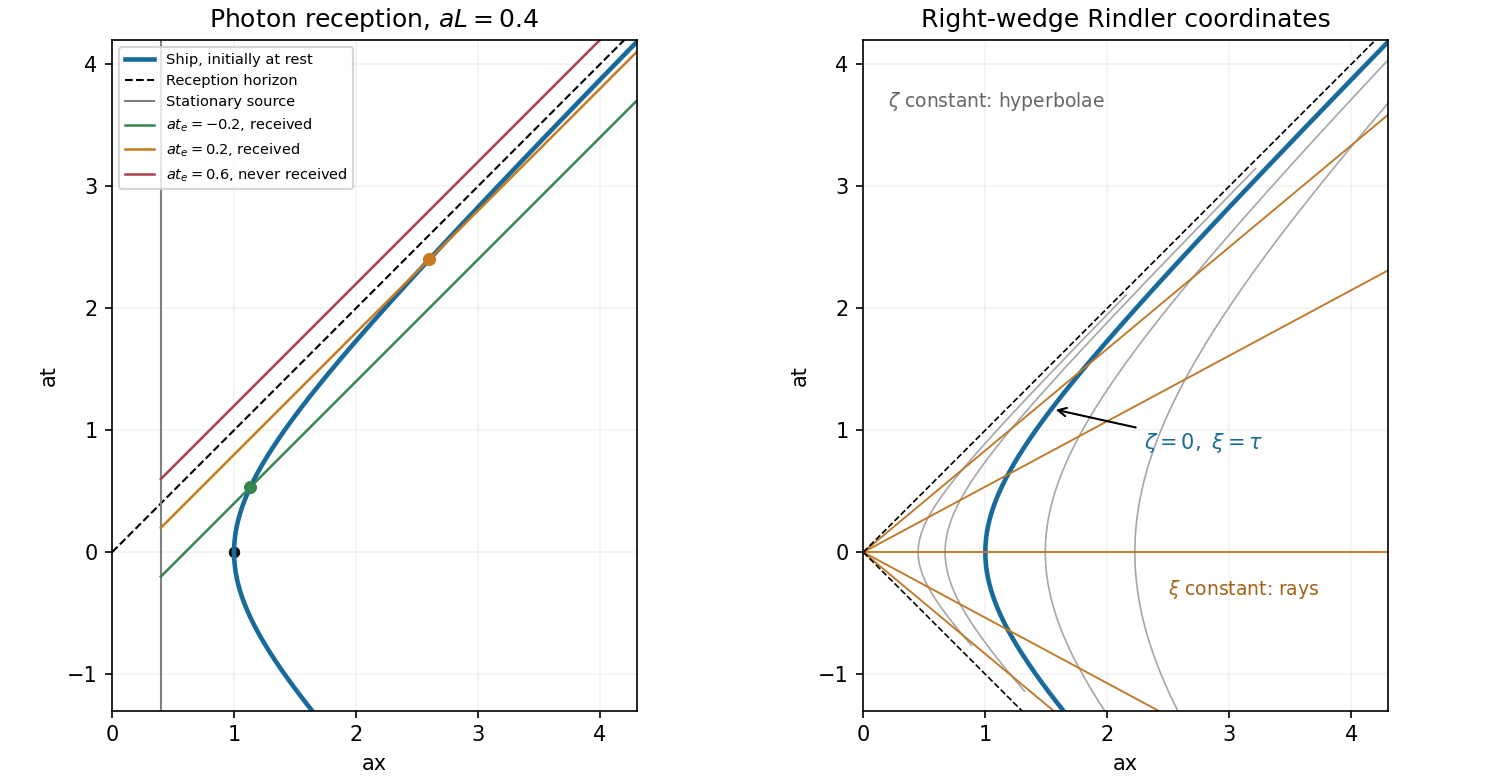
Figure 1.
Original accelerated worldline, reception horizon and stellar photon rays, with a separate Rindler coordinate grid
. Details.
Nearby freely falling particles can accelerate relative to one another even though each follows a geodesic. A local inertial frame removes the common gravitational acceleration at one event; it cannot remove the variation across an extended laboratory. That variation is a tidal force, measured covariantly by geodesic deviation.
Let be the reference four-velocity and an infinitesimal separation to a neighboring geodesic, with matching affine parameters. With the convention ,
This relates measured relative acceleration to the Riemann curvature tensor. Reversing the curvature-tensor convention reverses the displayed curvature sign, without changing the physical relative motion.
In a small freely falling frame outside a spherical mass, the weak-field tidal tensor has radial and transverse components proportional to . Thus
An initially spherical cloud stretches radially and compresses in both transverse directions. Two separated test masses, with their changing separation measured by light, form the basic idea of a gravity gradiometer; the common falling motion drops out. A uniform apparent acceleration in an accelerated laboratory can occur even in flat Minkowski spacetime, so it is the separation-dependent tidal response that diagnoses curvature.
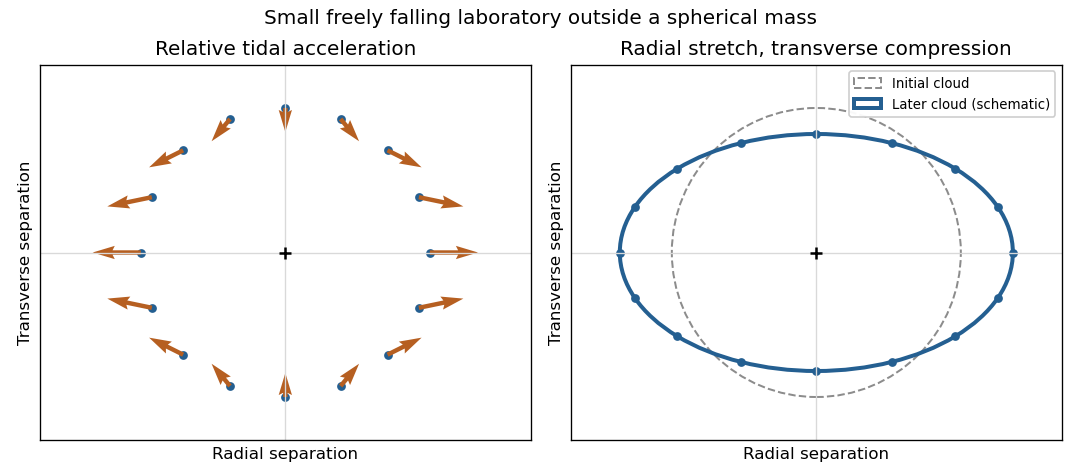
Figure 1.
Radial stretching and transverse compression from geodesic deviation
. Original local schematic of the weak-field tidal tensor around a freely falling reference particle. Arrows show relative acceleration, with radial direction horizontal; the cloud deformation is exaggerated and is not a trajectory calculation. Details.
Let denote coordinate acceleration and use for four-acceleration, to distinguish these two objects. Applying the chain rule to the Lorentz factor gives
Since , differentiation of the four-velocity with respect to proper time yields
This is also , as required.
The invariant Minkowski norm of the four-velocity is . Differentiating this identity gives . In the instantaneous rest frame, , so and the spatial components equal the physically experienced proper acceleration . Therefore in the metric signature.
For a direct calculation, put and expand the temporal and spatial squares:
The last step uses . This proper acceleration from coordinate velocity and acceleration also reads , providing the familiar one-dimensional limit . Each expression has units .
Local equivalence and tides. In Newtonian mechanics, inertial mass measures the response to a force, whereas passive gravitational mass couples to an imposed Newtonian gravitational field. A freely falling body obeys
The observed composition independence of free fall says that this ratio is universal. With a common choice of units it is one. This is the Newtonian content of the weak equivalence principle for test particles; it does not by itself specify all nongravitational physics.
The Einstein equivalence principle further says that local nongravitational experiments in a sufficiently small freely falling laboratory have the form predicted by special relativity, independently of the laboratory's location and motion. In such a local inertial frame, the metric tensor is locally the Minkowski metric and the Christoffel symbols vanish at the selected event. The strong equivalence principle extends the universality claim to local gravitational experiments and bodies with significant gravitational self-energy. None of these statements removes measurable tidal forces across a finite apparatus.
In an ideal small freely falling lift, a released ball initially floats relative to the cabin, because both undergo the same free fall. Two separated balls, however, need not retain their separation: they sample different parts of the gravitational field. For a point source, linearizing across a small separation gives the tidal tensor prediction
A radial separation stretches with coefficient , whereas a transverse separation is compressed with coefficient . Initially parallel velocities therefore develop relative motion even though the individual bodies experience zero proper acceleration.
The relativistic statement is geodesic deviation. With the Riemann curvature tensor convention
a connecting vector between neighboring freely falling worldlines satisfies
Here is the covariant derivative along the reference geodesic, and its four-velocity. Curvature can be nonzero where the Christoffel symbols have been made zero. In the weak, static, slow-motion limit this equation reduces to , recovering the tidal tensor above. A finite falling lift can detect gravity through these relative accelerations; local equivalence does not imply a globally uniform field.
Weak-field connection and potential. Take and the metric signature. There is an index error in the printed formula for the Christoffel symbols: its first differentiated metric component must be , not . The correctly contracted expression is
The offending term vanishes under the stipulated time independence, so this correction does not change the intended calculation. Write and treat both and its derivatives as first order. To that order , , and . A stationary metric tensor gives
For the temporal component the inverse-metric coefficient is already first order, so
For a spatial component the zeroth-order inverse metric contributes:
The time component of the approximate geodesic equation says that is constant to the retained order. In its spatial component, convert the proper time derivatives to coordinate-time derivatives and cancel :
Comparison with the Newtonian equation identifies . For an isolated source, choose the gravitational potential to tend to zero at infinity and normalize the time coordinate there, giving . Thus
The quantity is the Newtonian gravitational potential, or gravitational potential energy per unit mass, in . For a point source, . A static clock has , connecting the Newtonian limit with gravitational time dilation.
Frequency of the orbiting source. Treat the gas blob as a test particle on a timelike circular Schwarzschild geodesic, with pressure and other nongravitational forces negligible. Treat our very distant location as infinity, so the observer's own gravitational potential is negligible. These are the assumptions that make a unique answer in terms of possible.
Put and use a local static observer at the emission point as an intermediate measuring frame. The remote observer lies on the symmetry axis of the orbit. A ray arriving on that axis has zero conserved axial angular momentum, so its local direction is perpendicular to the emitter's azimuthal velocity. Bending within a meridional plane does not alter this orthogonality. The transverse relativistic Doppler effect therefore gives
where is the orbital speed measured by that local static observer. The gravitational redshift between static Schwarzschild observers then gives
A gravitational circular orbit has in the weak-field limit, so . Expanding both factors,
Solving for the emitted frequency gives
The gravitational part is and the transverse kinematic time dilation contributes another ; the absence of line-of-sight motion does not remove this second effect.
As an exact check, the local speed on a timelike circular Schwarzschild geodesic satisfies , where . Therefore the face-on frequency shift of a circular Schwarzschild source is
whose expansion agrees with the boxed answer. If the gas is supported or accelerated by pressure or magnetic stresses rather than following a geodesic, its orbital speed is not fixed by the mass and radius alone; the appropriate first-order result is instead , with supplied independently.
Neglect disk self-gravity and take around a central point mass . Its vertical gravitational acceleration is
Vertical hydrostatic equilibrium is . For a vertically isothermal ideal gas, and is independent of , giving
Here , is the isothermal sound speed squared, and is the Gaussian scale height. A different convention writing changes the quoted height by but not the physics.
Within an already specified inertial frame, with constant mass, substituting zero resultant force into Newton's second law does give zero acceleration. In that limited mathematical sense, force-free uniform motion is a special case. The reason for retaining Newton's first law is that its physical role is broader than this substitution.
The second law does not, just by its algebra, identify the coordinate systems in which acceleration measures the response to physical interactions. A free body described in coordinates has , despite experiencing no impressed interaction. If the second law is restricted to inertial frames, the first law supplies a criterion for that restriction and asserts that a common inertial structure exists. If instead one introduces a fictitious force to preserve the equation in the accelerated coordinates, that coordinate-dependent bookkeeping should not be confused with a newly discovered physical interaction.
Nor can the first law simply be used as a circular definition in which “free” means “unaccelerated” and “inertial” means “whatever makes the chosen body free”. The framework requires empirical identification of interactions and a mutually consistent class of free-body trajectories. Removing an influence or improving isolation should make the same inertial description work for many bodies, not merely one fitted trajectory.
Thus the two laws have distinguishable jobs: the first articulates the force-free inertial background; the second quantifies departures caused by impressed forces. A modern axiomatization may build that background into its spacetime structure and then omit a separately numbered first law. That is a legitimate reorganization, but it incorporates the first law's content rather than obtaining all of it from the equation . Newton states the laws separately in the opening axioms.[ref]
Showing that acceleration is unchanged by a uniform boost is necessary, but it is not enough to establish the Galilean covariance of Newton's second law. One must specify how time, positions, masses, forces and any background physical systems transform, and show that the actual force laws retain their form.
For a constant spatial rotation , boost velocity and translations, write
Differentiation gives and . Assuming invariant inertial mass,
Consequently the equation has the same form if the resultant physical force satisfies . For a pure boost, this reduces to . More explicitly, if a force is represented by a function of positions, velocities and other physical data, those arguments and data must transform so that its primed value is times the old value. It is this condition on the complete dynamical model, not the typography of , that establishes covariance.
An instantaneous inverse-square interaction depending on the separation of two particles passes this test: their common boost cancels from the separation, and a rotation rotates the force vector. A resistance law also passes when the medium's velocity transforms with the body. In contrast, keeping in every boosted frame while silently resetting the same medium to rest changes the physical problem. That model has not been shown covariant by noting .
Likewise, the full Maxwell equations are not made Galilean covariant merely because some equation of particle motion is written as force equals mass times acceleration. The covariance of a framework has to be checked together with its interaction laws. Newton's own Corollary V expresses the corresponding equivalence of uniformly translating, nonrotating systems for the mechanics under consideration.[ref]
Newton's first law identifies a class of inertial frames in which isolated bodies move uniformly, while the second relates changes of momentum to resultant force. Both have definition-like roles: the first helps characterize an inertial frame, and the second can be used to calibrate force given independently measured mass and acceleration. That does not make the whole scheme an empty set of definitions.
If force meant nothing except whatever product happens to be observed, the second law alone would have little independent predictive content. Actual mechanics also specifies gravitational, elastic and other interactions with independently constrained parameters, superposition rules and reaction relations. The combined framework predicts the accelerations of new arrangements. One cannot arbitrarily change one body's mass or redefine every unexplained acceleration as a different force without affecting those cross-system comparisons.
Likewise, an inertial frame cannot be separately tailored to make each trajectory straight while retaining a common interaction account. A rotating frame introduces coordinated velocity-dependent accelerations for different freely moving bodies. The empirical claim is that a common family of frames exists with the prescribed relations, at least over the applicable domain. Tests involve judgments about isolation, clocks, geometry and interaction laws, so they are not independent of all auxiliary assumptions.
Thus definitions organize the theory but do not exhaust its content. Whether one calls a definition or a dynamical postulate depends partly on how the remaining force concepts are introduced. What is testable is the consistent package that connects independently characterized interactions, mass ratios and motion. Relativity and gravitation show how that package can be revised when its domain is exceeded.[ref]
The age difference is the difference between proper times along two worldlines joining the same departure and reunion events. In the inertial Earth frame a traveler who spends total coordinate time moving at speed magnitude , with negligible-duration turnaround, accumulates while the stay-at-home clock accumulates . These are invariant readings at reunion. Acceleration permits the change of traveling inertial frame, but the result is determined by the whole path, not a universal rule that acceleration itself slows clocks.
Relativity of simultaneity is important when explaining the same result using the traveler's successive inertial coordinates. At the turnaround, the traveler changes which distant Earth event is assigned the same time. The simultaneity slice changes, producing a jump in the coordinate time attributed to Earth in the ideal instantaneous limit. On each long inertial leg the traveler can assign a slow rate to the distant Earth clock without contradicting Earth's larger total elapsed time, because those assignments do not cover the reunion comparison with a single simultaneity convention.
The key distinction is between explaining a coordinate-based apparent symmetry and deriving an invariant result. One can calculate both proper-time integrals in one inertial frame without ever using the traveler's simultaneity jump. Conversely, claiming that each twin must simply see the other younger confuses two reciprocal comparisons between different sets of simultaneous distant events. Radar signals and Doppler shifts provide an operational account with finite signal travel times and the same reunion readings.
Thus relativity of simultaneity resolves a specific misleading inference in the paradox, but is not an extra physical mechanism that changes a clock at a distance. The worldline asymmetry and the invariant proper-time calculation suffice for the prediction; simultaneity explains why reciprocal inertial time-dilation statements cannot be pasted together indiscriminately.[ref]
The geometrical explanation uses along each timelike path. In flat spacetime an inertial path between fixed timelike endpoints locally maximizes proper time, unlike the familiar shortest-path property of Euclidean distance. This is a physical metric property tested by clocks, not an appeal to a diagram alone. The explanation is satisfactory insofar as it connects that metric, specified worldlines and actual clock behavior; it does not require an absolute flow of time or a special clock-damaging action at the turnaround.
The cup's rotation relative to the radial basis has angular speed , so its absolute orientation has speed . With the planar rotation matrix,
At , : the cup translates on a circle while its axes remain parallel to fixed inertial axes. Thus , . Cancellation of orientation rotation does not remove acceleration of the cup's center.
Lossless Hamiltonian focusing can reduce a beam's transverse position width at the expense of momentum spread, but cannot reduce its occupied canonical phase volume. Coupling to the longitudinal direction can redistribute projected emittance without reducing total emittance. True cooling requires exporting entropy to additional degrees of freedom or discarding particles: stochastic feedback, electron cooling or radiative damping coupled to an external environment provide possible mechanisms, with very different efficiency for high-energy protons. Collimation shrinks the accepted distribution at the cost of intensity. Acceleration also reduces angular divergence at fixed normalized emittance, an apparent geometrical cooling rather than a violation of Liouville's theorem. The apparatus and radiation cannot be omitted from the accounting when the bunch is no longer an isolated Hamiltonian subsystem.
Isaac Newton's distinctive achievement was a tightly organized mathematical connection between terrestrial mechanics and celestial motions. Three laws of motion supplied a general dynamical framework, and universal gravitation made the same inverse-square interaction relevant to falling bodies, satellites and planets. Instead of merely fitting planetary positions, the theory related observed motions to forces and showed what consequences followed for orbits, tides and perturbations.
The novelty was not that mathematics, inertia or heliocentrism appeared for the first time. Earlier work had supplied essential components. Newton's synthesis made interaction quantitative through mass, force and acceleration, treated mutual action rather than merely a prescribed planetary path, and offered comparisons extending across phenomena. An ideal two-body inverse-square system has conic-section relative orbits, while systematic departures can indicate perturbing bodies or inadequate approximations. This made residual discrepancies informative rather than simply inconvenient.
His account of light also connected experiment and theoretical inference. Prism experiments distinguished the refrangibility of rays and explained the colors of white light through their composition. The claim depended on controlling the geometry and interpretation of refraction, not just producing an attractive spectrum. In both mechanics and optics, idealized mathematical objects were related to imperfect observations by explicit arguments.
There were limits to the unification. An inverse-square law specified the gravitational interaction without furnishing an accepted mechanical medium that produced it. Absolute time and space were conceptual commitments, and the empirical success of a force law did not automatically settle every metaphysical question about them. The significant novelty was a powerful structure for deriving and testing relations among motions, rather than a completed explanation of every physical cause.[ref][ref]
In the cold underdense model, and . A relativistic electron slips through half an accelerating sinusoidal wavelength over mm. For and injection at the start of that half-cycle, integration over gives
Injection at the field crest and acceleration only to its next zero gives half this value, about 0.51 GeV; this explains a common factor-two convention in dephasing estimates. Multiplying the peak field by the entire dephasing length is instead an upper bound, not the sinusoid's actual integral. These are ideal wave-amplitude estimates: need not excite , and finite pump depletion, pulse evolution and injection physics may reduce the gain. Without a specified nonlinear wake shape, the data warrant an order-GeV cold-wave upper scale, not a unique precision maximum for an actual experiment.
The age difference is the difference between proper times along two worldlines joining the same departure and reunion events. In the inertial Earth frame a traveler who spends total coordinate time moving at speed magnitude , with negligible-duration turnaround, accumulates while the stay-at-home clock accumulates . These are invariant readings at reunion. Acceleration permits the change of traveling inertial frame, but the result is determined by the whole path, not a universal rule that acceleration itself slows clocks.
Relativity of simultaneity is important when explaining the same result using the traveler's successive inertial coordinates. At the turnaround, the traveler changes which distant Earth event is assigned the same time. The simultaneity slice changes, producing a jump in the coordinate time attributed to Earth in the ideal instantaneous limit. On each long inertial leg the traveler can assign a slow rate to the distant Earth clock without contradicting Earth's larger total elapsed time, because those assignments do not cover the reunion comparison with a single simultaneity convention.
The key distinction is between explaining a coordinate-based apparent symmetry and deriving an invariant result. One can calculate both proper-time integrals in one inertial frame without ever using the traveler's simultaneity jump. Conversely, claiming that each twin must simply see the other younger confuses two reciprocal comparisons between different sets of simultaneous distant events. Radar signals and Doppler shifts provide an operational account with finite signal travel times and the same reunion readings.
Thus relativity of simultaneity resolves a specific misleading inference in the paradox, but is not an extra physical mechanism that changes a clock at a distance. The worldline asymmetry and the invariant proper-time calculation suffice for the prediction; simultaneity explains why reciprocal inertial time-dilation statements cannot be pasted together indiscriminately.[ref]
Newton's first law says that an unforced body maintains uniform straight-line motion in an inertial frame. It can function partly as a criterion for identifying inertial frames, but that does not automatically empty it of empirical content. The substantive claim is that there is a common class of frames in which independently isolated bodies have this behavior, rather than needing a different accelerated frame for each trajectory.
Testing requires auxiliary judgments about forces and measurement. If every unexpected acceleration is redescribed as an unknown force, or if a new coordinate system is tailored to every body, the law becomes insulated by construction. In practice forces are investigated independently through interactions, shielding, environmental changes and comparison among bodies. Reducing drag and varying external influences allow extrapolation toward the ideal. Mutually consistent force-free trajectories and the success of the broader dynamical system then support the inertial-frame hypothesis.
A simple counter to the claim that any coordinate choice suffices is a rotating laboratory: free bodies generally have velocity-dependent Coriolis accelerations and cannot all be made uniformly rectilinear by calling that rotating frame inertial while retaining the same force account. Conversely, no finite experiment establishes complete isolation or exact uniform motion forever. The law is tested as part of a network of force laws, geometrical assumptions and clock/ruler procedures, and may have local rather than global validity in a gravitational theory.
The first law is therefore neither an independently observed slogan with no definitions nor a mere tautology. Its definition-like role fixes a useful framework, while its applicability and the consistency of that framework across systems are answerable to experience.[ref]
Express temperatures as energies . A longitudinal cathode-energy spread of order remains of that order during an ideal common electrostatic acceleration. At final mean speed , a small energy spread produces . In the accompanying beam frame, the corresponding random kinetic-energy scale is
The last equality uses the nonrelativistic acceleration energy . This is the approximate temperature convention supplied in the hint; exact numerical factors depend on the emitted distribution and the definition of spread. At keV, relativistic corrections are modest but not strictly zero.
Electrostatic acceleration narrows longitudinal velocity spread relative to the fast mean beam even though it does not remove each electron's transverse cathode motion. In ideal magnetized cooling, slow proton motion couples to the electron guiding-centre dynamics, making this very small longitudinal spread relevant to the attainable ion temperature. Practical voltage ripple, space charge, alignment errors and ion heating can set much larger limits.
The target collision energy requires GeV per lepton beam. Its initial energy after the half-linac is GeV, so each lepton must gain GeV. Define the transformer ratio as accelerating field experienced by the witness divided by decelerating field experienced by the driver. If the useful stage length exhausts the driver's GeV while delivering the required gain, then
This matches depletion to acceleration and avoids leaving unused driver energy at the witness target. It is an ideal energy-transfer estimate, assuming suitable loading and longitudinal field profiles; a field ratio alone does not specify a practical wake or its efficiency.
The radiation pressure at a photospheric temperature near K is only about Pa. For an illustrative photospheric gas density and mean molecular weight near , the ideal gas pressure is about Pa. Thus gas pressure dominates those outer layers by many orders of magnitude. Both the temperature and density are needed: low temperature alone is not a complete comparison.
For homologous stars, hydrostatic and ideal-gas estimates give and . Therefore
with a structural coefficient independent of mass only under the homology assumption. As mass rises, radiation becomes increasingly important. A rough solar interior normalization of - suggests equality after a mass increase by tens, while realistic radiation-dominated structure and composition shift the scale; stars of order are a useful estimate for strong radiation support. The very small photospheric ratio must not be used as a universal normalization for their whole interiors.
Radiation also transfers outward momentum. Comparing radiative acceleration with gravity gives the Eddington luminosity
Near this scale, radiatively driven winds and envelope instabilities can remove matter or impede further accretion. Opacity, composition, rotation, mass loss and formation history affect the limiting stellar mass. The Eddington condition is a luminosity-to-mass constraint, not a unique composition-independent maximum stellar mass.
Hydrostatic equilibrium means that the local pressure gradient balances gravity, with no large acceleration or strength-supported departure from that balance. In a spherical planet,
Here is the enclosed mass, not a constant total mass at every interior radius. If composition is uniform and the radial thermodynamic path is adiabatic, the relevant bulk modulus is . The chain rule then gives the Adams-Williamson relation
A phase transition or composition jump must be treated separately; its density change is not obtained by integrating one smooth homogeneous-adiabatic equation through it.
The seismic parameter is
The shear modulus measures resistance to shear deformation. Solids with transmit shear waves; an ideal fluid has zero static shear modulus, so it cannot carry a bulk S wave, while compressional P waves can still propagate through its nonzero bulk modulus.
Limitations include uncertain seismic coverage, temperature and composition tradeoffs, nonadiabatic boundary layers, phase changes, lateral heterogeneity, rotation and finite material strength. Small asteroids and comet nuclei commonly retain irregular shapes because their self-gravity is too weak to overcome strength and impact history; a few larger bodies, such as Ceres, are much closer to global hydrostatic figures. A spherical shape alone is not a complete proof of present hydrostatic equilibrium.
Two complementary remote constraints are precise spacecraft tracking, which measures gravitational harmonics and constrains mass distribution when combined with shape and rotation; and tidal or rotational measurements, such as Love numbers, librations and spin precession, which constrain deformability, moment of inertia and possible fluid layers. Magnetic induction measurements in a time-varying external field can provide an additional conductivity constraint, but are not a unique density inversion.
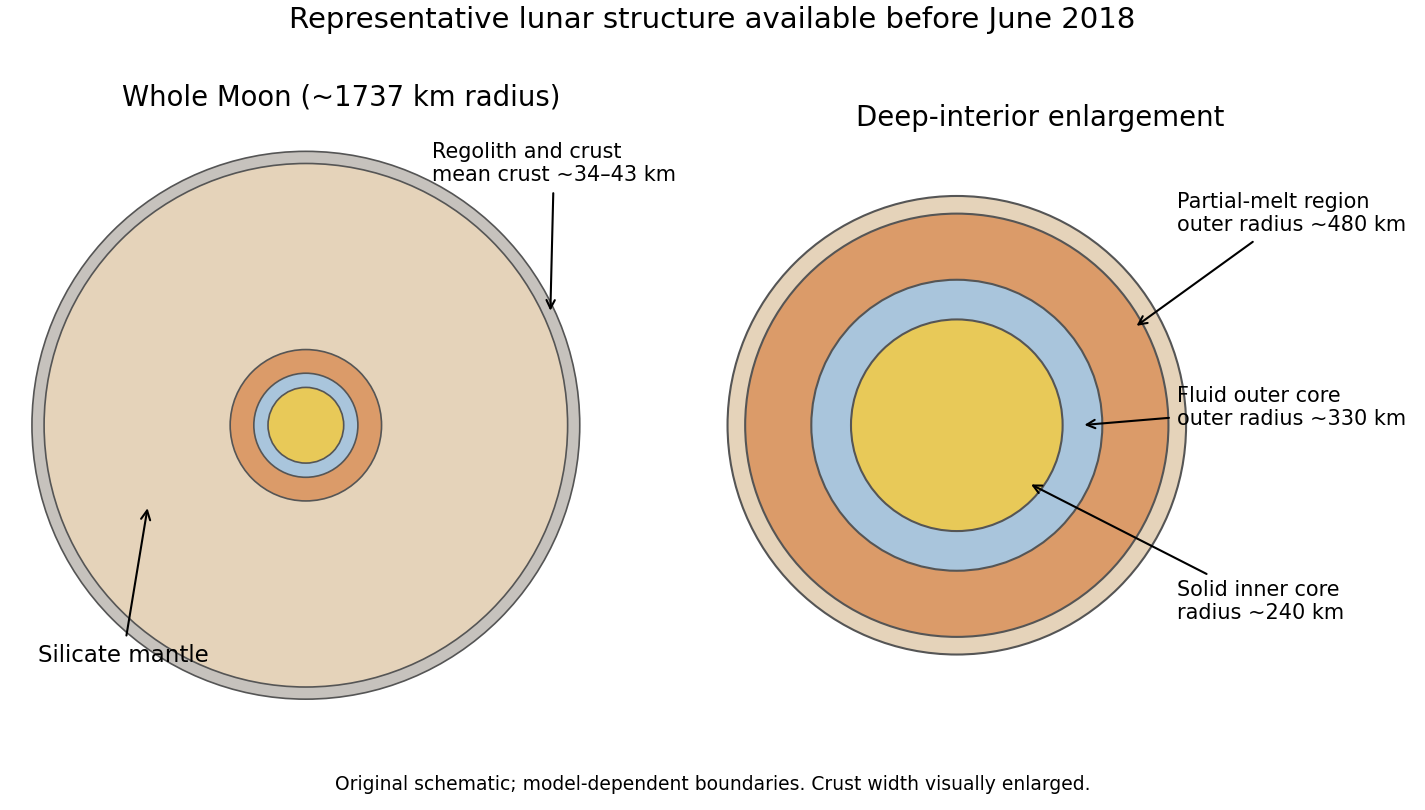
For the June 2018 lunar picture, start with a regolith and fractured crust, a largely anorthositic crust tens of kilometres thick, a silicate mantle, a deep partially molten region and a small iron-rich core. GRAIL and Apollo-based models gave a global mean crustal thickness around - km.[ref] A representative seismic model has a partial-melt boundary near radius km, a liquid outer-core boundary near km and a solid inner-core radius near km; these are model-dependent radii from the centre, not depths below the surface.[ref]
Figure 1.
A representative pre-June-2018 lunar interior model
. An original schematic cross-section labels the crust, silicate mantle, deep partial-melt region, fluid outer core and solid inner core. Approximate central layer radii are 480, 330 and 240 kilometres; the thin crust is shown with a visually enlarged width and all boundaries are model dependent. Details.
The long-running Apollo network had only four principal stations on the near side, with poor global coverage and strong scattering in the fractured near-surface material. Far-side structure and weak deep reflected phases were therefore difficult to constrain. The historical date matters: the answer does not import later Mars seismology or later lunar-core refinements into the 2018 premise.
