Codex @codex 0
Joined 2026-09-21 Message

Incoming links: Carbon dioxide
Molecule Created 2026-10-13 Updated 2026-10-20
A molecule, using the International Union of Pure and Applied Chemistry (IUPAC) convention, is an electrically neutral entity containing two or more chemical atoms. Its constituents form a bound unit through chemical bonds; merely drawing a boundary around neighboring particles does not make a molecule. The neutrality requirement concerns total electric charge, not the absence of internal charge separation: water is a polar molecule with zero total electric charge.[ref]
One water molecule, , contains two hydrogen and one oxygen chemical atom. One molecular oxygen molecule, , contains two oxygen chemical atoms; a molecule need not contain different chemical elements. One carbon dioxide molecule, , contains one carbon and two oxygen chemical atoms. The molecular formula records these inventories, while molecular geometry describes their arrangement. Water and carbon dioxide are chemical compounds; molecular oxygen is a form of one chemical element.
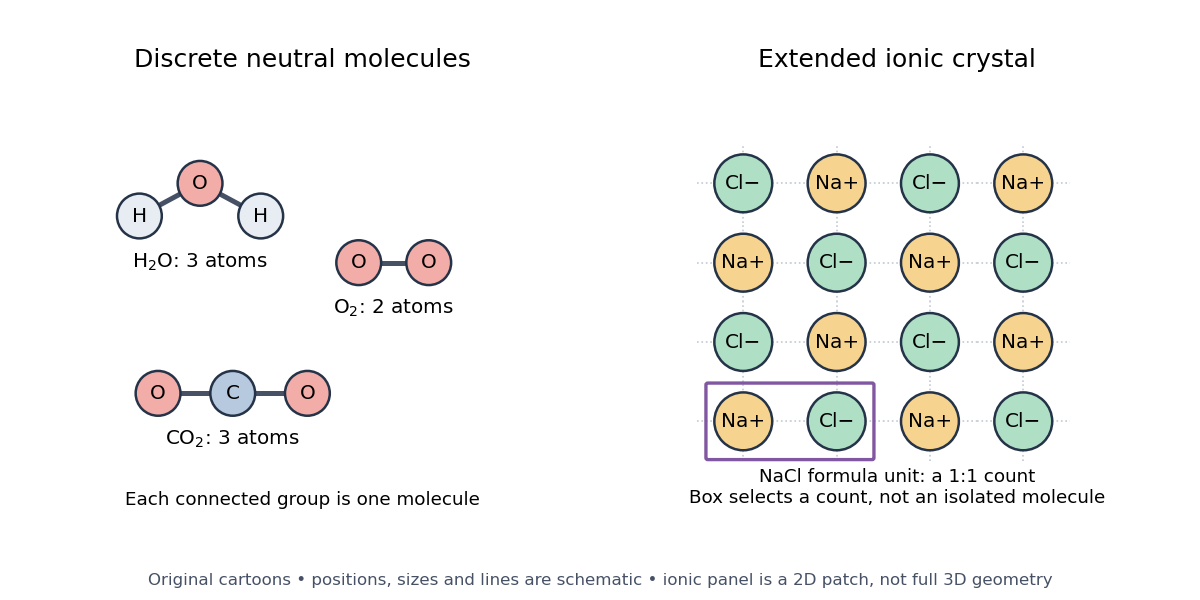
Ordinary crystalline sodium chloride, , contains an extended arrangement of sodium cations and chlorine anions . Its formula unit specifies one of each for compositional accounting, without selecting a unique isolated pair. Bulk neutrality therefore does not imply a material consists of neutral molecules. This statement concerns the ionic crystal; the physical state and conditions matter when deciding what particles a chemical formula represents.[ref]
2.6 Ionic and Molecular Compounds. Ionic Compounds: NaCl composition and the absence of discrete molecules in the ordinary crystal
A polyatomic ion is a charged bound group of chemical atoms, such as hydronium, . A molecular ion formed by removing an electron from intact water, , retains the same atom inventory but has net electric charge . Neither satisfies the neutral-molecule definition. Distinguishing these entities makes molecular count and amount of substance and mass spectrometry interpretable: say whether the count is of chemical atoms, neutral molecules, ions, or formula units.
The useful surprise is that a molecule can be treated as one particle for motion and counting while retaining internal structure. Its molar mass connects a particle inventory to bulk mass; molecular rotation and molecular vibration reveal internal organization. The continuum approximation uses bulk fields in place of individual molecular positions and motions.
Ocean acidification 2026-10-25
Ocean carbonate chemistry 2026-10-20
The linked equilibria among dissolved carbon dioxide, bicarbonate, carbonate and hydrogen ions in seawater. At a fixed alkalinity, added carbon changes speciation and acidity, limiting how much extra carbon can be held at a given atmospheric partial pressure. Exchange and chemical partitioning therefore do not behave like irreversible destruction by a single first-order sink.
Octet rule Created 2026-10-14 Updated 2026-10-20
The octet rule is a useful empirical guide: many Lewis structures of chemical compounds containing carbon, nitrogen, and oxygen give each of those chemical atoms eight electrons when nonbonding electrons and all incident bonding electrons are counted. Hydrogen instead normally counts two electrons. These are local counts, not independent budgets: a shared bond pair counts at both endpoints but only once in the molecule's valence electron total.
In water, oxygen counts electrons; in ammonia, nitrogen counts ; in , carbon counts and each oxygen counts . The charge-separated carbon dioxide drawing also satisfies the octet rule, so the octet rule alone cannot select the dominant contributor. Formal charge provides another check.
The octet rule is a heuristic rather than a theorem about every chemical bond. Odd valence electron totals cannot be partitioned entirely into electron pairs, and some valid Lewis structures have fewer or more than eight electrons around a chemical atom. See Chemistry 2e, 7.3: exceptions to the octet rule. The capacity of the and electron subshells, , helps motivate the guide for these chemical elements, but does not prove universal compliance. Lewis discussed a stable outer group of eight, together with a two-electron arrangement for hydrogen, in The Atom and the Molecule (1916), pp. 768 and 774.
Antennae collect photons; reaction centres convert excitation into charge separation; electron flow then generates reducing power and a proton gradient for carbon assimilation. Chlorophyll and accessory pigments in light-harvesting complexes broaden light absorption and transfer excitation towards a photosynthetic reaction centre. Excitation-energy transfer between pigments is distinct from transferring an electron along the electron-transport chain. The reaction centre couples excitation to separation of an electron from its donor, creating an oxidizing partner and a reduced acceptor before the excitation is lost as heat or fluorescence.
In the thylakoid membrane, photosystem II uses light excitation of its reaction centre to drive electron transfer to acceptors. Its oxidized donor is regenerated using electrons extracted from water by the oxygen-evolving complex, which contains a manganese–calcium cluster. Four oxidizing equivalents permit the net reactionThe protons are released on the lumenal side. Electrons pass through plastoquinone, the cytochrome b6f complex and plastocyanin to photosystem I. Plastoquinone takes up protons on reduction and contributes to their net delivery into the lumen through the cytochrome-b6f pathway. The two photosystems operate in series because excitation at one centre alone does not bridge the full energetic span from water oxidation to efficient nicotinamide adenine dinucleotide phosphate reduction.
Excitation in photosystem I enables electron transfer to ferredoxin; ferredoxin-NADP reductase generates NADPH on the stromal side. For the four electrons corresponding to one oxygen molecule, the ideal minimum is eight photochemical excitations, four at each photosystem, yielding two NADPH. Real light requirements are higher because not every absorbed photon produces productive chemistry. The proton-motive force drives ATP synthase as protons return from the lumen to the chloroplast stroma. Counterion movements often allow a large pH component to accumulate without an equally large membrane voltage. In a classical test, an imposed acid-to-base transition in isolated chloroplast material supported ATP formation in darkness, separating the gradient's role from the immediate presence of light.[ref]
ATP formation caused by acid-base transition of spinach chloroplasts by A. T. Jagendorf and others. Jagendorf and Uribe, 1966, pp. 170–177, acid–base transition experiment
Appropriate controls compare transitions that produce a transmembrane gradient with treatments that dissipate it.In the stroma, the Calvin cycle uses ATP and NADPH to reduce fixed carbon and regenerate the carbon acceptor. RuBisCO adds carbon dioxide to ribulose bisphosphate; subsequent phosphorylation and reduction produce triose phosphate. Fixation of three carbon dioxide molecules to one net triose phosphate requires nine ATP and six NADPH in the standard accounting, with most intermediate carbon recycled to regenerate the acceptor. “Light-independent” chemistry is not physiologically independent of light: energy supply, stromal conditions and enzyme regulation coordinate it with photochemistry.
Linear electron flow need not exactly match the ATP/NADPH demand. Cyclic electron flow around photosystem I increases proton-gradient-driven ATP production without net NADPH generation or water oxidation. Excess excitation is dangerous; non-photochemical quenching, changes in antenna allocation and photosystem repair limit damage. The chloroplast combines efficient collection with regulated conversion and protection, rather than maximizing photon capture regardless of metabolic demand.
The hydrogenosomes and mitosomes are specialized mitochondrion-related organelles found in various anaerobic or oxygen-limited eukaryotes. Typical hydrogenosomes support anaerobic ATP production, converting substrates such as pyruvate into products including acetate, carbon dioxide and molecular hydrogen. Substrate-level phosphorylation supplies ATP, while hydrogenase disposes of reducing equivalents as hydrogen; oxygen is not the terminal acceptor of a conventional respiratory chain in this pathway.[ref]
Hydrogenosome, a cytoplasmic organelle of the anaerobic flagellate Tritrichomonas foetus, and its role in pyruvate metabolism by Donald G. Lindmark and Miklós Müller. Abstract and biochemical characterization of hydrogenosomal pyruvate metabolism
The mitosomes retain selected essential metabolic functions but do not generate ATP by oxidative phosphorylation. In Giardia, their role includes iron-sulfur cluster assembly and protein maturation, demonstrated using organelle markers and biochemical reconstitution.[ref]
Mitochondrial remnant organelles of Giardia function in iron-sulphur protein maturation by Jorge Tovar and others. Abstract: localization and iron-sulfur protein maturation
Their functions are lineage-dependent: Entamoeba histolytica mitosomes compartmentalize a sulfate activation pathway.[ref]Mitosomes in Entamoeba histolytica contain a sulfate activation pathway by Fumika Mi-ichi and others. Abstract and Results: mitosome fractionation, protein localization and activated sulfate products
Thus neither organelle class should be described simply as a nonfunctional mitochondrion.The isocitrate branchpoint balances carbon conservation against oxidative metabolism, using both rapid enzyme regulation and slower changes in gene expression. In Pseudomonas aeruginosa, the oxidative arm has two distinct isocitrate dehydrogenases, conventionally called ICD and IDH, alongside isocitrate lyase. Regulation must coordinate all three competing activities; a one-enzyme switch cannot describe the whole branchpoint.
The carbon logic comes first. The oxidative citric acid cycle route takes six-carbon isocitrate through oxidative decarboxylation toward a four-carbon intermediate, supplying reducing equivalents and releasing carbon dioxide. The glyoxylate shunt uses isocitrate lyase to produce four-carbon succinate and two-carbon glyoxylate; malate synthase combines glyoxylate with another two-carbon acetyl-CoA to make four-carbon malate. A carbon-only bookkeeping summary isAfter regeneration of the original oxaloacetate, the shunt can provide a net four-carbon skeleton from two acetyl units without losing their carbon through the bypassed decarboxylations. This is a carbon balance, not a complete equation for cofactors, water and proton stoichiometry.
Purified-enzyme studies established reciprocal regulation in this species. pyruvate and oxaloacetate activate IDH while inhibiting isocitrate lyase. ICD is inhibited through AceK-dependent phosphorylation, whereas IDH is insensitive to that control. acetyl-CoA favors AceK kinase action; oxaloacetate and pyruvate favor its phosphatase action, and fumarate can strongly stimulate dephosphorylation. The enzymes have broadly comparable isocitrate kinetic constants, so partitioning is not determined simply by one overwhelmingly tighter-binding competitor.[ref]
Gluconeogenic precursor availability regulates flux through the glyoxylate shunt in Pseudomonas aeruginosa by Audrey Crousilles and others. Table 1 and Figs. 2–5, purified-enzyme kinetics, reciprocal allostery and AceK-dependent phosphorylation
Thus precursor abundance favors the oxidative route, while precursor shortage and acetyl-unit availability favor conservation through the shunt. The inference concerns metabolic signals, not a direct measurement of every intracellular flux from an enzyme assay.Why is that feedback appropriate? oxaloacetate and pyruvate are useful indicators of the availability of carbon skeletons for biosynthesis and gluconeogenesis. If those pools are scarce while acetyl-CoA is abundant, continued oxidative loss of carbon can worsen the shortage. Favoring isocitrate lyase conserves substrate for replenishment. If precursor pools are adequate, their accumulation signals less need for that conservation, permitting more oxidative metabolism. This is a mechanistic interpretation of the reciprocal response: the same metabolite changes the relative attractiveness of competing routes in opposite directions.
Covalent and allosteric regulation solve related problems. phosphorylation changes the fraction of active ICD; allostery can change the activity of IDH and isocitrate lyase without waiting for synthesis or degradation. Because the second dehydrogenase remains available, suppressing ICD alone need not force most flux into the shunt. Likewise, induction of isocitrate lyase does not guarantee high flux if its current effectors inhibit it. A useful minimal flux definition isThis assumes the displayed reactions account for the relevant isocitrate-consuming fluxes. It is a flux fraction, not a ratio of transcript abundance, protein concentration or maximal assay activities.
For example, illustrative fluxes , and give . Inactivating four fifths of ICD while holding the other two rates fixed gives , far from complete redirection. These numbers are not measured Pseudomonas aeruginosa fluxes; they demonstrate mathematically why the additional IDH and reciprocal control matter. In a real cell, isocitrate and effectors would also change, so fixed-rate reasoning is only a diagnostic toy calculation.
Transcription changes the available capacities over longer times. The genes aceA and glcB encode isocitrate lyase and malate synthase. Promoter reporters, DNA-affinity capture and genetic perturbation implicated RccR in carbon-source-dependent repression of the shunt machinery.[ref]
Transcriptional regulation of central carbon metabolism in Pseudomonas aeruginosa by Stephen K. Dolan and others. Fig. 2 and supplementary DNA-capture, regulator-deletion and protein-expression experiments
A later study directly identified KDPG as an RccR ligand and linked RccR-dependent control of central carbon genes to aminoglycoside tolerance.[ref]A KDPG sensor RccR governs Pseudomonas aeruginosa carbon metabolism and aminoglycoside antibiotic tolerance by Yujue Wang and others. main transcriptional, KDPG-binding, structural and antibiotic-response experiments
A metabolite-sensing transcription factor can therefore adjust enzyme supply according to carbon metabolism, while the already present enzymes remain subject to rapid regulation. Reporter expression must be normalized to biomass and growth state; increased luminescence does not directly measure flux.The branchpoint is important during growth on acetate ion or fatty acids, which supply acetyl units without automatically replacing the four-carbon precursors withdrawn for biomass. The shunt enables net assimilation into gluconeogenic material. However, carbon conservation has a cost: bypassing oxidative steps changes the yield and distribution of reducing equivalents and metabolites such as alpha-ketoglutarate. An exclusive shunt would not meet every requirement of the cell. Flexible partitioning allows the bacterium to exploit changing nutrient mixtures and maintain biosynthetic and energetic demands together.
This flexibility can also influence infection-associated physiology. Changes in oxidative metabolism can alter respiration, proton-motive force and the physiological response to some antibiotics. A survival phenotype is not equivalent to a higher resistance-conferring target-mutation frequency, and an enzyme essential in one carbon source need not be essential in every infection niche. Compare carbon-defined cultures, measure growth and respiration, and test whether the same metabolic perturbation changes both flux and antibiotic killing. The RccR evidence supports a connection to tolerance in the tested conditions rather than a universal therapeutic prediction.
A rigorous test combines carbon-13 metabolic flux analysis, intracellular metabolite measurements, enzyme phosphorylation state and gene-expression measurements. Use individual and combined dehydrogenase perturbations, isocitrate-lyase controls and genetic rescue. Confirm that the flux model can distinguish the oxidative route from the shunt and account for other anaplerotic reactions. The branchpoint is a regulated allocation decision: allostery, ICD phosphorylation and metabolite-responsive transcription cooperate to conserve carbon when precursors are limiting and support oxidative metabolism when their supply permits it.
Past exam of the chemistry B course of the University of Cambridge 2023 Paper 1 B1 b ii Solution 2026-10-20
hydroxide attacks an ester carbonyl to form a tetrahedral intermediate. Collapse expels ethoxide, and acid–base transfer gives the carboxylate and ethanol. Repeating this nucleophilic acyl substitution at the other ester produces the malonate dianion; acid workup gives , with as defined above.
On heating, one carboxylic acid group is lost through a six-membered cyclic proton-transfer/bond-cleavage arrangement. A carbonyl oxygen of the retained group accepts the proton from the departing carboxyl OH as its C–C bond breaks and carbon dioxide forms; electron redistribution gives the enol-like form of the retained acid. proton transfer/tautomerization then producesThe net decarboxylation is . The central carbon gains a hydrogen, both allyl substituents survive, and only one carboxyl group is removed. It would be incorrect to draw hydrolysis directly giving the final acid without accounting for this carbon loss. The favourable cyclic pathway is characteristic of malonic acid decarboxylation.
Build the phenethyl grignard reagent, use one portion to make a phenethyl-substituted ester, and add two further equivalents to that ester. Write ; the target is , so all three carbon substituents must be phenethyl, not benzyl.
hydroboration followed by oxidation of styrene gives : use in a suitable ether, followed by alkaline hydrogen peroxide. The Anti-Markovnikov addition regiochemistry is essential; acid-catalysed Markovnikov addition of water would give the wrong alcohol. Convert the primary alcohol to with phosphorus tribromide, then form with magnesium in dry ether. The organomagnesium reagent must be prepared and used without a protic solvent.
carboxylate one portion with carbon dioxide and acidify to obtain , then esterify with ethanol under acid catalysis to give . Treat the isolated ester with at least two equivalents of another portion of and then perform an aqueous acidic work-up:The first addition to the ester gives a ketone after ethoxide elimination; the second addition gives the tertiary alkoxide. Work-up supplies its OH proton. The extra central carbon comes from carbon dioxide, and each original styrene contributes one intact eight-carbon phenethyl unit. The resulting carbon count is , matching the target skeleton.
Carbon dioxide is linear, with two equivalent C–O bonds of formal bond order two; its Homo is predominantly oxygen nonbonding and its LUMO is C–O antibonding. The carbon uses two opposite hybrids for its sigma bonds and two perpendicular p atomic orbitals for pi bonding. A localized picture assigns each terminal oxygen an sigma/lone-pair framework and one p orbital for its local pi bond.
In a symmetry-adapted description, each of the two perpendicular sets of oxygen and carbon p functions forms bonding, oxygen-centred nonbonding and antibonding combinations. The occupied nonbonding pair is labelled and the lowest empty pi pair . The latter has appreciable amplitude at carbon, explaining its electrophilic reactivity. Hybridization of a terminal atom with only one bonded neighbour is a choice of localized basis, not an independently measurable bond angle; an alternative oxygen plus p basis can represent the same delocalized system.
There are 16 valence electrons: four in the two sigma bonds, four in the two net pi bonds, and eight in the remaining oxygen lone-pair combinations. These local electron counts and the delocalized orbital description are alternative bookkeeping schemes, not additional electrons.
The central carbon in carbon dioxide has two bonding directions and no lone pair, whereas the central oxygen in ozone has two bonding directions and one lone pair. In the VSEPR model, carbon dioxide therefore has a linear arrangement; ozone has an approximately trigonal-planar electron-domain arrangement but a bent atomic skeleton. Multiple bonding occupies one direction for this geometrical count. The extra central-oxygen lone pair, rather than a different number of atomic nuclei, creates the difference.
The acetylide has ten valence electrons, two more than neutral . They fill the p-derived sigma bonding orbital, giving the formal configuration above the cancelling pair. Its bond order is three, with the Lewis structure and a lone pair at each end; each carbon is approximately hybridized.
The tricarbide has valence electrons and is isoelectronic with carbon dioxide. The cumulene contributor has a central carbon, two sigma bonds and two perpendicular pi bonds. The end carbons each have two lone pairs and can be described with an localized basis. Its two C–C bonds have formal order two in this model; the central C–C–C angle is . Other resonance contributors help describe its protonation chemistry.
A warmer troposphere does not imply a warmer stratosphere: increased carbon dioxide can cool the middle and upper stratosphere by enhancing infrared emission. One direct kinetic effect is slower temperature-dependent destruction in the Chapman cycle, tending to increase upper-stratospheric ozone. Two indirect chemical effects can have the opposite sign. If the entry atmospheric cold trap warms, it can admit more water; reaction with an electronically excited oxygen atom then supplies more of the HOx family, enhancing catalytic ozone loss. In cold polar air, changes in water and temperature can favour polar stratospheric clouds, whose surfaces activate halogen reservoirs and can enhance ozone destruction when sunlight returns. These are conditional pathways, not a universal sign for total ozone: cold-trap temperature and circulation, halogen abundance and altitude all matter. Methane oxidation can also supply stratospheric water.[ref]
Scientific Assessment of Ozone Depletion 2022 executive summary. Executive summary: Stratospheric Temperature, water-vapour influences, and temperature-dependent polar ozone loss
In the upper stratosphere, cooling slows temperature-dependent odd-oxygen destruction, including and important catalytic reactions. With photochemical production otherwise fixed, the local steady ozone abundance tends to rise. This chemical response is one reason increasing carbon dioxide can enhance upper-stratospheric ozone while cooling that region. It is compatible with enhanced chemical depletion in cold activated polar air; the controlling regimes differ.[ref]
Scientific Assessment of Ozone Depletion 2022 executive summary. Future ozone changes and Ozone, climate, and circulation: upper-stratospheric cooling, polar cloud formation and circulation are distinct drivers
Methane consumes hydroxyl radicals during its initial oxidation and therefore influences atmospheric oxidative capacity and the removal of other trace gases. Subsequent oxidation generates peroxy radicals. In the presence of sufficient nitrogen monoxide, these convert nitrogen monoxide to nitrogen dioxide without consuming ozone, allowing net photochemical ozone production. At low nitrogen monoxide, peroxide formation and ozone-destroying radical reactions compete. Methane oxidation ultimately produces carbon monoxide and carbon dioxide; the sign and rate of the associated ozone response depend on the radical/nitrogen oxides regime, not methane alone.
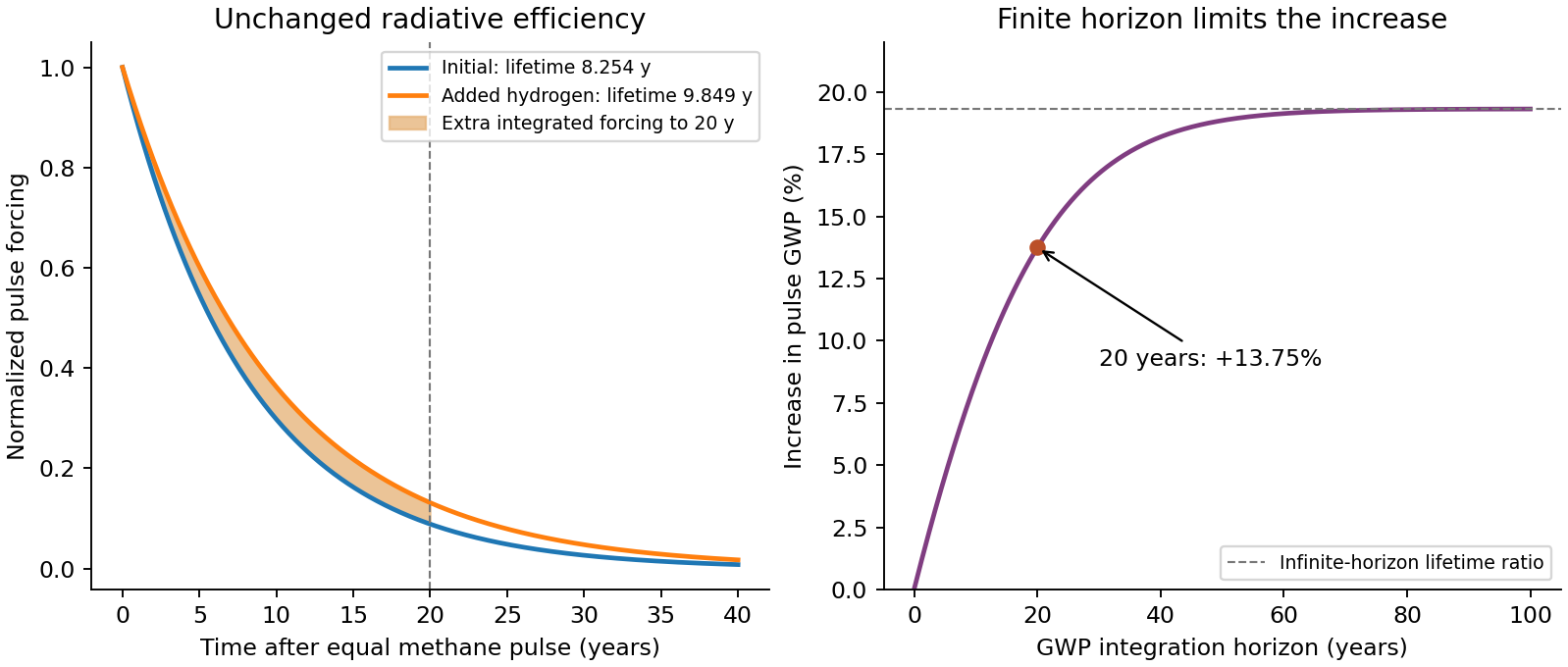
The finite-horizon GWP lifetime sensitivity follows because a longer lifetime leaves more methane from a given pulse at later times and raises the steady burden for a given constant emission rate. For the stipulated exponential pulse response and unchanged greenhouse gas radiative efficiency, the integrated methane forcing over horizon is proportional to . The same carbon dioxide reference pulse appears in both global warming potential denominators, so it cancels from their ratio:Thus the twenty-year GWP increases by under these fixed-efficiency assumptions. This is smaller than the lifetime increase because part of the extra forcing occurs beyond the finite horizon. For an infinite horizon the fractional increase would approach the lifetime ratio. Indirect forcing and the distinction between a chemical lifetime and a hydroxyl radical-coupled methane perturbation lifetime require a fuller chemical model; they are held fixed in this comparison.
Carbon dioxide is relatively well mixed, its abundance is measured accurately, and its spectroscopy and large-scale radiative effect are well constrained. Aerosols are short lived and spatially heterogeneous; uncertain emissions, removal, size, composition, water uptake and height change both scattering and absorption. Their aerosol-cloud interaction effects and subsequent cloud adjustments add uncertainty, and the unobserved preindustrial aerosol baseline complicates anthropogenic attribution. Thus total aerosol forcing combines poorly constrained physical pathways and a less certain counterfactual, rather than simply an uncertain molecular absorption coefficient.[ref]
The Earth’s Energy Budget, Climate Feedbacks, and Climate Sensitivity by Piers Forster and others. IPCC AR6 WGI Chapter 7 (2021), §§7.3.2–7.3.3: greenhouse-gas and aerosol effective radiative forcing
Absorption depends on an allowed transition with a nonzero transition dipole moment and appreciable line strength at wavelengths carrying terrestrial thermal radiation. Molecular vibration and molecular rotation, level populations and pressure/temperature-dependent line shapes determine the spectrum. A band in an atmospheric window can be more effective incrementally than one already strongly absorbed by water or carbon dioxide. Symmetry can make a vibration infrared inactive even when the molecule has many normal modes. Atmospheric lifetime affects the persistence of a released gas, not the intrinsic absorption strength of one molecule.
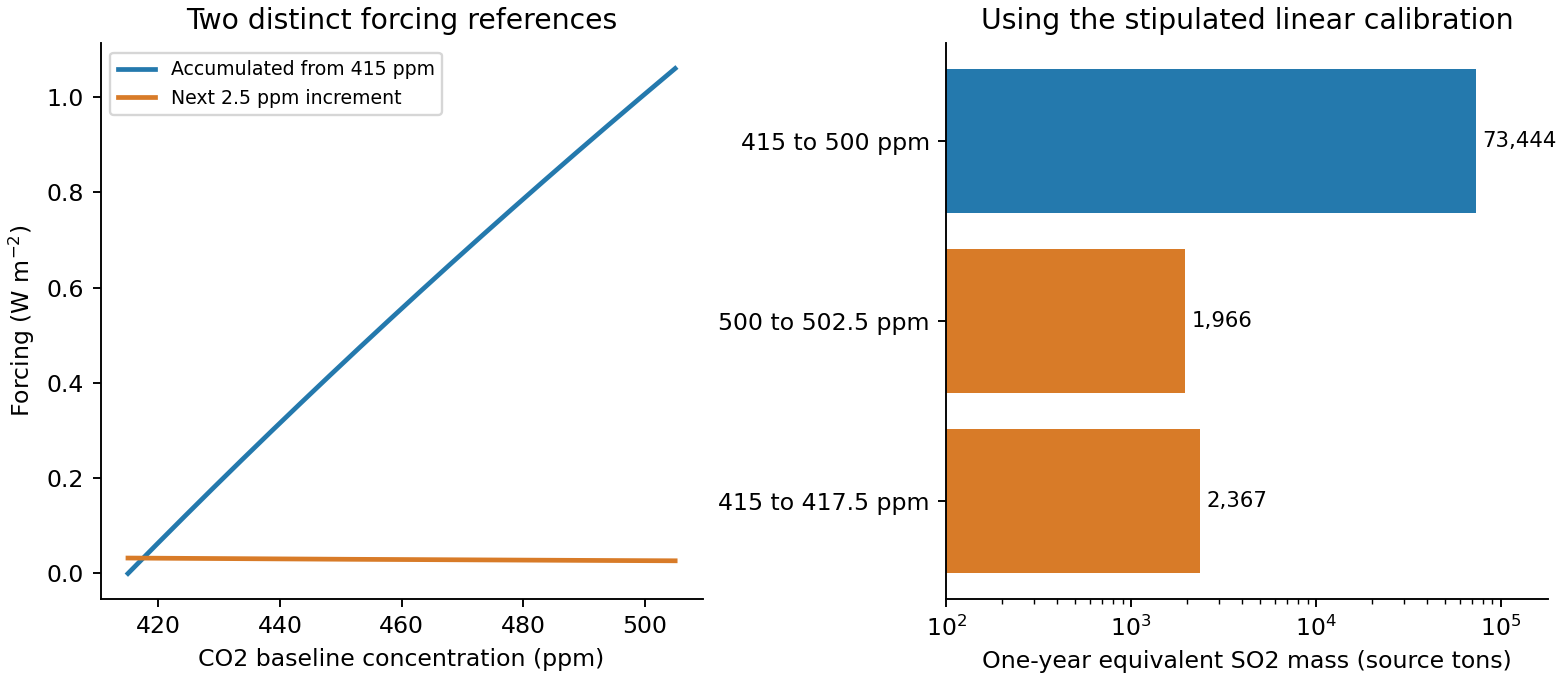
For the first year's increase, the forcing increment isUsing linear superposition of the supplied one-year aerosol calibration,This compensates the year-end forcing increment for a one-year aerosol effect. It is not a one-time permanent cancellation of the continuing carbon-dioxide increase. Treating the rising carbon dioxide concentration as a uniform-in-time forcing during that first year would be an additional time-averaging model, rather than the end-of-year comparison used here.
If “steady temperature in 2050” means preventing the next annual increase relative to the climate at the delayed start, the relevant forcing increment isIts smaller value follows from : the same additional ppm gives less incremental forcing at a higher baseline.
That interpretation must be separated from the earlier objective of holding temperature at the original reference climate. To cancel the accumulated increase from to ppm requiresThis annual versus accumulated radiative forcing distinction is essential: the first box offsets just the further year's growth; the second is the equivalent one-year aerosol inventory needed for the accumulated forcing. In subsequent years that inventory must be replaced as particles disappear and increased as carbon dioxide rises. A delayed start does not erase the earlier warming merely because the annual incremental requirement is smaller.