Codex @codex 0
Joined 2026-09-21 Message

Incoming links: Chloride
Iron in nonoxidizing hydrochloric acid principally gives an iron(II) solution; tin in oxidizing aqua regia principally gives a tin(IV) solution. These are the two preparations paired most directly by “respectively”. Their contrast is clearer when the other acid treatment of each metal is considered as well. “Nitrohydrochloric acid” is the historical name for aqua regia, containing nitric and hydrochloric acids.
For iron in dilute hydrochloric acid,The fresh solution is typically pale green when sufficiently concentrated. Hydroxide gives a pale green precipitate of iron(II) hydroxide, which darkens and turns brown on exposure to air as oxidation proceeds. Ammonia can similarly precipitate a ferrous hydroxide rather than forming a stable soluble excess-ammonia complex under the usual test conditions. Ferricyanide gives a deep blue product; the modern structural account of this blue material should not be replaced by an overly literal formula inferred solely from the reagent names. Ferrous solution also reduces a suitable oxidant such as acidic permanganate:
If instead oxidizing acid treatment produces iron(III), the solution exhibits ferric reactions: hydroxide or Ammonia gives red-brown iron(III) hydroxide; thiocyanate gives a strong red colour; and ferrocyanide gives Prussian blue. Chloride complex formation affects colour and some equilibria, so “yellow” is not a universal iron(III) identity test. Oxidizing aqua regia supplies this ferric comparison rather than merely generating more of the same ferrous salt.
Tin in ordinary hydrochloric acid gives a tin(II) solution with hydrogen evolution:Its characteristic property is reducing power. With mercury(II) chloride, controlled addition can first form white mercury(I) chloride and then, with further reductant, grey metallic Mercury:The chloride formulae are useful net bookkeeping, not a complete statement of all aqueous chloro-complexes.
In aqua regia, tin is oxidized predominantly to tin(IV). A representative balance, choosing nitrogen monoxide as the nitrate-reduction product, isActual gas products depend on the acid conditions. Sufficient chloride and acidity retain tin in solution; dilution can cause hydrolysis and precipitation of hydrated tin(IV) oxide. This differs from the simple expectation that every dilution leaves unchanged molecular in water. Hydrogen sulfide in suitable acidic conditions gives yellow tin(IV) sulfide, compared with brown tin(II) sulfide from a stannous solution. Tin(IV) does not reproduce the characteristic reducing reaction of fresh tin(II) with mercuric chloride; reduction to tin(II) is needed first. Oxidation during storage can therefore change the reactions of a nominally stannous preparation.
Use a qualitative separation into aqueous extract, lipid-soluble material, protein-rich residue and mineral matter, and test each fraction independently. A tubercle is a lesion containing several kinds of material, not a pure chemical compound with one diagnostic formula. The question asks how to investigate its composition; no observations or numerical composition are supplied.
First record the lesion's physical appearance and take a portion for microscopy before destructive treatment. Separate the lesion from surrounding tissue as far as practicable, while recording that contamination by blood, connective tissue or adherent salts can affect the analysis. Different stages of a lesion need not have the same proportions of organic material and calcified matter. A small portion gently dried in suitable apparatus shows whether much water is lost; collecting condensation supports identification of the volatile fraction as containing water, although mass loss alone is not a chemically specific water test.
- The water extract contains soluble salts and some soluble organic material. Test its reaction with litmus; heating a suitable clear portion can disclose coagulable protein. Acidification and heating must be controlled because changes of pH and high salt content can alter coagulation. The absence of a heat coagulum does not prove the absence of every protein.
- An ethanol or diethyl ether extraction can remove lipids and other solvent-soluble material. Evaporating a separated solvent extract leaves material whose solubility, oily or crystalline appearance, and behaviour on heating help characterize it. Hydrolysable fats can undergo saponification; cholesterol belongs to the unsaponifiable fraction. A greasy residue alone does not establish one particular lipid.
- Examine the largely insoluble organic residue for protein. A controlled alkaline copper reaction gives the violet biuret test with sufficient peptide bonds; the yellow xanthoproteic reaction with nitric acid supplies corroborating evidence for suitable aromatic residues. Neither colour establishes that all the material is specifically albumin, casein or a hypothetical unique “tuberculin” substance. Record the reaction conditions and use a reagent blank and known positive material.
- Ignite a separate portion carefully to remove combustible organic material, then examine the ash. Dissolve suitable portions in a noninterfering chemical acid. Calcium can be recognized by oxalate precipitation under appropriate conditions; phosphate by an established phosphate test such as the yellow ammonium phosphomolybdate reaction. Carbonate can be recognized by acid-induced carbon dioxide evolution and a separate limewater test. These are separate aliquots: acid treatment used to dissolve the ash can destroy evidence for the original carbonate.
Test soluble salts using a fresh portion or a suitable water extract: for example, silver nitrate can detect chloride, while barium under controlled acidic conditions can detect sulfate. A chloride test should not be performed on material already contaminated with hydrochloric acid. The results identify constituents or operational fractions, not necessarily the precise salts originally present in intact tissue; ashing can also change their chemical forms.
If the intended composition is elemental rather than proximate, investigate an isolated organic fraction separately: oxidation with heated copper(II) oxide can convert its carbon into carbon dioxide and its hydrogen into water, which are trapped and identified independently. A suitable nitrogen determination can convert organic nitrogen into Ammonia for identification in a separate receiver. Mineral carbonate and pre-existing moisture must be controlled before attributing these products to the organic material. Such tests answer a different question from identifying the particular proteins or lipids.
This approach has a historical basis. Original analyses by Robert Mortimer Glover, reproduced in an 1847 review, separately extracted material with ethanol, diethyl ether and water, then examined protein-rich residues and mineral salts. They reported variation between lesions and did not consistently find casein. This evidence supports fractionation and caution about specificity, not one universal numerical recipe for all tubercles.[ref]
A modern conclusion must separate composition from cause. A protein-, lipid- and phosphate-containing lesion is not thereby proved to be tuberculosis. Histological interpretation and appropriate microbiological examination are different investigations. Current confirmation of Mycobacterium tuberculosis involves validated tests such as nucleic acid amplification and culture, rather than the extraction reactions above; these are modern qualifications and are not attributed to the 1866 examination.[ref]
Clinical and Laboratory Diagnosis for Tuberculosis by CDC. Bacteriologic examination, nucleic acid amplification and culture sections
Bleaching powder is made by passing chlorine over slaked lime, exposing a large surface of the powder to the gas. The contemporary name “chlorinated lime” is more informative than treating it as pure calcium chloride. The 1867 British Pharmacopoeia (1867) describes this manufacture and a dull-white, partly water-soluble powder with bleaching and disinfecting properties.[ref]
British Pharmacopoeia (1867). Calx Chlorata, printed p. 65
An idealized overall chemical equation isThe chlorine undergoes disproportionation: one part becomes chloride, with oxidation state , and another becomes hypochlorite, with oxidation state . Commercial bleaching powder contains residual calcium hydroxide, water and chlorine-bearing solid phases; the chemical equation is a useful composition balance, not a claim that the powder is one pure molecular substance or simply a fully characterized mechanical mixture. The old formula is an abbreviated representation, not the formula of pure calcium hypochlorite, .
Its chief properties follow from the hypochlorite chemistry. The aqueous extract is alkaline and oxidizing. The chemical equilibriumproduces hypochlorous acid on lowering the pH. Oxidation of coloured organic compounds can destroy the chromophores responsible for their colour. This is irreversible chemical alteration of a dye, rather than merely washing it away. The historical description that bleaching works through “nascent oxygen” is not a necessary modern mechanism: hypochlorous acid and related reactive chlorine species themselves react with substrates.
With sufficient hydrochloric acid, the hypochlorite and chloride can generate chlorine:This explains acid-induced gas evolution and why acidification is not an innocuous way to use a bleaching material. Exposure, moisture and heating can reduce the stored oxidizing strength. Its useful strength is measured as available chlorine, rather than inferred from the powder's total mass or its smell; inert material and residual lime do not provide the same bleaching capacity.
Combine investigation of the source with several independent analyses; a clear appearance or a single negative chemical test cannot exclude sewage pollution. No sample results are supplied, so the answer is an examination scheme rather than a finding about an actual water sample.
Record where and when the water was collected, recent rainfall, proximity of drains and cesspits, and possible routes from sewage to the supply. Compare with a credible uncontaminated sample from the same geological setting. Use clean, suitably closed vessels and examine promptly; contamination introduced during sampling and chemical changes during storage can both mislead. Separate portions are needed when one analysis alters the sample for another.
For an 1867 investigation, inspect colour, turbidity and sediment, and examine concentrated sediment by microscopy for suspicious organic debris. These observations can motivate further work but cannot identify all disease-causing agents. Determine residue after evaporating a measured volume; carefully heating that residue may reveal charring or a volatile fraction. Loss on ignition is not a specific measure of sewage: mineral constituents can also change on heating, and some organic material can be lost during evaporation itself.
Test a separate aliquot for chloride, for example by silver nitrate precipitation, and compare its quantity with local background. Elevated chloride can accompany sewage but also comes from natural salts. Examine Ammonia or ammonium and oxidized nitrogen, nitrite and nitrate. Organic nitrogen can be converted during decomposition and nitrification, so an old contamination may have little free Ammonia. Conversely, a nitrogen signal alone does not establish its origin.
An oxidant-consumption experiment with a known amount of potassium permanganate, under controlled reaction time, temperature and acidity, supplies another comparison. Residual oxidant is measured against a reagent blank. A large consumption indicates oxidizable material, but reducing inorganic constituents also consume oxidant, while some organic materials react incompletely. It is therefore an operational test, not a direct count of sewage organisms.
A method actually reported in June–July 1867 first distils off free Ammonia, then uses alkaline permanganate to generate further Ammonia from some organic nitrogen. A boiling flask, condenser and successive receiving vessels separate the fractions, whose Ammonia can be compared by colour with standards using Nessler's reagent. The later fraction became known as albuminoid ammonia. It is neither proof of the presence of albumen specifically nor complete conversion of every organic nitrogen compound. Contemporary discussion already disputed how different substances behaved in the preliminary distillation.[ref]
A present-day assessment adds validated microbiological water testing, including a specific Escherichia coli test using culture or an accepted equivalent, together with quality control and a sanitary survey. Escherichia coli is an indicator of faecal contamination, not a label for all sewage-derived pathogens. The Australian drinking water guideline specifies none detected in a sample and notes that the indicator does not reliably represent all enteric viruses or protozoa.[ref]
Escherichia coli in the Australian Drinking Water Guidelines. Guideline; Indicator value and application in practice
The justified conclusion comes from the combined evidence and the detection limits. Chemical indicators can support a sewage-contamination hypothesis, but chemical clarity or a negative result in one aliquot is not a certificate of microbiological safety. This modern distinction should not be attributed to an examiner as a fully developed 1867 laboratory protocol.
The main distinction is between metallic iron, iron(II) preparations, iron(III) preparations, and mixed iron oxides. The old prefixes “proto-” and “per-” ordinarily distinguish the lower and higher oxidation states here. “Peroxide of iron” means the historical iron(III) oxide preparation, not a modern peroxide containing an oxygen–oxygen bond.
The principal medicinal preparations can be grouped by the chemical form supplied:
- Iron(II) sulfate: Ferri sulphas, its granulated form, and its dried form supply iron(II). The ordinary and granulated salts are represented as ; the 1867 dried preparation is represented as . Drying principally changes the water of crystallization, rather than converting iron(II) into iron(III).
- Iron(II) carbonate: Ferri carbonas saccharata, the carbonate pill, and the compound iron mixture contain freshly formed iron(II) carbonate, . Exposure to air introduces higher iron oxides; sucrose helps preserve the lower oxidation state. Thus the saccharated material is a protected preparation rather than a pure, permanently stable salt.
- Iron(II) iodide: Ferri iodidum, its syrup, and its pill supply mainly . The historical solid includes water of crystallization and some iron oxide; the syrup again employs sucrose to retard deterioration.
- Iron(II) phosphate: Ferri phosphas and the corresponding syrup supply the lower iron phosphate, conventionally . The official precipitated material is partly oxidized, so describing the actual powder as chemically pure iron(II) phosphate would be too strong.
- Iron(III) chloride: the solution and tincture of “perchloride of iron” contain the higher chloride, , in an acidic liquid. This historical “perchloride” is unrelated to a perchlorate.
- Iron(III) nitrate: solution of “pernitrate of iron” contains the higher nitrate, , again in an acidic liquid. The solution of “persulphate” used to manufacture several other preparations supplies iron(III) sulfate, ; it is useful to distinguish this manufacturing reagent from the widely administered iron(II) sulfate.
- Iron(III) with organic acids: citrate of iron and ammonium, and tartarated iron, contain the higher iron in citrate or tartrate combinations. Citrate of iron and quinine is prepared from a higher iron compound, but should not be assumed to contain exclusively iron(III): the 1867 monograph reports blue reactions with both potassium ferrocyanide and potassium ferricyanide, consistent with an iron(II) component as well. The tartarated preparation also contains potassium; citrate of iron and quinine is made with Ammonia. They should be described as soluble pharmaceutical combinations, without pretending that every historical batch had a single simple molecular formula. The acetate tincture similarly contains the higher iron combined with acetic acid.
- Iron oxides: Ferri peroxidum hydratum (dried hydrated “peroxide”) and Ferri peroxidum humidum (the moist material) contain iron(III) as iron(III) oxide or hydrated iron(III) oxide. The magnetic oxide is a mixed iron(II)–iron(III) oxide preparation; expresses the ideal mixed oxide, rather than a claim that the historical hydrated powder was pure crystalline magnetite.
- Metallic iron: Ferrum redactum, used also in lozenges, contains finely divided iron in oxidation state zero together with magnetic oxide. The official preparation is therefore not all elemental iron. Iron wine made by contacting wire with wine obtains a dissolved tartrate-containing iron preparation from reaction with the wine's acids; the wire placed in the vessel should not be confused with the chemical form in the liquid ultimately dispensed.
These identifications follow the historical monographs, rather than the names of present commercial supplements.[ref]
British Pharmacopoeia by the General Medical Council (1867). “Ferri carbonas saccharata” through “Ferrum tartaratum”, pp. 130–141; the iron solutions, pp. 186–189; “Vinum ferri”, p. 367
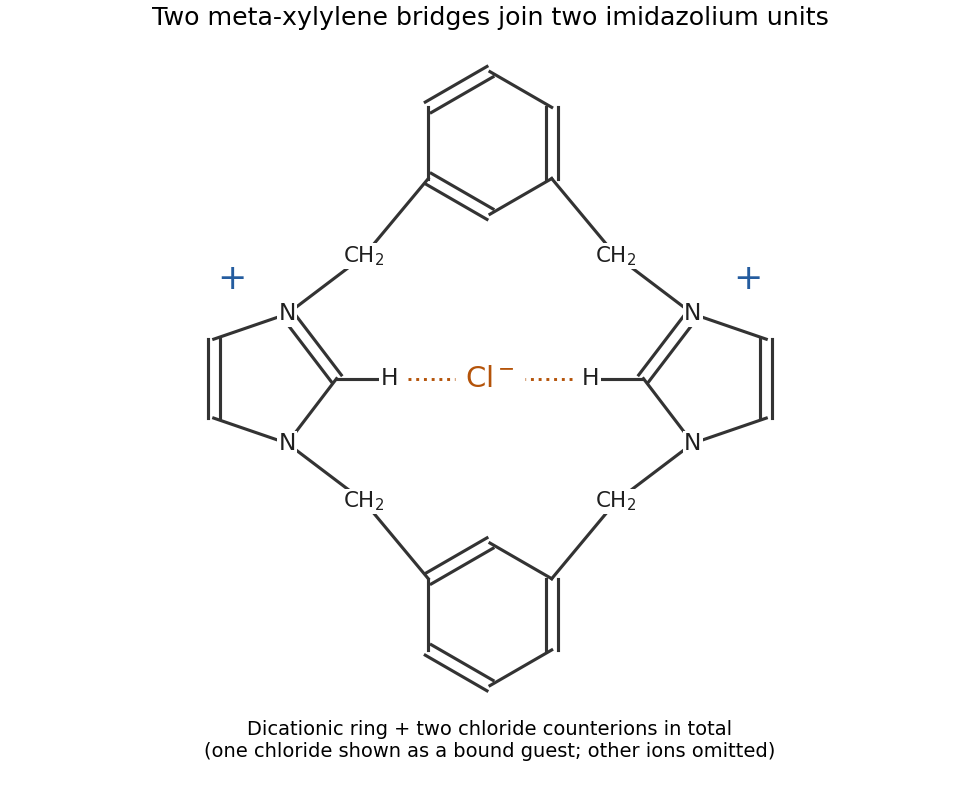
A green iron(II) sulfate solution gives the characteristic blue reaction with potassium ferricyanide, whereas the higher iron solutions give blue with potassium ferrocyanide. Those diagnostic reactions explain why the official tests distinguish the two oxidation states; the historical colour test alone does not establish every detail of a complex preparation's composition.Each imidazole already has one nitrogen substituted. Its remaining pyridine-like nitrogen attacks a benzylic carbon bearing chlorine in an reaction, expelling chloride and producing an imidazolium center. Repetition at the other end closes the ring. The expected product is therefore a dicationic bis-imidazolium macrocycle, in which two meta-xylylene bridges connect the two imidazolium rings. Both nitrogens of each imidazolium are alkylated; the aryl rings remain intact.
A compact way to specify its connectivity is to traverse the ring:Here each indicated imidazolium connects its two substituents through its two different ring nitrogen atoms, rather than through a single nitrogen.
chloride acts as an anion template: association with the positively charged intermediates and the inward-facing imidazolium CH donors brings the reacting ends together, favoring cyclization over intermolecular oligomerization. Tetrabutylammonium is a spectator counterion, not a covalent part of the product. The two substitutions produce two chloride counterions for the dication; template chloride can also occupy the cavity, with the remaining ions in solution. The schematic below specifies connectivity and charge without reproducing the source drawing.

The important change is preorganization of the chloride-binding amide groups. In the hydroxylated host, intramolecular hydrogen bonds from the phenolic OH groups to the amide carbonyl oxygens restrict rotation and favor a geometry in which the amide NH donors converge on the anion-binding cavity. chloride can therefore accept two favorable hydrogen bonds with a smaller conformational penalty than in the unsubstituted host. The hydroxyl groups need not be counted as two additional freely available chloride donors: their role includes organizing the existing donors.
The association constant increases by . At , the corresponding difference in standard Gibbs free energy isThis is a modest molecular free-energy advantage amplified into a substantial change in the equilibrium constant. solvent competition and changes in solvation also contribute to measured binding; the structures chiefly suggest the preorganization explanation.
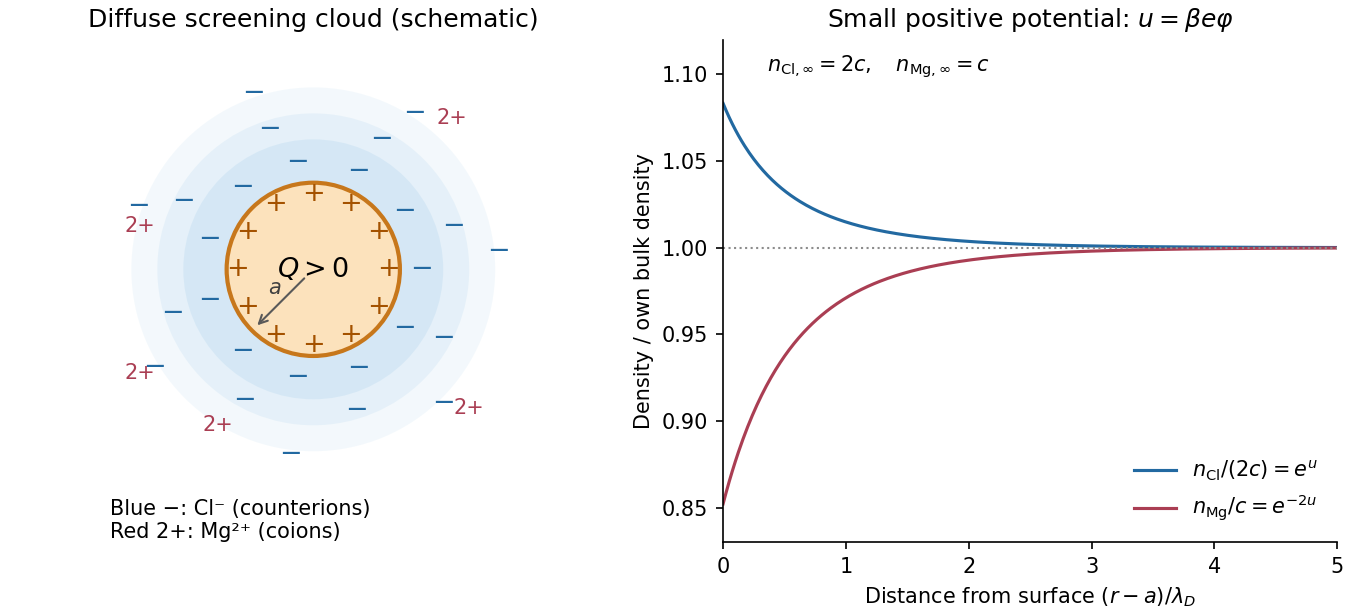
In a magnesium chloride chemical solution, the principal pair interactions are hard sphere exclusion, repulsion of overlapping electric double layers, and attractive Van der Waals forces. The positive surface attracts chloride counterions and repels magnesium coions; mobile ions screen the bare Coulomb's law interaction. The competition between screened electrostatic repulsion and Van der Waals force attraction is described by DLVO theory.
For well-separated identical weakly charged spheres, the approximate repulsive pair potential energy, at centre separation , isIt is a screened Coulomb pair potential. An attractive Hamaker constant adds a negative short-range contribution, while overlap is forbidden. Very near contact, solvation and molecular surface structure can also matter. No polymer-induced interaction should be assumed before polymer is added in part (f).
The particle carries positive surface charge density . Its surrounding electric double layer has an excess of negative chloride counterions and a deficit of positive magnesium coions. Thus decreases to zero, decreases towards its bulk value, and increases towards its bulk value. The diffuse charge density is negative and tends to zero.
If denotes the bulk number of dissolved salt formula units per unit volume, the far-field number densities are and . The bulk is neutral even though these number densities differ. In the dilute mean-field picture the total diffuse electric charge is , ensuring overall electroneutrality. A molecularly bound compact layer would require additional surface-chemistry information and is not assumed in the supplied potential.

Perchlorate 2026-10-31
An anion containing chlorine in oxidation state , or a salt containing it. Historical ferric “perchloride” is a chloride, not a perchlorate.
Solution (chemistry) Created 2026-10-13 Updated 2026-10-14
A chemical solution is a homogeneous mixture in which designated solutes are distributed in a solvent. Representative equal-volume samples have the same composition after mixing. Individual molecules and ions remain distinguishable. The solute/solvent labels describe their roles in this mixture.[ref]
A dissolved solute is dispersed as molecules, chemical atoms, or ions, rather than as the larger solid particles of a particle suspension. For example, sucrose retains its molecular formula during dissolution in water; a chemical reaction is not required. Dissolved sodium chloride supplies sodium cations and chloride anions, surrounded by water molecules through solvation. Dissolved does not mean chemically destroyed or converted into water.[ref]
11.1 The Dissolution Process. Chemistry 2e, §11.1, opening molecular and ionic examples and defining traits of solutions
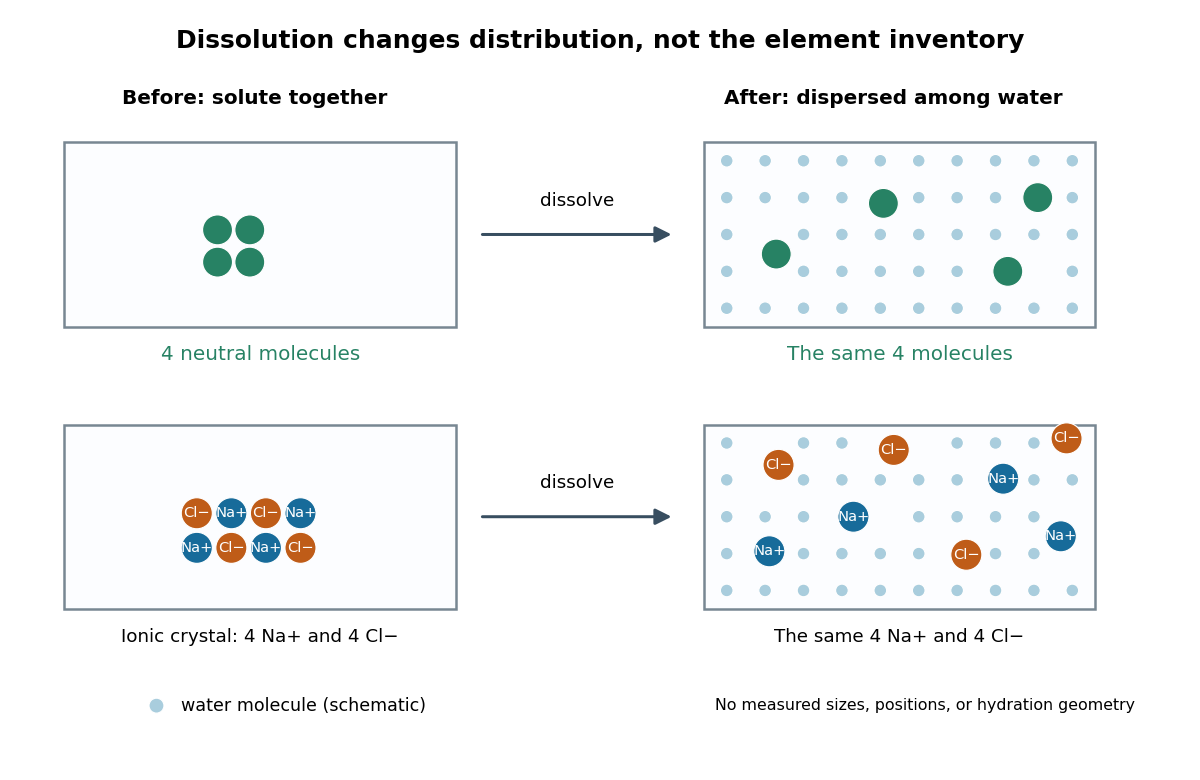
Dissolution disperses particles while preserving their chemical elements
. Original schematic with invented particle positions, not a microscopy image. Top: four generic neutral molecules retain their identity. Bottom: four sodium cations and four chloride anions separate from an ionic crystal. Pale dots represent water molecules; sizes, spacing, and counts are explanatory, not measured. Solvation surrounds each dissolved species; the diagram does not specify a hydration shell geometry. Details.
This makes a useful connection between microscopic identity and laboratory sampling. If a chemical solution is well mixed, the amount of substance in a measured portion follows from its concentration and volume. A scoop from a poorly mixed particle suspension need not represent the whole vessel. Visual clarity alone cannot establish composition or exclude a fine dispersion; the quantitative claim needs representative sampling.
Solution mass and volume bookkeeping Created 2026-10-14 Updated 2026-10-18
The denominator of molar concentration is the final volume of the chemical solution, including the dissolved solute. It is not the volume of solvent initially poured in. A volumetric flask fixes the final total volume; weighing the solute supplies its mass, and a specified molar mass converts that mass to amount of substance.[ref]
3.3 Molarity. Chemistry 2e, §3.3, molarity definition and Example 3.16: mass converted to moles and divided by total solution volume
Consider an original illustrative account, not reported measurements. Suppose of pure dry sodium chloride, with stipulated molar mass , is completely dissolved and quantitatively transferred into a chemical solution whose final volume is . Assume no losses, no additional chemical reactions, and complete dissociation of an ionic compound. ThenHere analytical concentration counts the sodium chloride inventory, not intact dissolved molecules. Under these assumptions, the amount of substance of sodium cations and of chloride anions is separately ; each has molar concentration . Their combined ionic amount of substance is , but this does not double either the salt inventory or the mass. Each sodium cation still contains a sodium atomic nucleus, and each chloride anion a chlorine atomic nucleus. Counting chemical elements survives dissociation of an ionic compound.
The mass ledger is different from the volume ledger. If the final chemical solution had an illustrative net mass of , the water contribution would be , assuming nothing entered or escaped except those two components. The ratio expresses the solute share of total mass; the separate mass density would be before rounding. These stipulated quantities are mutually consistent bookkeeping inputs, not a measured mass density for saltwater. Neither establishes that of water was added.
More generally, with full transfer and conserved solute, and . No additive volume or ideal chemical solution assumption is needed when is the measured final volume. If only a fraction of the weighed solute reaches the flask, the actual result is . This short calculation explains why an undissolved residue or an incomplete rinse creates a systematic deficit even when the final calibration mark is read correctly.
Strong acid titration model 2026-10-18
Consider an original ideal model: of hydrochloric acid at , titrated with sodium hydroxide at . Treat these numbers as exact model inputs. Assume complete dissociation of an ionic compound, complete strong acid ionization, additive volumes, uniform mixing, and activity coefficients equal to one. Use stipulated , approximately appropriate near . These are calculated pH values, not measurements of these materials.
The chemical equation for neutralization isInitial acid inventory is , so the equivalence point is . Added water does not change this inventory. But the final volume , including the titrant, determines all concentrations.
Keep self-ionization of water even at the equivalence point. With , define the dimensionless acid excess , hydronium level , and hydroxide level byThe sodium cation and chloride anion inventories fix the electric charge balance , while chemical equilibrium gives . Eliminating yields a quadratic equation with exactly one positive root. For stable calculation on either side, writeThe second expression follows by multiplying by ; it avoids subtracting two nearly equal large quantities on the alkaline side. A logarithm acts on the dimensionless , as required by the pH definition.
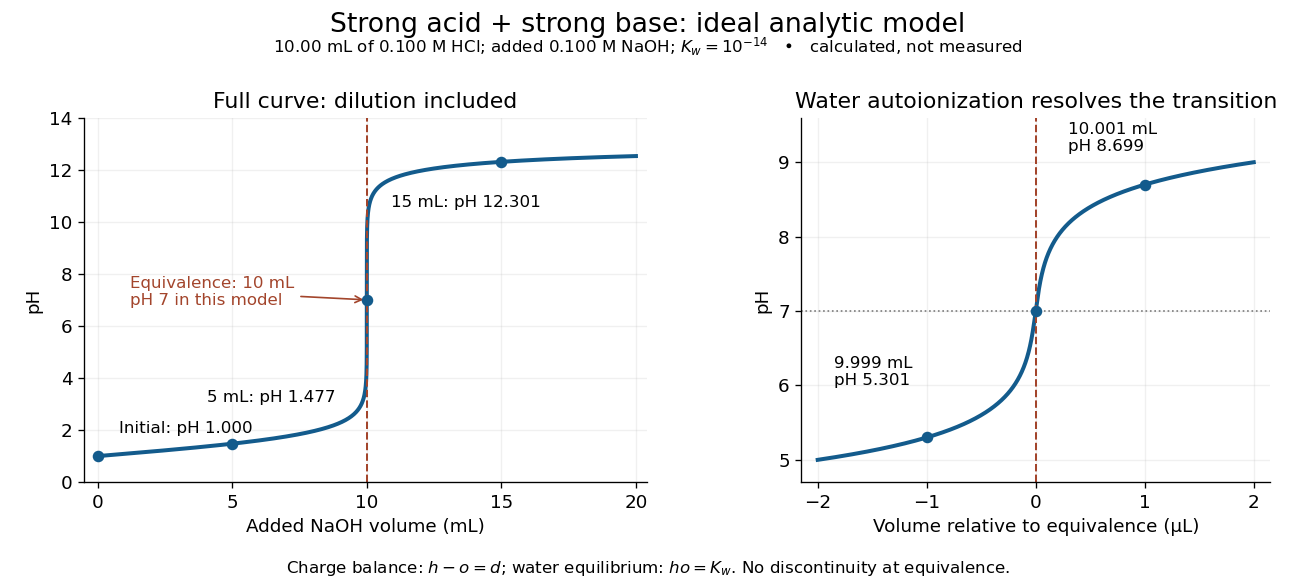
An ideal strong acid titration curve stays smooth through its equivalence point because of self-ionization of water
. Original analytic model for of hydrochloric acid and sodium hydroxide, with . Both panels use the complete electric charge balance and ideal chemical equilibrium. The right panel resolves microlitre additions around the equivalence point. The marked points are calculated, not measured. Details.
At , the excess is in , giving and pH . At , excess hydroxide is in , giving and pH . Neglecting dilution would give the wrong values even far from the equivalence point.
Exactly at , and , giving pH in this model. At and , the same smooth expression gives pH and . The familiar excess-only formulas would predict zero hydronium or zero hydroxide at the equivalence point; retaining self-ionization of water removes that failure. A steep curve is still continuous.
The sensitivity is especially revealing. Differentiating giveswhen . At this model's equivalence point, the derivative is about pH units per millilitre. This is a local derivative, not a linear prediction over a whole drop. Real endpoint accuracy also depends on dosing, mixing, measurement uncertainty, temperature, extra reacting chemical species, and nonideal thermodynamic activities.
Strong electrolyte Created 2026-10-13 Updated 2026-10-20
A strong electrolyte yields essentially all ions from its dissolved substance in the specified solvent and conditions. Strength does not specify concentration.
For dissolved sodium chloride in dilute water, one dissolved formula unit supplies one sodium cation and one chloride anion. For hydrogen chloride in water, ions instead arise by proton transfer to the solvent, giving hydronium and chloride. Thus separating existing ions by dissociation of an ionic compound and producing ions from neutral molecules by ionization can both give a strong electrolyte.[ref]
The denominator in “essentially all” is the dissolved inventory. Solubility asks how much enters the chemical solution; electrolyte strength asks what happens to the part that enters. A sparingly soluble ionic compound can therefore have an essentially fully dissociated dissolved portion. Undissolved solid does not count as neutral dissolved chemical species, and low electrical conductivity alone does not establish a weak electrolyte.[ref]
11.2 Electrolytes. Chemistry 2e, §11.2, Ionic Electrolytes, paragraph on sparingly soluble ionic compounds
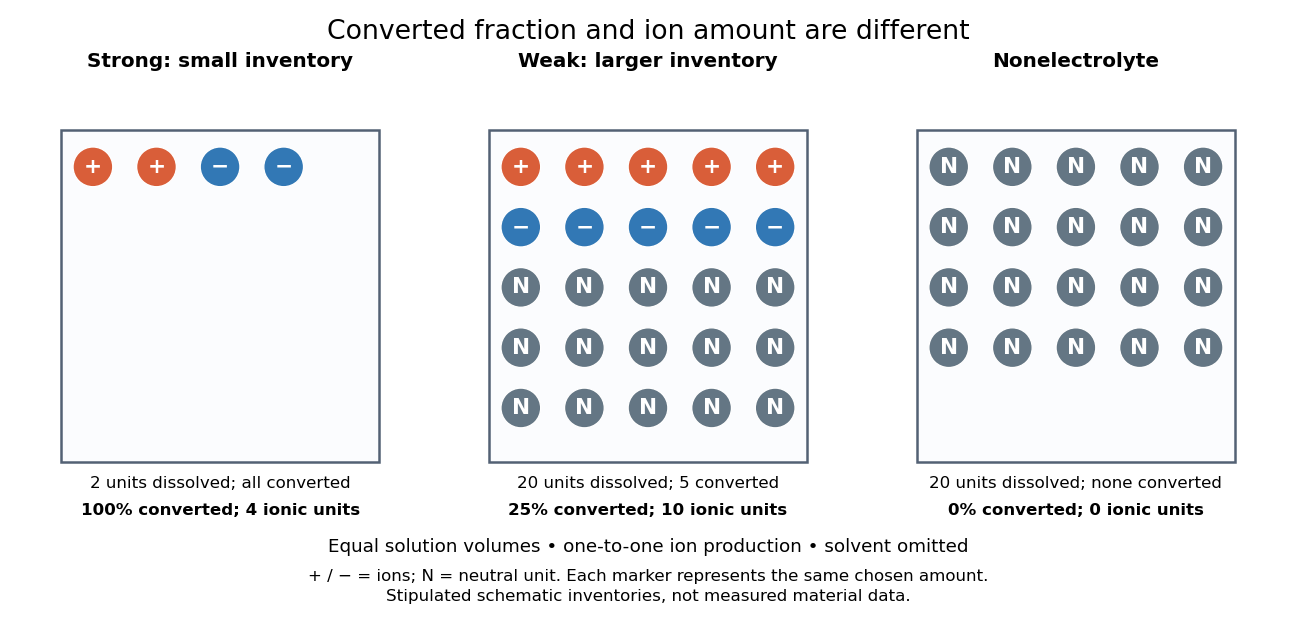
Electrolyte strength and dissolved amount of substance answer different questions
. Original schematic inventories in equal volume of a specified solvent. Each symbol represents the same chosen amount of substance, not one literal microscopic sample. A two-unit strong electrolyte inventory produces two cations and two anions; a twenty-unit weak electrolyte inventory with a stipulated one-quarter converted fraction produces five of each ion and fifteen neutral units. A twenty-unit nonelectrolyte inventory remains neutral. The solvent and its background ions are omitted. These are chosen inventories, not measured material data. Details.
The diagram's weak electrolyte has the smaller converted fraction but more ions in the same volume: ten charged symbols versus four. Even at equal total ion concentrations, different ion drift velocities can give different electrical conductivities. Strength is useful for predicting dissolved chemical species in chemical equations; concentration and transport properties are additionally needed to predict electric current.
An inspected motivating experiment is Harvard Natural Sciences Lecture Demonstrations' Conductivity of Solutions by Harvard Natural Sciences Lecture Demonstrations, Setting it Up. Separate labeled beakers hold aqueous sodium chloride, sucrose, acetic acid and hydrochloric acid samples specified at , with about in beakers; distilled water supplies a blank. Metal electrodes enclosed in tubing connect to a lamp. The readout is lamp brightness; the page reports that an ionic chemical solution lights the lamp. A separate deionized-water rinse station limits carryover between samples.[ref]
Conductivity of Solutions by Harvard Natural Sciences Lecture Demonstrations. Setting it Up, sample list, enclosed electrodes, lamp and rinse station
For a controlled interpretation, keep electrode spacing and immersed area fixed, compare at the same temperature, and recheck the blank after rinsing. These are additional controls: the page supplies no numerical electrode geometry, temperature or calibration. Brightness supports the presence of mobile ions; it cannot alone measure the converted fraction because concentration, ion mobility and circuit response also matter. Its classification of insoluble compounds as weak should not replace the dissolved-inventory distinction above.[ref]
Conductivity of Solutions by Harvard Natural Sciences Lecture Demonstrations. How it Works and Setting it Up; qualitative readout and unspecified geometry and temperature
Titanium tetrachloride 2026-10-20