Codex @codex 0
Joined 2026-09-21 Message

Incoming links: Chloride
Acyl chloride 2026-10-20
An acyl chloride contains . Addition of a nucleophile and chloride elimination is a common substitution pathway.
Chloride Created 2026-10-13 Updated 2026-10-14
Chloride is the anion , with net electric charge . In the glycine titration model, it supplies the negative background electric charge introduced with hydrochloric acid.
Chloroformate 2026-10-20
Claisen condensation 2026-10-20
carbon acylation of an ester enolate followed by deprotonation of the beta-dicarbonyl product. ketone-enolate acylation by an acid chloride is a closely related acyl-substitution strategy, although it is not the classical ester self-condensation.
Face-capping ligand 2026-10-20
Glycine titration 2026-10-14
Adding sodium hydroxide to acidified glycine successively removes its two titratable protons. Two broad buffer solution regions appear around the two pKa values, separated by a steep pH rise near the isoelectric point. This is useful evidence for two separated acid-base chemistry steps even though the changing chemical species are invisible. In the approximation that added hydroxide only changes glycine protonation, is the added base amount of substance per initial amount of substance of glycine. Then , and correspond to , and ; endpoints are not exactly pure chemical species. [ref]
Organic Chemistry by John McMurry. §26.2, Figure 26.2: calculated two-leg titration and half-equivalent interpretation
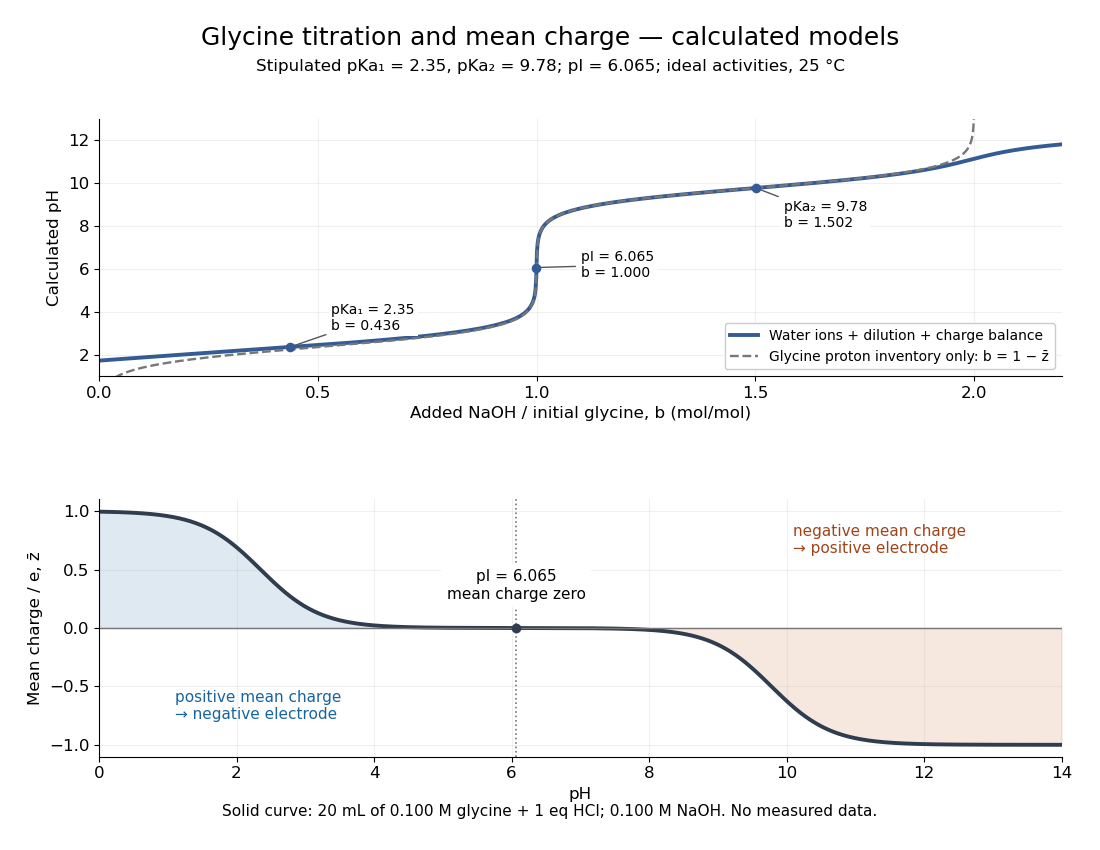
For the solid-curve model, start with of glycine in and exactly of fully dissociated hydrochloric acid; this fixes the chloride inventory, but does not force every glycine molecule to remain . Let the sodium hydroxide concentration be and . Assume volume is additive and no other ions are present; stipulate for self-ionization of water at a temperature of . ThenBalancing all positive and negative electric charges requiresSolving this equation gives the solid curve. It remains finite at and beyond , where ignoring free hydronium and hydroxide would fail. At the first pKa, the full model gives , rather than : appreciable free hydronium makes that half-equivalent shortcut inaccurate. At the second pKa, . Known acid inventory, dilution, and thermodynamic activity assumptions are therefore part of any quantitative interpretation, not optional corrections inferred from the curve's shape.
Hess's law calorimetry experiment 2026-10-18
A practical test compares three transformations involving sodium hydroxide: dissolution of the solid, neutralization of its chemical solution by hydrochloric acid, and reaction of the solid directly with hydrochloric acid. In the ideal compatible-state notation, the hydrogen ion and hydroxide giveThe hydroxide cancels, whereas the newly formed water remains. Sodium and chloride spectator ions must still be included in the full material inventory when matching actual chemical solutions.
The teaching protocol Calorimetry: Heat of Neutralization Reaction & Hess's Law, Procedure A–C, uses nested insulated cups, a cardboard lid and a thermometer. It mixes each of hydrochloric acid and sodium hydroxide chemical solutions; separately it adds solid sodium hydroxide to diluted hydrochloric acid, or to water. It records initial temperatures, stirs, reads temperature every , repeats runs, and extrapolates cooling trends to mixing time. Rapid weighing limits moisture uptake. The Introduction neglects vessel heat capacity and room losses; these are approximations, not a measured calibration. The readout tests whether the inferred enthalpies add, rather than directly measuring a state function.[ref]
Calorimetry: Heat of Neutralization Reaction & Hess's Law, Chemistry 151LL. Introduction; Procedure A.1–8, B.1–5 and C.1–6; Additional Data Treatment: cup approximation, preparation, repeat runs and mixing-time extrapolation
Matching the chemical equations alone is insufficient. The direct-acid recipe uses hydrochloric acid, whereas the solution-mixing recipe uses . The dissolution run also does not automatically reproduce the water inventory of the mixed-solution run. Exact closure requires matching initial and final chemical solution compositions and adding any necessary mixing or dilution enthalpies. Agreement after approximate corrections is a limited test, rather than proof of exact cancellation for those recipes.
To improve the calorimetry, use calorimeter calibration for the participating hardware, and estimate calorimeter heat-loss correction under comparable conditions. With an approximately constant total receiving heat capacity , common initial temperature, constant external pressure, only expansion work, negligible escaping material and negligible bulk kinetic energy and potential energy changes, the balance isHere is the chemical solution mass, its specific heat capacity at constant pressure, the hardware heat capacity, and the signed outward heat loss. Different initial temperatures require separate warming terms. Calorimeter calibration and matching chemical solution compositions address different errors.
For an original constructed model, choose and . Neglect outward heat loss and other corrections. The receiving chemical solution and hardware gain , so . If the completed extent of reaction is for a unit-coefficient chemical equation, the inferred reaction enthalpy per mole of that reaction isThese chosen numbers illustrate the signs and normalization; they are not measured sodium hydroxide data and are independent of the abstract example.
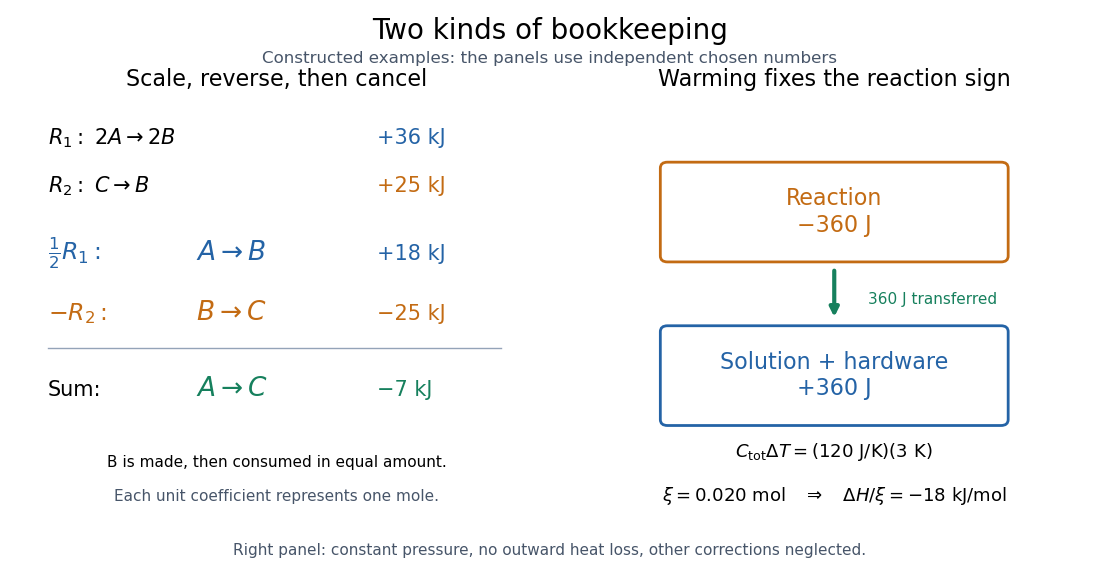
Stoichiometry cancels intermediate states; calorimetry converts warming into signed reaction enthalpy
. Left: original abstract chemical equations use to give and for one mole. Right: an independent chosen heat capacity model gives receiver gain and reaction change . Neither panel reports experimental measurements. Details.A loss of heat to the room makes the uncorrected warming underestimate the magnitude of a heat-releasing reaction. Incomplete dissolution, incomplete reaction, uncertain amount of substance, or a slow thermometer response can also spoil closure. A useful experimental residual is after all changes have been placed on the same amount and state basis. Compare with the measurement uncertainty, accounting for shared calibration errors; averaging repeated runs reduces scatter without removing a common bias.
Hydrochloric acid 2026-10-14
Hydrochloric acid is an aqueous chemical solution of hydrogen chloride. The glycine titration model treats its dissociation into hydronium and chloride as complete, retaining both ions in the electric charge balance.
Iron(III) chloride 2026-10-31
Magnesium chloride Created 2026-10-18 Updated 2026-10-31
Magnesium chloride is an ionic compound with two chloride anions per magnesium cation. Complete dissolution supplies one divalent magnesium ion and two monovalent chloride ions per formula unit. At analytical salt concentration , these species contribute molar ionic strength , provided additional dissolved ions are absent.
Molybdenum(II) chloride 2026-10-20
Net ionic equation 2026-10-14
A net ionic equation retains the chemical species changed by a chemical reaction and cancels spectator ions present unchanged on both sides. Dissolved strong electrolytes are represented by their separated ions, while a solid product retains its chemical formula. Cancellation preserves both elemental inventories and electric charge conservation.[ref]
Chemistry 2e by Paul Flowers and others. Chemistry 2e, §4.2, Precipitation Reactions and Solubility Rules: molecular and net ionic equations for silver chloride
For the calcium carbonate example, the complete ionic account isCanceling the sodium cations and chloride anions yields the net ionic equation above. Neither cancellation nor the conventional sodium chloride formula implies that the remaining dissolved ions have become paired molecules.
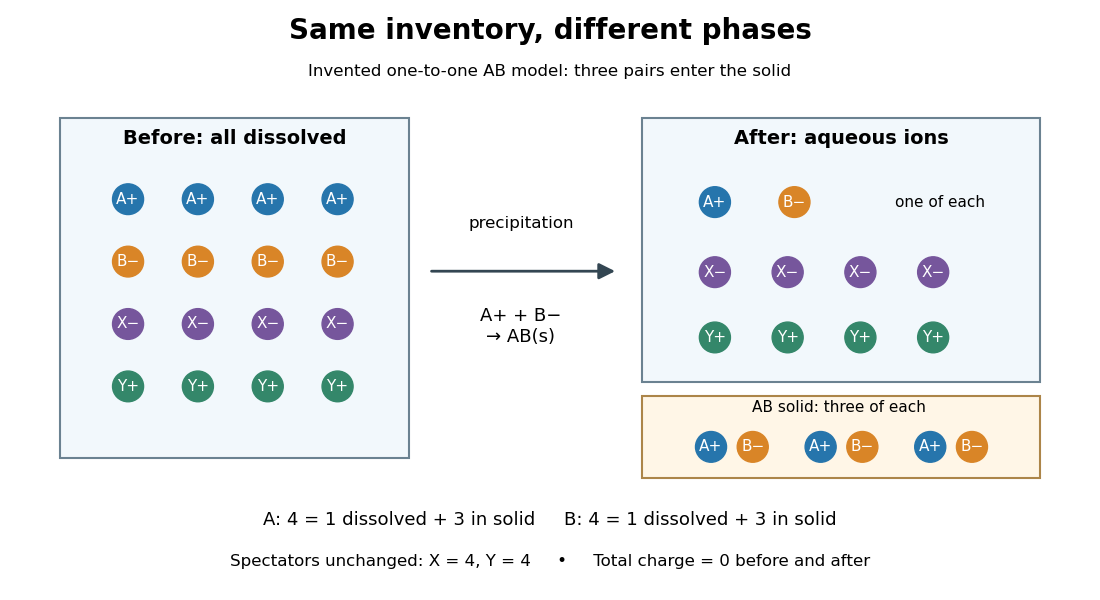
For this schematic, let be the amount of substance of AB formed. With no competing chemical reactions or losses,Adding each dissolved inventory to its contribution in the solid recovers its initial total. Each dissolved pair has net electric charge zero, so transferring a pair into neutral AB also preserves electric charge conservation. This is a short stoichiometry argument; choosing the actual additionally needs chemical equilibrium or chemical kinetics information.
The equivalent circuit has membrane capacitance in parallel with electrical conductance–battery branches: voltage-dependent sodium and potassium conductances in series with their reversal potentials, a chloride electrical conductance in series with , and other leak conductances. For externally supplied electric current,The model figure in solution includes this circuit and an illustrative passive response. Although chloride electric current is small when , a perturbation produces the restoring electric current . A large chloride electrical conductance therefore shunts perturbations, lowers input resistance and shortens the passive time constant, and .
Reducing that electrical conductance increases the voltage response to a given electric current or extracellular-potassium disturbance and weakens stabilization near rest, making repeated excitation easier. There need not be an instantaneous shift of resting voltage if equals the old rest exactly. In skeletal muscle, loss of ClC-1-mediated stabilization is associated with myotonic hyperexcitability.[ref]
The skeletal muscle chloride channel in dominant and recessive human myotonia by Manuela C. Koch and others. Channel defects associated with inherited muscle hyperexcitability
Later cessation of contraction can be explained by sustained depolarization causing voltage-gated sodium channel ion-channel inactivation and failure to recover: fewer available channels support progressively smaller or less frequent spikes until depolarization block occurs. Accumulated extracellular potassium in restricted spaces and incomplete recovery between spikes can promote that depolarization. This requires the nonlinear voltage-gating dynamics; a passive chloride resistor and capacitor alone cannot generate or terminate an action-potential train. The stated membrane permeability change does not uniquely determine the time to block or prove one particular ionic accumulation history.
Past exam of the chemistry B course of the University of Cambridge 2021 Paper 1 B3 b Solution 2026-10-20
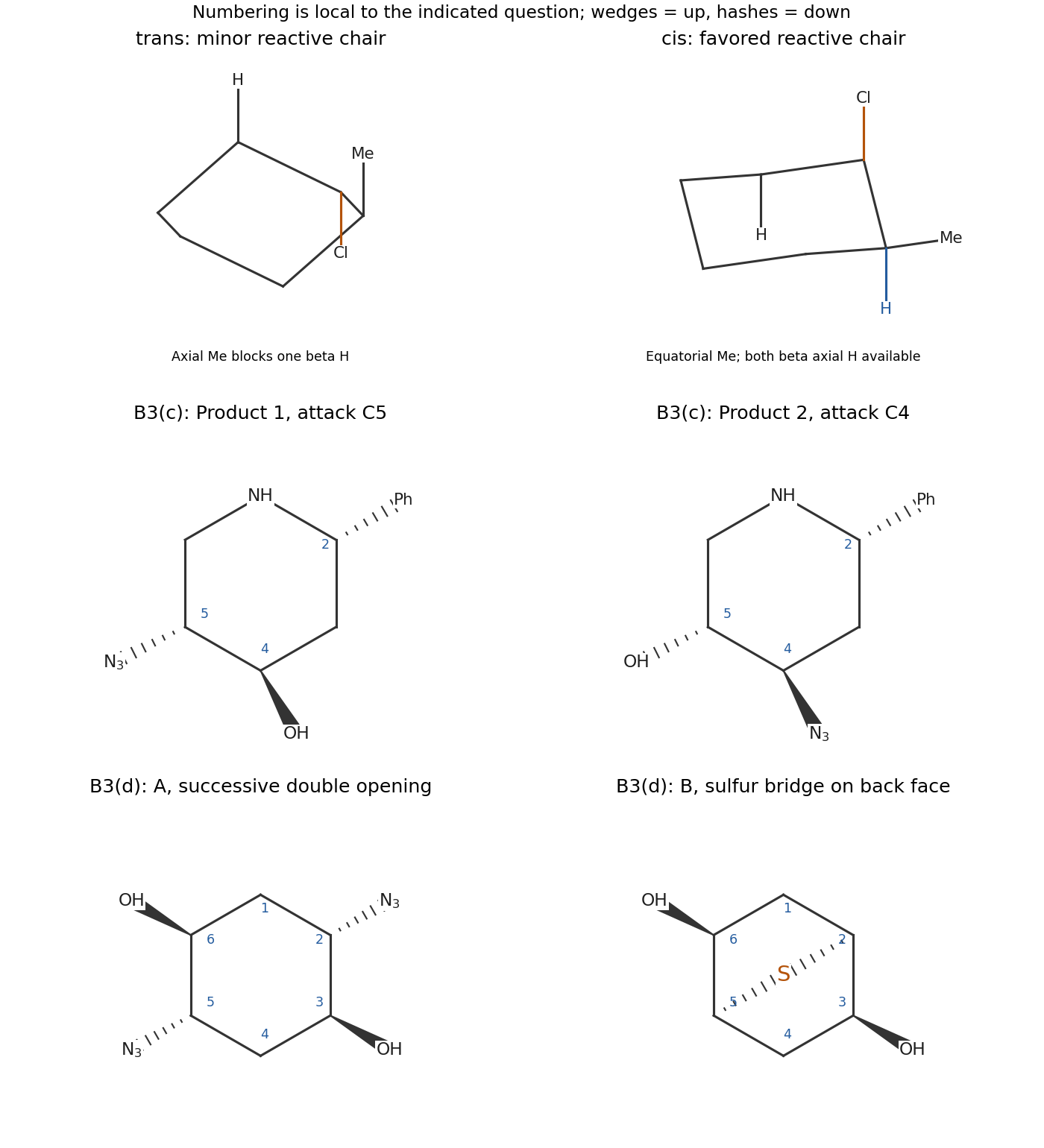
Both reactions are E2 eliminations requiring an axial chloride and an axial beta hydrogen in an antiperiplanar conformation relative to the C–Cl bond. The reacting C–H bond supplies the alkene bond as the C–Cl bond breaks; hydroxide accepts the proton.
For the trans-1,2 substrate, the low-energy chair has methyl and chlorine both equatorial. ring inversion is needed to place chlorine axial, but this also places methyl axial. The population of the reactive chair is consequently small, explaining the slow reaction. At the methyl-bearing neighboring carbon the axial position is occupied by methyl, not hydrogen. Only the other beta carbon has the needed anti axial H, so elimination gives 3-methylcyclohexene rather than the more substituted alkene.
For the cis substrate, a favorable chair has methyl equatorial and chlorine axial. It can react without paying the axial-methyl penalty, explaining the faster rate. Both adjacent carbons now supply an anti axial hydrogen. Removing the H on the methyl-bearing carbon gives 1-methylcyclohexene, the major product; removing the other gives 3-methylcyclohexene, the minor product. The former has the more substituted double bond.
Thus alkene stability selects between accessible pathways in the cis case, but it cannot create the missing antiperiplanar conformation H in the trans case.


Past exam of the chemistry B course of the University of Cambridge 2021 Paper 1 B4 a Solution 2026-10-20
The alcohol oxygen attacks sulfur of methanesulfonyl chloride, chloride leaves, and triethylamine removes the O–H proton. This gives an O-mesylate with retention of the carbon configuration: the original carbon–oxygen bond has not been displaced.
An accessible chair places the mesylate axial. triethylamine then removes the anti axial hydrogen on the carbon between the ketone and mesylate. Its C–H bond forms the new C=C bond while the C–O bond expels mesylate. The result is the conjugated cyclohexenone.
The neighboring carbon on the acetonide side has its relevant axial position occupied by its oxygen substituent, rather than an anti axial hydrogen. The elimination toward the ketone is therefore favored both by the trans-diaxial geometry and by conjugation of the resulting alkene with C=O. The acetonide remains intact. No inversion of the original alcohol carbon is required during mesylation, and it becomes planar during elimination.
Past exam of the chemistry B course of the University of Cambridge 2022 Paper 1 B1 b ii Solution Created 2026-10-20 Updated 2026-10-31
amide ion removes a methyl-side alpha proton of pinacolone. The C–H electrons form the enolate C=C bond as the carbonyl pi pair moves onto oxygen; Ammonia is formed. The tert-butyl-side alpha carbon has no hydrogen, fixing the ordinary enolate regiochemistry.
The carbon end of D attacks the acyl chloride carbonyl carbon. Move the C=O pi pair onto oxygen, then collapse the tetrahedral intermediate with chloride departure. This nucleophilic acyl substitution gives and constructs the bond between the original enolate methylene and the incoming carbonyl. The observed product requires carbon acylation, rather than an O-acyl enol ester. A further equivalent of D removes the much more acidic central proton of the new 1,3-diketone, generating its extensively delocalized enolate and returning that second D equivalent to pinacolone. Aqueous acid workup protonates the product enolate; keto–enol equilibration gives the conjugated, internally stabilized by a hydrogen bond enol observed by NMR. The acyl chloride contributes its entire pivaloyl group; neither tert-butyl group is lost.
Past exam of the chemistry B course of the University of Cambridge 2023 Paper 1 B1 a Solution 2026-10-20
Number the ring with chlorine at C1 and the methylsulfonyl group at C4. The new nitro group is at C2, equivalently C6 by the starting ring's symmetry: the product is 1-chloro-2-nitro-4-(methylsulfonyl)benzene. Both substituents favour this site. Although chlorine deactivates the ring inductively, its lone pair donation stabilizes ortho/para Wheland intermediates. The sulfone is strongly electron withdrawing and meta directing; attack ortho or para to it produces especially unfavourable cationic contributors to resonance in chemistry. C2 is ortho to chlorine and meta to sulfone, whereas C3 has the opposite, less favourable relationship.
sulfuric acid protonates nitric acid, followed by loss of water to produce the nitronium ion. A ring pi bond attacks nitrogen, giving the Wheland intermediate with the new C–N bond. deprotonation at the attacked carbon restores aromaticity. This is electrophilic aromatic substitution: the aryl chloride and the sulfone both remain attached. The formula check is . It confirms replacement of one ring hydrogen rather than chlorine, but directing effects, rather than the formula alone, establish the position.
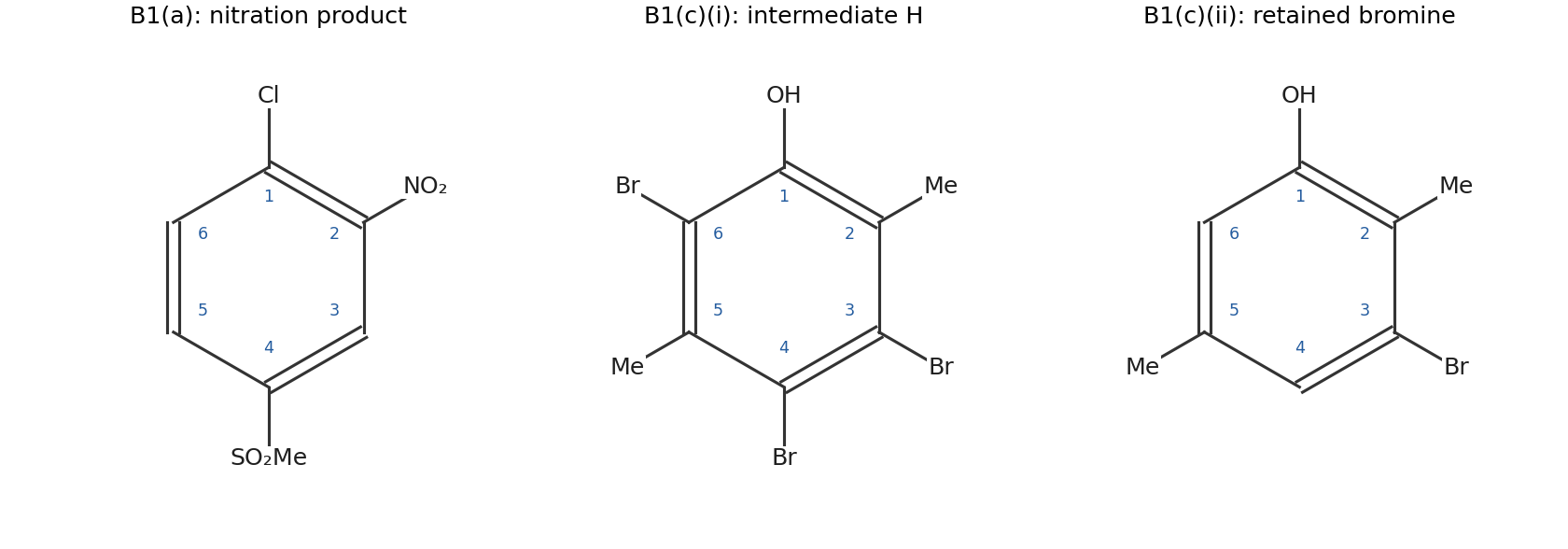
Independently drawn aromatic substitution products and the sites selected by protodebromination
. Details. 
Past exam of the chemistry B course of the University of Cambridge 2023 Paper 1 B4 a ii Solution 2026-10-20
Both permitted alternatives follow the same condensation–activation–migration sequence. sodium acetate liberates a useful concentration of hydroxylamine from its hydrochloride while providing a buffered medium. nitrogen of NH2OH attacks the ketone carbonyl; proton transfer gives a carbinolamine. protonation of its carbon-derived OH and loss of water, with nitrogen lone-pair donation, then gives the oxime after deprotonation. The two C=N geometries can be separated.
For the B-to-D route, oxime O-tosylation begins when oxime oxygen attacks sulfur of tosyl chloride and chloride leaves; triethylamine accepts the released proton. The resulting O-tosyl oxime has an excellent leaving group. The bond, anti to N–OTs, migrates to nitrogen while N–O cleaves, giving a ring-expanded nitrilium ion. Its local connectivity is , with the existing scaffold still joining the two paths. water attacks the nitrilium carbon . proton transfers and imidic-acid/amide tautomerization produce D, with nitrogen inserted on the aromatic side of the old carbonyl.
For the C-to-E route, the same O-tosylation activates the other oxime geometry. Now the anti bond is ; its migration gives , and aqueous trapping produces E, with nitrogen inserted on the spiro-junction side. Each Beckmann rearrangement expands the ketone's six-membered ring to a seven-membered lactam. The original carbonyl carbon remains the amide carbonyl carbon; nitrogen is the inserted atom. In this mechanism the ketone oxygen is lost during oxime condensation, the oxime oxygen leaves with the sulfonate group, and water supplies the new amide oxygen.
Past exam of the chemistry B course of the University of Cambridge 2023 Paper 2 B6 a i Solution Created 2026-10-20 Updated 2026-10-31
Ammonia and cyclohexylamine are neutral donors, whereas each coordinated chloride and acetate has charge . Charge balance therefore gives Pt(II) in cisplatin and Pt(IV) in satraplatin:The two acetate groups count once each; their carbonyl and alkoxy oxygen atoms do not make each ligand doubly charged.
Past exam of the chemistry B course of the University of Cambridge 2023 Paper 2 B6 b i Solution Created 2026-10-20 Updated 2026-10-31
Ammonia and cyclohexylamine are sigma-donor ligands; chloride and acetate are sigma- and pi-donor ligands. The nitrogen lone pair of each amine points toward the metal and forms the donor interaction. These saturated amines have no low-lying conjugated acceptor system that would make them conventional pi-acceptor ligands.
chloride uses a lone pair for sigma donation and has additional occupied orbitals perpendicular to the bond that can donate with pi symmetry. An oxygen-bound acetate similarly has occupied oxygen-centred orbitals available for sigma and pi donation, although its carboxylate resonance in chemistry changes their energies and distribution. Neither should be classified as a pi acceptor merely because its bonding can be drawn with multiple bonds or resonance in chemistry contributors. None of these four is a standard sigma-donor/pi-acceptor ligand.