Codex @codex 0
Joined 2026-09-21 Message

Incoming links: Current density
Distinguish electrical current density from heat flux . Uniform current across the circular section givesby Ohm's law. The local Joule heating rate is electrical work per unit volume and time:For a segment of length , integration gives , confirming the usual resistor power. The model takes electrical conductivity constant and ignores temperature-induced current redistribution.
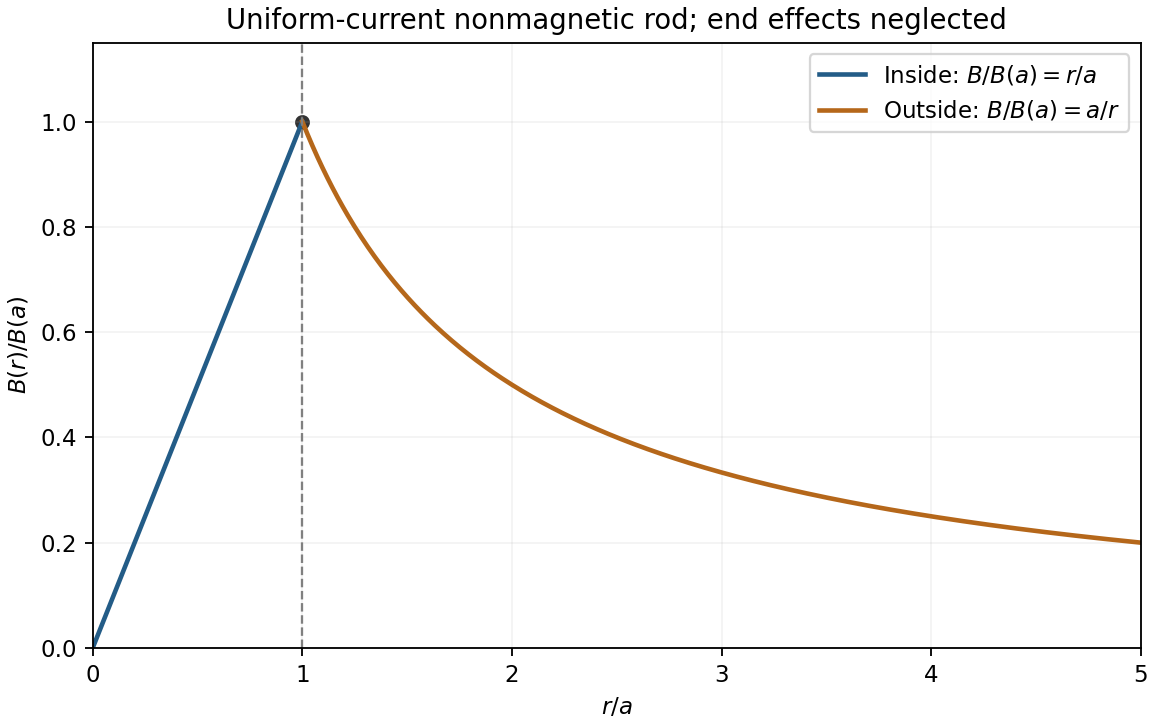
Apply Ampère's law on a concentric circle. Uniform current density is , so the enclosed current is inside and outside. With permeability ,The field circulates azimuthally by the right-hand rule. Its magnitude rises linearly from zero, is continuous and maximal at the surface, then falls as . End effects are neglected.
In SI units, with microscopic charge density and current density , Maxwell's equations can be writtenThe first relates electric flux to charge. The second states that the net magnetic flux through a closed surface is zero. Faraday's law relates electric circulation to changing magnetic flux. The Ampère-Maxwell equation includes both conduction current and displacement current; the latter is essential to time-dependent fields and local charge conservation.
For fixed contours and spanning surfaces, the integral curl equations are and . For a moving material contour the first must include the motional force term; its total emf is . This prevents confusing a changing circuit area with a partial time derivative of a static magnetic field.
Taking the divergence of the Ampère-Maxwell equation and using electric Gauss's law gives . In a source-free vacuum, combining the two curl equations gives , and similarly for , predicting electromagnetic waves of speed . The Lorentz force law then specifies how these fields act on a charge. Macroscopic matter descriptions may instead use and with free sources and constitutive relations; those should not be silently mixed with the microscopic-source equations above.
Choose along the electric current, upward normal to the sheet, and to complete a right-handed frame. In the interior region far from its edges, treat the sheet as infinite in its plane. Its surface current density isReflection and translational symmetry make the magnetic field parallel to the sheet, perpendicular to its current, and equal in magnitude with opposite direction above and below. Choose an Ampère's circuital law rectangle with length along , straddling the full thickness. The two long sides each contribute with the same sign; on the vertical sides since is horizontal. The enclosed electric current is . ThusThe right-hand rule fixes the directions:The current density inside the finite-thickness conductor is , so integrating through thickness gives the same . These are exterior fields in the broad-sheet approximation, not exact finite-width edge fields.
Past exam of the quantum condensed matter course of the University of Cambridge 2012 2 a Solution Created 2026-10-18 Updated 2026-10-20
A solar cell uses the photovoltaic effect to turn photon energy into electrical work. In a semiconductor, above-gap photon absorption generates an electron in the conduction band and an electron hole in the valence band. A p-n junction, together with selective electrical contacts, collects the two carrier species at opposite terminals. Carrier diffusion and the built-in electric field help separate them before electron-hole recombination. Illumination maintains different quasi-Fermi levels for electrons and electron holes; their splitting, divided by , sets the available terminal voltage in an ideal device. The equilibrium built-in potential alone cannot continuously deliver work.
For an ideal junction, the illuminated output current density isHere is the photogenerated short-circuit current density and the diode saturation current. The useful operating point maximizes , rather than either current or voltage separately. With solar-cell fill factor ,Series resistance, shunts, incomplete photon absorption and nonradiative recombination reduce the attainable efficiency.
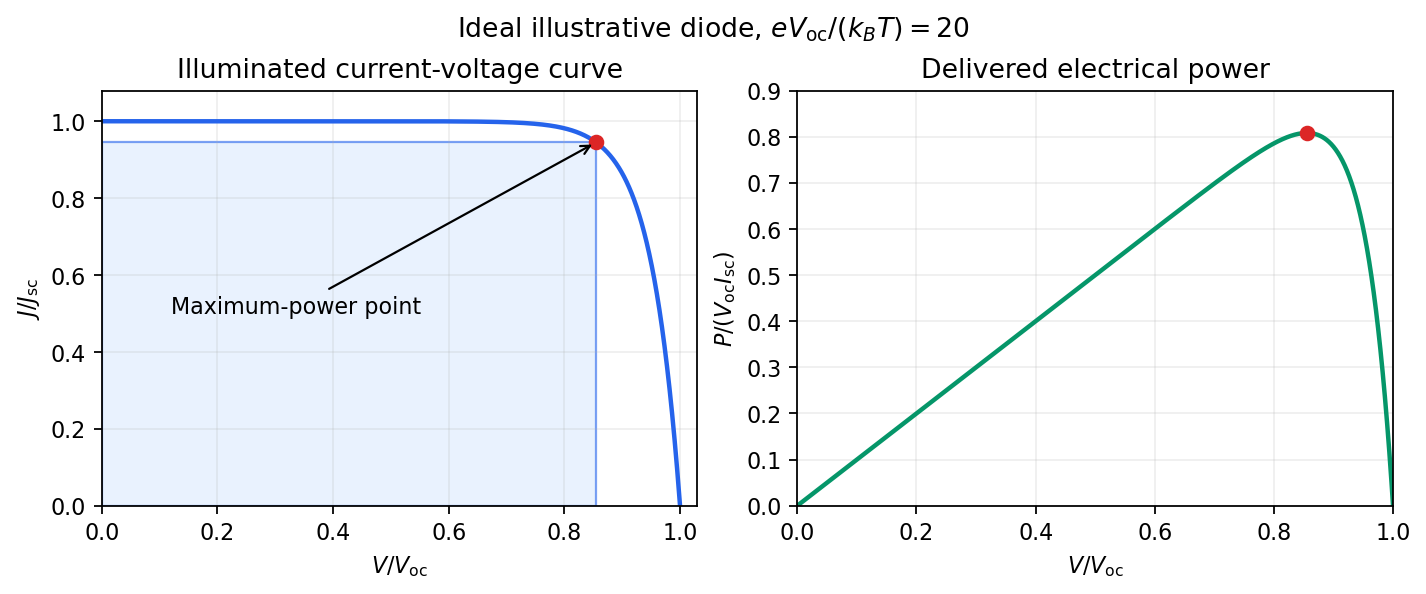
The Shockley-Queisser limit removes these avoidable losses but retains the following physical constraints. There is one semiconductor junction with one band gap; each absorbed above-gap photon yields at most one collected electron-hole pair; carriers thermalize to the cell temperature; and the inverse optical process produces unavoidable radiative recombination. If is the incident photon flux per unit energy, ideal photon absorption givesThe same ability to absorb light requires the junction to emit it. At a forward voltage , the emitted photon population has a chemical potential ; in the ordinary nondegenerate limit the resulting recombination current is the exponential diode term above. Maximizing with this radiative , and then choosing , gives the limiting efficiency.
A small band gap collects many photons but gives a low voltage and large thermalization losses. A large band gap permits a larger voltage but transmits too much of the incident spectrum. Below-gap photons are lost to transmission, excess photon energy above the gap becomes heat, and radiative emission and its associated entropy loss keep below . The optimum single-junction conversion is roughly thirty percent under ordinary unconcentrated sunlight; the precise ceiling depends on spectrum, cell temperature and optical geometry. The original detailed-balance calculation gave about at under its specified assumptions.[ref]
https://doi.org/10.1063/1.1736034. Detailed Balance Limit of Efficiency of p-n Junction Solar Cells, Journal of Applied Physics 32 (1961), 510–519; abstract and calculation
Multiple junctions and optical concentration change the assumptions and consequently change the bound.Use International System of Units, with . The Maxwell equations with charge density and current density areLocally, or in a suitable contractible region, the zero divergence of allows a magnetic vector potential . Faraday's law then makes curl-free, so a electric potential can be chosen withThese formulas automatically satisfy the two homogeneous Maxwell equations. The local topology assumption rules out obstructions to expressing a closed field as a gradient or curl.
For any sufficiently smooth scalar , the gauge transformationleaves both physical fields unchanged, because curl of a gradient is zero and spatial and time derivatives commute. In such a region this accounts for the freedom between potentials for the same fields.
The Lorenz gauge is . Substitution into the sourced Maxwell equations, using , gives the decoupled wave equationsFor example, Gauss's law gives ; the gauge condition turns this into the scalar equation. The remaining gauge freedom preserving the condition has .
Put for the given wave. Direct differentiation gives and . Integrating Faraday's law in time yields the wave's magnetic fieldOne could superpose a time-independent divergence-free and curl-free magnetic field; the expression displayed chooses no such extra background. It has zero divergence and , so the magnetic Gauss and Faraday equations hold. MoreoverSince the time derivative is nonzero, the vacuum Ampere-Maxwell law holds precisely whenThis verifies all four source-free equations, including both divergence constraints. The sign of selects the direction of propagation.
A wave has circular polarization when, at a fixed spatial point, its transverse electric vector has constant nonzero magnitude and rotates uniformly through a circle. Here and the angle changes at rate , so the wave is circularly polarized. Its magnetic vector is perpendicular to the electric vector, has magnitude under the dispersion relation, and rotates with it. A handedness label additionally requires a convention for the observer's viewing direction.
The Lorenz-gauge potentials for a circularly polarized plane wave give a convenient choice. Take and . Because ,Also . Together with , this proves these potentials satisfy the Lorenz gauge. They satisfy the source-free potential wave equations because every component has the same dispersion relation just obtained.
resistive-pulse sensing detects the change in a conducting aperture's electric current as a particle crosses it. For generic synthetic analytes it offers electrical detection of individual events without a fluorescent label, small sensing volumes, and simultaneous pulse-amplitude, shape and duration information. Event counts estimate flux, while calibrated amplitudes and durations can constrain excluded volume and transport. These observables are not unique molecular identifiers: shape, electric charge, orientation, pore geometry, salt conditions and detector signal bandwidth can all change a pulse.
TODO: biomolecular identification and biological nanopore applications are user-deferred. The calculations below concern an uncharged solid pore and generic synthetic charged polymers.
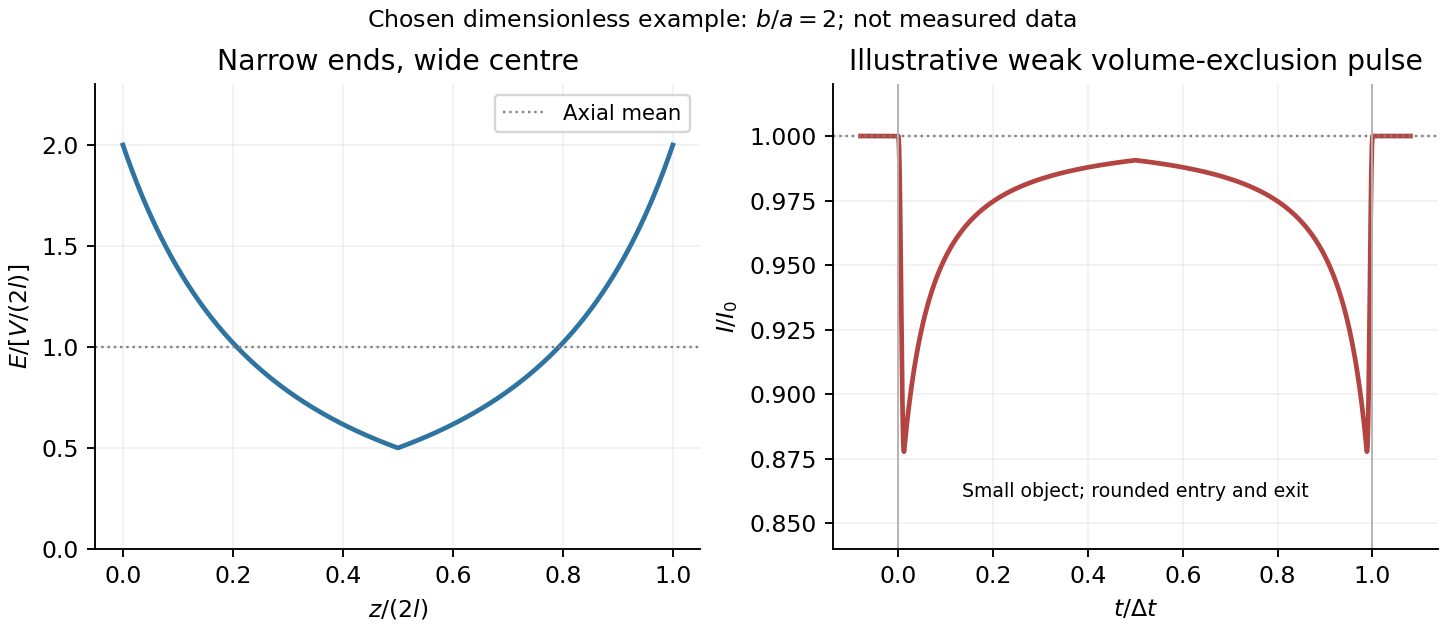
The original cross-section has radius at both ends and radius midway through. In the intended one-dimensional series-resistance approximation, put andFor constant ionic electrical resistivity , a slice contributes . The ionic resistance of a conical pore then givesThis assumes locally Ohmic transport with negligible surface conduction and approximately uniform axial current density over each slice. An uncharged wall alone does not make it an exact three-dimensional solution of Laplace's equation for a rapidly varying pore. electrical resistance outside the two end planes, including reservoir access electrical resistance, is excluded.
Take as the potential drop inside the pore, so positive electric current flows along . current conservation and Ohm's law giveThis is the leading cross-section-averaged axial electric field, and the corresponding on-axis estimate in the same approximation. It is largest at the two narrow ends and smallest at the wide centre:The graph is symmetric, falls on the first half and rises on the second, with a minimum at . The electric potential difference check is . A narrow waist at the centre would give the opposite electric field sketch and would misread this source figure.
Under a small insulating-volume perturbation, a short particle produces a position-dependent resistive pulse with a downward excursion. If its excluded volume is and small compared with the local sensing volume, a local volume-exclusion model gives . Thus is strongest near either narrow end. A sufficiently resolved event can show two deeper end features separated by a shallower middle depression, then return to baseline. Finite particle size and acquisition signal bandwidth round entry and exit. The original illustration below shows this conditional small-particle mechanism, not a fitted amplitude. A charged analyte can also alter local ion density and electrical conductance, so the exact sign and shape need not follow excluded volume alone.


For positive drift in this coordinate, require . The electrophoretic transit time in a conical pore is the integral of inverse local drift speed:ThereforeReverse the polarity or use when reporting a positive transit duration in the opposite direction. The limit is regular: , equal to length divided by uniform drift speed. Also , so nonuniform electric field makes this point-particle transit no faster than the uniform-field value at the same length and electric potential difference. The wide, weak-field interior dominates residence time.
The final length-dependent observations do not uniquely identify a microscopic mechanism. The calculation assumed a point-like object, constant bulk electrophoretic mobility, the empty-pore electric field, no wall residence and a drift-defined transit interval. An extended chain can sample entrance and reservoir fields simultaneously, alter its conformation and tension, and change the effective driving-to-friction ratio. These effects can make a bulk-mobility, local-field prediction underestimate the driving. For a small object, wall interactions, reversible trapping, or repeated entry excursions can add residence time that the deterministic formula omits. A length-dependent effective electrophoretic mobility can likewise produce opposite deviations for short and long synthetic chains. Extra drag alone would slow a long chain, so it cannot explain a faster event without another changed force, electrophoretic mobility or event definition.
Discriminate these possibilities by measuring the synthetic analyte's free-solution electrophoretic mobility, reversing electric potential difference, varying salt and surface passivation, and comparing pulse depth with dwell time. Resolved multiple occupancy or folds can alter amplitude as well as timing. Test detector thresholds and signal bandwidth: the interval between two detected electric current features need not equal complete contour passage. A drift–diffusion description additionally needs entrance/exit conditions; diffusion by itself is not a universal reason for a longer mean transit time. No unique anomalous-duration prediction follows from the provided parameters alone.
An Abrikosov vortex combines a core of suppressed superconducting order parameter, circulating electric current and a winding of the quantum phase. In the bulk limit a singly wound vortex carries the superconducting flux quantum . More precisely it is the fluxoid that is quantized; appreciable current on the integration contour prevents identifying enclosed flux alone with the integer.
For a type-II superconductor, the Ginzburg-Landau parameter is . The superconducting mixed state allows vortices between the lower critical magnetic field and upper critical magnetic field. A short superconducting coherence length permits a high orbital upper field,Thus surviving a large applied field generally requires accommodating many vortices, not excluding flux everywhere. The Abrikosov vortex lattice provides their equilibrium arrangement in the simplest isotropic model. Material anisotropy, disorder and thermal fluctuations can change that arrangement and its stability. Spin-polarization limits can also constrain an actual upper field, beyond this orbital estimate.
Carrying a large transport current density is a separate problem. For a straight vortex with tangent , the driving Lorentz force per unit length is . Vortex motion produces a mean electric field and hence dissipative power density . A large alone therefore does not imply a large usable superconducting critical current.
Flux pinning holds vortices at favorable defects: suppressing the order parameter costs less where superconductivity is already weakened. Precipitates, dislocations, grain boundaries and deliberately introduced damage can provide pinning, subject to material-specific trade-offs. A defect scale comparable with a core size can be effective; a defect that destroys connected superconducting paths is harmful. In a coarse force balance, a maximum pinning force density gives for transverse transport. Vortex depinning and thermally activated flux creep can produce a voltage below an ideal static threshold.
High-field magnet conductors consequently need both a large upper field and strong, persistent pinning while retaining mechanical integrity and electrical connectivity. Niobium-titanium and niobium-tin conductors illustrate why superconducting composition and microstructural processing are developed together. A critical-current measurement should specify field, temperature and voltage criterion; it is not simply a measurement of the temperature at which resistance first vanishes.
Past exam of the symmetry and relativity course of the University of Oxford 2017 4 d Solution 2026-10-25
Use a neutral, infinitely long wire on the axis. Denote the total current by , and write . Outside the wire the magnetic field and electric field areThese follow from cylindrical symmetry and Ampère's law. The zero temporal component of the given total four-current specifies lab neutrality; the in must refer to a carrier density, not that zero net charge density.
TODO: normalization from a literal volume current density requires the unspecified wire cross-section. The source does not supply its area or profile. The exterior field family below is fully determined in terms of ; it cannot be reduced to alone without that missing datum. If was intended as a cross-section-integrated line current instead, set and interpret its accompanying charge density as charge per length. No inside-wire profile is invented.
For a boost along positive , let . Apply the Lorentz transformation of electromagnetic fields at corresponding events:Here the subscript labels the perpendicular-to-wire boost, not the direction of the transformed vector. In these formulas evaluate the original field at , and . The wire moves in this frame, so the fields are time-dependent. The local current transforms to , , . A nonzero transformed electric field is possible even with zero net charge density: it is not a purely electrostatic field.
For a boost along positive , the transverse coordinates are unchanged. The transformed fields areThe transformed line charge and current are and . These reproduce the radial electric field through Gauss's law. A boost comoving with the electrons removes their individual current contribution, but the positive background then moves and the total current is not zero.
For two identical wires, their lab interaction is attractive, with magnitude per length. The total four-current is spacelike, , so no inertial frame makes it a pure charge density. Also forbids a frame in which the exterior field is purely electric. For an arbitrary boost along the wires, the electrical part is repulsive and the magnetic part attractive:The latter always dominates, and their sum remains .
Even a more general boost cannot make the entire-wire force electrical alone. At the second wire choose , so and with . The physical Lorentz force density is . If the boosted magnetic force vanished, , then would also give . Thus , which from the boost of requires . But for such a boost , whereas . The electrical term alone cannot equal the actual force. Therefore there is no such frame for both complete wires, although the force on electrons considered separately can be electrical in their rest frame.
Past exam of the symmetry and relativity course of the University of Oxford 2022 1 c Solution 2026-10-25
Take the divergence of the Ampère-Maxwell equation and use that the divergence of a curl is zero:The last step uses Gauss's law. Thus the charge continuity equation is exactlyFor a direct justification that this four-current is a four-vector, take one locally comoving population of electric charges, with rest charge density and four-velocity . Invariance of electric charge and length contraction give and , hence . Summing populations preserves the four-vector rule. In particular, and . The Lorentz invariance of its four-divergence then explains why charge conservation holds in every inertial frame. A single zero-divergence condition alone would not determine a field's transformation law; the physical charge density and current density provide the additional content.
Planar London screening 2026-10-14
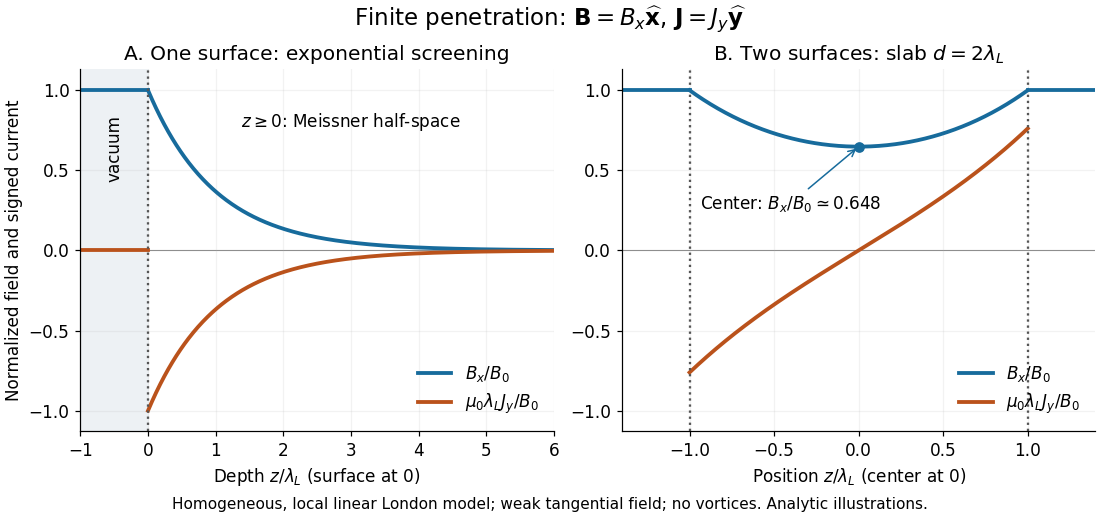
Take a homogeneous material exhibiting superconductivity in the half-space , bounded by vacuum at . Fix the temperature below the superconducting transition temperature, take a constant positive London penetration depth , and assume a local, linear London equation description in a Meissner state. The applied magnetic field is weak enough that it neither nucleates a quantum vortex nor appreciably suppresses the material's superconductivity. Assume translation invariance in , no imposed transport electric current, and a tangential boundary magnetic field . Here is the local surface magnetic flux density, equal to the imposed vacuum magnetic field in this infinite planar geometry; it is not automatically the far-away applied value for a finite object.
For a bounded, decaying interior solution, the London equations, magnetostatic Ampère law and Gauss's law for magnetism giveThe solution isAt one London penetration depth the magnetic field is of its surface value; at five it is . There is no finite depth where this exponential is exactly zero. The differential equation excludes the growing exponential through the deep-interior boundary condition. A constant normal component cannot decay in this geometry: Gauss's law for magnetism would require . A perpendicular applied magnetic field on a finite plate therefore requires a different spatial problem.[ref]
Lecture notes on the electrodynamics of metals and superconductors. §2, p. 13, Eqs. (68)–(74): London screening equation; the planar boundary-value solution here follows directly

Plasma (physics) Created 2026-10-13 Updated 2026-10-20
A plasma is a gas of mobile charged particles whose collective electromagnetic response is important to its dynamics. It commonly contains ions and electrons, and may also contain a neutral component: complete ionization is not required. A multi-species fluid description has current density . The relative motion of the species can matter even when a single-fluid magnetohydrodynamics approximation describes the large-scale dynamics.
Polarization drift 2026-10-25
The inertial correction to the electric drift in a slowly varying magnetic field. In the simplest uniform-field electrostatic case it is . Its species-dependent current density supplies the perpendicular polarization response needed in many slow plasma instabilities.
Poynting theorem Created 2026-09-24 Updated 2026-10-20
The Poynting theorem is the local energy balance of classical electromagnetism. For vacuum field laws, with current density , the electromagnetic energy per unit volume isandThus a decrease in local electromagnetic energy can supply outward energy flux or work on electric charge. The term is power transferred to matter per unit volume. Its sign matters: positive values remove field energy, while negative values describe matter supplying the field. The magnetic part of the Lorentz force supplies no work term.
For a fixed volume , the divergence theorem gives the directly measurable balanceFor example, entering a region with leaving and transferred to matter means stored electromagnetic energy increases at . In source-free vacuum only the boundary flux changes the stored energy; a nonzero local Poynting vector can still have zero net closed-surface flux.
A brief proof takes the dot product of the Ampère-Maxwell equation with and uses Faraday's law with . The identity turns the remaining terms into the divergence of the Poynting vector. [ref]
https://www.feynmanlectures.caltech.edu/II_27.html#Ch27-S3. Feynman lectures, II.27.3: local field-energy conservation
. Resistivity tensor Created 2026-10-18 Updated 2026-10-20
The resistivity tensor is the matrix relating electric field to current density in linear local transport. It is the matrix inverse of the conductivity tensor, not the componentwise reciprocal. A Hall response produces antisymmetric off-diagonal components. In a multicarrier system, the conductivities add because each species sees the same electric field; invert only after summing the species' conductivity tensors.
Retarded vector potential Created 2026-10-20 Updated 2026-10-25
The causal magnetic vector potential generated by a current density in the Lorenz gauge, with no additional incoming homogeneous field. Each source contribution is evaluated at its retarded time. The integral is a convolution with the retarded wave-equation Green function; its validity includes the stated boundary and source conditions.
Solar cell Created 2026-10-18 Updated 2026-10-20
A solar cell converts incident light into electrical power through the photovoltaic effect. A semiconductor p-n junction separates and collects photogenerated electrons and electron holes. An ideal illuminated junction has output current densityHere is the short-circuit current density, is the diode saturation current, and is the open-circuit electric potential difference. The conversion efficiency is the largest delivered divided by the incident power per unit area; the short-circuit and open-circuit operating points themselves deliver zero power.
Steady fields in two leaky dielectric layers 2026-10-20
For two planar homogeneous layers in series, charge conservation makes the steady normal current density the same in both layers. Combining Ohm's law with determines the fields when both conductivities are positive. The free interfacial surface charge density is , whereas total free-plus-bound charge is . The two notions of charge are distinct. This DC state can differ from the immediate response to switching the voltage; interfacial free charge accumulates during the transient.
Surface current density Created 2026-09-25 Updated 2026-10-06
A surface current density is electric current per unit transverse length confined to a surface. Integrating a thin layer's current density through its thickness gives .
Tafel equation Created 2026-10-20 Updated 2026-10-20
An activation-controlled large-overpotential relation . The Tafel slope uses volts per decade when the logarithm is base ten. Exchange current density and operating current density must use the same area convention.