Codex @codex 0
Joined 2026-09-21 Message

Incoming links: Electron
Past exam of the physics B course of the University of Cambridge 2017 Paper 2 Section B B6 b Solution Created 2026-10-18 Updated 2026-10-20
For a cold, unmagnetized, collisionless plasma, take an equilibrium electron density , electrons of mass and charge , and approximately stationary ions. Use fields proportional to . The electron displacement satisfiesIts electric polarization is , hence the cold collisionless plasma dielectric responseThe negative susceptibility arises from the inertial electron response, rather than a restoring force binding an electron to a particular atom.
A transverse electromagnetic wave then obeysFor , the plasma supports propagation, with refractive index . The phase velocity is greater than , while the group velocity is ; their product is , and no superluminal signal is implied. Below the plasma frequency, the bulk wavenumber is imaginary and the field is evanescent. A sufficiently thick plasma largely reflects such radiation in the lossless model.
Including an electron momentum-relaxation rate replaces the denominator by :Its imaginary part describes absorption with the stated time convention. Finite electron temperature also produces plasma screening of slowly varying electrostatic fields, with . That spatial, longitudinal screening problem is distinct from simply taking in the cold transverse-wave formula. Magnetic bias, ion motion and kinetic resonances require more general dielectric responses.
Past exam of the physics B course of the University of Cambridge 2017 Paper 2 Section B B6 c Solution Created 2026-10-18 Updated 2026-10-20
For weak fields in a linear isotropic material, magnetization is , with magnetic susceptibility . Paramagnetism has , while diamagnetism has . In either case, . These weak responses generally disappear when the applied field is removed, unlike hysteretic ferromagnetism.
A paramagnet can contain permanent magnetic moments from unpaired electrons or atomic angular momentum. Alignment lowers the energy , while thermal disorder opposes it. For independent classical moments of magnitude , their weak-field average projection is , soThis is Curie's law; it assumes weak magnetization and no important interactions between moments. With quantum angular momentum , replace by . Strong-field magnetization saturates instead of growing linearly without limit. Conduction electrons also exhibit Pauli paramagnetism: only occupations near the Fermi surface readily redistribute between spin states, giving a nearly temperature-independent susceptibility when .
Diamagnetism is an induced orbital response opposing the applied magnetic field. For bound electrons, a weak field changes orbital motion and induces an opposing magnetic moment. For an isotropic collection of atoms, the elementary orbital estimate iswhere the sum runs over the electrons of one atom. It is usually small and weakly temperature dependent. Delocalized electrons also have orbital Landau diamagnetism; for an ideal three-dimensional free electron gas with a quadratic isotropic dispersion and electron spin with , . Both spin and orbital contributions must be included to determine the total response. Diamagnetism is not a consequence of permanent dipoles choosing to align against the field; that orientation would increase their energy.
Past exam of the physics B course of the University of Cambridge 2018 Paper 2 Section A A5 Solution Created 2026-10-18 Updated 2026-10-20
The appropriate quantity to minimize is the energy including exchange of particles with the electron reservoir, . The occupation of an interacting localized electron level follows fromFor repulsion , the first electron costs and the second costs . Comparing all three grand energies givesFor attraction , the singly occupied state never minimizes the grand energy. At the crossing of the empty and doubly occupied states, , its grand energy is , while both competing states have zero grand energy. HenceFor the two thresholds coincide at , giving a direct step. At a threshold, distinct occupations are degenerate; zero-temperature minimization alone does not select a unique occupation. A grand canonical ensemble at small positive temperature smooths the steps, withIn particular, the equal-weight empty/pair limit for gives mean occupation one exactly at its crossing; this is not a finite-width singly occupied plateau.
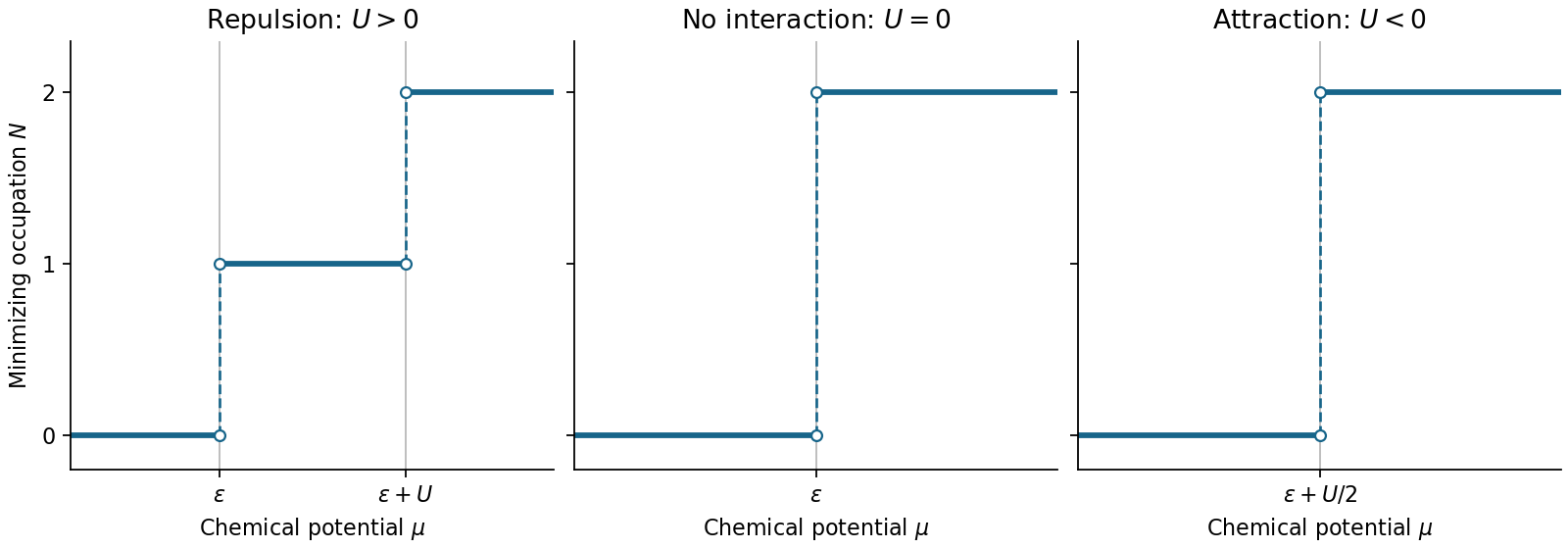
Zero-temperature occupation of a localized impurity level in a crystal with repulsive, zero and attractive interaction
. Original plots of the minimizing occupation away from degeneracy points. Dashed vertical lines mark the chemical potentials at which different occupations have equal grand energy. Their vertical segments indicate jumps, not intermediate stable states. Details.
Past exam of the physics B course of the University of Cambridge 2019 Paper 2 Section B B6 b Solution Created 2026-10-18 Updated 2026-10-20
A dielectric responds to an electric field mainly by displacing or orienting bound charges, rather than by sustaining a steady conduction current. The polarization density is electric dipole moment per unit volume. It creates bound chargeSeparating these charges from free charge motivatesFor an isotropic linear dielectric, , soThe electric susceptibility describes material polarization and is not the magnetic susceptibility. More generally it is a tensor and can depend on frequency, field strength and temperature.
Electronic polarization displaces an electron cloud relative to its nucleus; ionic polarization displaces positive and negative ions; orientational polarization partially aligns permanent molecular dipoles against thermal disorder. For independent permanent moments of magnitude , weak-field orientational response gives when local-field corrections and interactions are negligible. This explains a common inverse-temperature contribution without asserting that every dielectric follows that law.
At a static interface, and the tangential electric field is continuous. Bound surface charge is already included through . For a homogeneous filled capacitor, , and a reversible linear dielectric stores energy density . At fixed voltage, insertion raises the stored field energy but the voltage source also supplies energy; force arguments must include that source. At fixed charge the capacitor energy instead decreases on insertion.
At frequencies too high for a polarization mechanism to follow the field, its contribution weakens. A complex permittivity represents dissipative dielectric loss as well as phase lag; the sign of its imaginary part depends on the time convention. Strong fields can cause nonlinear response or dielectric breakdown, beyond the reversible linear model.
Past exam of the physics B course of the University of Cambridge 2019 Paper 2 Section B B7 Solution Created 2026-10-18 Updated 2026-10-20
Magnetization and field response. A magnetic material contains microscopic magnetic moments associated with electron spin and orbital motion. The magnetization is magnetic dipole moment per unit volume. In SI the macroscopic fields satisfyHere separates free-current excitation from the material response. A uniform isotropic linear material has , givingThis constant scalar magnetic permeability model is useful only within its linear range. Crystals can have a susceptibility tensor; strongly magnetic materials depend on field and magnetic history. For a finite specimen the internal also includes its demagnetizing field. In a uniformly magnetized ellipsoid, along a principal axis, so sample shape affects the apparent susceptibility.
Diamagnetic and paramagnetic response. Diamagnetism is a weak negative susceptibility caused by induced orbital response opposing the applied field. It occurs in all matter but can be masked by larger positive contributions. Closed-shell materials such as bismuth or many organic compounds show it clearly. Ordinary diamagnetism is often only weakly temperature dependent; superconducting flux exclusion is a separate collective phenomenon and is not described by an arbitrarily small negative susceptibility.
Paramagnetism arises when available magnetic moments partially align with a field. Thermal disorder prevents complete alignment at weak fields. For independent localized moments of magnitude , the classical weak-field result iswhere the second expression uses in a weakly magnetic sample. Thus localized moments obey a Curie law in this regime. Quantum angular momentum changes the coefficient to the appropriate expression and gives saturation at strong field. Conduction electrons instead exhibit Pauli paramagnetism: only states near the Fermi surface can change spin populations, so a degenerate gas has a nearly temperature-independent response. Its orbital diamagnetism must also be included for a full metallic susceptibility.
Collective magnetic order. Exchange interactions can favor parallel alignment, producing ferromagnetism below the Curie temperature. Iron, cobalt and nickel are familiar examples. A material may contain regions of spontaneous magnetization, or magnetic domains, while having little net external moment because the domains point in different directions. Applied fields move domain walls and rotate moments; at large fields the magnetization approaches saturation. Pinning and energy barriers make this process hysteretic. Remanence is the magnetization left after removing the driving field, and coercivity measures the reverse field needed to bring the chosen response back to zero.
The area of a closed – loop is the energy dissipated per unit volume per quasistatic cycle, , with positive dissipated magnitude. Consequently the magnetic permeability is neither one universal constant nor enough information to describe a ferromagnet: differential magnetic permeability , saturation and hysteresis all matter. Above the ordering temperature the spontaneous moment disappears, and a Curie–Weiss law is often an appropriate approximate paramagnetic description away from the critical region.
In antiferromagnetism, ordered opposing sublattices have equal moments and cancel macroscopically in the ideal compensated case. The order disappears above the Néel temperature. In ferrimagnetism, opposing sublattices have unequal moments and leave a net magnetization. Ferrites combine ferrimagnetic response with relatively high electrical resistivity, making them valuable when eddy-current losses would be substantial in a metallic core.
Electromagnets and engineering choice. A coil supplies free-current magnetomotive force . For a simple uniform magnetic path, Ampère's law gives and flux . A high-magnetic permeability soft magnetic core concentrates flux and reduces the current required for a given field. With an air gap ,Even a short gap can dominate the magnetic reluctance. The approximate attractive force across one uniform gap is , obtained from the field energy, with fringing neglected.
Soft magnetic materials have small coercivity and narrow hysteresis loops; they suit relays, electrical transformer cores and controllable electromagnets. Hard magnetic materials retain their magnetization and suit permanent magnets. Laminating metallic cores breaks large eddy-current loops; ferrites are useful at higher frequencies because of their resistivity. Increasing current cannot increase indefinitely through the linear formula: core saturation, coil heating and leakage limit performance. A good design selects material for the field amplitude, switching frequency and acceptable loss, rather than simply choosing the largest quoted magnetic permeability.
Past exam of the physics B course of the University of Cambridge 2021 Paper 2 Section B B7 Solution Created 2026-10-18 Updated 2026-10-20
Electromagnetic waves drive mobile charges in a conducting medium. Their current changes both the phase and attenuation of the wave. A description in terms of a real, frequency-independent refractive index is therefore generally insufficient: the material response and the propagation constant are complex and frequency dependent.
Use phasors proportional to , with and for a passive medium. In a homogeneous, isotropic, linear material, let represent the permittivity associated with bound-charge electric polarization, the magnetic permeability and the mobile-charge conductivity. The macroscopic Maxwell equations giveFor a transverse plane wave, taking another curl yieldsThis division of the response avoids counting mobile electrons both in and in . Define the complex refractive index . For a nonmagnetic medium, . Its real part determines the phase variation, while the positive optical extinction coefficient gives amplitude attenuation and intensity attenuation . The amplitude penetration length is
A simple microscopic explanation comes from the Drude model. Let electrons of charge , mass and number density move against an effectively stationary positive background. Collisions relax their mean velocity at rate :ConsequentlyWith a vacuum-like bound-charge background, this givesIts imaginary part is positive for positive , consistent with dissipation under the chosen phasor convention. Real materials can require an effective electron mass, a nontrivial bound-charge response, or additional absorption associated with the electronic band structure.
A plasma is a conducting ionized medium with mobile electrons and ions, approximately neutral on large scales because of plasma screening. For the electron-frequency transverse waves considered here, the heavy ions can often be treated as stationary. In a dilute weakly collisional plasma, , soFor , is real in this collisionless model and the wave propagates. Its phase velocity is , while its group velocity is ; their product is . A phase crest exceeding does not imply superluminal information transport. For , the refractive-index square is negative andThe transmitted field is evanescent rather than a traveling bulk wave. A sufficiently thick collisionless plasma reflects such radiation without Ohmic absorption. Collisions make the response complex and permit absorption. This accounts for a plasma cutoff and, qualitatively, the reflection of some radio frequencies by ionized atmospheric layers. The simple model describes transverse waves; plasmas also support longitudinal collective modes.
In a metal, positive ions usually form a crystal lattice. Mobile conduction electrons occupy states described by the electronic band structure and normally form a degenerate Fermi gas. The conduction-electron density is usually much higher than in a dilute gas plasma. Thus its plasma frequency is commonly in the optical or ultraviolet range, rather than the lower radio-frequency values possible in dilute plasmas. Electron scattering from the lattice, defects and other excitations gives a finite relaxation rate. The distinction is not that every plasma is collisionless and every metal collisional: the controlling ratio for either material is , together with its carrier density and bound-charge response.
At sufficiently low frequency, , the metal's conductivity is approximately real, . In a good conductor the conduction current dominates the displacement current, . The wave equation then givesFor example, a tangential electric field varies asThe current is therefore concentrated within a few skin depths of the surface: this is the skin effect. As frequency increases within this regime, . In a wire whose radius greatly exceeds , only a thin outer region carries appreciable alternating current, increasing the effective resistance. In a conducting shield, the same penetration suppresses the field transmitted through a sufficiently thick wall.
The Poynting theorem identifies the loss as Joule heating. The cycle-averaged heating density for a complex conductivity isThe wave impedance is . For incidence from vacuum at normal incidence, the electric reflection amplitude is , where . A good conductor has small and therefore strong reflection, while the part of the incident power entering it is dissipated over the skin depth.
At high enough frequency that , a metal's free-electron response also approaches the collisionless plasma form. The low-frequency formula must not simply be extrapolated into that regime. Real optical behavior additionally depends on the electronic band structure and transitions between bands. Both plasmas and metals are therefore described by the same electromagnetic response framework, but their relevant densities, scattering rates and frequency regimes differ.
Past exam of the physics B course of the University of Cambridge 2022 Paper 1 Section A A3 Solution Created 2026-10-18 Updated 2026-10-20
An electron has electric charge , so its gain of kinetic energy through an accelerating electric potential difference of magnitude is . Starting from rest, conservation of energy givesWith , electron mass , and ,This is a speed; the velocity points along the accelerating path, opposite the electric field. Here , where is the speed of light, so the classical kinetic energy approximation is accurate. As a check, special relativity gives and , agreeing to the quoted precision.
By symmetry, the two grounded plates take equal induced surface charge and the electric field has magnitude between either plate and the sheet. The grounded-plate potential of a central charged sheet is thereforeAn electron released at zero potential gains kinetic energy . ThusThe planar infinite-sheet approximation neglects edge effects. Here denotes charge magnitude; the electron's negative charge makes it accelerate toward the positive sheet. Relativistic corrections are below0.1%. Numerical constants use rounded CODATA values, not a claim about the historical handbook: , and . [ref]
Take the incident photon along , and write for the boost. In the boosted frame the initial momenta areTheir sum vanishes when , giving and . The initial photon energy there is , and total energy is .
For right-angle Compton scattering in the centre-of-momentum frame, choose the outgoing ZM photon along . The electron has the opposite momentum . Conservation of energy determines its magnitude:Thus . Inverting the velocity transformation givesConsequentlyThe electron recoils below the incident direction for our choice of photon scattering above it; the reflected configuration reverses both transverse signs. Finally,As a check, , so the final energies sum to the initial . The outgoing laboratory photon makes with .
For steady currents in vacuum, Ampère's law is . A rectangular loop with one long side inside an ideal long solenoid and the other outside gives , because the exterior field is negligible and the perpendicular sides contribute zero. Thus , approximately uniform away from the ends.
Write the electron electric charge as , with . The Lorentz force is ; it does no work. For perpendicular motion, givesHere is the positive angular speed; the rotation sense is determined by the negative electron electric charge.
The parallel velocity is unaffected, while the perpendicular component rotates. Hence the path is a helix with and . For on-axis entry into a solenoidal tube, the transverse circle passes through that axis: its guiding centre is displaced by , and its maximum distance from the tube axis is , not .
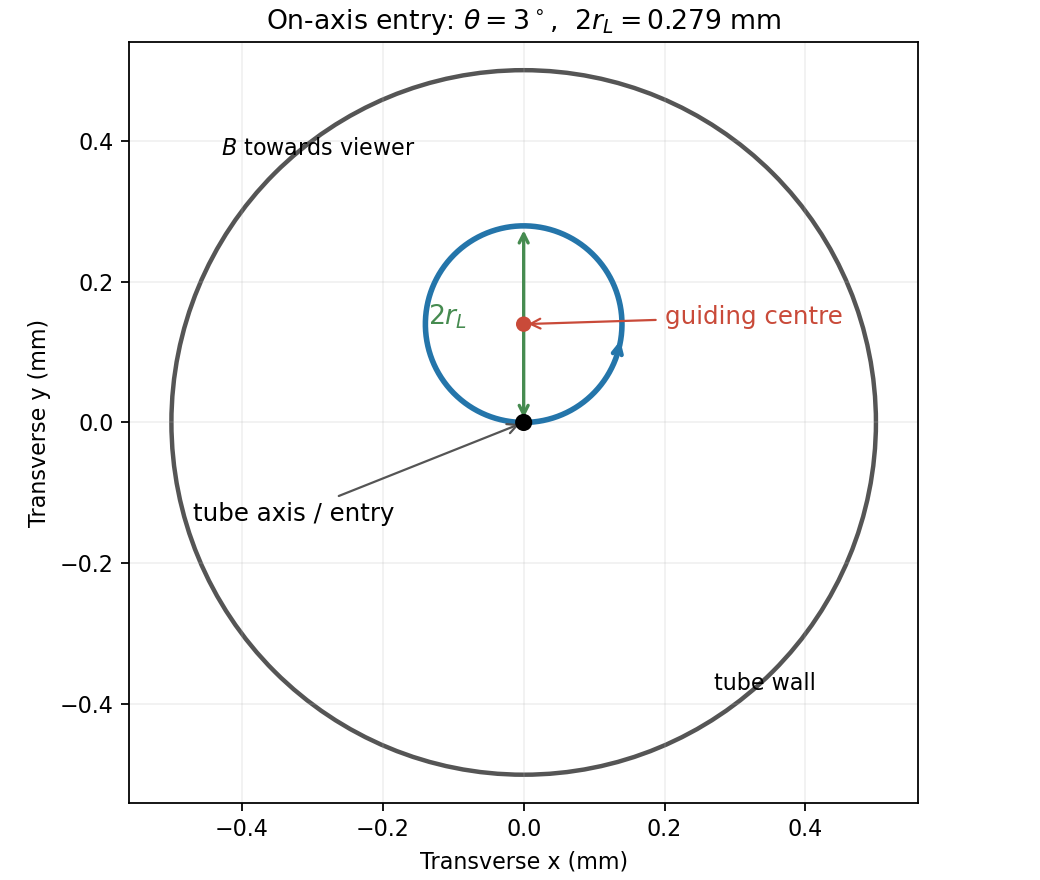
End-on electron orbit: the circle passes through the tube axis and reaches twice its Larmor radius from it
. Details. 
Using the nonrelativistic approximation appropriate to ,The cyclotron period is , so the flight lasts revolutions. The electron therefore crosses the axis again four times before leaving. At , . Wall clearance requires , givingThe transit is longer than a full orbit, so the maximum transverse excursion really is sampled before exit.
For the solenoidal time-of-flight energy window, the prescribed time fixes , while . ThereforeThese are total kinetic energies. The upper value is the ideal grazing limit; if touching the wall counts as rejection, it is a supremum approached from below.
The de Broglie wavelength fixes the same momentum , but the nonrelativistic electron has :Here , consistent with the stated nonrelativistic approximation. The photon energy and electron kinetic energy are not interchangeable.
Here is potential energy, is the stationary state's total energy, and is its spatial probability amplitude. The wave function has time factor ; is a position probability density for a normalized state. Stationary plane-wave scattering solutions are idealizations described by probability-current ratios, or components of a normalizable wave packet.
Above an upward step, a classical particle is fully transmitted with reduced speed. Quantum mechanically the abrupt wavelength change generally produces both reflected and transmitted amplitudes even though both regions are classically allowed. With unit incident amplitude and no wave arriving from the right,The reflected component has signed wavevector and the same wavenumber magnitude as the incident component. A finite potential jump with constant mass and no delta interaction requires continuity of and :The probability current gives probability reflection and transmission and , with . The amplitude may exceed one without violating conservation of total probability, because the transmitted group speed is smaller.
For , let . The bounded right-hand solution is , an evanescent wave tail with amplitude penetration scale . It carries no outgoing probability current in an infinitely long forbidden half-space, so reflection is total. This differs from transmission through a finite potential barrier, where a second boundary can support quantum tunnelling.
For a downward step, replace by . The same boundary conditions give a nonzero negative , corresponding to a reflected amplitude with phase reversal. If reflection were forbidden, would require both and , impossible for a nonzero step. Reflection therefore does not require a classical potential barrier; the discontinuity of wavenumber mismatch is enough.
For the specified electron energies, , so the requested amplitude coefficients areThe corresponding probability coefficients are approximately and . electron mass cancels from these ratios; there is no need to invent an additional material effective mass.
The threshold must conserve both energy and momentum. For head-on photons, the total energy is , while the total momentum has magnitude . Their combined invariant mass satisfiesAt the threshold for photon-photon pair production, the electron and Positron have no relative momentum in their centre-of-momentum frame, so . ThereforeSimply equating the laboratory energy to would miss the very large laboratory momentum: the newly produced pair must carry it away.
Past exam of the physics course of the year 1 of the natural sciences course of the University of Cambridge 2018 Section A 5 Solution Created 2026-10-18 Updated 2026-10-20
For a photon, the photon energy formula and the vacuum relation give . For an electron, the de Broglie wavelength gives the same momentum magnitude , but the nonrelativistic kinetic energy is . Using , and ,Thus, to the precision of the wavelength,The electron answer is its kinetic energy, as required for the diffraction experiment; its relativistic energy would additionally include the approximately rest energy. Since , the nonrelativistic approximation is well justified. Equal wavelengths imply equal momenta, not equal energies for particles with different energy–momentum relations.
Past exam of the physics course of the year 1 of the natural sciences course of the University of Cambridge 2018 Section A 6 Solution Created 2026-10-18 Updated 2026-10-20
Put the charged sheet at and the grounded plates at . By symmetry the electric field points away from the positive sheet with equal magnitude in the two gaps. A Gaussian pillbox crossing the sheet givesThe plate boundary conditions fix their electric potentials to zero. For the charged sheet between grounded parallel plates, the central potential isWith vacuum permittivity , . An electron has electric charge , so moving from a grounded plate to this positive potential decreases its potential energy by . Conservation of energy then givesThe unrounded value is , about . Either plate gives the same speed. The ideal calculation neglects the electron's disturbance of the prescribed field and image-force effects at its release point, consistently with treating it as a test particle.
Past exam of the physics course of the year 1 of the natural sciences course of the University of Cambridge 2019 Section B 9 Solution Created 2026-10-18 Updated 2026-10-20
Experimental evidence. Tests of special relativity check linked predictions about light propagation, clocks and four-momentum. Several independent kinds of experiment support those predictions.
- In the Michelson-Morley experiment, light follows perpendicular paths in an interferometer. Rotating the apparatus would change their round-trip travel-time difference in a classical stationary-aether model. The expected orientation-dependent interference fringe shift was absent at the predicted scale, consistent with isotropy of the round-trip speed of light in special relativity. This experiment alone does not distinguish special relativity from every alternative theory.[ref]On the Relative Motion of the Earth and the Luminiferous Ether by Albert Abraham Michelson and Edward W. Morley. 1887 report, apparatus and predicted versus observed orientation-dependent fringe shifts
- The Fizeau experiment compares light propagation with and against flowing water using an interference fringe displacement. Neglecting optical dispersion, the velocity-addition formula predicts
The Hypotheses Relating to the Luminous Aether by Hippolyte Fizeau. 1851 report, counter-propagating beams, reversing water flow and resulting fringe displacements
- A controlled muon storage-ring time-dilation experiment measured circulating muons at . Its measured mean lifetimes were about , compared with about at rest, consistent with . This tests time dilation with accelerator-selected particles.[ref]Measurements of relativistic time dilatation for positive and negative muons in a circular orbit by J. Bailey and others. 1977 abstract, Lorentz factor and positive- and negative-muon lifetimes
Atmospheric muons and the two frame descriptions. Atmospheric cosmic rays create unstable particles whose decay chains produce muons. A stopped-muon experiment measures the time between a stopping signal and the subsequent decay electron, obtaining the proper mean lifetime . The associated light-travel distance is only , yet substantial numbers of energetic atmospheric muons reach detectors after travelling several kilometres.
For an ideal selected cohort produced height above a detector and moving downward at constant speed , the flight time in the terrestrial frame is . Time dilation predicts a laboratory mean lifetime , hence survival fractionWithout time dilation, the predicted exponent would be and the surviving population much smaller. Altitude comparisons constitute a cosmic-ray muon time-dilation experiment: select comparable momenta or energies and account for detector acceptance, atmospheric energy loss and backgrounds before interpreting the count ratio.
For illustration, not as a claimed measurement, take and . Then , the laboratory flight time is , and the predicted surviving fraction is about . Omitting time dilation would give only about on the same idealized constant-speed model.
In the muon rest frame, its decay still follows . The atmosphere and ground move upward. Their separation, measured simultaneously in that frame, is shortened by length contraction:The same survival fraction follows. The terrestrial description uses a longer-lived moving particle; the muon-frame description uses a shorter atmospheric flight path. They describe the same production and detection events. This consistency illustrates both time dilation and length contraction, while the survival measurement is not two independent experimental tests merely because it can be described in two frames.
Energy-momentum invariant. For a particle with rest mass ,Since , substitution and cancellation of giveThis relativistic energy-momentum relation reduces to when .
Laboratory beam energies. If both final muons are at rest in the laboratory, their total momentum is zero and their total energy is . Four-momentum conservation therefore requires equal and opposite incoming momenta. Because the electron and Positron have equal rest masses, they then have equal total energies:Subtract each particle's own rest energy:Using the usual handbook rest energies gives approximately for each beam. These are the ideal kinematic threshold values. Just above threshold, the pair has small, equal and opposite momenta in this laboratory frame.
Positron momentum. Apply the relativistic energy-momentum relation to and use its stipulated negative- direction:The electron has the opposite momentum, with .
Boost to the electron rest frame. The electron's velocity is . Thus moves in the positive- direction, and its Lorentz factor satisfiesThe positron has the same laboratory total energy as the electron, so . The supplied Lorentz transformation then givesAs a sign check, the same boost gives , as required for the electron rest frame.
Past exam of the physics course of the year 1 of the natural sciences course of the University of Cambridge 2022 Section A 5 Solution Created 2026-10-18 Updated 2026-10-20
Write for the side length. In an equilateral triangle, the distance from centre to a vertex is ; it is two thirds of the altitude . By the superposition principle, the electric potential at the centre due to the three fixed electrons isHere is the elementary charge and the vacuum permittivity. The approaching electron has electric charge , so its potential energy, measured relative to infinity, is positive:The fixed sources do not move, and radiation is excluded. Hence conservation of mechanical energy givesUsing , for the electron mass, and givesThis speed is small enough to justify classical kinetic energy. There is an idealization in the word “stops”: along the line normal to the triangle through its centre, this threshold energy makes the electron approach the central equilibrium asymptotically. A smooth, conservative trajectory cannot reach an equilibrium with exactly zero velocity in finite time unless it was already there. The energy threshold, and therefore the requested initial speed, is nevertheless unambiguous.
Past exam of the physics course of the year 1 of the natural sciences course of the University of Cambridge 2022 Section B 9 a Solution Created 2026-10-18 Updated 2026-10-20
The time-independent Schrödinger equation is the energy eigenvalue equation for a particle of mass . The Hamiltonian operator is the sum of the kinetic operator and the prescribed potential energy . Here is the reduced Planck constant. A corresponding stationary state is . The Born rule identifies as probability density for a state with wavefunction normalization ; integrating it over an interval gives a position probability. A plane wave scattering state is not a normalizable wavefunction on the whole line, but its probability currents give the reflection and transmission fractions of an incident wave packet.
There is a notation discrepancy in the sources: the original PDF prints an unbarred in the kinetic term, whereas the local TeX uses . The standard physical equation uses the reduced Planck constant , where is the Planck constant; that convention is used below. Reading the printed literally as the Planck constant would scale all lengths in this model by relative to the standard answers, but would leave the amplitude ratios unchanged.
For , both sides allow oscillatory wavefunctions. A classical particle always crosses the potential step and slows because its kinetic energy falls from to . In quantum mechanics there is generally both reflection and transmission even though the particle is above the step. Define the positive wavenumbersWith no wave incident from the right, writeA finite potential step with constant mass makes both the wavefunction and its first derivative continuous. The two boundary conditions at areSolving gives the reflected and transmitted wavefunctionsFor the specified electron energies, , so the relative probability amplitudes areThe transmitted probability amplitude exceeding one is compatible with conservation of quantum probability, since the outgoing speed is smaller. In fact the probability current givesThese are the quantum reflection probability and transmission probability, which must be distinguished from the requested relative amplitudes.
Past exam of the physics course of the year 1 of the natural sciences course of the University of Cambridge 2022 Section B 9 c Solution Created 2026-10-18 Updated 2026-10-20
A scanning tunneling microscope brings a tip and surface, both electrical conductors, close enough to leave only a small vacuum gap. An applied electric potential difference makes occupied electron states on one side able to feed unoccupied states on the other. Although the gap is a classically forbidden potential barrier, quantum tunnelling through its finite width produces an electric current.
For an approximate rectangular potential barrier of gap width , the transmission probability, and thus the electric current at fixed small bias, varies approximately as . This strong distance dependence makes the device sensitive to changes in separation on the scale of a chemical atom. Feedback control moves the tip vertically to keep the electric current constant during a scan; the required height changes form an image of the surface, with contrast also depending on its electronic states. The finite gap permits transmitted probability current, whereas the semi-infinite step in part (b) does not.
Substitution into the Schrödinger equation gives . For the stated electron well,The transition emits the energy difference, , soUsing the full excited-state energy as the photon energy would neglect the nonzero ground-state energy.