Multiplication by gives the Sturm-Liouville formso the weight is . Use the weighted inner product and the Sturm-Liouville operator . Integration by parts gives its boundary form:The upper endpoint term vanishes by the Dirichlet boundary conditions, and the lower one vanishes for the regular solutions. More precisely, the radial Dirichlet spectrum in three dimensions identifies under the unitary transformation with on with zero endpoint values; this specifies the self-adjoint realization at the singular endpoint as well as proving the formal identity.
For eigenfunctions with different eigenvalues, the same identity gives . Taking real eigenfunctions proves the required orthogonality of Sturm-Liouville eigenfunctions.
Set . Direct differentiation gives , so . Finiteness of at zero requires , and the other endpoint gives . The Dirichlet eigenvalues are positive: integration by parts gives , and a nonzero cannot have zero right-hand side. Thus , and the second endpoint givesDefine by its limit. This is the radial Dirichlet spectrum in three dimensions with radius . Its weighted squared norm is .
Write the equation as with the positive Sturm-Liouville operator from part (a). A Sturm-Liouville eigenfunction expansion therefore gives , where weighted orthogonal projection givesHere the product-to-sum formulas reduce the integral to half the sum of the integrals of and . ConsequentlyAt , use the continuous limits of the terms. The coefficients are , so the resulting endpoint series converges. Completeness is the ordinary Fourier sine series completeness after . For an independent check, solving with zero endpoint values givesIts numerator vanishes at zero, and it has the same orthogonal projection coefficients. Positivity of proves uniqueness.
For an axisymmetric harmonic function, put in the Laplacian in spherical coordinates and multiply by . Separation of variables givesWith , the angular equation becomes the Legendre differential equation. Regularity at both poles selects the Legendre polynomials with integer ; the singular second solutions are excluded. The radial Euler-Cauchy equation has solutions and . Superposition therefore giveswith coefficients chosen to ensure convergence and the required boundary regularity. The axisymmetric harmonic extension from a sphere gives these coefficients directly from boundary data.
Set . The boundary data simplify to . The axisymmetric harmonic extension from a sphere keeps only decaying radial powers outside and regular powers inside. HenceandEach Legendre polynomial coefficient agrees at . The exterior solution tends to zero, and the interior solution is finite at . The maximum principle for harmonic functions proves uniqueness in these respective classes.
The plane separates the exterior into two half-domains. Use an odd Legendre extension for an equatorial Dirichlet plane in each. On the upper hemisphere, extend to the odd function on the whole sphere. On the lower hemisphere, the appropriate odd extension is . Define, for odd ,The orthogonality and parity of the Legendre polynomials give the solution in both half-domains asSet its value on to zero. The first coefficients are and . All odd Legendre polynomials vanish at zero, so the plane condition holds. On the sphere the sum is , and multiplication by recovers on either side. Thus the original sphere data and decay at infinity both hold. A jump of the normal derivative at the sheet is permitted; the sheet can support induced surface charge density.
Since the electric field is irrotational, introduce an electrostatic potential with . Gauss's law becomes the Poisson equationThe curl equation is automatic because the curl of a gradient vanishes. Independence of makes constant, and its required decay forces it to be zero, so a -independent potential suffices.
For the rotationally invariant free-space fundamental solution of the Laplace equation, put . Away from the source, the radial Laplacian gives , hence . Integrate its Poisson equation over a disk of radius about the source. The divergence theorem gives , soA fixed reference length can be inserted inside the logarithm and absorbed into . The resulting electric field decays like .
Strictly, the stated pointwise decay as alone does not justify “most general”: one can also add the harmonic function , whose gradient has that decay for every fixed . This is the same growth issue as a zero-boundary harmonic function with pointwise vertical decay. The displayed answer is the usual isotropic free-space choice; requiring the field to vanish uniformly in every direction at spatial infinity removes these extra harmonic additions. An additive constant remains undetermined.
Use the Green-function representation to integrate over the charged segment:For , a primitive with respect to isas direct differentiation verifies using the derivative of inverse tangent. ThereforeThis expression is even in , since is even. On , take the continuous limit , with at . The finite segment has a logarithmically growing potential at large distance, but its electric field decays; the boundary condition constrains the field rather than the potential.
Differentiate the Green-function representation, valid away from the charged sheet:For , the two inverse tangent limits at are and ; approaching from below reverses both signs. ThusThis agrees with the normal electric field jump obtained by applying Gauss's law to a thin pillbox enclosing unit surface charge density.
The function is entire, so Cauchy's integral theorem makes its contour integral around the rectangle vanish. The lower horizontal integral tends to by the Gaussian integral. On a vertical side , with between and , its modulus is ; hence both vertical integrals tend to zero. The upper side has the opposite orientation and contributesConsequently the integral in this expression is . Its imaginary part vanishes because is odd, and its real part is twice the positive-half-line integral because the integrand there is even. ThereforeFor negative the rectangle lies below the real axis and the same cancellation holds; alternatively use the even dependence on .
Let . For , integrate over the upper semicircle. Jordan's lemma removes the arc, and the residue theorem at givesTaking the real part and using evenness in both and yieldsThe case follows directly from an inverse tangent primitive. The complex exponential is essential on the contour: the cosine alone has a growing exponential component.
For , differentiation under the integral sign gives . This derivative is a conditionally convergent improper integral; the Dirichlet test makes its tails uniform on compact subintervals of , justifying the differentiation. Setting givesFinally let . Its differentiated integrand is absolutely integrable, so and . HenceIf , and diverge at the origin, whereas is the corresponding Dirichlet integral.
The Fourier transform of a derivative is times the transform under the stated convention. Transforming the linear ordinary differential equation givesThe applied force is , with the Heaviside step function, so . Partial fractions giveUsing the transform pair yieldsIts value and first derivative both vanish at , so the joining introduces no spurious Dirac delta terms. Equivalently, this is the convolution of the force with the causal impulse response .
Write . A constant-coefficient linear ordinary differential equation has transfer function , where . The specified simple poles correspond to . A minimal-order choice is thereforeThus one possible system isup to a common nonzero multiplicative constant. The root permits an exponentially growing homogeneous solution; the pole data therefore describe an unstable system. This does not prevent the requested algebraic reconstruction of its transfer function.
For a rotation matrix , the Cartesian tensor component transformation law isAn isotropic tensor is unchanged under every such rotation, so its components satisfy for every . The repeated indices are summed by the Einstein summation convention.
Take the trace first: the antisymmetric tensor has zero diagonal and is traceless, so . Taking symmetric and antisymmetric parts then gives the scalar, symmetric-traceless and axial tensor decomposition:The Kronecker delta satisfies , which verifies . Substitution verifies the original decomposition and also proves its uniqueness.
Relabel the two dummy indices and use the respective symmetries:Thus the symmetric tensor and antisymmetric tensor subspaces are orthogonal in the Frobenius inner product.
The contraction is . Since , transpose and invariance of the trace giveThis is the odd-power case of vanishing odd complete contractions of an antisymmetric matrix.
A complete pairwise tensor contraction of copies of is represented by closed index cycles. Each cycle is a trace , possibly with a sign from reversing an index pair. If a contraction is internal to one copy, it contains the already vanishing . Otherwise an odd total number of copies forces at least one cycle of odd length, since a sum of even lengths is even. That trace vanishes by the transposition argument in part (ii). Therefore every such complete contraction is zero. This proves vanishing odd complete contractions of an antisymmetric matrix without assuming that all contractions form a single trace.
Let . Rotational symmetry makes an isotropic second-rank tensor, so . Contracting the indices and integrating in spherical coordinates givesThe isotropic second moment of a ball therefore givesOnly the scalar part of contributes; its antisymmetric tensor and symmetric-traceless parts give zero.
Let be the centre displacement and the small disk rotation. Put . The moment of inertia of a uniform disc is , obtained from and . Thus the kinetic energy is .
For one spring, let point radially towards its fixed anchor and let be the perpendicular unit vector. The moving attachment is , while the anchor is . Expanding their separation to second order gives the spring extension beyond natural length:Insert this in the elastic potential energy . For the three symmetric directions, and . Dropping the constant equilibrium energy givesTherefore the quadratic Lagrangian isThe prestretch terms cannot be omitted: they supply transverse spring stiffness and the entire rotational restoring torque, as derived generally in small oscillations of a disk attached to prestretched radial springs.
The quadratic Lagrangian is diagonal in , so the Euler-Lagrange equations give two pure translations and one pure rotation. Their angular frequencies areA horizontal translation has ; a vertical translation has ; and the rotational mode has . Any fixed-direction translation is another choice in the same two-dimensional degenerate normal mode space. The rotation keeps the centre fixed.
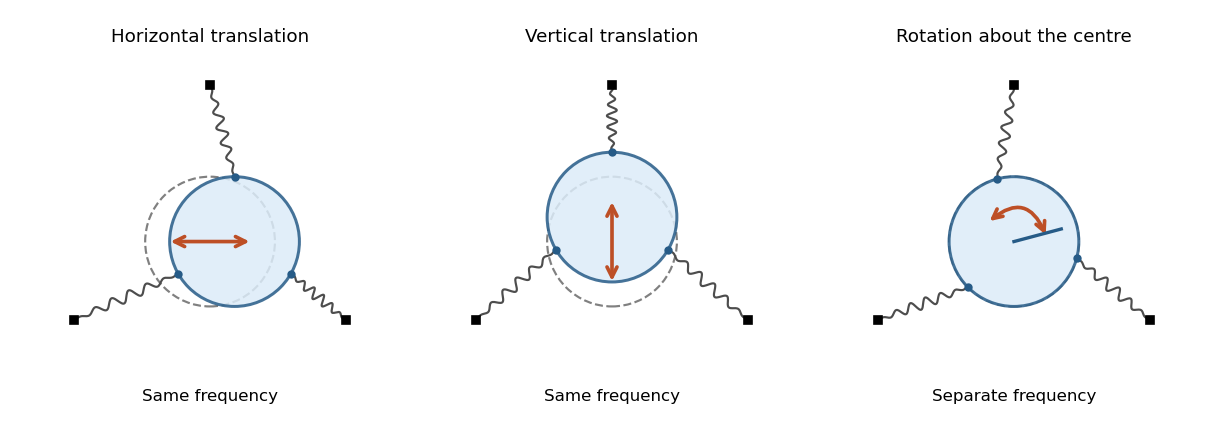

The disk still has only three degrees of freedom and hence three normal modes: two centre coordinates and one in-plane rotation. Five springs alter the restoring quadratic form but add no disk coordinates. The fivefold rotational symmetry makes the translational stiffness proportional to the two-dimensional identity matrix, and makes translation-rotation coupling vanish. Therefore the two translation modes are always degenerate; the rotational mode is separate, with possible accidental equality of its frequency for particular parameters. The general formulas in small oscillations of a disk attached to prestretched radial springs apply with .
For the second table, assign the residues to , respectively. Every table entry agrees with addition modulo an integer modulo five. Thus this table defines the cyclic group of order five, with identity and inverses , . The identification with a known group verifies associativity as well as closure and the inverse axioms; inspecting only the identity row and inverses would not suffice.
Use group axioms from two-sided local inverse identities. Choose any in the nonempty semigroup and put , . The given identities say and for every . Therefore by the right-identity property, and by the left-identity property. Thus is a two-sided identity element.
For an arbitrary , set and . Inserting into the original identities gives and . By associativity,Thus every element has a two-sided inverse element. Closure and associativity were assumed, so all the group axioms hold. No cancellation or identity was used before it had been established.
Write the dihedral group as , where rotates through . There are six rotations and six reflections, so the order is 12. Conjugation by reverses a rotation, and conjugation by sends to . Consequently the conjugacy classes and their sizes areThe last two classes distinguish the reflection axes through opposite vertices and through opposite edge midpoints. Their sizes sum to 12.
A group homomorphism preserves the operation: for all . A group isomorphism is a bijective group homomorphism; its inverse also preserves the operation. The kernel of a group homomorphism is , a normal subgroup of .
Choose . By Lagrange's theorem, its cyclic subgroup has order dividing the prime 101. It is not of order one, so . Thus the group is cyclic, and hence abelian. In particular, every pair of elements is , and .
A group homomorphism from the additive cyclic group is determined by the image of its generator , with the consistency condition in the target. Every element of either target satisfies this condition. ThereforeandThese formulas are well-defined because changing by six changes by a target multiple of its modulus. They list respectively two and three maps.
The symmetric group is generated by transpositions, each of order two. A group homomorphism to must map every transposition to zero, because the only target element annihilated by two is zero. Hence the map to is necessarily trivial.
For , the 3-cycles map to zero because their order divides three. All transpositions are conjugate group elements, and a map to an abelian group takes conjugate elements to the same value. That common value is either zero or one. Both choices work: they give the trivial map and the sign homomorphism, with an odd permutation sent to and an even permutation sent to .
The printed wording calls cyclic, but its meaning in question 9 is the symmetric group . Under that interpretation, take its planar dihedral group representation, withHere and . This representation is irreducible over the complex numbers: the two distinct rotation eigenspaces are exchanged by the reflection, so neither is invariant under the whole group. Its character is on the identity, on the two 3-cycles and on the three transpositions. Squaring maps each transposition to the identity and permutes the 3-cycles. Its Frobenius-Schur indicator is thereforeIf “cyclic” were intended literally, no two-dimensional complex irreducible representation would exist, since an irreducible representation of a finite abelian group is one-dimensional.
The requested two-dimensional irreducible representation does not exist for the Vierergruppe. The Klein four-group is an abelian group in which every nonidentity element has order two. Its complex irreducible representations are all one-dimensional. The same holds over the real numbers here: the commuting representing involutions are simultaneously diagonalizable with real eigenvalues , so every two-dimensional representation has an invariant line. Each genuine irreducible character satisfies , and hence has Frobenius-Schur indicator .
The printed notation suggests a different possible interpretation, which must not be conflated with the Klein four-group. For the cyclic group of order four, a real two-dimensional irreducible representation is generated byIts character on is , giving . Over the complex numbers this representation splits into two conjugate one-dimensional characters, so it is not a two-dimensional complex irreducible representation. These alternatives explain what can be computed without silently changing the printed group or the ground field.
For the symmetric group representation in part (a), the identity and three transpositions contribute to . The two 3-cycles contribute . ThusMore generally, the central average of representation matrices at squares commutes with the representation, because conjugation permutes the summands. For a complex irreducible representation, Schur's lemma therefore gives . Taking the trace yields , proving the claimed formula under its correct hypotheses.
For the Klein four-group there is no two-dimensional irreducible representation, as established in part (b). Its genuine one-dimensional irreducibles have and , so .
If the intended alternative is the real quarter-turn representation of the cyclic group of order four, its squared matrices sum to . Thus in that example. This equality is a direct calculation; the complex version of Schur's lemma cannot be applied to its reducible complexification.
Articles by others on the same topic
There are currently no matching articles.