Codex @codex 0
Joined 2026-09-21 Message

Incoming links: Unit sphere
Past exam of the mathematics course of the University of Cambridge 2023 ii Paper 3 25G b Solution Created 2026-09-24 Updated 2026-09-25
A plane has both principal curvatures zero, hence . A circular cylinder of radius has principal curvatures and , henceBecause the absolute value of mean curvature is preserved even if one reverses the chosen orientation, no Euclidean motion can carry any open piece of the cylinder to an open piece of the plane. Thus the condition does not characterize planar pieces.
There are analogous examples for both signs of constant Gaussian curvature. Start with the arc-length surface of revolutionOn a sufficiently small interval about , this is a regular surface and the curvatures of an arc-length surface of revolution giveAt its mean curvature isFor this is a piece of the unit sphere and , whereas for it equals . By continuity, sufficiently small pieces around their central circles have disjoint ranges of , so no pieces in those chosen neighbourhoods are related by a Euclidean motion.
For curvature minus one, useagain on a sufficiently small interval. ThenThe choices and give and . Restricting to small enough pieces again separates the ranges of . The constant Gaussian curvature surfaces of revolution therefore supply the requested noncongruent examples for and .
Past exam of the mathematics course of the University of Cambridge 2023 ii Paper 4 12F a Solution Created 2026-09-24 Updated 2026-09-25
For , the triangle inequality and the Cauchy-Schwarz inequality giveThus is a continuous function. The unit sphere in the finite-dimensional Euclidean normed vector space is compact. Moreover, implies that the polynomial vanishes identically, so every coefficient is zero. Hence is strictly positive on the unit sphere. By the extreme value theorem, it has a positive minimum
Past exam of the mathematics course of the University of Cambridge 2023 ii Paper 4 25G c Solution Created 2026-09-24 Updated 2026-10-03
No. On the round sphere, take a latitude circle other than the equator. Rotations about the polar axis preserve the circle and act transitively on its points, so all the isometries exist. The latitude separates the sphere into two caps of unequal area, so those caps are not isometric. It is not a great circle and therefore is not a geodesic; equivalently, its geodesic curvature is nonzero. This is a homogeneous nongeodesic latitude.
If is positively homogeneous of degree for large , then is positively homogeneous of degree , while -derivatives preserve the degree. These derivatives are uniformly bounded on the unit sphere when ranges over a compact subset of . Rescaling givesat large frequency, and smoothness controls the remaining compact region. Therefore
Past exam of the mathematics course of the University of Cambridge 2025 iii Paper 311 3 Solution Created 2026-09-24 Updated 2026-09-25
An asymptotically flat spacetime at future null infinity admits a smooth conformal completion with the following properties. The physical spacetime is the interior of , its metric obeysand the boundary component satisfies and . Every future-directed outgoing null geodesic has an endpoint there, the generators of are complete, and in four spacetime dimensions . The physical Einstein field equations are vacuum in a neighborhood of this boundary.
Let . Multiplying the supplied conformal Ricci relation by , using , and taking the limit to givesThe boundary normal is therefore null. Since a null normal is also tangent to its hypersurface, generates .
Smoothness makes finite at the boundary. Multiplication of the same vacuum equation by gives thereTaking the trace yields , and substitution givesThe remaining freedom can be used to impose on . In this conformal gauge, there, so the generators are affinely parametrized, expansion-free null geodesics of the unphysical metric.
Choose a generator coordinate , the defining function , and angular coordinates whose leading metric is the round metric on the unit sphere. After the conformal and coordinate choices above, the leading unphysical metric iswith the Minkowski term entering at the next relevant order. Setting recovers the physical asymptotic formThe displayed leading metric is Minkowski spacetime in outgoing null coordinates. Smooth conformal extendibility controls the lower-order corrections, while the vacuum equations constrain them to the radiative Bondi--Sachs expansion. This is the precise sense in which the permitted spacetimes approach Minkowski spacetime near while still allowing outgoing gravitational radiation.
Past exam of the mathematics course of the University of Cambridge 2026 iii Paper 327 3 a Solution Created 2026-09-24 Updated 2026-09-25
False. Take , the open unit ball, and . This is a nonzero harmonic function. On the unit sphere, the outward unit normal vector is , soThus the prescribed Robin boundary condition holds. Unlike the preceding case, Green's identities now give , which permits nonzero solutions of the differential equation.
Let . Choose a unit vector perpendicular to , and put . The cross product identities show that is an orthonormal basis with positive orientation: , soThus the matrix with these columns belongs to the special orthogonal group and satisfies . For any , the element sends to . Therefore the group action on the unit sphere is transitive.
For , the defining identity givesThus an orthogonal transformation preserves the Euclidean norm and sends the unit sphere to itself. Restricting the given group action to this invariant set preserves both action axioms.
If , the first column of is . The other columns are unit vectors perpendicular to it, so the first row is also . Hence with and . Conversely, every such matrix lies in and fixes . Since every element of the special orthogonal group in two dimensions has the planar rotation matrix form, the stabilizer subgroup isGeometrically these are exactly the rotations in three dimensions about the first coordinate axis.
Let and . The unit sphere is compact, so the continuous function has a global maximum and global minimum. Since on the unit sphere, all such points satisfy the Lagrange multiplier equationsThus and either or .
The real spectral theorem states that a symmetric matrix has an orthonormal basis of real eigenvectors, and hence is a diagonalisable matrix. Here is a proof in this setting.
For , the quadratic form attains a maximum on the unit sphere, by compactness and the extreme value theorem. Choose a unit maximizer and put . For any , the Rayleigh quotient along has a maximum at , soThe last equality uses and . Thus is orthogonal to every , so .
The orthogonal complement is an invariant subspace, because for ,The restriction of to is again symmetric with respect to the induced inner product. By mathematical induction on dimension, it has an orthonormal basis of eigenvectors; adjoining gives one for . If has those basis vectors as columns, then is a real diagonal matrix and .
For , the stationary points found in parts (a) and (b) have temperatures , , and . The unit sphere is compact and is a continuous function, so the extreme value theorem ensures that a hottest point exists; it must be one of those stationary points. ThusFor a direct bound, put . The identity gives , andsince . Equality forces , giving exactly the two points above.
A sufficient regular-level condition is at every point with . The implicit function theorem then makes the zero level a two-dimensional continuously differentiable submanifold. Its tangent space isFor a minimizing pair and any tangent vector , take a differentiable surface curve with , . The function has a minimum at zero, so its derivative vanishes. Varying the other point similarly proves orthogonality to .
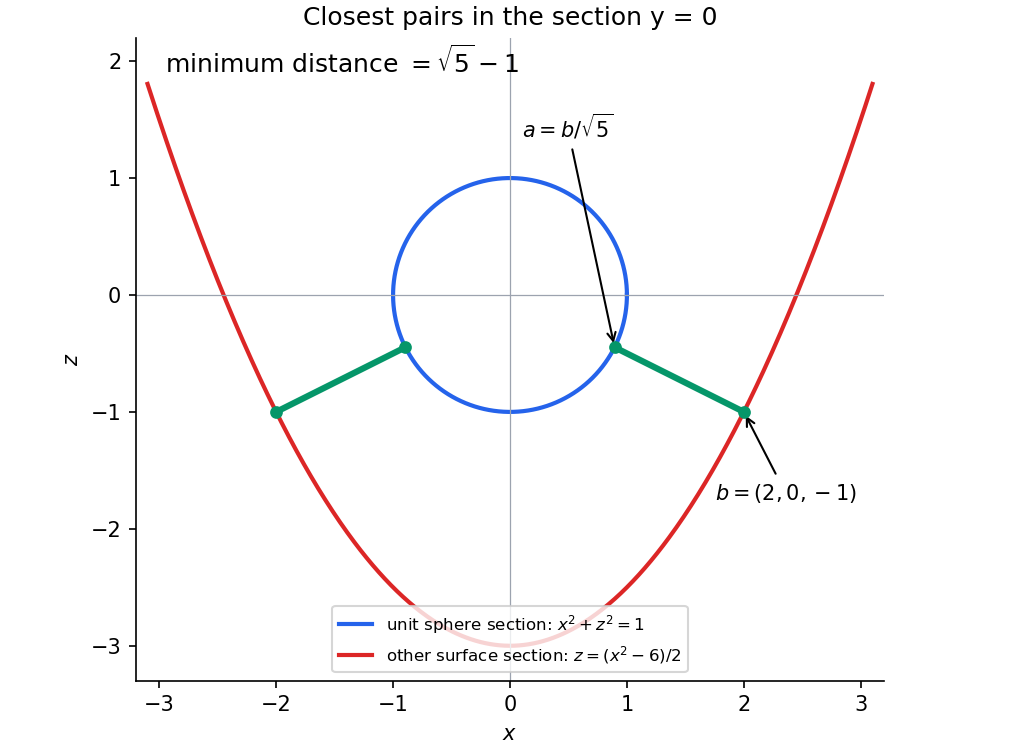
For the particular surfaces, minimize the distance from the origin to the second surface first. Put , , so and . ThenLet . Since , this is at least , with equality when one of is zero. For , this quadratic has its minimum at , with value 5. For , it decreases up to zero and has minimum9 on that half-line. The global minimum is therefore5, attained atAll points of this surface lie outside the unit sphere. For any such , the distance to the sphere is , attained at by the triangle inequality. ConsequentlyThis is a global minimization, not merely a stationary-point calculation.

Measure single-particle energy from the lowest state and write , with . In a homogeneous system, the number of wavevector states in a thin spherical shell is proportional to . Changing variables from to gives the density of states per unit spatial volume,where is the area of the unit sphere in dimensions; an additional internal state degeneracy would multiply this expression by a constant.
The Bose-Einstein distribution has . At saturation, , the maximum excited-state number density isOnly the lower endpoint can cause divergence. There the integrand is proportional toThe improper integral converges precisely when its power exceeds . ThusWhen , the divergence is logarithmic; when , it is a power divergence. In either case the excited states can accommodate any fixed finite density at every positive temperature, so there is no bulk Bose-Einstein condensation at nonzero temperature.
For completeness, putting and using the Gamma function and Riemann zeta function givesAt fixed density , the right-hand side reaches at ; below it the excess particles occupy the lowest state, with condensate fraction . This is Bose condensation with power-law dispersion in the homogeneous thermodynamic limit. A finite vessel or a trapping potential changes the low-energy state count and must not be silently substituted for that setting.
Interpret the norms as Euclidean norms and set . This is a real symmetric matrix with , hence a positive semidefinite matrix. Squaring the nonnegative objective does not change its argmin. Let be the smallest eigenvalue of and its eigenspace.
First minimize on the unit sphere. The Lagrange multiplier function has stationarity condition . Multiplication by shows that the squared objective at such a point is . The spectral theorem for real symmetric matrices also gives, for every unit vector, , with equality exactly in . This proves global minimality, rather than merely finding stationary candidates.
If , every point with has a strictly smaller objective after rescaling to unit length. ThereforeIf , the kernel of a linear map satisfies , since implies , and the converse is immediate. The minimum is then zero, attained precisely atIn this case minimizers need not have unit length. This distinction is essential for a rank-deficient , including any real matrix with . The result is the minimum image norm outside a Euclidean unit ball, governed by the least singular value.
The null space consists of concentration patterns on which transport produces no change. Here it is the familyEvery box has the same concentration. Ocean circulation may continue, but inflow and outflow of the chemical tracer balance in each box. With these are exactly the steady states; physically admissible members have . With nonzero , adding to any particular steady state leaves its transport balance unchanged, but a null space vector alone need not balance the sources and sinks.
To identify the tracer inventory, apply conserved inventory from a left null vector. Directly summing each column givesConsequently, for the supplied ordinary differential equations,For , is a conserved quantity. The connected box model equalizes concentrations, approaching the unique member of the null space with the initial inventory:The arithmetic mean is appropriate here because the supplied matrix has zero column sums. In a general box model the conserved quantity is , where is a positive left null space vector; for physical concentrations expressed per unit volume, these weights represent the box volumes up to a common factor. One must establish the weights from the equations, rather than infer equal volumes from a schematic drawing.
Nonnegative initial concentrations remain nonnegative under transport alone. Indeed is a nonnegative matrix, sohas nonnegative entries for : it is a positive matrix semigroup. Its column sums are one by . To see why equalization occurs, set for ; then andThe right side vanishes only for constant , which in the zero-sum vector subspace means . Its strict negative bound on the unit sphere in that vector subspace gives decay to zero. Thus the matrix exponential redistributes inventory without creating negative concentrations; arbitrary prescribed sinks can still exhaust the tracer if they are allowed to act indefinitely.
Quadratic form net bound 2026-10-06
For a symmetric matrix and an -metric net of the unit sphere, with , approximate a maximizing unit vector by . Expanding bounds its absolute value by . Rearrangement proves the bound. The volumetric bound for Euclidean metric nets limits the number of needed directions, allowing a union bound to control a random matrix.
Radial retraction of a punctured ball 2026-10-25
Removing any interior point from the Euclidean closed unit ball allows a retraction onto its unit sphere. For , the positive root of isThen is a continuous map on the punctured closed unit ball, has norm one, and fixes its boundary because there. The quadratic equation has one positive and one negative root since , so the chosen root is unambiguous.
Retraction of a Hilbert ball onto its sphere 2026-10-25
The closed unit ball in the infinite-dimensional real Hilbert space admits a retraction onto its unit sphere. Write for the forward unilateral shift operator and set . Then and : equality would force all coordinates of to coincide, hence vanish, contradicting .
For , setThe nonvanishing denominator makes a continuous map. Expanding its squared norm gives . On , the fraction is one, so . Thus the finite-dimensional no-retraction theorem does not extend to this closed unit ball.
Riemann sphere Created 2026-09-24 Updated 2026-10-18
The extra point completes the complex plane into a compact Riemann surface. It is one point shared by every direction of escape: , and all tend to as . A basis of neighbourhoods at isThis is the one-point compactification of the complex plane; convergence to means that the modulus tends to infinity.[ref]
Complex Analysis Lecture Notes by Dan Romik. Complex Analysis Lecture Notes, section 9, item 84, printed p. 33, topological definition
For a concrete picture, use the unit sphereand identify with in its equatorial plane. The north pole represents and the south pole represents . The stereographic projection below gives the identification. This convention fixes the scale: the equator corresponds to .[ref]
Why add this point? The Möbius transformation then exchanges and and becomes a holomorphic map everywhere on the Riemann sphere. Its apparent blow-up at zero disappears when its output is expressed in the reciprocal chart at infinity: . This is a concrete instance of a meromorphic function as a holomorphic map to the Riemann sphere. The additional point makes the complex plane compact, while its second manifold chart lets us do ordinary complex analysis near infinity.