Topics (384k) Articles (398k) Users (410) Discussions (242) Comments (383) Files (13k) New article

For any real three-dimensional vectors , the displayed linear equation has the unique solutionTaking a dot product with first yields . Taking a cross product with and using the vector triple product identity givesSubstitution into the original equation cancels the longitudinal terms and proves the formula. Conversely direct substitution verifies it for all , including , since the denominator is positive. If , the underlying identity for linear maps is , using .
For radial acceleration , conserved specific angular momentum gives an angular radial frequency through the Binet equation. Successive pericentres differ by , so a small perturbation produces apsidal precession . Writing the unperturbed semilatus rectum as gives the displayed inverse relation. For a nearly circular orbit of period , use . Positive means prograde precession; is a length. A measured rate per century must first be converted to an angle per orbit.
The observed colour minus the inferred intrinsic colour in specified photometric passbands; for B and V it is .
Earth-rotation aperture synthesis uses Earth's changing orientation to vary a fixed ground baseline's projection onto the plane of the sky. In two dimensions, and are the components of along two perpendicular sky tangents. Tracking one field traces a curve in this plane; changing the physical baseline supplies other curves. A track samples Fourier transform coordinates, rather than the brightness along a track across the sky.
For a horizontal east–west baseline of length , choose the sky-axis signs so thatwhere is hour angle and is declination. The ellipse follows by projecting the rotating baseline onto sky tangents. At a celestial pole it is a circle; near the celestial equator its minor axis collapses. Thus the same ground layout constrains different sky directions unequally. Rotation improves coverage, but does not fill every spatial frequency, and synthesis across many hours assumes that the source changes negligibly during that interval.
For a differential one-form , a monomial integrating factor exists on a chosen domain away from the axes when constants makeThis follows by expanding the exactness condition . When are sums of monomials, matching their coefficients often reduces the search for to a small linear system. Integrating then gives the implicit solution . Curves excluded by the multiplying factor, especially solutions on coordinate axes, must be tested in the original equation.
Consider an original ideal one-dimensional monatomic harmonic oscillator chain with neighbor separation , mass and nearest-neighbor restoring coefficient . Its displacement equation isSubstitute the normal mode . Since ,Choose ångströms and . This is one acoustic phonon branch, distinct from the two-atom elastic example. It has and .
For coherent creation of one phonon in a crystal, the excitation's wave vector and the measured transfer obey , with a reciprocal lattice vector. To connect the dispersion relation to an illustrative intensity, take zero temperature, longitudinal displacements and the first interval , choosing . Expand the scattering phase to first order, . The constant term supplies elastic scattering; the linear term creates one phonon. Its displacement matrix element is proportional to , so the squared amplitude has weight , apart from common factors. Normalize this weight to one at :The limit follows from . Set and replace the ideal sharp line by a normalized Gaussian function:This chosen broadening illustrates readout width; it is not a measured resolution or a full spectrometer resolution function. Integrating over all gives . The small negative-energy tail is a broadening artifact, not a zero-temperature phonon-annihilation signal.
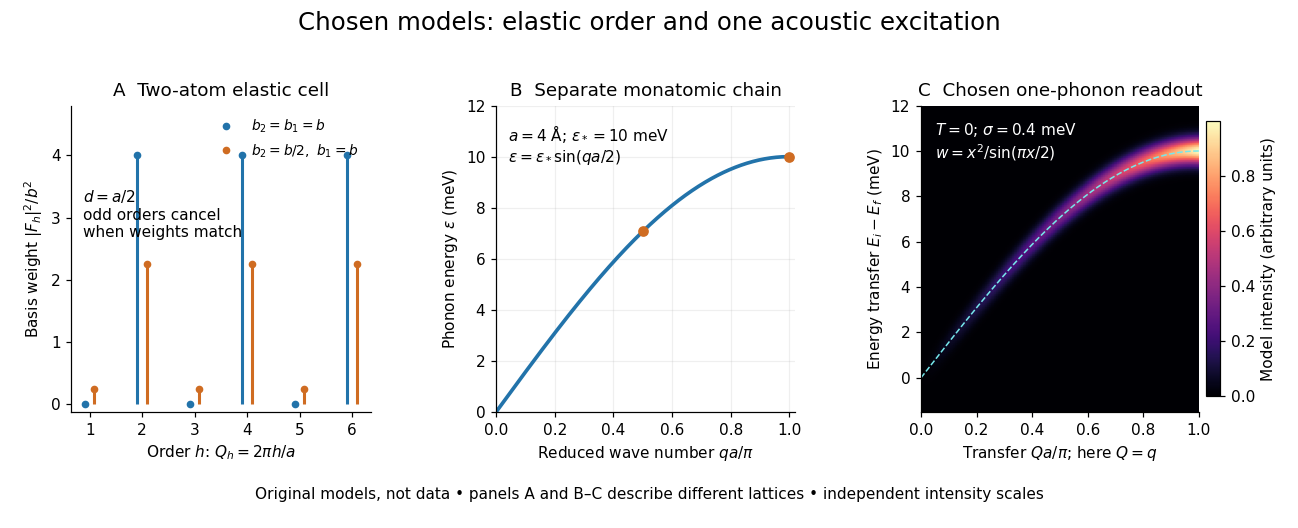
These panels separate three kinds of information: allowed reciprocal lattice positions, cancellation within a crystal basis structure factor, and an excitation's energy as a function of wave vector. The chain has no magnetic degrees of freedom, optical branches, damping or multi-phonon processes. It illustrates how one excitation could be read; it proves nothing about the completeness of a real material's excitation spectrum.
A triple-axis spectrometer uses Bragg's law at an initial crystal monochromator to select and at a second analyzing crystal to select . The sample sits between these selectors. The three axes refer to the monochromator, sample and analyzer rotations. The final counter measures accepted counts; the analyzer's wavelength selection makes those counts sensitive to outgoing energy even when the counter does not measure each neutron's energy directly.
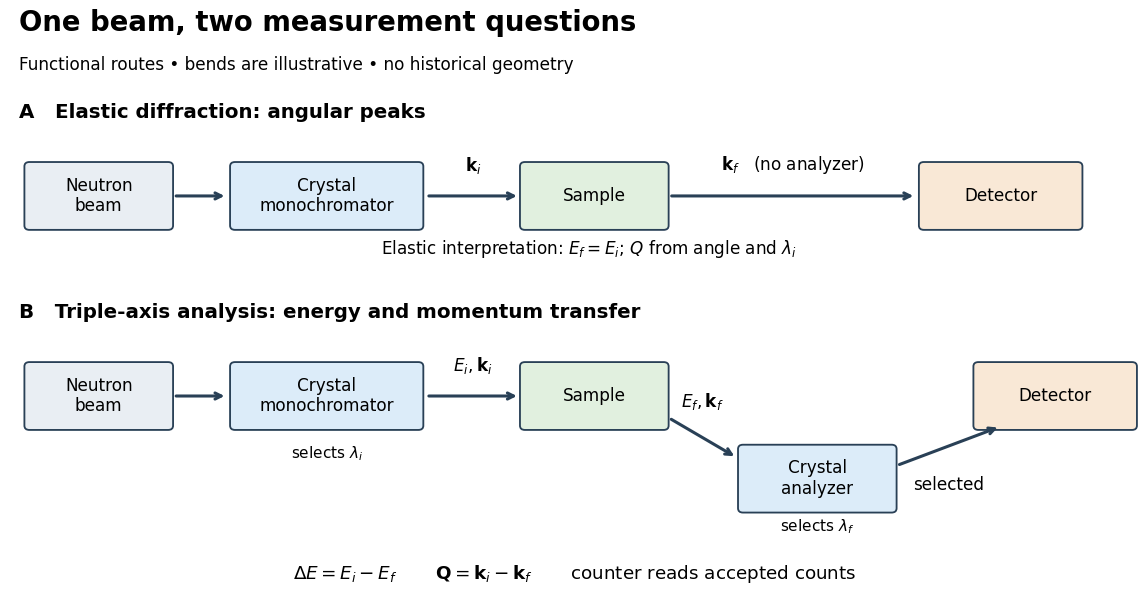
For a constant- scan, change incident or outgoing energy while coordinating sample and analyzer settings so that stays fixed. Counts versus then probe excitations at one momentum transfer. Changing only the analyzer angle generally changes both transferred quantities. Incident-beam monitoring, analyzer response and the instrumental resolution must enter quantitative interpretation; the diagram's arrows specify information flow, not an absolute intensity calibration.
Magnetic coercivity is the magnitude of a reverse applied magnetic field intensity required to bring a previously magnetized specimen's magnetization to zero on a specified hysteresis branch. It depends on material, preparation and measurement history. It differs from remanent magnetization, which is the remaining magnetization at zero applied field.
The reciprocal chart makes infinity an ordinary coordinate origin. Its domain is the Riemann sphere minus the point ; and elsewhere. A neighbourhood of infinity becomes the open disc . In sphere coordinates this is exactly the capFor , the exterior together with infinity becomes and . The boundary itself is excluded from each open set.
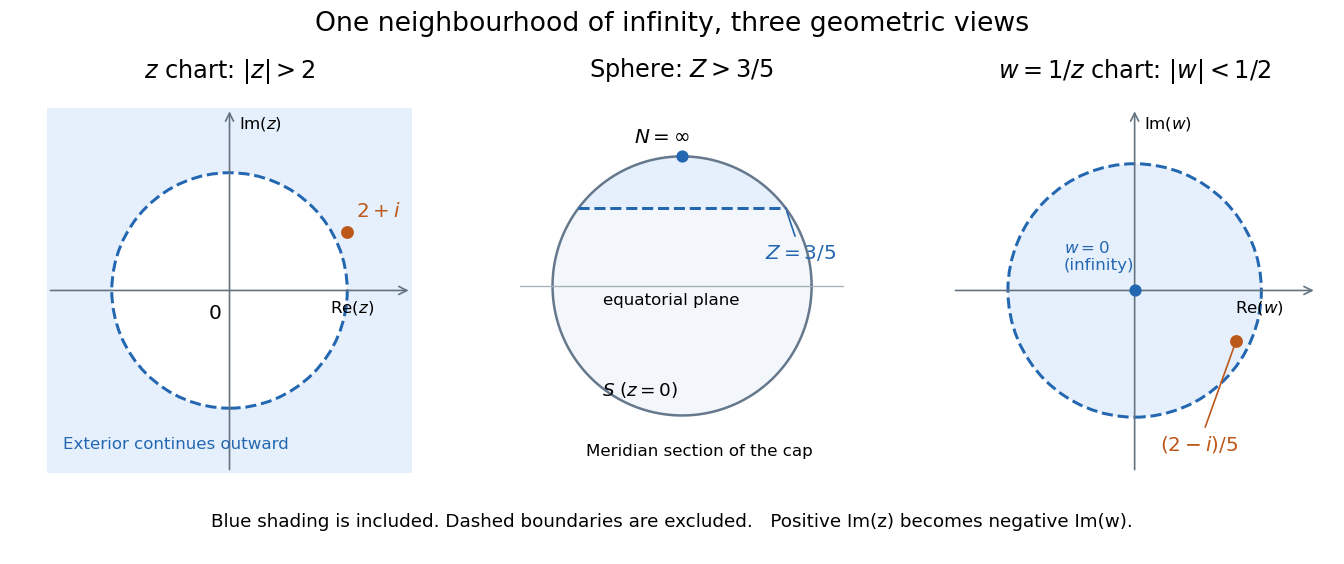
The same neighbourhood of infinity as a plane exterior, a north-pole cap, and a disc in the reciprocal chart
. Details. The point lies in this neighbourhood because . Its reciprocal coordinate is , with , and its sphere height is . The negative imaginary part of is the axis reversal required by the holomorphic stereographic atlas of the sphere.
For a complex-valued holomorphic function defined outside a large disc, having a removable singularity at infinity means that extends to a holomorphic function at . This definition reduces questions at infinity to familiar questions at a finite point.[ref]
Complex Analysis Lecture Notes by Dan Romik. Complex Analysis Lecture Notes, section 9, items 81–82, printed p. 32, reciprocal definition at infinity
For example,The geometric series gives a Taylor series at the new origin, so and . The coefficient is the derivative in the specified coordinate. In contrast, becomes , displaying a pole of order two at infinity when the target is the complex plane. As a holomorphic map to the Riemann sphere, it uses the target reciprocal coordinate , which is regular at zero.The bridge from detector readout to a particle resonance is four-momentum conservation. In units , sum the measured final-state four-momenta:For two photons separated by angle , gives the displayed diphoton formula. Two back-to-back photons of each have . A four-lepton candidate instead uses four four-momenta in the same sum. Collision debris outside the selected decay is not included. Since the partons carry unknown fractions of the incoming proton momenta, reconstructing the decay products is more informative than assigning the full beam energy to each candidate.
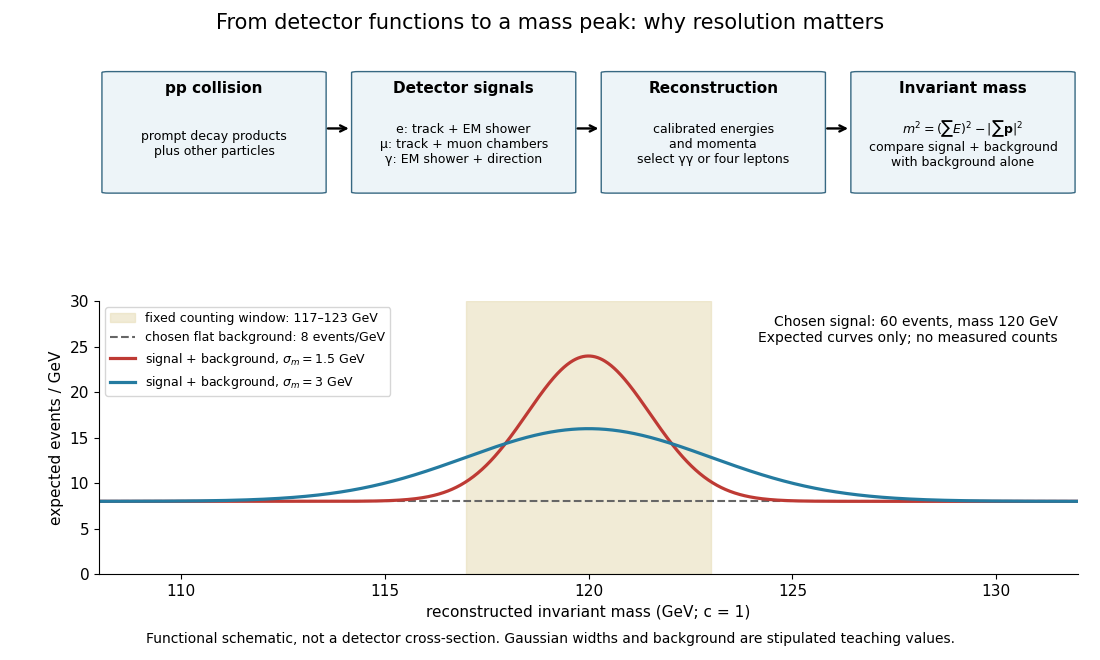
Suppose the intrinsic decay width is negligible compared with the stipulated detector spread. Let the reconstructed signal mass follow a normal distribution with mean and standard deviation . For a total expected selected signal and flat background density events per electronvolts, the expected count density isThis is a deliberately chosen response model, not a fit to either experiment. In the fixed window with , direct integration givesThe expected signal counts are for and for . Doubling the spread lowers the fraction in the same window without changing the total signal. Detector resolution can therefore change the visibility of a peak even with identical particle production.
As a separate counting example, stipulate an observed integer count and an exactly known background mean . The Poisson distribution gives a likelihood for nonnegative signal mean . Its maximum-likelihood estimator is , and the likelihood ratio statistic against isThis tests a specified window with a specified background, and is not either experiment's discovery significance. If the background mean is allowed to vary freely, background alone can choose and fit that count exactly. Control samples, a defensible mass-shape model, nuisance parameters and corrections for searching many masses are therefore essential to the experimental inference.
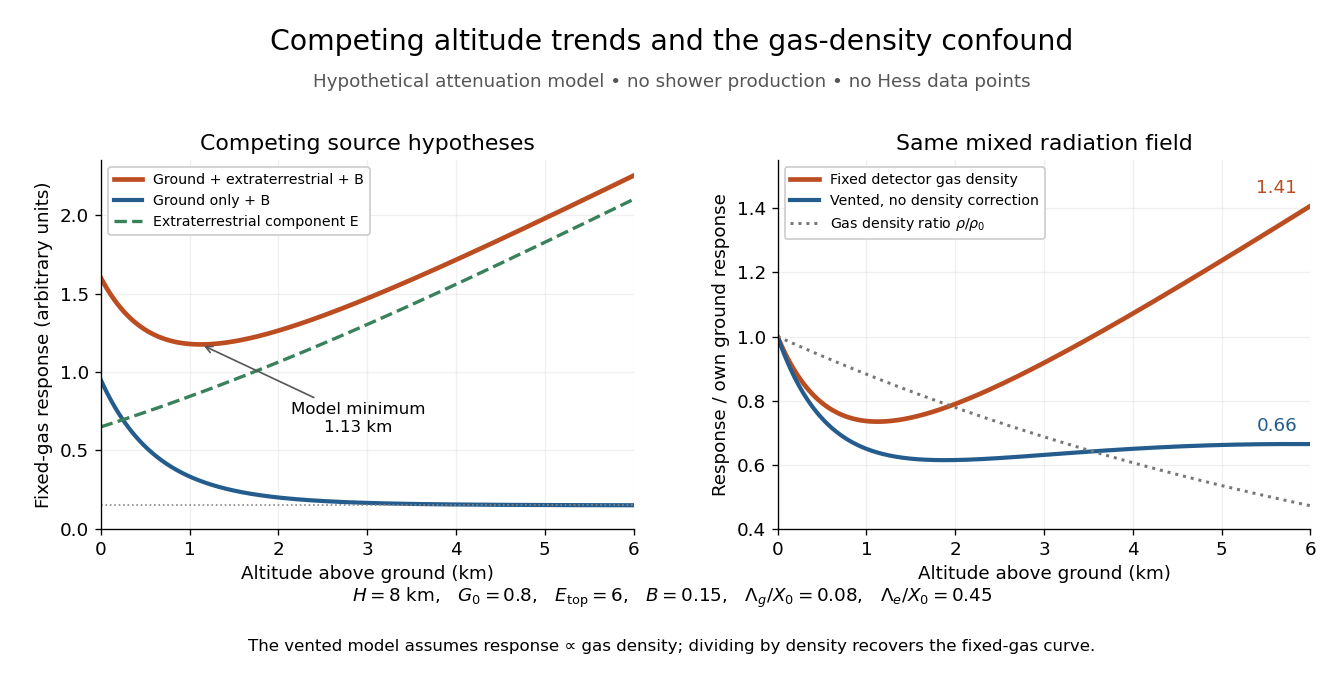
An original cosmic-ray altitude attenuation model illustrates how competing origins can produce a dip followed by a rise. It is a hypothetical absorption calculation, not a reconstruction or fit of Hess's measurements, and it excludes air shower production. Put for height above a flat ground surface and assume gas density with constant scale . The overlying atmospheric mass per unit area isLet denote a ground-origin contribution attenuated by material below the chamber, and a downward extraterrestrial contribution attenuated by material above it. Assume constant attenuation mass columns :These are rates at a fixed detector gas density, in arbitrary common units. The constant represents residual background. The equation gives exponential function attenuation along each propagation direction. Thus decreases and increases as increases; their sum need not be monotone. The different arguments of the two exponential functions encode the entire geometric idea.
Competing altitude trends and the gas-density confound
. Original hypothetical curves for the cosmic-ray altitude attenuation model, with no historical data points. Left: ground-only and ground-plus-extraterrestrial explanations at fixed detector gas density. Right: the same mixed radiation field with fixed gas density or a vented chamber, each normalized to its own ground value. Details.The figure chooses , , , , and , all for illustration. Differentiation givesThe minimum occurs where , at approximately for these invented parameters. At the fixed-gas response is about times its ground value, but multiplying by gives an uncorrected vented-chamber response of only times its ground value. A real increase in radiation response per gas mass can therefore be hidden by a decrease in target gas density. This is the reason to distinguish radiation from the amount of gas being irradiated.
The model treats propagation as attenuation without generating new particles. Real primary cosmic rays interact, redistribute energy and produce air showers; an atmospheric profile need not follow either simple exponential function. The model also holds backgrounds and detector response fixed. Its value is to expose the sign of competing effects and the density confound, while Hess's experimental argument depends on his actual comparisons and instrument limitations.
An elementary ionization-chamber charge-loss model makes the inference explicit. Let a positively charged electrode and its electrometer have effective capacitance , electric potential difference , and enclosed gas volume . Assume constant , a short enough interval that collection conditions remain stable, and no multiplication of charge in the gas. If ionization produces ion pairs per unit volume per unit time and a fraction is collected, thenHere is the elementary charge and is the parasitic electric current through imperfect insulation. Each fully collected ion pair transfers one elementary charge through the measuring circuit; counting its two opposite carriers as two transfers would introduce a factor-of-two error. The relation follows from charge conservation, rather than from a model of the incoming particle's identity.
For an invented example, take , , , a measured fall of , and a separately determined leakage-equivalent fall of . The leakage-subtracted fall is , soThis is about collected ion pairs per second throughout the chamber, not that many primary cosmic rays. Unknown collection losses make another uncertainty; changes in capacitance would require differentiating with both factors variable.
Gas density is a separate issue. Under a fixed radiation field, fixed gas composition and approximately constant energy deposited per unit gas mass, the volume-based ionization rate scales as . For a vented ionization chamber, the ideal gas law gives the illustrative correctionwhere is absolute temperature. A pressure-only correction presumes equal temperature. A sealed rigid chamber instead fixes gas number density as it rises: its internal pressure may change with temperature without losing gas. This does not make its insulation, electrometer calibration or collection efficiency insensitive to temperature. Nor can dividing by gas density correct arbitrary radiation from the vessel walls or changing particle energies. Those are distinct effects, not a universal normalization recipe.
For a commutative ring with an identity element, use coordinatesThese matrices form a group under multiplication, withThese formulas require no division, so they remain valid over rings with zero divisors. The center of a group is : the commutator has only central coordinate , and testing and forces . For finite , its group order is . This includes real, integer and modular versions of the Heisenberg group; the ring must not be confused with the finite field of four elements.
Suppose is continuous at and, for some ,For , its convolution with the heat kernel is smooth and solves the heat equation. On every compact set in , spatial or time derivatives of the heat kernel are bounded by the displayed integrable weight times a constant: their polynomial factors are absorbed by the strictly narrower Gaussian. This justifies differentiation under the integral sign.
Moreover, , soInside , continuity makes the difference uniformly small. Outside that interval, for , the inequality givesThe right side tends to zero, proving that the weighted tail contribution vanishes; the constant term is controlled by the vanishing Gaussian tail mass. Thus as . In particular, continuous data of polynomial growth satisfy this hypothesis, even when they are unbounded. This extends the Gaussian approximate identity argument beyond bounded data.
Let be continuous and suppose that the displayed improper integral converges separately at both infinite endpoints for some . Absolute convergence is not required. Then its heat-kernel solution exists, is smooth and solves the heat equation for , and tends to as at each fixed .
To prove the smoothing claim, take a primitive of . The assumed convergence makes bounded. For , integration by parts givesThe endpoint term vanishes. The coefficient of in the exponent of is . Its derivatives therefore have Gaussian decay on every compact subset of , justifying differentiation under the integral sign in the absolutely convergent right-hand expression. Since , it satisfies the heat equation.
For the initial limit, apply the same construction to and split at . Continuity controls the local part by its small oscillation times the unit kernel mass. On each remaining tail, is monotone for sufficiently small : its maximum lies at , approaching . If the relevant primitive has absolute bound , integration by parts bounds that tail by times the value of at its finite endpoint. For either endpoint , that value tends to zero like times a fixed constant. Both tails vanish, proving the limit. Separate endpoint convergence matters here; merely assuming a symmetric Cauchy principal value does not provide the bounded primitive used in this proof.
The quantum Hall effect connects an electrical measurement to a quantum counting rule: a two-dimensional electron gas in a perpendicular magnetic field can exhibit plateaus of transverse electrical resistance. The integer case supplies a resistance scale built from the Planck constant and elementary charge, rather than the sample's dimensions. The fractional quantum Hall effect involves additional many-electron physics.
Hall conductivity is the transverse part of the electrical response in which an applied electric field drives a perpendicular current density. In two dimensions, one convention writes and .
The sign depends on the magnetic-field orientation and chosen axes. In a quantum Hall effect plateau, the longitudinal response is strongly suppressed and the Hall response takes quantized values. Electrical conductivity and electrical resistivity are inverse tensors; taking the reciprocal of a single component is generally incorrect when longitudinal and transverse responses coexist.
A transverse Hall voltage develops when a longitudinal current flows through a sample in a perpendicular magnetic field. With , a uniform slab of thickness along the magnetic field has a signed transverse voltage magnitude set by , with the final sign determined by the chosen voltage leads.
In an isotropic single-carrier Drude model, let the electric current density point along , with zero transverse current and magnetic field along . The Hall coefficient is and the longitudinal electrical conductivity is , where the charge carrier mobility is positive. Consequently . This signed Hall angle convention describes the angle of the electric field relative to the current; a convention measuring current relative to field has the opposite sign.
Pinned article: Introduction to the OurBigBook Project
Welcome to the OurBigBook Project! Our goal is to create the perfect publishing platform for STEM subjects, and get university-level students to write the best free STEM tutorials ever.
Everyone is welcome to create an account and play with the site: ourbigbook.com/go/register. We belive that students themselves can write amazing tutorials, but teachers are welcome too. You can write about anything you want, it doesn't have to be STEM or even educational. Silly test content is very welcome and you won't be penalized in any way. Just keep it legal!
Intro to OurBigBook
. Source. We have two killer features:
- topics: topics group articles by different users with the same title, e.g. here is the topic for the "Fundamental Theorem of Calculus" ourbigbook.com/go/topic/fundamental-theorem-of-calculusArticles of different users are sorted by upvote within each article page. This feature is a bit like:
- a Wikipedia where each user can have their own version of each article
- a Q&A website like Stack Overflow, where multiple people can give their views on a given topic, and the best ones are sorted by upvote. Except you don't need to wait for someone to ask first, and any topic goes, no matter how narrow or broad
This feature makes it possible for readers to find better explanations of any topic created by other writers. And it allows writers to create an explanation in a place that readers might actually find it.
Figure 1. Screenshot of the "Derivative" topic page. View it live at: ourbigbook.com/go/topic/derivativeVideo 2. OurBigBook Web topics demo. Source. - local editing: you can store all your personal knowledge base content locally in a plaintext markup format that can be edited locally and published either:This way you can be sure that even if OurBigBook.com were to go down one day (which we have no plans to do as it is quite cheap to host!), your content will still be perfectly readable as a static site.
- to OurBigBook.com to get awesome multi-user features like topics and likes
- as HTML files to a static website, which you can host yourself for free on many external providers like GitHub Pages, and remain in full control

Figure 2. You can publish local OurBigBook lightweight markup files to either OurBigBook.com or as a static website.
Figure 3. Visual Studio Code extension installation.
Figure 5. . You can also edit articles on the Web editor without installing anything locally. Video 3. Edit locally and publish demo. Source. This shows editing OurBigBook Markup and publishing it using the Visual Studio Code extension. 
- Infinitely deep tables of contents:




All our software is open source and hosted at: github.com/ourbigbook/ourbigbook
Further documentation can be found at: docs.ourbigbook.com
Feel free to reach our to us for any help or suggestions: docs.ourbigbook.com/#contact