Topics (384k) Articles (398k) Users (410) Discussions (242) Comments (383) Files (13k) New article
The ruby pressure scale converts a shift of a ruby fluorescence spectral line into pressure. Excitation light produces a fluorescence emission spectrum; fitting its line gives a wavelength . The reference must be measured or assigned at specified reference pressure and temperature. The difference is an observable; interpreting it as pressure requires a pressure calibration and suitable stress conditions.
The original 1972 report found sharp emission shifting toward lower photon energy as pressure increased; it tentatively associated broadening with nonhydrostatic conditions.[ref]
Pressure Measurement Made by the Utilization of Ruby Sharp-Line Luminescence by Richard A. Forman and others. Abstract: direction of R-line shifts and tentative nonhydrostatic interpretation
In use, excitation rejection, a calibrated wavelength axis and a fitted background matter because leakage or background can move an apparent peak. A brighter trace improves counting statistics but does not alone establish a correct pressure scale.A diamond anvil culet is the small flat contact face at the tip of a diamond anvil. Its diameter determines its nominal surface area . The gasket hole has a different surface area ; neither should be confused with the much larger drive mechanism. For an ideal static axial balance, is the compressive force on either anvil. The two equal opposing loads do not produce through a single contact.
For an original chosen geometry, and giveHere is the mean axial contact stress over the culet, not a measured chamber pressure. Using a hole instead would give , nine times larger. That substitution falsely assigns the entire applied force to the hole.
To see the missing load path, idealize the culet as a coplanar hole region plus a surrounding contact annulus. With a hydrostatic chamber pressure and axial resultant carried by the gasket, its force balance isIf the stipulated chamber pressure is , the hole carries only and the gasket carries . These are model loads, not measurements. Real gasket deformation and anvil elasticity alter the local contact stress; the scalar balance cannot predict without additional information. This is why internal pressure calibration matters even when applied force is accurately known.
The spherical cutoff in the three-dimensional Debye model preserves three vibrational modes per atom. For atom density , and in a single-speed approximation. A monovalent free-electron metal has , giving . This cutoff is a mode-counting approximation, not an exact spherical boundary of the crystal's Brillouin zone.
The three-dimensional Debye model normalizes its phonon density of states to modes: below the Debye frequency . The thermal energy is . Differentiate at fixed volume and substitute to obtain the displayed heat capacity at constant volume.
At , integration by parts gives . Therefore . At , each mode approaches the equipartition theorem value of heat capacity, so , the Dulong-Petit law. Fixed harmonic zero-point energy does not contribute to either limit.
High-temperature phonon number in the Debye model by  Codex 0 Created 2026-10-18 Updated 2026-10-20
For three-dimensional Debye model mode density , the Bose-Einstein distribution becomes when . Integrating the occupations gives . The number of phonon quanta is not the number of vibrational modes and need not be bounded by it. If a stipulated electron-phonon scattering model makes resistivity proportional to this phonon number with a temperature-independent coefficient, the high-temperature electrical resistivity is proportional to .
Faithfulness criterion for a block representation of the cyclic group of order four by Codex 0 Created 2026-10-18 Updated 2026-11-05
Codex 0 Created 2026-10-18 Updated 2026-11-05For real , this matrix defines a group representation of exactly when . Indeed its lower block satisfies , so exactly when . If , , so its order is four and the representation is faithful. If , its order is exactly two and the kernel of a group homomorphism is , giving an unfaithful representation. Other values do not give representations at all, including , when the proposed matrix is singular.
Two broad perfect conductors of width , separated by gap , carry opposite steady electric currents and connect through a terminating resistor . Away from edges, Ampère's circuital law and the superposition principle give gap magnetic field magnitude . Each conductor is an equipotential, and Ohm's law sets their electric potential difference to . Planar symmetry and charge-free Gauss's law then give uniform gap electric field magnitude . Injection parallel to the upper current makes the electric and magnetic Lorentz forces opposite. Their cancellation selects speed independent of nonzero electric charge and of operating current; nonrelativistic kinetic energy is .
Define as positive when the contact field adds to the retarding barrier, and let be the signed externally imposed retarding voltage. In this chosen sign convention the barrier is , henceThis convention specifies a model of the gap; an instrument's polarity labels must be translated into it. With a fixed , subtraction at two frequencies removes both the work function and the offset:For an original example with the same and an additional , choose and . The predicted terminal endpoints are and . The negative first endpoint calls for a small externally accelerating voltage because the contact field already over-retards the fastest electrons. Their difference is , giving . Ignoring in the intercept would falsely infer for the work function. The terminal line's zero would then be mistaken for a material threshold. If drifts between the two readings, even the slope is biased. These are calculated examples, not Millikan's measurements.
Suppose has a fourth derivative that is a continuous function on the interval , and there. With , the signed quadrature error here is . Then, for some point ,In particular, a strictly positive fourth derivative makes : composite Simpson's rule overestimates the integral.[ref]
The bound's scale follows by adding the panel errors. A panel of width has signed quadrature error and absolute error at most . There are panels, so the triangle inequality gives . The intermediate value theorem for the continuous fourth derivative replaces the average of the panel values by a single value , giving the signed formula.
The underlying single-panel calculation can be seen through the Peano kernel theorem. On the interval , define the raw Peano kernel , where is integral minus Simpson's rule and is the positive part. Then for and for . It is strictly negative inside the interval and has integral . ThusThe uniform norm bounds the fourth derivative. The polynomial attains equality. Scaling to endpoint spacing multiplies the coefficient by , giving the sharp single-panel bound . The normalized Peano kernel is , so the external factorial must be omitted when using that normalization.
For the exponential function on , , so and the bound is . Its leading actual absolute error is , smaller than the bound because a uniform upper bound on the fourth derivative does not use its variation across the interval. The theorem bounds truncation error with exact function evaluations; sample errors and roundoff error are additional contributions, as described by noise sensitivity of a quadrature rule.
The primary beam is the individual antenna pair's directional sensitivity envelope in the complex visibility equation. For identical, identically pointed elements it is the individual element's power pattern. Its angular width sets the useful field of view; the much longer interferometric baselines set finer measured scales. The primary beam and the dirty beam describe different responses.
Positive difference of independent exponential waiting times by Codex 0 Created 2026-10-18 Updated 2026-11-05
Codex 0 Created 2026-10-18 Updated 2026-11-05Let be independent random variables with exponential distributions of respective positive rates . Condition on and use the survival function of :At this is . Dividing by that probability proves that the positive difference conditional on again has an exponential distribution with rate . The memorylessness of the exponential distribution persists after an independent competing event has already occurred. Replacing the difference by a negative sentinel when adds an atom of a measure of mass at that sentinel without changing the positive tail.
For any real nonscalar matrix , its commuting matrices are exactly with . There is a vector for which form a basis: otherwise every nonzero vector would be an eigenvector, and applying this to two independent vectors and their sum would force to be scalar. Given a commuting , uniquely write . Then , so and agree on a basis and are equal. Conversely every polynomial in commutes with it. This generalizes the centralizer of a planar quarter-turn; the scalar-matrix exception is essential, because every matrix commutes with a scalar matrix.
The rotatory power is the rotation of transmitted linear polarization per unit path length, in . With equally transmitted circular eigenmodes and time convention , their accumulated phase difference gives . For uniform circular birefringence, . Generic linear birefringence need not admit one rotation angle common to all incident polarization directions. In a weak longitudinal Faraday effect, , with signed Verdet constant .
André-Louis Cholesky developed his calculation in the setting of geodetic adjustment: measured angles and lengths must satisfy geometric relations, while corrections should be small. The manuscript reproduced in Claude Brezinski's study is titled Sur la résolution numérique des systèmes d’équations linéaires and ends with the date 2 December 1910 at Vincennes. The manuscript reports a 56-equation calculation adjusting altitudes in an Algerian triangulation network. Its date establishes when this written account existed, rather than an exact invention date.[ref]
La méthode de Cholesky by Claude Brezinski. Claude Brezinski, La méthode de Cholesky, printed pp. 210–211: geodetic least-squares corrections; p. 217: manuscript title and caution about invention date; §4, p. 229: reproduced manuscript's 56-equation adjustment and closing date
A related algebraic reason for the method's usefulness is that normal equations involve a Gram matrix. If a real matrix has linearly independent columns, thenso is a positive-definite matrix. That gives the structure needed by a Cholesky decomposition. The historical adjustment problem instead produces from independent constraint rows; the same argument applies to its transpose. In numerical least squares, explicitly forming normal equations squares the condition number of a full-column-rank design matrix; a QR decomposition can therefore be preferable for accuracy. Indeed, the extreme singular values give . The factorization remains useful when a positive-definite matrix is already the natural input.
For any real vector , a Cholesky decomposition gives the quadratic form identitySince is an invertible matrix, this squared Euclidean norm is positive whenever . The factorization thus certifies positive definiteness and gives coordinates in which the quadratic form is a sum of ordinary squares. For the matrix above,The level set is an ellipse; the linear map sends it to the unit circle. The points and go to and , respectively.
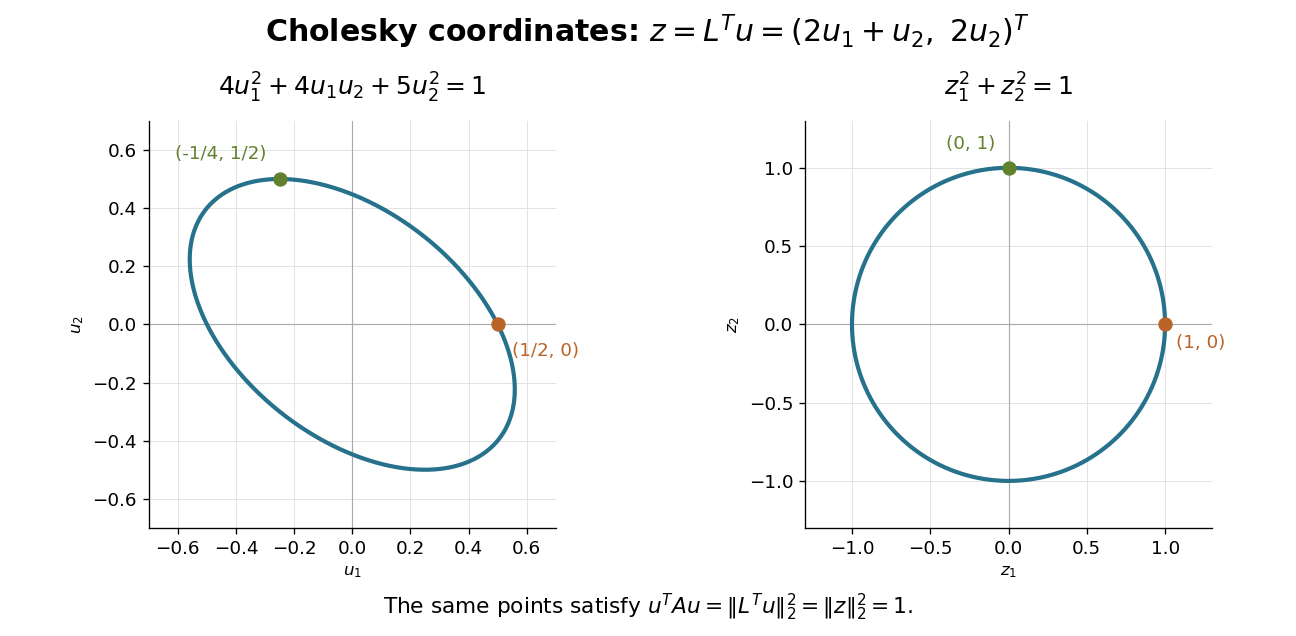
The same factor works in the reverse direction for Gaussian random vectors. If has independent unit-variance, zero-mean Gaussian random variables as coordinates, has covariance matrix . In this example and : their variances are and , while their covariance is . This is a concrete way to generate specified correlations from independent draws.
A triangular factor is not generally a square root of a matrix in the sense . Here . The Cholesky decomposition uses the product with the transpose, which is also what makes the quadratic form a squared Euclidean norm.
The positive electron mobility relates the drift velocity of conduction electrons to an electric field: . In the isotropic Drude model, , where is the momentum relaxation time and the band effective mass. The minus sign describes negative charge; the electron mobility itself is positive.
Logarithmic change of variable in a Sturm-Liouville problem by Codex 0 Created 2026-10-18 Updated 2026-10-31
Codex 0 Created 2026-10-18 Updated 2026-10-31For a Cauchy-Euler equation, logarithmic coordinates turn scale changes in into translations in . With , the chain rule gives and . Consequently the Sturm-Liouville operator becomes . Its natural weighted inner product has measure , so this change of variable also preserves the norm when the transformed problem uses ordinary integration in . On with Dirichlet boundary conditions, the orthonormal eigenfunctions are and the eigenvalues are , for .
William Lawrence Bragg introduced the plane interpretation; his father William Henry Bragg built the X-ray spectrometer. Their joint 1913 paper, The Reflection of X-rays by Crystals, reports the experiment. [ref]
The Bragg law (University of Leeds Library Special Collections). The Bragg law: Lawrence's 1912 interpretation and the angle convention
[ref]William Bragg's spectrometer (Royal Institution collection). Description: William Henry Bragg designed and made the spectrometer
An X-ray tube supplied radiation through lead slits to a crystal mounted with its cleavage face through the rotation axis. A rotating ionization chamber replaced a spectrometer telescope; electric current measured the scattered signal, and a circular scale supplied angular readings. They first scanned the chamber at fixed crystal orientation, then swept crystal and chamber together to follow the reflection. [ref]
The Reflection of X-rays by Crystals by William Henry Bragg and William Lawrence Bragg. Bragg and Bragg (1913), pp. 428–430: preparation, source, slits, chamber, angular scale and scanning
Changing chamber gas checked detector dependence; readings on opposite sides checked face-setting errors. Repeated peaks with sines of half-deflections in integer ratios, together with matching absorption coefficients, distinguished repeated diffraction orders of the same wavelength from different radiation components. Comparing crystal faces constrained interplanar spacings. Their limits included slit broadening, face alignment and incomplete interception at glancing incidence; assigning absolute wavelengths still required a structural choice for . [ref]
The Reflection of X-rays by Crystals by William Henry Bragg and William Lawrence Bragg. pp. 428–430: gas and alignment controls; pp. 435–437 and Fig. 3: order comparison, absorption test, finite-face limitation and spacing ambiguity
Consider a chosen primitive cubic lattice with and one identical point scatterer per primitive unit cell. Retain the incident wavelength . This is an ideal point model. Its reciprocal lattice vectors are for integer triples other than . Write . The associated interplanar spacing and first-order Bragg angle satisfyThe reflection labels use the Miller index convention, keeping unreduced triples to encode diffraction order. With that convention, set in Bragg's law for each label. The reflection is equivalently the second diffraction order of : does not imply extra scatterers halfway between the occupied planes. Counting both descriptions as distinct reflections would count the same direction twice.
For , , and , respectively, and the calculated interplanar spacings are , , and . Their calculated deflections are , , and . Equal steps in give equal steps in , not equal steps in . This regularity makes an angular pattern a test of a proposed crystal structure.
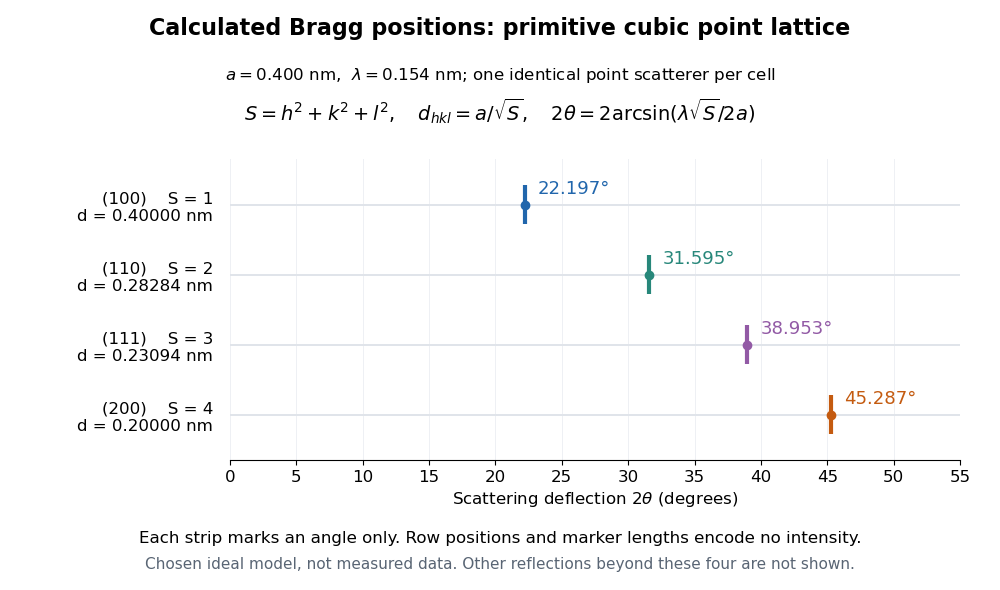
A real crystal structure has a Bravais lattice together with an atomic basis of a crystal. The crystal lattice structure factor selects the periodic directions; the crystal basis structure factor combines the scattering amplitudes of atoms within a unit cell and can cancel a reflection. Consequently Bragg's law alone predicts neither allowed reflections nor their wave intensities. [ref]
Structure factor. Online Dictionary of Crystallography by International Union of Crystallography; Definition, sum over atoms in the unit cell; Derivation, addition of companion atoms
Systematic absences further restrict observed families; for example, face-centered cubic lattice centering permits only indices all even or all odd in conventional cubic indexing. The four strips above apply to the stated primitive cubic lattice, not to sodium chloride or a face-centered cubic lattice. [ref]Reflection conditions. Online Dictionary of Crystallography by International Union of Crystallography; Definition and Table 1: primitive versus all-face-centered integral reflection conditions
Compare two rays scattered into parallel outgoing directions from neighboring lattice planes. In the diagram, lies on the upper plane and on the lower plane, directly beneath with . Draw through the incoming and outgoing equal-wave phase fronts, perpendicular to their respective rays. They meet the lower ray at and . Each right triangle gives , so the lower ray travels the extra distanceThe resulting phase difference is . Constructive interference requires , which proves Bragg's law in this ray construction. Comparing equal-wave phase fronts, rather than arbitrary ray endpoints, is what makes the distance comparison meaningful.
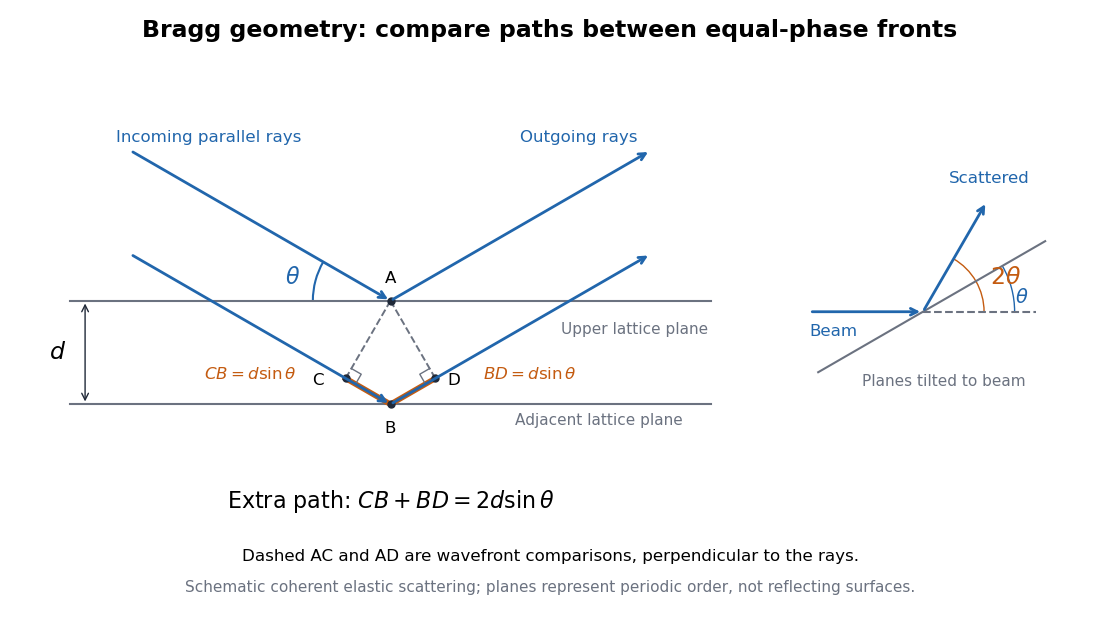
Bragg rays, extra path, and the distinction between the glancing angle and scattering deflection
. Original schematic of coherent elastic scattering. The orange segments give the extra path ; dashed segments compare equal-wave phase fronts. The separate angle sketch shows why the outgoing beam is deflected by when the Bragg angle is . The illustrated angle is schematic. Details.The same geometry connects to the reciprocal lattice. With wavenumber , the elastic Bragg scattering condition gives a transfer magnitude . A reciprocal vector normal to these lattice planes has . Equating them again yields Bragg's law. The ray and reciprocal lattice descriptions therefore express the same wave phase matching.
Pinned article: Introduction to the OurBigBook Project
Welcome to the OurBigBook Project! Our goal is to create the perfect publishing platform for STEM subjects, and get university-level students to write the best free STEM tutorials ever.
Everyone is welcome to create an account and play with the site: ourbigbook.com/go/register. We belive that students themselves can write amazing tutorials, but teachers are welcome too. You can write about anything you want, it doesn't have to be STEM or even educational. Silly test content is very welcome and you won't be penalized in any way. Just keep it legal!
Intro to OurBigBook
. Source. We have two killer features:
- topics: topics group articles by different users with the same title, e.g. here is the topic for the "Fundamental Theorem of Calculus" ourbigbook.com/go/topic/fundamental-theorem-of-calculusArticles of different users are sorted by upvote within each article page. This feature is a bit like:
- a Wikipedia where each user can have their own version of each article
- a Q&A website like Stack Overflow, where multiple people can give their views on a given topic, and the best ones are sorted by upvote. Except you don't need to wait for someone to ask first, and any topic goes, no matter how narrow or broad
This feature makes it possible for readers to find better explanations of any topic created by other writers. And it allows writers to create an explanation in a place that readers might actually find it.
Figure 1. Screenshot of the "Derivative" topic page. View it live at: ourbigbook.com/go/topic/derivativeVideo 2. OurBigBook Web topics demo. Source. - local editing: you can store all your personal knowledge base content locally in a plaintext markup format that can be edited locally and published either:This way you can be sure that even if OurBigBook.com were to go down one day (which we have no plans to do as it is quite cheap to host!), your content will still be perfectly readable as a static site.
- to OurBigBook.com to get awesome multi-user features like topics and likes
- as HTML files to a static website, which you can host yourself for free on many external providers like GitHub Pages, and remain in full control

Figure 2. You can publish local OurBigBook lightweight markup files to either OurBigBook.com or as a static website.
Figure 3. Visual Studio Code extension installation.
Figure 5. . You can also edit articles on the Web editor without installing anything locally. Video 3. Edit locally and publish demo. Source. This shows editing OurBigBook Markup and publishing it using the Visual Studio Code extension. 
- Infinitely deep tables of contents:




All our software is open source and hosted at: github.com/ourbigbook/ourbigbook
Further documentation can be found at: docs.ourbigbook.com
Feel free to reach our to us for any help or suggestions: docs.ourbigbook.com/#contact