Topics (384k) Articles (398k) Users (410) Discussions (242) Comments (383) Files (13k) New article
In ideal linear polyethylene, incorporated ethene contributes monomeric units; the smallest constitutional repeating unit is . See monomer for the counting distinction.
Nylon 6,10 has an amide-linked chain whose constitutional repeating unit contains a six-carbon diamine contribution and a ten-carbon diacid-derived contribution. See monomer for its stoichiometry and polymerization for the authored demonstration.
A constitutional repeating unit is the smallest chemical unit whose repetition describes a regular chain. Its boundaries mark repetition, not necessarily the origin of the chemical atoms from a single monomer. See IUPAC: constitutional repeating unit.
The degree of polymerization counts monomeric units in a chain. is its number average over a specified collection of chains. State whether unreacted monomers are included and distinguish this count from constitutional repeating units or statistical segments. See IUPAC: degree of polymerization.
A polyurethane contains repeated connections of the form . Suitable hydroxy groups and isocyanate groups can produce those connections by polyaddition; exactly two suitable groups per feed molecule give the bifunctional linear model only when competing reactions and ring closure are excluded.
Polymerization converts a monomer, or a mixture of monomers, into a polymer: repeated chemical reactions establish a connected molecular chain or network. The central question is how connections form, not merely whether a material becomes solid. Joining small molecules can produce a thread that can be handled, while the individual molecules remain invisible. See IUPAC, Basic Definitions of Terms Relating to Polymers, definition 2.2.
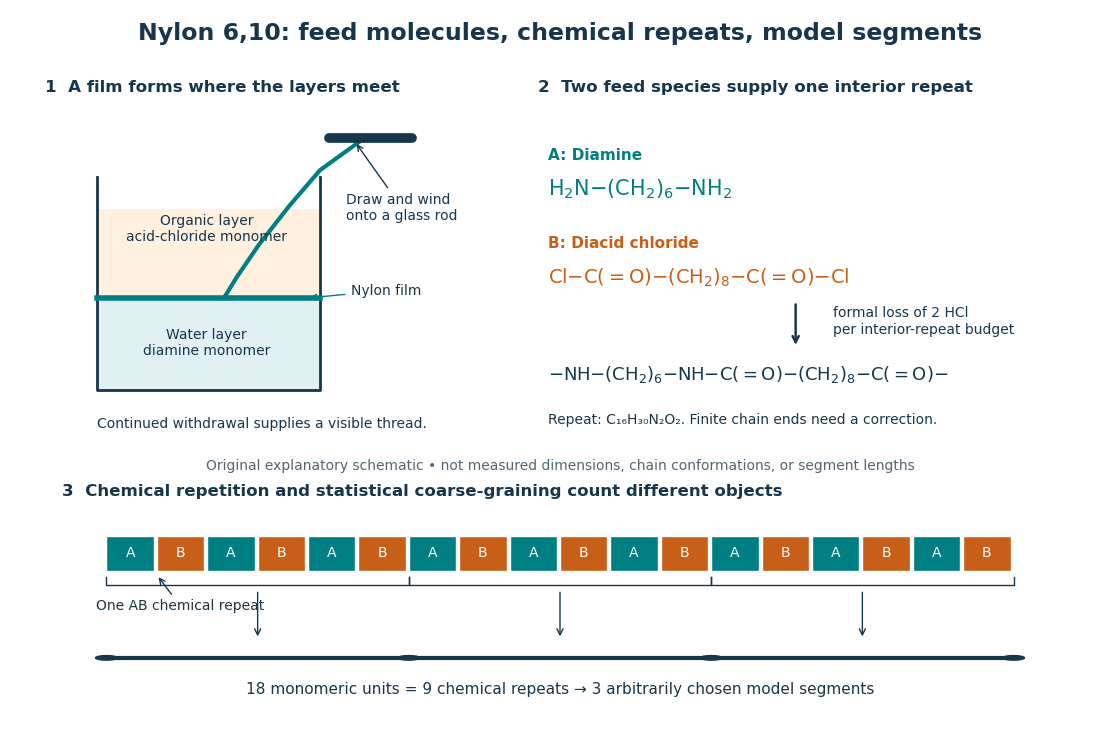
From two liquid layers to a Nylon 6,10 thread: monomers, a constitutional repeating unit, and statistical segments
. Original schematic of the authored UCSB polymerization demonstration described below. Chemical formulas identify the actual reactants and interior repeat; colored blocks identify their contributions. The lower coarse-graining sketch deliberately groups three repeats per model segment. Shapes, sizes, and that grouping are illustrative, not measured molecular geometry or a fitted Kuhn length. Details.In step-growth polymerization, complementary reactive groups on monomers and on shorter or longer chains can react with one another. A two-unit chain can join a three-unit chain to make a five-unit chain; growth does not require a specially active end to add only free monomers. An example is the Nylon 6,10 reaction of with : each amine end can form an amide connection with an acid-chloride end, with formal elimination of . Both reactants have two suitable ends, allowing repeated joining. See Paula Hammond, MIT 10.569 lecture 2: step-growth joining and Hammond, lecture 5, p. 4: acid chloride–amine reaction.
In chain-growth polymerization, a monomer reacts with an active site on a growing chain, and the growth step regenerates an active site. Schematically, , where counts incorporated monomeric units and the star denotes reactivity rather than a particular electric charge. Ethene forming polyethylene is an example: the double chemical bond is converted into single chemical bonds as the carbon backbone grows. Initiation creates the active chains; subsequent reactions can deactivate them or transfer reactivity to another molecule. See IUPAC: chain polymerization and John McMurry, Organic Chemistry, 31.1: chain growth. Whether growth is stepwise or carried by an active site is a different question from whether small byproducts are released: chain-growth polymerization can also release them.
A motivating experiment: drawing nylon from a liquid interface. Feldwinn's UCSB demonstration places of an aqueous chemical solution of hexamethylenediamine, , in a beaker, then gently adds of sebacoyl chloride, , in an organic solvent. The procedure specifies hexane; other parts of that handout list cyclohexane. The layers remain separate. The instructor catches material at their interface with tweezers and winds it slowly onto a glass rod; the handout reports continued spooling of Nylon 6,10. It specifies freshly prepared acid-chloride chemical solution and washing the thread before touching it. These are observations and conditions of a supervised laboratory demonstration, not measurements of chain lengths. See Feldwinn, UCSB Demonstration Library, Demo 044, pp. 1–3.
The mechanistic interpretation is that the monomers encounter one another near the interface, where amide connections produce the film; withdrawing it exposes a region where more material can form. An authored research demonstration independently reports a rapidly formed interfacial film collapsing into a thread on withdrawal, using cyclohexane and an aqueous chemical solution containing potassium hydroxide. See Polymer Day: Outreach Experiments for High School Students, Journal of Chemical Education (2017), nylon demonstration. This is the striking observation: a thread much longer than the beaker can emerge because material is continually supplied to the formation region, rather than because a pre-existing thread was hidden in the liquid.
Useful proposed controls, not results reported in those demonstrations, omit one monomer at a time while retaining the same solvents, liquid amounts, and pulling procedure. The prediction is loss of a renewable drawable Nylon 6,10 film; merely finding cloudiness would not establish polymerization, since other chemical reactions, including acid-chloride hydrolysis, can occur. See McMurry, 21.4: competing acid-chloride hydrolysis. Stopping and restarting withdrawal would probe renewal at the interface. Even successful drawing does not measure the degree of polymerization, establish a chain-length probability distribution, or prove the entire growth mechanism. Chemical identification and a molecular-size measurement would be needed for those stronger conclusions. These controls and limits are inferences from the setup, not invented experimental data.
Why almost complete reaction matters in step growth. For ideal linear step-growth polymerization, assume exactly two reactive groups per starting molecule, equal numbers of complementary groups, only joining of different chains, no rings, no branching, and no loss of chain material. Let count starting monomer molecules, including both reactant species, and let be the fraction of either type of reactive group consumed. There are initially groups of each type, so connections reduce the number of chain-bearing molecules to ; the count excludes small byproducts but includes unreacted monomers. The number-average degree of polymerization, measured in monomeric units, is thereforeThus , , and give , , and . Losing the last fraction of unreacted groups matters enormously. See Hammond, lecture 3: balanced step-growth conversion. This counts residues of both feed species; a Nylon 6,10 interior constitutional repeating unit contains two such monomeric units.
For an feed with initial reactive-group counts, put and now let denote the fraction of the limiting groups consumed. Under the same linear, no-ring assumptions, and , givingFor , even complete consumption of gives . Stoichiometry controls chain length as well as yield. See Hammond, lecture 2, pp. 2–3: stoichiometric imbalance. The liquid-interface demonstration is not a homogeneous, balanced reactor, so its thread length cannot be inserted into this formula as a molecular chain length.
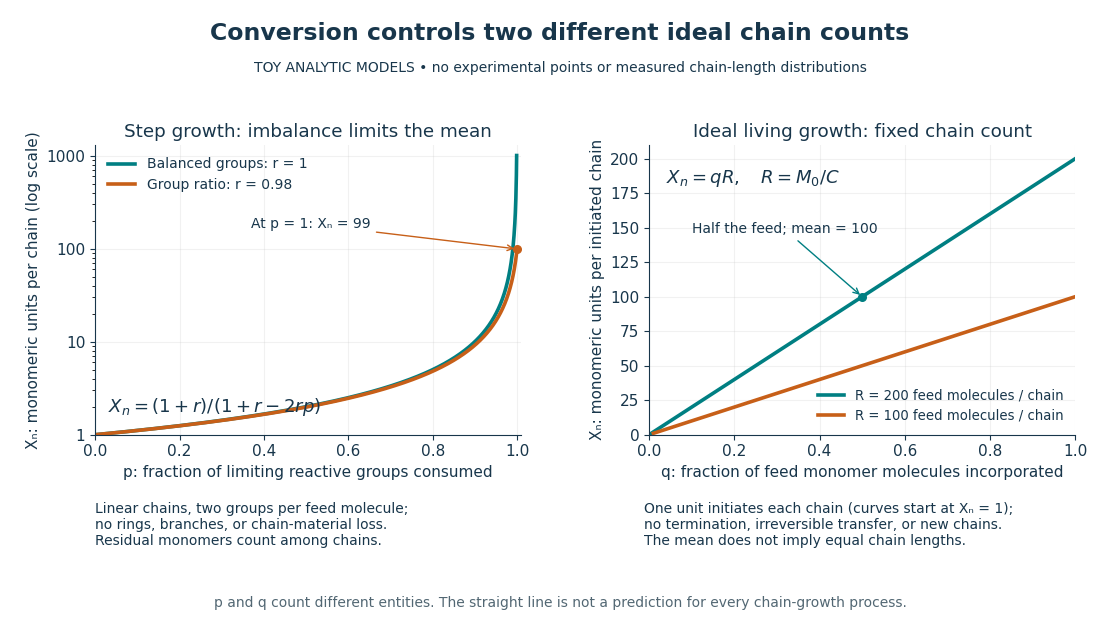
Two ideal degree of polymerization counts: late growth in step-growth polymerization and fixed-chain growth in ideal living polymerization
. Toy analytic curves, not measured data. Left: , with the limiting-group conversion and the initial reactive-group ratio. Right: , with the fraction of feed monomer molecules incorporated and their initial number per initiated chain. The two horizontal axes count different entities; the right plot represents a special ideal model, not all chain-growth polymerization. Details.A contrasting chain count. In ideal living polymerization, assume no chain termination or irreversible chain transfer, all chains initiated before the counted growth, one chain per effective initiator, a fixed chain count , and every consumed monomer molecule incorporated into those chains. If is the initial number of feed monomer molecules and their incorporated fraction, conservation gives in monomeric units, excluding initiator fragments. For , incorporating half the feed gives . If initiation consumes one monomer molecule per chain, the fixed-chain interval starts at , rather than . See Hammond, lecture 21, p. 1: ideal living-chain count. The mean does not imply identical chain lengths. Living polymerization does not require reversible loss of monomers; the defining absence of chain termination and irreversible chain transfer is explained in Devon Shipp, IUPAC Polymer Education workshop, Radical Polymerizations II, slide 50. Ordinary chain-growth polymerization with new chains, termination, or transfer need not follow the straight line.
The useful connection is between local chemistry and a macroscopic material: selecting reactive ends and their proportions controls connectivity, while the resulting polymer's conformation is a separate problem described by models such as the freely jointed chain or Gaussian chain. Formation of chemical bonds, the count of monomeric units, and the count of statistical segments must be kept distinct.
The Flory approximation balances the entropic cost of expanding an ideal chain against a mean-field excluded volume interaction. For segments of length in spatial dimensions, minimizing gives . This yields the scaling exponents in three dimensions and in two dimensions. It is a scaling approximation, not an exact numerical free energy or proof of critical exponents; confinement replaces by the accessible coil volume.
For a singly charged ion species in Gaussian units, is its plasma frequency and . The ion skin depth marks a characteristic scale below which ion and electron motion can separate in a magnetized plasma. Together with the Alfvén speed, it satisfies , the coefficient of guide-field propagation in electron magnetohydrodynamics.
The plasma frequency is the characteristic electrostatic oscillation frequency of a charged species displaced against a neutralizing background. For number density , charge and mass , the displayed formula uses SI units; in Gaussian units it is . The ion skin depth is for the ion species. Different species have different plasma frequencies.
Adipose tissue stores energy-rich lipid and also performs endocrine and mechanical functions. Its adipocytes, vascular supply and other cell populations interact. Changes in tissue mass do not uniquely describe its metabolic or signaling state.
Skeletal muscle is striated muscle tissue organized into long multinucleate fibers and supporting connective tissues. Neural activation recruits force that is transmitted to attachments. Its output depends on fiber properties, recruitment and mechanical loading, not only the amount of muscle present.
The liver integrates metabolism, synthesis, storage, detoxification and biliary secretion. Its hepatocytes receive blood from both portal and arterial routes, while bile flows through a separate collecting pathway. This spatial organization connects processing of absorbed material to systemic distribution and excretion.
A physiologist investigates the functions of organisms and their parts. Experiments connect controlled inputs to measured outputs, such as current to membrane voltage or pressure to blood flow. The role is defined by functional questions rather than one particular instrument or organ.
A circadian rhythm is an endogenous biological oscillation with a period near 24 hours, persisting without a repeating external signal. A circadian clock times biological activities and anticipates daily changes without continual external instructions. A free-running circadian rhythm reveals its intrinsic period; entrainment of circadian rhythm coordinates it with an external cycle.[ref]
Overview of Circadian Rhythms by Martha Hotz Vitaterna and others. Vitaterna, Takahashi and Turek (2001), Overview of Circadian Rhythms, pp. 85–86, Biological Rhythms and Basic Properties of Circadian Rhythms
In 1994, Martha Hotz Vitaterna and colleagues screened offspring of mutagen-treated C57BL/6J mice (the house mouse). Each mouse lived in a CAGE with a running wheel, inside a ventilated, light-tight chamber with timer-controlled lighting. Wheel revolutions were recorded electronically or on an event recorder. The initial screen used 14:10 LD for the first 41 animals and 12:12 LD thereafter; LD denotes hours of light and darkness. Transfer to constant darkness, DD, omitted the next scheduled lights-on; recording continued for at least three weeks. The first 41 animals also received brief light pulses, so those records were not uninterrupted DD.[ref]
Mutagenesis and Mapping of a Mouse Gene, Clock, Essential for Circadian Behavior by Martha Hotz Vitaterna and others. Vitaterna and others (1994), Mutagenesis and Mapping of a Mouse Gene, Clock, Essential for Circadian Behavior, Figure 1 and References and Notes 6–10
The subsequent-generation comparison in Figure 2 used 12:12 LD before DD. Animals without the Clock mutation and with mutant genotypes supplied the comparison: the B6 examples in panels A–C had initial DD periods of 23.6, 24.8 and 27.1 hours, respectively; the homozygote later lost its sustained circadian rhythm. Total activity remained comparable across genotypes in the interstrain comparison. The mutation therefore altered timing, beyond merely reducing running. Wheel activity is a behavioral readout; it does not directly measure every circadian clock or establish a human period.[ref]
Mutagenesis and Mapping of a Mouse Gene, Clock, Essential for Circadian Behavior by Martha Hotz Vitaterna and others. Figure 2A–C; Table 2 and discussion of activity counts and loss of rhythmicity; References and Notes 10 and 14
Daily activity under LD alone cannot establish entrainment of circadian rhythm. Light can directly change activity without resetting the circadian clock: masking of circadian rhythm. Removing the light cycle helps distinguish these effects; they can coexist.[ref]
Overview of Circadian Rhythms by Martha Hotz Vitaterna and others. p. 92, glossary entries Entrainment, Free running and Masking
In an experiment, other repeating inputs must also be controlled: a nominally dark room with daily handling is not automatically an environment without timing cues.Extracellular fluid is the body fluid outside cells, including plasma and interstitial compartments. Exchange between these spaces and the intracellular compartment depends on barriers and transport. Changes in total extracellular volume and changes in dissolved concentration are separate physiological quantities.
The skin is the external protective organ formed by interacting epithelial and supporting tissues with vessels, nerves and appendages. Barrier function, sensation, heat exchange and repair depend on that organization. The epidermis is one layer rather than the whole organ.
Homeostasis is the maintenance of usable internal conditions despite disturbances. It concerns selected regulated physiological variables, rather than keeping every part of an organism unchanged: core body temperature may remain near its usual range while skin temperature, sweating and blood pressure change. Regulation makes a relatively dependable environment for biological cells out of a changing external world. [ref]
1.5 Homeostasis. §1.5, opening paragraphs and Negative Feedback: normal ranges and compensatory responses
A useful causal description separates a physiological sensor, a physiological integrator and a physiological effector. The return from the physiological effector's action to the sensed regulated physiological variable closes a feedback control loop. In negative feedback, that return opposes the disturbance. The insulin and glucagon articles already trace the blood glucose example; synaptic integration explains how several inputs can jointly influence a neuron. These are implementations and ingredients, not a requirement that every regulatory loop use one anatomical control center. [ref]
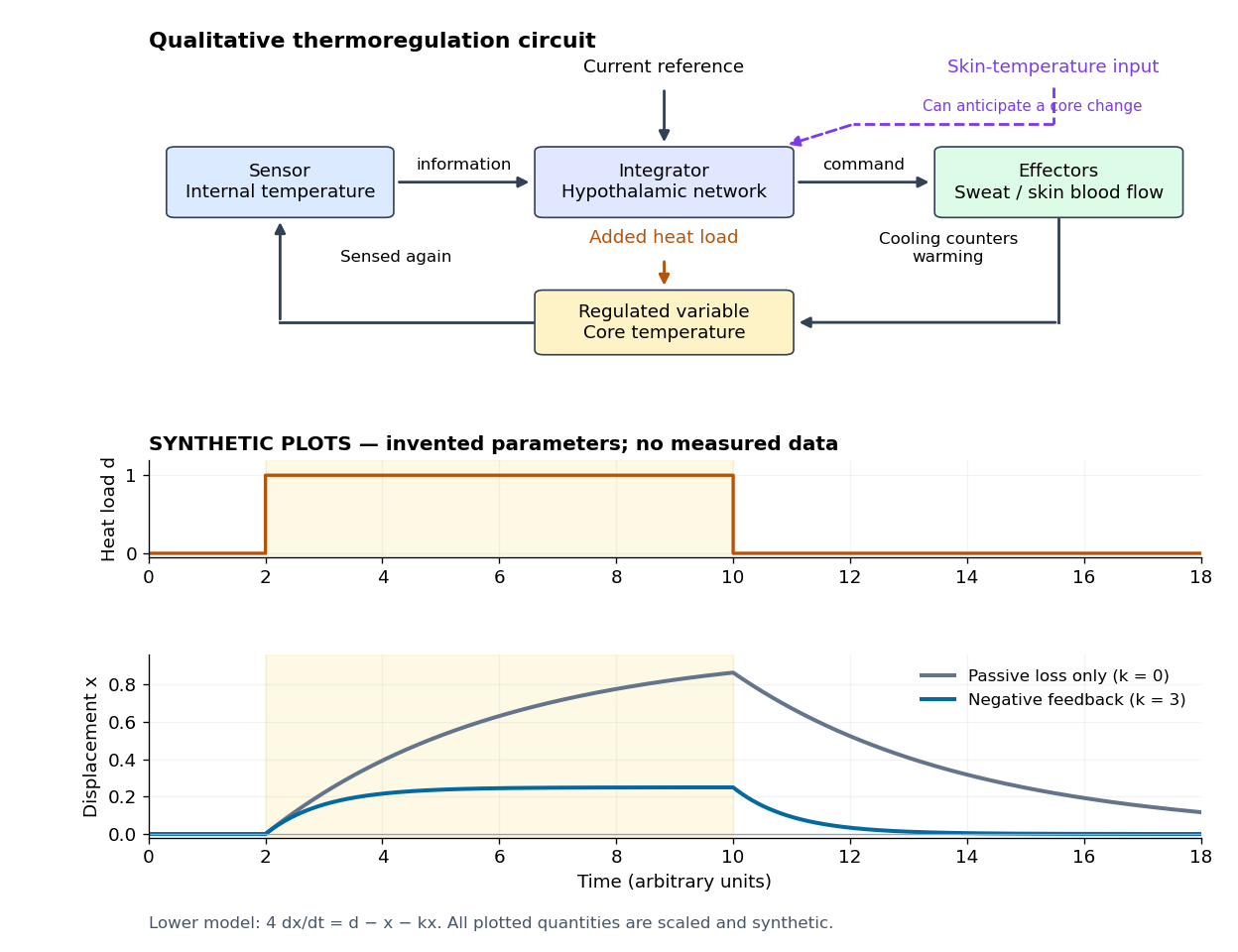
Homeostasis is useful precisely because internal activity can change: a nearly steady temperature can conceal a large increase in heat transfer. Conversely, observing a flat trace alone does not identify a regulatory mechanism. The environment might simply be constant, or the measuring instrument too insensitive; a perturbation and an independent response readout provide stronger evidence. The skin-temperature perturbation experiment below makes that distinction tangible.
The historical motivation was the puzzle of stability in changing living material. In his 1932 The Wisdom of the Body, Walter Bradford Cannon emphasized that an organism exchanges material with its surroundings and continually replaces its own structure, yet maintains relatively steady internal conditions. This authored excerpt presents homeostasis as active compensation for external and internal disturbances, rather than a static body. [ref]
Homeostasis (excerpt from The Wisdom of the Body). Homeostasis excerpt, paragraphs beginning The wonder increases, Resistance to changes and In short; hosting page identifies book and 1932 date
Scanning Tunneling Microscopy Research by Hoffman Laboratory by  Codex 0 Created 2026-10-13 Updated 2026-11-05
This source is credited to an organization.
Institutional laboratory account; individual collaborators are not treated as page authors. No date inferred from the filename.
Cited passages: Vortex Imaging in Iron Pnictide Superconductor, Fig. 2 and the discussion of disordered vortices and bulk pinning.
Superconductivity: The Meissner Effect, Persistent Currents and the Josephson Effects by MIT Department of Physics by Codex 0 Created 2026-10-13 Updated 2026-11-05
Codex 0 Created 2026-10-13 Updated 2026-11-05This source is credited to an organization.
Institutionally credited laboratory guide. Fall 2016–Spring 2017 identifies the course offering; the guide has a separate revision timestamp. The department is not inferred to author every source in the course.
Pinned article: Introduction to the OurBigBook Project
Welcome to the OurBigBook Project! Our goal is to create the perfect publishing platform for STEM subjects, and get university-level students to write the best free STEM tutorials ever.
Everyone is welcome to create an account and play with the site: ourbigbook.com/go/register. We belive that students themselves can write amazing tutorials, but teachers are welcome too. You can write about anything you want, it doesn't have to be STEM or even educational. Silly test content is very welcome and you won't be penalized in any way. Just keep it legal!
Intro to OurBigBook
. Source. We have two killer features:
- topics: topics group articles by different users with the same title, e.g. here is the topic for the "Fundamental Theorem of Calculus" ourbigbook.com/go/topic/fundamental-theorem-of-calculusArticles of different users are sorted by upvote within each article page. This feature is a bit like:
- a Wikipedia where each user can have their own version of each article
- a Q&A website like Stack Overflow, where multiple people can give their views on a given topic, and the best ones are sorted by upvote. Except you don't need to wait for someone to ask first, and any topic goes, no matter how narrow or broad
This feature makes it possible for readers to find better explanations of any topic created by other writers. And it allows writers to create an explanation in a place that readers might actually find it.
Figure 1. Screenshot of the "Derivative" topic page. View it live at: ourbigbook.com/go/topic/derivativeVideo 2. OurBigBook Web topics demo. Source. - local editing: you can store all your personal knowledge base content locally in a plaintext markup format that can be edited locally and published either:This way you can be sure that even if OurBigBook.com were to go down one day (which we have no plans to do as it is quite cheap to host!), your content will still be perfectly readable as a static site.
- to OurBigBook.com to get awesome multi-user features like topics and likes
- as HTML files to a static website, which you can host yourself for free on many external providers like GitHub Pages, and remain in full control

Figure 2. You can publish local OurBigBook lightweight markup files to either OurBigBook.com or as a static website.
Figure 3. Visual Studio Code extension installation.
Figure 5. . You can also edit articles on the Web editor without installing anything locally. Video 3. Edit locally and publish demo. Source. This shows editing OurBigBook Markup and publishing it using the Visual Studio Code extension. 
- Infinitely deep tables of contents:




All our software is open source and hosted at: github.com/ourbigbook/ourbigbook
Further documentation can be found at: docs.ourbigbook.com
Feel free to reach our to us for any help or suggestions: docs.ourbigbook.com/#contact