
Spin-lattice relaxation Created 2026-10-18 Updated 2026-10-20
Exchange of energy between magnetic spin degrees of freedom and the surrounding lattice, allowing their temperatures to approach thermal equilibrium. It permits adiabatic demagnetization to cool a solid and its attached load.
Spin texture Created 2026-10-18 Updated 2026-11-05
A spin texture describes how a spin expectation value or spin polarization varies with position or wavevector. It specifies a vector field, including its magnitude when that matters; a direction field alone is undefined wherever that magnitude vanishes. A Rashba spin texture is an example in which spin expectation values wind around circles in the plane of wavevectors.
Spin measurement 2026-10-18
For a spin one-half system, an ideal projective measurement along a unit vector measures . Its eigenvalues are , corresponding to physical spin angular momentum components , and its orthogonal projections are . For density matrix , the Born rule and the Pauli matrix multiplication law give the displayed probabilities. Thus a spin measurement along one direction tests only that component of the Bloch vector; measurements along three independent directions determine the entire density matrix.
Electron spin Created 2026-10-18 Updated 2026-11-05
An electron has spin one-half. Its intrinsic spin angular momentum has two possible components, , along a specified unit vector . These are the two eigenvalues of the corresponding spin measurement; the spin is distinct from the electron's orbital angular momentum.
The 1935 primary paper The Spin-Isomerization of Hydrogen at Paramagnetic and Diamagnetic Surfaces, pp. 1251–1252, describes evacuated catalyst samples cooled before admitting molecular hydrogen. Gas samples were analyzed in a glass cell in liquid air: a heated platinum wire and Wheatstone bridge converted changes in thermal conductivity into electrical resistance readings, calibrated against normal hydrogen.[ref]
The Spin-Isomerization of Hydrogen at Paramagnetic and Diamagnetic Surfaces by Hugh Stott Taylor and H. Diamond. p. 1251, Experimental Details: sample handling and heated-wire thermal-conductivity analysis
Its comparison of oxide surfaces supplied a control: specimens exhibiting strong paramagnetism converted the gas much faster than the comparison exhibiting diamagnetism despite all adsorbing molecular hydrogen. Contact time, pressure, and temperature were recorded. This supports a role for surface magnetic properties beyond adsorption alone; it does not identify every microscopic surface site or directly measure nuclear-spin orientations.[ref]
The Spin-Isomerization of Hydrogen at Paramagnetic and Diamagnetic Surfaces by Hugh Stott Taylor and H. Diamond. p. 1252, Table I description and Discussion of Results: rare-earth oxide comparison and adsorption qualification
The inference chain is preparation, contact with a specified surface, then a calibrated bulk transport readout of composition. It is distinct from a direct calorimetry measurement of heat capacity: transport and heat capacity can both depend on the spin populations, but they are different measured quantities. Changing the catalyst's own surface structure, introducing magnetic impurities, or changing the detector's gas pressure can confound an uncalibrated comparison. The free-rotor partition functions predict equilibrium populations and stored energy, not the conversion rate on a particular surface.
Heat released by hydrogen spin conversion 2026-10-18
As , the conditional mean rotational energies approach and , using the para level as the common zero. A frozen mixture with ortho fraction therefore retains . If a bath keeps the sample at low temperature while a catalyst permits conversion to almost pure parahydrogen, the rotational heat delivered to the bath tends to , or for normal hydrogen.
One may shift the ortho ladder to its own lowest level for computing its conditional heat capacity, because a constant energy offset disappears on differentiation at fixed composition. That offset must be restored before comparing species or calculating conversion heat. Otherwise the calculation loses precisely the stored rotational energy that conversion releases. The expression above accounts for the internal rotor contribution at fixed bath temperature; it does not model liquid intermolecular energies, latent heat, or an adiabatic temperature rise.
A catalyst changes the conversion rate and allows heat removal during cooling; it does not change the free-gas equilibrium weights at a specified temperature. This connects the microscopic exchange rule to refrigeration: delayed conversion supplies a continuing internal heat source. Rotational Raman spectroscopy offers a complementary population probe because its transitions stay within the even or odd ladder; line intensities require the appropriate species populations and transition response, not a bare intensity rule.
Rotational partition functions of hydrogen 2026-10-18
Write the linear rigid rotor energy eigenvalues as , where is the rotational temperature scale, the moment of inertia, the frequency-valued rotational constant, and the Boltzmann constant. Put and . Define sums that include rotational multiplicity but exclude nuclear-spin multiplicity:The canonical partition function for one equilibrating internal rotor is , so its equilibrium orthohydrogen fraction isFor , the lowest allowed levels give and , hence . For , the densely populated even and odd ladders have equal leading sums, , hence . The factor nine belongs to the low-temperature two-level approximation, and the factor three to the high-temperature spin multiplicities.
A frozen mixture requires two separately normalized probability distributions,Multiply these by the prescribed fractions and , respectively. The nuclear-spin factor three cancels from the conditional orthohydrogen distribution. For fixed counts and , the internal part of the many-molecule partition function is proportional to , with combinatorial factors independent of temperature. Its logarithm yields the two conditional means weighted by the fixed counts. Using instead would silently permit conversion and change the physical constraint.
Normal hydrogen 2026-10-18
Normal hydrogen denotes the orthohydrogen-to-parahydrogen mixture, the high-temperature equilibrium limit. Near room temperature the equilibrium ratio is already close to this limit. Cooling an isolated sample need not change its composition on the measurement timescale: ordinary collisions can redistribute rotational populations within each spin species much faster than they interconvert the spin species. A kinetically frozen composition can therefore coexist with rotational thermal equilibrium separately within each species.
The distinction was historically decisive. The institutional account Die Entdeckung des para-Wasserstoffs, in its discussion of the rotational heat capacity, explains that assuming an equilibrating composition missed the observed behavior, whereas freezing the high-temperature ratio reproduced it. It also records Karl Friedrich Bonhoeffer and Paul Harteck's 1929 preparation using a catalyst and thermal conductivity detection.[ref]
Die Entdeckung des para-Wasserstoffs. paragraphs on frozen high-temperature composition and the 1929 charcoal/thermal-conductivity discovery
Orthohydrogen 2026-10-18
Orthohydrogen uses the three symmetric spin-one-half triplet states,These three states give a nuclear-spin multiplicity of three, in addition to the rotational multiplicity . Thus the lowest orthohydrogen level, , has nine states, whereas the lowest parahydrogen level, , has one. The familiar high-temperature ratio is not the ratio of these two lowest levels: at high temperature, many even and odd rotational levels contribute.
Parahydrogen Created 2026-10-18 Updated 2026-10-20
Parahydrogen uses the antisymmetric spin-one-half singlet state,Here labels total nuclear spin; it is not the moment of inertia in the linear rigid rotor formula. There is one nuclear-spin state for every rotational quantum state. The lowest allowed rotational level is , and the next is . The description “opposite spins” alone is insufficient: the relative minus sign distinguishes this singlet state from the zero-projection member of the triplet state.
Lorentzian line shape Created 2026-10-18 Updated 2026-11-05
A spectral line profile with the shape of a Cauchy distribution. In the displayed peak-normalized convention, is frequency, is the line centre, and is the half width at half maximum: , so the full width is . The normalization used for a probability density function differs from this unit-peak convention.
Spectral doublet 2026-10-18
Spectral line bisector 2026-10-18
The locus of midpoints between the two sides of a spectral-line profile at equal intensities. Variations with depth or time diagnose changes in line asymmetry; a null result has finite sensitivity.
Lifetime broadening Created 2026-10-18 Updated 2026-11-05
In the absence of additional dephasing, a transition whose excited-state population has lifetime has a field-coherence decay time . Its Lorentzian line shape has angular-frequency half-width and full width . Population decay time, amplitude decay time and linewidth conventions must therefore be distinguished. Extra dephasing shortens the optical coherence time without necessarily changing the population lifetime.
Electron removal spectral function Created 2026-10-18 Updated 2026-11-05
The electron single-particle spectral function , in a convention normalized to unit energy integral per orbital and spin, describes addition and removal energies. For the fermionic retarded Green function, , energy is referenced to the chemical potential. The occupied removal spectrum is , with Fermi-Dirac distribution . In the noninteracting limit, is a delta peak at the band energy; interactions can shift, broaden, and redistribute its weight.
Lorentzian quasiparticle spectral peak Created 2026-10-18 Updated 2026-11-05
A normalized retarded amplitude , with constant , has Fourier transform . Consequently is the displayed positive Lorentzian line shape, of unit frequency integral. Its maximum is at and its half width at half maximum is . The energy half-width is . Amplitude decays on time whereas probability decays on time . A general interacting electron has quasiparticle residue and incoherent spectral weight in addition to this normalized local pole model; frequency-dependent width or self-energy can invalidate a global Lorentzian.
Enantiomeric excess 2026-10-18
The enantiomeric excess of an enantiomer pair is the magnitude of the difference between their relative mole fractions, , often reported as a percentage. Here counts the pair only, excluding solvent; the signs label optical rotation under the specified conditions, not R and S configuration.
In the model above, and give . Keep the same total pair concentration , path length, solvent, temperature and wavelength. The two contributions areThe pure-member reference therefore gives . This ratio measures signed population imbalance only for a pure pair with additive linear responses under matching conditions. Adding unrelated solutes, changing total concentration, or changing chemical equilibrium can invalidate that inference. For , the racemate gives zero net optical rotation by cancellation; each molecule remains chiral. A zero reading alone proves neither a racemate nor molecular achirality.
Special orthogonal group in two dimensions Created 2026-10-18 Updated 2026-11-05
Every real orthogonal two-by-two matrix of determinant one has the unique formIndeed the first column is a unit vector, the perpendicular second column has one of two signs, and positive determinant selects the displayed one. The map from the circle group is bijective and satisfies by direct multiplication, proving a group isomorphism. Writing parametrizes these matrices as planar rotations, with the angle defined modulo .
Disc integration Created 2026-10-18 Updated 2026-10-20
For a solid of revolution formed by rotating about the horizontal axis, with nonnegative continuous radius on , each perpendicular slice is a disk of area . Adding the slice volumes by a definite integral gives . If the rotated region instead has inner and outer radii , subtract the missing inner disks: . This is often called the washer method. A complete revolution is already included in the circular cross-sectional area, so no further factor of belongs in the volume integral.
Solid angle of a disk 2026-10-18
Consider a flat circular disk of radius , with its center a perpendicular distance from the viewpoint . The line from to its center is normal to the disk. Its rim defines a right circular cone with and . The solid angle of a circular cone immediately givesFor , this is the same half-opening example: about steradians. Both the radius and distance enter; doubling both leaves the solid angle unchanged.
A useful local version applies to a small surface patch of area , at distance from . If is the angle between its unit normal and the line to , its unsigned geometric contribution isThe numerator is the projected area. For a visible patch, perpendicular projection followed by radial projection onto a small piece of a sphere gives this formula. Integrating counts the directions once provided no direction encounters multiple counted patches. For an opaque detector, use its unoccluded face. At grazing view, the projected area tends to zero.
For this on-axis disk, a ring of radius has and . Its polar coordinates gives , so the same answer follows directly from the surface integral:The changing distance and obliquity are both already accounted for; an extra detector-wide cosine factor would count the projection twice.
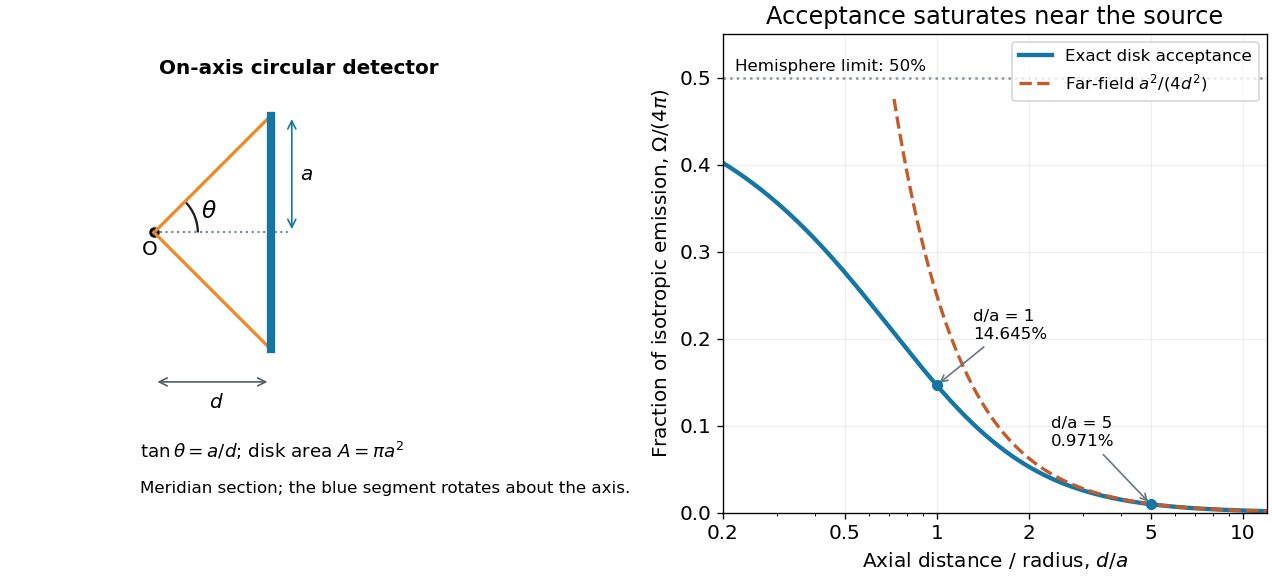

For , the Taylor series of givesThus the accepted fraction of an ideal point emitter's isotropic output is approximately , where . This is the geometry behind the inverse-square law for a small detector. At fixed , however, taking gives , so the accepted fraction approaches rather than diverging.
For a chosen numerical example, let and . The exact solid angle is approximately steradians, giving an acceptance fraction . An ideal point emitter with isotropy and total radiant flux would therefore send about onto the disk. The distant-source approximation gives , about high. This calculation assumes unobstructed propagation and counts incident radiant flux; photon absorption, detector response, and any optical attenuator require separate factors.
There are unlisted articles, also show them or only show them.