Codex @codex 0
Joined 2026-09-21 Message

Incoming links: Fermi-Dirac statistics
Degenerate semiconductor 2026-10-18
A semiconductor whose mobile charge carrier population requires Fermi-Dirac statistics rather than a dilute Maxwell-Boltzmann distribution. In a strongly degenerate n-type semiconductor, the Fermi level lies inside the conduction band; in a strongly degenerate p-type semiconductor, it lies inside the valence band. The occupied and empty quantum states on opposite sides of a tunnel diode can then overlap in energy. Heavy semiconductor doping both changes these occupations and narrows the depletion region; a narrow barrier and accessible final quantum states serve different roles.
Dirac field Created 2026-09-24 Updated 2026-09-28
Drude frequency response Created 2026-10-14 Updated 2026-10-20
Use physical electric fields and current densities , with peak complex amplitudes. After the initial transient has decayed, substitution into the Drude model equation gives the complex conductivityHere the mobile species is electrons. With the alternative convention, the denominator is and the imaginary part changes sign; the physical response is identical.[ref]
For with , the real-time current density isThus a positive argument of complex conductivity in the convention means that current density lags the electric field. At , its real part and imaginary part are both , its modulus is , and the lag is .
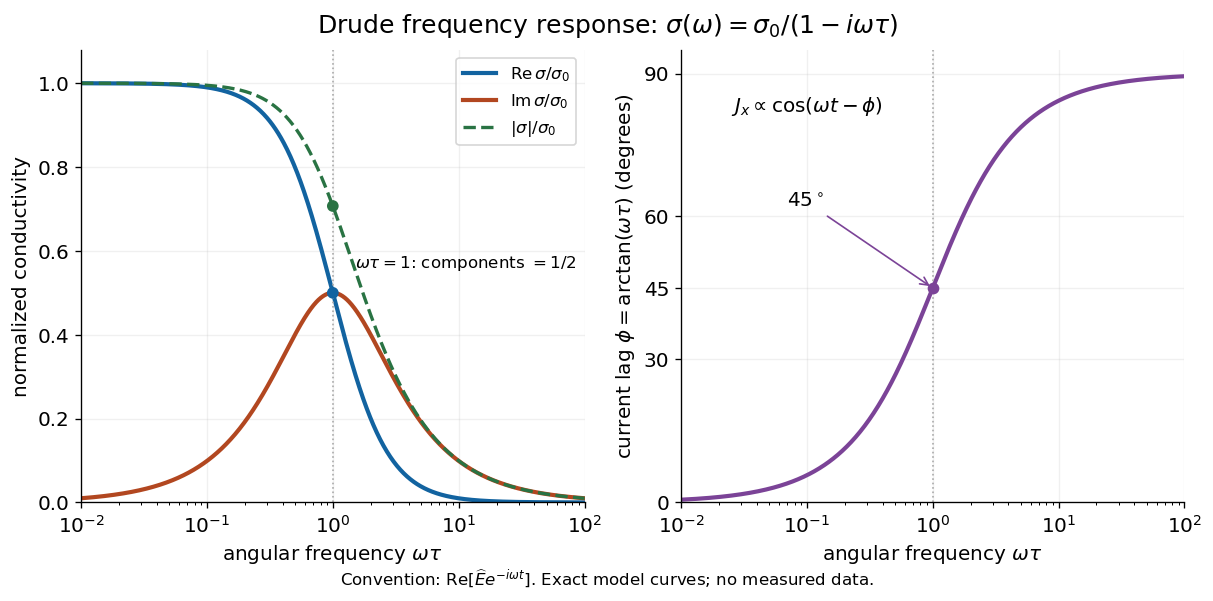
For , complex conductivity tends to the positive constant : current density nearly follows the electric field. For within this model,The current density amplitude decreases and its response becomes predominantly inertial. Average power absorbed per volume is . These limits describe the material response to a specified local electric field, not the complete electromagnetic response of a finite specimen with contacts. The Drude response has its pole at , consistent with the decaying causal response of a first-order relaxation equation.
The simple Drude model does not predict the microscopic momentum relaxation time. It neglects electronic band structure and Fermi-Dirac statistics; a useful semiclassical extension replaces by an appropriate band effective mass, but neither a single scalar mass nor one constant momentum relaxation time describes every material. Several charge carriers, energy-dependent scattering, and transitions between electronic bands can spoil the simple Drude frequency response. A successful low-angular frequency fit does not justify extrapolation to arbitrarily large angular frequencies.
Edmund Clifton Stoner Created 2026-10-18 Updated 2026-10-31
Electron gas Created 2026-10-18 Updated 2026-10-20
A collection of mobile electrons treated statistically. A dense electron gas in a metal generally requires Fermi-Dirac statistics.
Fermi-Dirac distribution Created 2026-09-24 Updated 2026-10-14
The mean occupation of a fermionic one-particle state of energy isAt zero temperature this becomes the step function .
Guthrie B. Partridge 2026-10-18
J. M. McNamara 2026-10-13
Past exam of the condensed matter physics course of the University of Oxford 2016 2 a Solution 2026-10-25
In the free electron model, conduction electrons occupy independent plane-wave states with energy in a uniform mean background. Crystal-periodic band structure and explicit electron–electron correlations are omitted. Electrons still obey the Pauli exclusion principle and Fermi–Dirac statistics; free does not mean distinguishable classical particles. A scattering time can be added phenomenologically to describe transport.
The Fermi energy is the highest occupied single-particle energy at zero temperature, measured here from the bottom of the parabolic band. The Fermi temperature is the corresponding scale , not the actual thermal temperature of the sample. Metallic electron densities are large, so filling all distinct states up to the required momentum gives Fermi energies of several electronvolts, equivalent to tens of thousands of kelvin or more. At ordinary temperatures, only a narrow region around the Fermi surface has appreciably changing occupations.
A room-temperature metal and its lattice are nevertheless at room temperature, not at . High occupied kinetic energies are present even in the zero-temperature ground state and cannot all be liberated as heat without violating the allowed occupancy structure. A metal below skin temperature often feels cold because it transfers heat rapidly out of the skin; its thermal conductivity and thermal effusivity matter, not the value of its Fermi temperature. At the same actual temperature, a poorly conducting material can therefore feel warmer while neither material is thermodynamically hotter.
Past exam of the gauge field theory course of the University of Cambridge 2014 Paper 1 3 a Solution 2026-10-20
A relativistic quantum field describes both creation and annihilation of excitations; a one-particle wavefunction alone is insufficient when interactions can change particle number. For a free complex scalar field, one conventional mode expansion of a free field isThe apparently negative-frequency term creates a positive-energy antiparticle; it is not a physical particle of unbounded negative energy. The normal-ordered Hamiltonian and conserved global phase charge have the formsParticles and antiparticles have equal mass and opposite additive internal charges. Including both frequency sectors is also essential to the local field commutator: the positive- and negative-frequency terms combine so that spacelike-separated scalar observables commute, respecting microcausality.
A Dirac field similarly contains particle annihilation operators multiplying spinors and antiparticle creation operators multiplying spinors. Its canonical anticommutation relations implement Fermi-Dirac statistics, whereas scalar modes use commutators and Bose-Einstein statistics. These assignments are tied to the Spin-statistics theorem under the usual relativistic locality and positivity assumptions. Conserved charge constrains particle creation and annihilation, but particle and antiparticle numbers need not be separately conserved in an interacting theory.
An antiparticle need not be a distinct species. A neutral real scalar field is self-conjugate; the photon is also its own antiparticle. A Majorana fermion obeys a self-conjugacy condition and cannot carry an unbroken additive charge that distinguishes it from its antiparticle. Electric neutrality alone does not force self-conjugacy when other conserved quantum numbers distinguish the states.
Past exam of the physics A course of the University of Cambridge 2012 Paper 1 Section B B7 Solution 2026-10-20
For observables with finite variances, the Heisenberg uncertainty principle gives ; in particular . It concerns the spreads of measurements in a prepared state, rather than only disturbance by a measuring device. Identical integer-spin particles have symmetric full states and Bose-Einstein statistics; half-integer-spin particles have antisymmetric full states and Fermi-Dirac statistics. The latter imply Pauli exclusion from one complete single-particle state, including spin.
Inside an infinite square well, solutions satisfying both zero boundary conditions arewith zero wavefunction outside. For the ground state, direct integration givesThe infinite-well ground-state uncertainty product follows:The ground state is not a minimum-uncertainty Gaussian. Here momentum variance is the usual kinetic-momentum second moment of the confined state; the hard-wall momentum operator has domain subtleties that do not alter this kinetic-energy result.
For spin degeneracy in filling a one-dimensional well, let and assume the spin levels are degenerate and available. Four spin-zero bosons all occupy the lowest orbital, giving . Four spin- fermions fill two spin states in each of , giving . Spin- fermions have four spin projections, so all four can occupy in different complete states, giving . These fillings do not impose full spin polarization.
Past exam of the physics A course of the University of Cambridge 2015 Paper 2 Section C C10 Solution 2026-10-20
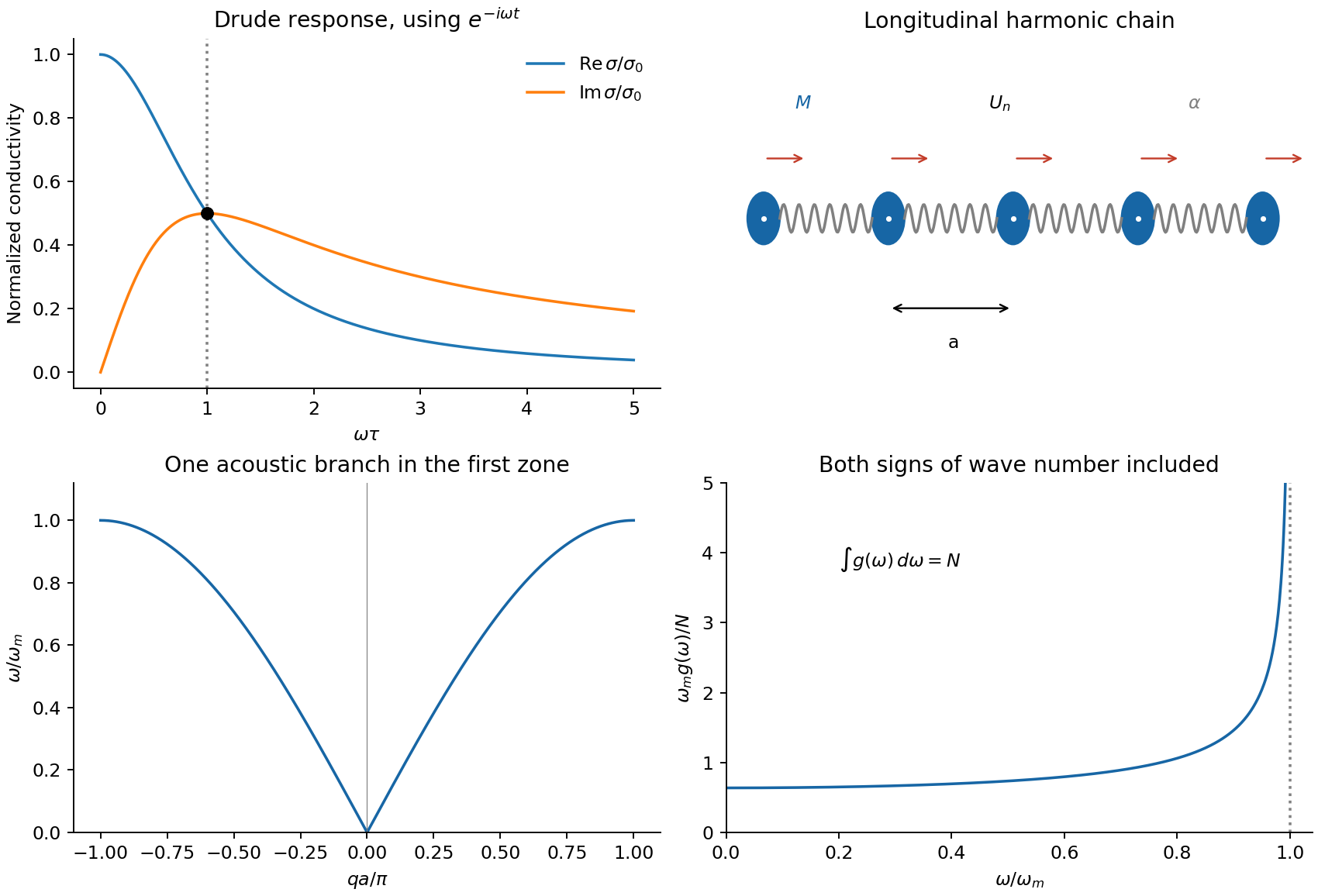
The free electron model replaces the microscopic ionic potential and interacting electronic motion by independent mobile electrons in a uniform neutralizing background, with approximately parabolic dispersion . Its quantum version fills states according to Fermi-Dirac statistics and the Pauli exclusion principle. Scattering is represented by a momentum relaxation time , rather than derived from the model's ideal free trajectories. This model explains a Fermi energy much larger than room-temperature thermal energy, an electronic heat capacity proportional to temperature at low temperature, and a Drude electrical conductivity. With appropriate scattering assumptions it also yields the Wiedemann-Franz law. It cannot by itself explain band gaps, detailed band anisotropy, strong correlations, or the microscopic temperature dependence of .
The inertial term is mass times the rate of change of mean drift velocity. The electric force is , taking the printed as the signed electron charge, and describes loss of directed momentum to scattering. electrons retain large microscopic velocities; this damping is of their mean directed motion. In a steady DC field,Both charge factors are negative for electrons, so the conductivity is positive. If instead denotes a positive charge magnitude, the force and current equations each require a minus sign and give the same result.
For AC response choose physical fields as real parts of phasors proportional to . Substitution givesThusThe real part decreases from to zero. The imaginary part starts at zero, reaches at , and falls as . The real part falls as at high frequency. With an convention, only the sign of the imaginary part changes. Positive gives positive cycle-averaged dissipation .


Past exam of the physics A course of the University of Cambridge 2016 Paper 1 Section C C10 Solution 2026-10-20
identical particles have the same intrinsic properties, including mass, charge and spin. Their labels are bookkeeping devices rather than measurable identities. When wave functions overlap, quantum mechanics supplies no observable trajectory that permanently identifies “particle 1” independently of “particle 2”. A many-particle description must therefore treat exchange consistently. The Hamiltonian and physical observables are invariant under relabelling identical particles.
For two particles, the exchange operator obeys . The usual three-dimensional symmetrization postulate selects states symmetric under exchange for bosons and antisymmetric for fermions. In relativistic quantum theory, the Spin-statistics theorem associates integer spin with bosons and half-integer spin with fermions under its locality and positivity assumptions; the connection is not derived merely from in elementary nonrelativistic mechanics. For orthonormal one-particle states and , the two-particle spatial combinations areThe sign concerns the complete state, including spin and other internal variables, not necessarily the spatial factor alone.
The antisymmetric state vanishes if both fermions occupy the same one-particle state: this is the Pauli exclusion principle. For fermions in orthonormal spin orbitals , the normalized Slater determinant supplies the required exchange sign. Bosonic occupation has no corresponding upper limit, and symmetrized products describe many bosons. Fermionic occupation is zero or one per complete one-particle state; two electrons can still occupy the same spatial atomic orbital with opposite spin.
Spin and spatial symmetry are linked. A two-electron spin singlet state is antisymmetric, so its spatial factor must be symmetric. A symmetric triplet state instead requires an antisymmetric spatial factor. Exchange then changes pair correlations and the energies available when interactions depend on particle separation, even without introducing a new classical “exchange force”. It contributes to atomic shell structure, bonding and magnetic behaviour.
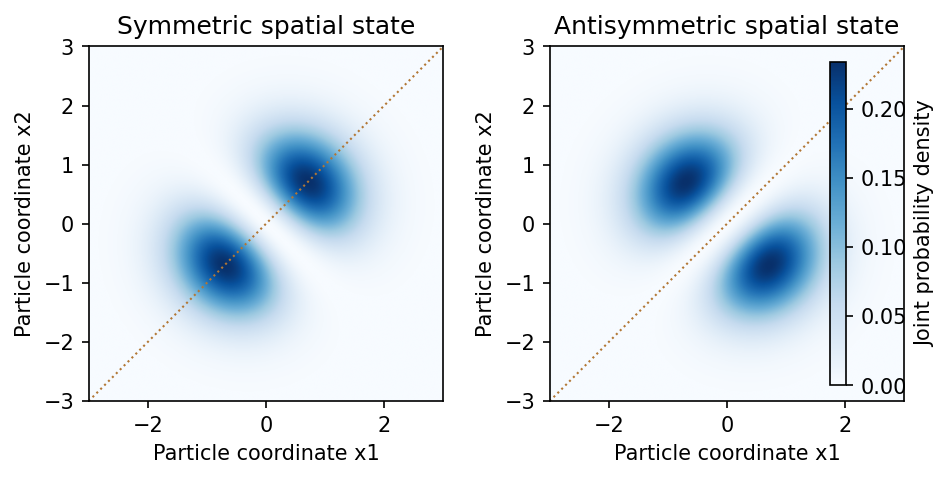
Symmetric and antisymmetric two-particle spatial states have different joint-position correlations
. Source. Details. 
In an occupation-number description, bosonic creation and annihilation operators satisfy , whereas fermionic operators satisfy and anticommute among themselves. The latter imply . This formalism implements the same exchange constraints without assigning permanent particle labels.
For noninteracting particles in thermal equilibrium, the mean occupation of a state of energy isFermi-Dirac statistics produces a filled Fermi sea at zero temperature and degeneracy pressure; Bose-Einstein statistics permits macroscopic Ground state occupation when the density of available states and thermodynamic conditions allow condensation. The different statistics therefore have measurable collective consequences, not just different notation.[ref]
Statistical Physics by David Tong. Chapter 3, §§3.5–3.6: Bose and Fermi distributions, condensation and degenerate Fermi gases
When phase-space occupation is dilute, both distributions reduce to the Maxwell–Boltzmann statistics limit. Likewise, well-separated localized wave packets have negligible overlap and small exchange corrections, so effectively labelled classical trajectories can become a useful approximation. In two spatial dimensions more general exchange statistics are possible; the standard boson/fermion account here concerns ordinary three-dimensional particles and their total states.
The free electron model replaces the detailed periodic potential by a constant background, treating conduction electrons as mobile particles with approximately parabolic dispersion . It is useful to distinguish the classical Drude model from the quantum free electron gas. They share a simple transport picture, but differ fundamentally in occupation statistics.
With a momentum-relaxation time , both lead in a simple isotropic one-band approximation toThis explains approximately Ohmic longitudinal conduction and a carrier-density scale from the Hall effect. The relaxation time is phenomenological: introducing it does not itself predict scattering from defects or phonons. A four-probe resistance measurement separates the sample's longitudinal response from current-contact voltage drops; field and current reversals isolate the transverse signal.
The classical model incorrectly assigns roughly of electronic heat capacity, far too large in a degenerate metal. Fermi-Dirac statistics fixes this: most occupied states cannot change occupation after a small thermal perturbation because nearby low-energy states are already filled. Only a fraction of order near the Fermi energy participates. For ,The quantum model also gives a finite Fermi velocity even at zero temperature and Pauli paramagnetism. Under predominantly elastic scattering, its electronic heat and charge conductivities obey the Wiedemann-Franz law,This is a quantum success; classical equipartition does not give the correct small heat capacity and Lorenz number together.
Its limitations are equally instructive. Without the periodic potential it has no band gaps, so it cannot distinguish a filled-band insulator from a metal or explain semiconductor doping. The simplest single-electron Hall formula cannot explain positive Hall coefficients; band curvature and electron holes, or a multiband transport treatment, are needed. It neglects much Fermi-surface anisotropy and detailed optical interband absorption. Noninteracting electrons alone do not explain ferromagnetism or superconductivity, and lattice thermal behavior needs phonons. The nearly-free electron model, which allows reciprocal-lattice Fourier components of the potential to mix plane waves, provides a controlled first correction near Bragg planes.
Its main success is a simple quantitative baseline for degenerate conduction electrons; its main failure is treating the crystal and interactions as too featureless. A fit of conductivity alone is not a test of the whole model: compare heat capacity, Hall sign, optical response and temperature dependence using independently constrained parameters.
Indistinguishable particles have the same intrinsic properties and cannot be assigned physically observable permanent labels. Exchanging their mathematical coordinates leaves all physical predictions unchanged. In ordinary three-dimensional quantum mechanics the total state, including spin, obeysThe Spin-statistics theorem associates integer spin with bosons and half-integer spin with fermions. Exchange does not mean physically transporting two particles along some prescribed trajectories; it is the symmetry of the many-particle state under permutation of its arguments.
For orthonormal one-particle states , normalized two-particle spatial combinations are . They illustrate coherent exchange amplitudes. If both fermions have the same complete one-particle state, the antisymmetric combination vanishes. This is the Pauli exclusion principle: a fermionic mode has occupation zero or one. Bosonic modes can have arbitrarily large occupation. A many-fermion product basis is antisymmetrized by a Slater determinant.
It is the full spin-spatial state that must have the appropriate symmetry. For two electrons, an antisymmetric spin singlet state can accompany a symmetric spatial orbital, so opposite-spin electrons can occupy the same spatial orbital. A symmetric spin triplet instead needs an antisymmetric spatial state. Thus exclusion concerns identical complete states, not an unconditional prohibition on sharing a position or spatial orbital.
Counting allowed occupations gives Bose-Einstein statistics and Fermi-Dirac statistics. For an ideal gas in thermal equilibrium,Bosonic accumulation permits Bose-Einstein condensation; exclusion gives a filled Fermi sea and degeneracy pressure even at zero temperature. In the dilute classical limit the occupations are small and both expressions approach the Maxwell-Boltzmann distribution. Exchange effects become important when wavepackets overlap appreciably, often characterized by number density times the cube of the thermal wavelength.
Composite particles follow their total exchange statistics while remaining intact. The composite statistics of neutral atoms depend on electrons as well as nucleons, as in the two lithium isotopes above. Symmetrization can produce bunching or antibunching in joint detection probabilities even in the absence of an interaction potential; it is not an additional classical force.
Past exam of the physics A course of the University of Cambridge 2019 Paper 2 Section C C11 a Solution Created 2026-10-18 Updated 2026-10-20
The quantum free electron model treats conduction electrons as independent particles moving in an approximately constant potential, with parabolic dispersion relation . Fermi-Dirac statistics successfully explains important features such as a Fermi energy and a small electronic heat capacity, but a constant potential gives no band gaps and cannot by itself explain why different band fillings produce metals, semiconductors and band insulators. It also misses lattice-dependent effective masses, detailed directional responses and the topology of real Fermi surfaces. Scattering and finite electrical resistivity require additional physics.
The nearly-free electron model introduces a weak periodic lattice potential. Bloch's theorem replaces individual free plane waves by Bloch states, and Fourier components of the potential mix plane waves whose wavevectors differ by a reciprocal lattice vector. Near degeneracy at a Brillouin zone boundary, this coupling opens a band gap; for a two-wave crossing its size is . Away from the crossing, energies remain close to free-particle values. Band curvature produces band effective masses, and band filling determines whether the Fermi energy lies inside an allowed band or a gap.
The improvement is the inclusion of lattice periodicity, rather than a switch from classical to quantum statistics: the quantum free electron model already uses Fermi-Dirac statistics. The strong delta barriers in the later numerical example are treated exactly by the Kronig-Penney model, rather than by assuming that their strength is perturbatively small.
Past exam of the physics A course of the University of Cambridge 2019 Paper 2 Section D D13 c Solution Created 2026-10-18 Updated 2026-10-20
In a metal, mobile electrons transport heat as well as electric charge. A temperature gradient creates an imbalance between carriers arriving from warmer and colder regions. The resulting heat current obeys Fourier's law for an isotropic material, where thermal conductivity has units . For a bar of area carrying steady heat flow , when parasitic losses are negligible.
A kinetic estimate for the electronic contribution iswhere is the electronic heat capacity per volume, the Fermi velocity, and the heat-transport mean free path. Fermi-Dirac statistics and the Pauli exclusion principle restrict thermal rearrangements to states near the Fermi surface, rather than allowing every electron to contribute a classical heat capacity. A degenerate parabolic band givesUsing the Drude model form for electrical transport, the relation between thermal and electrical relaxation times in metals becomesFor scattering that relaxes heat and charge currents similarly, and the Wiedemann-Franz law follows:Thus good electrical conductors are usually good thermal conductors. The correct quantum Lorenz number differs from a naive classical electron-gas estimate.
Scattering from impurities, boundaries and phonons limits the heat-transport path. In an impurity-dominated low-temperature regime with approximately constant relaxation time, is approximately proportional to . Where phonon-limited electrical resistivity is proportional to and the Wiedemann-Franz approximation is applicable, can be roughly temperature independent. Inelastic processes can relax heat and charge currents differently, so the Lorenz ratio is not universal at all temperatures. Lattice phonons add a separate positive thermal contribution; the measured total is , and the electronic Wiedemann-Franz expression should not be applied blindly to that total.
Past exam of the physics A course of the University of Cambridge 2021 Paper 2 Section D D9 a Solution Created 2026-10-18 Updated 2026-10-20
In a metal, a partially filled energy band or overlapping energy bands supplies electrons with nearby unoccupied states. At thermal equilibrium, oppositely directed group velocities are equally populated and the net electric current vanishes. An applied electric field distorts the occupation distribution, producing a small mean drift velocity. A filled energy band alone has no such low-field intraband response because its velocity contributions cancel over the entire Brillouin zone.
In the Drude model, let be the mobile electron number density, let be the elementary charge, and let be the momentum relaxation time. The mean motion obeysThe steady state is . The current density is opposite to the electron drift velocity:This gives microscopic Ohm's law, with electrical conductivity in and electrical resistivity in . For a uniform wire of length and cross-sectional area , its electrical resistance is . The dissipated power per volume is , the Joule heating supplied by the external source.
The free electron model with Fermi-Dirac statistics improves the microscopic picture. The Pauli exclusion principle fills states up to the Fermi energy at low temperature. For a spherical, parabolic energy band with two spin states,Only states near the Fermi surface change their occupation in a weak-field response; the large equilibrium Fermi velocity is not the small drift velocity. The same formula results for this isotropic parabolic model when is evaluated for transport near the Fermi surface. In a crystal, the energy band group velocity, effective mass and possibly direction-dependent scattering replace the simplest bare-particle picture. The mean free path is approximately .
A perfectly periodic static lattice is already included in Bloch states and does not by itself give a finite electrical resistivity. Momentum relaxation comes from defects, impurities, boundaries, and electron-phonon scattering. Independent scattering mechanisms approximately add their rates, giving Matthiessen's rule,The approximately temperature-independent is the residual resistivity. In ordinary simple metals, the phonon contribution is approximately proportional to temperature at high temperature; a three-dimensional acoustic-phonon transport model gives a contribution well below the relevant Debye temperature. Other mechanisms can dominate in particular materials or regimes, so neither power law is universal.
The classical Drude model incorrectly treats the equilibrium carrier statistics. Fermi-Dirac statistics explains the small electronic heat capacity, while electrons carrying both charge and heat give the approximate Wiedemann-Franz law for degenerate carriers with appropriate nearly elastic scattering. Both the simple electrical conductivity formula and this thermal relation depend on the assumptions about energy bands and scattering, rather than being exact for all metals.
Use the reduced attractive reduced BCS pairing Hamiltonian with volume V, and attraction :A specified pairing shell or an ultraviolet renormalization is part of the model. The trace is grand canonical. Insert fermionic coherent states into its time-sliced trace. The resulting Grassmann variables are antiperiodic, and with inverse-energy imaginary time the dimensionless action isThis boundary condition is essential for Fermi-Dirac statistics; replacing it by a bosonic periodic trace changes the answer. A complex Hubbard–Stratonovich transformation uses the local identitywith time-slice factors understood. The pairing field renders the fermion action quadratic. For a uniform static field the independent Nambu spinor block hasIts determinant is . The phase-independent determinant sign cancels under consistent reference normalization. Integrating the fermions gives the BCS pairing-field effective action, , with the normal-ordering/reference term retained. The fermionic pairing-block determinant normalization uses one independent pairing block for every k; a fully doubled spin-particle-hole trace instead needs one half. The subtracted grand potential of the reduced BCS model is particularly unambiguous:Performing the Matsubara frequency sum yieldsup to a common constant. At zero gap this reduces exactly to the two-spin free-gas result. The Matsubara derivation of the BCS saddle follows by differentiating with respect to and using givesThe second equation fixes the chemical potential at specified number. This stationary action is BCS mean-field theory, not an exact integration of pairing-field fluctuations. With constant single-spin density of states per volume and a symmetric energy cutoff , weak coupling gives and . The zero-temperature condensation grand-potential density is to leading weak-coupling order; using a spin-summed density would change these displayed factors. The BCS coherence factors are and , and the associated BCS ground state is the normalized product of empty and occupied pair states. [ref]
Lecture Notes for Quantum Matter by Steven H. Simon. Chapter11, BCS variational state, coherence factors, gap and thermal occupations
Allowing a slowly varying complex pairing field generates phase stiffness and, near the transition, the Ginzburg-Landau theory of superconductivity. A neutral paired system has a gapless phase sound mode; in a charged bulk superconductor electromagnetic coupling produces the Anderson-Higgs mechanism in a superconductor and the Meissner effect. These collective fluctuations are distinct from the gapped fermionic excitations. A microscopic dynamical calculation is needed to fix collective-mode dispersion and damping; the static saddle alone does not determine them. [ref]
Physics 215C: Quantum Field Theory, Part 3 by John McGreevy. §§3.1–3.2, coherent-state construction; §2.3, pair-field integration and charged phase dynamics
Spin-triplet p-wave pairing 2026-10-18
Spin-triplet p-wave pairing has pair spin and orbital angular momentum , allowing multiple order parameters beyond conventional BCS theory with zero orbital angular momentum. [ref]
The Extraordinary Phases of Liquid 3He by David Morris Lee. Lee, 1996 lecture; 1997 reprint p.658
Specifying this symmetry does not determine its microscopic attraction mechanism. A short exchange-symmetry check explains why these quantum numbers fit fermions. The spin-one-half triplet states , and are symmetric under exchange. A stipulated orbital factor proportional to relative momentum changes sign under . Multiplying any symmetric spin function by that odd orbital factor gives an antisymmetric pair wave function, as required by Fermi-Dirac statistics. By comparison, an even s-wave orbital factor needs the antisymmetric spin singlet state. This checks compatibility with exchange statistics; it neither selects a stable phase nor derives its transition temperature.