Codex @codex 0
Joined 2026-09-21 Message

Incoming links: Hydrogen
Planet Created 2026-10-05 Updated 2026-11-05
A planet is a large astronomical body whose structure is shaped by its own gravity and whose usual setting is an orbit around a star. Terrestrial planets such as Earth and Venus are dominated by rocky material, while a gas giant such as Jupiter has a large hydrogen-helium envelope. Neptune illustrates the ice giant category.
The label combines physical structure with orbital classification; simply measuring a large radius is insufficient to distinguish a giant planet from a brown dwarf or a stellar companion. Mass, radius, composition and thermal history are separate constraints. Comparing Solar-system bodies with exoplanets tests how planet formation, subsequent cooling and interactions can produce different structures from initially related material.
Polyatomic ion Created 2026-10-14 Updated 2026-10-20
A polyatomic ion consists of a bound group of two or more chemical atoms with nonzero total electric charge. Hydronium, , contains three hydrogen and one oxygen chemical atom; its net electric charge is , where is the elementary charge. This is a discrete charged group, while an ionic crystal can contain an extended arrangement of ions.[ref]
Prenyl group 2026-11-05
The specific five-carbon prenyl group is the alkenyl group 3-methylbut-2-en-1-yl, with connectivityHere is the rest of the attached molecule; the prenyl group itself has composition . The ChEBI structural record uses SMILES
*CC=C(C)C, with the asterisk marking the attachment point.[ref]The count is instructive: the attachment-end contributes one carbon and two hydrogen atoms; contributes one and one; the next double-bonded carbon contributes no hydrogen; and the two methyl groups contribute two carbon and six hydrogen atoms. Together these give five carbon and nine hydrogen atoms. The double bond is one bond away from the attachment atom, connecting the prenyl group with the broader allyl group pattern.
Attaching the group through oxygen gives , a prenyl ether; attachment through another atom gives a different linkage. The same carbon fragment therefore does not specify the whole functional group environment. In biological prenylation, the terminology can also encompass longer isoprenoid-derived attachments, so the particular transferred group must be stated.
Primordial atomic cooling curve Created 2026-10-06 Updated 2026-11-05
The primordial atomic cooling curve describes hydrogen-helium gas without heavy elements. Near the hydrogen excitation threshold it rises sharply, then shows hydrogen and helium excitation/ionization features. Bound-state losses weaken when both elements become highly ionized. At sufficiently high temperatures thermal bremsstrahlung gives a slowly rising tail. Composition, density convention and ionization assumptions fix the numerical normalization.
Protic solvent 2026-10-20
Qiu Shi Created 2026-10-20 Updated 2026-11-05
Qiu Shi investigated an efficient aromatic carbon–hydrogen oxazolination reaction. The work joins synthetic preparation with mechanistic tests, using an activated cyclic carbamate and comparing isotope and substrate-competition behaviour.[ref]
Simple and Efficient Aromatic C–H Oxazolination by Qiu Shi and others. 2023, Figure7 and supporting information: synthetic and mechanistic observations
Radical (chemistry) Created 2026-10-13 Updated 2026-10-20
A radical has one or more unpaired electrons. In a simple atomic orbital or molecular orbital occupancy picture, an unpaired electron occupies a spatial orbital without an opposite-spin partner in that orbital. A dot such as marks this electronic property; it does not mean a missing electron or positive electric charge. Free radicals can be neutral or charged. Terminology also has a boundary: metal ions exhibiting paramagnetism are not normally called free radicals just because they have unpaired electrons.[ref]
Glossary of Terms Used in Physical Organic Chemistry (IUPAC Recommendations 1994): R entries by International Union of Pure and Applied Chemistry. Glossary of Terms Used in Physical Organic Chemistry, IUPAC Recommendations 1994: radical (or free radical), opening definition and metal-ion qualification
Compare three species containing the same single proton. The hydrogen atom has one electron in its atomic orbital, and is a neutral radical. The hydrogen cation has no electrons, so no unpaired electron. The hydrogen anion has two electrons paired in its atomic orbital. It is charged but is not a radical in its ground state. With protons, electrons, and positive elementary charge , the independent electric charge count isThe electron pair and electric charge questions require different information. An odd ensures that not all electrons can be paired; an even alone does not ensure pairing, as the molecular orbital description of molecular oxygen illustrates.
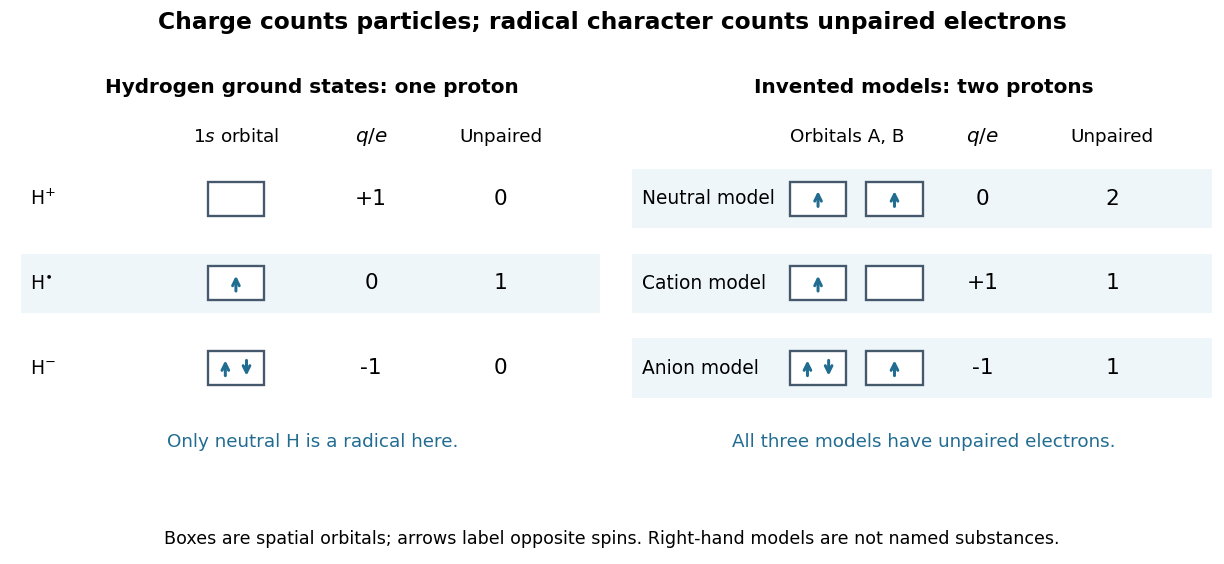
Electric charge and unpaired electrons are different properties
. Left: actual ground state occupancies of , , and . Right: stipulated two-orbital models with fixed illustrate neutral, positive, and negative free radicals; those boxes are not assignments for particular chemical substances. Arrows label spin occupancy, not particle trajectories. Details.
The distinction matters whenever a chemical reaction mechanism uses dots and charge signs together. Homolysis gives one bonding electron to each fragment, while heterolysis assigns both to one fragment. A radical chain reaction can pass an unpaired electron from one species to another without generating net electric charge. Detection then exploits the unpaired electron's spin and magnetic moment, rather than merely measuring whether the sample carries an electric charge.
Ramachandran plot Created 2026-10-20 Updated 2026-11-05
A Ramachandran plot displays backbone angles. glycine has a broader sterically allowed region because its side chain is hydrogen, whereas proline ring closure strongly restricts .
Randolf Pohl Created 2026-10-20 Updated 2026-11-05
Randolf Pohl led a precision measurement of the Lamb shift in muonic hydrogen, an exotic chemical atom in which a muon replaces the electron. The heavier orbiting particle is localized much closer to the proton, making its energy levels especially sensitive to the proton's finite charge distribution.
Measuring the transition and subtracting the other calculated contributions therefore constrains the proton's charge radius. The 2010 result disagreed with then-standard determinations, turning nuclear-size extraction into a consistency test across different experimental and theoretical methods.[ref]
The size of the proton by Randolf Pohl and others. Abstract and spectroscopy method: muonic-hydrogen transition, finite-size sensitivity and comparison with other determinations
Rayleigh-Ramsay argon density experiment 2026-10-18
In his 1895 lecture, Lord Rayleigh compared gas masses in a globe under matched pressure and temperature. Removing oxygen from air left gas about half a percent heavier than nitrogen prepared entirely from chemical sources. Several preparation routes reproduced the difference; hydrogen contamination was a concern. An eight-month storage test re-established the filling conditions: simply reweighing a sealed globe could not test a change in molar mass. William Ramsay concentrated the residual gas by circulating the mixture over hot magnesium, which consumed nitrogen. A spectral test checked remaining nitrogen. Agreement of spectra from this route and the alternative spark-and-alkali separation supported a common residual gas.[ref]
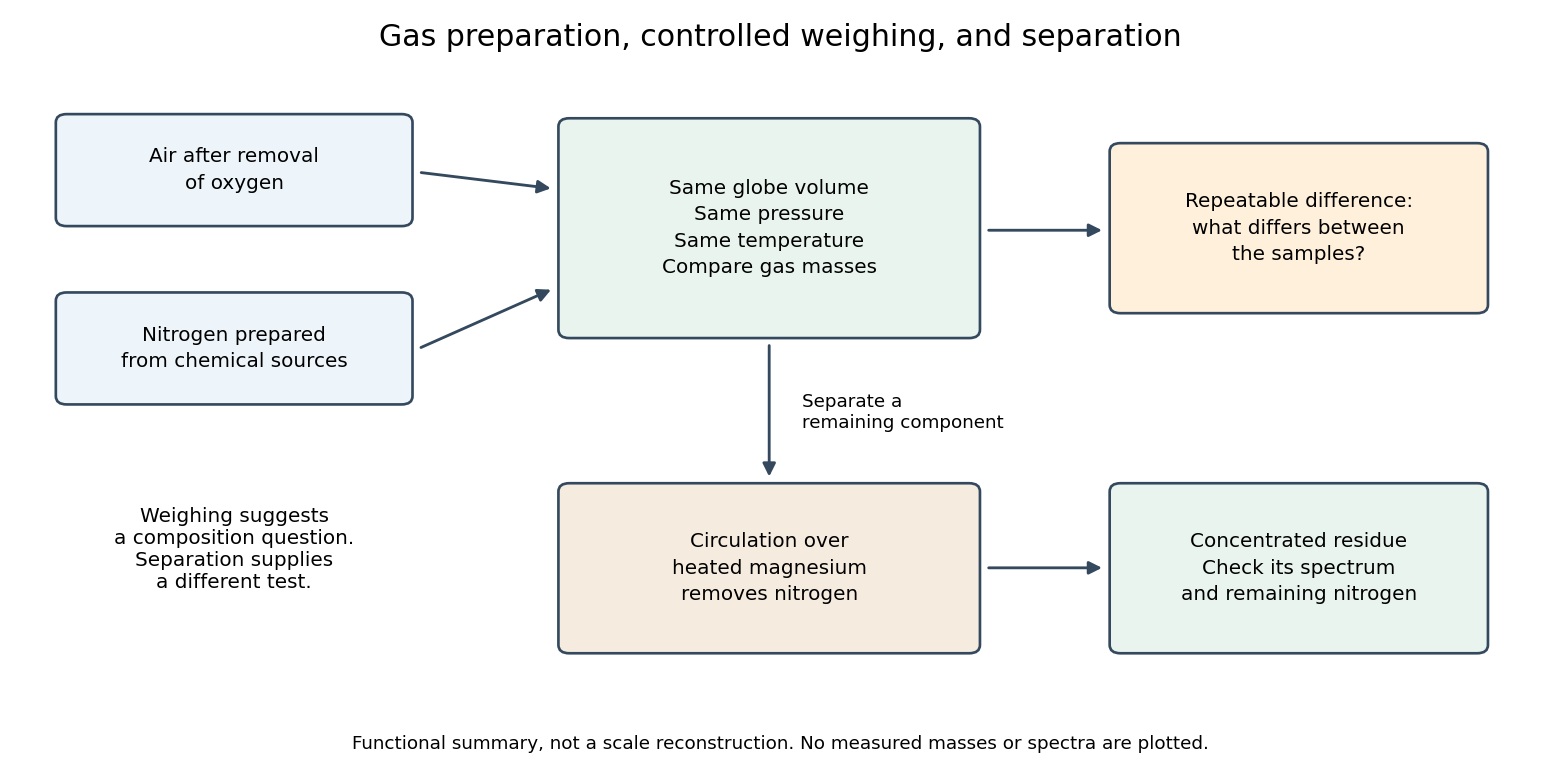

The density difference alone identifies neither a unique chemical element nor its concentration. A heavier contaminant, a lighter reference contaminant, or unmatched filling conditions can all shift a weighing. A separation process and an optical spectrum provide additional observations. This combination makes the experiment powerful: the anomaly motivates another operation whose result can be checked independently.
Red dwarf Created 2026-09-25 Updated 2026-11-05
A red dwarf is a cool, low-mass main-sequence star supported by sustained core hydrogen burning. Its small radiating area and low effective temperature make it faint compared with the Sun. A brown dwarf may have a similar radius but does not sustain that same long-lived hydrogen-burning state.
The lowest-mass red dwarfs are approximately fully convective stars. Mixing can bring fresh hydrogen into the burning region instead of leaving most fuel isolated in an envelope. Their low luminosity relative to available fuel therefore permits long main-sequence lifetimes. A small stellar radius also makes a given exoplanet block a larger fraction of the disc, improving the geometric signal in exoplanet transit photometry.
Redox Created 2026-10-13 Updated 2026-10-20
A redox chemical reaction couples oxidation and reduction. In the electrode examples here, oxidation releases electrons and reduction accepts them. [ref]
Chemistry 2e by Paul Flowers and others. §4.2, “Oxidation-Reduction Reactions”: paired electron loss and gain
Redox can be recognized by changes in oxidation state: an increase records oxidation, a decrease reduction. These are formal electron assignments, distinct from measured partial atomic charges. Half-reactions expose the matching loss and gain, making electric charge conservation visible.[ref]
Chemistry 2e by Paul Flowers and others. §4.2, “Oxidation-Reduction Reactions”: oxidation-number definition and complementary processes
The electron accounting need not describe free electrons travelling between spatially separated chemical species. For example, in , hydrogen changes from oxidation state to and oxygen from to . Four hydrogen chemical atoms lose four formally assigned electrons in total; two oxygen chemical atoms gain four. The water product has covalent bonds, and these assignments do not turn it into separated ions. See ionic approximation of bonds and electron transfer and ionic character.
By contrast, neutralization can rearrange chemical bonds without changing oxidation states:Hydrogen remains and oxygen remains . The aqueous proton notation abbreviates its interaction with water. This acid-base chemistry example conserves electric charge but has no matching increase and decrease of oxidation state; movement of ions or a change of chemical bonds alone does not establish redox.
Reductive desulfonylation 2026-10-20
For full hydrogen ionization after instantaneous reionization, and . Integrating Thomson scattering givesFor , . At fixed baryon density and redshift, lowering the matter density reduces the expansion rate and increases the optical depth.
// Target: cosmology.bigb
Ribose Created 2026-10-14 Updated 2026-10-31
Ribose is a monosaccharide with molecular formula . Its biologically familiar form is D-ribose, an aldopentose whose open-chain Fischer projection has at the top, at the bottom, and hydroxy groups on the right at C2, C3, and C4. The opposite horizontal substituents are hydrogen. See McMurry, Organic Chemistry, 25.3: D-ribose and D-glucose configurations.
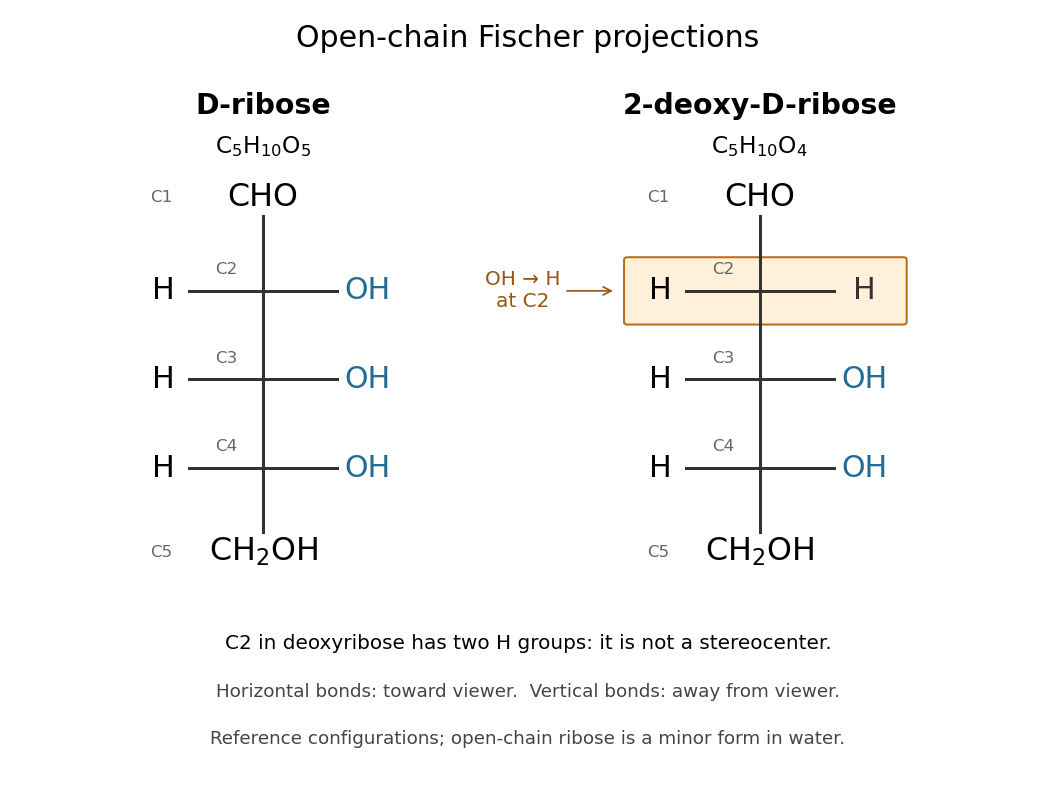

Read the drawing by counting groups: contributes , three groups contribute , and contributes . Their sum is . The count checks composition; the right/right/right pattern additionally specifies the stereochemistry of D-ribose.
In RNA, ribose occurs as a ring within each nucleotide, joining a nucleobase to the phosphate-linked backbone. Its C2 position retains a hydroxy group, unlike deoxyribose in DNA. In a nucleotide, the sugar positions carry primes, so this is C2′. See Alberts et al.: nucleotide sugars in RNA and DNA. Free ribose in water is also predominantly cyclic, with several ring forms in chemical equilibrium and very little open-chain form; the Fischer projection is valuable for comparing configurations, not for estimating their abundances. See Mason et al., The Conformation of a Ribose Derivative in Aqueous Solution: A Neutron Scattering and Molecular Dynamics Study (2013), introduction.
Robert Curtis Retherford Created 2026-10-18 Updated 2026-11-05
An experimental atomic physicist who, with Willis Eugene Lamb Jr., measured the Lamb shift in 1947. Their microwave method distinguished hydrogen levels that the simplest relativistic theory placed at the same energy. The experiment made a small spectral discrepancy into a precise test, helping motivate improved calculations in quantum electrodynamics.[ref]
Romain Melot Created 2026-10-20 Updated 2026-11-05
Romain Melot investigated total synthesis strategies based on carbon–hydrogen bond activation. One sequence combines extensive bromination with selective removal of bromine, illustrating how temporary substitution can guide the preparation of a chosen aromatic substitution pattern.[ref]
Total Synthesis of (Nor)illudalane Sesquiterpenes Based on a C(sp3)-H Activation Strategy by Romain Melot and others. 2019, Scheme6: perbromination and selective HI debromination of 2,5-xylenol
Rotational monitoring of deuterium exchange Created 2026-10-14 Updated 2026-10-14
A distinct experiment in An Automated, Highly Selective Reaction Monitoring Instrument Using Molecular Rotational Resonance Spectroscopy by Ann Adele Byars and others (Figure 1 and Figure 3) tracked exchange of hydrogen for deuterium in ethyl acetoacetate mixed with deuterated methanol. A pump circulated chemical solution through a valve; a calibrated loop injected aliquots into a temperature-controlled inlet, held at room temperature for this exchange experiment. Neon carried the vaporized sample to a cavity spectrometer. Separately recorded broadband spectra and fitted rotational Hamiltonians identified transitions for the four isotopic forms before targeted monitoring.[ref]
An Automated, Highly Selective Reaction Monitoring Instrument Using Molecular Rotational Resonance Spectroscopy by Ann Adele Byars and others. apparatus and assignment paragraphs around Figure 1; deuterium-exchange method and Figure 3
The readout was each assigned line's signal over reaction time, normalized by the sum of the four signals. Transitions with the same quantum numbers reduced response-factor differences. A solvent wash addressed observed sample carryover. The signals distinguished the unsubstituted, two singly substituted, and doubly substituted forms. Only one gas-phase structural form was detected; the authors explicitly caution that their readout does not recover the structural chemical equilibrium in chemical solution.[ref]
An Automated, Highly Selective Reaction Monitoring Instrument Using Molecular Rotational Resonance Spectroscopy by Ann Adele Byars and others. deuterium-exchange paragraphs surrounding Figure 3; sample carryover and wash paragraph
This example uses nonlinear molecules, so neither the single-constant linear rigid rotor nor the synthetic comb above is a fit to its spectrum. Its connection to the model is the sensitivity of moments of inertia to isotope placement. Line position helps assign a species; signal size additionally depends on sample transfer, initial quantum state populations and instrument response. Matching quantum numbers is a useful control, not a proof of identical response factors. These distinctions explain why resolving species and determining their concentrations are separate inference steps.
Ryōji Noyori Created 2026-10-20 Updated 2026-11-05
Ryōji Noyori developed chiral catalysts for asymmetric hydrogenation, in which addition of hydrogen preferentially produces one enantiomer. This work was recognized by the 2001 Nobel Prize in Chemistry.[ref]
https://www.nobelprize.org/prizes/chemistry/2001/press-release/. Official announcement: chirally catalysed hydrogenation
The catalyst creates competing reaction paths with different activation free energies. It can thus favour one molecular handedness while being regenerated, linking catalysis with stereoselectivity.

Portrait of Ryōji Noyori
. 日本学士院ホームページ (Japan Academy). CC BY 4.0, via Wikimedia Commons. Source.