E. Margaret Burbidge helped connect observed stellar elemental abundances with stellar nucleosynthesis in the 1957 synthesis written with G. R. Burbidge, William Alfred Fowler and Fred Hoyle. Their account combined stellar burning stages and nuclear reactions into an explanation of how stars build many chemical elements.[ref]
Synthesis of the Elements in Stars by E. Margaret Burbidge and others. Introduction and sections on elemental abundances and nuclear processes
The abundance pattern acts as a physical constraint: a proposed nuclear reaction sequence must account for relative yields, rather than merely produce an element in principle.
G. R. Burbidge co-developed the 1957 account of stellar nucleosynthesis with E. Margaret Burbidge, William Alfred Fowler and Fred Hoyle. The work distinguished slow neutron-capture processes from rapid neutron-capture processes by comparing neutron capture and radioactive-decay timescales.[ref]
Synthesis of the Elements in Stars by E. Margaret Burbidge and others. Sections on slow and rapid neutron-capture synthesis
That ordering matters because a nucleus can either capture another neutron or decay first, producing different paths through the nuclides and different final abundance patterns.
Sandra Faber contributed to the cold dark matter explanation of galaxy formation. With George R. Blumenthal, Joel Primack and Martin Rees, she developed the 1984 account in which small early particle velocity dispersion preserves galaxy-scale density fluctuations against free streaming.[ref]
Formation of galaxies and large-scale structure with cold dark matter by George R. Blumenthal and others. Abstract: suppressed free streaming and the post-recombination fluctuation spectrum
The central test connects particle behaviour to astronomical structure: the surviving fluctuation spectrum determines which scales can seed galaxies and galaxy clusters.

Portrait of Sandra Faber
. Source. Joel Primack helped formulate cold dark matter as a quantitative framework for galaxy formation. The 1984 study with George R. Blumenthal, Sandra Faber and Martin Rees linked a primordial fluctuation spectrum to the formation of galaxies and galaxy clusters when collisionless particles have sufficiently small early velocity dispersion.[ref]
Formation of galaxies and large-scale structure with cold dark matter by George R. Blumenthal and others. Abstract and introductory formulation of cold collisionless matter
Here “cold” concerns the particles' early random velocities, not whether the later galaxies are thermally cold.
Andrew W. Howard measures the physical properties and population of exoplanets. In the 2013 study with Erik A. Petigura and Geoffrey W. Marcy, the team searched Kepler space telescope photometry and inserted synthetic exoplanet transits into real observations to measure transit survey completeness.[ref]
A Plateau in the Planet Population Below Twice the Size of Earth by Erik A. Petigura and others. Abstract: transit injection/recovery, stellar spectroscopy and occurrence versus planet radius
Correcting missed detections changed the question from “how many candidates were found?” to the underlying exoplanet occurrence rate. For the study's 5–50-day orbital periods, the rising distribution flattened below about twice Earth's radius.

Portrait of Andrew W. Howard
. Source. Arpita Roy proposed, with collaborators, a physical explanation for the lunar crustal dichotomy: the Moon's farside crust is thicker on average than its nearside crust. Their primordial Earthshine hypothesis connects this asymmetry to unequal irradiation by a hot post-impact Earth.
If the young Moon was already in synchronous rotation, the permanently Earth-facing side would have received more radiation. The proposed temperature gradient would favor condensation of crust-forming refractory material on the cooler farside. The explanation is a model of how a thermal asymmetry could seed a compositional one; it depends on the early locking, cooling and mixing history.[ref]
Earthshine on a Young Moon: Explaining the Lunar Farside Highlands by Arpita Roy and others. Abstract and sections 2–4: early locking, irradiation gradient, condensation and mixing requirements

Portrait of Arpita Roy
. External portrait hosted by Space Telescope Science Institute. Source.Nicolaus Copernicus reorganized planetary astronomy by placing Earth among the planets moving around the Sun. His 1543 De revolutionibus orbium coelestium by Nicolaus Copernicus treated terrestrial motion as part of the explanation of observed celestial appearances.
This changes the geometry of apparent backward planetary motion. The observer is moving too: when Earth overtakes an outer planet, the changing relative position can reverse the observed direction of its progress against distant stars. Copernicus's system still used combinations of circular motion; the heliocentric model did not already contain Johannes Kepler's elliptic orbits.[ref]
De revolutionibus orbium coelestium by Nicolaus Copernicus. Dedication and Book I: motivation for terrestrial motion and planetary arrangement

Portrait of Nicolaus Copernicus
. Unknown painter, circa 1580 portrait in the Town Hall museum at Toruń; faithful reproduction. Public domain (Commons PD-Art, author life+100; U.S. faithful-reproduction position stated). Source and usage information on the linked Wikimedia file page. Source.Ibn al-Shatir constructed mathematical models of planetary motion from combinations of uniform circular motions. His work in the Nihayat al-Sul treated both the angular progress of planets and their displacement above or below the reference orbital plane.
The Venus model offers a concrete example: the same carefully organized rotations can describe longitude and latitude without adding an independent collection of spheres merely for latitude. A modern mathematical reconstruction and edition of the relevant chapter makes this economy of construction explicit. The achievement concerns the geometry of a predictive astronomical model; it does not require asserting a particular unverified route of transmission to later European work.[ref]

Lunar-model diagram attributed to Ibn al-Shatir
. Lunar-model diagram attributed on Commons to Ibn al-Shatir, dated there to the fourteenth century; reproduction from CCVALG, uploaded by Viaros17. Public domain in its source country and in the United States, according to the linked file page. Source.Nasir al-Din al-Tusi developed geometric constructions for mathematical astronomy, including the Tusi couple. In its planar form, two equal-radius uniform circular motions with opposite angular rates can produce a straight oscillating resultant.
For example, adding the planar vectors and gives . The transverse components cancel while the remaining coordinate oscillates. This supplies a useful building block for representing astronomical motion through circular components. The planar identity should be distinguished from spherical variants, which require their own geometric argument.[ref]
The Spherical Case of the Tūsī Couple by George Saliba and E. S. Kennedy. Research abstract: development of the construction and distinction between plane and spherical applications

Portrait of Nasir al-Din al-Tusi
. Artwork by Kh. Mirsoyev; Azermarka, Azerbaijan commemorative stamp (2001); existing Commons crop. Public domain (official postage stamp; Commons PD-AZ-exempt). Source and usage information on the linked Wikimedia file page. Source.Ptolemy developed a mathematical system for predicting celestial motion in the Almagest by Ptolemy. The work combines a stationary central Earth with geometrical models and observational parameters for the apparent paths of the Sun, Moon and planets.
An epicycle is a circle whose center travels on another circle. Adding these motions can produce an apparent backward loop even though the component rotations continue steadily. This illustrates the predictive purpose of the construction: observed angular behavior is represented by organized component motions. A successful fit of sky directions does not by itself uniquely establish the physical arrangement of the bodies.[ref]
Almagest by Ptolemy. Book I, terrestrial framework; planetary books, geometrical constructions and parameters

Portrait of Ptolemy
. Unknown engraver, in André Thevet, Les vrais portraits et vies des hommes illustres (1584), folio 87; scan via UQAM. Public domain (PD-Art, life+100/pre-1931 publication). Source and usage information on the linked Wikimedia file page. Source.Robert Crittenden co-authored an analysis of the cross-correlation between cosmic microwave background maps from WMAP and cosmic X-ray background maps from HEAO 1. Such a comparison tests whether angular variations measured in different radiation bands share a physical origin.
The paper examined possible foreground explanations for the correlation before interpreting it as evidence consistent with the Integrated Sachs-Wolfe effect. This is an example of testing a cosmological signal through independently measured maps and explicit alternative sources of correlation.[ref]
Investigating the origins of the CMB-XRB cross correlation by Stephen Boughn and Robert Crittenden. Abstract: WMAP/HEAO1 cross-correlation and tests of foreground origins

Portrait of Robert Crittenden
. External portrait linked from the institutional profile. Source.Stephen Boughn co-authored work investigating the connection between the cosmic microwave background and the cosmic X-ray background. A cross-correlation between their sky maps can probe the Integrated Sachs-Wolfe effect, providing a cosmological test that uses more than the microwave map alone.
The cited study specifically investigated foreground sources that might mimic the correlation. Its interpretation depended on testing those alternatives, illustrating why detection of a statistical association and identification of its physical origin are separate scientific steps.[ref]
Investigating the origins of the CMB-XRB cross correlation by Stephen Boughn and Robert Crittenden. Abstract: expected ISW correlation, alternative foreground origins and the interpretation of the observed signal

Portrait of Stephen Boughn
. External portrait linked from the institutional profile. Source.George R. Blumenthal helped formulate the cold dark matter account of the formation of galaxies and larger cosmic structures. The 1984 paper with Sandra Faber, Joel Primack and Martin Rees considered matter whose early velocity dispersion was sufficiently small that free streaming would not erase fluctuations on galactic scales.
This connects a proposed microscopic property of dark matter to observable cosmic structure: surviving density fluctuations grow through gravity, and their initial spectrum constrains the later distribution of galaxies. The paper evaluated a model with calculable consequences, rather than merely adding unseen mass to individual systems.[ref]
Formation of galaxies and large-scale structure with cold dark matter by George R. Blumenthal and others. Abstract: collisionless cold particles, undamped galactic-scale fluctuations and predictive fluctuation spectrum
Jelle S. Kaastra develops the physical interpretation of X-ray radiation spectra from hot astronomical plasma. His review with collaborators explains how ionization equilibrium, spectral lines and continuum radiation constrain the diffuse gas in galaxy clusters and between galaxies.
A spectrum acts as a diagnostic because different ions and transitions respond differently to temperature and other physical conditions. The interpretation requires an atomic model: an observed spectral line is evidence about the emitting plasma, rather than a direct reading of a single universal temperature.[ref]
Thermal radiation processes by Jelle S. Kaastra and others. Abstract: ionization balance, line and continuum processes and practical X-ray diagnostics
D. R. Gies co-authored a spectroscopy study connecting stellar wind signatures with the X-ray behavior of Cygnus X-1. The team monitored H-alpha emission and separated components associated with different moving gas structures.
Comparing those line profiles with X-ray output supplied evidence about the supply of gas to an accreting black hole. The paper interpreted changes in the donor wind as a possible driver of changes in accretion rate and radiation state.[ref]

Portrait of Douglas R. Gies
. External portrait linked from the institutional profile. Source.Edward Fomalont led a precise radio test of gravitational lensing near the Sun. The team used the Very Long Baseline Array to compare four radio sources over eighteen days in 2005, measuring changes in their relative apparent directions as the Sun moved across the sky.
Observations at several frequencies helped assess refraction in the solar corona. The 43 gigahertz data, sufficiently far from the Sun, largely avoided that disturbance. Fitting the gravitational signal gave the post-Newtonian parameter , consistent with general relativity. The experiment illustrates why controlling propagation through plasma matters even in a test of gravity.[ref]
Progress in Measurements of the Gravitational Bending of Radio Waves Using the VLBA by Edward Fomalont and others. Abstract: four-source experiment, frequencies, coronal refraction and fitted gamma
Richard B. Larson investigated the collapse of a protostar using numerical fluid dynamics. His 1969 calculations followed a spherically symmetric gas cloud and found a strongly nonuniform collapse: a small central core reached stellar mass density before most of the surrounding envelope had fallen very far.
This result separates formation of the first dense core from assembly of the final star. Subsequent accretion from the envelope can continue after the center has stopped collapsing. The imposed spherical symmetry makes the calculation tractable while excluding rotationally supported disks and other nonspherical structures.[ref]
Numerical Calculations of the Dynamics of a Collapsing Proto-Star by Richard B. Larson. Abstract: spherical collapse, small initial core and subsequent infall
Mark G. Wolfire co-authored models of the cold neutral medium and warm neutral medium within the interstellar medium. The analysis calculated the range of pressure over which these gas phases can coexist in thermal equilibrium.
The pressure range depends on environmental inputs such as the radiation field and composition. Connecting the allowed equilibria to Galactic conditions explains why a single temperature is inadequate for describing much of the neutral interstellar gas, and why radiative cooling must be considered together with energy input.[ref]
The Neutral Atomic Phases of the ISM in the Galaxy by Mark G. Wolfire and others. Abstract: pressure limits, dependence on heating and abundances, and the two-phase interpretation

Portrait of Mark G. Wolfire
. External portrait linked from the institutional profile. Source.Jeffrey E. McClintock studies black holes through the X-rays emitted by their accreting gas. In work on GRS 1915+105, his team fitted a relativistic accretion disk model to the thermal continuum and inferred a rapidly rotating Kerr black hole.
The inference depends on connecting the fitted inner emitting scale to the black hole's spin. The study selected relatively low-luminosity thermal-state data, where a thin accretion disk was an appropriate approximation, and included changes between local emission and the measured radiation spectrum. It reported a dimensionless spin exceeding 0.98 within that modeling framework.[ref]
The Spin of the Near-Extreme Kerr Black Hole GRS 1915+105 by Jeffrey E. McClintock and others. Abstract: thermal-state selection, relativistic disk fit, luminosity restriction and spin bound
J. R. Herrnstein led a 1999 determination of the Euclidean distance to NGC 4258 from maser emission in its nuclear accretion disk. Very-long-baseline interferometry resolved the changing angular positions of emitting regions orbiting the central black hole.
Combining those proper motions with measured acceleration and the orbital geometry gave a geometric Euclidean distance, rather than a distance obtained by assuming a standard candle's luminosity. The reported supplied an independent anchor for the cosmic distance ladder.[ref]
G. Pietrzyński led a 2013 measurement of the Euclidean distance to the Large Magellanic Cloud using eight late-type eclipsing binaries. The systems contained cool giant stars, whose physical and angular sizes could be compared to infer Euclidean distance.
The study reported approximately accuracy and kept statistical and systematic uncertainties separate. Choosing these systems addressed modeling difficulties associated with hotter binaries, while improving an anchor of the cosmic distance ladder and hence the calibration of the Hubble constant.[ref]

Portrait of G. Pietrzyński
. External portrait linked from the identified institutional or researcher profile. Source.D. H. Kelker coauthored the classical Lutz-Kelker bias analysis with T. E. Lutz. Its mathematical question is how a noisy observed stellar parallax, together with assumptions about the underlying stellar population, changes the inference of absolute magnitude.
The paper makes those assumptions explicit, including a Gaussian distribution for measurement errors. Its correction belongs to that statistical model; applying it to a different selection process requires checking the model again.[ref]
On the Use of Trigonometric Parallaxes for the Calibration of Luminosity Systems: Theory by T. E. Lutz and D. H. Kelker. pp. 573–574, abstract and beginning of The Distribution Function
T. E. Lutz and D. H. Kelker analyzed systematic effects in luminosity calibration from noisy stellar parallaxes. Their 1973 treatment assumes a spatial distribution of stars and a model for measurement uncertainty, then examines the inferred absolute magnitudes.
The resulting Lutz-Kelker bias illustrates why an unbiased measurement of one quantity does not automatically yield unbiased inference after selection or a nonlinear transformation. The calculation's population and measurement assumptions are essential to interpreting the proposed corrections.[ref]
On the Use of Trigonometric Parallaxes for the Calibration of Luminosity Systems: Theory by T. E. Lutz and D. H. Kelker. pp. 573–574, Introduction and The Distribution Function: parallax errors, spatial distribution and magnitude calibration
Timothy M. Heckman investigates how activity in galaxies drives large outflows of gas. His team used sodium absorption spectral lines in infrared-bright starburst galaxies to detect material moving toward the observer relative to each galaxy's overall velocity.
Absorption samples gas in front of the emitting background. A systematic blueshift can therefore reveal an outflow on the near side. The study found strongly shifted lines in twelve systems and argued, using their viewing geometry, that ambient gas was being accelerated along the minor axis by a hot starburst-driven galactic wind. Associated reddening also linked the outflow to interstellar dust transport.[ref]
Absorption-Line Probes of Gas and Dust in Galactic Superwinds by Timothy M. Heckman and others. Abstract: Na D sample, blueshifts, orientation and dusty outflow interpretation
Avishai Dekel studies the physical assembly of galaxies, including how they acquire the gas needed for star formation. With collaborators he used cosmological numerical simulations and clustering theory to investigate rapidly star-forming galaxies in the young Universe.
Their model showed narrow cold streams penetrating the hot gas of massive dark-matter haloes. Such inflows can supply an extended rotating galactic disk without requiring every episode of rapid star formation to be triggered by a destructive major merger. The paper distinguished smoother stream-fed growth from the rarer, more extreme merger-driven starbursts.[ref]
Cold streams in early massive hot haloes as the main mode of galaxy formation by Avishai Dekel and others. Abstract: simulations, penetrating cold streams and comparison with merger-driven formation

Portrait of Avishai Dekel
. דאגלס גוטרי (author as credited on Commons). CC BY-SA 3.0, via Wikimedia Commons. Source.Andrew Fabian studies the interaction between accreting supermassive black holes and hot gas in galaxy clusters. His team's deep Chandra X-ray Observatory observation of the Perseus cluster revealed weak ripples in X-ray surface brightness around the central radio bubbles.
The study interpreted a nearby density jump as a weak shock wave and the ripples as signatures of propagating sound waves. Repeated inflation of bubbles by the central source could transfer enough energy to offset radiative cooling in the cluster core. The observation thus supplied a concrete mechanism linking a central black hole's activity to the thermal evolution of much more extended gas.[ref]
A deep Chandra observation of the Perseus cluster: shocks and ripples by A. C. Fabian and others. Abstract: nearly 200 ks observation, surface-brightness ripples, weak shock and heating–cooling comparison

Portrait of Andrew Fabian
. Thomas Barstad Eckhoff, credited as Thomas Eckhoff; published by The Kavliprize. CC BY-SA 2.0, via Wikimedia Commons. Source.Hagai Netzer develops models connecting the spectral lines of active galactic nuclei to the conditions of their surrounding gas. In his account of emission-line physics, photons from the central source heat the gas by photoionization, while several atomic processes remove or redistribute that energy.
The resulting electron temperature follows a heating–cooling balance. It need not equal either the temperature assigned to the radiation field or the excitation temperature describing atomic level populations. This distinction is essential when interpreting a bright spectral line as a diagnostic of an illuminated cloud.[ref]
AGN Emission Lines by Hagai Netzer. Section 4.2, Thermal Equilibrium: kinetic, radiation and excitation temperatures; bound-free and collisional heating and cooling

Portrait of Hagai Netzer
. Via Wikimedia Commons; credits and usage information are on the linked source file page. Source.Frank Shu developed a mathematical account of star formation through the gravitational collapse of isothermal gas spheres. His 1977 treatment used self-similarity to describe the flow after a central core had formed, reducing the evolving spatial problem to functions of a scaled coordinate.
In the inside-out collapse solution, an outward-moving expansion wave separates the still-static outer gas from an infalling inner region. Near the center the flow approaches free fall, and accreting material encounters a radiating shock wave at the core. The construction connects the initial cloud structure to the subsequent supply of mass to a growing protostar under explicit symmetry and temperature assumptions.[ref]
Self-Similar Collapse of Isothermal Spheres and Star Formation by Frank H. Shu. pp. 488–489, abstract and similarity formulation; expansion-wave solution

Portrait of Frank Shu
. SSR2000, own photograph, 19 October 2013. CC BY-SA 3.0, via Wikimedia Commons. Source.Neal J. Evans II studies star formation and the connection between interstellar gas and newly formed stars. His 2012 review with Robert C. Kennicutt Jr. compares ways of estimating gas content and star formation rates, from individual molecular clouds to entire galaxies.
The comparison matters because neither quantity is simply read off a photograph: a measured signal must be converted into gas mass or a star formation rate. The review assembles those measurement prescriptions before comparing the physical relations inferred from them.[ref]
Star Formation in the Milky Way and Nearby Galaxies by Robert C. Kennicutt Jr. and Neal J. Evans II. Abstract: gas measurements, updated rate prescriptions and the range of spatial scales
Robert C. Kennicutt Jr. studies how gas becomes stars in galaxies. His 1998 observational analysis combined normal spiral galaxies and starburst galaxies, finding an approximately power law between disk-averaged star formation rate per unit area and gas surface density. This Kennicutt–Schmidt law connects measurements across whole galaxies to prescriptions used in models of galaxy formation.[ref]
The Global Schmidt Law in Star Forming Galaxies by Robert C. Kennicutt Jr.. Abstract: combined samples, disk averaging and fitted index 1.4±0.15
With Neal J. Evans II, he also reviewed how different observations estimate star formation rates and how the gas–star formation relation changes between molecular clouds and whole galaxies.[ref]
Star Formation in the Milky Way and Nearby Galaxies by Robert C. Kennicutt Jr. and Neal J. Evans II. Abstract: rate diagnostics and cloud-to-galaxy scales

Portrait of Robert C. Kennicutt Jr.
. External portrait linked from the identified institutional or researcher profile. Source.Luis C. Ho investigates supermassive black holes and their connections to host galaxies. His review with John Kormendy organized dynamically measured black hole masses by host structure, including classical bulges, galactic disks and pseudobulges.
The distinction changes the physical interpretation of a scaling relation. Strong correlations with some bulge properties do not establish equally close coupling to every component of a galaxy. The review argued that weak relations for galactic disks and pseudobulges require a richer account of black hole growth than a single universal coevolution rule.[ref]
Coevolution (Or Not) of Supermassive Black Holes and Host Galaxies by John Kormendy and Luis C. Ho. Abstract: dynamically measured demographics, component-dependent correlations and proposed growth regimes

Portrait of Luis C. Ho
. External portrait hosted by Kavli Institute for Astronomy and Astrophysics, Peking University. Source.John Kormendy investigates the structure of galaxies and their central supermassive black holes. His 2013 review with Luis C. Ho examines black hole mass measurements inferred from spatially resolved motion and their correlations with different components of the host galaxy.
An important distinction is between a galactic bulge, a galactic disk and a pseudobulge: the authors find that the same simple coevolution story does not describe all three. A correlation such as the M-sigma relation is therefore evidence to interpret in its structural context, rather than a universal description of every galaxy.[ref]
Coevolution (Or Not) of Supermassive Black Holes and Host Galaxies by John Kormendy and Luis C. Ho. Abstract: spatially resolved kinematics, bulge velocity dispersion and different correlations for disks and pseudobulges

Portrait of John Kormendy
. Source. Karen L. Masters studies the structure and evolution of galaxies. Her review with Jerry A. Sellwood connects observed spiral arms to the dynamics of galactic disks, comparing proposed mechanisms with observations and numerical numerical simulations.
A visible spiral pattern need not be a permanent set of the same stars. Recurrent patterns can rearrange a galactic disk and increase random stellar motion; continuing activity then depends in part on the dissipative gas component. Their review also used the number of spiral arms to discuss how much mass resides in the thin galactic disk relative to its surrounding halo.[ref]
Spirals in Galaxies by Jerry A. Sellwood and Karen L. Masters. Abstract: gravitational instability, recurring transient spirals, gas dissipation and arm-number constraints

Portrait of Karen L. Masters
. Via Wikimedia Commons; credits and usage information are on the linked source file page. Source.Jerry A. Sellwood studies the dynamics of galactic disks, including the origin and evolution of spiral density waves. His review with Karen L. Masters compares observations, dynamical theory and simulations of recurring spiral patterns.
The review emphasizes a physical feedback: transient spiral activity increases random stellar motion, which can make further spiral activity harder to sustain. A dissipative gas component can alter that evolution. This connects the visible shape of a spiral galaxy to the changing dynamical state of its stars and gas, rather than treating the arms as a permanently fixed decoration.[ref]
Spirals in Galaxies by Jerry A. Sellwood and Karen L. Masters. Abstract: self-excited patterns, random motion and the role of dissipative gas

Portrait of Jerry A. Sellwood
. External portrait linked from the identified institutional or researcher profile. Source.Ralph S. Sutherland coauthored a study of probability distributions of electron kinetic energy in H II regions and planetary nebulae. With David C. Nicholls and Michael A. Dopita, he investigated whether deviations from a Maxwell-Boltzmann distribution could account for disagreements between different inferred temperatures and chemical abundances.
The authors explored a Kappa distribution with an enhanced high-energy population. The methodological point is that a temperature diagnostic depends on the assumed particle distribution; fitting different spectral lines can probe that assumption rather than merely repeat the same measurement.[ref]
Resolving the electron temperature discrepancies in H II regions and planetary nebulae: kappa-distributed electrons by David C. Nicholls and others. Abstract: discrepancies between diagnostics and the proposed kappa-distribution interpretation
Michael Dopita modeled the physical processes producing emission from ionized astronomical gas. With David C. Nicholls and Ralph S. Sutherland, he investigated why different spectral lines can give discrepant electron temperatures and chemical abundances in H II regions and planetary nebulae.
Their proposed explanation changed the assumed electron kinetic energy distribution from a Maxwell-Boltzmann distribution to a Kappa distribution, which has a more populated high-energy tail. Because different atomic transitions sample different electron energies, this change affects their inferred temperatures differently. The paper presented a testable interpretation of the diagnostic discrepancy.[ref]
Resolving the electron temperature discrepancies in H II regions and planetary nebulae: kappa-distributed electrons by David C. Nicholls and others. Abstract: nebular temperature discrepancies and consequences of a kappa electron distribution
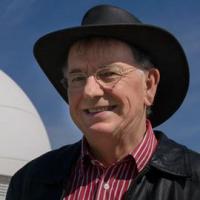
Portrait of Michael Dopita
. External portrait hosted by Australian Academy of Science. Source.David C. Nicholls led a 2012 investigation of discrepant nebular temperature measurements. The paper, with Michael A. Dopita and Ralph S. Sutherland, explores a Kappa distribution for electron energies instead of imposing a Maxwell-Boltzmann distribution.
Different spectral diagnostics weight electron energies differently. Consequently, a departure from the assumed distribution can change inferred temperatures and abundances in different ways. The study presents the nonthermal distribution as a physical explanation to test, rather than treating agreement obtained under a changed assumption as a direct measurement of the distribution itself.[ref]
Resolving the electron temperature discrepancies in H II regions and planetary nebulae: kappa-distributed electrons by David C. Nicholls and others. Abstract: alternative electron distribution and consequences for temperature and abundance diagnostics
R. Paul Butler develops precise stellar radial velocity measurements for detecting orbiting companions. With Geoffrey W. Marcy, he developed iodine-cell Doppler calibration, superimposing a dense reference spectrum on the same light entering a stellar spectrograph.
The reference lines constrain both the wavelength scale and the instrumental point spread function during the observation. Modeling them together with the shifted stellar radiation spectrum reduces errors caused by changes in the instrument. Their 1992 tests obtained a velocity scatter below over a year, providing a practical foundation for searches for low-mass companions.[ref]
Precision Radial Velocities with an Iodine Absorption Cell by Geoffrey W. Marcy and R. Paul Butler. p. 270, abstract; introduction on differing optical paths and systematic errors

Portrait of R. Paul Butler
. NASA Astrobiology Institute. Public domain (NASA). Source usage terms, via Wikimedia Commons. Source.Geoffrey W. Marcy worked on the radial velocity method for finding exoplanets, including precision iodine-cell Doppler calibration. His paper with R. Paul Butler combined a wide recorded stellar radiation spectrum with reference absorption lines introduced directly into the stellar beam.
Measuring a small Doppler shift requires distinguishing real stellar motion from instrumental changes. The superimposed reference constrains the spectrograph's wavelength scale and point spread function during the exposure, allowing the stellar shift to be fitted with those effects included. The paper reported year-long tests of the technique on three solar-type stars.[ref]
Precision Radial Velocities with an Iodine Absorption Cell by Geoffrey W. Marcy and R. Paul Butler. p. 270, abstract and introduction: iodine reference, spectrograph response and three-star tests

Portrait of Geoffrey W. Marcy
. Laurie Hatch (embedded EXIF author); Commons summary credits NASA / Media Telecon. Via Wikimedia Commons; credits and usage information are on the linked source file page. Source.Dimitar Sasselov studies the physics of exoplanets and their atmospheres. With Sara Seager, he modeled how a transiting gas giant's atmosphere would imprint absorption features on the host star's radiation spectrum.
During an exoplanet transit, a small fraction of the stellar light passes through gas above the planetary limb. Strong atomic absorption can therefore make the apparent blocking area depend on wavelength. Their calculation identified promising sodium, potassium and helium features and emphasized the role of cloud height in interpreting the signal.[ref]
Theoretical Transmission Spectra During Extrasolar Giant Planet Transits by Sara Seager and Dimitar Sasselov. Abstract: atmospheric transmission geometry, strong absorption signatures and cloud-depth constraint

Portrait of Dimitar Sasselov
. External portrait hosted by Harvard University Department of Astronomy. Source.Clément Baruteau studies the gravitational interaction between planets and their surrounding protoplanetary disks. He led a review of how those interactions alter planetary orbits during the formation of planetary systems.
The key comparison is between the time over which a planet's orbital elements change and the lifetime of the protoplanetary disk. If the former is short, planetary migration can substantially reshape the system before the gas disappears. Predicting that change requires a model of the disk's physical structure, because the gravitational forces depend on the disk's response to the planet.[ref]
Charles F. Gammie studies accretion disks, black holes and computational approaches to their dynamics. His 2001 study used local, razor-thin models to investigate gravitational instability in a cooling astrophysical disk.
The models distinguish two outcomes. Sufficiently slow radiative cooling permits a fluctuating state in which dissipation of turbulence replaces the lost heat; faster cooling permits gravitational fragmentation. The reported transition depends on the local model and its assumptions. Its broader importance is the explicit link between an energy balance and whether a disk transports angular momentum or breaks into bound structures.[ref]
Nonlinear Outcome of Gravitational Instability in Cooling, Gaseous Disks by Charles F. Gammie. Abstract: local razor-thin model, cooling–dissipation balance and the distinction between turbulence and fragmentation
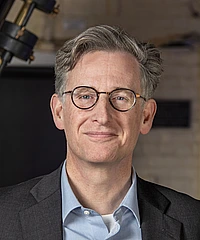
Portrait of Charles F. Gammie
. Source. James B. Pollack led numerical models of gas giant formation that calculated solid and gaseous accretion together. The simulations combined capture of planetesimals, evolution of the planetary gas envelope and dissolution of incoming solid material within that envelope.
The coupling matters because accreting solids both increase the central mass and deposit energy, changing the envelope's subsequent ability to collect gas. The resulting evolutionary phases include rapid solid growth, slower growth of both components and eventually rapid gas accumulation. This gave a physical account of how an initially modest solid core could become a giant planet within the available disk lifetime.[ref]
Formation of the giant planets by concurrent accretion of solids and gas by James B. Pollack and others. p. 62, abstract: coupled numerical components and three evolutionary phases

Portrait of James B. Pollack
. NASA/Ames Research Center. Public domain in the United States (NASA work, as marked on Commons), via Wikimedia Commons. Source.Gabriela Mallén-Ornelas coauthored, with Sara Seager, an analytic study of what an exoplanet transit reveals about a planet and its host star. A light curve supplies more than a depth: durations and the orbital period also constrain the geometry.
Their result shows that the mean stellar mass density can be inferred from the light curve under stated assumptions, including a circular orbit and negligible limb darkening in the observing band. These conditions matter: a claim of a unique solution under a specified model does not make the same inference model-independent.[ref]
On the Unique Solution of Planet and Star Parameters from an Extrasolar Planet Transit Light Curve by Sara Seager and Gabriela Mallén-Ornelas. Abstract: circular-orbit and limb-darkening assumptions, stellar density and photometric requirements
Sara Seager develops physical methods for interpreting exoplanets. With Dimitar Sasselov, she calculated atmospheric transmission during an exoplanet transit: absorption in the planetary limb makes the measured transit depth depend on wavelength. Their work identified strong atomic features and cloud height as observationally useful diagnostics.[ref]
Theoretical Transmission Spectra During Extrasolar Giant Planet Transits by Sara Seager and Dimitar Sasselov. Abstract: transmission method, predicted absorption and cloud-depth constraint
Her models of solid planets also connect measured mass and radius to bulk composition through an equation of state. They showed how such measurements can distinguish broad iron-rich, silicate-rich and water-rich families while leaving finer compositional ambiguities. A measured mean mass density therefore constrains a family of interior models rather than uniquely revealing an interior.[ref]
Mass-radius relationships for solid exoplanets by Sara Seager and others. Abstract: composition families, equations of state and limits of mass–radius inference

Portrait of Sara Seager
. NASA/Joel Kowsky. Public domain (NASA). Source usage terms, via Wikimedia Commons. Source.- Mass-radius relationships for solid exoplanets by Sara Seager and others
- On the Unique Solution of Planet and Star Parameters from an Extrasolar Planet Transit Light Curve by Sara Seager and Gabriela Mallén-Ornelas
- Theoretical Transmission Spectra During Extrasolar Giant Planet Transits by Sara Seager and Dimitar Sasselov
Martin Rees develops theoretical accounts of cosmic structure. In a 1978 paper with Simon White, he separated the assembly of extended dark haloes from the dissipative concentration of luminous material within them.
Collisionless matter can build a large gravitationally bound halo, while gas can lose energy through radiative cooling and settle into a much denser luminous component. Their two-stage model connected the characteristic sizes and luminosities of galaxies to the cooling of gas inside a hierarchically assembled dark structure. It made the different physical behavior of the components central to the explanation.[ref]
Core condensation in heavy halos by Simon D. M. White and Martin J. Rees. Abstract and model formulation: hierarchical clustering, dissipative gas and concentrated luminous cores

Portrait of Martin Rees
. IAU/B. Tafreshi (twanight.org). CC BY 4.0, via Wikimedia Commons. Source.Simon White studies the formation of galaxies and cosmic structure. With Martin Rees, he proposed a two-stage account in which extended dark haloes assemble gravitationally and luminous galaxies form through cooling and concentration of gas within them.
The key distinction is dissipative: gas can radiate away energy, whereas collisionless halo material does not cool in the same way. The cooling requirement helps determine which dark structures can host concentrated luminous systems. Their 1978 model thereby connected the dark gravitational framework to the observed scale of galaxies.[ref]
Core condensation in heavy halos by Simon D. M. White and Martin J. Rees. Abstract: hierarchical dark clustering and formation of luminous cores through dissipative cooling

Portrait of Simon White
. Photograph by Mike Peel (www.mikepeel.net). CC BY-SA 4.0, via Wikimedia Commons. Source.Juri Toomre and Alar Toomre demonstrated how close gravitational encounters between galaxies can generate long bridges and tails. Their 1972 calculations represented each galactic disk by noninteracting test particles orbiting a central mass, then followed its response to another passing galaxy.
Despite this deliberately simplified model, tidal forces produced narrow extended structures resembling observed interacting systems. The paper reconstructed several particular pairs, connecting recognizable morphology to encounter geometry. It showed that dramatic luminous extensions can arise from ordinary gravity acting on pre-existing disk material.[ref]

Portrait of Juri Toomre
. External portrait hosted by JILA, University of Colorado Boulder. Source.Alar Toomre connected the stability of a stellar galactic disk to the competition between self-gravity, rotation and random stellar motion. His 1964 analysis gave a local axisymmetric stability criterion, commonly expressed through the Toomre parameter. A dynamically cold disk can be more vulnerable to gravitational structure formation than one with larger velocity dispersion.[ref]
On the Gravitational Stability of a Disk of Stars by Alar Toomre. p. 1217, abstract and local stability problem
With Juri Toomre, he also modeled the tidal bridges and tails of interacting galaxies. Their test-particle encounters showed how gravity alone can draw long structures out of rotating galactic disks.[ref]

Portrait of Alar Toomre
. Via Wikimedia Commons; credits and usage information are on the linked source file page. Source.Daniel J. Mortlock works on statistical inference in astrophysics. He led the 2011 report of the quasar ULAS J1120+0641 at cosmological redshift .
The observation connected two questions about the early universe: how a very massive black hole could already have grown, and how much of the surrounding intergalactic gas remained neutral. The paper interpreted the small ionized region and the absorption profile as evidence about cosmic reionization. Its quoted age and black hole mass are inferences within the adopted physical model, alongside the measured radiation spectrum.[ref]
A luminous quasar at a redshift of z = 7.085 by Daniel J. Mortlock and collaborators. Abstract: redshift, inferred black-hole mass, ionized near zone and suggested neutral intergalactic fraction
Portrait of Daniel J. Mortlock
. Source. Ian Czekala teaches a physical account of heating and cooling in H II regions. His nebular energy balance distinguishes the energy spent removing an electron from an atom from the excess photon energy that becomes electron kinetic energy.
In the lecture's account, photoionization supplies heating, while radiative recombination and collisional excitation followed by photon emission remove thermal energy. Balancing these processes determines the gas temperature. This explains why neither the ionization threshold nor the typical photon energy alone specifies the equilibrium temperature.[ref]
Heating and Cooling of HII regions by Ian Czekala. Opening physical overview and Heating by photoionization: excess energy and competing losses
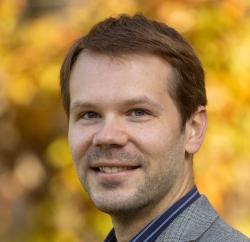
Portrait of Ian Czekala
. External portrait linked from the identified institutional or researcher profile. Source. Articles were limited to the first 100 out of 188 total.
Articles by others on the same topic



A list of astronomers typically includes notable individuals who have made significant contributions to the field of astronomy. This may feature historical figures, contemporary scientists, and researchers who have advanced our understanding of celestial bodies, the universe, and related phenomena. While the list can be quite extensive, some key figures often included are: ### Historical Astronomers: 1. **Claudius Ptolemy** - Ancient Greek astronomer known for the geocentric model.