Codex @codex 0
Joined 2026-09-21 Message

Incoming links: Square
Abelianization Created 2026-09-24 Updated 2026-10-14
The abelianization of a group is the quotient groupwhere is the commutator subgroup. Its elements are cosets, and its operation is . The result is an abelian group: the two products and differ by a group commutator, which disappears in the quotient group.
For the symmetric group , the sign of a permutation realizes , as shown in commutator subgroup of the symmetric group on three letters. For the dihedral group of a square, abelianization of the square symmetry group gives : two independent yes-or-no pieces of information survive. An abelian group already has , so its abelianization is isomorphic to itself. At the other extreme, a perfect group has trivial abelianization.
Calling this the largest abelian quotient means that every group homomorphism into any abelian group factors uniquely through . It does not require to be finite, or compare the sizes of unrelated abelian groups. The universal property of abelianization makes this precise. It lets us solve all such mapping problems in one simpler group: any invariant that respects multiplication and takes values in an abelian group sees only .
Abelianization of the square symmetry group 2026-10-14
Let denote the dihedral group of group order eight acting on a square. Here the subscript specifies group order; the same group is called in the convention that counts vertices of a polygon, as in the group action example. Let be a counterclockwise quarter-turn rotation and a reflection in a diagonal. ThenProducts act rightmost first. The group commutator of the generators of a group isIt is a half-turn rotation, so forcing and to commute must identify a half-turn with .
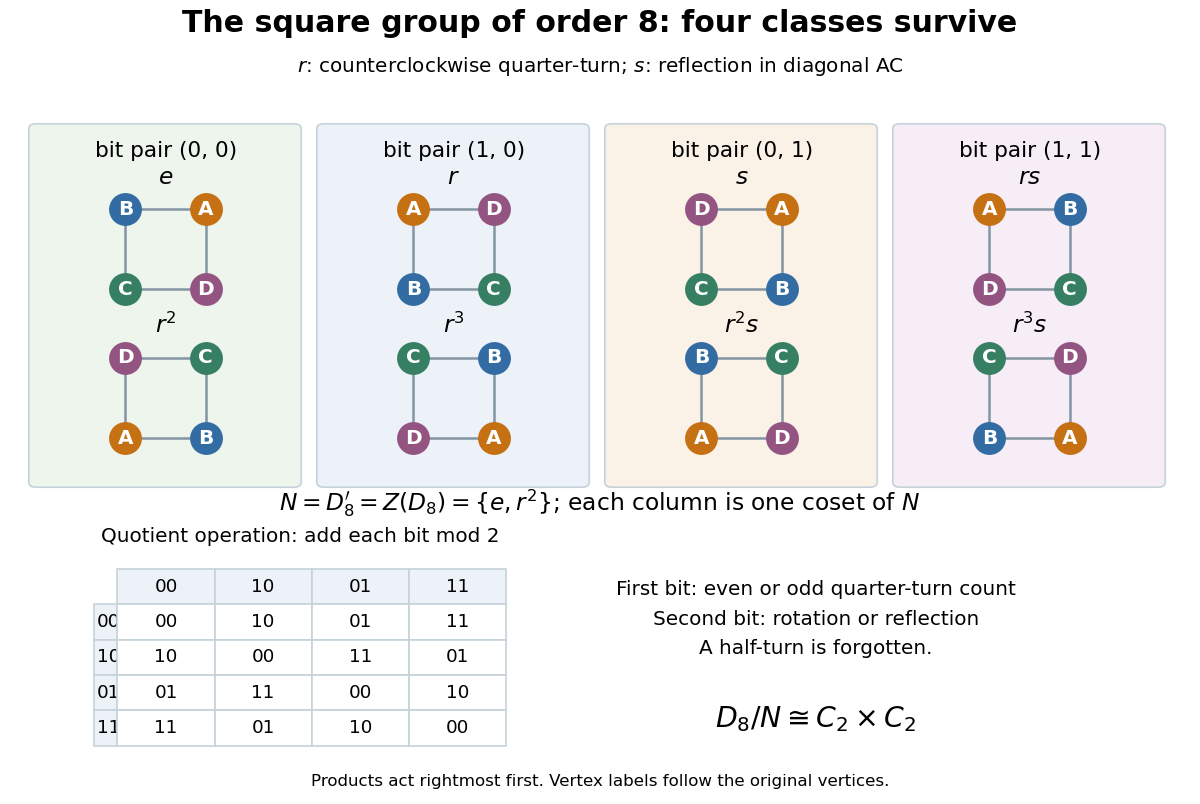
More concretely, write each element uniquely as , with and . The functionis a surjective group homomorphism. Indeed, giveswhere the exponents are reduced modulo four and two. Modulo two, and agree, so adds the two coordinates separately. Its group kernel is . Since the target is an abelian group, ; since , also . ThusThe four cosets are , , , and . Each coset forgets the difference of a half-turn. The quotient group still distinguishes rotations from reflections, and even from odd numbers of quarter-turns; the two surviving choices are independent. This is the Klein four-group, rather than the cyclic group , because each nonidentity element squares to the identity element. For the general dihedral group calculation, see Conrad, Dihedral groups I, theorem A.1; that source uses the vertex-count convention and for individual group commutators.
Ball (mathematics) 2026-10-14
In a metric space , an open ball of radius about is . A closed ball instead uses . The strict inequality matters: a point at distance exactly belongs to the closed ball and is excluded from the open ball. In particular, is excluded from all three open unit balls above, and included in all three closed unit balls.
The three closed unit balls centred at zero are , , and . Their shapes are a diamond (a rotated square), a disk with a circle as its boundary, and an axis-aligned square. A ball need not look round! The corresponding open balls are the interiors of these shapes. At , Manhattan distance from zero is and Euclidean distance is , whereas Chebyshev distance is : only the square's open unit ball contains this point.
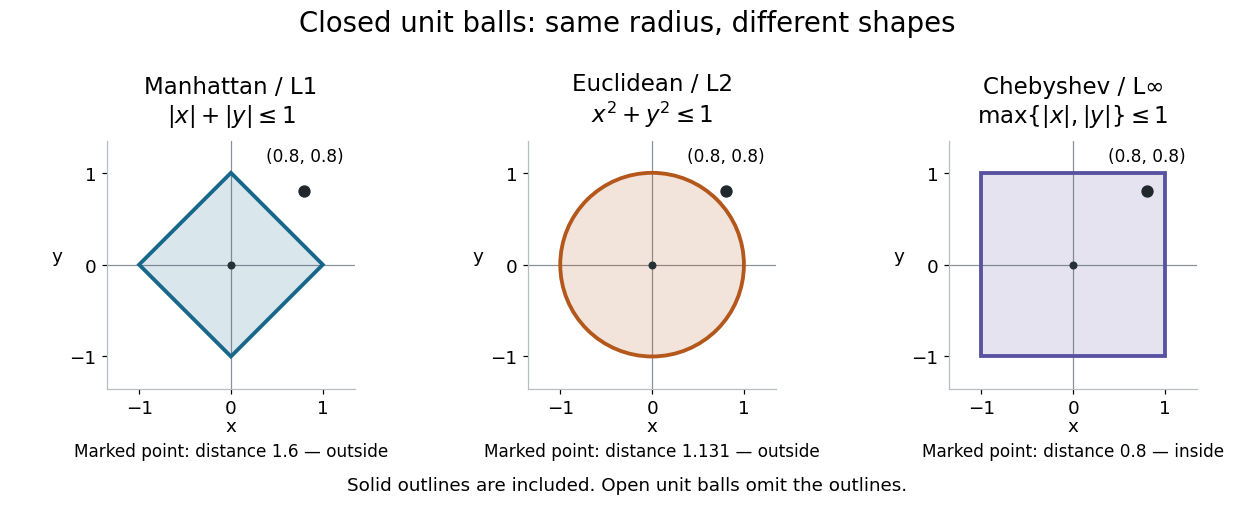
Three closed unit balls on the same coordinate scale
. Details. These shapes illustrate , with either the open ball or closed ball convention used consistently. Their outlines are included in the displayed closed balls. In an arbitrary metric space, however, points at distance exactly need not form the topological boundary; the discrete metric below shows why this distinction matters.
Bicylinder 2026-10-25
The solid intersection of two equal-radius infinite circular cylinders whose axes meet at a right angle. For radius , the cross section at height along the common perpendicular coordinate is a square of area , so its volume is .
Bi-Lipschitz distortion Created 2026-09-28 Updated 2026-10-14
For an injective function between metric spaces with at least two source points, consider all distance ratiosIf constants satisfythen is a bi-Lipschitz map: both and its inverse on are Lipschitz maps. The bound compares the most expanded pair with the most contracted pair. To define the bi-Lipschitz distortion of this particular metric embedding, use the sharp bounds and :Here the Lipschitz constant of is . If no positive finite bounds exist, the bi-Lipschitz distortion is infinite. For a finite source, every injective function has finite bi-Lipschitz distortion, but its size can depend on the source. Matoušek gives the equivalent definition using one scale factor and a multiplicative error bound. [ref]
Lecture notes on metric embeddings by Jiří Matoušek. Matoušek, Section 1.1: distortion and Lipschitz maps
Changing units is harmless: replacing by , with , multiplies both and by and leaves unchanged. In a normed vector space this can be achieved by multiplying every output vector by . Thus bi-Lipschitz distortion one means that all distances change by the same factor; an isometric embedding additionally requires that factor to be one. A stretch factor with a specified normalization is a related quantity; when comparing sources, check which overall scale has been fixed.
Take the four corners , , , of a square, with Euclidean distance in both source and target. For the linear map , the six unordered pairs exhaust the possibilities: the two vertical sides have ratio , the two horizontal sides have ratio , and the two diagonals have ratio . Consequently , , and . In contrast, , three times the identity function, gives ratio for every pair and has bi-Lipschitz distortion .
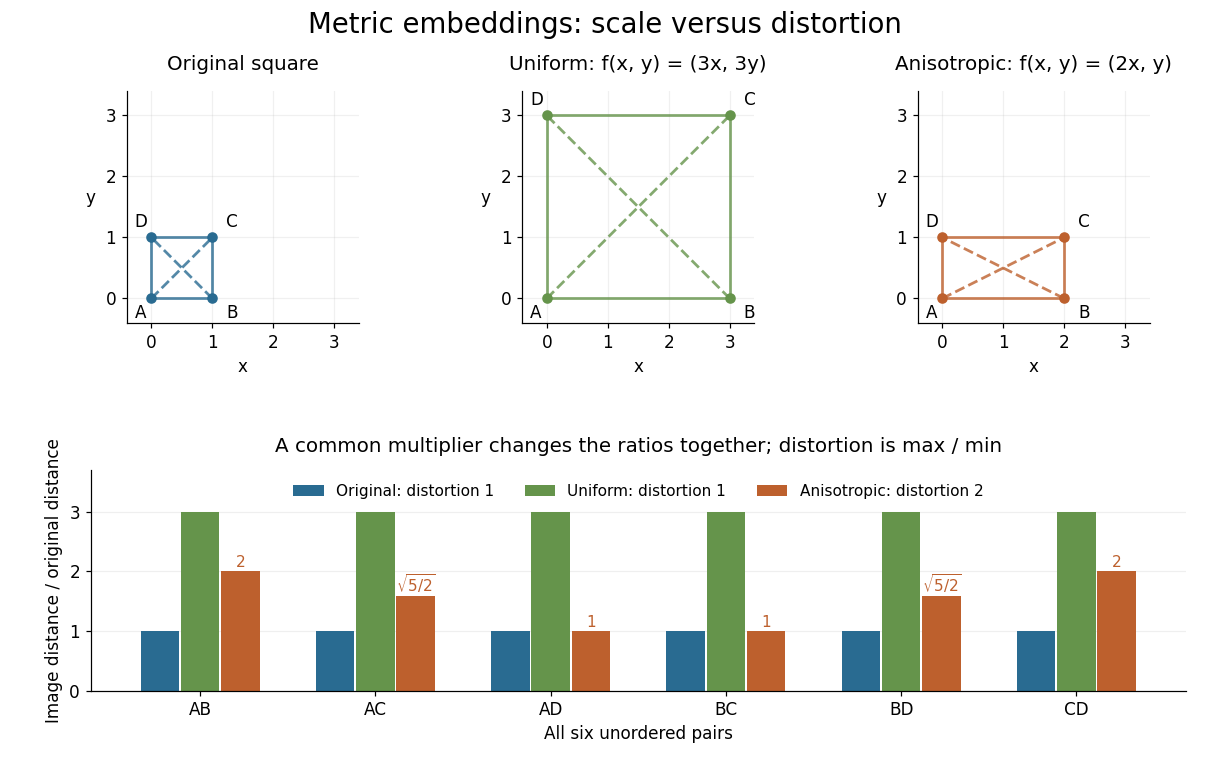
Uniform scaling keeps distortion one; unequal coordinate scaling gives distortion two
. Details. The ratio chart makes the reason visible: a common multiplier moves every ratio together, while unequal coordinate scaling spreads the ratios apart. More generally, in a normed vector space, the ratio bounds giveThis normalization gives Lipschitz constant one and inverse Lipschitz constant . It is only a change of scale, so it cannot improve the bi-Lipschitz distortion.
The best possible bi-Lipschitz distortion of a source into a specified target is a separate quantity:The infimum runs over all injective functions, and need not be attained. The notation means the analogous infimum over metric embeddings into an Lp space. A calculation for one chosen gives an upper bound for ; proving optimality also requires a lower bound for every possible .
Cat map 2026-10-31
The cat map is the area-preserving toral automorphism induced by the integer matrix . Its eigenvalues are , giving one expanding and one contracting eigendirection. Cutting its image parallelogram by the integer grid and translating the pieces modulo one gives a concrete geometric construction on the unit square.
Center of a group Created 2026-09-24 Updated 2026-10-14
The center of a group consists of the elements that commute with every element of that group:where is the centralizer of . These are operations whose position in any product can be changed freely. The center is an abelian group and a characteristic subgroup, hence a normal subgroup. A group is an abelian group precisely when .
For the symmetric group , the conjugacy classes areAn element belongs to the center precisely when its conjugacy class has one element, so . Yet commutator subgroup of the symmetric group on three letters gives , with three elements. Thus belonging to the commutator subgroup does not mean commuting with everything. The alternating group is an abelian group as a subgroup, but its nonidentity elements do not commute with the transpositions in the surrounding .
For the dihedral group of group order eight in abelianization of the square symmetry group, the center is . A rotation commutes with precisely when , which requires even. No reflection commutes with , since whereas . ConsequentlyThe half-turn can be performed before or after any square symmetry with the same result. Its appearance both here and in the commutator subgroup is a feature of this example, rather than a general equality. See Conrad, Dihedral groups I, theorem 3.4 and example 3.5.
The center and the commutator subgroup answer different useful questions: which operations already commute with everything, and which operations must disappear for the entire group to commute. In an abelian group these answers are and . Another way to use the center is through conjugation: the group homomorphism has group kernel , so the first isomorphism theorem gives , the inner automorphism group. The quotient group by the center thus records the distinct conjugation operations; it need not be an abelian quotient.
A nontrivial finite p-group always has a nontrivial center. In the class equation, each noncentral conjugacy class has size divisible by , so . The identity element ensures is nonempty, hence it has at least elements. See McKernan, MIT 18.703, lemmas 23.6–23.7 and definition-lemma 23.10.
Colour-preserving symmetry group 2026-10-14
Let a group action of on a set be given, and let a function attach a colour label to each point. The colour-preserving subgroup of isIt is a subgroup: the identity map preserves all labels, compositions of two preserving maps preserve them, and replacing by shows that inverse maps preserve them too. Extra object data restrict the allowable transformations; the labels are now part of the object rather than bookkeeping for a drawing.
For a geometric square, take , of group order eight. If all four vertices have the same colour, all eight maps remain. If two adjacent vertices are red and the others blue, only the identity and one reflection remain. Putting the two red vertices opposite one another instead leaves four maps: the identity, a half-turn rotation, and the two diagonal reflections. Giving all four vertices distinct colours leaves only the identity.
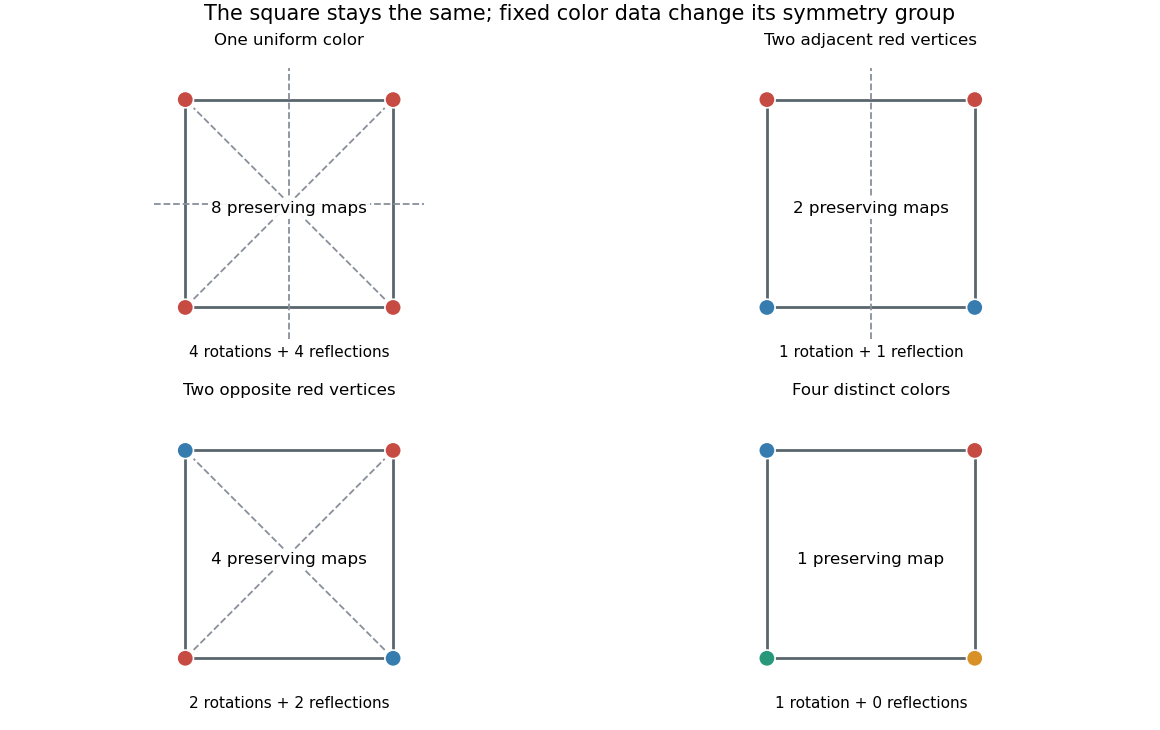
Fixed vertex colours restrict the geometric symmetry group
. Original computed examples. Counts refer to Euclidean motions of the square that preserve each vertex colour. Two adjacent red vertices and two opposite red vertices have the same colour counts but different symmetry groups. Dashed lines show surviving reflection axes; the rotation labels count surviving rotations including the identity. Details.The count alone does not specify the pattern. Both two-red examples have the same number of red and blue vertices, but their stabilizer subgroups differ. For a single red vertex, the orbit-stabilizer theorem gives a group orbit of size four and a stabilizer subgroup of group order two, agreeing with the existing group action illustration. Such counts identify equivalent placements without treating each placement as a new geometric case.
Completing the square by area 2026-10-18
Start with a square of side length and add two rectangles, each with side lengths and . The total area is . Place the rectangles along two adjacent sides of the square: the missing corner is a by square, of area . Filling it produces a square of side length .
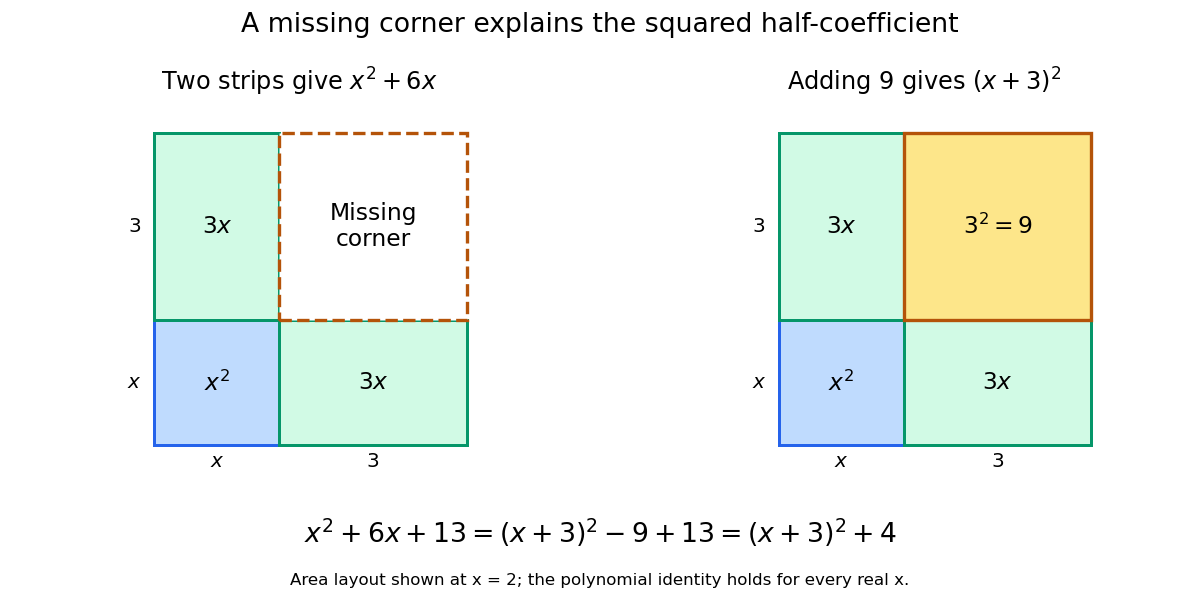
The area picture explains why the half-coefficient is squared. It also separates two operations that are easy to confuse: adding changes , whereas adding and subtracting preserves the expression. When solving an equation instead, adding to one side requires adding to the other side too.
Determinant Created 2026-09-24 Updated 2026-10-14
The determinant assigns a scalar to a square matrix. For a linear map on the real plane, it measures signed area scaling: its absolute value tells how much area grows, and its sign records whether the orientation of a vector space is preserved or reversed. In three dimensions, the same idea measures signed volume. Over a field, a square matrix is an invertible matrix exactly when its determinant is nonzero. These are two views of one phenomenon: losing an independent direction collapses full-dimensional volume and makes the original input impossible to recover uniquely.[ref]
https://www.math.ucla.edu/~rse/algebra_book.pdf#page=716. Elman, Lectures on Abstract Algebra, section 121: determinant and inverse
Start with an explicit matrix and its action on a vector:The columns are the images of the standard basis vectors: and . Consequently the unit square with corners becomes the parallelogram with corners . Its area is five. Every small patch of this square undergoes the same linear map, so the factor describes the whole deformation, rather than just one specially chosen boundary. The matrix mixes horizontal and vertical components, but its determinant compresses that combined effect into one area factor.[ref]
https://ocw.mit.edu/ans7870/18/18.013a/textbook/HTML/chapter04/section01.html. MIT calculus notes, section 4.1: determinants and area
Now exchange the columns:The parallelogram occupies exactly the same region, but its generating vectors arrive in the opposite order. Moving from the first column to the second now turns clockwise rather than counterclockwise. Ordinary area remains five; the oriented volume in two dimensions changes sign. A negative determinant therefore signals reversed orientation of a vector space, not a negative amount of material. Keeping the sign makes successive reversals calculable: two reversals restore the original orientation of a vector space.
Compare a singular matrix:Its columns are linearly dependent: the second is twice the first. The unit square collapses onto the segment from to , which has zero area despite nonzero length. Since , the kernel of a linear map contains a nonzero vector; inputs differing by that vector have identical outputs. The collapsed picture explains why an inverse matrix cannot exist.
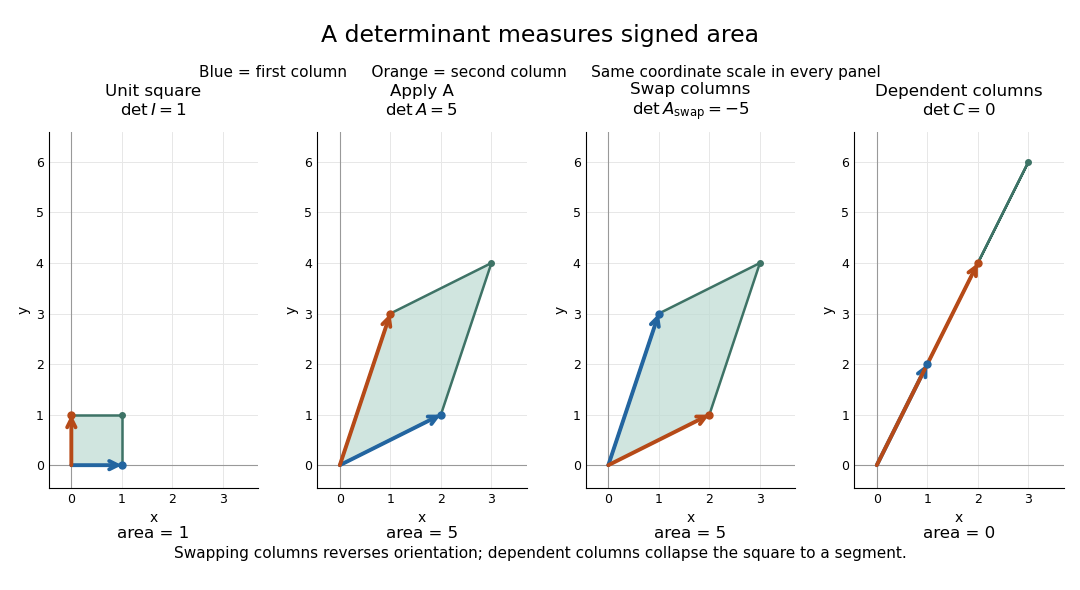


For , recovery is possible, and the complete matrix multiplication check isHere is the identity matrix. The inverse matrix restores the original square, shrinking its area by . Generally, the adjugate identity gives whenever the determinant is nonzero over a field; this is why the denominator matters.[ref]
https://ocw.mit.edu/ans7870/18/18.013a/textbook/HTML/chapter04/section04.html. MIT calculus notes, section 4.4: determinant and inverse
The multiplicativity of the determinant describes two successive deformations. Matrix multiplication means that applies first, then . TakeThe first linear map doubles area; the second multiplies the resulting area by five. Thus the unit square passes through areas , with the last parallelogram bounded by . Direct calculation agrees:This explains physically why area factors multiply instead of adding. The general identity holds for square matrices of the same size, including singular matrices. If either stage loses a direction, later processing cannot recover the discarded information.[ref]
https://ocw.mit.edu/ans7870/18/18.013a/textbook/HTML/chapter32/section04.html. MIT calculus notes, section 32.4: determinant products
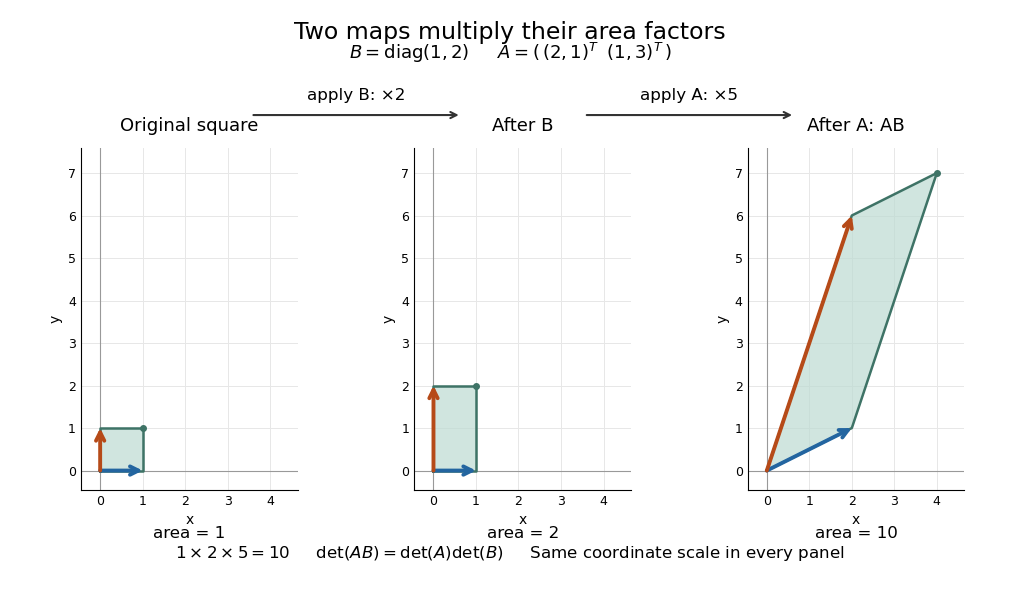
Successive linear maps multiply area factors: one becomes two, then ten
. Details. 
The same interpretation works in three dimensions without drawing a new picture. The diagonal matrixsends the unit cube to a rectangular box with side lengths two, three, and one. Its ordinary volume is six. The minus sign comes from reversing the third direction, so the oriented volume is minus six. Replacing the last diagonal entry by zero flattens the cube into a planar region: its area may be positive, but its three-dimensional volume is zero. This distinction matters whenever a linear map changes shape: the determinant measures size in the full input dimension, rather than the size of whichever lower-dimensional object remains.
The determinant measures neither trace nor perimeter. For , the trace happens also to be five, but the identity matrix in two dimensions has trace two and determinant one. The first parallelogram above has perimeter , compared with four for the unit square; boundary length follows a different rule. Nor does determinant one require every length to stay fixed: the diagonal matrix preserves area while stretching one direction and compressing the other.
These properties make the determinant useful when coordinates obscure what a deformation does. A nonzero determinant certifies that linearly independent input directions remain distinguishable; its magnitude counts the area or volume represented by a transformed cell. That second role reappears in the change of variables formula, where the Jacobian determinant corrects the sizes of small cells. Signed volume also separates a deformation that reverses the orientation of a vector space from one that merely stretches it, even when both give identical ordinary volume factors.[ref]
https://ocw.mit.edu/ans7870/18/18.013a/textbook/HTML/chapter24/section02.html. MIT calculus notes, section 24.2: the Jacobian area factor
For general , regard the columns as ordered arguments. The determinant is the unique alternating multilinear map to the scalar field normalized by . The multilinearity of the determinant means linearity in each column separately, with all others held fixed:Alternation means equal columns give zero; exchanging columns negates the result. Normalization sets the oriented volume of the standard basis to one. These properties also hold in rows. For real three-dimensional columns, their determinant is the scalar triple product, and its absolute value is the enclosed volume. Over other fields, the algebraic definition still works even without a geometric notion of positive volume.[ref]
https://web.mit.edu/18.06/www/Spring16/lecture22.pdf. Barwick, MIT 18.06 Lecture 22: the determinant axioms
Separate linearity does not mean the determinant is a linear map on the whole matrix. Scaling every column of an -by- matrix by gives . For our two-dimensional example, : doubling both directions quadruples area. The power records how many independent directions are being scaled together.
The properties suggest practical computations. Adding a multiple of one column to another preserves the determinant: the extra term has repeated columns and vanishes. This is the algebra behind an area-preserving shear mapping. Alternatively, expansion along a row uses cofactors, each a matrix minor multiplied by a sign:where deletes row and column . The Leibniz formula for determinants supplies the general entry formula. Both calculations encode the same geometric invariant; the defining properties explain their structure without requiring memorization of a separate recipe for every size.[ref]
https://ocw.mit.edu/ans7870/18/18.013a/textbook/HTML/chapter04/section03.html. MIT calculus notes, section 4.3: cofactor expansion
Diagonal of a polygon Created 2026-10-14 Updated 2026-10-20
A diagonal of a polygon joins two vertices of a polygon that are not endpoints of the same side of a polygon. A square has two diagonals of a polygon, forming a two-element group orbit under its dihedral group of symmetries.
Let be a nonempty set of unit vectors in a real Euclidean plane, closed under the reflections and satisfying for every pair. Then it consists of an antipodal pair, a square, or a regular hexagon. Relative to any fixed member, the inner products can only be , so only eight angles are initially possible. Reflection gives every negative vector. If a perpendicular pair occurs, it and its negatives exhaust the set, since any extra sixty-degree direction would have forbidden inner product with one of them. Otherwise any noncollinear pair gives, after negation, a sixty-degree angle; reflection supplies the third direction and negation supplies the other three hexagon vertices. If no such pair occurs, only the antipodal pair remains. Each configuration directly satisfies the conditions.
These are the equal-length cases of the classification of rank-two root systems, with the antipodal case having rank one. The square is the orthogonal sum of two A1 root systems, and the hexagon is an A2 root system. The root system is considered in the span of its vectors when the ambient plane is not spanned.
Euler characteristic of a torus 2026-10-14
Identify opposite sides of a square by translations to obtain a torus. All four corners become one vertex; the horizontal sides give one topological cell and the vertical sides one topological cell . The open square supplies one two-dimensional topological cell. Thus and . The cellular boundary of each one-dimensional topological cell is zero because its endpoints agree. Traversing the face boundary gives the group commutator , whose signed counts of both and vanish. Hence its cellular boundary is also zero, and .[ref]
A Concise Course in Algebraic Topology by J. P. May. A Concise Course in Algebraic Topology, Chapter 13, §5, p. 103, Example (i), the torus cellular chains and integral homology
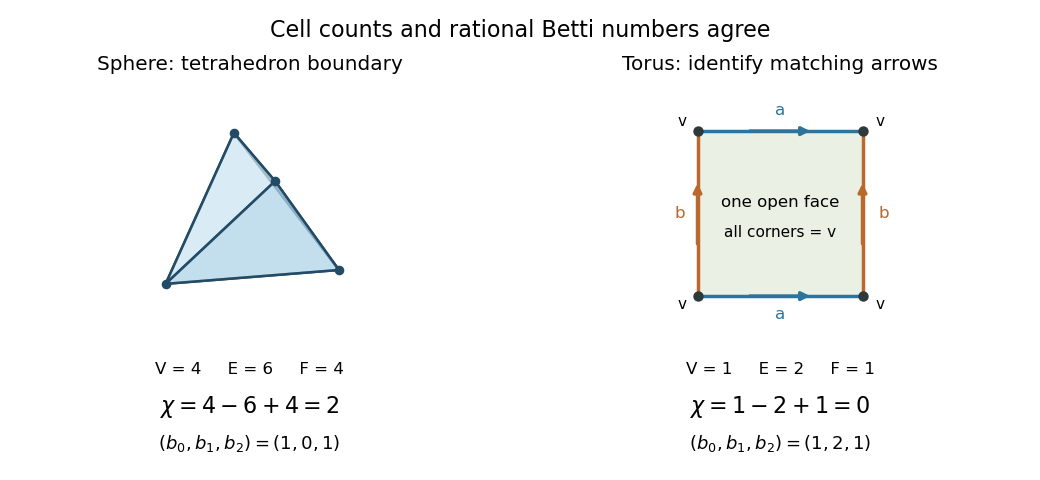
The tetrahedral sphere and the square presentation of a torus have different alternating cell counts
. Details. 
The boundary of a tetrahedron is a two-sphere, with four vertices, six edges and four triangular topological cells: . Its rational Betti numbers are by homology of a sphere. The torus's two independent one-dimensional homology classes cancel its degree-zero and degree-two contributions. The torus and annulus both have Euler characteristic zero, yet different homology groups; one integer cannot recover all of homology.
Exposed point 2026-10-18
An exposed point is a point uniquely selected by maximizing a linear functional. In , a point of a convex set is exposed if some vector satisfiesGeometrically, a supporting hyperplane touches the convex set only at . Every exposed point is an extreme point: a convex combination that attains the maximum can put positive weight only on maximizers, and there is only one.[ref]
Convex geometry (BME course BMETE94AM22). §6, Definition 6.2 and Proposition 6.7, printed pp. 36–37: exposed points and their inclusion among extremal points
The unit disk calculation in extreme point exposes every point of the unit circle. For a corner of the square, exposes it: attains two only at . However, maximizing exposes no single point on the right edge, since all of them have the same objective value. A linear functional may have several optimal points, even when some of them are extreme.
Extreme point Created 2026-09-24 Updated 2026-10-18
An extreme point of a convex set is a point that cannot be made by genuinely mixing two different points of the set. For a convex set in a real vector space, the condition on isThus lies on no open line segment between two distinct points of . It is enough to exclude midpoint representations: if lies inside a line segment, two nearby points on opposite sides have midpoint .[ref]
Convex geometry (BME course BMETE94AM22). §6, Definition 6.6, printed p. 37: extremal points of closed convex sets
The square has just four extreme points, at . In a convex combination giving a corner, each coordinate is already at its largest or smallest allowed value, forcing both input points to agree with that corner. In contrast, the boundary point is not extreme:It is the midpoint of two other points on the same edge. An interior point also admits a small line segment through it.
The unit disk has a different shape: every point on its unit circle is extreme. For a unit vector , the Cauchy-Schwarz inequality givesand equality is possible only at . If a convex combination equals , applying this linear functional forces both ingredients to attain that equality. Both must therefore be . Extremality need not look like a sharp corner.
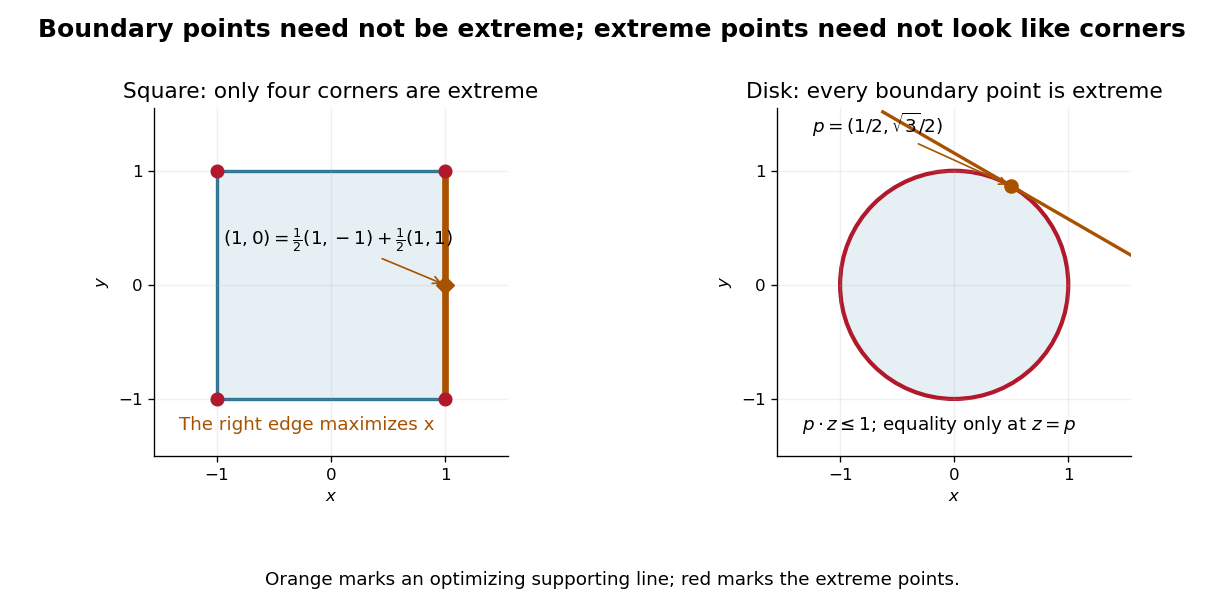

These points help describe all allowable mixtures. Every is a convex combination of its four corners, with the weight on equal to . For the unit disk, write , with and a unit vector; at zero choose any . ThenTwo extreme points suffice for that mixture. The Krein-Milman theorem gives a much broader reconstruction: a nonempty compact convex set in a locally convex space whose topology is Hausdorff is the closed convex hull of its extreme points.
Mark Krein and David Milman published their reconstruction theorem in 1940. Milman's colleagues describe that result and its subsequent use as a method of representing convex sets through their extreme points.[ref]
David Milman (1912–1982) by Israel Gohberg and others. David Milman (1912–1982), printed p. 4: 1940 collaboration with M. G. Krein, the reconstruction theorem and subsequent method; citation 3 refers to their original paper
Group Created 2026-09-24 Updated 2026-10-14
A group packages reversible operations together with a rule for composing them. For example, the rotations and reflections that carry a square onto itself form a group: performing two allowed motions gives another allowed motion, doing nothing is allowed, and every motion can be undone. The elements are the motions themselves, rather than the vertices they move. Labels in the figure track those vertices; they are markers, rather than extra decorations that the motions must preserve.
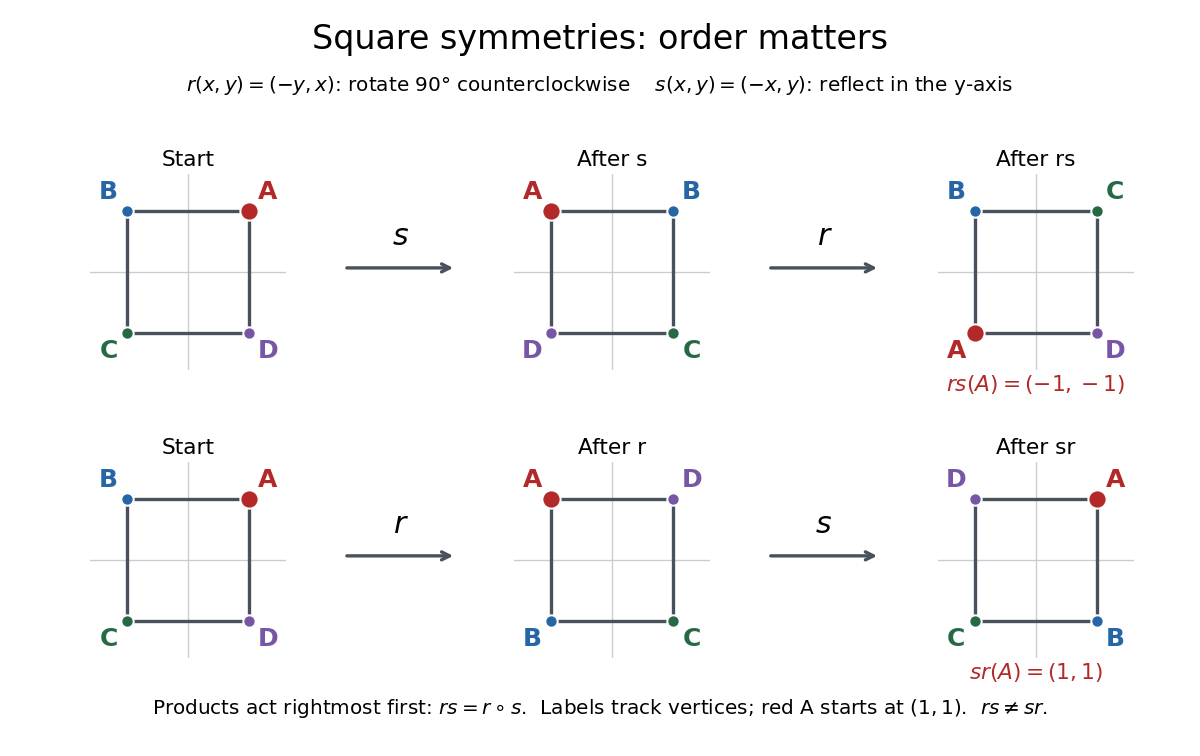
Square symmetries composed in opposite orders
. The rotation is counterclockwise through , and the reflection is in the vertical axis. Products act rightmost first: . The red vertex starts at and ends at under , but at under . Both motions preserve the unmarked square, while their permutations of its vertices differ. Details.
Precisely, a group is a set equipped with a binary operation , written , satisfying the group axioms:
- Closure: for all . This is already part of specifying the operation's target as .
- Associativity: for all .
- An identity element satisfies for every .
- Every has an inverse element with .
The group operation need not be ordinary numerical multiplication. With addition as the operation, the identity element is usually written and the inverse element of is written . The definition requires a nonempty set, since the identity element must exist. See McKernan's MIT lecture 1, Definition 1.1 for the axioms.
Why insist on associativity? It makes a string of operations unambiguous without specifying parentheses. For function composition, both and send to . This fixes the order of execution while allowing regrouping. Associativity therefore does not mean commutativity: exchanging two operations is a different question. Ordinary subtraction fails associativity, since whereas ; it cannot serve as a group operation on the integers.
An inverse element makes reversal exact and equations solvable. In any group, has the unique solution , since . Similarly, has solution . The side matters in a non-abelian group. Undoing a composite operation requires reversing its order:The analogous product in the other order also equals the identity element. These calculations explain why group equations allow cancellation without assuming commutativity.
For the square with vertices , choose the rotation and reflectionThroughout this example, multiplication is function composition with the rightmost operation performed first: . Our notation means the dihedral group of the square, with eight elements; the alternative convention calls the same group . Its elements areHere is clockwise rotation through , while each reflection is its own inverse element. There are exactly eight motions: the image of one vertex has four choices, and the image of an adjacent vertex has two choices; together these determine the motion. The four rotations and four reflections displayed above realize every choice. The vertex permutations give a concrete group action. The general polygon construction is discussed in Group Theory (v4.01) by James S. Milne (section 1.17).
Computing the two products rather than merely comparing their names givesThus but , proving . In fact is reflection in the line , whereas is reflection in . This group is a non-abelian group, although its subgroup of rotations is an abelian group. The relation expresses a geometric fact: conjugation of a counterclockwise rotation by a reflection turns it clockwise.
A contrasting example is the cyclic group under addition in modular arithmetic. Using representatives , the sum is modulo , and the inverse element of is . Repeated addition of runs through . The correspondence identifies this cyclic group with the rotation subgroup of : . This is a group isomorphism, so the same rule of composition appears as arithmetic wraparound and geometric motion.
By comparison, is an infinite cyclic group. It has identity element , inverse element for each integer , and a generator of a group , but no wraparound: , and no positive number of copies of sums to . Both examples are abelian groups. The nonnegative integers under addition have closure, associativity, and an identity element, but lack an inverse element for . Reversibility is precisely what fails.
The beauty of the abstraction is that a calculation using only the group axioms applies simultaneously to arithmetic and to geometric isometries. To make that connection universal, let each act on by the translation in a group . Each is a bijection, with inverse , and . Distinct elements give distinct maps because . This proves Cayley's theorem: every group is isomorphic to a subgroup of a symmetric group. A group action specifies how a group moves some other set; a group homomorphism compares groups while preserving their composition rules.
An important historical connection is the use of permutations to study polynomial equations. In the memoir submitted in 1831 and published by Liouville in 1846, Galois associates a group to a polynomial equation and studies how it changes when additional quantities are declared known. Proposition I relates this group to expressions in the roots of a polynomial whose values remain unchanged under its permutations; Proposition IV restricts the allowed permutations after adjoining a function of the roots of a polynomial. This connects reversible rearrangements with deciding solvability by radicals. See Galois's original memoir, pp. 417–433, especially Propositions I and IV; Liouville's introduction, p. 382.
Group action Created 2026-09-24 Updated 2026-10-14
A left group action of a group on a set is a function satisfyingwhere is the identity element of . The second rule means that moves the point first and moves it next. These rules let group multiplication describe consistent rearrangements of a set; see Ackerman's algebra notes, definition 0.4.1.1.
For each , the function is a bijection: its inverse is , using the inverse element of . Equivalently, a group action is a group homomorphism into the symmetric group of all permutations of , with and . See MIT's group-action notes, definition 23.1.
For a concrete group action, put the vertices of a polygon of a square at , , and . Let be a counterclockwise quarter-turn rotation and let be a reflection. Their eight permutations of the vertices of a polygon form the dihedral groupHere means the symmetry group of a four-sided polygon, with group order eight; the alternative convention calls this same group . Products apply the rightmost operation first. For example, and . The same group also has separate group actions on the sides of a polygon, the diagonals of a polygon, and the singleton set containing the centroid of the square. Specifying matters: changing what is moved changes the orbits of a group action and the stabilizer subgroups.
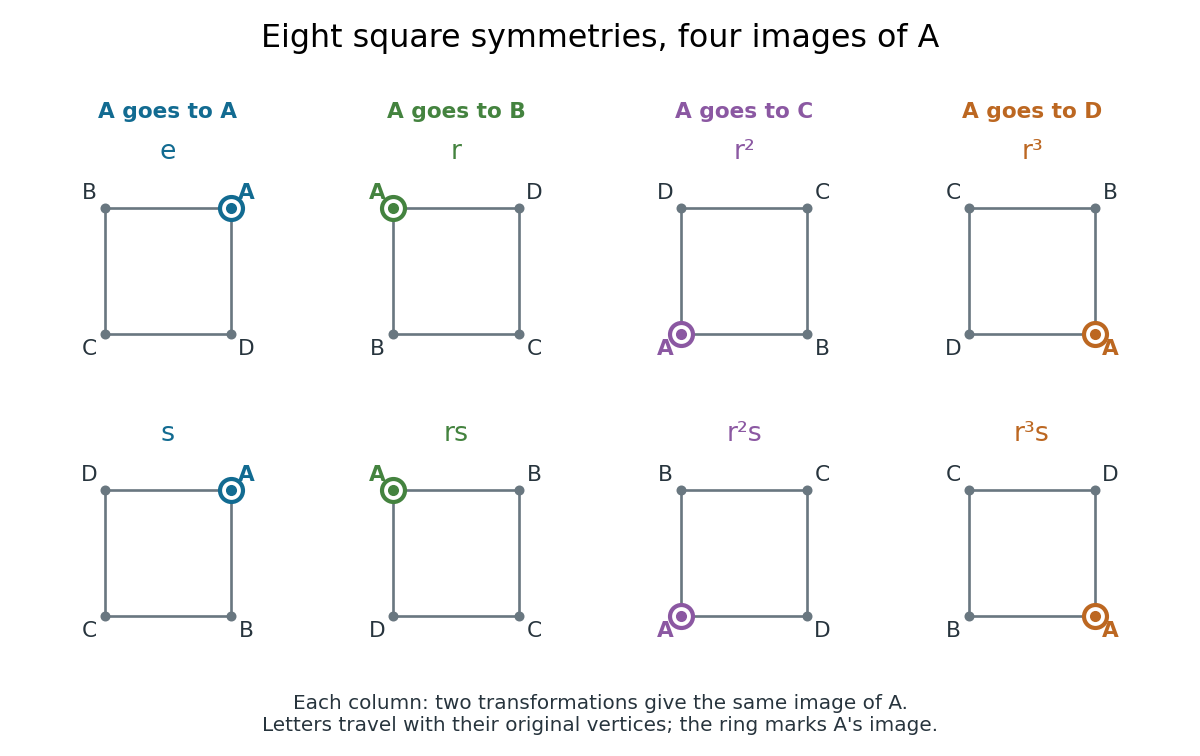

A group action need not be a faithful group action. For example, the cyclic group acts on by , using modular arithmetic. Only the parity of matters: fix both points and exchange them. The associated group homomorphism has group kernel , of group order two. Either point has a group orbit of size two and a stabilizer subgroup of group order two, so the orbit-stabilizer theorem gives .
The useful questions are which positions can be exchanged, and which transformations survive after imposing a constraint such as keeping one marked point fixed. An orbit of a group action answers the first question; a stabilizer subgroup answers the second. This turns a list of transformations into a count of distinct configurations, and explains why several transformations can produce the same configuration.
Group isomorphism Created 2026-09-24 Updated 2026-10-14
A group isomorphism is a bijective group homomorphism . It matches the entire group operation: , with each product taken in its own group. Its inverse is automatically a group homomorphism. A group automorphism is the special case .[ref]
The target is part of the claim. The doubling example under isomorphism is a group isomorphism , between the additive integers and the additive even integers. Exactly the same rule , declared as , is an injective endomorphism that misses and every other odd integer, so is not a group automorphism. Changing the declared target changes surjectivity, even though it does not change the formula or its compatibility with addition.
An isomorphism lets a calculation in one model solve the same problem in another. The example under group identifies addition modulo four with function composition of rotations of a square via . Through this group isomorphism, adding exponents corresponds exactly to composing motions. More generally, a group isomorphism preserves order of a group element, carries subgroups to subgroups, and carries a generating set of a group to a generating set of a group. Having equally many elements is insufficient: the permutation in group automorphism already fails compatibility on two inputs.
Why does the inverse preserve the group operation? Write and , possible because of surjectivity. ThenThis proves the inverse condition directly. Analogous calculations work for each operation of a ring and for addition and scalar multiplication in a vector space. The argument relies on preserving those operations; it supplies no general continuity claim for the inverse of a continuous bijection between topological spaces.
History of completing the square 2026-10-18
Al-Khwarizmi presented geometric completions of squares in his treatment of quadratic equations. His exposition used verbal instructions, positive lengths and areas, rather than the modern algebraic notation used here. The area assembly above illustrates the same principle with a different expression and arrangement. The modern polynomial identity also covers negative values of the variable and roots of a polynomial in the complex numbers, which need no interpretation as positive side lengths.[ref]
Al-Khwarizmi by John Joseph O'Connor and Edmund Frederick Robertson. MacTutor, Abu Ja'far Muhammad ibn Musa Al-Khwarizmi: six standard equation forms, verbal algebra and geometric square completion
Embed the order-eight dihedral group as in the symmetric group , and let be its two-dimensional complex representation obtained from its square action. Let be the three-dimensional complex representation from the rotational symmetry group of a cube. In the class order , the induced character is : only the identity and the square's half-turn have nonzero character values. This equals the character of , since . Characters distinguish finite-dimensional complex semisimple representations, giving the displayed isomorphism. Its trivial character multiplicity is .