A topological surface is a Hausdorff space with a countable basis in which every point has a neighborhood homeomorphic to an open subset of .
For two connected closed surfaces, remove an open disc from each and identify the resulting boundary circles by a homeomorphism. The resulting closed surface is their connected sum, defined up to homeomorphism independently of these choices. A triangulation version removes one triangular face from each and glues their boundary three-cycles by a simplicial homeomorphism.
At a seam vertex the two vertex links of a simplex are paths; gluing their matching endpoints produces a cycle graph, proving the local surface condition. Removing a triangular face subtracts one from each Euler characteristic, while boundary gluing reduces both the vertex count and the edge count by three. Therefore . If the result were orientable, either punctured summand would inherit consistent choices of orientation of a simplex, and these would extend over its capping face. Thus a nonorientable summand forces a nonorientable surface result. The classification theorem for closed combinatorial surfaces then gives .
The torus and Klein bottle are not homeomorphic because only the former is orientable. Adding a projective plane to either by connected sum of surfaces makes a nonorientable surface with Euler characteristic minus one. The classification of compact surfaces identifies both with three projective planes. Thus connected-sum cancellation can fail even for closed connected surfaces.
A closed combinatorial surface is a finite connected simplicial complex in which every simplex is a face of a triangle and the link of a simplex at every vertex is a cycle graph. Every edge then lies in exactly two triangles, and the triangles at a vertex form a single cyclic fan. The edge-incidence condition alone is insufficient: gluing two triangulated spheres only at one vertex gives two disjoint circles in that vertex's link.
Its geometric realization is a compact surface without boundary. Triangle interiors have disc neighbourhoods, edge interiors have such neighbourhoods from the two incident triangles, and the cyclic fan gives one at each vertex. A finite realization is a Hausdorff space with a countable basis of a topology, being a finite union of geometric simplexes in Euclidean space. If connectedness is omitted by convention, require these properties separately on each connected component.
A connected compact surface is determined by its orientability, number of boundary circles and genus. An orientable surface of genus has Euler characteristic ; a surface which is not orientable with crosscaps has Euler characteristic . In particular, a closed connected surface with vanishing first mod-two homology is a sphere, and a connected closed orientable surface of Euler characteristic zero is a torus.
Every closed combinatorial surface has geometric realization homeomorphic to exactly one member of the following list: the sphere ; the connected sum of surfaces of tori; or the connected sum of surfaces of real projective planes. Every member admits a finite triangulation. The orientable family has Euler characteristic , including for the sphere; the nonorientable surface family has Euler characteristic . Thus orientability and Euler characteristic determine the homeomorphism type. The first two nonorientable cases are the real projective plane and the Klein bottle. For a finite disconnected simplicial complex satisfying the same local conditions, the unordered list of its connected components' types determines its type.
The sphere with three points removed is an orientable noncompact surface of genus zero with three ends. It can be realized by pairing the two sides at each of two opposite ideal vertices of an ideal hyperbolic quadrilateral in the hyperbolic disk. The four ideal vertices fall into three equivalence classes; after adding these three points the cell structure has one face, two edges and three vertices, hence Euler characteristic two. Removing these added vertices recovers the original quotient.
A surface with boundary is a two-dimensional manifold with boundary: it is locally homeomorphic to the plane or to the closed upper half-plane. Points represented on the edge of a half-plane chart form its one-dimensional boundary.
A boundary component of a surface with boundary is a connected component of its manifold boundary. For a compact surface with boundary, these are finitely many circles. Their number enters the classification of compact surfaces: in the orientable case and in the nonorientable surface case, where is the nonorientable genus.
Consider a connected assembly of closed discs formed by identifying pairs of boundary arcs, each arc used once and all arcs in a given tile having disjoint endpoints. Its gluing graph has one vertex per tile and one edge per paired arc. A spanning tree joins the initial discs into a single closed disc; each of the remaining pairings attaches a band. This is a thickening of the gluing graph, so it is homotopy equivalent to that graph. Thus its Euler characteristic is and its fundamental group is the free group . If the gluing graph is a tree, the assembled surface is itself a closed disc.
Suppose each pairing preserves the positive boundary parameter of the reference discs. A global orientation must then assign opposite orientation signs to adjacent tiles, because their induced boundary orientations on an interior seam must oppose one another. Such signs exist exactly when the gluing graph is bipartite. An odd gluing cycle therefore proves that the assembly is a nonorientable surface. A Dirichlet boundary condition or a Neumann boundary condition on an unpaired arc has no effect on this topological calculation.
The pair of pants is the compact genus-zero surface with boundary having three boundary components. It is obtained from the sphere by deleting the interiors of three disjoint discs and is homotopy equivalent to a wedge of two circles.
A Y-piece is a compact curvature- hyperbolic surface homeomorphic to a pair of pants, with three geodesic boundary curves. Its labelled boundary lengths determine it up to isometry. Cutting along the three mutually perpendicular seams produces two congruent right-angled hyperbolic hexagons with alternating sides . Conversely, doubling the hexagon along its other three sides constructs the Y-piece for arbitrary positive lengths.
An X-piece is a curvature- four-holed sphere with geodesic boundary, formed by gluing two Y-pieces along equal-length cuffs. For a specified separating cuff and labelled outer boundaries, four outer lengths, the internal cuff length , and a twist determine the metric. The gluing is orientation-reversing on boundary circles, with relative arclength displacement measured from chosen seam endpoints. Without markings, the gluing displacement is taken modulo ; with a marking, records Dehn twists as well. Changing the chosen separating curve can give different parameter descriptions of the same unmarked surface.
Orient the three boundary classes so that in . A homeomorphism with orientation sign and boundary permutation sends to . Its trace on the rank-two quotient of by is therefore .
The genus counts the handles of a connected closed orientable surface. Such a surface has Euler characteristic .
For a continuous map of nonzero mapping degree between closed connected oriented surfaces, rational cohomology injectivity of a nonzero-degree map gives an injection on . Since the first Betti number of an oriented surface of genus is , the source genus is at least the target genus.
A closed orientable surface of genus is homeomorphic to a sphere with handles. Its Euler characteristic is .
A connected -sheeted covering space of a closed orientable surface of genus has genus . Lifting a finite cell decomposition gives cells above every base cell, so its Euler characteristic is . Equating this with gives the formula. For , every positive occurs: send one handle generator of the fundamental group to in and all remaining generators to zero, then use the classification of connected covering spaces for the kernel of that surjection.
For a compact connected nonorientable surface, its nonorientable genus is the number of real projective planes in its connected sum of surfaces representation after capping all boundary components of a surface by closed discs. The classification of compact surfaces gives , with boundary components of a surface. The real projective plane has and the Klein bottle has .
A connected closed nonorientable surface of crosscap genus is the connected sum of real projective planes and has Euler characteristic .
A free action of a finite group on a topological surface has a surface quotient: sufficiently small coordinate discs have disjoint translates and descend homeomorphically to quotient neighbourhoods.
Every simple closed curve on the sphere separates it into two connected components, each having the curve as its boundary.
For a compact set homeomorphic to a circle, lifting an argument along its parametrization identifies the quotient by continuous exponentials with . By planar logarithm factorization it is also free abelian on the bounded complementary components, so exactly one exists. A proper closed arc has trivial exponential quotient, and therefore connected complement. Given a small open arc of inside any neighborhood of a point, join points from the two complementary regions by a path avoiding the remaining closed arc. The first and last intersections with occur in the small arc, proving that the neighborhood meets both regions. Thus is the common boundary of its unique bounded and unbounded regions.
A Jordan domain is the bounded complementary component of a closed simple curve in the plane. The Jordan curve theorem separates the plane into this inside component and one unbounded outside component. A conformal bijection from the disc or complex upper half-plane to this simply connected domain extends to a homeomorphism of their closed conformal boundaries by the Caratheodory boundary extension theorem.
A Jordan curve in the two-sphere is carried to an equator by a homeomorphism of the sphere; equivalently, the closures of its two complementary regions are discs. This strengthens the separation assertion of the Jordan curve theorem and controls the boundary degrees of characteristic maps for cell decompositions of a surface.
The outer boundary of a compact planar set is the boundary of the unbounded component of its complement. Its filled hull is . When the outer boundary is a simple closed curve, the hull is its closed interior. For a simply connected open domain , containment of a compact trace and of its filled hull are equivalent. This lets outer-boundary pushforwards retain simply connected domain-containment information.
A simple triod is the union of three arcs that share one endpoint and are otherwise disjoint. The Moore triod theorem states that every pairwise disjoint family of simple triods in the plane is countable. One proof chooses data from a countable basis of open disks around each branch point; the Jordan curve theorem shows that two disjoint triods cannot determine the same finite basis data, giving an injection into a countable set of finite tuples.
For a polygonal schema with all its sides paired and two same-direction occurrences of an edge label , the words , , and describe homeomorphic quotient spaces. Here inversion of a string reverses its order and inverts each letter. Cut from the start of the first side to the start of the second, using a diagonal . The pieces have boundary words and . Gluing the old sides gives outside word ; reversing the whole boundary and choosing a new starting point gives . Alternatively cut from the end of the first side to the end of the second. The pieces are and , and gluing their old sides gives , cyclically . Renaming the new paired side gives both asserted forms. These are actual cutting and gluing homeomorphisms, so they preserve all the other side identifications as well as the Euler characteristic.
Start with a polygonal disk and pair all its sides, specifying for each pair a homeomorphism matching endpoints. Arrow labels encode whether each occurrence is traversed with or against its assigned direction. Form the quotient topology using those identifications and no extra identifications in the interior. Matched edge interior points have disk neighbourhoods formed from two half-disks; the corner sectors around each identified vertex form a circular link. The quotient is therefore a closed surface. A boundary word records each edge label exactly twice. Its endpoint identifications determine the vertex count, while its signs determine orientability. This encoding is distinct from treating a side-paired polygon as an abstract simplicial complex; a compatible subdivision is needed for a simplicial triangulation.
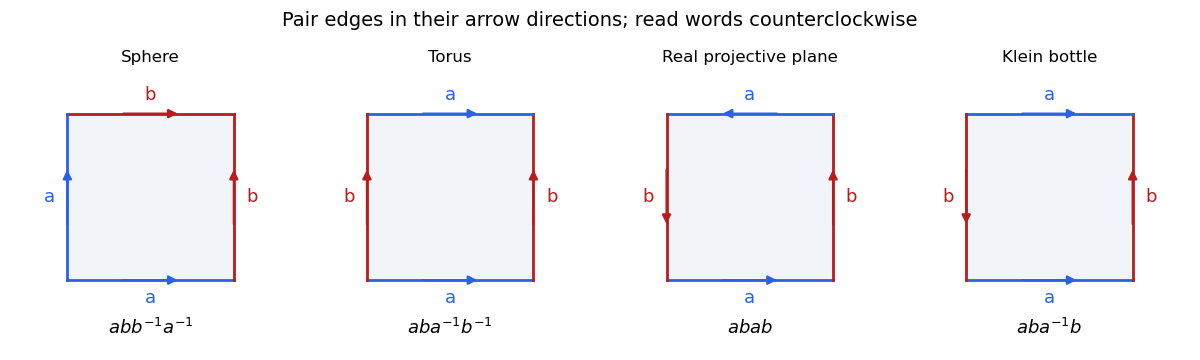
Read a boundary word counterclockwise, giving every paired edge a label. A positive exponent means the edge arrow agrees with the boundary traversal, and an inverse means it disagrees. Identify equally labelled edges in their arrow directions. The sphere has a square word ; the vertex count is three, giving Euler characteristic . A closed orientable surface of genus has wordA nonorientable surface which is the connected sum of surfaces of real projective planes has word . For , this is a digon; the square word , identifying antipodal boundary points, is another model of the real projective plane. The Klein bottle has square word , representing the nonorientable case . The classification theorem for closed combinatorial surfaces says that these orientable and nonorientable families exhaust the connected closed cases.
Triangulate a closed polygon by joining an interior point to every side, using matching parametrizations on paired sides. Orient every radial edge away from the interior point and choose consistent orientations on paired boundary edges. Each triangle then has a local vertex ordering with the centre first and its boundary edge in the chosen direction. These local orderings agree along shared edges. The quotient triangles and their affine face identifications form a finite delta-complex, even if some triangle vertices become identified. The second barycentric subdivision of a delta-complex removes these identifications at the simplicial level without changing the underlying quotient space. Thus every polygonal schema with a complete pairing has a finite triangulation. A single subdivision need not suffice to give an abstract complex.
Replace each corner of a polygonal schema by a small closed interval cutting across that corner. The endpoint identifications induced by paired polygon edges glue these intervals into a graph at each vertex equivalence class. This is its vertex link. A circle link gives a disc neighbourhood; a closed interval link gives a half-disc neighbourhood in a surface with boundary.
For a complete pairing of the sides of a single polygon, every link endpoint is paired exactly once. In each vertex equivalence class the link graph is connected, since the corner endpoint identifications generate precisely that class, and all its vertices have degree two. It is therefore a circle. For partial pairings, a connected link can instead be a closed interval when it has two unpaired endpoints. Counting free polygon edges alone does not count boundary components of a surface; their endpoints must first be identified.
Start with a polygonal schema whose outer boundary has sides, and remove a triangular disc strictly inside its polygon. Cut the resulting annulus along an arc from an outer vertex to an inner vertex. The cut space is a closed disc with marked sides: the original outer sides, two banks of the cut, and three inner sides. Parametrize it by a convex polygon with that many sides. A boundary homeomorphism carrying the marked vertices in cyclic order extends over the disc by radial extension after identifying both discs with a standard closed disc.
Transport the original side identifications to this polygon and identify the two cut banks, leaving the three inner sides unpaired. The quotient space is the original surface with an open triangular disc removed. In boundary-word notation, if is the original word, the new word is , with unpaired. The torus has ; a square model of the real projective plane has , pairing antipodal points of the square's boundary.
Identifying the sides of one polygon in pairs gives a cell structure with one face, edges and some number of vertex classes. For a closed orientable surface of genus ,Since , every such schema satisfies .
A regular hyperbolic octagon with opposite sides paired gives a genus-two surface when each angle is . The eight vertices then form one smooth quotient point because their angles sum to .
The mapping class group of an oriented surface is the group of orientation-preserving self-homeomorphisms of modulo isotopy. It acts on isotopy classes of curves and arcs.
A mapping class is an isotopy class of self-homeomorphisms of a surface. Orientation-preserving classes form the mapping class group. Acting on markings changes a point of Teichmüller space while preserving the underlying unmarked Riemann surface.
If a finite group acts faithfully by orientation-preserving isometries on a closed hyperbolic surface of genus at least two, then . An isometry isotopic to the identity induces an inner automorphism of the surface group; its suitable lift commutes with every deck transformation and fixes their limit set, forcing the lift and the original isometry to be the identity.
Every finite group is the deck group of a connected finite regular covering of some closed orientable surface of genus at least two. Choose a surface group that surjects onto and take the covering corresponding to the kernel. The resulting free action embeds into the mapping class group of the covering surface.
A Dehn twist cuts an oriented surface along a simple closed curve , rotates one side once, and glues it back. If a curve or arc has nonzero geometric intersection with , the iterates usually represent distinct isotopy classes, with intersection numbers growing linearly in .
The mapping class group of a compact connected oriented topological surface, for orientation-preserving maps fixing its boundary pointwise and isotopies relative to that boundary, is generated by Dehn twists about simple closed curves. Boundary-parallel twists are allowed. For a closed surface of positive genus a finite generating collection exists. Permuting boundary components requires additional generators if that larger group is used.
If uses the ordered-tangent orientation convention for algebraic intersection number of curves on an oriented surface, a right-handed Dehn twist takes to on first homology. In particular a separating-curve twist acts trivially there.
In orientation-preserving annular coordinates with orientation , the twist is , where increases from zero to one. The map is the identity outside this annulus and near its boundary. The orientation of the ambient topological surface, rather than the orientation assigned to the curve, fixes the handedness.
A proper arc on a punctured surface approaches punctures at both ends. It is simple when its interior is embedded, and essential when it cannot be isotoped, relative to its ends, into a puncture.
Two transverse arcs form a bigon when subarcs between two consecutive intersection points together bound an embedded disc whose interior is disjoint from both arcs. Pushing one side across the disc removes the two corner intersections.
Two curves or proper arcs are in minimal position when their number of transverse intersection points is the least possible among representatives of their isotopy classes.
Two transverse essential simple curves or proper arcs on a surface are in minimal position exactly when they form no bigon. For proper arcs, the proof uses the compactification of the universal cover to control their ends at punctures.
The geometric intersection number is the minimum number of transverse intersection points among representatives of the isotopy classes of and . Representatives in minimal position realize it.
For transverse oriented curves on an oriented surface, the algebraic intersection number is the sum of the local signs of their crossings. It depends only on their oriented homology classes and is antisymmetric:Its absolute value is at most the geometric intersection number.
During a generic isotopy of one transverse curve, crossings with a fixed curve can only be created or removed in pairs of opposite local sign. Their signed sum, and hence the algebraic intersection number, is therefore invariant.
The vertices of the arc complex of a punctured surface are isotopy classes of unoriented essential simple proper arcs. A finite set spans a simplex when its classes have representatives with pairwise disjoint interiors. The mapping class group acts on the complex by simplicial automorphisms.
The three-punctured sphere has six arc classes: one joining each unordered pair of distinct punctures and one returning to each puncture. The three joining arcs span one triangle; for each puncture, its returning arc and the two joining arcs incident to it span another triangle. Its mapping class group is the symmetric group on the three punctures and has two vertex orbits, distinguished by whether the endpoints agree.
The mapping class group of the four-punctured sphere has two orbits on vertices of its arc complex: arcs whose endpoints are distinct and arcs whose endpoints coincide. Each orbit is infinite, and Dehn twists exhibit infinitely many classes of the second type based at any fixed puncture.
An Alexander system is a finite collection of pairwise nonisotopic essential simple curves and proper arcs in pairwise minimal position, arranged without triple intersections and with no three members intersecting pairwise. Pairwise isotopic Alexander systems can be carried to one another simultaneously by an ambient isotopy.
For a filling Alexander system , the structure graph is the embedded graphwith vertices at all curve intersections, arc endpoints, and punctures. Its edges are the curve, arc, and boundary segments between consecutive vertices. A homeomorphism preserving the system induces a graph automorphism.
If an Alexander system fills a surface, a homeomorphism preserving every member up to isotopy is determined up to isotopy by its induced automorphism of the structure graph. A trivial graph action makes it isotopic to the identity; the finite graph automorphism group shows that the pointwise curve-class stabilizer is finite.
A homeomorphism of a closed disc that fixes its boundary pointwise is isotopic relative to the boundary to the identity. Radially interpolate the action toward the center after identifying the disc with the unit ball.
The center of has order two. A central class commutes with twists about two curves intersecting once, hence preserves both curve classes. The Alexander method reduces it to the identity or the elliptic involution , and both are central.
A self-homeomorphism of a connected surface induces an automorphism of its fundamental group after a path from the old basepoint to its image is chosen. Changing that path changes the automorphism by an inner automorphism, so isotopy classes define a homomorphism
The pure mapping class group consists of mapping classes that fix every puncture individually.
Pushing a distinguished puncture once around a loop defines a mapping class. For a simple loop, the push is the product of opposite Dehn twists about the two boundary components of a thin annular neighborhood of .
For a finite-type surface of negative Euler characteristic and the surface obtained by adding a puncture, forgetting that puncture gives
The pure mapping class group of the three-punctured sphere is trivial. The three simple arcs joining distinct puncture pairs form an ideal triangulation; a pure homeomorphism can be isotoped to fix these arcs, and the Alexander trick on the two complementary discs finishes the isotopy to the identity.
Forgetting the fifth puncture gives a split Birman exact sequenceLifts of two free generators generate a copy of meeting the point-pushing kernel trivially.
The vertices of the curve complex are isotopy classes of essential simple closed curves. Distinct vertices span a simplex when they have pairwise disjoint representatives.
For every connected orientable surface of complexity above one, the one-skeleton of the curve complex is connected. Surgery replaces one curve by an essential curve disjoint from it while reducing intersection with a fixed target; induction on geometric intersection number gives a path.
A collection of curves fills a surface when every essential simple closed curve intersects at least one member. For curves in minimal position on a closed surface, this is equivalent to every complementary component being a disc.
Split a closed genus-two surface along a separating curve into two one-holed tori. In each torus choose two disjoint proper arcs that cut it into a disc, and match their four endpoints across so that the four arcs join into one simple closed curve . Then and the complement of is two discs, so the pair fills.
The torus is the product of two circles and can be formed by identifying opposite sides of a square.
For the surface of revolution of the circle with center and radius in the upper half-plane, use and unit normal . Exactly four surface normals pass through the displayed . The equation forces . The case would put at radial distance , so ; its nonzero radial coordinate then forces or . All four combinations work. By contrast, infinitely many normals pass through : both complete circles with or have radial normals through that point. This is a concrete illustration of degenerate distance-critical sets versus isolated critical points.
Take modulo ; shifting either coordinate by leaves unchanged. Its partial derivatives are and . The only critical points are , and . The latter are a nondegenerate minimum and maximum, with values . At the origin the leading cubic is , linearly equivalent to a monkey saddle; its critical point is isolated but degenerate. Thus three smooth critical points coexist with the Morse lower bound of four for the torus.
Collapsing an essential meridian circle of a torus to one point gives the pinched torus. In the torus's CW structure, the two-cell attaches to two circles by the commutator. Collapsing one circle leaves one one-cell and a two-cell attached by a null-homotopic word. Thus the quotient is homotopy equivalent to . Its cellular chain groups are in degrees zero, one and two, with zero differentials, so its integral homology groups are and vanish in all higher degrees. This illustrates that collapsing a circle can preserve a top-dimensional homology class even while reducing the first homology rank.
The product of three circles is a compact smooth three-manifold. Quotient coordinates allow constant commuting vector fields. A rank-two plane field can have dense immersed leaves, as in a dense immersed cylinder in a three-dimensional torus.
Since is a product of circles, the Künneth theorem identifies its cohomology ring with the exterior algebra on the coordinate degree-one classes. Inversion negates each integral degree-one class, so it acts as in degree . Even in characteristic two, each degree-one class has square zero.
On the torus , an integer matrix defines an endomorphism. The coordinate circles give a basis of the first homology group, and the induced map on that group is . The Künneth theorem identifies higher integral homology with the exterior powers of , so the degree- map is . In top degree it is multiplication by . The map is a homeomorphism precisely when is a unimodular matrix; a merely nonsingular integer matrix need not have an integer inverse.
A solid torus is the product of a circle with a closed disk. Its boundary is the torus . It deformation retracts onto its central circle, so its degree-one de Rham cohomology is one dimensional and injects into that of its boundary.
A compact orientable irreducible three-manifold with connected torus boundary which is compressible is a solid torus. Compressing along a compression disk gives an embedded sphere. The compressed component has one sphere boundary and irreducibility makes it a ball; undoing compression attaches one one-handle, giving .
A meridian of a solid torus is a primitive curve on its boundary that bounds an embedded disk in the solid torus.
Suppose a compact -manifold is embedded in the half-space of . Spinning it around the boundary hyperplane gives the embeddingStarting with a circle and iterating proves that embeds in .
For major radius and minor radius with , the standard embedded torus of revolution in isIt is parametrized bywhich identifies the opposite sides of the unit square.
For the universal coveringlift a based loop from the origin. Its endpoint lies in the fibre , depends only on its based homotopy class, and turns concatenation into addition. This gives a natural isomorphism .
Every induces a based homeomorphismIts inverse is , and under the lift-endpoint description of the fundamental group of the torus, its induced map on is multiplication by .
Any two connected degree-two coverings of the torus fit into a commuting square with homeomorphisms of their total and base spaces. They correspond to index-two subgroups of , which are kernels of the three nonzero maps . Reduction modulo two shows that acts transitively on these subgroups; the classification of connected covering spaces and the lifting criterion for a covering space then supply the homeomorphism of total spaces.
The Möbius band is the topological surface obtained by gluing the ends of a rectangle with a half-turn. Precisely, it is the quotient spaceThe twist identifies the two apparent long edges into one boundary circle. Following the core circle of a Möbius band reverses local handedness, so this surface is not orientable. An untwisted untwisted band has two boundary circles and is orientable: the distinction survives stretching and bending because orientability is a topological invariant.
To explore the construction with paper, mark the two long edges in different colours, join the short ends after a half-turn, and trace an edge. The trace passes from one marked edge to the other without ever leaving the boundary. Separately, trace the centre line and track a local transverse arrow: it comes back reversed after one circuit. The boundary closes after twice the travel around the centre, while the transverse arrow needs two circuits to return to its original direction.
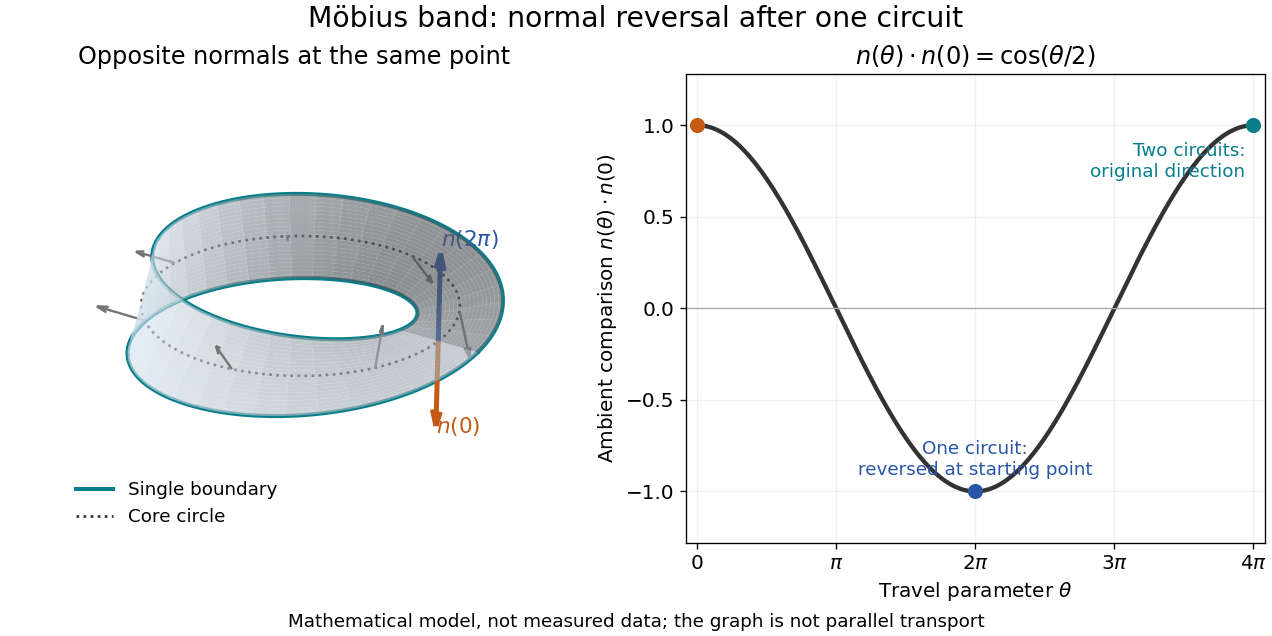


This original mathematical model has central radius and half-width :Its seam obeys . The dotted circle is the core circle of a Möbius band; the teal curve follows the single boundary through . At the same point on the core, the arrows for and are opposite. The graph compares a continuously followed unit normal with its starting value in the ambient space; the endpoint reversal, rather than any intermediate zero of the graph, establishes the obstruction. It is not a statement about parallel transport.
The Möbius band has the homotopy type of a circle: a deformation retraction shrinks each width coordinate to zero. Nevertheless its boundary represents twice a generator of its fundamental group. The boundary of a Möbius band winds twice around its core, so with compatible generator choices the boundary generator maps to in .
The historical account by Julyan H. E. Cartwright and Diego L. González places the mathematical discovery by August Möbius and Johann Listing in 1858, while investigating representations of twisted bands predating that work. A familiar-looking picture and a recognition of the underlying topological invariant are different kinds of evidence. [ref]
https://arxiv.org/abs/1609.07779. Cartwright and González, Möbius strips before Möbius, 2016
The core circle is the image of the centre line in the rectangle defining a Möbius band. Its endpoints are identified, so it is a circle. The formuladefines a deformation retraction onto that circle: it respects , starts at the identity map, and fixes the core throughout. Consequently the Möbius band has fundamental group isomorphic to , just like a circle; this alone cannot distinguish it from an annulus.
For the model of the Möbius band, the tangent vectors along its core circle of a Möbius band areTheir cross product, divided by its norm , gives the continuous unit normalAlthough , we have . Any other continuous choice of unit normal along this parametrized interval is either everywhere or everywhere: its relative sign is a continuous map into the discrete space , and the interval is connected. Thus no choice can agree at the identified endpoints. This short calculation proves that the Möbius band has no global continuous unit normal and is not an orientable surface.
The plotted quantity is . It compares ambient vectors at generally different points; after one circuit it is at the starting point, and after two circuits it is there. Only these endpoint comparisons are needed for the orientability argument.
In the quotient space description of the Möbius band, follow once along the rectangle. The seam sends its endpoint to the start of , which must also be traversed before returning to the original point. Under the deformation retraction onto the core circle of a Möbius band, these two stretches each travel once around the same circle. Orienting both circles by increasing longitudinal parameter gives a map of topological degree two. Equivalently, the group homomorphism on fundamental groups induced by inclusion of the boundary sends a chosen generator to twice the core generator, or to in multiplicative notation. Reversing the chosen boundary generator changes the sign, not the fact that it winds twice.
An untwisted band is the topological surface obtained from a rectangle by identifying with . It is the Cartesian product of a circle and a closed interval, and is homeomorphic to a closed annulus. A finite portion of the lateral surface of a circular cylinder realizes it in three-dimensional space. Its two boundary circles are and , and the matching seam directions make it an orientable surface. The Möbius band changes just one identification sign and loses both this two-component boundary and its orientability.
The Klein bottle is obtained from a square by identifying one pair of opposite sides with matching direction and the other pair with reversed direction.
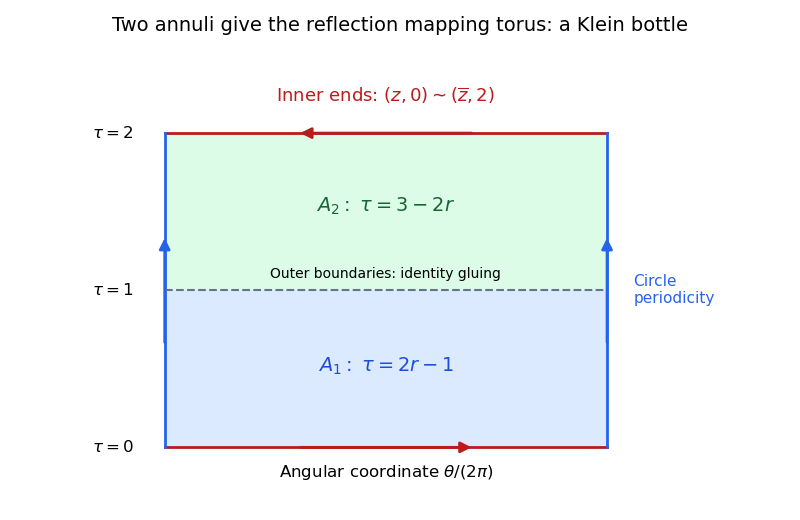
Glue the outer circles of two closed annuli by the identity, and their inner circles by complex conjugation. The result is a Klein bottle. To see the gluing explicitly, let and . Parametrize the first annulus by , with , and the second by , with . The outer-circle gluing identifies their common level . The remaining gluing isThis is the mapping torus of reflection of the circle. The coordinate maps and their piecewise inverses agree on every identified boundary, so the universal property of the quotient topology gives inverse continuous maps between the two quotient descriptions. Gluing collars by the reflection supplies disc charts at the seam; thus it is a closed surface. Cutting the circle coordinate at one point gives a rectangle with one matching and one reversed edge pairing, the usual Klein-bottle model. Its Euler characteristic is zero and it is a nonorientable surface, so the classification theorem identifies it with the connected sum of two real projective planes.

A one-sided section loop and a two-sided fiber loop in the reflection mapping torus have mod-two self-intersections one and zero and meet once. Their intersection form is . In the evaluation-dual cohomology basis, the Poincare duality pairing has matrix , giving and .
The integral cohomology groups of the Klein bottle are , , , and zero in higher degrees. The degree-one generator is pulled back from the base circle of the circle-bundle presentation, so its square is zero; hence every product of positive-degree classes vanishes.
The wedge has the same additive integral cohomology as the Klein bottle: in degree zero, in degree one, and in degree two. Products of positive-degree classes vanish because the degree-one class comes from the circle summand, so its cohomology ring is isomorphic to that of the Klein bottle.
Forthe transformations with even form an index-two translation subgroup. Its quotient is a torus, giving the orientation double cover .
Let be the mapping cylinder of the orientation double cover with its free end omitted. If a Hausdorff space contains as an open subset, van Kampen extends the orientation quotient of to a surjection of the ambient fundamental group onto . The ambient space is therefore not simply connected.
In a flat fundamental square, straight horizontal, vertical and rational-slope lines project to closed geodesics. The central horizontal glide axis is one-sided, a vertical line is two-sided, and the line closes with one transverse self-intersection.
Articles were limited to the first 100 out of 101 total.
Articles by others on the same topic
There are currently no matching articles.