Topics (384k) Articles (398k) Users (410) Discussions (242) Comments (383) Files (13k) New article

Bertrand Duplantier works on random geometry and statistical physics. With Scott Sheffield, he gave a probabilistic construction of a Liouville quantum gravity area measure and a relation between Euclidean and random-geometry scaling exponents.[ref]
Liouville Quantum Gravity and KPZ by Bertrand Duplantier and Scott Sheffield. abstract, regularized area measure and KPZ relation
The construction illustrates why a random field cannot always be manipulated as an ordinary pointwise function. A Gaussian free field first receives a spatial regularization, such as its average around a small circle. Exponentiating this smoothed field requires a scale-dependent normalization before taking a limit. Merely writing without specifying that procedure omits an essential mathematical step.
Their result links how a set scales under ordinary area with how it scales under the random area measure. It turns a prediction from mathematical physics into a statement about precisely defined random objects, rather than identifying the two notions of dimension by analogy alone.[ref]
Liouville Quantum Gravity and KPZ by Bertrand Duplantier and Scott Sheffield. abstract and quantum scaling formulation
Jian-Sheng Wang co-developed the Swendsen-Wang algorithm with Robert H. Swendsen. Their method constructs and updates clusters of spins rather than changing one spin at a time, addressing critical slowing down in equilibrium Monte Carlo simulations.[ref]
For example, a large nearly aligned region in an Ising model can be difficult to reverse through local changes because intermediate configurations create costly boundaries. A collective move can change the region coherently while the full transition rule retains the desired equilibrium statistics. The useful question is then the correlation between successive samples, not merely how many update attempts are executed. Wang's institutional personal-page redirect identifies his current research homepage.[ref]
https://phyweb.physics.nus.edu.sg/~phywjs/. Redirect to the identified author homepage
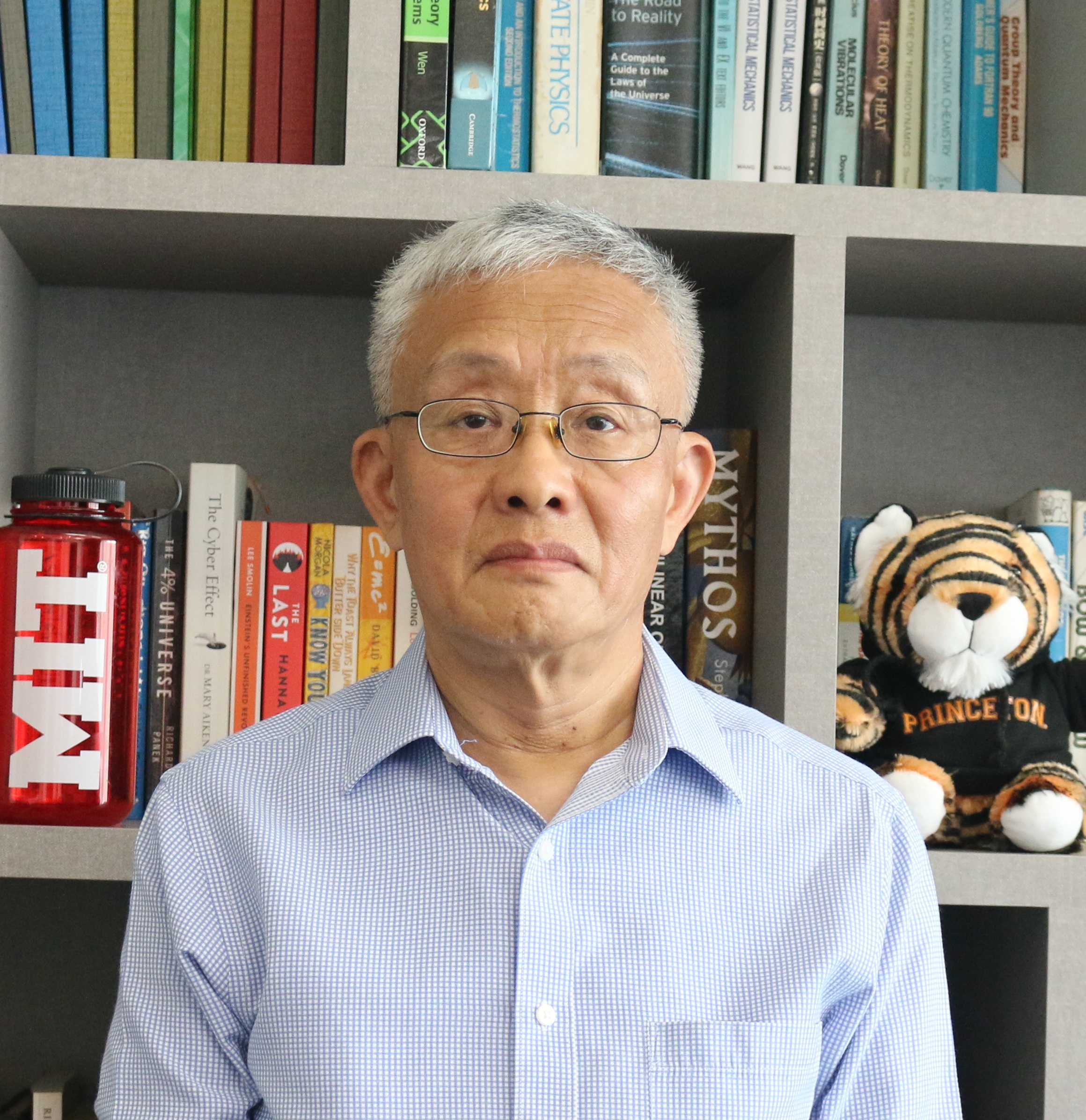
Portrait of Jian-Sheng Wang
. Source. Robert H. Swendsen co-developed the Swendsen-Wang algorithm with Jian-Sheng Wang. Their 1987 paper introduced collective updates for spin-system Monte Carlo simulations, reducing the difficulty of sampling large correlated regions near a phase transition.[ref]
Nonuniversal critical dynamics in Monte Carlo simulations by Robert H. Swendsen and Jian-Sheng Wang. abstract and cluster-update construction
The key distinction is between physical dynamics and a sampling algorithm's dynamics. Replacing many single-spin changes by a collective update can preserve the intended equilibrium probability distribution while changing how quickly samples decorrelate. An improvement in simulation speed is therefore not a claim that a real magnet changes by that same update rule. Swendsen's Carnegie Mellon profile identifies his field as computational physics.[ref]

Portrait of Robert H. Swendsen
. Source. A dimensionless constant has no residual physical dimensions, so changing units leaves its numerical value unchanged. The fine-structure constant is an example: the dimensions carried by its constituent quantities cancel.
A dimensional constant such as the speed of light can be assigned the numerical value one through a unit convention; this cannot make an arbitrary dimensionless coupling equal one. Dimensionless ratios also distinguish physical regimes, but not every such ratio is a universal physical constant. A Reynolds number, for example, depends on the selected flow, length and material properties.
Electronic structure describes the quantum states and spatial distribution of a system's electrons, including their energies, occupancies and correlations. It determines much of the chemical bonds, optical response and reactivity of atoms, molecules and solids.
An electron configuration is one compact approximate description, but it is not the full many-electron state. In molecular calculations, molecular orbitals and electron density reveal where charge is distributed; a many-electron wave function also encodes correlations. In a crystal, energy bands express how allowed electronic energies depend on wavevector. Approximations such as Hartree-Fock theory and density functional theory address different representations of the same underlying quantum problem.
Photochemistry studies chemical changes initiated or influenced by light. Absorption of a photon can prepare an electronically excited molecule, opening reaction pathways different from those available on its ground-state potential energy surface.[ref]
IUPAC Compendium of Chemical Terminology, fifth edition (Gold Book). Photochemistry P04588 and photochemical reaction P04585
The absorbed energy is , so changing wavelength changes both which species absorb and which states are reached. Photodissociation of molecular oxygen is an atmospheric example. Absorption alone does not guarantee chemical conversion: relaxation and competing reactions affect the quantum yield. A photon-initiated chain can produce more than one product event per absorbed photon, so a chemical quantum yield need not be at most one.
Chemical affinity is the thermodynamic driving tendency of a specified chemical reaction, defined at fixed temperature and pressure aswhere is Gibbs energy, the extent of reaction, signed stoichiometric coefficients and chemical potentials.[ref]
IUPAC Compendium of Chemical Terminology, fifth edition (Gold Book). Affinity of reaction, entry A00178
For the chosen forward direction, : positive chemical affinity favours a small positive advance. At an unconstrained equilibrium, . For a reaction quotient and equilibrium constant , under the usual activity conventions. This is a thermodynamic condition, not a rate prediction; a favourable reaction can remain slow because of an Gibbs energy of activation.
Surface chemistry studies chemical processes at interfaces, where local coordination and composition differ from the bulk. Adsorption can concentrate reactants, change their electronic environment and enable surface-mediated catalysis. The active surface can be a solid–gas, solid–liquid or other interface.
For a spherical particle of radius , the surface-area-to-volume ratio is . Making particles smaller therefore increases the fraction of material exposed to the environment. This geometric change helps explain why fine particles can react differently from a bulk specimen of the same nominal composition. Surface structure, defects and adsorbed species still matter: geometric area alone does not count chemically active sites.
Freeze-drying, also called lyophilization, removes water from a frozen material chiefly by sublimation: solid water passes directly into vapor. Reduced pressure makes that route useful without requiring the whole sample to pass through a liquid-water stage. Primary drying concerns removal of ice by sublimation; secondary drying concerns removal of residual sorbed water by desorption.[ref]
Lyophilization of Parenteral (7/93) by the Food and Drug Administration. Introduction and Glossary, historical July1993 guide: phase-change definition and named stages.
A hypothetical mass balance separates water removal from the measurement convention. Suppose a specimen contains of dry solids and of water. If its final mass is , with no solids lost or chemical change, the residual water is . Its wet-mass mass fraction iswhereas water relative to dry solids is .
Both percentages describe the same imagined sample with different denominators. The mass change establishes water removal under the assumptions, but does not independently prove that sublimation was the mechanism. That claim requires information about the material's phase and the physical process.
X-ray scattering is the redirection of X-rays through interaction with matter. The angular distribution and energy of the outgoing radiation carry information about the material. In elastic scattering the photon energy is unchanged; in inelastic scattering energy is exchanged. X-ray diffraction concerns organized interference of scattered waves, rather than a separate kind of radiation.
The scattering vector compares outgoing and incoming wave vectors. Consider two identical scatterers separated by , each with real elastic scattering amplitude , and neglect multiple scattering. Their amplitude sum and intensity areTwo atoms can therefore scatter strongly in one direction and cancel in another. The measured pattern depends on arrangement, not merely on the number of atoms. For repeating lattice planes in a crystal, constructive interference gives Bragg's law .[ref]
The1913 experiment by William Henry Bragg and William Lawrence Bragg made the angular pattern measurable with a rotating crystal and an ionization chamber in place of a spectrometer telescope. Slits selected a narrow incoming beam; the detector current was measured as its angle changed. Peaks and repeated orders constrained crystal structure and X-ray wavelengths, linking an electrical measurement to atomic-scale geometry.[ref]
The Reflection of X-rays by Crystals by William Henry Bragg and William Lawrence Bragg. pp.428–430 apparatus and angular scan; pp.435–438 reflection orders
Equilibrium dialysis measures partitioning or binding using two compartments separated by a semipermeable membrane. In a common ligand-binding design, a small ligand can cross while the binding macromolecule is retained on one side. Under matched solution conditions, the free ligand equilibrates; retained bound ligand can make the total ligand concentrations different.
A historically motivating assay measured inducer binding to the lac repressor during its isolation by Walter Gilbert and Benno Müller-Hill. The primary paper describes equilibrium dialysis against radioactive inducer as a way to detect the regulatory protein.[ref]
Isolation of the lac repressor by Walter Gilbert and Benno Müller-Hill. printed p. 1891, assay description and Design of the Experiment
Detecting binding was an experimentally tractable step even before every part of the repression mechanism was known.For an original one-site model, let free ligand concentration be , retained site concentration , and dissociation constant . Bound concentration isIf compartment volumes are , and protein is confined to compartment 1, total ligand amount obeysFree concentration is not generally the initial concentration: binding can substantially deplete the free pool.
Take equal 1.00 mL compartments, , and total ligand 8.00 nmol. Expressing numerically in micromoles per litre gives , henceThe total concentrations are about 5.438 and 2.562 micromoles per litre, although free ligand equilibrates. Substituting the initial average concentration 4.00 for would overestimate bound concentration in this model.
The interpretation requires adequate equilibration, membrane retention of the macromolecule, known accessible volumes and suitable blank measurements. Nonspecific membrane adsorption or unequal chemical conditions can imitate or modify an apparent binding difference. Equal free concentrations are an assumption appropriate to the stated ideal setup; equilibrium more generally concerns compatible chemical potentials, not arbitrary equality of total concentrations.
Peter Spirtes develops mathematical and computational methods for causal discovery. His work asks which causal conclusions can be recovered from statistical data and background knowledge when fully controlled experiments are unavailable, and how to turn the corresponding guarantees into practical algorithms.[ref]
Peter Spirtes by Carnegie Mellon University. Research: the two goals of the Tetrad project and limitations of its assumptions
With Clark Glymour and Richard Scheines, he coauthored Causation, Prediction, and Search by Peter Spirtes, Clark Glymour and Richard Scheines. One important example is the PC algorithm, which uses conditional independence information to remove candidate edges and orient some of the remaining ones. Under its assumptions, the resulting graph represents an equivalence class of possible causal explanations; it need not recover every arrow in a unique graph. Making these limitations explicit is part of the method's contribution, rather than an exception to it.[ref]
Causation, Prediction, and Search by Peter Spirtes, Clark Glymour and Richard Scheines. Chapter 5, section 5.4.2, PC algorithm; Markov equivalence and the stated causal assumptions

Portrait of Peter Spirtes
. Portrait selected from the matching Carnegie Mellon institutional profile. Source.Richard Scheines studies causal discovery: learning causal structure from statistical evidence under explicit assumptions. With Peter Spirtes, Clark Glymour and collaborators, he developed the Tetrad research programme, connecting causal inference, algorithms and machine learning.[ref]
Richard Scheines by Carnegie Mellon University. Bio, first two paragraphs: causal discovery, statistical evidence and Tetrad collaboration
In Causation, Prediction, and Search by Peter Spirtes, Clark Glymour and Richard Scheines, the collaborators examine how patterns of conditional independence constrain a causal directed acyclic graph. The connection is informative but conditional: faithfulness of a directed acyclic graph, restrictions on unobserved causes and the correctness of the independence information affect what can be identified. Different graphs can remain indistinguishable under Markov equivalence of directed acyclic graphs, so observational data need not select one unique causal story.[ref]
Causation, Prediction, and Search by Peter Spirtes, Clark Glymour and Richard Scheines. Chapter 3, Markov and faithfulness assumptions; chapter 5, discovery algorithms

Portrait of Richard Scheines
. Portrait selected from the matching Carnegie Mellon institutional profile. Source.A point particle is an idealization whose position is represented by a single spatial point and whose internal size and structure are omitted. It can still carry parameters such as mass, electric charge or spin.
The approximation is useful when the relevant length scales are much larger than the object's size and internal deformation is unimportant. A planet can be treated as a point mass for some orbital calculations even though it is extended. Short-distance fields and self-interaction can expose the limits of the idealization.
Energy deposition is the transfer of energy from incident particles or radiation to a specified material region during a specified time. In a detector, it can produce ionization, excitation, scintillation or heat. The measured signal depends on how those channels are collected and calibrated.
An energetic charged particle may deposit only part of its energy while crossing a thin sensor. Secondary photons or particles can carry energy out of the sensitive volume, so incident energy and deposited energy need not coincide. Conversely, a sufficiently containing calorimeter aims to collect the full shower response. Separating energy deposition from readout response prevents an uncalibrated pulse height from being mistaken for a direct energy measurement.
The Carboniferous is the Paleozoic geological period between the Devonian and the Permian, approximately 359–299 million years ago. Its subdivisions include the Mississippian and Pennsylvanian. The name refers to the importance of coal-bearing rock successions, rather than implying that every Carboniferous environment was a coal swamp.[ref]
International Chronostratigraphic Chart by the International Commission on Stratigraphy. Version 2024/12; Carboniferous boundaries and subdivisions
Coal records the accumulation and burial of plant material in settings where production and preservation exceeded decay. Carboniferous fossils and the sediments around them can therefore be used together: a plant compression constrains the vegetation, while the enclosing deposit supplies evidence about the environment of preservation. A fossil assemblage is a sample from particular places and preservation conditions, not a census of all life during the period.
Metalation introduces a metal into a molecule or replaces an attached atom or group with a metal-containing connection. In organometallic chemistry, the term often refers to forming a carbon–metal chemical bond, for example by replacing a carbon-bound hydrogen.
The word describes the transformation, while the mechanism can involve proton transfer, metal insertion or other pathways. A metalated carbon centre may act as a nucleophile in a subsequent bond-forming reaction. Which site is metalated depends on acidity, coordination and kinetics, so the most acidic isolated bond need not uniquely predict the product under every reaction condition.
A halophile is an organism adapted to growth in high-salt environments, with its preferred or required salt conditions depending on the species. The term describes a way of living, rather than one clade. For example, Haloferax volcanii is a member of Archaea, whereas Dunaliella parva belongs to the algae. A halophile must sustain cellular function despite the effects of external salinity on water movement and proteins.[ref]
A concrete mechanism was tested by Ami Ben-Amotz and Mordhay Avron in 1973. They measured intracellular glycerol in Dunaliella parva and estimated its concentration using cellular volume. Changing external sodium chloride caused corresponding changes in intracellular glycerol, with a new balance through osmoregulation reached after about 90 minutes. Their leakage measurements supported metabolic production and breakdown of glycerol as the explanation, rather than simple escape of the solute. This connects environmental change to measurable osmoregulation.[ref]
The experiment illustrates why a growth habitat alone does not identify a mechanism. Two halophiles can inhabit salty surroundings while controlling intracellular solutes differently. A useful comparison specifies the organism, external salt concentration, cellular response and time after the salt change.
Lattice theory studies partially ordered sets in which every pair has a greatest lower bound and a least upper bound, called its meet and join . These operations encode the order: exactly when .
The power set of a set, ordered by inclusion, forms a lattice with intersection as meet and union as join. Positive integers ordered by divisibility form another lattice: meet is the greatest common divisor and join is the least common multiple. Thus the join of two and three is six, while neither number precedes the other in this order. Lattice theory compares such structures through their algebraic identities and order properties.
A time-sharing operating system multiplexes processor time among interactive operating-system processes so that each can make progress while sharing one machine. A timer interrupt can end the current time slice, enter the kernel and let Process scheduling select another runnable process. Saving and restoring its Execution context lets the interrupted process later resume where it stopped.
In a simplified round-robin example, four always-runnable processes with10ms time slices each receive a turn every40ms, ignoring switch overhead. A blocked process need not consume its turn. Smaller slices reduce scheduling delay but increase the fraction of time spent switching contexts. Interactive responsiveness therefore depends on both the scheduling policy and workload; merely supporting multiple users does not guarantee a latency bound. The1974 Unix paper describes a concrete time-sharing system organized around protected processes, files and shared system services.[ref]
The UNIX Time-Sharing System by Dennis M. Ritchie and Ken Thompson. process and system-overview sections
Pinned article: Introduction to the OurBigBook Project
Welcome to the OurBigBook Project! Our goal is to create the perfect publishing platform for STEM subjects, and get university-level students to write the best free STEM tutorials ever.
Everyone is welcome to create an account and play with the site: ourbigbook.com/go/register. We belive that students themselves can write amazing tutorials, but teachers are welcome too. You can write about anything you want, it doesn't have to be STEM or even educational. Silly test content is very welcome and you won't be penalized in any way. Just keep it legal!
Intro to OurBigBook
. Source. We have two killer features:
- topics: topics group articles by different users with the same title, e.g. here is the topic for the "Fundamental Theorem of Calculus" ourbigbook.com/go/topic/fundamental-theorem-of-calculusArticles of different users are sorted by upvote within each article page. This feature is a bit like:
- a Wikipedia where each user can have their own version of each article
- a Q&A website like Stack Overflow, where multiple people can give their views on a given topic, and the best ones are sorted by upvote. Except you don't need to wait for someone to ask first, and any topic goes, no matter how narrow or broad
This feature makes it possible for readers to find better explanations of any topic created by other writers. And it allows writers to create an explanation in a place that readers might actually find it.
Figure 1. Screenshot of the "Derivative" topic page. View it live at: ourbigbook.com/go/topic/derivativeVideo 2. OurBigBook Web topics demo. Source. - local editing: you can store all your personal knowledge base content locally in a plaintext markup format that can be edited locally and published either:This way you can be sure that even if OurBigBook.com were to go down one day (which we have no plans to do as it is quite cheap to host!), your content will still be perfectly readable as a static site.
- to OurBigBook.com to get awesome multi-user features like topics and likes
- as HTML files to a static website, which you can host yourself for free on many external providers like GitHub Pages, and remain in full control

Figure 2. You can publish local OurBigBook lightweight markup files to either OurBigBook.com or as a static website.
Figure 3. Visual Studio Code extension installation.
Figure 5. . You can also edit articles on the Web editor without installing anything locally. Video 3. Edit locally and publish demo. Source. This shows editing OurBigBook Markup and publishing it using the Visual Studio Code extension. 
- Infinitely deep tables of contents:


All our software is open source and hosted at: github.com/ourbigbook/ourbigbook
Further documentation can be found at: docs.ourbigbook.com
Feel free to reach our to us for any help or suggestions: docs.ourbigbook.com/#contact