Topics (384k) Articles (398k) Users (410) Discussions (242) Comments (383) Files (13k) New article

Prokaryotic nomenclature is the system of rules used to attach scientific names to taxa of bacteria and archaea. Naming supplies stable references for scientific communication; deciding which organisms belong together remains a question of taxonomy and evidence. The 2025 revision of the International Code of Nomenclature of Prokaryotes explicitly preserves freedom of taxonomic thought.[ref]
International Code of Nomenclature of Prokaryotes. Prokaryotic Code (2025 Revision) by Aharon Oren and others. General Consideration 8 and Principle 1(4)
A nomenclatural type anchors a name to a reference element. A type strain serves this role for a named species under the ordinary species rules. The reference need not be the most typical member of its group: it fixes how the name is applied when the boundaries of a taxon are reconsidered.[ref]
For an invented classification example, suppose a named species contains bacterial strains A, B and C, with A its type strain. New evidence divides the group into A+B and C. Anchoring the old name to A identifies which resulting group retains that reference; finding that C has an unusual metabolism does not itself move the name to C. The example separates a reproducible naming decision from the biological evidence for splitting the group.
A species name combines a genus name with a specific epithet. Valid publication and the use of a correct name involve further rules, including publication and priority requirements. A name appearing somewhere in print is therefore not automatically a name with standing under this Code.[ref]
International Code of Nomenclature of Prokaryotes. Prokaryotic Code (2025 Revision) by Aharon Oren and others. Rule 12a, Principle 6 and Rules 24a–27
Ribosomal RNA oligonucleotide cataloguing compares organisms through collections of short sequences obtained from ribosomal RNA. Instead of determining one complete modern sequence, investigators generated fragments, identified their sequences and compared which longer fragments were shared. The resulting catalog supplied molecular evidence about relationships beyond external appearance.
The 1977 Carl R. Woese and George E. Fox paper describes digestion of small-subunit ribosomal RNA with ribonuclease T1, followed by separation of the products using two-dimensional electrophoresis. Sequencing the resulting oligonucleotides produced a catalog characteristic of the examined material. Comparing catalogs helped establish the distinct position of the methanogenic organisms discussed in the paper. This was an RNA-fragment experiment, not a modern amplified-marker survey.[ref]
Phylogenetic structure of the prokaryotic domain: the primary kingdoms by Carl R. Woese and George E. Fox. p.5089, Table1 legend: digestion, fingerprint separation, sequencing and catalog comparisons; Abstract and Discussion: phylogenetic interpretation
The RNA oligonucleotide association coefficient used nucleotide counts in cataloged sequences of six or more residues:Here and count nucleotides represented by the eligible fragments in the respective catalogs, while counts those represented in their shared portion. It is therefore not simply the fraction of fragment labels found in common, nor the percentage identity of a complete aligned RNA.[ref]
Phylogenetic structure of the prokaryotic domain: the primary kingdoms by Carl R. Woese and George E. Fox. p.5089, Table1 legend: definition of the association coefficient and hexamer-or-larger restriction
For an original accounting example, let , and . Then . A catalog with fewer recorded nucleotide residues can share the same amount of material while giving a different normalized comparison. Agreement in short fragments alone also need not imply identical full sequences.
The scientific advance was a reproducible molecular comparison usable across morphologically different microbes. Its interpretation still depended on the marker, sampling and method. A catalog similarity supplies evidence for analysis in phylogenetics, not a complete reconstruction of every gene, a direct date of divergence or a guarantee that two organisms have the same physiology.
Instrument calibration applies measurement calibration to a particular measuring instrument: reference inputs with known measurement uncertainty are compared with its indications to obtain a relation for interpreting later readings. It determines a response and its measurement uncertainty; physically adjusting the instrument is a separate operation.[ref]
For an original balance example, an empty pan indicates and a reference mass of indicates . An assumed linear measurement model isA later indication givesThe correction here is ; subtracting only the measurement zero offset leaves the scale error uncorrected. These illustrative readings are exact arithmetic inputs, not a claim of zero measurement uncertainty.
In a real comparison, apply several reference loads across the working range, remove and replace them, and repeat points while increasing and decreasing the load. Two points alone fit a line exactly and cannot establish linear response. Record environmental conditions, reference values and their measurement uncertainties, scatter and instrumental drift. Subsequent results inherit uncertainties in the indication and fitted parameters, including their covariance. Recheck after adjustment because the original response relation may have changed.
A measurement standard realizes a specified quantity with an assigned value and associated measurement uncertainty, and is used as a reference. It can be a physical artifact, a measuring system or a suitable reference material. The value and its measurement uncertainty apply under stated conditions and at the relevant time; a nominal label alone is insufficient.[ref]
For an original comparison, take a reference resistor with assigned electrical resistance and standard uncertainty . A comparison measures a working resistor's ratio , with independent . The measurement model givesand first-order propagation of uncertainty givesThe reference's measurement uncertainty remains in the result even if the ratio could be read with arbitrarily many digits.[ref]
A practical comparison records reference conditions, connecting arrangements and repeated readings while checking effects such as instrumental drift. A primary measurement standard has a particular basis for its assigned value; a working reference need not be primary to transfer useful metrological traceability. Distinguish this physical reference from a written technical specification, which is another use of the word standard.
Measurement precision describes agreement among repeated indications or measured values obtained under stated conditions. It is commonly characterized using a standard deviation, variance or coefficient of variation, which describe the observed spread. Measurement repeatability is precision under a particular restricted set of conditions; intermediate measurement precision and measurement reproducibility concern other specified conditions.[ref]
For an original balance example, take three repeat readings of a reference object: , and . Their arithmetic mean and sample standard deviation areSuppose the reference object's assigned mass is with standard uncertainty . The observed mean differs from that reference by , much more than the within-series scatter. These chosen readings therefore illustrate why close repeat readings do not establish agreement with a reference. They do not determine the true systematic offset from only three trials.
Measurement accuracy and measurement trueness answer different questions from precision. A common additive offset leaves the deviations , and hence , unchanged. Averaging more independent readings can reduce random uncertainty in the mean but does not by itself remove that common offset.[ref]
International vocabulary of metrology by JCGM. VIM3entry2.15 note4; entry2.14, trueness and systematic error
A useful physical study repeatedly removes and replaces the reference object while recording load procedure, environmental conditions and elapsed time. Specify which parts of the measurement were repeated: repeated display readings alone may omit placement variation or instrumental drift. The statistic describes the stated experiment, not an unconditional property of the instrument.
A measurement procedure describes in sufficient detail how a measurement is performed, including its measurement method, measurement model and the calculations that produce a measurement result. The VIM notes that the description usually enables an operator to carry out the measurement and can include a target measurement uncertainty.[ref] Naming an instrument or writing a final equation alone leaves much of this operational description unspecified.
Consider an original procedure for the resistance measuring system described above. Specify the test resistor and temperature, the two-terminal lead arrangement, source current, readout settings and settling time. Record the measured or assigned current with its measurement uncertainty. First replace the test resistor by a short whose resistance is negligible in the chosen model, and record indication . Insert the test resistor without changing the declared lead configuration, allow the specified settling interval and record . Repeating the short reading after the sample reading helps check stability.
Assume the current , lead resistance and additive readout offset remain common to the paired readings. Thenso the procedure's calculation isFor stipulated , and , this gives . The paired measurement removes the common lead and zero contributions under the stated model.
The sequence matters because those contributions can change. If the readout offset rises by between the short and sample readings, the same calculation is shifted by . This is an original instrumental drift example, not observed equipment performance.
Document which operations are repeated, how corrections are obtained, how deviations are handled and which uncertainty contributions remain. The procedure turns the apparatus and model into a repeatable set of operations; it does not make the supplied references, stability assumptions or recorded values exact.
A measuring system combines one or more measurement instruments with the other devices needed to produce measured values for specified quantities over specified intervals. A system can also consist of a single instrument when it performs the required function on its own.[ref]
International vocabulary of metrology by JCGM. VIM3entry3.2, definition and note; entry3.1, measuring instrument
The system boundary identifies which physical components and signal-processing operations contribute to a measurement result.For an original electrical example, assemble a current source, a test resistor, two connecting leads, a voltmeter and the calculation used to infer electrical resistance. The intended measurand is the test resistor's resistance at stated conditions. In a chosen ideal model, the current is , the leads contribute total resistance , and the readout has additive measurement zero offset :Here the voltmeter measures an electric potential difference across the complete resistor-and-lead path, with negligible input-current loading.
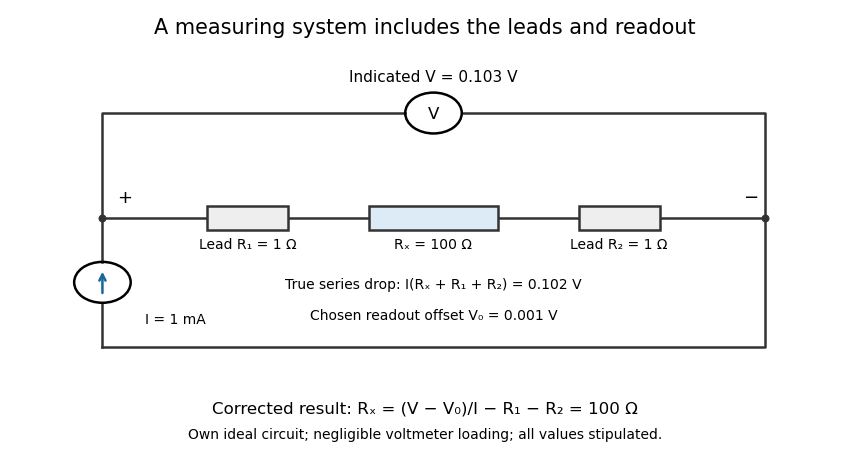
An electrical measuring system includes the connecting leads and readout response
. Own ideal circuit with stipulated1mA current,100ohm test resistor, two1ohm leads and1mV readout offset. The indicated103mV includes the102mV physical drop and1mV offset. Negligible voltmeter loading is assumed; these are teaching values rather than measured instrument performance. Details.With , , and indicated potential difference , the model gives . Dividing the indication by the current without either correction would instead give . The numerical resolution of the voltmeter alone therefore does not describe the whole measuring system's result.
A measuring chain describes successive signal transformations within such an arrangement. Its physical response and subsequent calculation belong in the system description, together with measurement calibration, reference conditions and relevant measurement uncertainty. Changing a lead connection, source setting or correction can change the result while leaving the main readout instrument unchanged. The measurement procedure records how that particular system is operated.
A measurement method describes the general logical arrangement of operations used to make a measurement. A measurement procedure supplies the detailed instructions for implementing that arrangement with a particular measuring system. The VIM lists substitution measurement methods, null measurement methods, differential methods, and direct or indirect methods among the possible descriptions.[ref]
International vocabulary of metrology by JCGM. VIM3entry2.5, definition, note and annotation dated11June2015
For an original substitution measurement method, drive an unknown resistor with a fixed electric current and record a voltmeter indication. Replace it by an adjustable reference resistor without changing or the other relevant conditions, and adjust the reference until the indication agrees. In an ideal measurement model,so matching implies . The common additive readout offset cancels. This cancellation depends on the current, connections and offset remaining common; the name of the method alone does not guarantee those conditions.
A null measurement method instead adjusts a reference to make a difference signal vanish, as in a balanced Wheatstone bridge. A resistance inferred from separately measured electric potential difference and electric current uses the relation . These are descriptions of how the information is obtained; the operational record must still specify apparatus, settings, timing, reference values and the measurement uncertainty. The measurement principle concerns the physical phenomenon used, while the measurement method concerns the organization of the measurement. Different methods can exploit the same physical principle.
A measurement result comprises the values attributed to a measurand together with the information needed to interpret those values. It commonly takes the form of a measured quantity value and its measurement uncertainty, but the result can contain a fuller probability distribution. A displayed number alone need not supply this information.[ref]
For an original electrical resistance example, report a corrected value at , with standard uncertainty . Specify that the uncertainty is a standard uncertainty, identify the resistor and the temperature condition, and retain the measurement procedure and measurement calibration records. Writing only “100.020” omits both the unit and the meaning of the last digits. Writing without stating what the second number represents is also incomplete.
An alternative report might use expanded uncertainty with coverage factor . This is a different uncertainty convention for the same central estimate; it is not a newly observed change in the resistor. A probability interpretation requires the distributional assumptions accompanying that convention.
An instrument's indication, a corrected measured quantity value and the complete measurement result therefore play different roles. Corrections from the measurement model, the specified measurand, environmental conditions and metrological traceability can all matter when comparing results. Extra displayed digits cannot replace the omitted measurement uncertainty.
A measurement principle is the phenomenon on which a measurement is based. The VIM gives the thermoelectric effect used to measure temperature as a physical example.[ref] Naming that phenomenon identifies the physical connection that makes an observable signal informative about the measurand.
A thermocouple uses the Seebeck effect to produce an electric potential difference associated with temperatures along a circuit of dissimilar conductors. In a chosen approximation with constant coefficient , the measurement model can be writtenwhere is the reference-junction temperature. For an original ideal example, choose , and . The inferred temperature difference is , so . These stipulated values illustrate the model, not the calibration of a particular thermocouple type.
The reference condition matters physically: the same signal at would imply in this model. A readout that neglects the reference temperature can give a precise-looking indication without measuring the intended temperature correctly. The measurement principle explains why the signal arises; it does not by itself supply all corrections or the measurement uncertainty.
The measurement method describes how operations are organized around the principle, for example comparing an output with a reference. The measurement procedure specifies the actual conductors, junction arrangement, temperature references, readout settings, settling interval and calculations. Different measuring systems can share a measurement principle while implementing different methods and procedures.
An interlaboratory comparison organizes measurements of the same or similar items by at least two laboratories under agreed conditions. Its purpose may be to compare measurement reproducibility, evaluate a measurement procedure, or assess participants through proficiency testing. The last purpose evaluates performance against criteria specified beforehand; it is one use of interlaboratory comparison, not a synonym for every such study.[ref]
Selection, Use and Interpretation of Proficiency Testing (PT) Schemes by Brian Brookman and Ian Mann. §§2–3, printed pp. 3–4: scope and definitions
A comparison begins with its experimental design. When the aim is to compare laboratory analysis, the organizer needs evidence of reference material homogeneity and reference material stability: unequal or changing test items would otherwise be confounded with differences between laboratories. If collection is part of the measurement procedure, the design must instead include analytical sampling explicitly. In a 2002 collaborative study, several samplers collected wheat and green coffee from bulk lots. The reported between-sampler variation was significant for two wheat analytes; for coffee, a significant repeatability contribution was detected without a significant sampling-reproducibility contribution. Thus even the importance of collection differences depended on the material and analyte.[ref]
Collaborative trials of the sampling of two foodstuffs, wheat and green coffee by Michael Thompson and others. Abstract: comparison of sampling reproducibility and repeatability for wheat and green coffee
For a common proficiency-test z-score, let laboratory report , let the assigned value in proficiency testing be , and let the standard deviation for proficiency assessment be . ThenThe denominator describes the scheme's assessment scale. It is not automatically the laboratory's own measurement uncertainty or the observed standard deviation of participants. The guide distinguishes this proficiency-test z-score from scores incorporating uncertainty, and discusses choosing the assessment scale to match the intended use.[ref]
An original hypothetical example shows why the assigned value matters. Suppose three laboratories report , and in the same units, with a stipulated assessment scale . Using their arithmetic mean as an interlaboratory consensus value gives and scores . An independently established assigned value of , with the same assessment scale, instead gives . Close agreement between participants is compatible with a shared displacement from an independent reference.
The identifiability issue is visible in a simple model,where is the reference quantity value, is a common systematic error, and describes laboratory-specific deviations. Pairwise differences eliminate both and . Moreover, replacing by leaves every predicted unchanged. Consequently agreement alone cannot identify a common bias. Evidence from an independently characterized certified reference material or an independent measurement calibration can help resolve this ambiguity. Its own measurement uncertainty and any shared dependencies must then enter the comparison model; one should not silently interpret the simple proficiency-test z-score as a full uncertainty calculation. This is the practical importance of distinguishing measurement precision, measurement trueness and shared bias in an interlaboratory consensus.
The dynamic range of a measurement procedure is the ratio between the largest and smallest positive inputs it can usefully distinguish under specified conditions. The quantity, bandwidth, observation interval, measurement calibration and acceptance criteria must accompany the number. An upper boundary might be set by amplifier clipping, while a lower boundary might require a specified signal-to-noise ratio. More displayed digits do not by themselves establish either boundary or better measurement precision.
Consider a photodiode responsivity measurement in which a photodiode produces electric current from optical power , with spectral responsivity in amperes per watt. A transimpedance amplifier with transimpedance produces an output electric potential difference , where is expressed in volts per watt. If a chosen detection criterion is times the root mean square output noise , and the linear output ceiling is , the noise-limited dynamic range isIncreasing shifts this input interval toward smaller optical power; it does not enlarge its ratio when the stipulated output noise and output ceiling remain fixed. The corresponding input-referred noise is .
An original numerical example makes the distinction concrete. Stipulate in either setting, , , and no other limiting effect. A high-sensitivity setting covers to ; a lower-sensitivity setting covers to . Each interval has . With compatible measurement calibration and range-overlap calibration in their common interval, gain ranging covers a contiguous union from to : . These are optical power ratios, so their values in decibels are , approximately and respectively.
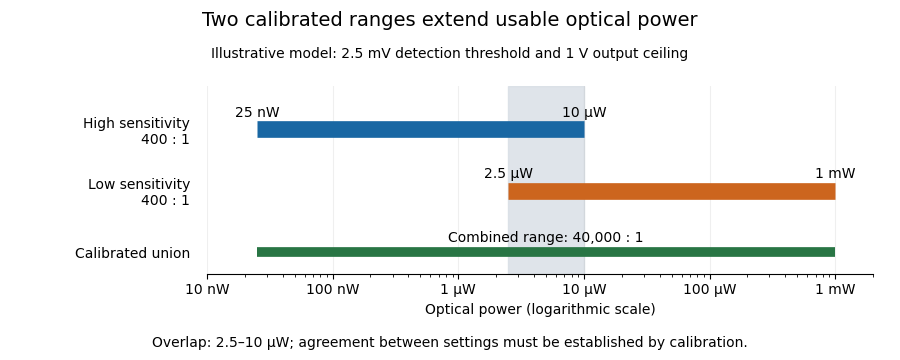
Two calibrated optical-power ranges cover a wider continuous interval
. Original illustrative ranges with the same stipulated output noise and ceiling. The shaded interval is available for checking agreement between gain settings. Details.The equal-noise assumption isolates the geometric effect of gain ranging; it is not a specification for an actual instrument. A real transimpedance amplifier changes several properties together: its feedback network affects bandwidth, noise and allowable input electric current. The DLPCA-200 manufacturer sheet shows a current-to-voltage converter followed by programmable amplification and gives separate tables for these dependencies.[ref] To test a combined dynamic range, vary a stable light source through the overlap, compare the two estimates of optical power, and allow the output to settle after switching. Agreement within the required measurement uncertainty is evidence that the two ranges can be joined; the mere presence of two gain switches is insufficient.
Extractive metallurgy develops processes for separating useful metals from ores and refining them to a required purity. A process may combine physical concentration, high-temperature reactions, dissolution and electrochemical recovery. The appropriate route depends on the mineral's chemical composition, the metal's reactivity and the fate of unwanted constituents.
For iron extraction, an iron oxide must lose oxygen. In a simplified reaction, , carbon monoxide is the reducing agent. Separating the resulting iron from slag and controlling remaining impurities are further tasks. Extraction is therefore a sequence of reaction and separation steps, rather than just melting the original rock.[ref]
Steel Production by the American Iron and Steel Institute. Blast-furnace reduction and pig-iron output
Physical metallurgy connects the internal structure of metals and alloys to their properties and the processes used to change them. It studies crystal structures, crystal defects, phases and their transformations, including changes caused by deformation and heat treatment.
A controlled comparison heats samples of the same steel and cools them differently, then measures hardness and examines their microstructures. Differences in properties can then be related to phase formation and transformation history rather than to a change in overall chemical composition. This is why selecting an alloy and selecting its thermal/mechanical processing are coupled design decisions.[ref]
Properties of Heat Treated Steel by Massachusetts Institute of Technology. Laboratory aims and comparison of heat treatments
An alloying element is a chemical element deliberately included in an alloy to control its properties or processing behaviour. In steel, carbon changes the phases and transformations available during heat treatment; other additions can modify corrosion, hardenability or high-temperature behaviour.
The effect depends on how an element is incorporated. Atoms dissolved in a solid solution can hinder dislocation motion, while an element concentrated in a secondary phase can affect strength through the size and distribution of particles. Thus a bulk composition does not uniquely determine mechanical strength: processing controls the microstructure through which the composition acts.[ref]
A metabolic network is a connected system of chemical reactions that transform the metabolites of a biological cell or organism. One reaction's product can be another reaction's substrate, so the activity of one enzyme cannot by itself determine flow through the whole system.
A minimal example has input into metabolite , conversion at rate , and removal of at rate :At a steady state, . Doubling the maximum capacity of the middle enzyme does not double throughput if the input remains fixed. In a larger metabolic network, the same bookkeeping is expressed as , with stoichiometric matrix and metabolic flux vector .
A genome-scale reconstruction for Escherichia coli combined annotated genes, biochemical literature and strain information to specify possible reactions. The network constrains which conversions are possible; predicting actual rates still needs environmental constraints and modelling assumptions.[ref]
The Escherichia coli MG1655 in silico metabolic genotype: its definition, characteristics, and capabilities by J. S. Edwards and B. O. Palsson. 2000, abstract: reconstruction and metabolic capabilities
Methylotrophy is the ability to grow using reduced carbon compounds with no carbon–carbon bonds, such as methanol, as carbon and energy sources. It requires both energy-yielding transformations and carbon assimilation into biomass. Facultative methylotrophs can also use other carbon sources; the historical description of Methylobacterium explicitly distinguished this metabolic flexibility.[ref]
The two carbon fates are different. Complete methanol oxidation can be represented byThis balanced equation accounts for carbon oxidized to carbon dioxide, not for net cell production. A growing methylotroph must retain carbon in cellular material as well. In the studied Methylobacterium pathway, formaldehyde is an intermediate at the junction of oxidation and assimilation routes.[ref]
A2005 plant-colonization experiment by Abdoulaye Sy and colleagues compared wild-type bacteria with mutants defective in methylotrophy. The mutants were disadvantaged during competition, but could reach wild-type colonization levels when introduced alone. This contrast showed that the metabolic ability mattered under the tested competitive conditions, while other usable carbon sources remained available on the plants. Growth in isolation and fitness in a microbial community therefore answered different questions.[ref]
Methylotrophic metabolism is advantageous for Methylobacterium extorquens during colonization of Medicago truncatula under competitive conditions by Abdoulaye Sy and others. Abstract and Figures2–3: competition versus single inoculation
Carbon assimilation is the incorporation of carbon from an external source into an organism's cellular compounds and biomass. It involves chemical transformations, rather than merely transport across a membrane. Carbon can also be oxidized for energy or released in secreted products, so disappearance of a carbon source from the surroundings does not alone measure assimilation.
Methylotrophy provides an illuminating example. In the experimentally studied Methylobacterium pathway, methanol is converted to formaldehyde, with carbon then entering either oxidation toward carbon dioxide or assimilation into cellular compounds. The same incoming carbon pool can thus support different metabolic functions.[ref]
Suppose an invented closed carbon account records100millimoles of carbon atoms taken up,40released as carbon dioxide,10released in other products, and no change in an unmeasured internal store. The remaining50millimoles are retained in biomass: . This is a conservation calculation under explicit assumptions. A real experiment must also check unmeasured products, pre-existing carbon stores and losses before assigning the remainder to new biomass.
Carbon fixation is one route contributing to carbon assimilation when inorganic carbon is converted into organic compounds. Assimilation of an already organic substrate is a different starting point. Measuring metabolic flux or tracing labeled carbon can help distinguish the incoming material's transformations from an increase in total cell mass.
A carbon source is a material from which an organism obtains carbon for its metabolism and growth. The carbon atoms can enter biomass, be transformed into other compounds, or leave through products such as carbon dioxide. Calling a material a carbon source therefore identifies its role in the carbon inventory; it does not mean every supplied carbon atom is retained in cells.
For an original inventory example,1millimole of glucose, , supplies6millimoles of carbon atoms, whereas1millimole of methanol, , supplies1millimole. Equal concentrations measured in moles of molecules need not mean equal concentrations of carbon. Carbon supply alone also does not specify the amount of usable energy or the growth yield.
An experimental example is the2005 study of plant-associated Methylobacterium. Mutants unable to use methanol effectively were disadvantaged in competition, yet could colonize plants well when introduced alone. The researchers inferred that other carbon sources were available on the plants. A supplied substrate, the substrates an organism can use, and the substrate limiting growth are separate questions.[ref]
Methylotrophic metabolism is advantageous for Methylobacterium extorquens during colonization of Medicago truncatula under competitive conditions by Abdoulaye Sy and others. Abstract and Figures2–3: competition and single-inoculation comparisons
Carbon assimilation describes incorporation into cellular material, while carbon fixation concerns incorporation of inorganic carbon, such as carbon dioxide, into organic compounds. The carbon source and energy supply must be identified separately: for photosynthesis, light can supply energy while carbon comes from carbon dioxide.
Radiology is the medical specialty that uses imaging to investigate disease and guide treatment. It encompasses interpretation of acquired images and procedures in which imaging guides an intervention. Its tools include radiography, computed tomography, magnetic resonance imaging and ultrasound; the specialty is not limited to techniques using ionizing radiation.[ref]
What does a radiologist do? by RadiologyInfo.org. Professional description of imaging methods and diagnostic/interventional roles.
The physical motivation is illustrated by Wilhelm Conrad Röntgen's experiments. An energized discharge tube enclosed in light-blocking paper caused a nearby fluorescent screen to glow. Materials between the tube and screen transmitted the new radiation differently; a hand showed darker bone shadows against fainter surrounding tissue. Photographic recording turned such transmission differences into persistent images.[ref]
On a New Kind of Rays by Wilhelm Conrad Röntgen. 1895 communication, English translation 1896; sections 1–2 and 14: screen, intervening objects and photographic shadow images.
An invented measurement example makes the contrast explicit: if identical incident signals of 1,000 counts give 500 and 100 transmitted counts along two paths, their transmissions are 50% and 10%. The measurement distinguishes paths, but does not by itself name a disease. Anatomy, projection geometry, technique and other evidence are needed for interpretation.
A radiologist connects such physical measurements to clinical questions. Interventional radiology additionally uses images to guide instruments or treatment. Image acquisition, interpretation and intervention are related activities, but each requires its own evidence and expertise.[ref]
What does a radiologist do? by RadiologyInfo.org. Physician interpretation and image-guided therapeutic procedures.
Pinned article: Introduction to the OurBigBook Project
Welcome to the OurBigBook Project! Our goal is to create the perfect publishing platform for STEM subjects, and get university-level students to write the best free STEM tutorials ever.
Everyone is welcome to create an account and play with the site: ourbigbook.com/go/register. We belive that students themselves can write amazing tutorials, but teachers are welcome too. You can write about anything you want, it doesn't have to be STEM or even educational. Silly test content is very welcome and you won't be penalized in any way. Just keep it legal!
Intro to OurBigBook
. Source. We have two killer features:
- topics: topics group articles by different users with the same title, e.g. here is the topic for the "Fundamental Theorem of Calculus" ourbigbook.com/go/topic/fundamental-theorem-of-calculusArticles of different users are sorted by upvote within each article page. This feature is a bit like:
- a Wikipedia where each user can have their own version of each article
- a Q&A website like Stack Overflow, where multiple people can give their views on a given topic, and the best ones are sorted by upvote. Except you don't need to wait for someone to ask first, and any topic goes, no matter how narrow or broad
This feature makes it possible for readers to find better explanations of any topic created by other writers. And it allows writers to create an explanation in a place that readers might actually find it.
Figure 1. Screenshot of the "Derivative" topic page. View it live at: ourbigbook.com/go/topic/derivativeVideo 2. OurBigBook Web topics demo. Source. - local editing: you can store all your personal knowledge base content locally in a plaintext markup format that can be edited locally and published either:This way you can be sure that even if OurBigBook.com were to go down one day (which we have no plans to do as it is quite cheap to host!), your content will still be perfectly readable as a static site.
- to OurBigBook.com to get awesome multi-user features like topics and likes
- as HTML files to a static website, which you can host yourself for free on many external providers like GitHub Pages, and remain in full control

Figure 2. You can publish local OurBigBook lightweight markup files to either OurBigBook.com or as a static website.
Figure 3. Visual Studio Code extension installation.
Figure 5. . You can also edit articles on the Web editor without installing anything locally. Video 3. Edit locally and publish demo. Source. This shows editing OurBigBook Markup and publishing it using the Visual Studio Code extension. 
- Infinitely deep tables of contents:




All our software is open source and hosted at: github.com/ourbigbook/ourbigbook
Further documentation can be found at: docs.ourbigbook.com
Feel free to reach our to us for any help or suggestions: docs.ourbigbook.com/#contact