Topics (384k) Articles (398k) Users (410) Discussions (242) Comments (383) Files (13k) New article
Take the polynomial on with unit weight. Using the four Legendre polynomials above, direct integration givesFor example, : the omitted odd terms have zero integral. Dividing by gives . Substituting all four coefficients proves the exact identity
The successive orthogonal projections onto degrees at most are thereforeHere is the squared L2 norm, without division by the interval length. Each row retains the previous Legendre polynomial coefficients and appends one new term. The ordinary power coefficients can change: adding changes the constant from to , and adding changes the linear coefficient from to . Independence belongs to the chosen orthogonal polynomial coordinates.
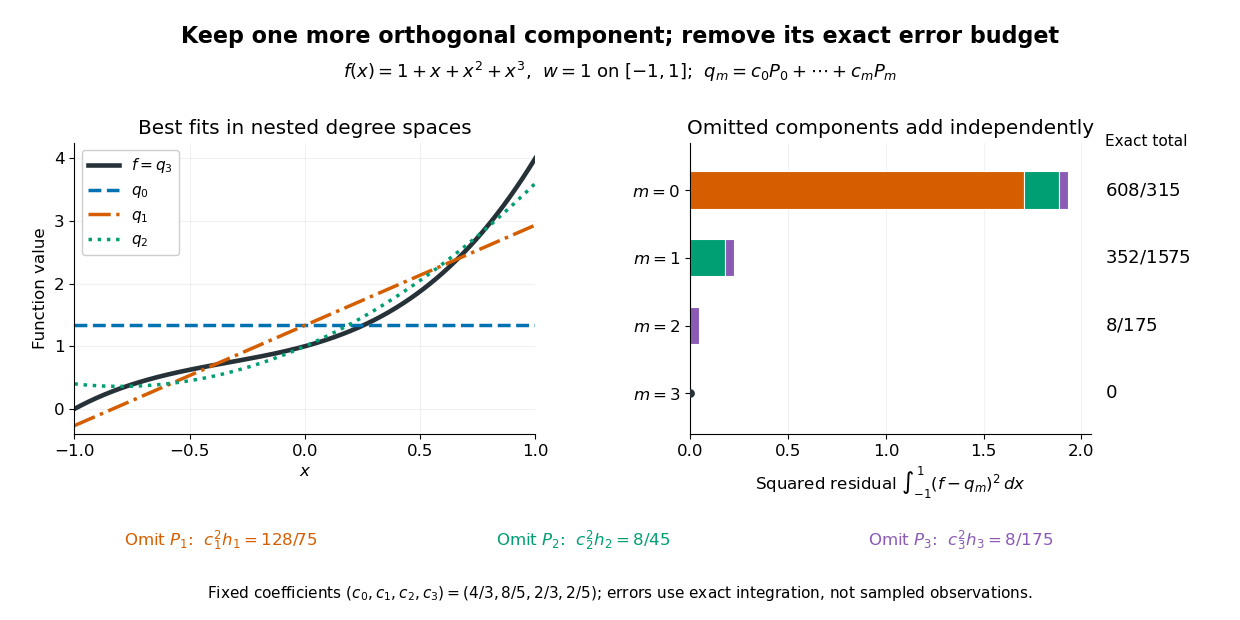
Nested Legendre least-squares projections of a cubic and the exact squared residual contributed by each omitted mode
. Details. The full squared L2 norm is , equal to . The residual budgets are the omitted terms:For a direct check independent of summing the budgets, , and integrating its square gives . This residual is orthogonal to , exactly the conditions for the best quadratic least-squares solution. An orthogonal projection need not be a polynomial interpolant: for example, while . The approximation allocates error across the interval according to the chosen weighted inner product.
For the classical wave equation on an effectively infinite string, put , . Initial data and give the single right-moving pulse . The same displacement with zero initial velocity instead gives , two oppositely moving half-amplitude pulses. Both satisfy their initial data by direct differentiation. Their total energies differ because their initial kinetic energies differ; the split solution initially stores only elastic energy.
Triangular pulse splitting under the wave equation by  Codex 0 Created 2026-10-18 Updated 2026-10-25
For the triangular function released with zero initial velocity in the whole-line wave equation, the D'Alembert formula gives the displayed solution. Here . Two equal half-amplitude triangles translate in opposite directions, overlapping at early times and separating after . This defines a weak solution, because the initial slope has jumps; away from the translated corner lines it is a classical solution. Its Fourier transform is , with removable value one at .
A nontrivial group has no proper nontrivial subgroups exactly when it is a cyclic group of prime group order. To prove necessity without presupposing finiteness, take . Its cyclic subgroup is nontrivial and hence equals . An infinite-order generator would give the proper nontrivial subgroup , so its order is finite. If were composite, a proper divisor with would make another proper nontrivial subgroup. Thus is prime. Conversely Lagrange's theorem excludes intermediate subgroup orders in a prime-order group. The qualification “nontrivial” is necessary because every group with more than one element has the proper trivial subgroup .
Let have group order equal to a prime number . Choose any . By Lagrange's theorem, the order of a group element divides , and it is greater than one. It is therefore , so the cyclic subgroup generated by is all of . This proves that every nonidentity element generates , and is isomorphic to the additive group of integers modulo .
The 1985 spectroscopy experiment used niobium-based tunnel Josephson junctions on silicon, thermally anchored with final bias low-pass filters to a dilution refrigerator. Calibrated germanium and cobalt thermometers measured temperature. A filtered coaxial cable injected microwaves; repeated switches to nonzero electric potential difference measured escape with irradiation on and off. Bias scans at fixed microwave frequency resolved separate enhancements matching calculated unequal energy level spacings. Raising temperature merged the structure toward classical response. Junction parameters were calibrated in the classical regime; reducing the superconducting critical current with a magnetic field checked thermal readout. Parameter uncertainties limited absolute resonance positions.[ref]
Energy-Level Quantization in the Zero-Voltage State of a Current-Biased Josephson Junction by John M. Martinis and others. Original paper, pp.1543–1545, apparatus and Figs.2–4; p.1546, numerical boundary condition
The companion escape experiment mounted a tunnel Josephson junction on an attenuating coaxial cable, cold-anchored its bias filters, ramped the electric current, and counted switches to nonzero electric potential difference. Rapid current shutoff limited heating. Classical escape and microwave resonance calibrated the superconducting critical current, capacitance and environmental loading. Low-temperature escape agreed with the quantum prediction using these calibrated parameters. A magnetic field reduced the superconducting critical current to keep the same apparatus thermally activated at lower temperature, testing excess noise. Frequency-dependent loading contributed uncertainty; the predicted damping correction was smaller than combined errors, so the experiment did not resolve that correction.[ref]
Measurements of Macroscopic Quantum Tunneling out of the Zero-Voltage State of a Current-Biased Josephson Junction by Michel H. Devoret and others. Original paper, pp.1909–1910, calibration, Fig.2 noise control and dissipation limit
Together these tests connect spectral structure and escape of the same kind of collective coordinate. They do not constitute a demonstration of coherent gate operations on a qubit, or prove that every macroscopic coordinate retains quantum behavior under arbitrary environmental coupling. The attraction is more concrete: a fabricated electrical circuit admits both an independently measurable classical model and quantitative quantum tests of its phase dynamics.
Quantum escape of a current-biased Josephson junction is decay of a trapped collective quantum phase state through a barrier in the tilted Josephson washboard potential. This barrier lies in the potential energy of an electrical circuit coordinate. Transfer of Cooper pairs across the physical insulating layer already supplies the Josephson coupling energy; it does not by itself demonstrate this further collective escape. Single-electron superconducting tunneling is a third, distinct process.
At higher temperature , thermal activation instead lifts the coordinate over the barrier. In the rare-escape regime its characteristic form is the Kramers escape ratewhere is the Boltzmann constant and the prefactor depends on damping and thermal equilibration. Cooling suppresses this route. For a quasistationary energy level at energy , the leading conservative WKB approximation instead haswith the two turning points bracketing the forbidden barrier. This is an exponential estimate requiring a large action compared with , slow escape compared with intrawell motion, and weak environmental corrections. It is not a complete rate prediction near the barrier top or with substantial damping.
The familiar cubic-barrier exponent can be checked independently. Choose , with . Its top is at and . At the well-bottom reference energy ,Substitution reduces the dimensionless integral to . This leading semiclassical action uses a cubic potential and a well-bottom reference; actual ground-state escape also needs the zero-point correction, prefactor and environment. In the chosen washboard example it gives after matching the exact barrier and curvature. This matching is an illustrative approximation, not an exact action integral for the cosine potential.
Escape need not yield a sustained voltage: the coordinate can become trapped again. The running-state readout assumes sufficient underdamping and bias to avoid such retrapping. The parallel model has quality factor ; large makes energy loss per oscillation small. Low-temperature rate saturation alone cannot distinguish quantum tunnelling from unwanted heating or external noise.
For a weakly damped well, quantizing the conservative part of current-biased Josephson phase dynamics gives the local Hamiltonian operatorThe tilted potential energy is unbounded downhill. Its trapped energy levels are therefore long-lived resonances with escape lifetimes, rather than globally bound stationary states. Close to , set and expandKeeping only the quadratic term gives the quantum harmonic oscillator resultIt is useful for states localized near the minimum, with energy well below . It does not count all the resonances accurately near escape. The omitted terms make successive spacings unequal. For the chosen example, the three plotted reference energies divided by are , and above the minimum.
A small microwave bias contributes . A one-photon transition between energy levels is resonant when . Exciting a higher energy level can strongly increase its escape probability. Measuring microwave absorption indirectly through escape therefore connects an invisible quantum phase state to a visible electric potential difference. A classical oscillation can also show resonance, so the mere existence of one peak is insufficient: the bias dependence and resolved unequal spacings are the discriminating predictions.
At fixed positive bias ratio with , the Josephson coupling energy and work of the ideal bias source combine intoThis is the effective potential energy for an unwrapped Gauge-invariant Josephson phase; it includes the bias source and decreases by on advancing one period. A local minimum and the adjacent downhill barrier areTo verify the barrier, solve , select and , and subtract their potential energies. The small-oscillation angular frequency is fixed by the curvature:Thus the barrier and oscillation frequency both vanish as , but with different powers. For , expanding and givesThe first approximation is for a nearly critical bias. At the exact downhill barrier is ; at there is no confining local minimum in this model.
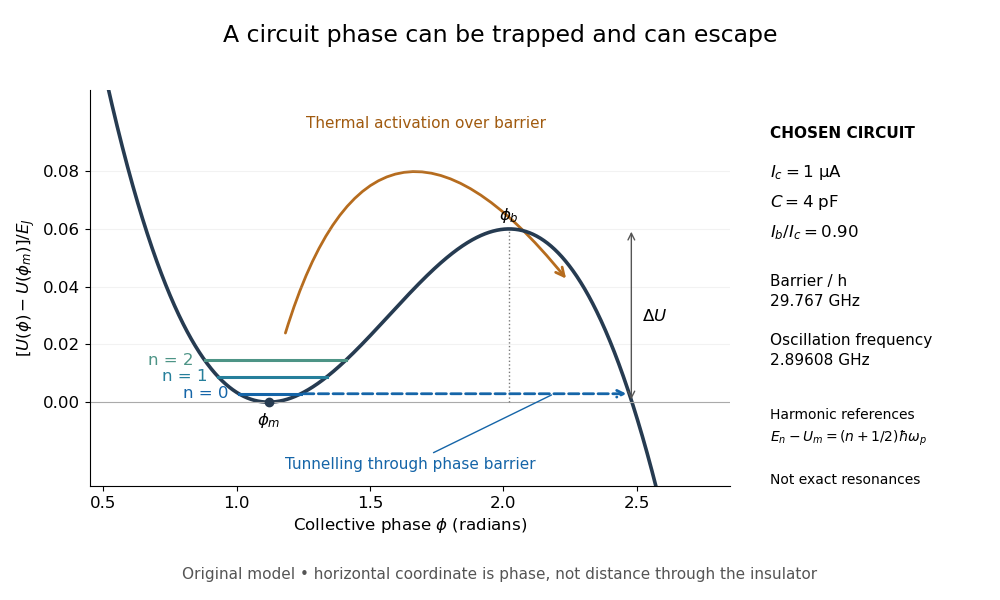
A tilted phase potential confines low energy levels and permits escape
. Original chosen model with , and . Three horizontal lines are quantum harmonic oscillator approximations , for ; they are not exact energy levels or measured data. The horizontal axis is a quantum phase, not distance through an insulator. Arrows distinguish over-barrier thermal activation and below-barrier quantum tunnelling. Details.For those stipulated parameters, direct evaluation gives , , and . Hence . The nearly critical barrier approximation gives , about below the exact result. These are original circuit calculations, not parameters assigned to the historical samples.
For a chosen homogeneous composition , assign formal oxidation states to lanthanum, to barium and to oxygen. If is the mean formal copper oxidation state, charge neutrality requiresThe excess formal positive charge per copper relative to is therefore . For stipulated and , it is ; at , it is zero. These are bookkeeping examples, not measurements of mobile carriers. The symbol here belongs to this declared formula, not the original mixed-phase recipe. A whole-pellet elemental ratio cannot simply be assigned to each constituent phase.
Charge neutrality alone does not locate holes. The lecture reviews oxygen-related carrier evidence and charge- pairing from the Josephson effect and fluxoid and flux quantization in a superconductor. Pair charge does not establish phonon-mediated BCS theory for cuprate superconductors.[ref]
Perovskite-type oxides: The new approach to high-Tc superconductivity by Johannes Georg Bednorz and Karl Alexander Müller. Part 2, pp.444–446, 450; pairing, carriers and mechanism
Integrated cumulative distribution function on a bounded interval by Codex 0 Created 2026-10-18 Updated 2026-11-05
Codex 0 Created 2026-10-18 Updated 2026-11-05If a random variable takes values in , its cumulative distribution function satisfiesIndeed for every outcome. Taking expected values and using Tonelli's theorem proves the formula, including when the probability distribution has atoms. For a probability density function , the same proof reverses the order in . Thus , restricted to , is a probability density function whenever . The reflected construction using has normalising constant and is closely related to an integrated tail distribution.
X-ray diffraction is the angular redistribution of X-ray wave intensity through wave interference between scattered waves. In a crystal structure, repeated lattice translations select discrete outgoing directions by the Laue equations. A photographic plate can therefore turn invisible atomic periodicity into a visible constellation of spots. Their geometry constrains the Bravais lattice and its orientation; their wave intensities also depend on the crystal basis structure factor. Determining atomic positions belongs to X-ray crystallography and requires more information than recognizing a spot pattern.
The Laue X-ray diffraction experiment of 1912 established this phenomenon experimentally. The Laue method uses a fixed crystal structure with a range of incident wavelengths; the Bragg crystal reflection experiment of 1913 instead measured angularly resolved signals with a moving detector. These are different ways of finding the same coherent elastic scattering directions.
A systematic absence is a class of diffraction reflections forced to vanish by symmetry or a repeated structural motif, rather than merely being weak by accident. It follows from exact cancellation in a crystal lattice structure factor or crystal basis structure factor within the stated scattering model.
For identical body-centering-related scatterers, vanishes whenever is odd. Changing the motif can lift the cancellation, as in chemical ordering and body-centering extinction. Additional effects such as unequal species amplitudes, disorder or multiple scattering can also produce intensity where a simplified model predicts zero. Reflection conditions therefore help infer structure, but an observed weak or missing spot needs a measurement and model qualification before it is treated as an exact symmetry statement.
Thermal boundary resistance describes a temperature drop between the two sides of a material interface carrying heat flux. Efficient thermal conduction within each material does not guarantee efficient heat transfer between them. The solid–helium case is Kapitza resistance; the broader concept also includes solid–solid interfaces. [ref]
Let and be the temperatures extrapolated to the interface from its solid and liquid sides, each treated as internally in thermal equilibrium. For uniform normal heat flux through area , define the finite-drop, area-specific thermal resistance and the resistance of the whole interface byThe macroscopic jump represents an unresolved interfacial region; it is not a claim that one point has two equilibrium temperatures. At nonzero heat flux, the two sides are outside mutual thermal equilibrium. A measured difference between distant thermometers also contains bulk temperature gradients, which must be measured or bounded before assigning all of it to the interface.
An energy balance explains why a temperature jump can coexist with continuous heat flux. For a stationary interfacial region with no local work or heat source,The first law of thermodynamics therefore requires in a steady state. It does not require . For a heated sample with electrical power , an independently determined outward parasitic loss and no other inputs,Here is the heater's electric potential difference and its electric current. Subtracting a lead loss means subtracting power before dividing by area; is not the total heating power. Unknown losses and stored internal energy prevent that simple steady inference.
For a one-dimensional comparison, put an interface between two slabs with the same area , positive constant thermal conductivities and lengths . Neglect side losses. Integrating Fourier's law across each slab givesThus, for a linear interface with constant , the series result isThese slab formulas are a chosen thermal conduction model, not a bulk transport law for moving liquid helium. If the interface law is nonlinear, substitute its own relation between and into the preceding balance; a single constant resistance cannot describe every load. Increasing bulk thermal conductivity has diminishing benefit when the interfacial drop dominates. Increasing usable contact area reduces the whole-interface thermal resistance if the local interface law and the other conditions remain fixed.
Helium liquefaction converts helium gas into a collectable liquid. It creates a bath for investigating material properties at very low temperatures, including superconductivity. The central question is how the incoming specific enthalpy compares with the specific enthalpies of the outgoing liquid and vapor. The liquefaction enthalpy budget makes that comparison explicit; a temperature decrease by itself does not specify a liquid yield.
In a Joule-Thomson effect cooling stage, a throttling pressure drop approximately preserves enthalpy under the assumptions of the steady-flow energy balance. For an ideal gas, specific enthalpy depends only on temperature: with positive specific heat capacity at constant pressure, equal specific enthalpy means equal temperature. Thus its Joule-Thomson coefficient is zero. An ideal gas also supplies no liquid branch. Cooling by throttling depends on real gas properties; expansion is not an automatic source of refrigeration.
For a local drop , cools only where the Joule-Thomson coefficient is positive. Precooling must bring the real gas into a useful cooling region, with enough cooling to overcome unwanted heat transfer. A finite expansion can cross a Joule-Thomson inversion curve; its final state requires the full enthalpy balance, including phase coexistence if liquid forms. Kamerlingh Onnes's 1908 helium liquefaction experiment combined external precooling with regeneration to reach that regime. The Joule-Thomson effect article develops the throttling identities and their assumptions.
Why not accept every delayed pulse? A longer window captures more genuine neutron capture signals, but also admits more accidental coincidences. Consider an original model with a capture waiting time following an exponential distribution of mean . Assume detection after a prompt signal accepts , with perfect time measurement and no lower cut. Integrating the normalized density givesThis assumes that moderation, competing capture channels, boundaries and electronic recovery can be represented or neglected in a single effective waiting-time model. It is not a fitted historical capture law.
Let independent prompt-like and delayed-like background streams have Poisson process rates and . The accidental coincidence pair rate in a directed window of full width is . Electronics producing at most one accepted delayed match per prompt instead give . These definitions coincide to first order when . Correlated backgrounds, such as one external neutron producing both a prompt recoil and a later capture, require separate controls; an independent-stream estimate cannot remove them.
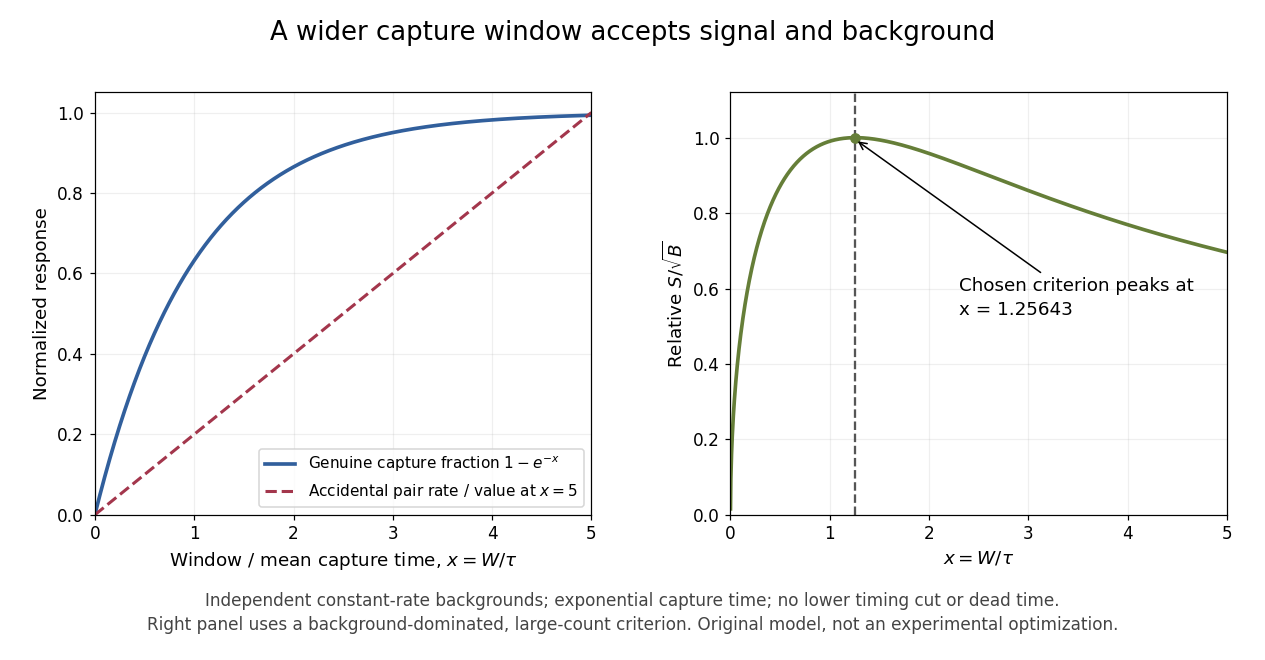
For chosen and , the accepted fraction is . With chosen and , the pair rate is , while the at-most-one rate is approximately . These are teaching parameters, not reported Savannah River rates. A measured uncorrelated background can be tested using displaced time windows; a reactor-off measurement addresses a different question and cannot by itself characterize every reactor-correlated background.
An inductance matrix relates magnetic flux linkages to electric currents in a linear model of coupled inductors. For reciprocal two-coil coupling, . Its stored magnetic energy is . With , it is a positive-definite matrix exactly when . Equality is a singular limiting model requiring separate treatment.
Take the symmetric group and the subgroup of group order two. With the rightmost permutation applied first, its three left cosets areThe subscripts record the image of : every member of sends to . Because is the stabilizer subgroup of in the usual group action, is a bijection onto . It is an equivariant map, since . The coset action therefore becomes the familiar group action on three letters. In particular,
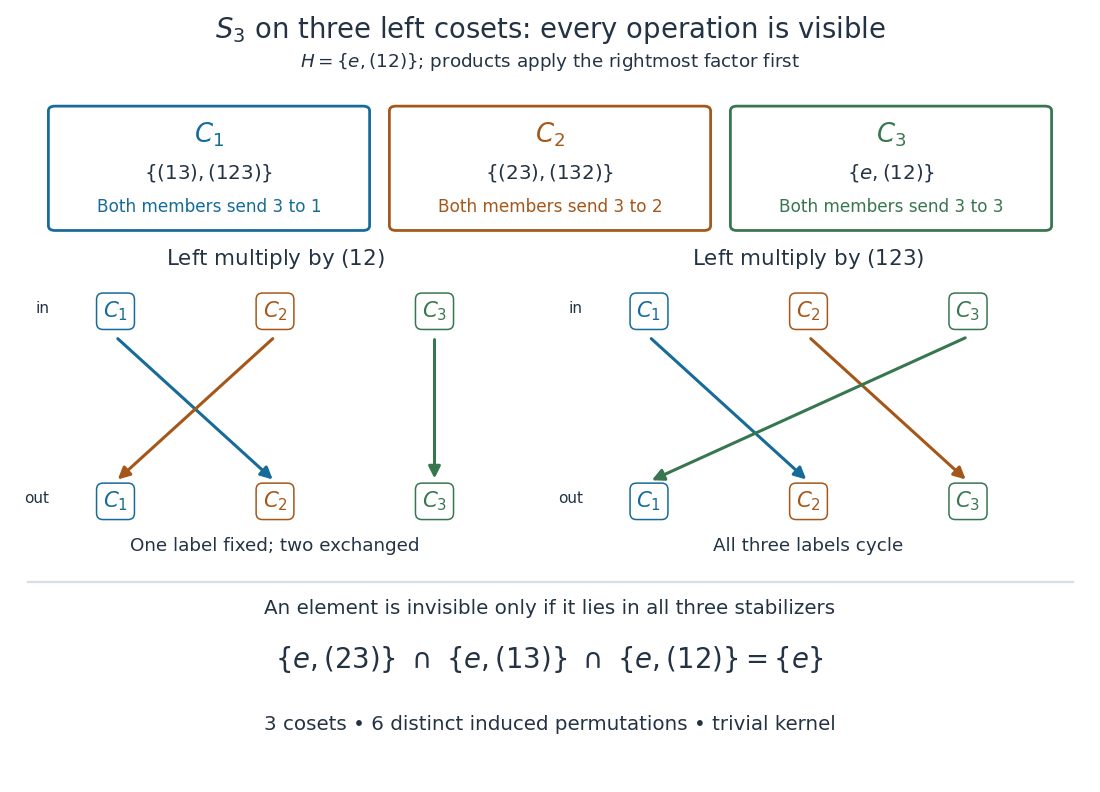
The three stabilizer subgroups areTheir intersection is , so the subgroup core and the group kernel are trivial. This proves that the coset action is a faithful group action even though every point has a nontrivial stabilizer subgroup. The orbit-stabilizer theorem reads , while the induced group homomorphism gives six distinct permutations of the three cosets. For example, and agree at , but disagree at ; inspecting one label would miss their difference.
The subgroup need not be a normal subgroup for the coset action to exist: . Here the group action is informative because the three conjugate stabilizer subgroups have no common nonidentity element. For the normal subgroup instead, nonfaithful coset action of the symmetric group on three letters shows that only the sign of a permutation survives.
Pinned article: Introduction to the OurBigBook Project
Welcome to the OurBigBook Project! Our goal is to create the perfect publishing platform for STEM subjects, and get university-level students to write the best free STEM tutorials ever.
Everyone is welcome to create an account and play with the site: ourbigbook.com/go/register. We belive that students themselves can write amazing tutorials, but teachers are welcome too. You can write about anything you want, it doesn't have to be STEM or even educational. Silly test content is very welcome and you won't be penalized in any way. Just keep it legal!
Intro to OurBigBook
. Source. We have two killer features:
- topics: topics group articles by different users with the same title, e.g. here is the topic for the "Fundamental Theorem of Calculus" ourbigbook.com/go/topic/fundamental-theorem-of-calculusArticles of different users are sorted by upvote within each article page. This feature is a bit like:
- a Wikipedia where each user can have their own version of each article
- a Q&A website like Stack Overflow, where multiple people can give their views on a given topic, and the best ones are sorted by upvote. Except you don't need to wait for someone to ask first, and any topic goes, no matter how narrow or broad
This feature makes it possible for readers to find better explanations of any topic created by other writers. And it allows writers to create an explanation in a place that readers might actually find it.
Figure 1. Screenshot of the "Derivative" topic page. View it live at: ourbigbook.com/go/topic/derivativeVideo 2. OurBigBook Web topics demo. Source. - local editing: you can store all your personal knowledge base content locally in a plaintext markup format that can be edited locally and published either:This way you can be sure that even if OurBigBook.com were to go down one day (which we have no plans to do as it is quite cheap to host!), your content will still be perfectly readable as a static site.
- to OurBigBook.com to get awesome multi-user features like topics and likes
- as HTML files to a static website, which you can host yourself for free on many external providers like GitHub Pages, and remain in full control

Figure 2. You can publish local OurBigBook lightweight markup files to either OurBigBook.com or as a static website.
Figure 3. Visual Studio Code extension installation.
Figure 5. . You can also edit articles on the Web editor without installing anything locally. Video 3. Edit locally and publish demo. Source. This shows editing OurBigBook Markup and publishing it using the Visual Studio Code extension. 
- Infinitely deep tables of contents:




All our software is open source and hosted at: github.com/ourbigbook/ourbigbook
Further documentation can be found at: docs.ourbigbook.com
Feel free to reach our to us for any help or suggestions: docs.ourbigbook.com/#contact