Topics (384k) Articles (398k) Users (410) Discussions (242) Comments (383) Files (13k) New article
An algebraic simplification proves equality only where both original and transformed expressions are defined. If a cancelled factor vanishes at a point, the simplified expression may instead describe an extension to that point. For example,holds only when and . The right side is zero at , but the left side is undefined there. A graph of the original function must retain those holes. The extension may be useful, but it is a different function with a larger domain of a function.
On , with positive side lengths and zero Dirichlet boundary conditions, separation of variables for giveswith the displayed eigenvalues. The one-dimensional endpoint conditions exclude constant and hyperbolic factors and force the positive integer sine frequencies. The product Fourier sine series basis is complete in the square-integrable functions on the rectangle. Consequently an eigenfunction with prescribed is a linear combination of exactly those modes with ; if none match, only the zero solution exists. Distinct pairs with the same sum give an eigenvalue with geometric multiplicity greater than one. On a square of side , for instance, has precisely the pairs and , so its eigenspace has dimension two.
For , the decaying solution of on the positive half-line with follows by integrating the Dirichlet half-line Green function for minus d2 plus 1:Both and are continuous at , whereas has the jump required by the bounded step in the forcing. Its common value there is .
For the upper half of a three-dimensional ball, let be the reflection of an interior source in the equatorial plane. The Dirichlet Green function inside a sphere, evaluated at the source and its reflection and then subtracted, vanishes on both the spherical cap and flat equatorial disc. Reflection makes the source distances and image distances agree on the plane. Only the original source is in the upper half-ball; the reflected source is in the lower half-ball, and both inversion images are outside the ball. Thus the difference has precisely the required Dirac delta distribution and Dirichlet boundary conditions.
The Dirac Hamiltonian is the first-order time-evolution operator obtained from the Dirac equation. For a free massive particle,where the Dirac matrices satisfy , and . These identities give , recovering the relativistic energy-momentum relation.
Minimal electromagnetic coupling replaces the canonical momentum by and adds , in SI units. The wavefunction has spinor components, and the free operator has positive- and negative-energy branches. The Dirac field interprets particle and antiparticle excitations with a stable vacuum; it is more complete than treating the negative branch as an ordinary one-particle spectrum with no lower bound.
For constant on all space and time, the active waveform transformation leaves the action of invariant: the density gains and the integration measure gains . With canonical momentum , its Noether current can be chosen asThe integrated charge is conserved if its boundary flux vanishes and the weighted integral exists. For a rightgoing wave packet , , it becomes . A fixed finite interval generally breaks this scale symmetry unless its boundaries and boundary data are transformed too.
Scale-breaking sources in derivative field theories by  Codex 0 Created 2026-10-18 Updated 2026-11-05
For a first-derivative real scalar field in one space and one time dimension, put . Its on-shell divergence isA quadratic derivative density with arbitrary field-dependent coefficients has zero derivative-homogeneity term. An extra term instead gives . A position-dependent kinetic coefficient gives . These source terms distinguish scale invariance from internal field-shift symmetry.
Use for the group of order with rotation and reflection . Every element is or , . The rotational conjugacy classes are the sets , reduced to singletons for central rotations. For odd , all reflections form one class, giving classes in total. For even , the identity and are central singletons, the other rotations form pairs, and the reflections split into even and odd powers of , giving classes. Indeed conjugation by changes a reflection exponent by , while conjugation by negates it. For odd prime , a normal subgroup containing a reflection must contain all reflections and hence the whole group; the proper normal subgroups are therefore only the identity subgroup and the rotation subgroup.
A missing diffraction order occurs when a principal maximum of an array factor coincides with a zero of the individual aperture's diffraction envelope. For identical slits of width and centre spacing , order has . It is missing if is a nonzero integer. This is cancellation of field contributions, not loss of the incident wavelength or a failure of the grating equation.
The obliquity factor weights the directional contribution of an aperture element in a scalar diffraction integral. In a fixed observation direction in the Fraunhofer diffraction regime, its variation across a sufficiently small aperture can be neglected along with the variation of the geometric amplitude denominator. Its angular dependence can still matter when comparing widely separated observation directions.
In 1992 the COBE DMR team, including George F. Smoot and Charles L. Bennett, used radiometer antennas to compare antenna temperatures between sky directions apart at , and , with two nearly independent channels per frequency. Repeated sky coverage supported least-squares solution map reconstruction.[ref]
The analysis fitted magnetic response and removed the assumed kinematic angular dipole and its second-order Doppler effect contribution. Channel sums retained sky structure; channel differences estimated noise. Cross-channel correlations, different frequency maps and Milky Way latitude cuts tested the interpretation. Residual large-angle structure supported Cosmic microwave background anisotropy; Galactic contamination particularly limited the cosmic microwave background quadrupole. Brightness fluctuations alone were not sufficient evidence of primordial structure.[ref]
Structure in the COBE Differential Microwave Radiometer First-Year Maps by George F. Smoot and others. §§2–3.1, p.L2: controls, motion subtraction, Table1
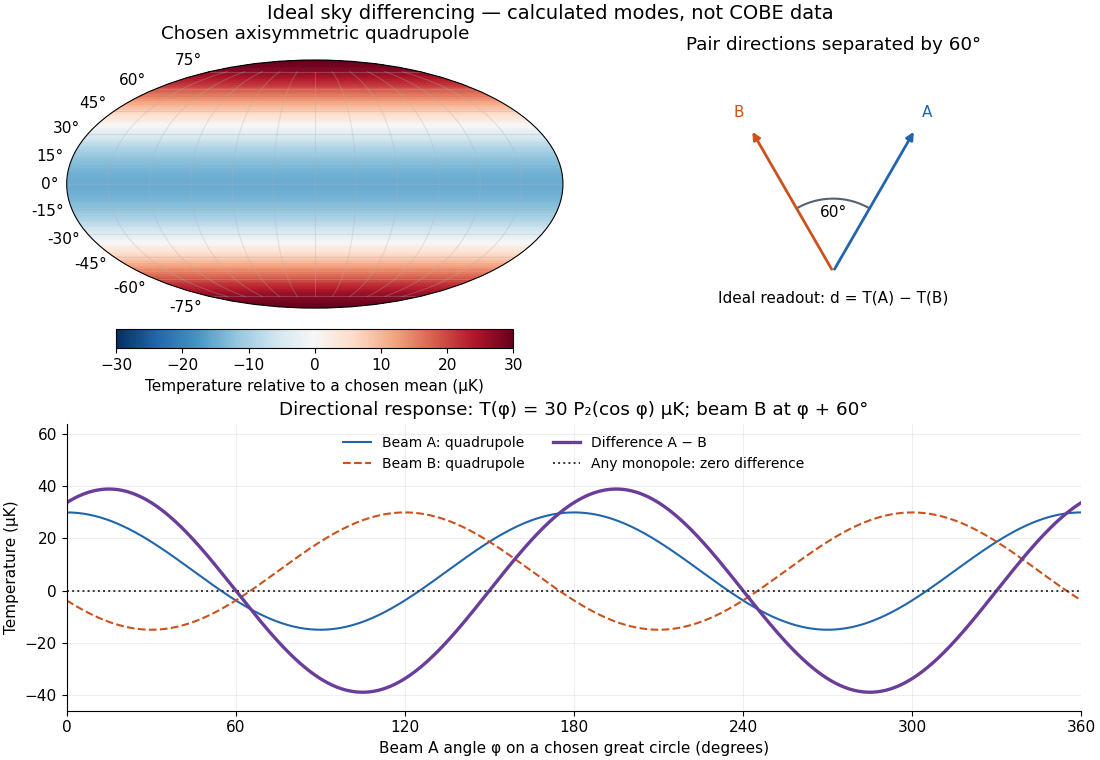
The two differences serve different purposes. Comparing two sky directions measures angular variation. Comparing two independently calibrated receiver maps observing the same sky tests noise and consistency. A common sky signal cancels in the latter comparison if their antenna beam patterns and response scales match; a systematic error shared by both channels need not cancel. Separating observer motion, local emission and intrinsic Cosmic microwave background anisotropy requires these additional tests.
For an ideal Diesel cycle with compression ratio , cutoff ratio and constant heat-capacity ratio , its thermal efficiency is . As the quotient tends to , giving . The maximum-to-minimum temperature ratio tends to , so the limiting efficiency equals that of a Carnot cycle between those temperatures. Both heat input and net work vanish in this limit: the result is a limit of their ratio, not a finite-work engine at exactly zero cutoff interval.
Expand the determinant along any fixed row using the displayed formula, where deletes row and column . The signed matrix minors are its cofactors. Applying the same formula to the transpose gives the column expansion. The row formula follows from the Leibniz formula for determinants by grouping permutations according to the selected column in row . For a lower triangular matrix, expanding along the first row reduces the determinant to times a smaller triangular determinant; induction gives the product of all diagonal entries, even when some vanish.
Suppose is differentiable at zero, and . Since , the displayed function satisfies near zero. It is a continuous function at zero exactly when . Its difference quotient is , so it has a finite derivative there exactly when : the value is for and zero for . The nonzero-slope assumption is essential; a higher-order zero would change both thresholds.
Apply the chain rule to the logarithm of a differentiable nonzero real-valued function. This converts products into sums and powers into multiplicative coefficients. In particular, for positive , . It is useful for monomial uncertainty propagation and for finding relative rates of change.
For a real exponent and , write . The chain rule and the derivative of the natural logarithm give . For a nonnegative integer exponent this agrees with polynomial differentiation and extends to all real . Reversing differentiation gives for on a suitable real branch. The exceptional exponent gives on either half-line.
For a homogeneous linear isotropic dielectric in vacuum, . Combining this with the depolarization field and the imposed uniform electric field gives . A sphere has . An infinite slab has normal to its faces and in its plane. A very long circular rod has along its axis and transverse to it. Slab and rod statements are limiting geometries, with end effects neglected; a finite cylinder does not generally have an exactly uniform internal electric field.
In deep inelastic scattering, the reference frame where the exchanged virtual photon has zero energy and spatial momentum magnitude .
SLAC-MIT deep inelastic electron scattering experiment by Codex 0 Created 2026-10-18 Updated 2026-10-25
Codex 0 Created 2026-10-18 Updated 2026-10-25Starting in 1967, a collaboration at the Stanford Linear Accelerator Center and the Massachusetts Institute of Technology directed an electron beam at liquid hydrogen, providing proton targets. Jerome Isaac Friedman, Henry Way Kendall and Richard Edward Taylor participated in this experimental program.[ref]
Deep Inelastic Scattering: Experiments on the Proton and the Observation of Scaling by Henry Way Kendall. 1990 Nobel lecture, section I.A, opening account of the program
The 1969 paper Observed Behavior of Highly Inelastic Electron-Proton Scattering reports inclusive electron spectra at and with incident energies from to . Its scaling comparison estimated under a transverse-virtual photon assumption, finding approximate agreement as a function of for and . These are the paper's conditions, not a claim of exact Bjorken scaling at every momentum transfer.[ref]
Pinned article: Introduction to the OurBigBook Project
Welcome to the OurBigBook Project! Our goal is to create the perfect publishing platform for STEM subjects, and get university-level students to write the best free STEM tutorials ever.
Everyone is welcome to create an account and play with the site: ourbigbook.com/go/register. We belive that students themselves can write amazing tutorials, but teachers are welcome too. You can write about anything you want, it doesn't have to be STEM or even educational. Silly test content is very welcome and you won't be penalized in any way. Just keep it legal!
Intro to OurBigBook
. Source. We have two killer features:
- topics: topics group articles by different users with the same title, e.g. here is the topic for the "Fundamental Theorem of Calculus" ourbigbook.com/go/topic/fundamental-theorem-of-calculusArticles of different users are sorted by upvote within each article page. This feature is a bit like:
- a Wikipedia where each user can have their own version of each article
- a Q&A website like Stack Overflow, where multiple people can give their views on a given topic, and the best ones are sorted by upvote. Except you don't need to wait for someone to ask first, and any topic goes, no matter how narrow or broad
This feature makes it possible for readers to find better explanations of any topic created by other writers. And it allows writers to create an explanation in a place that readers might actually find it.
Figure 1. Screenshot of the "Derivative" topic page. View it live at: ourbigbook.com/go/topic/derivativeVideo 2. OurBigBook Web topics demo. Source. - local editing: you can store all your personal knowledge base content locally in a plaintext markup format that can be edited locally and published either:This way you can be sure that even if OurBigBook.com were to go down one day (which we have no plans to do as it is quite cheap to host!), your content will still be perfectly readable as a static site.
- to OurBigBook.com to get awesome multi-user features like topics and likes
- as HTML files to a static website, which you can host yourself for free on many external providers like GitHub Pages, and remain in full control

Figure 2. You can publish local OurBigBook lightweight markup files to either OurBigBook.com or as a static website.
Figure 3. Visual Studio Code extension installation.
Figure 5. . You can also edit articles on the Web editor without installing anything locally. Video 3. Edit locally and publish demo. Source. This shows editing OurBigBook Markup and publishing it using the Visual Studio Code extension. 
- Infinitely deep tables of contents:



All our software is open source and hosted at: github.com/ourbigbook/ourbigbook
Further documentation can be found at: docs.ourbigbook.com
Feel free to reach our to us for any help or suggestions: docs.ourbigbook.com/#contact