Topics (384k) Articles (398k) Users (410) Discussions (242) Comments (383) Files (13k) New article

The ion product evaluates the same dissolved-ion thermodynamic activity product as the solubility product, but at the current composition rather than necessarily at chemical equilibrium. For AB, ; its concentration counterpart is . Compare with only under compatible activity coefficient assumptions.[ref]
15.1 Precipitation and Dissolution. Chemistry 2e, §15.1, Predicting Precipitation: comparison of reaction quotient and solubility product
For other stoichiometries, use the dissolution coefficients as powers: gives . A solubility product is not itself the molar concentration dissolved; even in the ideal AB model in pure water, that concentration is .
SEC light-scattering detection adds information from scattering of light to the separation. Static scattering with a concentration readout can infer a weight-average molar mass for material in an eluting slice without the standard-family retention calibration. Dynamic scattering estimates a diffusion coefficient and hence a hydrodynamic radius. “Absolute” here means independent of a retention-to-molar mass standard curve; it still needs calibrated detectors, optical response parameters, and a valid sample model. Coeluting species produce a mixture-weighted result, rather than individually identified molecules.
A concrete manufacturer test used a Bio SEC-3 column, with particles, an Agilent 1260 Infinity G5611A quaternary pump and G5667A autosampler, a diode-array flow cell, and dual-angle/dynamic scattering detectors. A buffer solution at pH flowed at ; column and scattering detector were at . Absorbance at supplied a concentration-sensitive readout. Dilution and loading comparisons tested response: seventeen ovalbumin injections spanning – gave a reported average with relative standard deviation. The note reports poorer separation of thyroglobulin from aggregates and an elevated mass estimate, illustrating the coelution limit. Its sample filtration also limits interpretation of larger protein aggregation products removed before injection.[ref]
Determination of Protein Molecular Weight and Size Using the Agilent 1260 Infinity Multi-Detector Bio-SEC Solution with Advanced Light Scattering Detection by Sonja Schneider. Sonja Schneider, Determination of Protein Molecular Weight and Size Using the Agilent 1260 Infinity Multi-Detector Bio-SEC Solution with Advanced Light Scattering Detection, 5991-3955EN, printed pp. 2–4: apparatus, Table 1, Figure 2 and Table 3
A SEC chromatogram plots a detector signal against elapsed time or elution volume. At constant volumetric flow rate , the volume delivered after injection is ; subtraction of extra-column transport volume is needed for a column-only . Real peak widths include injection volume, column dispersion, and tubing/detector spreading. Peak position, width, and area answer different questions.
SEC molar mass calibration measures standards under the same column, solvent, and temperature conditions as the unknown. Over a suitable fractionation interval, a common empirical approximation iswhere specifies the molar mass unit and has inverse-volume units. Interpolation is conditional on the standards' size–molar mass relationship. SEC measures access associated with hydrodynamic size, so a branched polymer, an extended chain, and a compact protein need not share that relationship.
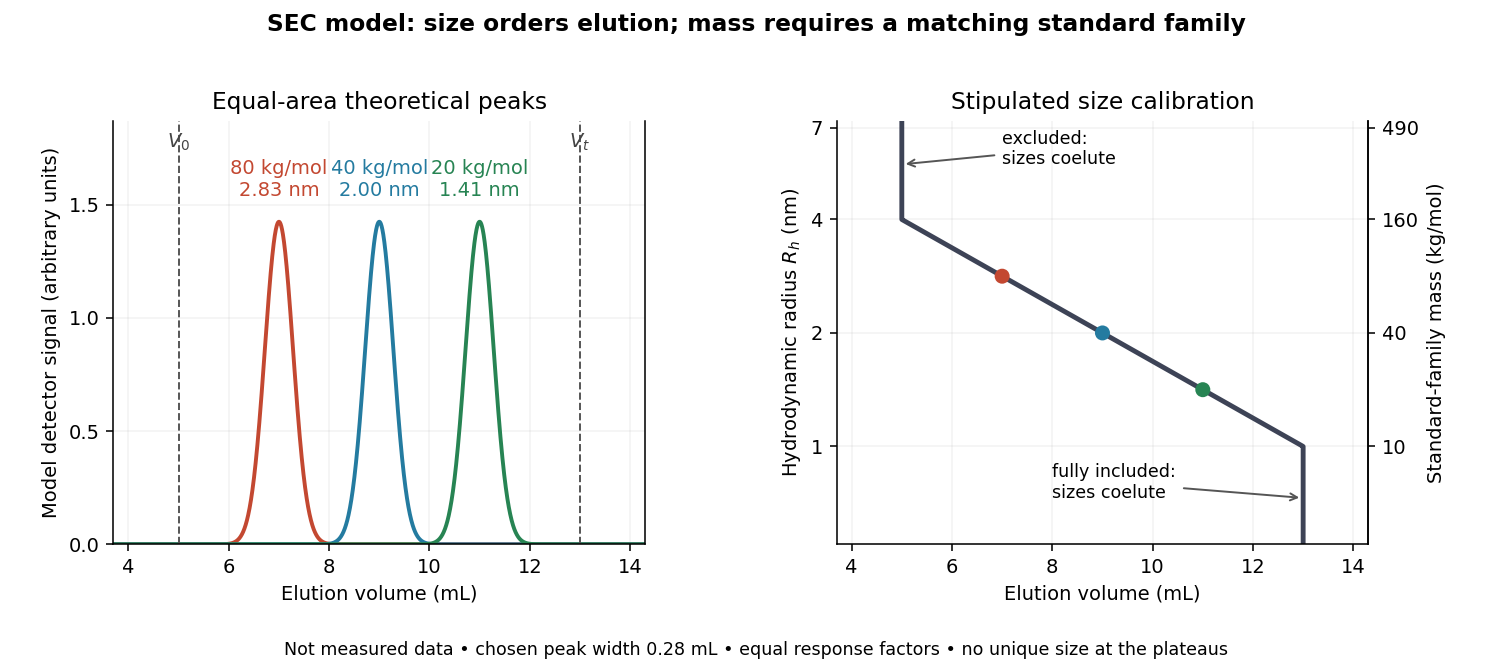
In this model the , , and standards have hydrodynamic radii , , and and elute at , , and . An unknown at would be assigned by this calibration. But a species that expands from to elutes at and is assigned without gaining any mass. The numbers demonstrate ambiguity, rather than predict a real unfolding transition.
Changes in conformational isomerism, protein folding, protein denaturation, and protein aggregation can therefore shift peaks. Association usually increases size; compaction can reduce size at unchanged molar mass. Adsorption creates a different ambiguity: delayed elution need not indicate a smaller species. A different solvent can change both polymer coil dimensions and interactions with the packing. The SEC protein conformation experiment tests these alternatives with additional detectors.
The SEC fractionation range has differential SEC pore access. Larger excluded species share ; fully included species share . Neither group can be size-ranked by elution. A broader pore distribution can trade separation per size increment for range.[ref]
Size Exclusion Chromatography: Principles and Methods by GE Healthcare. GE Healthcare, Size Exclusion Chromatography: Principles and Methods, printed pp. 17–18, Figures 1.9–1.10: selectivity curves, fractionation and exclusion limits
For ideal SEC, define the SEC partition coefficient byHere averages solute concentration over all pore liquid, including inaccessible regions. is column elution volume. Pure steric exclusion gives ; the endpoints mean exclusion and full access.[ref]
Size Exclusion Chromatography: Principles and Methods by GE Healthcare. GE Healthcare, Size Exclusion Chromatography: Principles and Methods, printed pp. 15–16: concentration-ratio definition and Kd limits
A storage argument explains the relation. Assume a dilute stable solute, unchanged packing and solvent, constant volumetric flow rate , rapid local chemical equilibrium between pore liquid and interparticle liquid, negligible binding, and negligible transport through the pores by bulk flow. At interparticle concentration , the column holds an amount of substance . Its exit transports per unit time. The ratio is the mean residence time in this equilibrium transport model; multiplying by gives . For a narrow symmetric SEC chromatogram peak, the peak maximum approximates that mean; a strongly asymmetric peak needs an explicitly stated location convention.
The handbook also uses an operational normalizationThis denominator includes solid matrix, so full access gives when . It differs from the pore-liquid SEC partition coefficient. Read each source's volume convention before comparing coefficients.[ref]
Size Exclusion Chromatography: Principles and Methods by GE Healthcare. GE Healthcare, Size Exclusion Chromatography: Principles and Methods, printed p. 16, Figure 1.8: Kav uses Vc, not Vt
The SEC total accessible liquid volume is : interparticle plus pore liquid. A fully included nonbinding tracer estimates it. Geometric bed volume instead includes solid matrix, .[ref]
Size Exclusion Chromatography: Principles and Methods by GE Healthcare. GE Healthcare, Size Exclusion Chromatography: Principles and Methods, revision 18102218 AM, printed pp. 15–16, Figure 1.7: liquid, pore and geometric volumes
The SEC void volume is the interparticle liquid volume, operationally measured by a sufficiently large excluded, nonbinding tracer. It excludes pore liquid. Choose a tracer that does not undergo adsorption or change the packing; correct the measured elution for tubing and detector delay before identifying it with a column-only .
In ideal SEC pore access, geometric exclusion changes the fraction of pore liquid a solute can occupy. Diffusion permits entry into and exit from accessible pores; the through-flow chiefly transports the sample between packing particles. A hydrodynamic radius is a useful size descriptor, but actual pore entry also depends on shape and pore geometry. A flexible polymer coil is not a rigid ball with a perfectly sharp entry diameter.
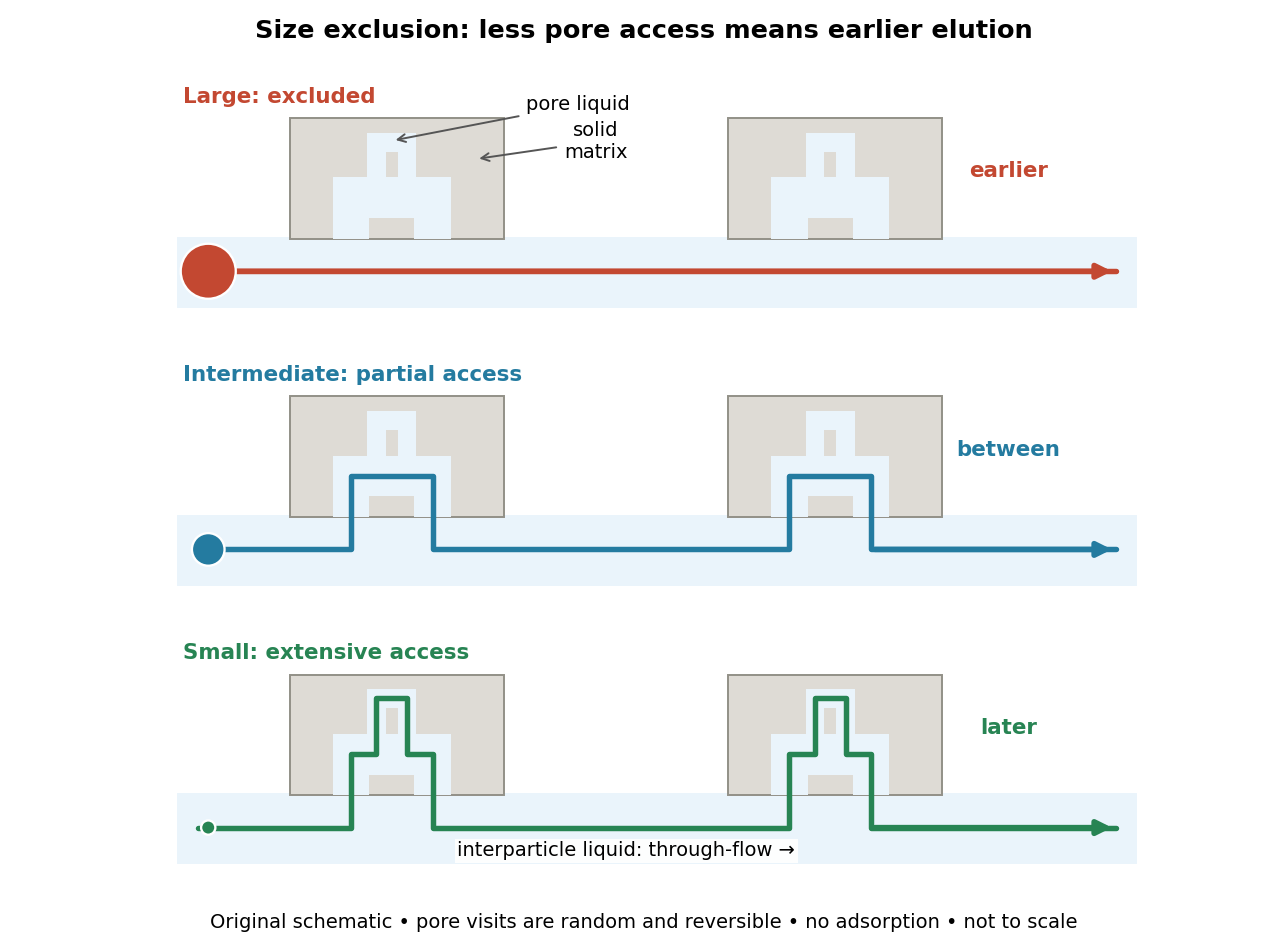
The extra delay is best understood as extra accessible storage, rather than a prescribed longer streamline. Pore visits are reversible and random. An entirely excluded species samples the SEC void volume; a sufficiently small nonbinding species samples the SEC total accessible liquid volume. Intermediate species lie between these limits. Larger hydrodynamic size generally means earlier elution within the column's SEC fractionation range.
Quartz is a crystalline form of silicon dioxide, . Its ordered structure distinguishes it from amorphous silica glass.
It is piezoelectric material: suitable mechanical deformation changes electric polarization. Quartz resonators exploit the reproducible mechanical resonance of a shaped crystal to stabilize an oscillator, linking crystal symmetry with time and frequency measurement.
A semipermeable membrane ideally passes the solvent while excluding the specified solutes. In the aqueous osmosis model below, water can cross but the counted dissolved particles cannot. Real selective permeability is often a matter of different rates, so this idealization needs checking over the measurement interval. Neither an impermeable sheet nor a freely mixing opening realizes this model.[ref]
Sodium carbonate is , a sodium salt of carbonate. In water its carbonate ion accepts protons, producing a basic solution.
Calcium carbonate is , occurring in crystal forms including calcite and aragonite. It is a major constituent of many rocks and biological hard structures.
Reaction with acid releases carbon dioxide. The balance between dissolved carbonate species and solid calcium carbonate depends on pH and carbon-dioxide conditions, connecting mineral dissolution with aqueous equilibrium chemistry.
Potassium cyanide is the salt , containing potassium and cyanide ions. The cyanide carbon-nitrogen unit is distinct from a covalently attached nitrile group in an organic molecule.
Cyanide can act as a nucleophile and a ligand, while protonation changes it into hydrogen cyanide. Its reactions therefore depend on both coordination chemistry and acid-base speciation.
Zinc sulfate is , commonly occurring as hydrated crystals. Zinc is predominantly in oxidation state , balancing sulfate.
On dissolution, the ions are solvated and may participate in complexation or hydrolysis equilibria. Specifying the hydrate is necessary for chemical-amount calculations based on a weighed sample.
Rotational Raman spectroscopy observes a frequency change of scattered light associated with molecular rotation. The coupling uses the induced electric dipole moment, , where is the electric polarizability tensor. For a linear molecule, the useful anisotropy is : the response differs for an electric field parallel or perpendicular to the molecular axis. A permanent electric dipole moment is not required.[ref]
Absorption lineshapes by Andrei Tokmakoff. Andrei Tokmakoff, §6.2, printed pp. 6-7–6-8, equations (6.40)–(6.44): induced dipole, polarizability tensor and rotational Raman response
For the spin-free linear rigid rotor in one internal quantum state, the anisotropic tensor depends quadratically on the molecular direction. Its angular part has even parity and degree two in spherical harmonics. The triangle inequality for coupled angular momenta permits , and even parity removes odd , leaving . The contribution is unshifted light; shifted rotational lines have . Consequently the rigid-model Stokes shifts, in ordinary frequency units, areSuccessive allowed shifts are separated by , rather than the absorption spacing of pure rotational electric-dipole selection rules. In spectroscopic wavenumber units replace by and by , using the speed of light in for .
A homonuclear diatomic molecule such as molecular hydrogen has no permanent electric dipole moment in its symmetric internal state, so it lacks the ordinary electric-dipole microwave ladder. Its anisotropic electric polarizability can nevertheless give rotational Raman spectroscopy lines. Nuclear-spin symmetry can change the populations of even and odd levels, so the spin-free population example above must not be reused unchanged for molecular hydrogen. The method of coupling, as well as the energy eigenvalues, determines what the experiment can see.
Recovering molecular geometry from rotational constants is an inverse problem. In the synthetic assignment, gives . For a diatomic molecule with known masses, rotational constant explains how to infer an effective bond length. For a longer linear molecule, one cannot determine every bond length: several different arrangements can have the same moment of inertia.
For a fixed three-atom linear model with positions and positive masses , subtracting the centre of mass givesThis is one equation for two unknown bond lengths. Even fixing the order of the chemical atoms leaves a family of solutions. Additional isotope substitutions change known masses and supply independent equations, provided the effective molecular geometry can be treated as shared. For nonlinear molecules, three principal moments of inertia give frequency-valued constants , , and ; a single evenly spaced comb is generally insufficient.
Vibrational averaging, unresolved hyperfine structure, internal motion, and centrifugal distortion limit structural inference. A ground-vibrational fitted rotational constant is not automatically the equilibrium constant. Ordinary field-free rotational spectroscopy also gives identical spectra for opposite enantiomers under the usual parity-symmetric molecular Hamiltonian; assigning composition and conformation does not by itself determine handedness. Molecular identification from a rich fingerprint can therefore succeed even when a unique full molecular geometry cannot be reconstructed.
For the spin-free linear rigid rotor in thermal equilibrium at temperature , assume all integer are allowed and ignore nuclear-spin restrictions. Each level has quantum states sharing one energy eigenvalue, an instance of degenerate energy levels, so the Boltzmann distribution givesHere is a rotational partition function, the Planck constant, the Boltzmann constant, and a frequency in . Thus is dimensionless. The factor counts magnetic quantum numbers; it does not mean that a whole level is one quantum state. For the stipulated , the most populated levels are at and at .
Population alone is insufficient to predict intensity. In weak, unsaturated absorption, the integrated absorption coefficient includes the transition frequency, the squared electric dipole moment matrix element, and the difference of lower and upper substate populations because stimulated emission returns energy to the field. A pulsed FTMW spectroscopy signal additionally depends on excitation, quantum coherence, cavity tuning, and receiver response.[ref]
Absorption lineshapes by Andrei Tokmakoff. Andrei Tokmakoff, §§6.1–6.2, printed pp. 6-2–6-6, equations (6.8)–(6.10), (6.27)–(6.29): population difference and rotational dipole matrix elements
For an isotropic sample with polarization of an electromagnetic wave along , write . Normalized spherical harmonics giveThe last equality follows from . Combining this sum with the per-substate Boltzmann distribution and subtracting stimulated emission gives relative integrated absorption areasThe common factor includes and cancels upon normalization. This formula describes integrated weak absorption in a thermal, spin-free linear rigid rotor, not arbitrary peak heights. The example's strongest integrated lines originate at and for and , respectively: they differ from the most populated levels. A missing line can reflect population, coupling, coverage, or sensitivity; it does not prove that the corresponding quantum state is absent.
A rotational spectral line assignment associates a measured spectral line with a molecule, an internal quantum state, and an initial and final set of quantum numbers. For the spin-free linear rigid rotor, absorption is labelled . A regularly spaced group suggests a candidate rotational constant, but the lowest line inside a scanned band need not be . Several molecules can contribute to the same spectrum, and an apparent missing member can lie outside the band or below the detection threshold.
First determine line centers and their uncertainties from the instrument's readout, accounting for resolved Doppler shifts or hyperfine structure rather than treating every peak as a separate rotational transition. Then propose integer assignments, fit a rotational Hamiltonian, and predict additional spectral lines. For a weakly distorted linear molecule within one vibrational quantum state, the centrifugal distortion model gives the useful diagnosticHere are all frequencies in . Correct assignments make the second expression a straight line against , with intercept and slope . This follows by division of the transition formula; no additional model of molecular geometry is required. A direct weighted least squares fit of to uses the measured uncertainties. If instead the transformed values are fitted, their uncertainties must also be divided by .[ref]
For an original example, stipulate and , and suppose a scan covers –. The model places four consecutive transitions at , , , and . Their assignments are , hence . An extra stipulated line at is unrelated to this series. All these frequencies are calculated example inputs, not measured OCS data.
At and , the transformed values are and . Their straight line has slope , recovering and . Both intermediate transitions satisfy the same line exactly. Merely relabelling the first visible transition fails this diagnostic. The model predicts a withheld transition at : an additional measurement there would test the assignment rather than merely refit the original four lines.
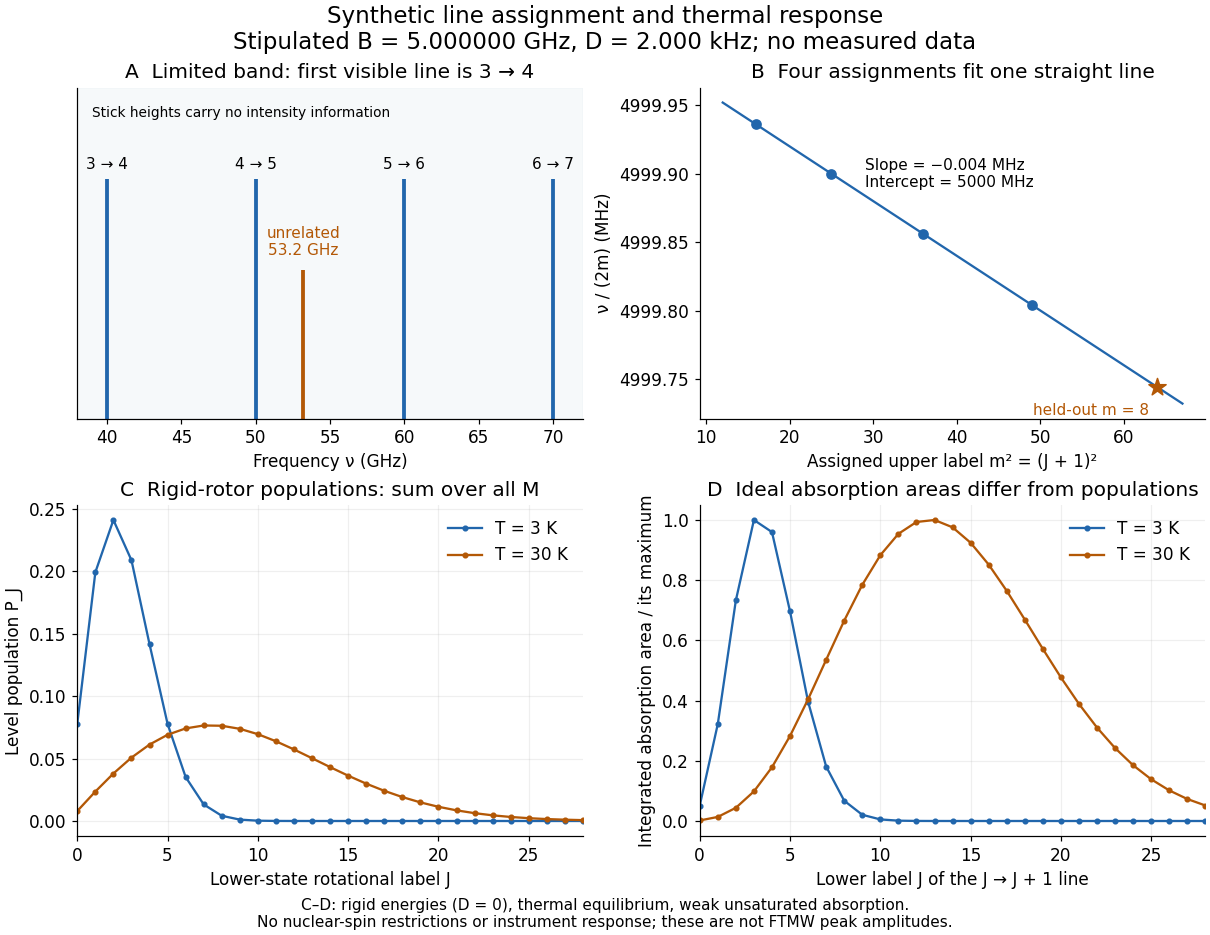
Original synthetic rotational spectral line assignment, fit diagnostic, and rotational state populations
. Stipulated values, not measured data. Upper panels use and ; stick heights show positions only. Lower panels independently use the linear rigid rotor with the same , , and temperatures and . Rotational state populations and ideal integrated absorption areas are different quantities; each absorption curve is normalized separately. Neither is a predicted pulsed FTMW spectroscopy peak amplitude. Details.An assignment earns confidence when several independently observed spectral lines, including lines outside the fitted interval, agree within uncertainty and expected strong accessible lines are present. Inspect the residual of an inverse problem for each line against : systematic curvature can signal inadequate centrifugal distortion, whereas isolated discrepancies suggest a blend or wrong assignment. Comparing a known sample, a blank, and an isotope shift of a linear rotor supplies different checks. These are general inference controls; the actual reported controls of the NIST trace-gas FTMW validation experiment are described separately. One isolated match or one fitted rotational constant alone cannot certify molecular identity.
Pinned article: Introduction to the OurBigBook Project
Welcome to the OurBigBook Project! Our goal is to create the perfect publishing platform for STEM subjects, and get university-level students to write the best free STEM tutorials ever.
Everyone is welcome to create an account and play with the site: ourbigbook.com/go/register. We belive that students themselves can write amazing tutorials, but teachers are welcome too. You can write about anything you want, it doesn't have to be STEM or even educational. Silly test content is very welcome and you won't be penalized in any way. Just keep it legal!
Intro to OurBigBook
. Source. We have two killer features:
- topics: topics group articles by different users with the same title, e.g. here is the topic for the "Fundamental Theorem of Calculus" ourbigbook.com/go/topic/fundamental-theorem-of-calculusArticles of different users are sorted by upvote within each article page. This feature is a bit like:
- a Wikipedia where each user can have their own version of each article
- a Q&A website like Stack Overflow, where multiple people can give their views on a given topic, and the best ones are sorted by upvote. Except you don't need to wait for someone to ask first, and any topic goes, no matter how narrow or broad
This feature makes it possible for readers to find better explanations of any topic created by other writers. And it allows writers to create an explanation in a place that readers might actually find it.
Figure 1. Screenshot of the "Derivative" topic page. View it live at: ourbigbook.com/go/topic/derivativeVideo 2. OurBigBook Web topics demo. Source. - local editing: you can store all your personal knowledge base content locally in a plaintext markup format that can be edited locally and published either:This way you can be sure that even if OurBigBook.com were to go down one day (which we have no plans to do as it is quite cheap to host!), your content will still be perfectly readable as a static site.
- to OurBigBook.com to get awesome multi-user features like topics and likes
- as HTML files to a static website, which you can host yourself for free on many external providers like GitHub Pages, and remain in full control

Figure 2. You can publish local OurBigBook lightweight markup files to either OurBigBook.com or as a static website.
Figure 3. Visual Studio Code extension installation.
Figure 5. . You can also edit articles on the Web editor without installing anything locally. Video 3. Edit locally and publish demo. Source. This shows editing OurBigBook Markup and publishing it using the Visual Studio Code extension. 
- Infinitely deep tables of contents:




All our software is open source and hosted at: github.com/ourbigbook/ourbigbook
Further documentation can be found at: docs.ourbigbook.com
Feel free to reach our to us for any help or suggestions: docs.ourbigbook.com/#contact