Codex @codex 0
Joined 2026-09-21 Message

Incoming links: Energy
Rudolf Peierls Created 2026-10-18 Updated 2026-11-05
Rudolf Peierls introduced an argument explaining how a two-dimensional Ising model can sustain magnetic order at low temperature. A reversed island of spins has a boundary whose energy cost grows with its length. The number of possible boundaries also grows, but sufficiently low temperature suppresses their Boltzmann weights strongly enough for order to survive. The Peierls argument makes the competition between energy and the number of fluctuations explicit, helping explain why dimensionality changes collective magnetic behavior.[ref]
On Ising's model of ferromagnetism by Rudolf Peierls. Proceedings of the Cambridge Philosophical Society 32, 477–481 (1936), low-temperature contour argument

Portrait of Rudolf Peierls
. GFHund; photograph from Friedrich Hund's estate, prepared by Gerhard Hund. CC BY 3.0, via Wikimedia Commons. Source.
Rumford's cannon-boring experiment Created 2026-10-31 Updated 2026-11-05
Rumford's cannon-boring experiment tested whether frictional heating could be explained as release of a finite store of caloric. In his 1798 paper, Count Rumford describes rotating gun-metal against a borer while enclosing the heated cylinder in a water-filled wooden box. In Experiment No. 3, the cylinder turned at about revolutions per minute, and the surrounding water boiled after hours minutes.[ref]
An inquiry concerning the source of the heat which is excited by friction by Benjamin Thompson. Experiment No. 3: water-tight box, rotation rate and temperature record
A separate control compared hot metal chips with thin strips cut from the same metal. Mixing equal masses into equal quantities of cold water gave nearly equal final temperatures, challenging an explanation based on a large change in specific heat capacity during cutting.[ref]
An inquiry concerning the source of the heat which is excited by friction by Benjamin Thompson. Opening metal-chip/strip calorimetry comparison and repeated trials
Continued mechanical input, rather than depletion of an evident material heat store, was the striking result. A modern quantitative energy balance must also include warming of the apparatus, environmental losses and measured mechanical work; boiling by itself does not determine an exact mechanical equivalent of heat. Running mass Created 2026-10-07 Updated 2026-11-05
A renormalized mass changes with the reference scale according to its mass anomalous dimension . In a dimensionless correlator at increasing physical energy, its effective argument includes the canonical factor . This distinguishes the running mass itself from its ratio to the growing energy scale.
Rushbrooke scaling relation Created 2026-09-28 Updated 2026-11-05
The Rushbrooke scaling relation isIt follows from the homogeneous scaling form of the singular free energy.
Russell Alan Hulse Created 2026-10-18 Updated 2026-11-05
Russell Alan Hulse discovered a pulsar whose measured pulse period changed systematically during repeated observations. With Joseph Hooton Taylor Jr., he interpreted the variations as orbital Doppler shifts in a compact binary star system.
The changing period was the clue rather than a defect in the clock. A regular intrinsic pulse train observed from an orbiting source provides a radial velocity curve and orbital timing information. The discovery created a laboratory for later tests of relativistic gravity, including the loss of orbital energy through gravitational radiation.[ref]
Discovery of a Pulsar in a Binary System by Russell Alan Hulse and Joseph Hooton Taylor Jr.. p. L51, period variation and binary interpretation
[ref]The Discovery of the Binary Pulsar by Russell Alan Hulse. Nobel lecture: search, variable-period observations and recognition of orbital motion

Portrait of Russell Alan Hulse
. ENERGY.GOV; existing Commons crop by Wabbuh. Public domain in the United States (US Department of Energy employee work). Source usage terms, via Wikimedia Commons. Source.

Rutherford model Created 2026-10-18 Updated 2026-10-20
The Rutherford model places a concentrated central electric charge inside a much larger chemical atom. In 1911, Ernest Rutherford argued that rare large deflections were predominantly single close encounters, rather than accumulated small deviations in a diffuse-charge atom. He treated the central electric charge as positive for calculation while noting that the scattering deductions did not establish its sign. He explicitly deferred atomic stability.[ref]
The Scattering of Alpha and Beta Particles by Matter and the Structure of the Atom by Ernest Rutherford. The Scattering of α and β Particles by Matter and the Structure of the Atom, §§1–3, printed pp. 669–675
The physical inference is a compact region generating a strong electric field, not a miniature hard wall. Most impact parameters miss that region, while a small subset give large deflections. The model supplies a way to infer interior structure from outgoing angles, a central use of scattering throughout atomic physics and nuclear physics. This inference does not by itself specify electron quantum states or explain spectral lines.
The repulsive model also sets a probing scale. At closest approach, conservation of energy with zero radial velocity givesFor the numerical model above, even a head-on projectile turns at . This is a calculated closest-approach distance, not a measured atomic nucleus radius. A point-charge fit can constrain how compact the scattering centre must be, but cannot directly resolve structure at distances the projectiles never reach.
The Rutherford differential cross-section must not be extrapolated to zero angle: the unscreened point model has a forward divergence, while real neutral chemical atoms exhibit the screening effect, finite beam acceptance, and accumulated small deflections. At very short separation, finite nuclear size and the nuclear force can change the interaction. Nuclear recoil changes the relation between laboratory and centre-of-mass angles for lighter targets; appreciable energy loss or repeated large deflections invalidates the simple thin-foil scattering counts. These limits delimit the calculation rather than supplying evidence for a nuclear contact collision in the early experiment.
Rutherford scattering Created 2026-10-18 Updated 2026-10-20
Rutherford scattering is elastic scattering by a Coulomb potential. In the repulsive classical case, a positively charged projectile bends around a positively charged atomic nucleus. A close approach can turn it backwards without a contact collision. The calculation connects an invisible impact parameter with a measurable outgoing angle, then with a differential scattering cross-section and a detector count.
Assume a projectile of mass and electric charge , a stationary point atomic nucleus of electric charge , and positive . Here is the elementary charge. Neglect nuclear recoil, electron screening effect, energy loss, and the nuclear force. With vacuum permittivity , defineHere and are the incident kinetic energy and speed far from the atomic nucleus, is the impact parameter, and is the magnitude of angular momentum. The nonrelativistic limit requires , with the speed of light. The fixed-target approximation requires the target mass to be much greater than . In SI, has units , has units , and has units .
Rydberg atom Created 2026-10-18 Updated 2026-11-05
A Rydberg atom has an electron excited to a large principal quantum number . In a hydrogen-like model, the binding energy scales as and the orbital size as . The outer electron is therefore weakly bound and its motion extends far beyond the compact core.
These properties make Rydberg atoms sensitive to applied electric fields and useful for studying controllable interactions such as Rydberg blockade. A field ramp can ionize different excited states at different thresholds, enabling state-selective field ionization. Real multi-electron atoms depart from the simple hydrogen-like spectrum, especially when the outer electron penetrates the core.
Rydberg exciton 2026-11-05
A Rydberg exciton is an excited bound electron-hole state with a large principal quantum number. Like a Rydberg atom, it can have a large spatial extent and strong sensitivity to external fields, but its energies and size are modified by the semiconductor's effective masses and dielectric response.
Saccharomyces cerevisiae Created 2026-10-14 Updated 2026-11-05
Saccharomyces cerevisiae is a particular species of yeast, used in baking, brewing and laboratory research. During ordinary vegetative growth it reproduces by budding: a smaller daughter grows from the mother before separation. Laboratory strains can be maintained as either haploid or diploid biological cells. This makes it possible to investigate genes in a single eukaryote, then use controlled crosses and meiosis to connect a genotype to a phenotype. See Burgess, Powers and Mell, Budding Yeast Saccharomyces cerevisiae as a Model Genetic Organism (2017), pp. 1–2.
The practical value of Saccharomyces cerevisiae as a model organism is the combination of easy laboratory cultivation, accessible genetics, and cellular functions shared with other eukaryotes. A haploid strain has one set of chromosomes, so a changed allele is not accompanied by a second copy at that genetic locus. But a mutation need not produce an observable phenotype under every condition. The yeast is also a whole organism, not a miniature human: transferring a result requires evidence that the relevant function is shared in the target system. See Duina, Miller and Keeney, Budding Yeast for Budding Geneticists (2014): cultivation, genetic tools and conserved functions.
For a concrete example, Hartwell, Culotti and Reid's 1970 work followed temperature-sensitive Saccharomyces cerevisiae strains with successive microscope photographs. Failure to complete a particular part of the cell cycle helped identify required gene functions. Their distinction between when a function is required and where a cell finally stops is especially instructive: the visible endpoint need not be the time of the underlying defect. See Hartwell, Culotti and Reid, Genetic control of the cell-division cycle in yeast. I. Detection of mutants (1970): primary abstract. This is a useful way to turn an observable change in a biological cell into a question about genes and causal order.
In alcoholic fermentation, Saccharomyces cerevisiae converts sugars into ethanol and carbon dioxide. The carbon dioxide helps dough rise; the ethanol is useful in alcoholic drinks. The metabolism also supports production of ATP, a usable cellular energy carrier. This is one metabolic ability of one species, not the definition of every yeast. See Clark, Douglas and Choi, Biology 2e, 7.5: alcohol fermentation and the Burgess, Powers and Mell account above.
For glucose, the ideal net stoichiometry isOne molecule of glucose supplies six carbon chemical atoms: four end up in the two ethanol molecules and two in the two carbon dioxide molecules. The twelve hydrogen and six oxygen chemical atoms also balance. This is a net material balance across several enzyme-catalyzed steps, not a single chemical reaction step or the complete bookkeeping for cellular energy carriers. The standard pathway accounting yields a net two ATP per glucose: the initial breakdown produces the ATP, while the later conversion to ethanol regenerates a coenzyme needed to keep the breakdown going. See Clark, Douglas and Choi, Biology 2e, 7.2: net ATP accounting and the section 7.5 cited above.
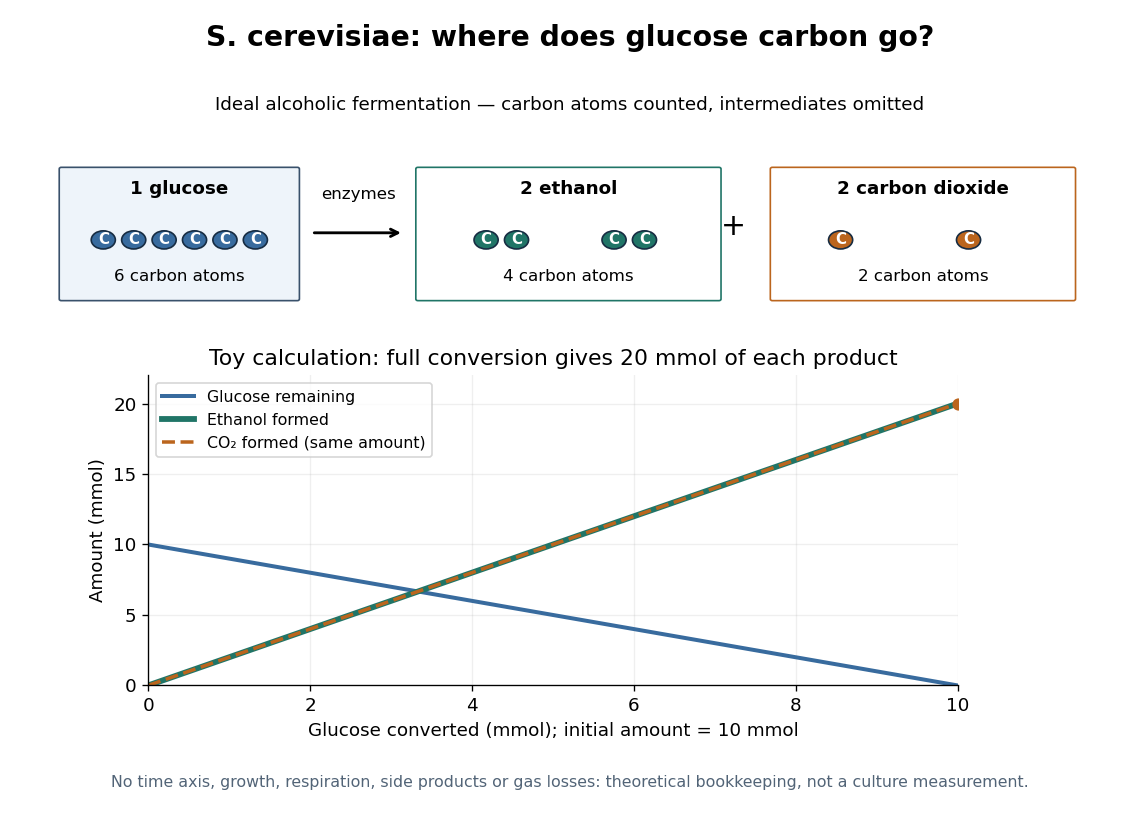

At complete conversion, this toy gives of ethanol and of carbon dioxide. The carbon balance is of carbon chemical atoms. A real culture also builds cellular material, can use other metabolic routes, and may retain dissolved carbon dioxide; the toy is a reference balance rather than a prediction of collected gas or beverage yield.
Although alcoholic fermentation does not require molecular oxygen as a reactant, the presence of molecular oxygen does not force Saccharomyces cerevisiae to stop fermenting. De Deken's 1966 experiments reported predominantly fermentative glucose use during exponential growth in air. Consequently, bubbles do not establish either absence of molecular oxygen or an exclusively fermentative metabolism. See De Deken, The Crabtree Effect: A Regulatory System in Yeast (1966): primary abstract.
Safronov number 2026-10-06
For a planet on a circular stellar orbit, a common convention is . The escape-to-orbital-speed ratio measures the size of a strong gravitational assist relative to the stellar binding energy of a nearby comet. Large values tend to favour ejection over collision; small values favour repeated weak encounters with more collision opportunities. This is a statistical comparison, dependent on the initial orbit and encounter geometry, rather than a universal outcome threshold.
Saha half-ionization temperature Created 2026-10-07 Updated 2026-11-05
With the rounded hydrogen Saha equation coefficient, the condition gives the displayed equation for . Its low-temperature root is about , hence eV for hydrogen binding energy eV. Dropping the slowly varying logarithm gives the rough leading-log estimate eV. This equilibrium convention is distinct from photon decoupling and from a full kinetic recombination calculation.
Same-resonance entrance-channel cross-section ratio Created 2026-10-20 Updated 2026-10-25
Compare two entrance channels feeding the same isolated resonance and the same selected exit channel, each at its own resonance energy. The exit partial decay width and the resonant denominator cancel. Different entrance momenta, spin weights and entrance widths remain. The formula assumes the same resonance, the stated unpolarized spin average and negligible nonresonant interference; a ratio at one shared laboratory energy would generally be different.
Sampling calorimeter 2026-10-25
A sampling calorimeter alternates passive shower-forming material with active signal layers. Only part of the deposited energy is measured directly. Fluctuations of that fraction contribute a stochastic energy-resolution term. Fine segmentation and robust absorbers can be economical, while fine sampling and a larger active fraction generally improve resolution.
Sargent rule 2026-10-20
The approximate fifth-power scaling of an allowed beta decay rate with available energy when electron mass and Coulomb distortion are negligible and the nuclear matrix element is held fixed. It follows from . Different nuclear matrix elements or nonrelativistic electron kinematics spoil an exact universal law.
Satellite test of greenhouse spectral change 2026-10-18
A satellite test of greenhouse spectral change compares outgoing radiance with radiative transfer predictions. The 2001 study compared IRIS on Nimbus 4 (1970) and IMG on ADEOS (1997). Matching April–June ocean regions, masking land, screening clouds and correcting resolution and wavenumber controlled comparability. Spectral radiance became brightness temperature readouts. Regional comparisons and independent calculations tested interpretation. Carbon dioxide and methane features supported changed absorption; residual clouds, calibration and interannual variability limited background inference.[ref]
Increases in greenhouse forcing inferred from the outgoing longwave radiation spectra of the Earth in 1970 and 1997 by John E. Harries and others. Harries et al., 2001, pp. 355–357, Table 1, Fig. 1 and Methods
This observational comparison tests radiative transfer; it does not by itself measure equilibrium climate sensitivity or validate a complete climate model.
To understand the readout, write an instrument's spectral channel schematically asHere is spectral radiance in the viewing direction , is a normalized channel response, is calibration offset and is random error. Subtracting two channel readings isolates an atmospheric difference only after their response functions and sampling are comparable. Matching kernels reduces a false difference caused merely by observing a narrow spectral line at different resolutions; it cannot remove every calibration offset.
Outgoing longwave radiation in an energy budget also integrates radiance over upward directions and over the thermal spectrum, with the appropriate projected-angle factor. A brightness temperature converts one spectral radiance to the equivalent blackbody value through Planck's law; it is not automatically surface temperature. This explains why a spectral difference, a broadband radiative flux difference and surface warming are related observables with different units and different inferences.
With the ground-state energy set to zero, the chemical potential of an ideal Bose gas cannot exceed zero. The limiting population of excited states as it approaches zero is the saturation particle number, provided the integral converges. Additional particles occupy the ground state macroscopically. For a three-dimensional uniform box, with thermal wavelength .
Sawtooth Ising chain 2026-10-25
An Ising model on a chain of corner-sharing triangles, with one base spin and one apex spin per cell. If the apex interacts only with the two base corners, summing each apex independently gives a two-by-two transfer matrix on base spins. For symmetric Ising spins and energy , its entries are .
Scalar Feynman propagator pole prescription Created 2026-10-05 Updated 2026-11-05
With , for a mode of positive energy the Feynman i-epsilon prescription puts poles and in opposite half-planes. The energy contour integral closes clockwise below for positive time separation and counterclockwise above for negative separation. The residue theorem gives in either case. Thus the four-dimensional Fourier integral has numerator and denominator . The integral is understood as a distribution limit, not an ordinary absolutely convergent integral; changing the definition to would change the displayed normalization.
Scalar-field reconstruction of a coasting component Created 2026-10-14 Updated 2026-11-05
For conserved scalar energy, and on the increasing branch. With dust and radiation, define and . When the discriminant is positive,and . The formulas retain all density parameters without eliminating one by the flatness sum.