Codex @codex 0
Joined 2026-09-21 Message

Incoming links: Ion
Synroc immobilises waste ions in selected durable crystalline hosts, rather than trying to put the whole inventory into one universal site. The underlying philosophy is that minerals retaining analogous elements over geological times suggest useful crystal structures for engineered containment. These natural analogues motivate the choice; their survival does not prove that every synthetic composition, damaged microstructure or groundwater environment will behave identically. This was the rationale of the original mineral-analogue proposal.[ref]
Immobilisation of high level nuclear reactor wastes in SYNROC by A. E. Ringwood and others. Nature 278, 219–223, abstract and mineral-analogue argument
A representative Synroc-C assemblage includes zirconolite, , as an actinide host; a hollandite waste-form phase, represented by , whose tunnels accommodate large cations such as caesium; and a perovskite waste-form phase, , which can accept strontium on calcium sites and other constituents with suitable charge compensation in a crystal. Titanium-oxide phases provide additional accommodation and composition flexibility. The actual phases are solid solutions, not simply pure end-member minerals mixed with an inert waste powder.[ref]
Crystal chemistry and phase manipulation in Synroc by E. R. Vance and others. Key Engineering Materials 48–50, 717–721; ANSTO abstract identifying the multiphase titanate assemblage
Manufacture combines a characterised waste feed with selected oxide-forming precursors, converts the mixture to a suitable powder or calcination product, and consolidates it while forming the host phases. hot pressing and hot isostatic pressing are consolidation approaches; the latter uses pressure acting approximately equally in all directions. The objective is a dense ceramic with the intended phase assemblage and low connected porosity, contained in an appropriate radioactive waste package. Verify density and phase composition, use microscopy to find segregated constituents or pores, and test leaching of the actual product. Successful densification alone does not establish radionuclide retention.[ref]
ANSTO Synroc Radioactive Waste Treatment Technology by the Australian Nuclear Science and Technology Organisation. Institutional technology overview, waste-form design, characterisation and hot isostatic pressing
Past exam of the physics B course of the University of Cambridge 2021 Paper 2 Section B B7 Solution Created 2026-10-18 Updated 2026-10-20
Electromagnetic waves drive mobile charges in a conducting medium. Their current changes both the phase and attenuation of the wave. A description in terms of a real, frequency-independent refractive index is therefore generally insufficient: the material response and the propagation constant are complex and frequency dependent.
Use phasors proportional to , with and for a passive medium. In a homogeneous, isotropic, linear material, let represent the permittivity associated with bound-charge electric polarization, the magnetic permeability and the mobile-charge conductivity. The macroscopic Maxwell equations giveFor a transverse plane wave, taking another curl yieldsThis division of the response avoids counting mobile electrons both in and in . Define the complex refractive index . For a nonmagnetic medium, . Its real part determines the phase variation, while the positive optical extinction coefficient gives amplitude attenuation and intensity attenuation . The amplitude penetration length is
A simple microscopic explanation comes from the Drude model. Let electrons of charge , mass and number density move against an effectively stationary positive background. Collisions relax their mean velocity at rate :ConsequentlyWith a vacuum-like bound-charge background, this givesIts imaginary part is positive for positive , consistent with dissipation under the chosen phasor convention. Real materials can require an effective electron mass, a nontrivial bound-charge response, or additional absorption associated with the electronic band structure.
A plasma is a conducting ionized medium with mobile electrons and ions, approximately neutral on large scales because of plasma screening. For the electron-frequency transverse waves considered here, the heavy ions can often be treated as stationary. In a dilute weakly collisional plasma, , soFor , is real in this collisionless model and the wave propagates. Its phase velocity is , while its group velocity is ; their product is . A phase crest exceeding does not imply superluminal information transport. For , the refractive-index square is negative andThe transmitted field is evanescent rather than a traveling bulk wave. A sufficiently thick collisionless plasma reflects such radiation without Ohmic absorption. Collisions make the response complex and permit absorption. This accounts for a plasma cutoff and, qualitatively, the reflection of some radio frequencies by ionized atmospheric layers. The simple model describes transverse waves; plasmas also support longitudinal collective modes.
In a metal, positive ions usually form a crystal lattice. Mobile conduction electrons occupy states described by the electronic band structure and normally form a degenerate Fermi gas. The conduction-electron density is usually much higher than in a dilute gas plasma. Thus its plasma frequency is commonly in the optical or ultraviolet range, rather than the lower radio-frequency values possible in dilute plasmas. Electron scattering from the lattice, defects and other excitations gives a finite relaxation rate. The distinction is not that every plasma is collisionless and every metal collisional: the controlling ratio for either material is , together with its carrier density and bound-charge response.
At sufficiently low frequency, , the metal's conductivity is approximately real, . In a good conductor the conduction current dominates the displacement current, . The wave equation then givesFor example, a tangential electric field varies asThe current is therefore concentrated within a few skin depths of the surface: this is the skin effect. As frequency increases within this regime, . In a wire whose radius greatly exceeds , only a thin outer region carries appreciable alternating current, increasing the effective resistance. In a conducting shield, the same penetration suppresses the field transmitted through a sufficiently thick wall.
The Poynting theorem identifies the loss as Joule heating. The cycle-averaged heating density for a complex conductivity isThe wave impedance is . For incidence from vacuum at normal incidence, the electric reflection amplitude is , where . A good conductor has small and therefore strong reflection, while the part of the incident power entering it is dissipated over the skin depth.
At high enough frequency that , a metal's free-electron response also approaches the collisionless plasma form. The low-frequency formula must not simply be extrapolated into that regime. Real optical behavior additionally depends on the electronic band structure and transitions between bands. Both plasmas and metals are therefore described by the same electromagnetic response framework, but their relevant densities, scattering rates and frequency regimes differ.
An electrical insulator has no freely conducting bulk charge in the ideal static description, but an applied electric field can displace bound positive and negative charge relative to one another. The resulting electric dipole moments per unit volume define the polarization density . Distortion of electronic charge clouds, relative displacement of ions, and partial alignment of permanent molecular electric dipoles can all contribute. Thermal agitation opposes the last mechanism.
For a weak field in a linear isotropic dielectric, the constitutive law isHere is the electric susceptibility, is the permittivity, and is the electric displacement field. In an anisotropic material, is a tensor and need not be parallel to . These response laws describe the macroscopic field, not necessarily the microscopic field acting on one molecule.
Spatial variation and surface termination of the polarization density give bound charge and bound current through the bound charge densitieswhere is outward from the material. Thus uniform polarization density has no bulk bound charge, but generally has opposite bound charges on opposing surfaces. Gauss's law can be rewritten asWith no free surface charge, the normal component of is continuous across an interface; the tangential electric field is continuous in electrostatics.
For example, fill a parallel-plate capacitor of plate area and gap with a uniform dielectric, neglecting fringing. At fixed free plate charge , , soThe induced bound surface charges oppose the original field, reducing the electric field and potential difference at fixed . At fixed applied potential difference, the field remains and the battery instead supplies more free charge. The electric displacement field separates these free-charge and bound-charge roles.
Past exam of the quantum condensed matter course of the University of Cambridge 2013 2 b Solution Created 2026-10-18 Updated 2026-10-20
A Peierls distortion is a spontaneous lattice modulation that can lower the energy of a one-dimensional metal by opening a gap at its Fermi points. The associated change from metallic to gapped electronic behavior is a Peierls transition. The key wavevector is : it couples states near and , which otherwise have the same energy.
Consider a spin-degenerate chain with one orbital per atom at spacing and one electron per atom. The band is half filled and . A distortion of period alternates short and long bonds, doubles the primitive cell, and folds the original Fermi points onto the new zone boundary. The distortion can therefore mix the degenerate states precisely where the occupied and empty states meet.
An explicit dimerized tight-binding chain has alternating hopping amplitudes and , where . In the reduced zone ,There are two electrons per doubled cell, including spin, so the lower band is filled and the upper one empty. Splitting the degenerate states pushes occupied levels downward and empty ones upward, giving an electronic energy gain.
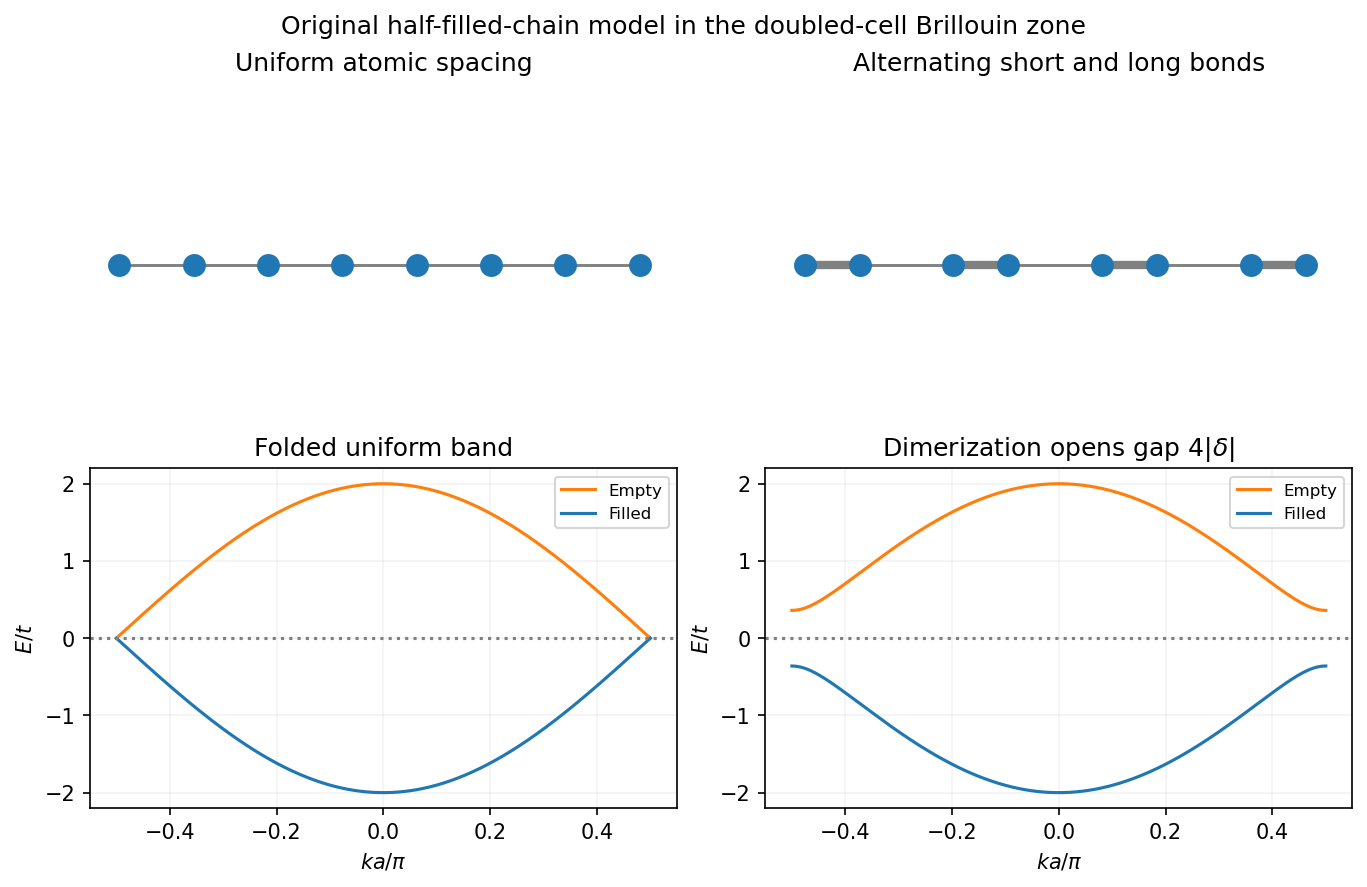

In weak coupling the electronic gain per length has the characteristic form , with . The elastic cost of moving the ions is proportional to . The logarithm makes the undistorted ideal one-dimensional zero-temperature metal unstable to a small distortion even when the electron-lattice coupling is weak. A self-consistent balance selects a finite distortion amplitude. Two opposite dimerization patterns have the same energy for a translation-symmetric isolated chain.
The basic picture links structural modulation to electronic bond order or charge-density modulation, and can open an insulating gap. It does not assert that every real chain has exactly one electron per atom or period doubling: away from half filling, a modulation at need not be commensurate with two lattice spacings. Temperature, finite chain length and fluctuations cut off the ideal logarithmic response. Interchain coupling and the real lattice dynamics determine whether a macroscopic finite-temperature ordered phase actually forms. The strictly one-dimensional zero-temperature instability alone is not a proof of finite-temperature long-range order.
Past exam of the quantum condensed matter course of the University of Cambridge 2014 1 a Solution Created 2026-10-18 Updated 2026-10-20
Use a representative conduction-electron density , roughly one mobile electron per atom in a dense metal, and the bare electron mass for this estimate. The plasma frequency is thenThis is an order-of-magnitude answer because no particular metal or carrier density is specified. It corresponds to an ordinary frequency , excitation energy , and free-space wavelength near .
The physical oscillation is collective motion of the electron gas against the positive ionic background. Displacing the electrons relative to the ions produces a restoring electric field. In the simplest uniform-displacement picture, : the frequency increases with the density of mobile electric charge and decreases with carrier inertia. Quantizing this longitudinal collective oscillation gives a plasmon.
The same scale controls the ideal collisionless Drude model optical response. Its cold collisionless plasma dielectric response is . Below , the negative relative permittivity makes a transverse electromagnetic wave evanescent, producing strong reflection; above it, the ideal model admits propagation. Real-metal collisions, interband photon absorption and background polarization modify this simple optical edge. Thus is a collective charge-response scale, not a single-electron scattering rate or a sharp transparency threshold for every real metal.
Past exam of the quantum condensed matter course of the University of Cambridge 2014 2 a Solution Created 2026-10-18 Updated 2026-10-20
A covalent bond is stabilized by shared electronic states extending across neighboring atomic nuclei. In a simple two-centre description, combining comparable atomic orbitals produces a bonding state with enhanced electron density between the nuclei and an antibonding state with a node there. For equivalent normalized orbitals with real overlap ,Their energy ordering follows from the molecular Hamiltonian; constructive interference and reduced gradients help explain why the bonding combination can be lower. Opposite-spin electrons can occupy the bonding orbital together. The familiar molecular-hydrogen bond is a basic example, while extended covalent networks form solids such as diamond. Orbital shape and hybridization make covalent bonding strongly directional and constrain bond angles. Occupying antibonding states reduces the net bond strength.
Ionic bonding instead emphasizes electric charge transfer and the electrostatic attraction of the resulting oppositely charged ions. Removing an electron from one atom costs ionization energy and adding it to another gains electron affinity; these isolated-atom terms alone need not favor transfer. In a crystal, the electrostatic lattice energy can stabilize the ionic arrangement. For a schematic lattice of singly charged ions at nearest-neighbor distance ,where the geometrical Madelung constant sums attractions and repulsions throughout the lattice. Short-range overlap repulsion prevents collapse and gives an equilibrium separation. Sodium chloride is an example of an extended ionic crystal, rather than isolated NaCl molecules in the solid.
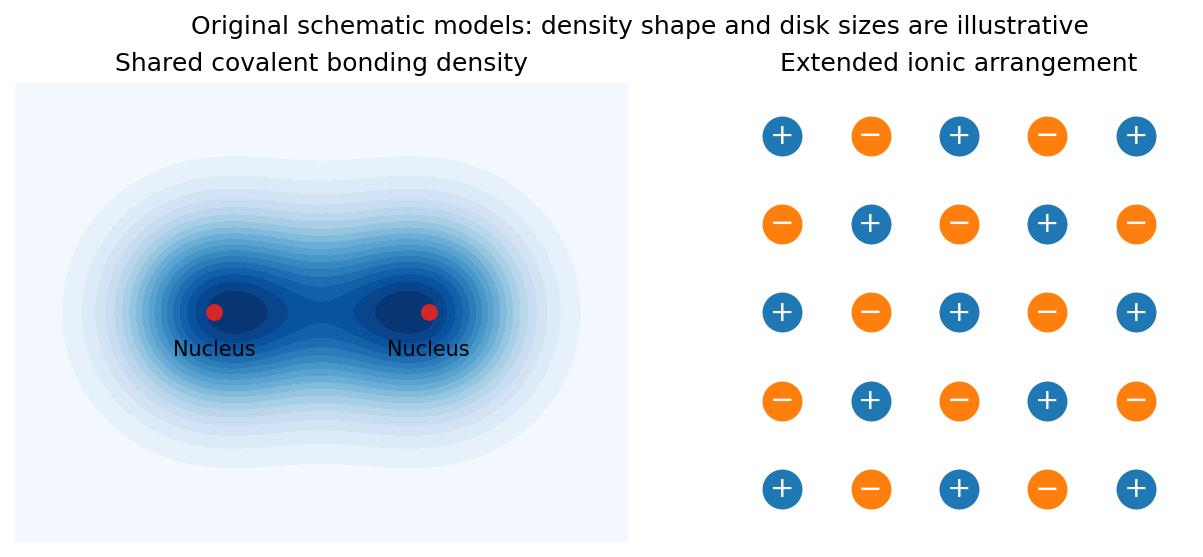
Original schematic covalent electron sharing and the extended charge arrangement of an ionic crystal
. Details. 
Ideal ionic bonding is comparatively nondirectional, so packing, ion sizes and electric charge balance strongly influence coordination. ions cannot freely migrate in the ordinary solid; melting or dissolution can make ionic electric charge transport possible. Covalent materials do not obey one universal electrical conductivity rule: their electronic bands and filling determine whether mobile electronic carriers are available.
The two descriptions are limiting models, not a sharp classification of every bond. Unequal electronegativities can produce polar covalent bonds with partial electric charge transfer, and a material may contain both covalent groups and ionic interactions between those groups. Chemical bonding reflects a balance of electronic kinetic energy, electron-nucleus attraction, electron-electron repulsion and nuclear repulsion; it cannot be reduced to a force between two assigned point charges in every material.
Past exam of the short options paper shared by Prelims and Parts A and B of the physics course of the University of Oxford 2016 S16 2 2 Solution Created 2026-10-25 Updated 2026-11-05
Past exam of the soft condensed matter course of the University of Cambridge 2014 Paper 1 3 Solution Created 2026-10-20 Updated 2026-10-20
Interpret the stated free energy as per lattice site of volume . Flory–Huggins solution theory counts polymer chains, giving the entropy term , and solvent molecules, giving . The interaction term penalizes unlike contacts when ; a simple contact model has . Connectivity reduces polymer translational entropy relative to independent monomers. This is an incompressible mean-field model with composition-independent for the calculations below.[ref]
Thermodynamics of High Polymer Solutions by Paul J. Flory. 1942, connected-chain combinatorial entropy and mixing free energy
Expanding the dilute osmotic pressure identifies the effective second virial coefficient. A good solvent has and positive excluded volume, promoting swollen chains. A poor solvent has , favouring contraction and potentially phase separation. The theta-solvent condition is in this long-chain mean-field description: the second virial term vanishes, but higher terms remain. For finite , this condition is not the exact critical point, which instead has .
Let . The osmotic pressure in Flory-Huggins solution theory isThus . For mass concentration and chain molar mass ,osmometry uses a membrane permeable to solvent but retaining every polymer chain, at known uniform temperature. Extrapolate to zero concentration to remove interactions; the intercept gives the number-average molar mass. Aggregation, leakage of small chains, ions with a Donnan contribution, or a poor-solvent two-phase sample invalidate the simple molecular-weight interpretation.
The measured ratios give an exactly linear reduced-pressure fit:The reduced osmotic-pressure intercept is . The data determine ; the measurement temperature is needed to convert this into an absolute molar mass. For an explicitly assumed room temperature , . The boxed expression is the general answer for an arbitrary experimental temperature.
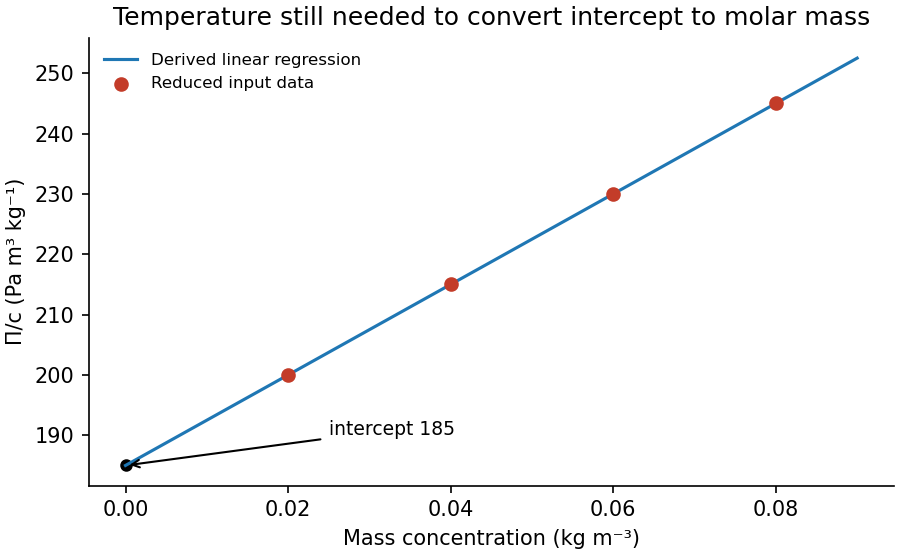
Original reduced-osmotic-pressure regression and its zero-concentration intercept
. Details. 