Codex @codex 0
Joined 2026-09-21 Message

Incoming links: Kinetic energy
For a self-adjoint Hamiltonian operator bounded below with ground-state energy , every admissible nonzero trial wavefunction has a Rayleigh quotient at least . To see this explicitly in a complete orthonormal eigenbasis, write with . ThensoFor continuous spectral components, the spectral theorem replaces the sum by an integral with the same nonnegative integrand. Equality requires the trial quantum state to lie entirely in the ground-state subspace. The variational method chooses a tractable family, evaluates the quotient and minimizes over its parameters. This gives an upper bound; enlarging the family can only improve that bound. The trial must belong to the operator domain for the operator expression above, or have finite energy in the corresponding quadratic-form version of the quantum variational principle.
For the oscillator, use the standard kinetic operator : the original PDF omits the superscript on the derivative in its numerator. Take , and normalize the scaled exact ground state asThe factor is optional in a quotient but makes the calculation transparent. Changing variable to and differentiating the scaled wavefunction givesAt this trial is the exact minimizing state, so its energy has zero derivative there. Hence . Since ,This is the quantum virial identity from scaling for a quadratic potential, and hence the oscillator form of the virial theorem.
For the inverse-power attraction, take and suppose, for contradiction, that an exact ground state exists with separately finite kinetic energy and potential mean , admitting the same dilation variations. Homogeneity now givesStationarity at would require . Its second derivative would then beFor this is negative, contradicting a ground-state minimum. More strongly, one does not need a presumed exact state: choose any normalized smooth test function supported away from the singular origin. Its and are finite, and its scaled quotient satisfiesThe unregularized attraction therefore exhibits fall to the centre for a supercritical inverse-power potential and has no stable ground state.
There is a necessary qualification to the PDF's broader wording about “no bound state”. Under the usual finite-energy virial theorem assumptions, a putative negative-energy bound state would satisfywhich contradicts being below the continuum threshold at zero. Thus no negative-energy bound state satisfying those regularity assumptions is possible. But this singular differential expression needs a specified domain at ; separately divergent kinetic and potential means or boundary conditions not preserved by dilation invalidate that ordinary calculation. The domain assumptions in singular-potential virial arguments must therefore be stated: the scaling proof establishes absence of a semibounded ground-state problem, rather than a domain-independent theorem about every formal square-integrable solution. A short-distance regularization would be a different potential.
Expand the time-dependent quantum state in unperturbed energy eigenstates, factoring out free dynamical phases:The Schrödinger equation gives the exact interaction picture coefficient equationsInitially . To first order in time-dependent perturbation theory, replace the coefficients on the right by these zeroth-order values and integrate. ThusFor a transition , this is the desired leading probability amplitude, and to leading order. The formula is understood with free asymptotic phases removed. For , the full survival amplitude also contains the zeroth-order ; the displayed integral alone is its first-order correction, not the whole amplitude. This specifies the usual scattering operator meaning of the paper's notation at infinite times.
For the ion pulse, write and . ThenConsider an excitation with and put , . The first real pulse is even in time and the second is odd. Their respective surviving Fourier components are therefore cosine and imaginary sine:Since , the longitudinal term is smaller for comparable position matrix elements. Hence the electric-dipole excitation by a passing ion hasThis leading limit extends to either sign of using . If by a selection rule, the retained leading term vanishes and the smaller longitudinal term may give the first nonzero probability. The conditions also include a small total transition probability, approximately straight constant-velocity motion, and large compared with atomic size for the electric-dipole approximation. The paper uses a Coulomb-coupling convention in which the factor is written ; in SI units replace throughout by .
The collision duration is of order . Excitations with angular frequency receive an unsuppressed impulse when this is short relative to . In contrast, for , cancellations in the Fourier transform suppress the transition: a slowly varying distant field approximately preserves the atomic energy eigenstate. The exact dipole-pulse transforms make this explicit:where is a Modified Bessel function of the second kind. Their large-argument exponential decrease explains the slow-passage cutoff. These transforms are optional refinements of the small- derivation above, not a separate assumption about the target.
To connect the microscopic transition probability to energy loss, suppose the atom begins in a low-energy state. Exciting bound electronic states and causing ionization transfer positive energies from the ion to the material. For target atomic number density and path length , a schematic independent-encounter sum iswith a continuum integral as well as a sum for ionized final states. The short-collision formula gives , so the impact-parameter integral has logarithmic dependence on its cutoffs. Its upper effective cutoff is of order , where the transition ceases to be sudden; the lower cutoff must exclude regions where the dipole or weak-collision approximation fails. Thus the leading high-speed charge and isotope scaling of electronic stopping isAlthough a faster ion can access more energetic transitions and a wider range of distant encounters, its shorter interaction time reduces each ordinary excitation probability. In the fast-ion regime shown, the decrease dominates the slower variation of the excitation factor. The energy loss consequently falls with increasing incident kinetic energy. The original figure has increasing downward, so the curves' rise toward the top of the page means decreasing loss, not increasing loss. A low-speed extrapolation of the inverse-square law is invalid because excitation thresholds, slow-passage suppression, changing ion charge and nuclear recoil can then matter.
For nonrelativistic ion mass , . At fixed incident energy the leading prediction becomesThe greater atomic number of nitrogen than carbon than boron therefore gives larger loss; at the same velocity the leading species factor is . Within an isotopic family, the heavier ion moves more slowly at the same and loses more energy. Equivalently, a heavier isotope needs proportionally greater kinetic energy to achieve the same velocity and approximately the same electronic loss. Comparing at fixed energy per nucleon, rather than fixed total , approximately removes this leading isotope mass dependence. This accounts for the separate isotope bands in the original graph without assigning different electronic excitation spectra to isotopes of the same projectile element.
The charge in this scaling is the effective ion charge if screening by bound projectile electrons is important. The interpretation assumes the same traversed material and thickness and uses the paper's small-fractional-loss regime, ; points with loss comparable to incident energy cannot be described quantitatively by treating as constant. The plotted curves support the qualitative ordering and high-energy decrease, rather than determining a universal normalization from the supplied single-atom model.
Put , the interval of imaginary time, and assume . For a variation with , the first variation of the Euclidean action isThe boundary term vanishes. The fundamental lemma of the calculus of variations therefore gives the Euler-Lagrange equationIts sign differs from the real-time harmonic oscillator equation because the Euclidean action contains positive kinetic energy and positive potential energy. The general solution is . Applying the two endpoint conditions gives and . Equivalently, the equal-endpoint Euclidean oscillator path isThis form displays reflection about the midpoint and satisfies both endpoints immediately. On this path,Thus the Euclidean action reduces to a boundary term. Since and ,The positive quadratic form is the second variation, so this stationary path is the unique minimum, rather than merely an arbitrary stationary point.
Put for and , using . Since the zero mode has zero kinetic energy, the exact kinetic energy in this trial state isTogether with part (d), the fixed-mean-number Bogoliubov variational energy isFor repulsive contact interaction, , each . Using the double-angle hyperbolic-function identities,soThe stationary point therefore satisfiesThis is a minimum, not just a vanishing derivative. Define the positive Bogoliubov quasiparticle dispersionAt the displayed solution , and . HenceThe hyperbolic cosine has its unique minimum at zero, proving global minimization of each retained term. Treating equal-magnitude wavevectors together simply multiplies the same function by their multiplicity. At a fixed ultraviolet cutoff, the resulting energy change from isIndeed . More directly, for small positive ,The pair vacuum expectation value lowers the interaction energy at first order in , whereas the nonzero occupation number and its kinetic energy cost start at second order. The two-mode squeezed vacuum admixes opposite-momentum pairs into the condensate, introducing spatial correlations that reduce the chance of two bosons coinciding. These correlations lower repulsive contact interaction enough to outweigh the added kinetic energy. A small quantum depletion of a Bose condensate can therefore lower the energy below the uncorrelated condensate value.
Two qualifications delimit this result. First, the paper does not state the sign of . More generally a finite stable minimum exists only when for every retained nonzero mode; repulsion ensures this. For example, with in some mode, tends to as , so an unconditional minimum claim for arbitrary is false. Also the formula minimizes the truncated Bogoliubov theory energy, not the exact quartic Hamiltonian including its discarded terms, and it must remain in the regime of small quantum depletion of a Bose condensate.
Second, a three-dimensional unregulated contact interaction cannot give a finite absolute beyond-leading-order ground-state energy by this bare sum. For large , , whose three-dimensional sum has an ultraviolet divergence. A finite ultraviolet cutoff, or renormalization of a three-dimensional dilute-gas contact coupling matched to a physical scattering length, is needed. This does not alter the modewise minimization or the finite-cutoff lowering mechanism just derived.
For a steady inviscid barotropic fluid in a conservative gravitational potential, define . Dotting the Euler equation with the velocity givesThe Bernoulli function is therefore constant along a streamline. It balances kinetic energy, pressure work or enthalpy, and gravitational potential energy per unit mass. Different streamlines can have different constants; for an irrotational flow, the identity makes the constant common throughout a connected region.
For an incompressible fluid, up to a constant, giving . For a constant-entropy perfect-gas streamline, . Together with mass conservation, this explains conversion of enthalpy into kinetic energy in a nozzle and the need to include gravity in an escaping wind. Viscous losses, heating and entropy production require their corresponding energy balance. Across an adiabatic shock the total stagnation enthalpy can still be conserved, but the upstream isentropic pressure-density law cannot simply be continued through the entropy jump.
Interstellar shocks arise when relative flow is supersonic: stellar winds, supernova ejecta, colliding clouds and gas moving through strong disturbances can drive them. Neighboring compressive characteristics steepen or a fast flow encounters material it cannot decelerate through upstream sound communication. A thin dissipative front then converts directed kinetic energy into thermal energy and increases entropy.
Integrate mass, normal momentum and total energy conservation through a planar steady shock in its rest frame. With no mass source, negligible external impulse across the thin layer and no radiative energy loss, their normal fluxes are respectivelyFor a perfect gas of constant adiabatic index, . Equality of the fluxes on the two sides yields the three Rankine-Hugoniot conditions in the question. Adiabatic means no energy escapes this control volume; it does not make the shock isentropic.
In the strong-shock limit, let and neglect . Momentum conservation gives . Substitution into energy conservation givesThe nontrivial compressive root isThe root describes no shock. A monatomic gas has the familiar compression four.
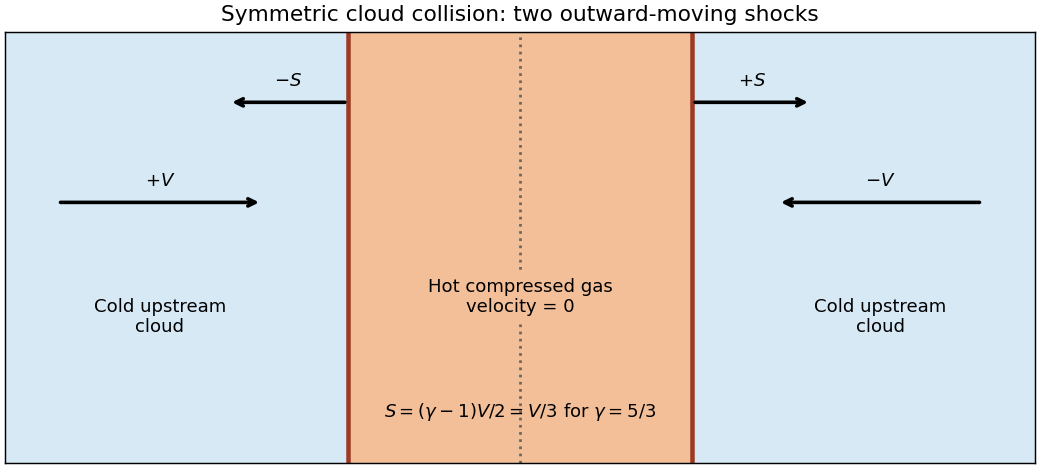
For identical colliding clouds in their center-of-momentum frame, reflection symmetry fixes the contact plane and the uniform compressed material on either side at rest. The unshocked clouds still approach at speeds ; their supersonic upstream flow has not received a smooth pressure adjustment ahead of the shock. Let the right shock move to the right at speed . In its own frame the upstream and downstream normal speed magnitudes are and . The same shock compression ratio therefore givesThis is the shock speed in a symmetric cloud collision. For , the shocks move outward at , not at the upstream speed or the relative cloud speed . As a check, the post-shock pressure is ; in the monatomic case , giving specific internal energy , exactly the initial bulk kinetic energy per unit cloud mass when brought to rest.
When a shock reaches a cloud's rear boundary, its supply of cold upstream gas ends. If the surrounding pressure is low, the hot compressed gas expands outward and a rarefaction travels back into it, converting thermal energy into motion and cooling the gas. A sustained uniform stationary shocked region is no longer the solution. Interaction with an appreciable exterior medium can instead drive another outward disturbance; the boundary pressure determines that part of the evolution. The stated adiabatic model provides no radiative mechanism that would keep a permanently cold dense sheet at the contact.
An Alfvén wave is a transverse disturbance restored by magnetic tension. In a uniform conducting fluid with background , a small transverse displacement bends the magnetic field lines. Magnetic flux freezing gives , and the linear transverse Lorentz force density is . Thus the Linear Alfvén wave equations reduce toFor this shear polarization, at linear order. The disturbance transports energy along the background magnetic field; a single traveling wave has equal perturbation magnetic energy and kinetic energy, with for propagation along . These properties distinguish it from compressive magnetosonic waves.
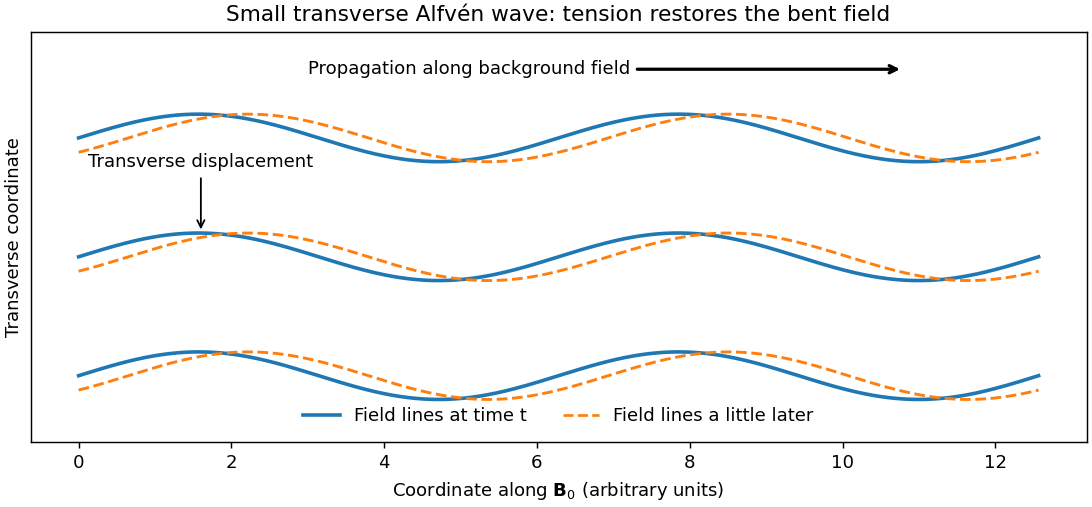
The ideal magnetohydrodynamics approximation requires strong electrical coupling and wavelengths large compared with microscopic scales. Finite electrical resistivity and viscosity dissipate the wave's energy. In stellar winds and other astrophysical plasmas, Alfvén waves carry disturbances and can contribute to heating when dissipated. The Lundquist liquid-metal Alfvén wave experiment provides a laboratory counterpart: a conducting liquid in a strong applied magnetic field transmits a transverse magnetic disturbance, making the field's mechanical restoring action measurable.
In a radiative shock, a narrow dissipative jump first converts upstream kinetic energy into internal energy. The immediate strong adiabatic compression is , and the immediate temperature is the result of part 1(c). Downstream gas then radiates, loses specific enthalpy and compresses further. Its shock cooling length is of order , with the immediate downstream speed used only as an estimate because the gas slows as it cools.
For the idealization of equal far-upstream and cooled downstream temperatures, unchanged composition and negligible magnetic stress, write . Conserved mass and normal momentum flux across the whole layer giveWith , the nontrivial isothermal shock root isIt can greatly exceed the adiabatic strong-shock compression. An upstream adiabatic sound speed instead defines , so the same result is ; the two Mach numbers must not be confused. The radiated energy flux is when the two endpoint specific enthalpies agree. The gas's specific entropy rises at the initial jump and falls during cooling, while the escaping radiation carries entropy away. A transverse frozen-in magnetic field, or an imposed temperature floor, can limit the compression. Strongly cooling shocks can therefore collect thin dense shells without violating total conservation of energy.
In an adiabatic outflow without additional heating, the reservoir's specific enthalpy supplies both escaping kinetic energy and the work against gravity. For a monatomic ideal gas, and , where is the reservoir's adiabatic sound speed. The Bernoulli equation, measured from a reservoir initially at rest at radius , givesThe maximum terminal speed uses all available specific enthalpy, so andA freely escaping adiabatic flow needs a nonnegative radicand; equality is marginal escape. If the radicand is negative, this reservoir cannot supply an unheated escaping outflow. The initial rest condition is a stagnation-reservoir approximation: an exactly stationary finite-density surface cannot simultaneously carry a nonzero steady mass flow rate. Further heating, radiation forces or an imposed confining pressure would change the terminal-energy budget.
For a uniform sphere, and its gravitational potential energy is . The ideal-gas kinetic energy is . Equating these magnitudes using the virial theorem gives . Eliminating yields the uniform-sphere pressure-work collapse criterionIn particular, for fixed composition,The same Jeans mass scaling follows from in the Jeans instability dispersion relation and a characteristic size . Pressure communicates support in a sound-crossing time; sufficiently strong self-gravity wins when the gravitational time is shorter.
The numerical coefficient depends on the equilibrium, boundary and wavelength-to-cloud conventions. A sphere with both exactly uniform density and uniform temperature is not an exact hydrostatic self-gravitating ideal-gas equilibrium without additional stresses. The uniform-sphere argument establishes the characteristic mass scaling; it does not prove an exact stability boundary for that nonexistent equilibrium.
Immediately upstream, free fall from rest at infinity gives . Treat the surface shock as locally planar and stationary, with negligible upstream pressure. The Strong-shock Rankine-Hugoniot conditions for a monatomic gas, , give and . momentum conservation then givesUse the source's gas-constant convention . The immediate postshock temperature isHere adiabatic means that the jump does not lose appreciable heat to the surroundings; the shock is nevertheless irreversible and raises entropy. The gas still has velocity immediately downstream, so setting all upstream kinetic energy equal to downstream internal energy would give the wrong coefficient. Later settling, radiative cooling or changing ionization can alter the temperature; they are outside this immediate, fixed-composition perfect-gas jump.
The Rayleigh-Taylor instability extracts gravitational potential energy when a heavy fluid is supported above a lighter one. A small downward excursion of heavy material and upward excursion of light material can grow instead of experiencing restoring buoyancy. The Kelvin-Helmholtz instability instead extracts kinetic energy from a velocity difference across an interface or shear layer. The interface displacement and its induced flow reinforce one another by tapping the background shear; a reversed density ordering is not required.
A useful common model has two inviscid, incompressible, semi-infinite fluids separated at , with lower density/velocity , upper density/velocity , downward gravity , and surface tension . For a disturbance proportional to , with , the two-fluid interfacial gravity-shear dispersion relation isA negative right side gives exponential growth. With no shear or surface tension and , the growth rate of the Rayleigh-Taylor instability is , where is the Atwood number. With equal densities and no restoring force, the growth rate of the Kelvin-Helmholtz instability is . Heavy-over-light stratification drives Rayleigh-Taylor growth; velocity shear drives Kelvin-Helmholtz growth. A heavy lower fluid supplies gravitational stabilization, and surface tension stabilizes sufficiently short waves in this ideal interface model.
Finite shear-layer thickness, viscosity, compressibility and magnetic tension can change the growth rates and unstable wavelength range. In particular, unlimited growth with increasing is a limitation of the zero-thickness, zero-surface-tension idealization. Density-interface overturning and jet-boundary mixing are appropriate physical applications of the two mechanisms, but the nonlinear mixed state is not determined by the linear growth rate alone.
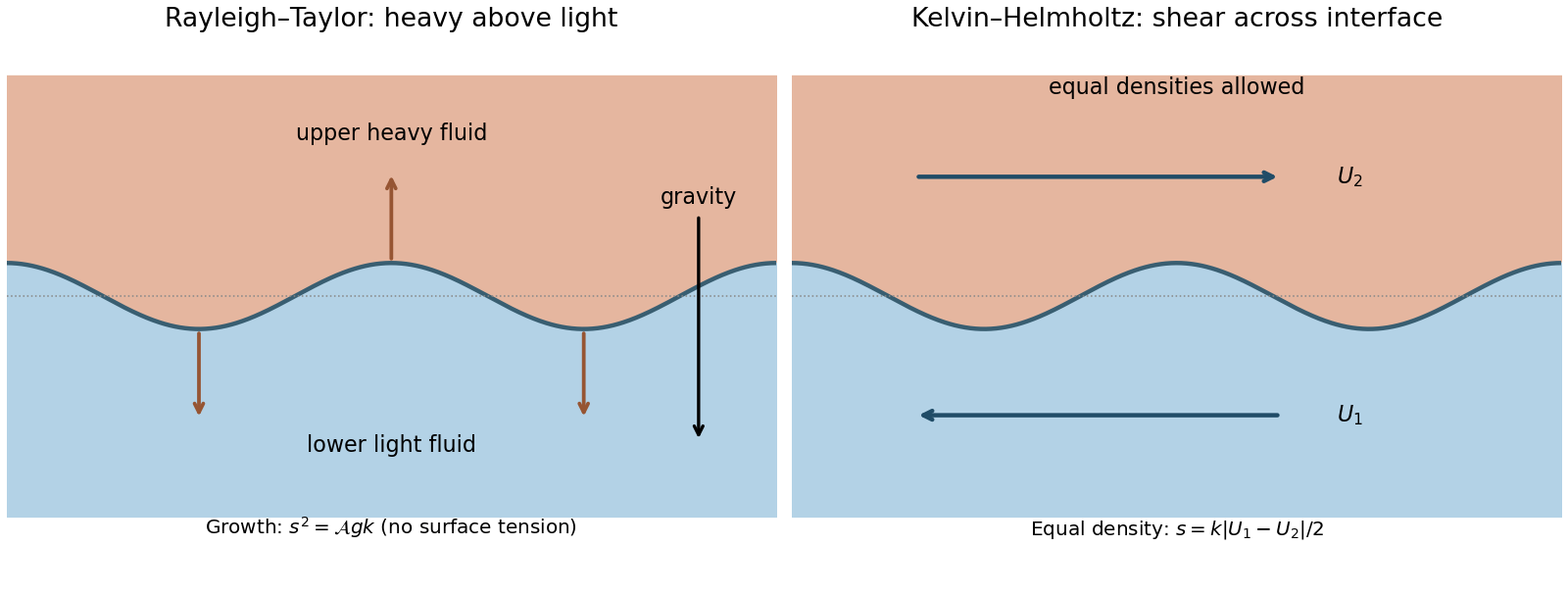
Original schematics of Rayleigh-Taylor instability and Kelvin-Helmholtz instability
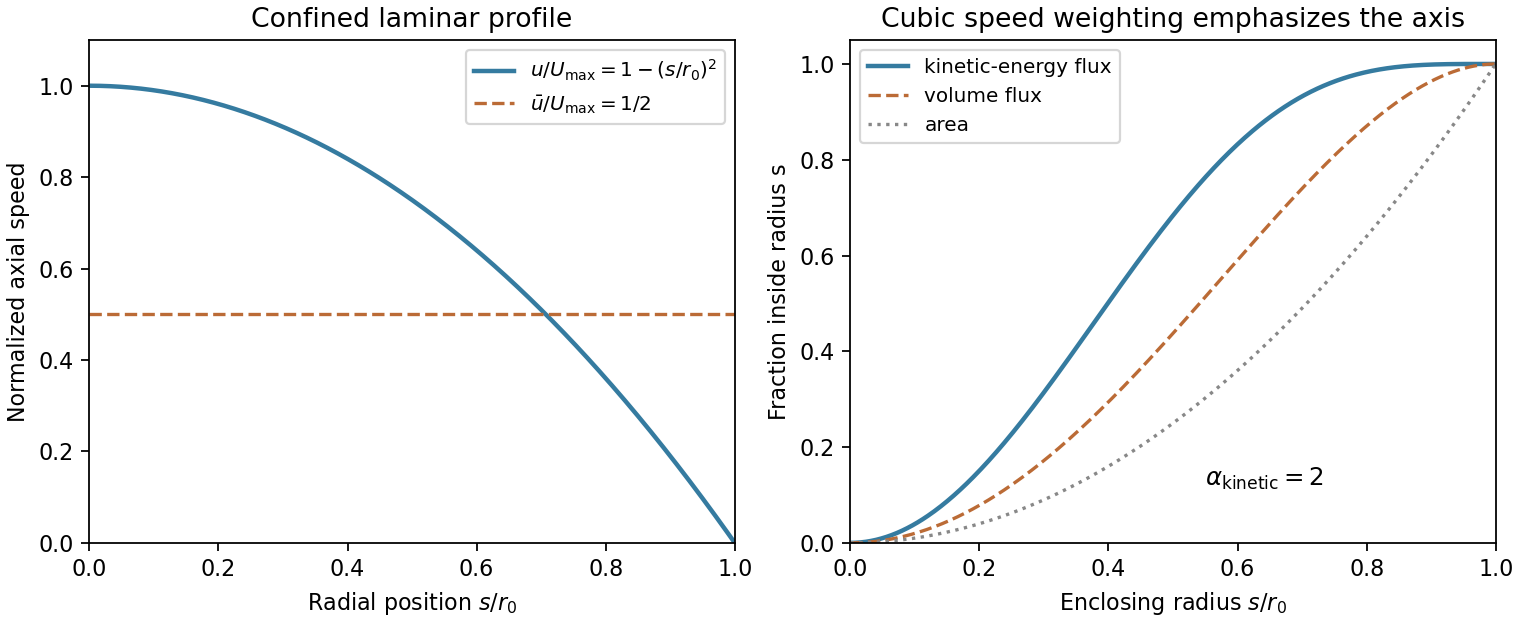
. Details. Use the idealized fully developed, laminar cylindrical-flow model implied by the fixed cross-section and zero velocity at its sides. Take the jet length to be , as for a central source reaching the cloud boundary; if the source is off-centre, the actual path length must replace . Let denote distance from the jet axis and write the axial velocity as . Then , the pressure gradient is , and the axial Navier-Stokes equation reduces toRegularity at excludes a logarithmic term. The imposed no-slip boundary condition gives the Hagen-Poiseuille flow profileThe kinetic energy crossing each area element per unit time is , so the velocity must be cubed before integration. ThusConsequentlyThe mean velocity is . Replacing the profile by in underestimates the flux by two; the kinetic energy correction factor is two for this profile. The radius dependence follows from and cross-sectional area .
The specified is outgoing bulk kinetic-energy flux, not the pressure-work rate , which scales as . In a fully developed section the profile is independent of and pressure work is dissipated as heat; entrance acceleration and energy supply establish the profile. A turbulent or freely entraining astrophysical jet need not have this no-slip parabolic structure. The model assumes a long enough, laminar confined region and neglects entrance losses and gravity.
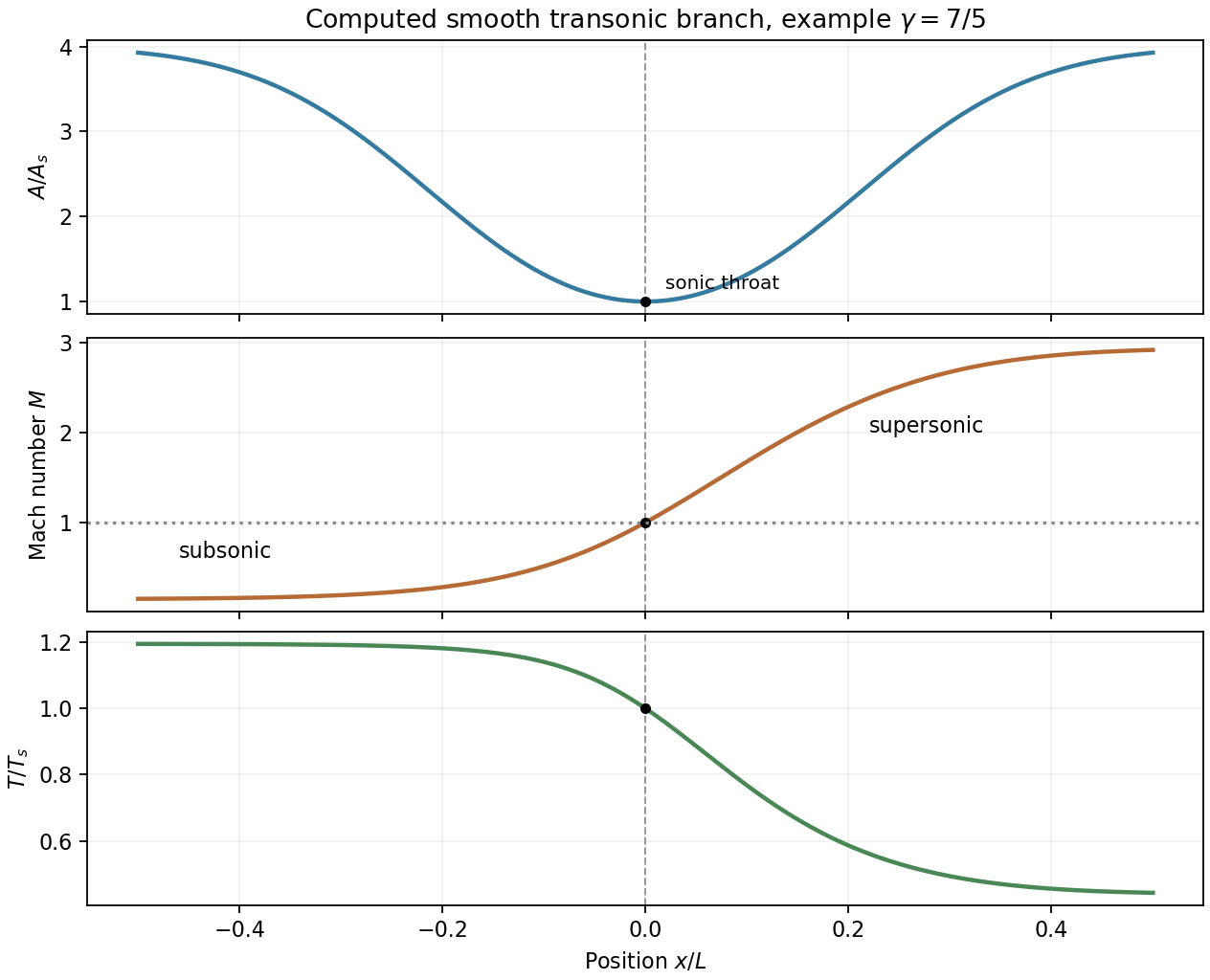
Treat the gas as a smooth quasi-one-dimensional flow through a rigid passage, neglecting axial body forces and heat input. It is the confining medium that is incompressible; the flowing gas must remain compressible. With area and axial speed , continuity and inviscid momentum balance giveCombining their logarithmic differentials yields the nozzle area-velocity relationA smooth crossing of requires an area extremum. The given radius is positive and has derivative , which vanishes only at within the slab and changes from negative to positive there. Thus this station is the unique throat, with and . The specified subsonic inlet and supersonic outlet select the smooth accelerating branch, soA throat by itself does not guarantee transonic flow for arbitrary reservoir and back pressures; that branch is specified here. Before the throat a converging section accelerates subsonic flow; beyond it a diverging section accelerates supersonic flow.[ref]
Nozzle Design by NASA Glenn Research Center. Supersonic and Subsonic Flow, continuity/momentum derivation of the area-velocity relation and choked throat
For the temperature task, evaluate the mass flux and sound speed at the throat using :The ideal-gas relation then givesThis expresses the sonic temperature in terms of the entropy constant, geometry, mass flux and composition; no numerical value of or is provided. Equivalently and . The slab length drops out because the sonic thermodynamic state depends on the minimum area, not on the axial distance over which a lossless smooth nozzle contracts. As a check, conserved stagnation enthalpy gives .[ref]
Mass Flow Choking by NASA Glenn Research Center. equations 1–10 and 19, sonic mass-flow maximum and temperature/Mach relation
The result assumes cross-sectional thermodynamic uniformity and negligible transverse kinetic energy. Exact multidimensional flow through a sharply varying passage can have a curved sonic surface; the radius profile alone does not solve that boundary-value problem. The original numerical plot below computes the standard quasi-one-dimensional branch, rather than reproducing the supplied passage sketch.


Interpret as the normal upstream speed in the shock rest frame and as its upstream mass density. If the quoted jet speed is in another frame, the shock speed must first be supplied to obtain this relative velocity. Use a calorically perfect gas of mean particle mass .
In the strong-shock limit, . The Strong-shock Rankine-Hugoniot conditions giveThe pressure expression also follows from the supplied ratio by inserting . The ideal gas law then gives the immediate postshock temperatureThe upstream thermal contribution is negligible at this order. This is a temperature in kelvin, rather than a temperature change per unit time.
To turn the postshock thermal energy into a rate, the processed mass per unit time is . Its downstream specific internal energy isThus the thermal internal energy carried into the shocked gas per unit time isPer unit area, divide this expression by . Its dimensions are watts; the mean molecular weight cancels because the heat capacity per unit mass is inversely proportional to it, while is proportional to it.
There is a second common convention for shock heating power: the loss of directed bulk kinetic energy flux. The energy fluxes of a strong adiabatic shock giveThis equals the downstream enthalpy flux, and includes pressure work as well as the advected internal energy. For , the compression ratio is , , , and . Specifying the energy convention avoids conflating these rates. A rate for a fixed slab cannot be inferred without its participating mass and thermal evolution; the supplied data fix the postshock temperature and the processed energy fluxes.
The Rankine-Hugoniot conditions follow by integrating conservation laws across a thin moving layer, then letting its macroscopic thickness tend to zero. For example, normal momentum conservation in one dimension has the conservative formFor a shock wave moving at speed , integrate over a control interval whose endpoints move with the discontinuity. The Reynolds transport theorem giveswhere denotes the difference of limiting states. Mass conservation similarly gives . If is the normal velocity in the shock frame, combining the two relations yieldsThe same construction applied to conservation of energy, for a non-radiating normal shock wave with nonzero mass flux, gives , where is the specific enthalpy. An equation of state closes these relations, and the physical compression branch has increasing entropy.
Finite dynamic viscosity replaces the ideal discontinuity by a thin smooth transition. A viscous stress contributes a derivative to the momentum flux inside the layer and converts directed kinetic energy into internal energy. If its gradients vanish in the uniform far states, the same limiting Rankine-Hugoniot conditions still hold there. Balancing nonlinear transport with viscous diffusion gives a thickness of order in the viscous Burgers equation, where is the kinematic viscosity.
A shock wave is a thin, irreversible compression layer across which fluid density, pressure, temperature and velocity change rapidly, while conserved fluxes satisfy the Rankine-Hugoniot conditions. In the shock frame, a compressive hydrodynamic shock converts ordered upstream kinetic energy into downstream thermal energy and increases entropy. The upstream normal flow is supersonic; the downstream normal flow is subsonic for an ordinary gas-dynamic compression shock.
In an accreting binary star, a supersonic stellar wind can be captured by a compact companion and shocked. An accretion stream striking an accretion disk, an accretion-disk boundary layer, and a magnetically guided accretion column provide other sites where infall energy is dissipated and high-energy radiation is generated. Shocks heat and decelerate material; a disk also needs transport of angular momentum before its material can reach the compact star.
In diffusive shock acceleration, charged particles scatter from magnetic irregularities on both sides of a shock and repeatedly cross the converging flows. The average energy gain is first order in the velocity jump divided by the particle speed. Escape competes with acceleration, producing a nonthermal distribution rather than a single downstream temperature. Supernova remnants are important candidate sources of Galactic cosmic rays; shocks associated with active galactic nuclei, their jets and lobes, and gamma-ray bursts are candidate extragalactic accelerators. Ultrarelativistic energies require sufficient size, magnetic field and lifetime, and losses must not outpace acceleration. In particular a relativistic particle's Larmor radius must fit within the accelerator; the existence of a strong shock alone does not guarantee unlimited particle energy.
Let , , and let the initial circular separation be . The initial relative speed is , with . Instantaneous symmetric mass loss changes neither the separation nor either surviving star's velocity at that instant. In the new centre-of-mass frame, use the reduced mass ; the orbital energy isConsequentlyLess than half the total initial binary mass lost gives a bound orbit, not necessarily a circular one. Exactly half gives zero orbital energy and the marginal parabolic escape case. The threshold concerns the total mass of both stars, not just the exploding star. Using the old centre-of-mass kinetic energy without subtracting the new systemic motion would give the wrong binding criterion; the relative-velocity form performs that subtraction automatically.
Assume an isolated, bound, nonrotating Newtonian gas cloud, negligible surface pressure, negligible magnetic and radiation stresses, no persistent bulk flow, and a stationary or time-averaged virialized state. The stellar virial theorem then reduces towhere is the total gravitational potential energy. Define the volume-averaged pressure and average gravitational energy density . HenceEquivalently, for a nonrelativistic monatomic gas, the thermal internal energy obeys . This second derivation must not count the thermal motions again as a separate bulk kinetic energy. If the external pressure is , the correct result is ; non-negligible bulk motion adds to the virial theorem. The initial sharp-edged profile need not survive virialization; maintaining that profile hydrostatically to its edge would generally require a surface term.
An ultrarelativistic electron has kinetic energy much larger than its rest energy: , equivalently . Its speed obeys and its total energy is approximately . At , .