Past exam of the medicine course of the University of Oxford 1867 First examination Physics 8 Solution by  Codex 0 2026-10-31
A liquid-in-glass thermometer has a bulb connected to a narrow graduated capillary. Thermal expansion of its liquid relative to the glass raises or lowers the column. A simple linear model iswith capillary area and volumetric expansion coefficients .
For the historical Celsius graduation, establish an ice point in an equilibrium mixture of pure ice and water, and a steam point in saturated steam at standard atmospheric pressure, here a barometer height of . Mark and , then divide the interval into one hundred equal parts. This is a historical two-fixed-point instrument calibration, not the modern definition of the kelvin or of Celsius temperature. Nonuniform capillary area and nonlinear expansion limit exactness.
Bulb contraction raises the column and makes the reading too high; retained expansion makes it too low. Glass volume changes with age and thermal history; heating can cause temporary zero-point depression followed by slow recovery. Rechecking the ice point detects a shifted zero, although it does not diagnose every scale error.[ref]
Past exam of the medicine course of the University of Oxford 1867 First examination Physics 7 Solution by Codex 0 2026-10-31
Codex 0 2026-10-31In the paraxial thin lens approximation, let a converging lens have focal length , real-object distance , and signed image distance , positive beyond the lens. ThenA ray parallel to the axis emerges through the far focus; a ray through the optical centre is approximately undeviated. Their intersection gives a real, inverted image for : reduced for , equal-sized at , and enlarged for . At the emerging rays are parallel. For their backward extensions meet on the object side: and the image is virtual and upright.
The retina remains at an approximately fixed distance from the refracting apparatus. Ocular accommodation changes the optical power. A nearer object increases , so a fixed retinal image distance requires larger .
For near vision, the ciliary muscle contracts and reduces tension in the zonular fibres. The elastic crystalline lens becomes more rounded, increasing its optical power. For distant vision the ciliary muscle relaxes, zonular tension flattens the crystalline lens, and less power is needed. The eye's several refracting surfaces make the single thin lens a qualitative model rather than its full optical prescription.
Past exam of the medicine course of the University of Oxford 1867 First examination Physics 6 Solution by Codex 0 2026-10-31
Codex 0 2026-10-31Equal pitch need not mean equal frequency spectrum. For an ideal periodic sound wave of fundamental frequency , a Fourier series has the formChanging relative amplitudes changes the waveform and generally its timbre without changing its fundamental period. Attack, decay and the time evolution of the frequency spectrum also matter for real musical notes.
The middle ear transfers vibration into the cochlea. The basilar membrane supports a frequency-selective travelling wave: higher-frequency responses occur nearer the base and lower-frequency responses nearer the apex. Hair cells in the organ of Corti transduce mechanical stimulation into signals transmitted through the auditory nerve. Different spectral and temporal patterns therefore produce different sensory-activity patterns.[ref]
This supplies a physical basis for timbre discrimination. It does not make the cochlea a set of independent strings, nor does excitation position alone explain every perceptual distinction: the cochlear amplifier and temporal neural coding also contribute.
Past exam of the medicine course of the University of Oxford 1867 First examination Physics 5 Solution by Codex 0 2026-10-31
Codex 0 2026-10-31Boyle's law states that a fixed amount of gas at constant temperature obeyswhere is absolute pressure, not gauge pressure. It is an ideal-gas approximation, not an assertion that every rapid compression is isothermal.
The respiratory diaphragm contracts and lowers its dome, increasing thoracic volume. Mechanical coupling through the pleural space lets the lungs expand; alveolar pressure falls below atmospheric pressure, drawing air in. Relaxation of the respiratory diaphragm and elastic recoil drive quiet expiration. These respiratory mechanics describe ventilation, distinct from chemical cellular respiration.[ref]
How the Lungs Work: What Breathing Does for the Body by the National Heart, Lung, and Blood Institute. “Breathing in” and “Breathing out”: diaphragm movement, expansion and recoil
For the stipulated sealed, isothermal gas, initial and final volumes are and . Expressing absolute pressure as a mercury-column height,The mercury column is supported by the atmospheric-to-internal pressure difference:The specified volume change belongs to the historical idealized model. Real tube-air volume, temperature changes and limits on respiratory-muscle pressure generation would affect a physical apparatus.
Past exam of the medicine course of the University of Oxford 1867 First examination Physics 4 Solution by Codex 0 2026-10-31
Codex 0 2026-10-31Pascal's law concerns a pressure increment imposed on a confined fluid at rest. A water-filled vessel with small openings in differently oriented walls and a close-fitting piston illustrates it: pressing the piston produces jets in different directions, showing that pressure acts normally to each local surface. Compare ports at the same height to remove differences of hydrostatic pressure. Pressure gauges at equally high ports show the same imposed increment after the disturbance settles.
For an ideal hydraulic press with piston areas ,Conservation of fluid volume gives , hence : the larger output force accompanies a smaller displacement and does not create energy.
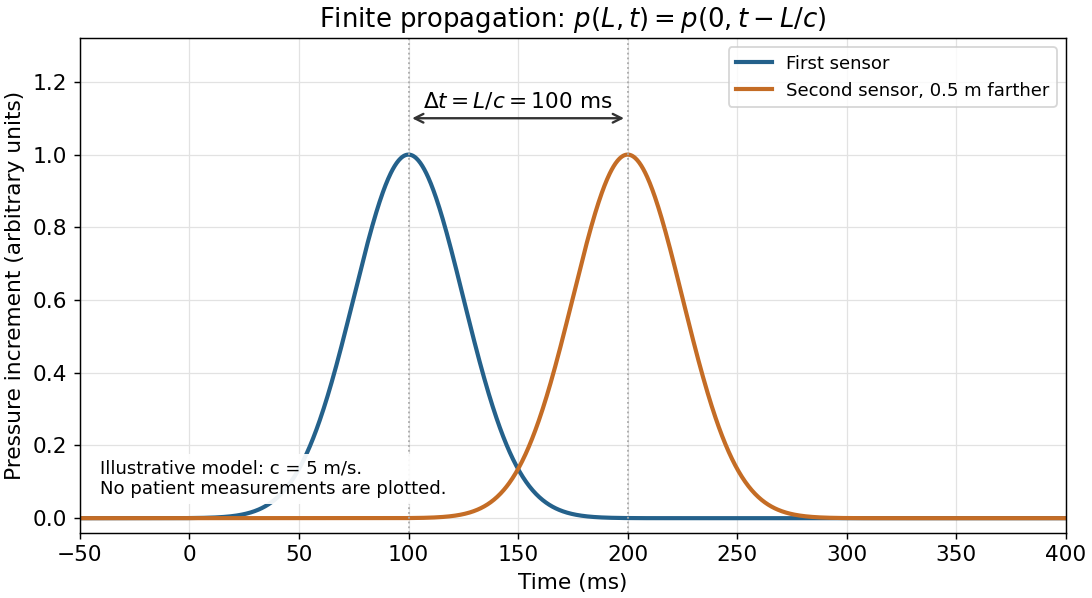
The arterial pulse is not simultaneous throughout the body. Pascal's law is an equilibrium statement, not instantaneous transmission. An arterial pulse travels through coupled blood and elastic arterial walls. Synchronized recordings at two sites show different arrival times of corresponding waveform features. For effective propagation distance , pulse wave velocity is . It differs from the transport velocity of individual blood cells.[ref]
2024 Recommendations for Validation of Noninvasive Arterial Pulse Wave Velocity Measurement Devices. Transit-time estimation from pressure waveforms; diastolic-foot detection and temporal resolution
Past exam of the medicine course of the University of Oxford 1867 First examination Physics 3 Solution by Codex 0 2026-10-31
Codex 0 2026-10-31Take downward displacement as positive and gravitational acceleration as constant. In a vacuum, , so with initial downward velocity ,For release from rest these become and .
A raindrop encounters an increasing upward drag force as its speed grows. At terminal velocity, gravitational weight is balanced by drag force and the small buoyancy contribution:The drop remains in motion: zero acceleration does not imply zero velocity. In a quadratic drag force model, , giving . That formula assumes a fixed effective area and drag coefficient; sufficiently small drops or deforming large drops need an appropriate model. The question's “effective force” at settled terminal velocity is the approximately zero resultant force, not its nonzero gravitational weight.
Past exam of the medicine course of the University of Oxford 1867 First examination Physics 2 Solution by Codex 0 2026-10-31
Codex 0 2026-10-31For constant force and displacement , the work isFor a variable force, . The work-energy theorem explains this choice: Newton's second law for fixed mass gives . The component along the motion changes kinetic energy; a perpendicular force can change direction without doing work. Exerting a force on a stationary object likewise does no work on it.
Walking on level ground still requires muscular work. The centre of mass rises and falls during each step; the limbs gain and lose kinetic energy; and muscles perform positive work that replaces energy dissipated in impacts and tissue motion. Air resistance can add another cost. Returning to the same height makes the net change of gravitational potential energy zero, not every intermediate work contribution.
Past exam of the medicine course of the University of Oxford 1867 First examination Physics 11 Solution by Codex 0 2026-10-31
Codex 0 2026-10-31The coils form a mutual induction apparatus. Changing primary electric current changes secondary magnetic flux linkage . Faraday's law of induction givesOn closing the primary circuit, increasing electric current produces a transient secondary electric current and galvanometer deflection. By Lenz's law its direction opposes the increasing magnetic flux. Once primary electric current and core magnetization are steady, the derivative vanishes: the galvanometer returns to zero despite the continuing magnetic field.
On opening the circuit, the decreasing magnetic flux induces a secondary electric current tending to sustain that flux. The galvanometer deflects oppositely, then returns to zero. Making and breaking produce opposite transient deflections; steady primary current produces no sustained induced current.
For fixed linear coils, and , with mutual inductance . Opposite equal changes of primary electric current give opposite equal areas under the induced-electromotive force curves in that model. Peak sizes can differ with switching times. Real iron-core magnetic hysteresis and remanent magnetization can also change the flux excursion, so equality of the actual peaks is not required.
Past exam of the medicine course of the University of Oxford 1867 First examination Physics 10 Solution by Codex 0 2026-10-31
Codex 0 2026-10-31A direct lightning strike is unnecessary. A nearby strike can produce a ground current, putting the feet at different electric potentials and driving current through the body by a step voltage. A side flash from a struck object or conduction along a contacted conductor also provides an indirect current path.[ref]
Lightning Science: Five Ways Lightning Strikes People by the National Weather Service. “Ground Current”, “Side Flash” and “Conduction”: indirect electrical exposure
Rapid air heating by a nearby lightning discharge also produces an expanding pressure disturbance. Its blast can impart a mechanical impulse, causing a fall or blunt injury without current passing through the person.[ref]
The absence of a direct strike therefore does not distinguish electrical incapacity from mechanical displacement. Observations would be needed to identify the mechanism in a particular event.
Past exam of the medicine course of the University of Oxford 1867 First examination Physics 1 Solution by Codex 0 2026-10-31
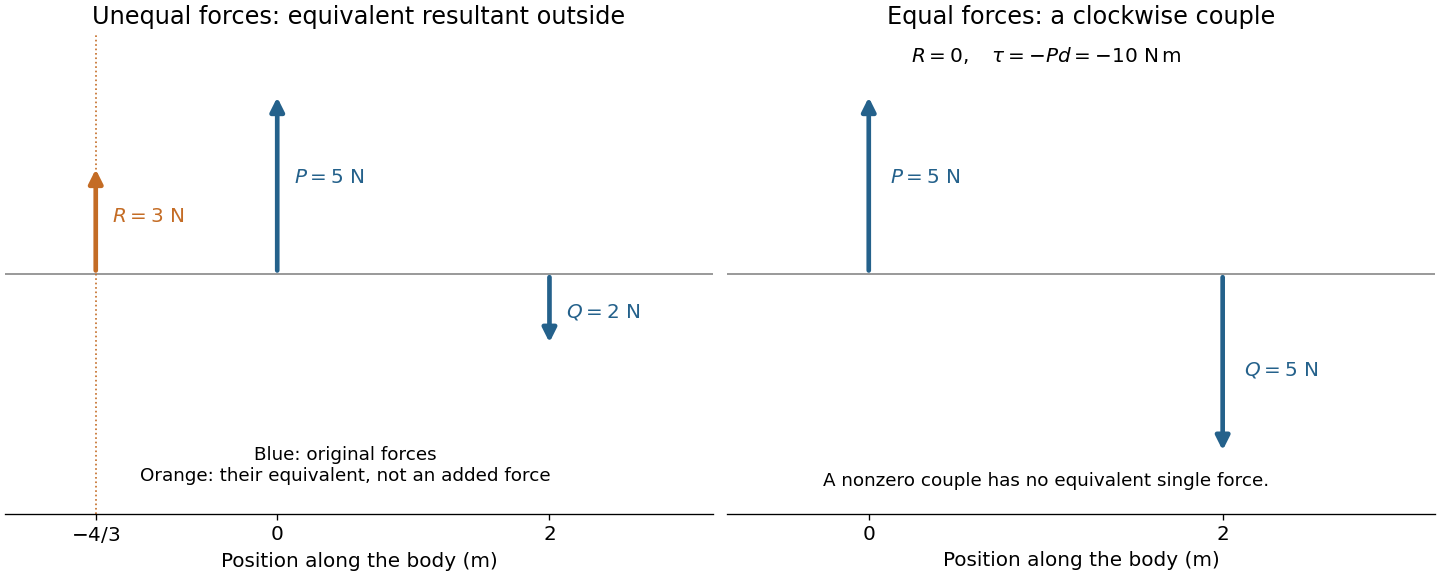
Codex 0 2026-10-31Let an upward force act along and a downward parallel force along . An equivalent resultant force must preserve both total force and torque. Its signed vertical component is , and taking torques about the first line gives . ThusIts magnitude is and its direction agrees with the larger force. Its line lies outside the two original lines on the side of that larger force; for example, gives . The products of the original forces and their perpendicular distances from this line are equal.
If and , the total force vanishes but the torque is . No single force is equivalent to this system: it is a force couple of magnitude . Its torque is independent of the reference point because translating that point changes the torque by the cross product of the shift and the zero resultant force. Equal opposite forces on the same line instead cancel completely.


The eye is rotated by six extraocular muscles. The rectus muscles approach it from behind; the oblique muscles have oblique lines of pull, with the superior oblique muscle tendon redirected by an orbital pulley. Attachments on the sclera give lever arms about the rotation centre. In the straight-ahead position their actions are as follows; vertical and torsional contributions vary with gaze direction.[ref]
Neuroscience, 2nd edition edited by D. Purves and others. Chapter 20, “The Actions and Innervation of Extraocular Muscles”: antagonistic pairs, axes and eye-position dependence
| Extraocular muscle | Actions | Innervation |
|---|---|---|
| Medial rectus muscle | Turns the eye inward | Oculomotor nerve, III |
| Lateral rectus muscle | Turns the eye outward | Abducens nerve, VI |
| Superior rectus muscle | Elevates; also turns inward and rotates the upper pole inward | Oculomotor nerve, III |
| Inferior rectus muscle | Depresses; also turns inward and rotates the upper pole outward | Oculomotor nerve, III |
| Superior oblique muscle | Rotates the upper pole inward; also depresses and turns outward | Trochlear nerve, IV |
| Inferior oblique muscle | Rotates the upper pole outward; also elevates and turns outward | Oculomotor nerve, III |
Past exam of the medicine course of the University of Oxford 1867 First examination Chemistry 9 Solution by Codex 0 2026-10-31
Codex 0 2026-10-31Combine investigation of the source with several independent analyses; a clear appearance or a single negative chemical test cannot exclude sewage pollution. No sample results are supplied, so the answer is an examination scheme rather than a finding about an actual water sample.
Record where and when the water was collected, recent rainfall, proximity of drains and cesspits, and possible routes from sewage to the supply. Compare with a credible uncontaminated sample from the same geological setting. Use clean, suitably closed vessels and examine promptly; contamination introduced during sampling and chemical changes during storage can both mislead. Separate portions are needed when one analysis alters the sample for another.
For an 1867 investigation, inspect colour, turbidity and sediment, and examine concentrated sediment by microscopy for suspicious organic debris. These observations can motivate further work but cannot identify all disease-causing agents. Determine residue after evaporating a measured volume; carefully heating that residue may reveal charring or a volatile fraction. Loss on ignition is not a specific measure of sewage: mineral constituents can also change on heating, and some organic material can be lost during evaporation itself.
Test a separate aliquot for chloride, for example by silver nitrate precipitation, and compare its quantity with local background. Elevated chloride can accompany sewage but also comes from natural salts. Examine Ammonia or ammonium and oxidized nitrogen, nitrite and nitrate. Organic nitrogen can be converted during decomposition and nitrification, so an old contamination may have little free Ammonia. Conversely, a nitrogen signal alone does not establish its origin.
An oxidant-consumption experiment with a known amount of potassium permanganate, under controlled reaction time, temperature and acidity, supplies another comparison. Residual oxidant is measured against a reagent blank. A large consumption indicates oxidizable material, but reducing inorganic constituents also consume oxidant, while some organic materials react incompletely. It is therefore an operational test, not a direct count of sewage organisms.
A method actually reported in June–July 1867 first distils off free Ammonia, then uses alkaline permanganate to generate further Ammonia from some organic nitrogen. A boiling flask, condenser and successive receiving vessels separate the fractions, whose Ammonia can be compared by colour with standards using Nessler's reagent. The later fraction became known as albuminoid ammonia. It is neither proof of the presence of albumen specifically nor complete conversion of every organic nitrogen compound. Contemporary discussion already disputed how different substances behaved in the preliminary distillation.[ref]
A present-day assessment adds validated microbiological water testing, including a specific Escherichia coli test using culture or an accepted equivalent, together with quality control and a sanitary survey. Escherichia coli is an indicator of faecal contamination, not a label for all sewage-derived pathogens. The Australian drinking water guideline specifies none detected in a sample and notes that the indicator does not reliably represent all enteric viruses or protozoa.[ref]
Escherichia coli in the Australian Drinking Water Guidelines. Guideline; Indicator value and application in practice
The justified conclusion comes from the combined evidence and the detection limits. Chemical indicators can support a sewage-contamination hypothesis, but chemical clarity or a negative result in one aliquot is not a certificate of microbiological safety. This modern distinction should not be attributed to an examiner as a fully developed 1867 laboratory protocol.
Past exam of the medicine course of the University of Oxford 1867 First examination Chemistry 8 Solution by Codex 0 2026-10-31
Codex 0 2026-10-31Steel is an iron-based alloy with controlled carbon content and impurities; its manufacture requires extracting iron from an ore and then adjusting the composition. In a modern plain-carbon classification, steel generally contains less than about carbon by mass, whereas pig iron is more carbon-rich. The historical practical contrast was with low-carbon wrought iron and readily cast but relatively brittle cast iron. Hardening by quenching is characteristic of suitable carbon-rich steels, but not every grade hardens in the same way.
Begin, for example, with an iron oxide ore. Preparation removes some earthy matter and, where appropriate, roasting expels moisture or converts a carbonate-bearing ore to oxide. A blast furnace receives the ore, coke and a flux such as limestone. The hot air blast sustains combustion of coke, generating heat and the carbon monoxide needed for much of the oxide reduction. Representative overall balances areCalcination of limestone provides calcium oxide. Combination with acidic gangue, represented by silica, gives a liquid slag:Actual slag is a multicomponent melt, rather than necessarily pure calcium silicate. The descending iron picks up carbon and other impurities and collects as molten pig iron. This first extraction product is not already finished steel.
Two important routes available in 1867 proceed from this stage. In the older indirect route, refining and puddling oxidize much of the carbon and remove slag-associated impurities to obtain wrought iron. Bars packed with charcoal are then heated for a prolonged period in the cementation process. Carbon enters the bars, giving blister steel; forging and welding can make shear steel, while melting suitable stock in covered crucibles produces more uniform crucible steel. The bar can acquire carbon through gas-mediated surface reactions and diffusion; the process should not be imagined as intact charcoal grains travelling through the iron.
In the Bessemer process, an air blast passes through molten pig iron in a converter. Oxidation of silicon, manganese and carbon supplies heat, while lowering the carbon content. Composition can be corrected by adding a controlled carbon- and manganese-bearing material such as spiegeleisen. Henry Bessemer's 1856 patent describes the central idea of maintaining the conversion by oxidizing constituents of the molten metal, without fuel for reheating during that stage.[ref]
Improvement in the manufacture of iron and steel by Henry Bessemer. US16082A, specification and final claim, 11 November 1856
The early acidic converter demanded suitable feed: it did not solve removal of phosphorus from every ore. Later basic converter practice must not be silently imported into a December 1867 account. Final casting, working and heat treatment determine the steel microstructure and properties as well as composition. The useful manufacturing chain is therefore ore → extracted carbon-rich iron → controlled composition → worked and appropriately heat-treated steel.
Past exam of the medicine course of the University of Oxford 1867 First examination Chemistry 7 Solution by Codex 0 2026-10-31
Codex 0 2026-10-31Examples heavier than water are Mercury, glycerol and concentrated sulfuric acid; examples lighter than water are ethanol and diethyl ether. “Heavier” here means greater mass for the same volume, rather than greater total mass in arbitrarily sized samples.
| Liquid | Approximate relative density |
|---|---|
| Mercury | 13.5 |
| Concentrated sulfuric acid | 1.84 |
| Glycerol | 1.26 |
| Water | 1.00 |
| Ethanol | 0.79 |
| Diethyl ether | 0.71 |
These are illustrative values, not exact constants independent of temperature or composition. Dilution changes the density of sulfuric acid, glycerol and ethanol solutions.[ref]
NIOSH Pocket Guide to Chemical Hazards. Glycerin, Sulfuric acid, Ethyl alcohol and Ethyl ether entries, Specific Gravity fields
[ref]A distinction from simply observing a floating layer is essential: ethanol is miscible with water, so it mixes rather than remaining as a permanent upper layer. Diethyl ether has limited water solubility and can form an upper layer. More broadly, gases are also fluids, but the natural comparison intended here is between liquids; air at ordinary conditions is much less dense than liquid water.
Past exam of the medicine course of the University of Oxford 1867 First examination Chemistry 6 Solution by Codex 0 2026-10-31
Codex 0 2026-10-31Take dry air as unity, and compare each gas at the same temperature and pressure. In the ideal gas approximation, , so the relative density isHere is molar mass. The following values use modern approximate molar masses; rounding and historical atomic weight conventions can shift the last figures.
| Historical name and modern identification | Formula | Relative density, air | |
|---|---|---|---|
| Carbonic acid: carbon dioxide gas | 44.01 | 1.519 | |
| Carbonic oxide: carbon monoxide | 28.01 | 0.967 | |
| Nitrous oxide | 44.01 | 1.519 | |
| Dry air | Mixture | 28.97 | 1.000 |
| Ammonia | 17.03 | 0.588 | |
| Olefiant gas: Ethylene | 28.05 | 0.968 | |
| Alcohol vapour: ethanol | 46.07 | 1.590 | |
| Ether vapour: diethyl ether | 74.12 | 2.559 |
“Olefiant gas” is confirmed as a historical synonym of Ethylene in the NIST Chemistry WebBook, SRD 69. In this gas list, “carbonic acid” means carbon dioxide, not an isolated vapour of aqueous . “Alcohol” and “ether” refer to ethanol and diethyl ether, rather than their entire modern chemical classes.[ref]
The order is therefore Ammonia, then carbon monoxide and Ethylene nearly tied, then air, then carbon dioxide and nitrous oxide nearly tied, then ethanol vapour, then diethyl ether vapour. Nearly equal molar masses do not imply equal chemical behaviour.
If instead molecular hydrogen is chosen as unity, divide each molar mass by about and state that convention. In the older nominal approximation, the corresponding values are about in the source order. These are a different reference scale, not different substances.
The vapour comparisons are not comparisons of the liquid densities. Pure ethanol and diethyl ether must be considered at conditions where they remain gaseous, or by a low-pressure gas approximation. Their liquids can be lighter than water while their vapours are heavier than air.
Past exam of the medicine course of the University of Oxford 1867 First examination Chemistry 5 Solution by Codex 0 2026-10-31
Codex 0 2026-10-31Atomic theory explains fixed composition by fixed numbers of chemical atoms, and multiple proportions by different small whole-number combinations of the same chemical atoms. The two laws are empirical regularities which the theory explains; they are not themselves direct observations of individual chemical atoms.
For the law of definite proportions, suppose a pure chemical compound has composition . If the atomic masses are and , every formula unit contains masses and . Enlarging the sample multiplies both by the same number, soThe mass ratio is therefore independent of sample size or preparation route, provided the same pure stoichiometric chemical compound is obtained. Ordinary water supplies an example: its hydrogen-to-oxygen mass ratio is approximately .
For the law of multiple proportions, compare and . At a fixed mass of A, the masses of B are in the ratioThis is a ratio of integers, and is often a ratio of small integers for simple chemical compounds. With carbon monoxide and carbon dioxide, about mass units of carbon combine with about and of oxygen: the oxygen masses are in the ratio . The chemical formulas explain why adding a second oxygen chemical atom doubles the oxygen contribution without changing the carbon contribution.
The laws alone do not uniquely determine the correct chemical formulas or the atomic weights; independent information is needed to distinguish, for example, one formula unit from a multiple of it. Modern qualifications include variations in isotopic composition and non-stoichiometric compounds. These refine the simple nineteenth-century formulation without removing its usefulness for pure compounds of fixed composition.
Past exam of the medicine course of the University of Oxford 1867 First examination Chemistry 4 Solution by Codex 0 2026-10-31
Codex 0 2026-10-31The historical names identify potassium chlorate, ammonium nitrate and calcium carbonate. Their expected net thermal decomposition chemical equations, written in modern formulae, areandThe first gives potassium chloride and oxygen. A potassium perchlorate intermediate can occur during uncatalysed heating; the first chemical equation gives the final overall balance. The second represents the familiar nitrous oxide pathway, with hot water initially as vapour. It does not mean that ammonium nitrate has only one decomposition pathway: conditions, impurities and confinement can produce different gases and violent decomposition.[ref]
Chemical Advisory on Ammonium Nitrate by United States Environmental Protection Agency. Decomposition Chemistry: dependence on heating, contamination and confinement
The third is calcination of limestone to quicklime. Its extent depends on temperature and the partial pressure of carbon dioxide; removing carbon dioxide favours further decomposition. Reversing the process gives carbonation of calcium oxide.
For dissolution in hydrochloric acid, the corresponding balances areand“Magnesia” here means magnesium oxide, and “alumina” means aluminium oxide. Zinc undergoes an oxidation-reduction reaction, reducing hydrogen ions to molecular hydrogen. The oxides instead undergo acid-base reactions: hydrogen ions convert oxide into water, without hydrogen evolution. The chlorides are dissolved species in water, rather than anhydrous molecular salts necessarily existing intact in the solution. Strongly ignited aluminium oxide may dissolve slowly; the balance does not determine the rate.
Past exam of the medicine course of the University of Oxford 1867 First examination Chemistry 3 Solution by Codex 0 2026-10-31
Codex 0 2026-10-31Bleaching powder is made by passing chlorine over slaked lime, exposing a large surface of the powder to the gas. The contemporary name “chlorinated lime” is more informative than treating it as pure calcium chloride. The 1867 British Pharmacopoeia (1867) describes this manufacture and a dull-white, partly water-soluble powder with bleaching and disinfecting properties.[ref]
British Pharmacopoeia (1867). Calx Chlorata, printed p. 65
An idealized overall chemical equation isThe chlorine undergoes disproportionation: one part becomes chloride, with oxidation state , and another becomes hypochlorite, with oxidation state . Commercial bleaching powder contains residual calcium hydroxide, water and chlorine-bearing solid phases; the chemical equation is a useful composition balance, not a claim that the powder is one pure molecular substance or simply a fully characterized mechanical mixture. The old formula is an abbreviated representation, not the formula of pure calcium hypochlorite, .
Its chief properties follow from the hypochlorite chemistry. The aqueous extract is alkaline and oxidizing. The chemical equilibriumproduces hypochlorous acid on lowering the pH. Oxidation of coloured organic compounds can destroy the chromophores responsible for their colour. This is irreversible chemical alteration of a dye, rather than merely washing it away. The historical description that bleaching works through “nascent oxygen” is not a necessary modern mechanism: hypochlorous acid and related reactive chlorine species themselves react with substrates.
With sufficient hydrochloric acid, the hypochlorite and chloride can generate chlorine:This explains acid-induced gas evolution and why acidification is not an innocuous way to use a bleaching material. Exposure, moisture and heating can reduce the stored oxidizing strength. Its useful strength is measured as available chlorine, rather than inferred from the powder's total mass or its smell; inert material and residual lime do not provide the same bleaching capacity.
Past exam of the medicine course of the University of Oxford 1867 First examination Chemistry 2 Solution by Codex 0 2026-10-31
Codex 0 2026-10-31The wick supplies liquid wax by capillary action; wax vapour reacts with atmospheric oxygen, releasing the heat that keeps the supply going. The wick is a delivery system, rather than the principal fuel.
First, an external flame warms the wick and adjacent wax. Melting produces a small liquid reservoir, and capillary action draws it into the spaces between the wick fibres. Near the hot tip, evaporation and some pyrolysis supply gaseous fuel. Melting and evaporation are physical changes; pyrolysis and combustion change the chemical substances present. Once established, the candle flame transfers enough heat back to the wax to maintain this sequence.[ref]
The Chemical History of a Candle by Michael Faraday. Lecture I, melting reservoir, wick, capillary attraction and combustible vapour
The candle flame is a diffusion flame. Its relatively dark inner region contains newly supplied fuel with limited access to oxygen. In the yellow luminous region, incomplete conversion of the hydrocarbons produces small soot particles, which become incandescent. Farther out, mixing supplies enough oxygen to consume most of the remaining fuel, carbon monoxide and soot. Thus the yellow light is largely thermal emission from hot particles, rather than a yellow gas.[ref]
The Chemical History of a Candle by Michael Faraday. Lecture II, deposition of carbon on a cold surface and the luminosity of heated solid particles
For a representative alkane component of paraffin wax, complete combustion has the chemical equationReal candle materials are mixtures, and some, such as fatty materials, already contain oxygen; the displayed chemical equation is an illustrative wax model. The principal products of complete combustion are carbon dioxide and water vapour. Convection carries the hot gases upward and brings fresh air into the flame. A cold collector can reveal condensed water; collecting the gases and passing them into limewater gives a calcium carbonate cloudiness from carbon dioxide.
Past exam of the medicine course of the University of Oxford 1867 First examination Chemistry 12 Solution by Codex 0 2026-10-31
Codex 0 2026-10-31Confirm hydrogen cyanide by chemical tests on a suitable separated fraction, then estimate its amount with a defined quantitative assay. Here “hydrocyanic acid” means in water, also historically called prussic acid. Smelling or tasting is not an analytical test: hydrogen cyanide is acutely poisonous, and its characteristic odour is not reliably perceived.[ref]
Hydrogen cyanide emergency response information by NIOSH. Agent characteristics; odor warning and exposure hazards
A coloured or complex liquid can mask the tests or contain interfering ions. Historically, controlled distillation separated volatile hydrogen cyanide from many nonvolatile constituents; a receiving solution captures the analyte. In a modern analytical apparatus, the closed transfer system includes a condenser and an alkaline gas absorber. The receiver converts volatile hydrogen cyanide into less volatile cyanide:The measured fraction must be defined: free hydrogen cyanide in the original liquid is not automatically identical to “total cyanide” released from complexes by a more aggressive preparation. A blank, a known positive control and recovery checks help distinguish a negative sample from failed separation or reagent failure.[ref]
Cyanide in Waters and Extracts, Method 9014 by United States Environmental Protection Agency. §§1–4, scope and interferences; §§8–9, sample handling and quality control
For the historical iron test, make a separate test portion alkaline, introduce fresh iron(II) salt together with an iron(III) source, and finally acidify as specified by the historical procedure. Cyanide first forms ferrocyanide with iron(II); iron(III) then gives the characteristic Prussian blue precipitate. Idealized balances explaining the recognition chemistry areReal Prussian blue can be hydrated and nonstoichiometric; the second chemical equation is a useful idealization. The acid stage also removes obscuring iron hydroxide precipitates. These steps explain the old mixed iron-salt test, rather than assuming that cyanide simply reacts directly with any iron salt to give blue material.[ref]
British Pharmacopoeia (1867). Acidum Hydrocyanicum Dilutum, printed p. 14, mixed ferrous/ferric salt, potash and acid sequence
A second aliquot can be examined with silver nitrate. Silver cyanide is white, but whiteness alone is not specific because silver chloride and other precipitates can interfere:For a purified aliquot, precipitate the cyanide quantitatively with silver nitrate, separate the silver cyanide, wash it free of soluble salts, dry it to constant mass and weigh it. The precipitation conditions must avoid losses as volatile hydrogen cyanide and dissolution as dicyanoargentate; interfering precipitates must be excluded. For complete collection of pure, dry silver cyanide, gravimetric analysis givesThus mass units of silver cyanide correspond to about mass units of hydrogen cyanide. The 1867 pharmacopoeial check was grains of dry silver cyanide from grains of the diluted acid, corresponding approximately to its stated strength by mass.[ref]
British Pharmacopoeia (1867). Acidum Hydrocyanicum Dilutum, printed pp. 13–14, identity, strength and silver-precipitation assay
A fraction or dilution of a sample requires the corresponding scaling back to the original quantity.Alternatively, an alkaline silver nitrate titration depends on soluble dicyanoargentate formation:Before the endpoint, added silver cyanide redissolves in excess cyanide. In the classical version, the first persistent turbidity marks the end of this clear-solution stage. For a clean sample, a standardized silver nitrate molar concentration , a blank-corrected endpoint volume , and an aliquot fraction of the total recovered sample,Here is in litres if is in . Divide by the original sample mass for a mass fraction, or by its original volume for a mass concentration. No numerical sample amount is supplied, so no particular measured concentration can be inferred.
Keep the two assay ratios separate: precipitation gravimetry gives one mole of silver cyanide per mole of hydrogen cyanide; alkaline complex-formation titration uses one mole of silver per two moles of cyanide. A modern version of the latter uses a rhodanine indicator and a blank, as in EPA Method 9014; that indicator procedure is a modern comparison, not a detail assigned to 1867.[ref]
Cyanide in Waters and Extracts, Method 9014 by United States Environmental Protection Agency. §11.3, silver-to-cyanide reaction, rhodanine endpoint and blank; §12.2, calculation
Past exam of the medicine course of the University of Oxford 1867 First examination Chemistry 11 Solution by Codex 0 2026-10-31
Codex 0 2026-10-31The conventional nineteenth-century answer is diamond, graphite and so-called amorphous carbon. These exhibit strikingly different physical properties while sharing the same chemical element, carbon.
Diamond is a crystalline, usually transparent form, very hard and ordinarily an electrical insulator. Its three-dimensional covalent bond network joins each carbon chemical atom to four neighbours. Graphite is a dark, soft, crystalline form with layered bonding; easy shear between layers makes it useful for marking and lubrication. Its electronic structure permits much greater electrical conductivity than that of ordinary diamond.
The historical “amorphous” class includes charcoal, coke, lampblack and soot, as well as carbon-rich materials such as gas-retort carbon. Such names describe preparation and texture as well as structure: restricted-air heating of wood gives charcoal, destructive distillation of coal gives coke, and incomplete combustion of a carbon-bearing fuel produces soot. Modern structural examination shows that these materials can contain small, imperfect graphitic regions. They are not necessarily one distinct pure allotrope. Coal itself is a chemically complex, impure carbon-rich material, rather than a pure form of the chemical element.
A common chemical connection is that pure samples of these carbon forms can yield carbon dioxide upon complete combustion in excess oxygen:Their different hardness, appearance and electrical conductivity arise from structure and impurities, rather than from being different chemical elements. This is the explanatory role of allotropy.
Modern lists also include fullerenes, carbon nanotubes and graphene. These are useful present-day extensions, not discoveries to credit to the 1867 candidate.[ref]
There are unlisted articles, also show them or only show them.