Past exam of the biological physics course of the University of Oxford 2016 3 b Solution by  Codex 0 2026-10-25
Suppose initially . Positive ions initially move by diffusion from side 1 to side 2. Since negative counterions cannot cross, side 1 acquires a negative interfacial charge and side 2 a positive one. The resulting electrical force opposes further positive-ion transfer. The two contributions balance when the electrochemical potentials are equal; individual ions still cross in both directions, but there is no net electric current of the permeant chemical species.
A simple capacitor model makes the feedback quantitative. If moles of monovalent positive ions move from initially neutral side 1 to side 2, the charge on side 1 is , hence . The free-energy stationarity condition isAs increases, both the concentration imbalance and the voltage drive toward reversal diminish the original diffusion tendency. The equilibrium lies before the bulk concentrations become equal. This demonstrates why a nonzero Nernst potential can coexist with very little change in bulk composition and approximate bulk electroneutrality. A concentration difference alone does not maintain an electrical voltage if both counterions can freely follow each other; selective permeability is essential to this model.
Past exam of the biological physics course of the University of Oxford 2016 3 a Solution by Codex 0 2026-10-25
Codex 0 2026-10-25Use signed ion valence and define . The molar electrochemical potential in side of an ideal dilute solution isTransfer of an infinitesimal amount from side 1 to side 2 changes the total Gibbs free energy by . At equilibrium this derivative is zero, soFor a cell with side 1 inside, this is . The concentrations are equilibrium free-ion concentrations, not automatically their exact initial values. For nonideal solutions the ratio must be a ratio of thermodynamic activities. The temperature and solvent must be common to both reservoirs, and an ion must actually be able to exchange for this equilibrium condition to be dynamically established.
Equal compartment volumes are unnecessary for deriving the voltage law, but help specify number conservation if concentration changes are appreciable. For equal volume and a monovalent cation transfer from side 1 to 2, , . Combined with the membrane capacitance, this gives an implicit finite-reservoir equilibrium rather than treating both concentrations as externally clamped.
Past exam of the biological physics course of the University of Oxford 2016 2 c Solution by Codex 0 2026-10-25
Codex 0 2026-10-25Let and use a one-molar standard state, so the inorganic phosphate activity is approximately . With the source's stated standard hydrolysis value,The downhill proton-transfer Gibbs free energy is for the signed driving force V. Ideal reversible balance of one complete turn requiresSolving yieldsAt 298.15 K the estimate is . Temperature is not specified in this paragraph; the first value explicitly adopts physiological temperature rather than pretending it is supplied. The unexpectedly large ADP/ATP ratio follows from using the printed standard value kJ/mol with the stated dilute inorganic phosphate. One must not silently replace that value by another convention or treat it as the already concentration-corrected cellular hydrolysis Gibbs free energy.
This estimate assumes ideal thermodynamic activities, consistent pH and magnesium conventions, tight coupling of ten protons to three ATP, no leak or transport overhead, and operation close to reversible balance. A working cell is not in global equilibrium. Net synthesis at this fixed driving force requires , hence above this reversible-balance threshold; finite chemical kinetics and dissipation prevent the stoichiometry alone from determining an exact physiological ratio.
Past exam of the biological physics course of the University of Oxford 2016 2 b Solution by Codex 0 2026-10-25
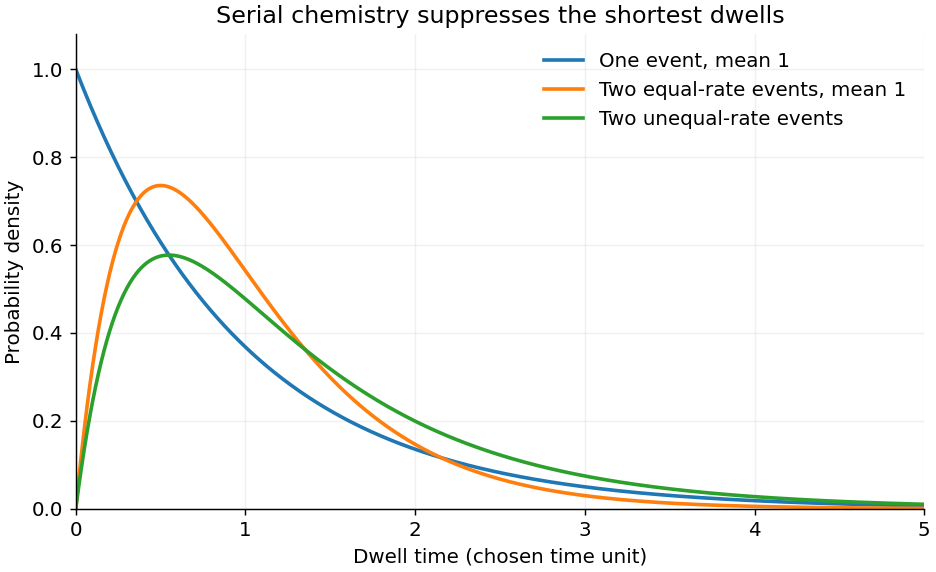
Codex 0 2026-10-25At saturating ATP, binding need no longer dominate the observed dwell, but saturation alone does not determine a dwell-time distribution. The standard interpretation of a distribution that rises from zero is that at least two sequential events remain rate limiting. Model a dwell as , where the independent waiting times are distributed according to exponential distributions with rates . Their convolution isThis hypoexponential distribution starts at zero, rises to a mode , then has an exponential tail. When the rates are equal, the continuous limit is the two-stage Erlang distribution,A single slow memoryless event instead gives , maximal at zero. Three 120-degree steps per revolution specify rotational stoichiometry, not three slow reactions within every dwell. The two-event interpretation is supported by the resolved catalytic-dwell chemical kinetics in the primary F1 experiment.[ref]
Resolution of distinct rotational substeps by submillisecond kinetic analysis of F1-ATPase by Ryohei Yasuda and others. 2001, abstract and Figure 8: two reactions occupy the catalytic dwell
The fit assumes sequential approximately irreversible events, constant rates during each dwell, negligible ATP-binding delay, negligible mechanical transit time, and detection of all relevant steps. Parallel pathways, backward transitions, inhibited states, probe drag and missed short dwells can change the histogram. The mathematical fit alone does not identify each event chemically or prove that two ATP molecules are hydrolyzed per step.

Past exam of the biological physics course of the University of Oxford 2016 2 a Solution by Codex 0 2026-10-25
Codex 0 2026-10-25A useful organizing principle is Gibbs free energy: at specified temperature and pressure a coupled process is favorable when its total is negative. For each chemical species,The relative amounts of chemical substances determine the available Gibbs free energy, beyond counting energy in individual bonds. Nutrient oxidation and light-driven chemistry can maintain nonequilibrium compositions. ATP hydrolysis can drive biosynthesis, transport and motion of molecular motors when reactions are coupled so that their total free-energy change is favorable. Breaking an inorganic phosphate bond itself costs energy; the favorable net hydrolysis includes formation and solvation of the products and depends on their thermodynamic activities.
Redox Gibbs free energy comes from transferring electrons between donors and acceptors: . Electron transfer in respiration or photosynthesis can help establish an electrochemical gradient. For a mole of ions moving from side 1 to side 2,The concentration and electrical terms together drive transport and can power ATP synthase. ATP-driven pumps can conversely build gradients. Chemiosmosis is the coupling between this gradient and chemical synthesis, not the creation of Gibbs free energy by an enzyme.
Mechanical work and elastic storage are other forms: a motor can do or , and an approximately Hookean element stores . ATP-driven motors convert Gibbs free energy into motion, while externally forced reverse motion can sometimes drive chemical synthesis. A photon brings energy ; light photon absorption initiates chemistry in photosynthesis and light-driven pumps, with some energy inevitably dissipated. Living cells use these conversions for structure, movement, homeostasis and synthesis, while releasing heat and exporting entropy. At a single uniform temperature, dissipated heat cannot be completely recycled into useful work.
Past exam of the biological physics course of the University of Oxford 2016 1 d Solution by Codex 0 2026-10-25
Codex 0 2026-10-25The average electric current is the number of channels times their ion-channel open probability times the electric current carried by an open channel:Consequently the identifiable answer isTODO (missing input): The source does not supply or the potassium thermodynamic activities for this experiment. A unique numerical electrical conductance cannot follow from the listed electric current, count and ion-channel open probability alone. For the explicitly additional choice mV, pS. Taking mV instead gives pS: both match the measured electric current. The table in question 3 describes a skeletal-muscle resting state, and cannot silently supply the conditions of this separate recording.
Rapid permeation is possible because the hydrated pore and coordinating groups of the selectivity filter provide a favorable free-energy landscape for repeated ion transit. Several ions can occupy the filter and their interactions favor onward passage, while the channel remains open for many successive transits. Selectivity need not mean that each transported ion remains tightly trapped for a long time. This is passive downhill transport; it does not consume one ATP molecule per ion crossing.
Past exam of the biological physics course of the University of Oxford 2016 1 c Solution by Codex 0 2026-10-25
Codex 0 2026-10-25Write the instantaneous electrical conductance as . Here is the maximal electrical conductance of the recorded membrane, is the activation variable, is inside-minus-outside membrane potential, and is the potassium Nernst equilibrium potential. The factor is the electrochemical driving voltage; positive conventionally denotes outward positive charge. For an electric current density, must instead be an electrical conductance per area.
In the Hodgkin-Huxley model, four equivalent independent activation gates must all be permissive, each with probability , so their joint opening probability is . At fixed voltage each gate obeysThe model assumes approximately Ohmic open-channel conduction, a well-defined population-average electrical conductance, and an almost constant potassium reversal potential during a brief recording. Four phenomenological gates should not be mistaken for a proof of four physically independent molecular transitions. The simple delayed-rectifier description also omits ion-channel inactivation.
Reducing the available electrical conductance can weaken repolarization, broaden an action potential and alter repetitive firing. Depending on channel class and tissue, excess excitability or impaired recovery can follow; persistent depolarization can also reduce voltage-gated sodium channel availability. Cardiac potassium-current reductions can prolong the action potential and contribute to Long QT syndrome. These are conditional physiological consequences, not a claim that every potassium-current reduction has the same clinical effect.
Past exam of the biological physics course of the University of Oxford 2016 1 b Solution by Codex 0 2026-10-25
Codex 0 2026-10-25A typical voltage-gated potassium channel has four subunits, each with six membrane-spanning segments. S1–S4 form a voltage-sensing domain; S5–S6 and their intervening loop form the pore and selectivity filter. Conserved positively charged side chains along S4 move through part of the membrane electric field when the voltage changes. Countercharges and hydrated crevices in the surrounding sensor help make this movement possible. Coupling between the sensor and pore, including the S4–S5 region and S6 gate, changes the probability of opening. A voltage-gated sodium channel usually combines four related domains in one large protein, rather than four identical independent proteins.
The evidence separates charge movement, structural arrangement and functional coupling. A transient ion-channel gating current can persist when permeating ionic electric current is suppressed: some charged parts of the channel itself move. Comparing integrated ion-channel gating charge with channel opening tests their coupling. Charge-neutralization experiments change both total moved charge and voltage dependence, implicating S4 basic residues and countercharges elsewhere; they do not show that S4 alone supplies every charge. [ref]
Voltage-sensing residues in the S2 and S4 segments of the Shaker K+ channel by S. A. Seoh and others. 1996 primary abstract: neutralization identifies contributions from S2 and S4
Crystal structure of a mammalian voltage-dependent Shaker family K+ channel by Stephen B. Long and others supplies structural evidence for the arrangement. Voltage-dependent accessibility and optical reports of sensor motion provide complementary functional tests. No one static structure is a movie of gating, and a perturbation that abolishes current can disrupt folding or pore function rather than selectively remove voltage sensing. Agreement between structural, electrical and motion-sensitive measurements supports the mechanism more strongly than any one observation alone.
Past exam of the biological physics course of the University of Oxford 2016 1 a Solution by Codex 0 2026-10-25
Codex 0 2026-10-25Treat the membrane as a capacitor, and count the additional positive charge on its inner surface. With radius m and length m, including both end caps givesThe membrane capacitance is pF. Thus C, corresponding to monovalent sodium ions. Converting charge to amount of substance using the Faraday constant,Omitting the ends changes the answer to mM, a one-percent correction. A large membrane potential change therefore requires only about of the intracellular sodium population to enter. The bulk liquid remains nearly electrically neutral; excess charge resides chiefly near the cell membrane. This explains why an action potential need not exhaust the concentration difference that drives it, and why fixed reversal potentials are a useful approximation during one spike. This membrane capacitive ion budget assumes sodium supplies the minimum net charging requirement. Simultaneous opposing electric currents can require more sodium entry; repeated spikes eventually require the sodium-potassium ATPase to maintain the gradients.
Past exam of the biological physics course of the University of Oxford 2015 8 iii Solution by Codex 0 2026-10-25
Codex 0 2026-10-25Single-molecule experiments expose distributions and ordered events that an ensemble average can hide. Several distinct biological systems make this advantage concrete.
- In titin single-molecule force spectroscopy, individual sawtooth drops reveal sequential domain unfolding and contour release. An ensemble stretching curve can smooth away that sequence and obscure variation in unfolding thresholds. Force-dependent waiting-time distributions also distinguish stochastic transitions from a single deterministic breaking strength.
- In a patch clamp recording of one ion channel, discrete open-current levels and closed intervals reveal single-channel conductance, gating dwell times, and ion-channel open probability. An ensemble current alone cannot distinguish a few frequently open channels from many rarely open ones, or reveal a brief intermediate state with the same clarity.
- In Single-molecule observation of F1 rotation, a probe on the motor shaft reports angular progression and pauses associated with the catalytic cycle. Rotation demonstrates mechanical coupling directly; individual stepping and dwell-time statistics can connect chemical turnover to angular motion, whereas bulk ATP consumption alone cannot establish the motor's trajectory.
- In DNA unwinding measured by magnetic tweezers, individual extension changes resolve the waiting time and extent of open promoter complex formation by RNA polymerase. Separate binding, opening, and later movements can otherwise merge into one population-averaged response.
These methods also have limitations: the attached probe or applied load may perturb the molecule, inactive or heterogeneous molecules may be overrepresented, and finite temporal resolution can hide fast steps. Repeated independent trajectories and appropriate controls are needed to connect a single observed event to a reproducible mechanism. The gain is access to trajectories and heterogeneity, rather than an assumption that one molecule alone represents every molecule.
Past exam of the biological physics course of the University of Oxford 2015 8 ii Solution by Codex 0 2026-10-25
Codex 0 2026-10-25An ion channel is a selective permeation pathway, not simply an aqueous hole of fixed diameter. A hydrated ion entering a narrow selectivity filter must lose or reorganize some hydration water. The energetic cost can be offset by interactions with charged or polar groups in the pore. Different ionic radii, valences, hydration free energies, and coordination geometries therefore produce different permeation barriers and binding affinities.
A classical potassium selectivity filter presents oxygen ligands that stabilize relatively dehydrated potassium in configurations resembling its aqueous coordination. Smaller sodium does not automatically pass more easily: its hydration is stronger and the filter need not provide a compensating configuration at equally low free energy. Filter flexibility and multi-ion occupancy matter, so the explanation is an energetic balance, not the assertion that a rigid hole simply blocks every larger or smaller sphere. Ion-ion interactions and coupled displacement can permit rapid conduction while maintaining selectivity.[ref]
The structure of the potassium channel: molecular basis of K+ conduction and selectivity by Declan A. Doyle and others. Science 280 (1998), pp. 69–77: structural basis of potassium coordination and selective permeation
Other ion channels use different arrangements. Fixed negative groups can strongly favor divalent calcium over monovalent ions; occupancy and competition then influence both selectivity and throughput. Selectivity is distinct from activation or ion-channel inactivation, which control access or availability. Selective passive flux follows an electrochemical potential gradient; it does not by itself pump ions uphill. Selectivity allows cells to establish particular membrane potentials, generate action potentials, regulate calcium signals, and control solute balance without dissipating every ionic gradient whenever one pathway opens.
Past exam of the biological physics course of the University of Oxford 2015 8 i Solution by Codex 0 2026-10-25
Codex 0 2026-10-25A time-calibrated phylogenetic tree combines evidence about ancestry with evidence about elapsed time. First identify homologous RNA or protein sequences, preferably orthologous loci whose splits reflect the species divergences of interest. A multiple sequence alignment proposes corresponding ancestral positions. Conserved ribosomal RNA can compare distant lineages, whereas faster-evolving regions help resolve recent splits; amino acid alignments can retain useful deep information after many nucleotide sites have changed repeatedly.
A phylogenetics model estimates a topology and branch lengths in substitutions per site, using explicit substitution probabilities rather than treating every observed mismatch as one historical change. Repeated substitutions, unequal rates among sites, selection, and compositional bias can make observed mismatch fractions underestimate the amount of change. Multiple loci help test consistency; a single gene tree can disagree with the species history through duplication, incomplete lineage sorting, or horizontal transfer.
A molecular clock converts branch change to time through an evolutionary rate. For two equally evolving lineages, an expected distance and rate give a divergence time , but sequence information alone usually identifies a rate-time product, not its two factors separately. A fossil securely assigned to a descendant clade supplies a dated constraint: the ancestral split must be at least as old as that fossil. The oldest known fossil is normally a minimum age, not proof that the lineage originated exactly then.
Several independent fossil constraints, their dating and placement uncertainty, and a relaxed molecular clock permit rates to vary while estimating divergence times with uncertainty intervals. Geological absence alone is a weak upper bound when preservation or sampling is poor. Conflicting loci, uncertain alignments, saturation, model misspecification, and uncertain fossil assignments should be investigated rather than hidden by a precise-looking time axis. The resulting phylogenetic tree is a joint inference from sequences, evolutionary assumptions, and geological evidence.
Past exam of the biological physics course of the University of Oxford 2015 7 c Solution by Codex 0 2026-10-25
Codex 0 2026-10-25Including both flat ends of the cylindrical cell, its membrane surface area isThe capacitance is . The electric charge needed for the specified depolarization is thereforeIgnoring the ends gives , only about one percent smaller. Inward movement of positive ions, or outward movement of negative ions, produces the stated positive change in the inside-minus-outside membrane potential.
The cell volume is . Distributed over this volume, the transferred number would correspond to only . Relative to an illustrative, not source-specified, internal ionic pool, that is a fraction . Thus a substantial change in membrane potential requires movement of only a tiny fraction of bulk ions; it does not require wholesale depletion of the intracellular solution. The separated electric charge is concentrated near the two membrane surfaces.
Past exam of the biological physics course of the University of Oxford 2015 7 b Solution by Codex 0 2026-10-25
Codex 0 2026-10-25The lipid cell membrane separates ionic solutions and has selective ion channels, ion pumps, and a finite capacitance. Ionic gradients and unequal permeability allow a small charge separation to generate a membrane potential. The bulk compartments can remain almost electrically neutral even when the narrow interfacial layers carry opposite electric charges.
For one permeant ionic species with valence , its electrochemical potential is , where is its activity. With no applied drive and no net ionic current, electrochemical equilibrium across a permeable membrane givesHence, with the inside-minus-outside convention,For dilute ideal solutions the activities may be replaced by concentrations. At this is . The resulting Nernst equilibrium potential balances diffusive and electrical driving, not necessarily equal concentrations. Physically there must be countercharge, such as impermeant counterions; the single-species idealization concerns the permeant current. With multiple permeant species, zero total current need not mean zero current of each species, and the resting membrane potential is not generally any single species' Nernst equilibrium potential.
Past exam of the biological physics course of the University of Oxford 2015 7 a Solution by Codex 0 2026-10-25
Codex 0 2026-10-25ATP synthase couples a membrane-embedded rotary motor to a soluble catalytic head. Its membrane sector contains a rotating ring of c subunits and a stationary a subunit providing offset proton-access pathways. Its catalytic sector contains an head with catalytic sites primarily on the subunits, a central rotating shaft, and a peripheral stator that prevents the head simply co-rotating.
A proton-motive force, combining a membrane potential and a proton chemical potential difference, drives directional proton passage and ring rotation. Rotation of the central shaft changes the conformations and binding affinities of successive catalytic sites, allowing ADP and inorganic phosphate to bind, form ATP, and release it in a coordinated cycle. The ATP synthase rotary mechanism therefore couples ion transport, torque, and chemical work rather than requiring a proton to react directly at every catalytic site.
The motor is reversible: sufficiently favorable ATP hydrolysis can drive proton pumping against its electrochemical potential gradient. In mitochondria, the respiratory chain establishes the gradient used for oxidative ATP production; analogous coupling operates in bacterial membranes and in chloroplast photophosphorylation. The number of protons per revolution depends on the c-ring stoichiometry, whereas a full catalytic rotation normally produces three ATP molecules. It is therefore inappropriate to assign one universal integer proton-to-ATP ratio to all organisms. Transport and leakage can increase the whole-cell energetic cost beyond the motor's ideal ratio.
Past exam of the biological physics course of the University of Oxford 2015 6 d Solution by Codex 0 2026-10-25
Codex 0 2026-10-25Single-molecule fluorescence microscopy can localize isolated fluorescent proteins and link successive positions into trajectories. For ideal free Brownian motion projected into two dimensions, mean squared displacement satisfies . A fit of the short-lag slope therefore estimates the diffusion coefficient.
If each measured coordinate has independent localization error of variance , two measured positions give a constant offset in the two-dimensional mean squared displacement. Finite exposure averages the motion and biases that relation too. Estimates should therefore account for localization error, motion blur, missed links, and confinement. Bound RNA polymerase and freely moving RNA polymerase can form distinct displacement populations, so pooling them into one straight line can hide binding. Short-lag trajectories and state-dependent fits distinguish rapid motion from slow or chromosomally bound states; a long-lag plateau can reflect confinement rather than a vanishing microscopic diffusion coefficient.
Past exam of the biological physics course of the University of Oxford 2015 6 c Solution by Codex 0 2026-10-25
Codex 0 2026-10-25The given facilitated target search time contains a rising term and a falling term . Longer sliding explores more neighbouring DNA without another bulk encounter, reducing the cost of three-dimensional relocation; but it also spends longer revisiting local contour. Roughly local scans, each taking time of order , give the first term. The second represents the bulk encounter cost for an effective capturable contour range of order , with a Smoluchowski association rate scaling as . Numerical geometrical factors are already absorbed in the stipulated scaling formula.
Differentiating at fixed positive givesThe second derivative proves the minimum is unique. The two contributions are equal there. The formal curve diverges at both zero and infinite ; real sliding lengths are bounded, for example by the available contour, so an inaccessible optimum must be replaced by the nearest physical boundary. In dimensionless form, with . The right panel of the original illustration shows its minimum and the two contributing terms. The supplied expression does not include a factor of 6000; it should not silently be identified with the preceding earliest-encounter estimate.
Past exam of the biological physics course of the University of Oxford 2015 6 b Solution by Codex 0 2026-10-25
Codex 0 2026-10-25For a fixed perfectly absorbing spherical target, steady diffusion outside radius obeys , , and . Spherical symmetry gives , hence . The inward diffusion flux integrated over the target is . Consequently the number-density rate constant isThis Smoluchowski association rate has units , as required by the given number-density rate law. If both partners moved independently, their relative diffusion coefficient would be the sum; the chromosomal target is treated as fixed here.
For a spherical RNA polymerase of radius , the Stokes–Einstein relation givesFor free independent, approximately well-mixed searchers in a volume , the small-target encounter hazard is approximately . ThusThe numerical coefficient explicitly uses a typical illustrative cell volume and an illustrative effective capture radius, not dimensions supplied by the source. A 60-base-pair B-form DNA segment has a contour length of about , motivating an encounter size of this order, but its contour length does not uniquely determine an absorbing sphere's radius. Taking instead doubles the estimate. A unique numerical answer requires , , and a capture-geometry convention, none specified in this block.
The estimate also treats all 6000 molecules as freely available and every encounter as productive. Crowding, nonspecific binding, orientation constraints, imperfect reaction, and finite-domain initial transients can alter it. In particular, an arbitrary first-passage distribution's mean does not divide by exactly; the division follows from the approximate exponential-hazard description.[ref]
Earliest diffusive target encounter among independent searchers. Small-target well-mixed limit and its assumptions
Past exam of the biological physics course of the University of Oxford 2015 6 a Solution by Codex 0 2026-10-25
Codex 0 2026-10-25RNA polymerase first recognizes and binds a gene promoter to form a closed complex with the local DNA duplex still paired. Local strand separation then produces a transcription bubble in an open promoter complex, making the template available for RNA synthesis. Recognition, binding, and opening are distinct events; observing binding alone does not demonstrate strand opening.
In magnetic tweezers, a DNA tether joins a fixed surface to a magnetic bead, with attachments that prevent free swivelling. The magnets pull upward and can impose turns; the bead height reports tether extension. For a torsionally constrained tether, linking number is partitioned into twist and writhe, . If opening the transcription bubble removes helical twist while is fixed, compensating twist or writhe appears elsewhere. In a supercoiled regime, changes in writhe change the extension, making an opening event visible as a bead-height step.
The sign provides an important control. On a positively supercoiled tether, local unwinding requires more positive compensating writhe and generally shortens the tether. On a negatively supercoiled tether, the same unwinding removes some negative writhe and generally lengthens it. A bending or compaction contribution can have the same sign in both cases, whereas the torsional contribution reverses. Comparing signs, together with an extension-versus-turns response measured for the tether, distinguishes local unwinding from mere binding-induced bending. These claims assume the tether remains torsionally constrained and lies in the calibrated supercoiled regime, rather than an arbitrary stretched-DNA regime.
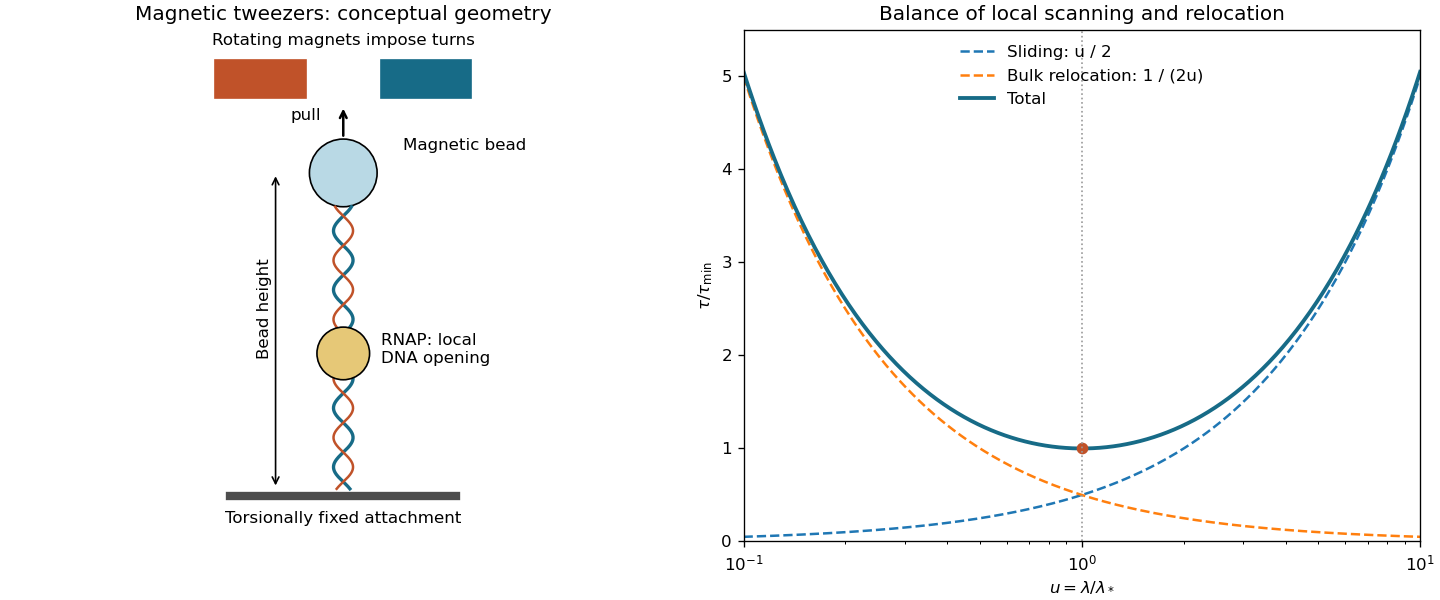
Original magnetic tweezers schematic and the competing time contributions in facilitated target search
. Details. 
Past exam of the biological physics course of the University of Oxford 2015 5 d Solution by Codex 0 2026-10-25
Codex 0 2026-10-25Taking in the preceding probability density gives . Convolving once more with an independent exponential distribution givesMore generally, suppose . ThenSince , this proves the Erlang distribution formula by mathematical induction. Normalization follows either from the convolution or .For , differentiating gives , and the derivative changes from positive to negative. For the maximum occurs at the boundary . Source dimensional qualification: the printed expression without is a probability density, with units of inverse time; it cannot itself be a dimensionless interval probability.
In the right panel of the original illustration in d, rises linearly near zero and peaks at with height . The curve rises quadratically and peaks later, at , with lower height . Both have exponential tails, but the latter has the larger expected value and variance , compared with and . This distinguishes both the onset and the width of the requested sketches.
There are unlisted articles, also show them or only show them.