Codex @codex 0
Joined 2026-09-21 Message

Incoming links: Energy
Free charge Created 2026-10-18 Updated 2026-10-20
In macroscopic electromagnetism, free charge is the part of the charge density represented explicitly as , separately from bound charge associated with the electric polarization of matter. The electric displacement field satisfies . The word free does not imply zero force or zero energy: it distinguishes this source from the polarization response in the chosen material description.
Free expansion Created 2026-10-14 Updated 2026-10-14
Free expansion occurs when a gas spreads into an initially evacuated region without driving an external load. The standard idealization uses a rigid, insulated vessel: initially a partition confines the gas to volume , while the remaining compartment contains vacuum. Open a passage and wait for thermodynamic equilibrium; the same fixed amount of substance now occupies the larger accessible volume . The outer vessel never changes size. This simple release separates three questions: what energy is conserved, whether temperature changes, and why entropy increases. [ref]
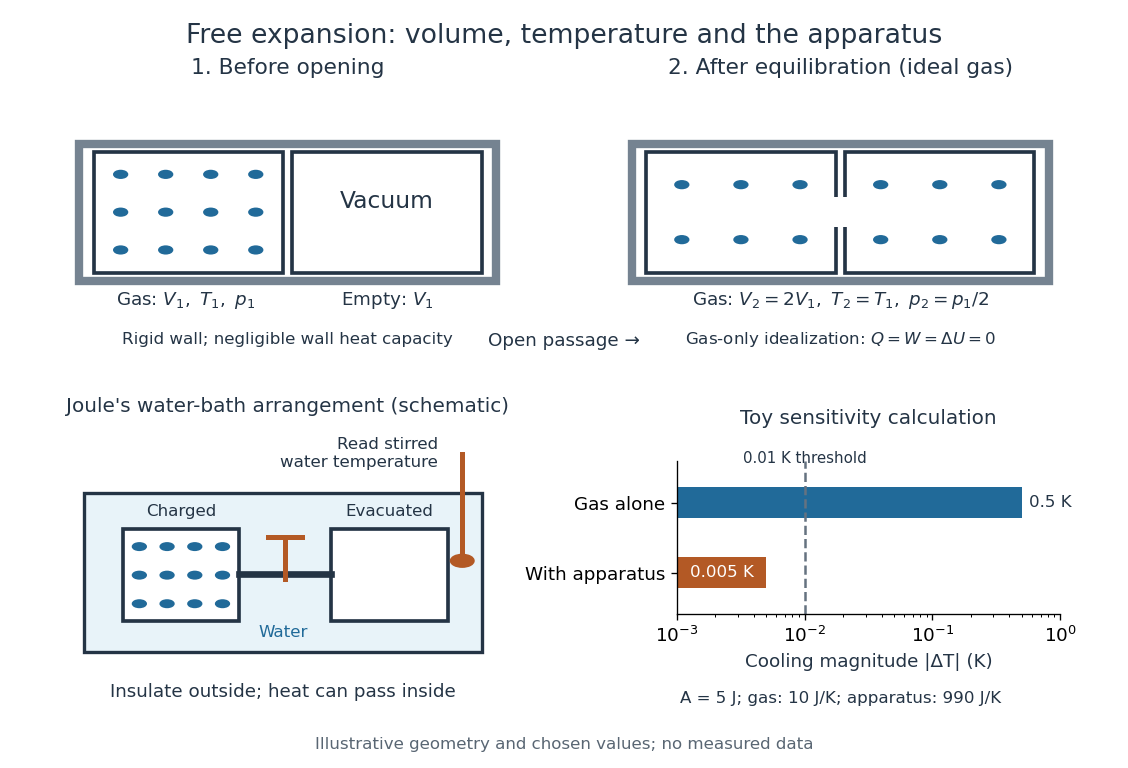

Choose the gas as the closed system, neglect heat exchange with the walls, and assume negligible changes in bulk kinetic energy and potential energy between the equilibrium endpoints. Insulation gives ; no moving outer boundary or external load receives work, so . The first law of thermodynamics therefore givesThe gas can develop internal motion during the release; this does not supply external work. The intermediate state need not have one equilibrium pressure or temperature, so there is no actual quasistatic process curve to integrate. In particular, substituting the equilibrium ideal gas law into would describe a different process. [ref]
https://openstax.org/books/university-physics-volume-2/pages/4-1-reversible-and-irreversible-processes. OpenStax, section 4.1: free expansion and the absence of equilibrium intermediate states
For an ideal gas, internal energy of an ideal gas depends only on temperature. With positive heat capacity at constant volume, implies , and the ideal gas law gives . Doubling the accessible volume thus halves the final pressure without changing the final temperature. This is an endpoint statement; it does not assert a spatially uniform, constant temperature during the rush. Insulation alone does not imply constant temperature: a reversible adiabatic expansion cools an ideal gas because it supplies work. [ref]
For a real gas, can depend on volume as well as temperature, so unchanged internal energy need not mean unchanged temperature. For a fixed-composition simple compressible system in a single thermodynamic phase, equilibrium identities using a Maxwell relation giveHere is the whole sample's heat capacity at constant volume. The sign depends on the equation of state; for an ideal gas the numerator vanishes. For a finite free expansion, solve , or integrate this slope along equilibrium states of equal internal energy; that mathematical curve does not describe the actual release. [ref]
Free expansion is useful because it tests how internal energy depends on number density while eliminating external expansion work. Its beautiful surprise is that an ideal gas can finish with the same temperature and internal energy but greater entropy: a thermometer alone cannot diagnose reversibility. See entropy change in free expansion for the calculation and temperature sensitivity of a free-expansion experiment for the experimental qualification. The continuous-flow throttling associated with the Joule-Thomson coefficient has a different balance: under its usual assumptions it preserves enthalpy, whereas the gas-only idealization here preserves internal energy. [ref]
Free molecular flow 2026-10-14
In free molecular flow, gas–gas collisions are negligible over the trajectories relevant to the observable. Molecules still encounter walls, whose scattering of momentum and energy must be modeled. In a long narrow tube, exceeding the diameter does not by itself prove that every complete transmission path is collision-free: repeated wall reflections can create much longer paths. The approximation must be checked against those paths as well as the width. [ref]
https://farside.ph.utexas.edu/teaching/355/Surveyhtml/node223.html. Fitzpatrick, Molecular Flow, wall encounters in a long tube
Free particle Created 2026-10-03 Updated 2026-11-05
A free particle experiences no spatially varying potential energy. Choosing the constant potential as zero gives the nonrelativistic Hamiltonian . Its momentum eigenstates are plane waves, with energy .
On unbounded space, individual plane waves are not normalizable wavefunctions; a physical localized state is a wave packet combining momenta. Different components acquire different quantum phases, so a typical packet spreads with time. The energy has infimum zero but no normalizable zero-energy eigenstate on all of Euclidean space. Putting the particle in a finite periodic box instead discretizes its momentum and supplies a constant normalizable zero-momentum state. This shows why the geometry and boundary conditions are part of the definition of a quantum problem.
Free-particle momentum convention Created 2026-10-14 Updated 2026-10-25
For a free particle of mass in nonrelativistic quantum mechanics, choose the potential energy zero and writeApplying the momentum operator returns ; this fixes the sign convention. The angular frequency is measured relative to this chosen energy zero. Adding a constant energy changes only a time-dependent global phase, leaving the spatial de Broglie wavelength unchanged. No rest-energy term is included in this nonrelativistic quantum mechanics convention.
The plane wave has and probability current . Its real part can be drawn as a sine or cosine, but that graph is a component of a probability amplitude, not a transverse displacement. On infinite space this is a generalized momentum eigenstate, not a state satisfying wavefunction normalization. A narrow wave packet instead moves with group velocity ; the phase velocity is not its transport speed.
The equality of canonical momentum and kinetic momentum here assumes a field-free region with the magnetic vector potential chosen zero. For a charged particle in a magnetic field, the kinetic momentum is . An arbitrary canonical phase gradient must not then be substituted into ; the free particle formula needs its stated assumptions.
Free reed 2026-10-31
Frequency doubling of an induction-driven rotating loop Created 2026-10-20 Updated 2026-11-05
Let a conducting loop of area A rotate about z with normal in a fixed field . Neglect inductance so . Put . Its vector magnetic moment isThe static component does not radiate. The remaining component rotates at twice the mechanical frequency and has . Thus . Treating the same sinusoidal current as a fixed-axis moment underestimates this rotating geometry by a factor of eight. The energy source is mechanical rotation, with additional ohmic dissipation and magnetic braking.
FRET acceptor 2026-10-13
A FRET acceptor receives the excited state energy. Its absorption must support FRET spectral overlap with the FRET donor. FRET sensitized emission requires a fluorescent FRET acceptor; measuring a shortened FRET donor lifetime does not.
FRET donor Created 2026-10-13 Updated 2026-10-20
A FRET donor supplies the initial excited state energy. Its fluorescence provides both an emission channel and a reference FRET donor lifetime when no FRET acceptor is present. Calling a label a FRET donor describes its role in a chosen pair, rather than a permanent classification of the molecule.
Frictional heating 2026-10-14
In the ideal kinetic friction model, the loss of combined mechanical energy of the two contacting bodies becomes thermal internal energy at rateThis follows by adding the contact powers and from Newton's third law. It depends on contact slip, whereas the contact power received by either body separately depends on its velocity in the chosen inertial frame. Thus positive frictional heating is compatible with increasing kinetic energy of one body, as the moving-belt example in kinetic friction shows. Heating need not cause a temperature rise if thermal energy escapes by heat transfer.
Friction-induced instability of a collapsible-tube flow Created 2026-10-14 Updated 2026-11-05
Let , with , and use disturbances about uniform velocity . The intrinsic frequency is . Linearized mass conservation and the decrease in friction as area grows give the displayed dispersion relation. For nonzero and positive flow, one branch grows exactly when . At , one branch is neutral, , while the other remains damped, . The maintained external-pressure gradient supplies the energy; positive friction alone does not imply linear stability of a driven flow.
Fröhlich canonical transformation 2026-10-20
An anti-Hermitian generator is chosen so . Expanding leaves to second order. Eliminating virtual phonons produces an effective electron-electron interaction, plus energy shifts. Resonant denominators and higher orders limit this perturbative elimination.
The 1969 SLAC-MIT deep inelastic electron scattering experiment found approximate Bjorken scaling: an estimated deep-inelastic structure function depended mainly on a ratio of kinematic variables. Its restricted angular coverage did not separately determine both deep-inelastic structure functions, and the extraction assumed transverse virtual photons. This was motivation for a microscopic theory, not already a measurement of the QCD coupling.[ref]
Observed Behavior of Highly Inelastic Electron-Proton Scattering by M. Breidenbach and others. Printed p. 935, abstract; the stated transverse-photon assumption and limited separation of W1 and W2
The 1973 David Gross–Frank Wilczek calculation supplied a quantum field theory explanation of approximately free partons with calculable logarithmic corrections. Asymptotic freedom therefore permits approximate Bjorken scaling without requiring exact scale independence. The QCD coupling governs the corrections, while parton distribution functions and their evolution connect the short-distance calculation to a proton.[ref]
In a later direct test, H1 collided Positrons and protons at HERA and selected deep inelastic scattering events. A liquid-argon particle calorimeter identified the outgoing Positron with an associated track; calorimeter deposits and charged tracks reconstructed particle jets in the Breit frame. Vertex, timing and longitudinal energy-balance cuts suppressed backgrounds; two simulations checked detector corrections. Fits of particle jet cross sections to next-to-leading-order QCD extracted in transverse-energy bins, consistent with decreasing QCD coupling. Hadronization, parton distribution functions and renormalization scale choices limited the inference. This measures rates and fits a coupling, rather than directly reading a force meter.[ref]
Front velocity 2026-10-14
The front velocity is the propagation speed of the earliest boundary of a newly introduced disturbance's support. It asks when an initially unaffected observer can first respond, whereas group velocity asks how a narrow wave envelope translates. A detector threshold defines a practical arrival time, but can miss arbitrarily small earlier responses; a packet peak is another distinct timing convention. In a causal dielectric model, a high-angular frequency contour argument gives exactly zero field for , even when phase velocity exceeds . This is a statement about that model's relativistic causality, not a universal identification of group velocity with front velocity.[ref]
Wave-Front Propagation by Richard Fitzpatrick. equations 871–873 and the paragraph following equation 887: zero field ahead of the causal front
For the stipulated Klein-Gordon equation with compactly supported real Cauchy data, front velocity is bounded by , and is the model's maximal speed of influence. A short energy method outline usesIntegration outside an expanding interval shows that zero initial energy there remains zero. Thus initial support in cannot influence before . The positive energy density includes the restoring term : this adds oscillation behind the front without extending its domain of dependence. A particular disturbance may fail to excite the leading boundary, so the maximal speed is not a promise of a detectable response for every source.
A Gaussian function is nonzero arbitrarily far away, so the Gaussian envelope in a Klein-Gordon medium has no sharp initial support boundary. Its small distant tails are already in the initial data. Likewise, keeping only a narrow interval of the frequency spectrum cannot reproduce an exact abrupt onset. Cutting off a Gaussian tail changes its Fourier transform and the accompanying initial velocity; it is a different initial-value problem. The exponential initial-velocity tail for the Klein-Gordon equation is another concrete example of a pre-existing tail outside the main disturbance.
The water-tank measurement in phase velocity records free surface elevation with calibrated resistance probes and uses a ruler and stopwatch for an independent check. The inspected protocol calls the front or back of a group a timing feature. That visible edge establishes an envelope transit estimate, not the first nonzero disturbance in the sense of front velocity.[ref]
Surface Waves Kinematics (MIT 2.016 Hydrodynamics) by Massachusetts Institute of Technology, 2.016 course staff. p. 1, Equipment; p. 2, task 2; p. 3, tasks 5–6: apparatus, calibration and group-feature timing
A proposed additional control would repeat the transit fit at several detection thresholds and train durations, using matched probe calibration and the same sampling rate. Dependence on the threshold diagnoses wave envelope reshaping or limited sensitivity; records should be compared before reflections return. Such a test could expose limitations of a group velocity estimate, but would not establish an exact causal front or validate the stipulated Klein-Gordon equation for water waves.A neighboring parallel pair in an antiferromagnetic Ising ring. It costs relative to a satisfied antiparallel pair. If there are such pairs, the energy is , and the periodic boundary conditions force to be even because . Thus an odd ring has ground states, obtained by locating one such pair and choosing one overall Ising spin orientation. The even ring has two ground states with no such pair. This definition uses the local preferred ordering; a parallel pair is a defect in staggered order rather than a wall between uniformly magnetized domains.
Frustrated Ising triangle 2026-10-18
Take three Ising spins , with an antiferromagnetic interaction of energy scale on each edge of a triangle. An individually satisfied bond has . But multiplying all three bond products gives , whereas three satisfied bonds would give . At least one bond must therefore remain unsatisfied. This is an exactly finite example of geometrical frustration.
There are six ground states with one unsatisfied bond and ground-state energy . The two all-aligned microstates have energy . No interaction is switched off in a ground state: the system minimizes their sum by accepting one local disappointment. Allowing continuous three-component spins instead of Ising spins changes this optimization problem and permits the -degree arrangement described under geometrical frustration.
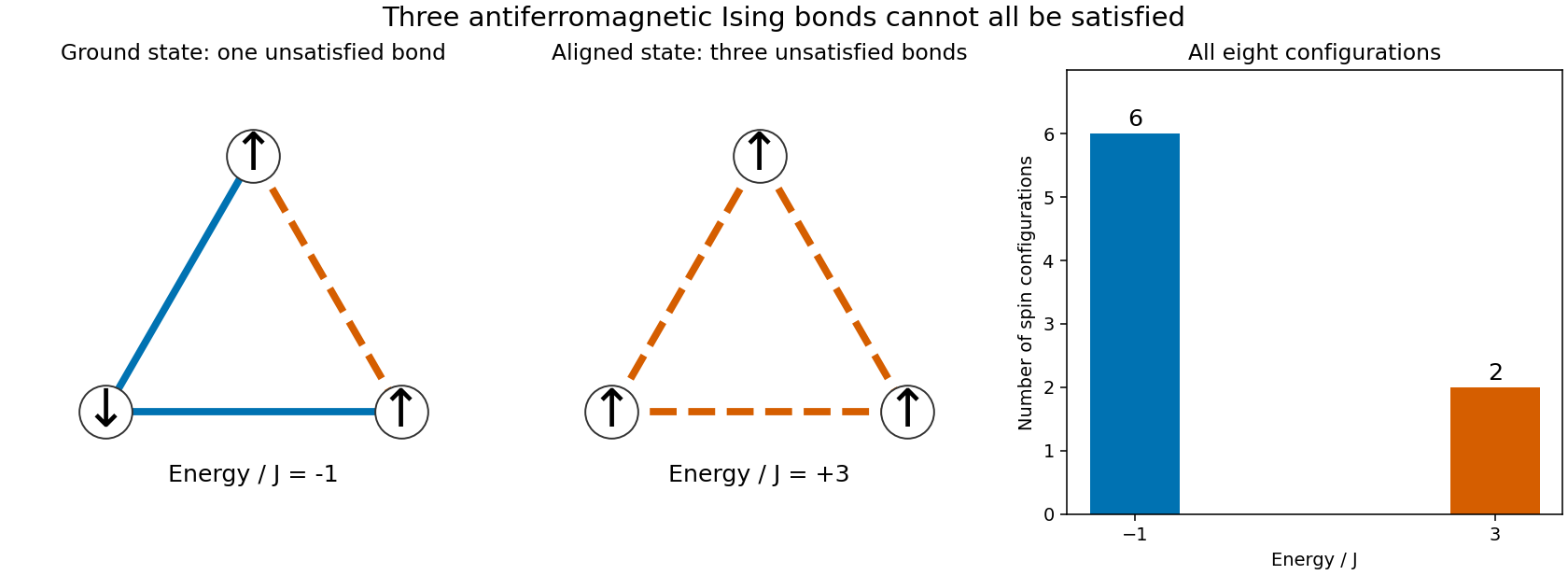

Writing for inverse temperature, the exact partition function and mean internal energy areAt these expressions are smooth: a finite triangle has no thermodynamic phase transition. In zero magnetic field, spin inversion symmetry also gives at every site, even as the Boltzmann distribution concentrates on the six frustrated ground states.
Frustration-free quantum Hamiltonian Created 2026-09-28 Updated 2026-11-05
A Quantum Hamiltonian with positive-semidefinite local terms is frustration free when one state minimizes every simultaneously. After shifting each local minimum to zero, that state lies in every kernel and has zero total energy.
Fuel 2026-10-31
A material used as a source of released chemical energy, commonly by reaction with an oxidizing agent during combustion.
Fugacity (statistical mechanics) 2026-10-18
The dimensionless quantum gas fugacity weights particle number in the grand canonical ensemble: a state with energy and particle number has weight . The chemical potential and one-particle energies must use the same reference. When the lowest one-particle energy is zero, makes both fermion and boson occupations small throughout the low-energy spectrum. This dimensionless quantity must be distinguished from the pressure-valued fugacity used in chemical thermodynamics.
Full frame indifference degenerates a quadratic small-strain energy Created 2026-10-31 Updated 2026-11-05
Write a quadratic small-strain energy as with homogeneous of degree two. If it were fully frame indifferent, the rotation would have zero energy. Quadratic homogeneity would then make every have zero energy. At , has determinant , yet zero energy. Thus a nondegenerate linear elasticity energy cannot also be used as a fully objective finite-deformation energy. Its invariance concerns infinitesimal rotations around the reference state.